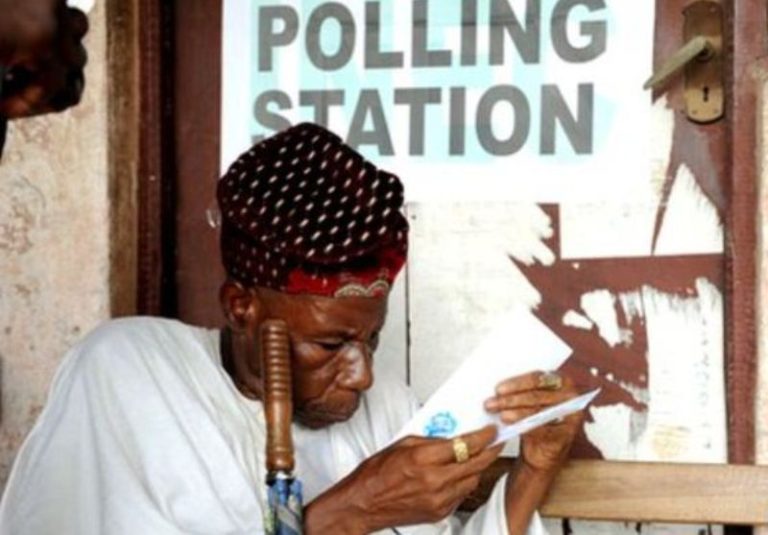
THE recent directive by the Independent National Electoral Commission (INEC) that smartphones and cameras will not be allowed in polling booths during the Osun governorship election and in subsequent elections has generated wide-ranging controversy.
Even when the INEC National Chairman, Mahmood Yakubu, clarified that the ban on smartphones and cameras will only apply once a voter has collected the ballot paper to proceed to the polling booth to thumbprint and cast his or her ballot, not many people were persuaded that the idea was a good one.
Yakubu had explained that the ban was one of the steps taken by INEC to curb the menace of vote buying and selling. He said that some voters would use their smartphones or cameras to take pictures of their already thumb-printed ballot papers in order to show it as proof that they had voted a particular political party, and then receive monetary gratifications from the party.
ON THE BAN OF USE OF PHONES CAMERAS IN THE VOTING CUBICLE… “INEC allows phones in Polling Units or Centres. We just don't want people going into the Polling BOOTHS with the camera phones to take pictures of their thumbed ballot paper” pic.twitter.com/Lk30Mq3J88
A ban on smartphones and digital cameras, Yakubu opined, will go a long way in checking vote buying and selling, which he described as a “cancer” in the Nigerian electoral system.
Vote buying has become an issue as witnessed in the Ekiti State Gov. Election & INEC cannot stand aloof and allow its efforts in planning successful elections be thrown into disrepute. We must protect the secrecy and sanctity of the vote
However, while many Nigerians have applauded the move, others say it is INEC’s way of rigging the election by ensuring that the manipulation of the process will not be captured on camera. Political parties also are divided on the issue with some saying it is a welcome development and others describing it as a move to rig elections.
Former National Chairman of Labour Party, Dan Nwanyanwu, commended INEC for coming up with the directive. Nwanyanwu, who is now the National Chairman of Zenith Labour Party, gave the commendation during Channels Television’s ‘Politics Today’.
Nwanyanwu even added that security personnel should search voters to ensure they have no hidden cameras on them with which they could take snapshots of the party they vote for with the intention of getting financial payments.
Also, Olugbenga Akintola, the candidate of the Alliance for Democracy in the Osun governorship election, said the ban on smartphones was a good one because it gives the so-called underdog candidates like himself, a better fighting chance at the polls.
On Twitter, there were many arguments in support of the ban. “This is actually a good idea,” tweeted Emeka Anene. “I am wondering how this will be implemented. Will INEC position somebody close to the booths to ensure nobody goes in with their phones? Or is there going to be a drop basket for phones once ballot is issued? What happens to defaulters?”
“If you think this isn’t a good idea, ask the people of Ekiti state. Once they snap the ballot paper, they will use the picture to collect 5k for the vote n delete it immediately. Nice one,” tweeted Adebukola.
However, the National Chairman of the Peoples Democratic Party (PDP), Uche Secondus, condemned the ban, saying it was a dictatorial move aimed at preventing the global community from knowing the process of the elections.
Similarly, popular social media user, Segun Awosanya, criticised the ban on smartphones at polling booths, saying it is inconveniencing to the voter. He tasked the INEC to come up with more pro-active measures to prevent political party agents from bringing cash to polling areas.
“The core of the issue is addressing the criminal syndicate that brings money to the polling unit. Report them and get them prosecuted via evidence gathering. Not inconveniencing the voters,” Awosanya tweeted on Wednesday.
“Asking people to drop their phones will increase the waiting process on the queue as well as other issues that will be confirmed from the executing of this directive. We are simply glossing over the main issue here.”
Also, former Governor of Cross River State and presidential aspirant on the platform of the Social Democratic Party (SDP), Donald Duke, did not agree with the ban. He tweeted: “INEC bans phones and cameras at polling stations. QED, let the rigging begin!”
Doyin Okupe, a former presidential spokesman, also condemned the directive. He said: “INEC has no powers to make laws in Nigeria especially such that concerns fundamental rights of citizens. This is not yet a Banana Republic. The ban cannot stand.”
Another Twitter user wrote: “Don’t be deceived. Voting happens in polling booths, not the units. If INEC can keep everyone blind in the polling booths then they can Rig the Election. Vote buyers are the problem not the electorates.”
IN continuation of examining the frontline candidates in the Saturday’s governorship election in Osun State, the ICIR, therefore, presents three of the five top candidates. The other two can be found here.
Moshood Adeoti (Action Democratic Party)
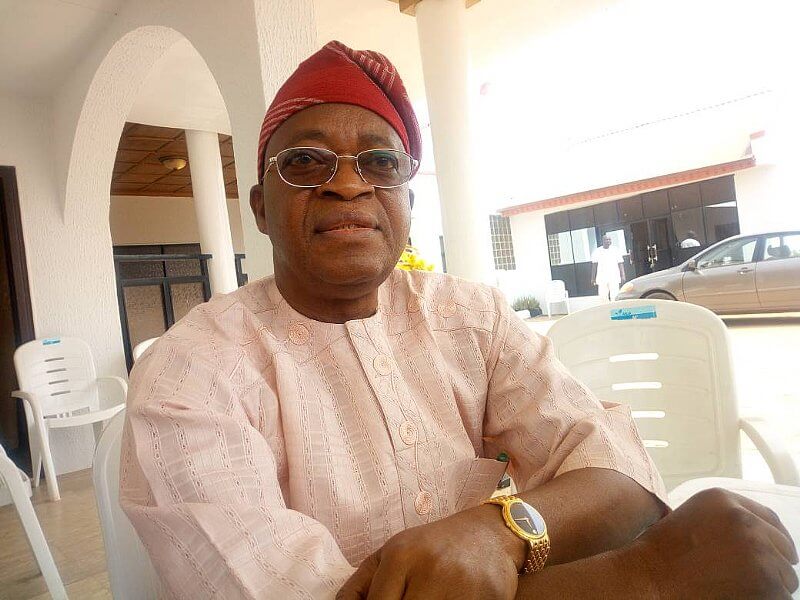
Moshood Adeoti
Until July 24 this year, Adeoti was the Secretary to the Osun State Government, but he resigned, dumped the APC, and declared his intention to contest for his former boss’ position.
Born on February 27, 1953, Adeoti graduated from the University of Benin in 1984 with a Bachelor’s degree in Business Administration.
He was a member of the defunct Unity Party of Nigeria (UPN), as well as the Social Democratic Party (SDP). Adeoti began his political career from the grassroots, gradually climbing up the ladder of political office till he got to the top.
He was elected a local government councilor in 1988, a local government supervisor in 1991, Iwo local government chairman in 1999, State Chairman of the Alliance for Democracy, and pioneer chairman of the Action Congress of Nigeria.
Adeoti was appointed SSG during Aregbesola’s first term in 2010 and he was retained in 2014. In the political circle in Osun State, Adeoti is referred to as the ‘grassroots man’, but whether the nickname would translate into votes on September 22, is yet to be seen.
Like Adeoti, Akinbade was a former Secretary to the Osun State Government during the administration of Olagunsoye Oyinlola.
The 63-year-old prince was trained as a civil engineer at the Polytechnic of Ibadan, before obtaining a post-graduate degree in the same discipline at the Federal University of Technology, Akure.
Before starting his own construction firm, Akinbade worked briefly at Adold Engineering Company in Opebi, Lagos, and at another firm called Feel Nigerian Limited, in Ibadan, Oyo State.
Before becoming SSG, Akinbade had worked as Commissioner for Works, Land and Physical Planning in April 1994 during the military administration of Anthony Odofia. He was retained in that office by the two military governors that succeeded Odofia, namely: Anthony Obi and Theophilus Bamgbose.
Akinbade was also a former Chairman of the Osun State PDP, and was a governorship aspirant on the party’s platform in 2011; the election did not hold eventually following the Court of Appeal’s annulment of Oyinlola’s electoral victory in November 2010. Four years later, Akinbade contested the governorship candidate on the platform of Labour Party but lost to Aregbesola. Now he is running as a member of the ADC, it is difficult to say whether he would have better luck.
Gboyega Oyetola (All Progressives Congress)
Adegboyega Oyetola
Born on September 29, 1954, Gboyega Oyetola has a Bachelors’ degree in insurance and a Master’s degree in Business Administration, all from the University of Lagos (UNILAG). He did his National Youth Service in Potiskum, Yobe state, before starting his career as an assistant manager with Leadway Assurance Company.
Oyetola also worked at Crusader Insurance and at Corporate Alliance Insurance. In 1991, he founded his own company, Silvertrust Insurance Brokers, and ran it successfully, until his foray into politics.
He was one of the founding members of the Alliance for Democracy, AD, in 1998 preparatory to the transition from military to civilian rule. He later moved to the then Action Congress of Nigeria (ACN), becoming one of the party’s chieftains in Osun State. He was also one of those who played an important role during the 2014 merger that gave birth to the APC.
Oyetola was the Chief of Staff to the Osun State Governor, Rauf Aregbesola, throughout his tenure. He only resigned recently when he decided to run for the governorship election.
Aregbesola, during a recent visit to the Ooni of Ife, described Oyetola as “a man of impeccable character and worthwhile personality who remains dogged and forthright to all policies that had impacted positively the lives of the citizens”.
Another interesting fact about Oyetola is his reported biological relationship with former Lagos State Governor and APC Chieftain, Bola Tinubu. Both men are believed to be cousins, but this factor could count for or against the APC candidate in the polls on September 22.
Many had criticised Oyetola’s emergence as the APC candidate, describing it as Tinubu imposing his cousin on the people. Others say Oyetola’s relationship with Tinubu would rub off positively on the State. However, whatever the case, Oyetola remains one of the candidates to beat in the coming election.
JUSTICE Abdulwahab Mohammed of the Kubwa Grade 1 Area Court, Abuja, has ordered the arrest of Hope Uzodinma, senator representing the Orlu Senatorial Zone of Imo State, following an allegation that he issued a N200 million dud cheque.
A dud cheque is one that cannot be honoured because the person who wrote it has no money or not enough money in his/her bank account.
Uzodinma was accused of issuing the dud cheque to Chima Akuzie and Chitex Ventures. Also joined as defendants in the suit were two companies, Smiec Engineering and Chemical Construction Company, and Niger Global Engineering and Technical Company.
The prosecution counsel, Oluwatosin Ojaomo, asked the court to invoke the provisions of section 131 of the Administration of Criminal Justice Act (ACJA) by issuing a warrant of arrest against the defendant.
Ojaomo said the defendants had no reason to be absent in court because they were aware that the case was fixed for September 18 for definite arraignment.
In his ruling, Justice Mohammed recalled that the defendant was absent on the last adjourned date of September 11, but his counsel, Eze Oguaju, had promised to make him available on the next adjourned date.
Mohammed issued a bench warrant against Uzodinma and entered a plea of not guilty for him and the other defendants. He based his decision on section 478 of the ACJA.
The judge adjourned the matter till September 25 for hearing.
Uzodimma recently defected to the All Progressives Congress (APC) from the Peoples Democratic Party (PDP) on whose platform he had won two senatorial elections.
The Dishonoured Cheques (Offences) Actstates that anyone who obtains credit for himself or any other person, by issuing a cheque that, when presented for payment not later than three months after issuance, is dishonoured on the ground that no funds or insufficient funds, “shall be guilty of an offence and on conviction shall – (i) in the case of an individual be sentenced to imprisonment for two years, without the option of a fine.”
PRESIDENT Muhammadu Buhari might have irked Nigerians when he said that his party, the All Progressives Congress (APC), does not have tolerance for corruption, contrary to wide perception that he has failed to prosecute his loyalists.
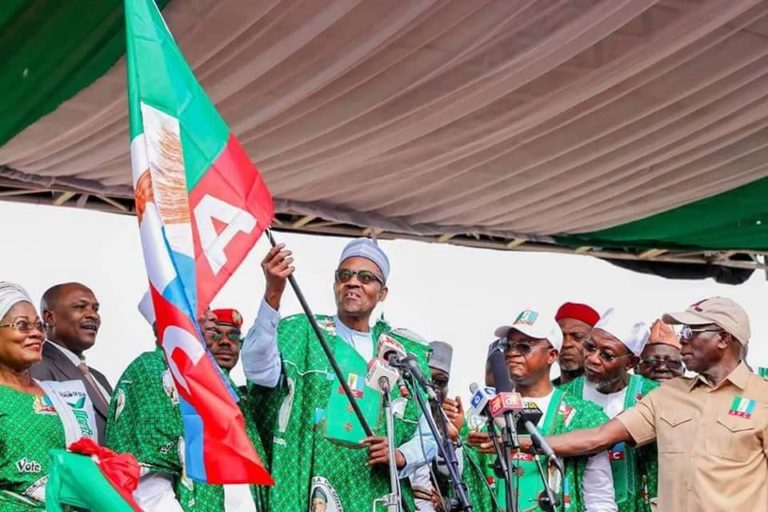
Buhari reiterated his anti-corruption mantra on Tuesday in Oshogbo, capital of Osun State, during the APC mega rally, ahead of the Saturday’s governorship election.
He also said the APC would not relent but would continue to invest in new projects which would improve the lives of people in Osun Sate and Nigeria at large.
“The children of all Nigerians must enjoy quality infrastructures, education, health care, job opportunities,” Buhari said.
The President called on voters in the state to vote for Gboyega Oyetola, the party’s governorship candidate, stating that “Oyetola is ready to work.”
He said the eight years of Rauf Aregbesola, the incumbent governor, in Osun has brought about massive development in the state.
He outlined some of his achievements in the state to include road construction and rehabilitation, and investment in health care programmes, as well as other programmes.
Buhari recalled that a school he commissioned at Oshogbo in 2016 is one of the best schools in Nigeria.
He said the success of Aregbesola administration were clear examples of a governor working for a state which also applied to other APC governors.
Buhari said for Osun to continue on the path of progress, Oyetola must be voted in as the governor, adding that without Oyetola, Osun would be in darkness.
“We will also continue to develop and bring up new impactful projects,” Buhari said.
He said APC would continue to ensure inclusiveness and economic diversification.
While Buhari has continued to harp on his administration’s fight against corruption, he has been unable to prosecute those who are loyal to him. One of such example of bias is the case against Babachir Lawal, Buhari’s former appointee as Secretary to Government of the Federation.
Lawal was sacked for an alleged embezzlement of the fund for the welfare of internally displaced persons in the northeast part of the country but he has not been prosecuted.
Kemi Adeosun, former Minister of Finance who recently resigned over certificate forgery was allowed to return to London without the federal government initiating criminal case against her.
COME Saturday, September 22, 2018, forty-eight political parties will present candidates to contest for the number one office in Osun State. The ICIR zoomed in on five of the candidates, among whom one is almost certain to be declared the winner.
Here they are:
ADEMOLA ADELEKE – PEOPLES DEMOCRATIC PARTY (PDP)
Senator Ademola Adeleke
Ademola Nurudeen Ifeanyi Jackson Adeleke, born in May 1960, was largely anonymous as far as politics in Nigeria was concerned, until the death of his older brother Isiaka Adeleke in April 2017.
At the time of his death, the older Adeleke, who had been elected Osun State Governor in 1992, was the senator representing Osun West at the National Assembly. Ademola contested and won the bye-election conducted by the Independent National Electoral Commission (INEC) to replace his deceased elder brother. He ran on the platform of the Peoples Democratic Party (PDP), having lost the All Progressives Congress (APC) ticket.
Ademola’s educational background is quite controversial; the authenticity of his secondary school certificate is still a matter of litigation. He was said to have attended Muslim Grammar School in his hometown, Ede, in Osun State, but whether he sat for the Senior Secondary Certificate Examination (SSCE) is yet to be ascertained.
Similarly, it has been established that although Adeleke attended the Jacksonville State University, in Alabama, United State of America, where he was admitted to study criminology, he did not graduate.
Nevertheless, Adeleke leaves no one in doubt when it comes to his love for dancing and his readiness to showcase this. He has earned the name “the dancing senator”, and deservedly so. Be it in church, or a political rally, or a social event, Adeleke is sure to mesmerize his audience with his amazing and highly entertaining dancing steps. Not even his nephew, the popular hip hop musician, Davido, can beat him on the dance floor.
This, however, is the main point critics harp on to argue that Adeleke will not make a good state executive, but it is left for the electorates in Osun State to decide.
IYIOLA OMISORE – SOCIAL DEMOCRATIC PARTY (SDP)
Iyiola Omisore
Born on September 15, 1957, into a royal family, Iyiola Omisore was educated at the Brunel University, London, earning two bachelor’s degrees, as well as a post-graduate certificate. He also holds a Ph.D in Infrastructure Finance from the International School of Management, Paris, France.
Omisore started his career with Drake and Gordham, an engineering firm in the UK, after two years, he was transferred to the company’s branch in Nigeria called Drake and Scull (Nig) Ltd. Here, Omisore supervised the construction of many significant projects including the Makurdi Air Force Base. He would later establish his own engineering companies; Mechelec Consultants and Chrisore Eng Ltd.
As a politician, Omisore was the Deputy Governor of Osun State between 1999 and 2003 under Governor Adebisi Akande. However, he was accused of having a hand in the murder of former Attorney General of the Federation, Bola Ige. He was charged to court and was remanded in prison.
Omisore has consistently denied having a hand in Bola Ige’s death. He was eventually discharged and acquitted.
But even while still in prison, Omisore contested and won the Osun East senatorial seat in April 2003 on the platform of the Peoples Democratic Party (PDP). He was also re-elected in 2007. However, Omisore’s quest to occupy Osun State’s number one office has not been successful so far, having lost to Rauf Aregbesola in 2014.
This time around, Omisore says Osun State, under Aregbesola’s leadership, is in need of a surgical operation, and only him could restore the state to the path of sustainable growth and development. His popularity in the state will be tested on weekend’s governorship election.
The profiles of other top three contenders will be published tomorrow. The ICIR is providing full coverage of the gubernatorial election.
MANY Nigerians have urged the federal government to do everything humanly possible to secure the release of Leah Sharibu, as well as the other aid workers that are still being held by Boko Haram.
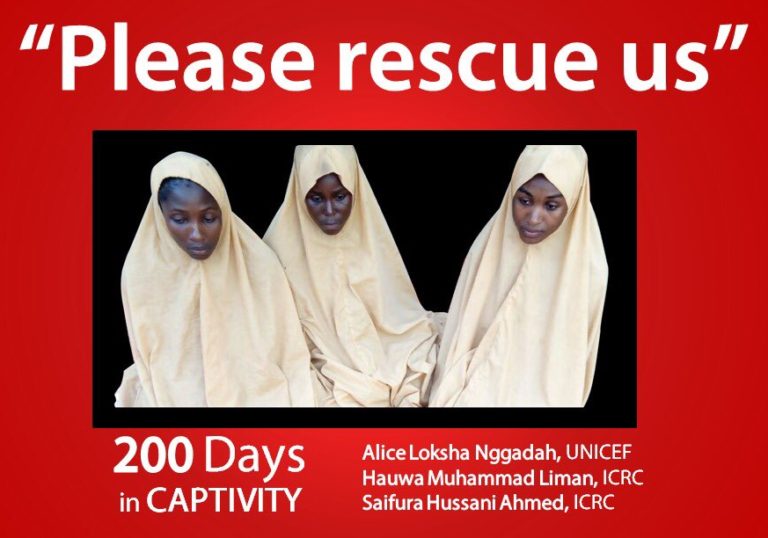
This is following Monday’s release of a video clip by the insurgents, showing the execution of Saifura Ahmed, one of the three aid workers that were abducted in Rann, Borno state, in March this year.
Ahmed was a staff of the International Committee of the Red Cross (ICRC), while the two other abductees — Hauwa Leman and Alice Ngaddah — worked with UNICEF before they were kidnapped.
In the video clip released on Monday and seen by The Cable newspaper, Ahmed was wearing a white hijab and was shot from behind. One of the terrorists who did not reveal his name said the execution was a “message of blood” to the Nigerian government since all efforts to contact them had failed.
“We contacted the government through writing and also sent audio messages but the government have ignored us. So, here is a message of blood,” the insurgent said.
“The other nurse and midwife will be executed in similar manner in one month, including Leah Sharibu,” he added.
In response, President Muhammadu Buhari issued a statement condemning the execution and called on the international community to prevail on Boko Haram “to stop these acts of extreme barbarism”.
However, many say the President should do more than just condemning the Boko Haram executions or asking the international community to intervene. They want Buhari to use the same strategy that led to the rescue of the kidnapped Dapchi schoolgirls – which included Leah Sharibu – to also negotiate for the release of the remaining hostages.
Recall that when the Dapchi girls were released in March this year, Leah Sharibu was held back by the insurgents because, according to her colleagues, she refused to renounce Christianity and convert to Islam.
“’We don’t negotiate with terrorists’. Bullshit. Whatever that was done to bring all the other girls back should be done for Leah Sharibu,” wrote a Twitter user whose name read simply as Maryam.
Another tweetread: “If it was payment Boko Haram wanted for Leah Sharibu in the first place, why wasn’t she included in the initial bargain?”
Similarly, Oluyemi Fasipe, another Twitter user asked: “Dear President Buhari, are you going to wait until Leah Sharibu is killed by BokoHarm before you move to #freeleahsharibu, #BringBackOurGirls and secure the release of other captives?”
The bring-back-our-girls (BBOG) group has said that it will march to the Presidential Villa on Wednesday to demand the rescue of all the Boko Haram hostages, including the remaining Chibok Schoolgirls, Leah Sharibu and the kidnapped aid workers.
It's way past the time for 'our thoughts and prayers are with you'…Leah Sharibu and the health workers need a compassionate government to go to any length to secure their release!
UNLIKE most other government agencies, the Universal Basic Education Commission (UBEC) has two websites: ubeconline.com, created in 2008 and ubec.gov.ng. According to information on the latter website, it went live on July 26, 2017. But more than a year after, the promising platform is still deficient.
UBEC is an agency of the federal government established to implement the UBE programme introduced in 1999 to foster quality and accessible basic education. It receives allocations in the billions every year to fund its nationwide activities. With a total cash release of N5.1 billion for capital projects in 2017, it is undeniably the most-funded MDA under the Ministry of Education.
But it is difficult to access UBEC’s records or follow details of its activities. Asides the ‘Who We Are’ page on the commission’s new website, there isn’t much helpful content available on it. Other pages are empty, including: Management Team, Interventions, Careers with UBEC, all ten sub-pages under Departments, and all six sub-pages under Media save News Headlines and Multimedia.
Under News Headlines are two items most editors would hesitate to publish. One posted on July 4 contains an unrelated picture of Certiport Plaza, a US-based computer skill certification company, and news that free feeding has been introduced in UBEC schools.
“We are glad to announce that free feeding has been introduced in all UBEC schools nationwide. Bon apettite,” says the one-line news.
“We are glad to announce that free feeding has been introduced in all UBEC schools nationwide.
The second report published 22 days later appears to celebrate in arrears the launch of the website. Again with a totally unrelated image, it says in one line: “UBEC website goes live today. We are all glad.” It is doubtful if the sentence still holds true a year and two months after.
Another proof the website has been abandoned after its creation is this third feature image, a screen shot of a website called 41Naija Entertainment. It accompanies a short, as well as stale message urging the “full involvement of all individuals, corporate entities, civil societies and community groups in the drive to achieve Education for All (EFA) and the Millennium Development Goals (MDGs) by 2015”.
Only five projects are listed on the website, including one which says “Testing Structures” and is said to be implemented in Maiha Local Government, Adamawa. Also, the picture accompanying the classroom project, said to be located in Makurdi, Benue, is actually that of a block of classrooms at Corpus Christi College, Ilawe-Ekiti, Ekiti.
Also, instructively, the email address on the new site is still linked to the old website: info@ubeconline.com. Not only that, this address is in fact no longer available. A mail sent to it by The ICIR on September 16 failed to deliver and returned a mailer daemon.
Mailer daemon: UBEC’s official email address is not functionalOnly five projects are featured on the UBEC website, though it also says “UBEC has constructed over 1000 classrooms across the nation”.
Social media is no exception
The social media links on the website are dysfunctional: Facebook, Twitter, YouTube. They merely reload the web page a visitor is presently viewing. This is not surprising as UBEC’s Facebook page is seldom updated, with the last statement posted in May, 2018. Also, only 25 posts have been made between January, 2016, and now — 18 of which are short posts celebrating various holidays from Independence, Children’s Day, Workers’ Day, Easter, to New Year.
On one of such posts published in April to wish the 814 followers “a happy Easter from all of us at the board”, Uchechukwu Okolo, a Facebook user, had commented: “You people are not functioning on this board at all.” The page’s administrator, in reaction, said they are trying to put things in order so they can “set the ball rolling”.
UBEC additionally has no channel on YouTube and cannot be reached on Twitter as it has no visible account there. A search for “Universal Basic Education Commission” on the platform returned no relevant account results, and one for “UBEC Nigeria” instead offered results for “Uber Nigeria”.
No provision for website creation in recent budgets
Section 16 of the Public Procurement Act of 2007 provides that: “all public procurement shall be conducted based only on procurement plans supported by prior budgetary appropriations and no procurement proceedings shall be formalized until the procuring entity has ensured that funds are available to meet the obligations.” In other words, procurement cannot be done outside provisions of an MDA’s budget.
However, a check through the Education Ministry budgets from 2014 to 2018 revealed that there has been no provision for the building of new website for UBEC. The closest projects to this are in the latest budget: Design and development of bid procurement purchase platform (N72.2 million) and design and implementation of monitoring and evaluation solution (N35.4 million).
Little difference on old website
Not only is UBEC’s older website (www.ubeconline.com) unattractive by contemporary standards, it is also not very helpful. Numerous links on the site are broken, including the Board Members and Departments pages. Also, information contained in the documents uploaded are often not broken down as to allow for critical analysis or verification.
The last time basic education data was uploaded on the platform was in 2014. Information on other projects too, such as those on al-Majiri, boy-child, girl-child, e-libraries and so on, was last updated in 2014 or 2015.
Financial records on matching grants are not accessible on the website, as the few visible links are broken and of no use. All links on the Downloads page are also broken.
It is still work in progress — web designer
When The ICIR contacted Muhib Olaniyan whose company, Computer and Telecom Services Ltd, designed the new website, he said the project is “still work in progress”. He added that he can confirm that the commission, in an ongoing retreat in Kaduna, is training personnel who are to update the platform.
“Because I’m not part of the system, I cannot answer your question on why they are not using it,” he said. “I can only confirm to you that they are making efforts to make the site functional. They are developing capacity towards using it by themselves.”
Asked for explanations on Monday, Osom Osom, UBEC’s Public Relations Officer, said the commission has basically “been trying to build a much more interactive platform” and directed The ICIR to Garba Kwandi, whom he said is supervising the website project.
He also said it is not entirely true the commission has no Twitter handle. According to him: “The commission does have a Twitter handle that can be accessed through its weekly television programme on NTA: Basic Education Today. It is also on Instagram.”
UBEC’s TV programme has only eight followers on Twitter
Upon checking, however, The ICIR found the said Twitter account was abandoned shortly after its creation. It was opened in April, has only eight followers, and only two tweets — one of which is a retweet from NTA News. It also states the official website of the commission as ubec.gov.ng.
A similar trend is observed on Facebook. Also created in April, the Basic Education Today page has 43 likes and only two updates — one is a profile picture update and the other a comment celebrating the completion of the programme’s first edition.
The old UBEC website is no longer available, following a phone call to UBEC PRO by The ICIR
Kwandi, during a telephone interview, said the commission is working to make the platform fully functional soon. Asked how soon the plans will be actualised, he simply repeated “very soon”.
Meanwhile, The ICIR observed that, shortly following the call to Osom, the old UBEC website address (ubeconline.com) began redirecting to the new address (ubec.gov.ng), even though contents on the former have not yet been transferred. This was not the case as at Monday, September 17.
The official address on the new platform has also been edited to now read “info@ubec.gov.ng”, which like the former is also not available for mailing.
This report is under The ICIR’s Unsightly Sites Series. The series profiles websites of various government bodies and agencies, and calls attention to their unpardonable inadequacies, with the aim of triggering improvements in the incorporation of Information and Communication Technology into governance in Nigeria.
SAFE and readily available water is important for public health, whether it is used for drinking, domestic use, food production or recreational purposes but the journey to achieving safe drinking water for all may be far-reaching due to the proliferation of unsafe packaged water. ADETOLA BADEMOSI presents findings of her investigations into the hygienic state of packaged water factories in the FCT, Niger and Nasarawa States as well as the environmental and health effects of poor hygiene in the areas.
“Pure water! Akwoi maisanyin? [is there cold one?],” a passenger, who obviously was dehydrated as a result of the hot weather asked the pure water seller. Impatiently, he gulped down two sachets of the water and heaved a sigh of relief. Although his thirst for cold water was quenched, he might have unknowingly gulped down a cluster of water bacteria.
“Pure water” is the household name for packaged sachet water. It became widely adopted by Nigerians after a major transition from the old “ice-water” which was packaged in a white polythene nylon and sold for just a few kobos in the past.
Over the years, sachet and packaged water evolved and was first sold at N5 then increased to N10 per unit. Apparently, the idea behind packaged water was to replace the iced water which was packaged in nylon was meant to address the issue of waterborne diseases, such as cholera, typhoid, dysentery, and polio. These diseases are reportedly caused by drinking water containing infectious viruses or bacteria, which often come from human or animal waste.
Bearing in mind the importance of safe drinking water to the health of the consumers, the proliferation of packaged, especially sachet water has become a cause for concern in Nigeria, especially when they are produced under unhygienic conditions.
This has become a major menace despite the establishment of the National Agency for Foods and Drugs Administration Control (NAFDAC) in 1994, which is responsible for regulating and controlling the manufacturing, importation, exportation, advertisement, distribution, sale and use of food, drugs, cosmetics, medical devices, chemicals and packaged water.
The production of unsafe sachet water has continued to thrive with little or no treatment adequate enough for the water being packaged for public consumption. The resultant effect on the health of consumers cannot be overemphasized.
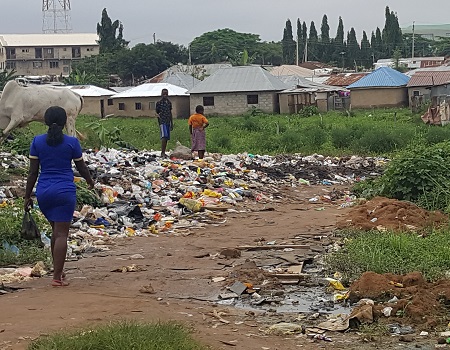
Dump site close to a pure water factory in Jabi district Abuja
On daily basis, different brands of sachet water are released into circulation, hawked by under-aged children and even adults on the streets, at bus stops, markets, and other places with human concentration. It is consumed by virtually all average Nigerians. However, the question that comes to mind is where and how they are produced.
A PLETHORA OF FINDINGS
Investigation conducted by this reporter on the proliferation of unhygienic sachet water in the Federal Capital Territory (FCT), Niger and Nasarawa States revealed that about 90 percent of pure water factories visited do not conform with the NAFDAC’s requirements for the establishment of water production factories.
For instance, one of NAFDAC criteria before setting up a packaged water factory for public consumption is that the factory must not be sited near a cemetery, abattoir, quarry, sewage treatment plant, sawmill, oil depot (Petroleum and Vegetable) or any such establishment that could be a source of contamination for processing, production and packaging of potable water.
NAFDAC code further indicates that: “The building should be designed to allow for free flow of personnel and materials to prevent cross-contamination. The building for the production of potable water should be purpose-built or suitably adapted to comprise a minimum of five rooms designated as the cloakroom, packaging material store, production room and finished product store & office.”
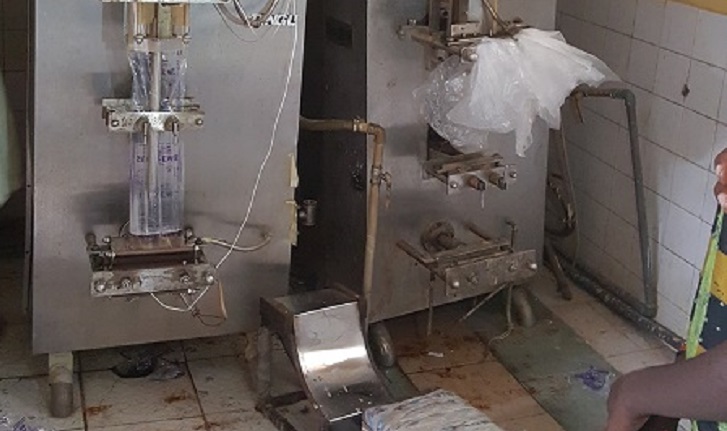
However, it was discovered that some factories in the FCT produce this commodity under really terrible conditions. Example of such is a company in the heart of the popular Jabi District, which operates directly beside a dump site where open defecation is freely practised and all forms of wastes are dumped. Every day, a huge stench pervades the whole area.
The company, with the brand name, PETCEN Ozonised water is located in a small compound, at the extreme end of a cluster of substandard houses. No one could imagine that such a firm operates in the environment which is about 10 metres away from the dump site.
The workers, during a visit to the location, were so conscious of occurrences around the business vicinity. Efforts to gain entrance into the main compound proved abortive but a quick survey of the entire factory revealed that the products are conveyed in an unbranded white but rickety looking ‘pick-up’ Van, while the major production factory is a sore sight. Although like every other factory visited, they had cylinders of industrial filters placed outside, the functionality is questionable.
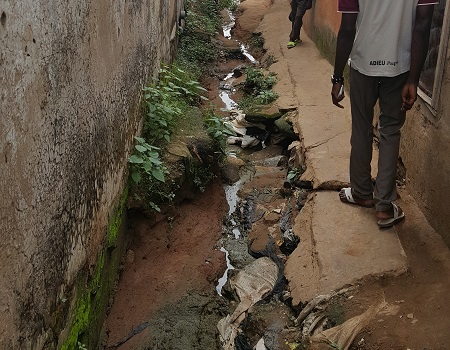
Closely attached to the factory’s fence is a shallow gutter and burglarized diesel generator house while the main entrance was loaded with a heap of refuse dirtbags.
John Haruna, a resident living in the area, told this reporter that the “pure water factory has been here for a very long time since I packed to this Jabi upstairs five years ago.”
Further investigations carried out in the FCT, also exposed to situations where the commodity is produced in shops and widely distributed for public consumption without considering the required treatment needed to certify the water safe for drinking.
Pathway to Kabinaf Table water, Niger State
For instance, a sachet water producing factory with brand name Tbillz Daily table water is located in a popular estate along Lifecamp, Abuja. Although the environment looked hygienic, what seemed peculiar to the factory is its mode of operation.
Though it is located in an estate, the commodity is being produced in a block of two shops closely confined to a building. “They don’t allow anybody to enter the compound as you see it,” Kolade Onibiyo, a resident in the estate told this reporter.
Onibiyo who wondered why the entire place is tightly confined in such a way that nobody could see through the building disclosed that the commodity is produced occasionally.
His words:“The building you are looking at is where they do the pure water but inside those two shops, you cannot even gain entrance into the building not to talk of saying you want to see how they are doing it. But why are they acting suspiciously if what they are doing is right? And as you see that place, at times in two weeks they may not do water. So, it is somehow but I used to drink the water because the shop beside us, at times, they use to supply them. It is God that is protecting us all.”
Interestingly, one could never have thought that such activities take place in the companies so far highlighted in the FCT, but their operations are mostly kept away from the prying eyes of the public. That possibly accounts for why NAFDAC officials are also missing their trail.
To further conceal their illegal operations, the commodities are conveyed in unbranded vehicles which are mostly rickety. They are distributed to wholesalers and retailers within their jurisdiction. Unfortunately, the commodity has a way of getting to a heterogeneous number of people.
Similarly in Lafia, Nasarawa State capital, pure water business seems to be the most popular one everywhere. “Pure water business is really booming here, I will even say this is the hub because hardly will you work past a street that you won’t find one or two factories,” Godwin, a local guide told this reporter.
Sadly, it was discovered that only a few operate closely with NAFDAC’s prerequisites. The situation is even worsened by the fact that most households have pushed aside the idea of drinking water from boreholes and taps as packaged water is embraced with belief that they are safer.
A visit to some factories in the state revealed how the purportedly “pure water” is packaged in shops located in secluded areas, away from prying eyes of the public.
Three of the factories visited are Pajo, Fasaha and Fajo table water companies. Interestingly, they are all are located within residential areas but residents, who are in the know of the illegal operations, seemed unperturbed.
Efforts to get officials of these companies to speak proved abortive as every question posed to them on their mode of operation was met with courteous replies and mild hostilities, perhaps for fear of being exposed.
However, a visit to the Alamari Table Water factory in the state was a different experience from other factories. It is located around the popular Stadium junction, Lafia and seemed to meet up with some of the NAFDAC’s approved standards.
Unlike other factories, the building was sectionalised and comprised of the cloakroom, raw materials store, toilet, finished goods store, production unit. Apart from this, the facilities and equipment included a borehole, industrial filter about three septic tanks, microfilters among others.
Entrance to Petcen table water factory, Jabi District, Abuja
“The processing starts from the borehole to the raw water tank, from the raw water tank to the industrial filter from there to the treated tank then it goes through the filters then the UV light before it comes to the machines. We don’t put any chemicals to purify, it is just with the processes I mentioned. With the UV light, if there is any germ, it traps it and won’t scale through,” Jonah Alogala, a supervisor at the factory explained.
While also speaking, Managing Director of the firm, who gave his name as Mr Alfred Alogala, accused the NAFDAC of complicity in the proliferation of substandard packaged water across the country.
Alogala, who is the state chairman of the now comatose Association of Table Water Producers (ATWAP), explained that officials of the agency rarely go out to inspect factories even as he alleged that when the illegal activities of the substandard products are brought to their knowledge, these are not handled professionally.
“The problem we are having in the industry is much blamed on NAFDAC, NAFDAC is not doing what they are supposed to do. They are supposed to inspect the factories regularly, your aim is not to victimize but to see that the right thing is done if the wrong thing is happening you have to advise them on what to do. And if they keep doing the wrong thing, you close up.
“They hardly even go round, for instance, a NAFDAC official, who is ahead of the unit, we the Association’ executives decided to go out and do self-assessment, some factories that we went to, honestly I cannot use the so-called pure water to bathe based on what we saw. Some of their microfilters were green, pure green because of dirt. Something that should be pure white has now turned pure green. So, we reported a particular case to NAFDAC and the man went and told the owner of the factory that we were the one that came to report. We helped him to do his job and he still went ahead to betray us. We didn’t know what happened afterward,” he explained.
He said the association was established to ensure that its members comply with NAFDAC’s guidelines by periodically going out to check their activities. However, he said its efforts were allegedly sabotaged by the regulatory agency.
“For now, the Association is comatose because, for quite some time, I was the State chairman, then we had four zones, we have Lafia zone, Akwanga, Keffi and Karu zones. So we used to help ourselves, we used to go round and check, we used to do sanitation but along the line, with this kind of attitude from the NAFDAC head, we had to suspend that. Another unit head sent his staff on inspection, he went on inspection and they found a lot of faults so they closed the factory, wrote the report in the person’s file and submitted to the head. The team leader explained what happened in the report, then the owner came and sat down and the head called the team leader in the presence of the owner and queried why he shut the factory. So it is a serious issue and has discouraged almost all the staff from going out.”
He further cited instances where approvals were allegedly given to factories who have not met with the criteria of the agency says: “For instance, some places that are not qualified to be certificated for production, maybe they bribe them, I don’t know but they will allow them.
“These are the same people who gave us as a precondition that for you to have a water factory, you must have, production room, goods room, finished goods room, cloakroom, toilet etc. If these facilities are not there, they are not supposed to approve. Then till the condition is fulfilled then they will go to others like testing of the water but you find out that in most cases, many people are producing in one room and they will give them a certificate. Not all NAFDAC numbers are fake, only a few of them but not all. There was a case where somebody just picked another person’s nylon, printed the same thing and was producing water.”
Similarly in Niger State, from the three factories visited (Al-machus, Supreme and Kabinaf), only one of them seemed to be operating in a fairly clean environment. Efforts, however, to gain access into the premises was met with strong resistance.
Two of the other factories, however, opened their doors widely to this reporter who pretended to be a student working on a project with a focus on packaged water. A quick observation of one of the factories situated in the heart of Suleja, Niger State, revealed that although the water is packaged for public consumption undergoes certain treatment processes, this may be rendered ineffective as a result of the environment in which it is located.
For instance at Supreme table water, the entire factory is an old building painted in cream and white with the dirtied white tiled floor. There was no such thing as finished goods room, cloakroom, except for a small room with two sealing machines.
The extremely tight structure which is situated in a small fenced compound, however, draws its water source from the water board.
“We have been running for about 20 years now and we get our raw water from the water board. It is close to us here, other people get theirs from borehole but our own is directly from the water board,” the factory owner explained.
Kabinaf Table Water factory was a sore sight. It is located in a filthy environment. The road leading to the company is characterised by stagnant water, unclosed mosquito breeding gutter etc.
On getting to the factory’s entrance, one could not have imagined that water for drinking is being packaged for sale in such place. In front of the gate was a rickety and unbranded pickup obviously used to convey these products to distributors or retailers.
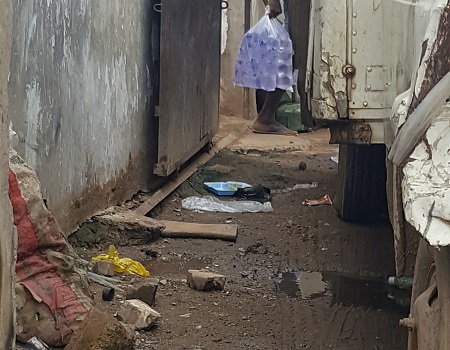
Further survey of the rather dirty compound revealed a small fence used to demarcate the factory from a residential house. Rags were left hanging loosely in some corners by the entrance. The floor was as well littered with dirt betraying the state of uncleanliness, very dark ground surface and other substances which are not fit to be in such place.
However, what is similar to all the factories visited is that they all seemed to have the equipment needed, some of which include industrial filters, microfilters, septic tanks among others but the question that comes to mind is if the commodities are pure considering the environment in which they are produced.
Also, the factories do not have signboards placed in front of their companies as a form of advertisement, since this is the sole aim of every business venture, to create awareness and make a profit. Gone were the days when water producing factories advertise their products in both electronic and print media.
UNDERSTANDING WHO’S STATISTICS ON CONSUMPTION OF CONTAMINATED WATER
According to the 2018 World Health Organisation (WHO) fact sheet on potable water, contaminated drinking water is estimated to cause 502 000 diarrhoeal deaths each year.
In Nigeria, about 150,000 children reportedly die of diarrhea-related diseases annually for drinking unsafe water, while a large sum of rural dwellers still lacks access to potable water.
According to the 2016/2017 Multiple Indicator Cluster Survey (MICS), about 90 percent of households in Nigeria consume contaminated water and other impure substances.
The 2016/2017 report which is the fifth round of the MICS series, revealed that an overwhelming majority representing 90.8 percent of households in Nigeria drink water contaminated by faeces and other impure substances like E. Coli.
coli is the name of a type of bacteria that lives in intestines. Although the majority of these bacteria are harmless, some types can make people sick and cause diarrhea. The worst type causes bloody diarrhea, and can sometimes cause kidney failure and even death.
“About two out of every three households use improved water sources, while a little more than one-third use improved sanitation compared to 58.5 percent and 31 percent respectively in 2011,” Mrs. Maureen Zubie-Okolo, a Monitoring and Evaluation Specialist with UNICEF said.
She said although 64.1 percent of Nigerians had access to improved drinking water sources, North-East states were, however, lagging behind with 52.4 percent, while South-West states top the chart with 87.3 percent of its residents having access to improved water sources.
NAFDAC’S PREREQUISITES FOR PACKAGED WATER: EXCERPT
Some of the structural guidelines for the production of quality and safe packaged drinking water stipulate that: “The entire factory premises should be fenced to demarcate it from all other buildings (residential or commercial). The factory must not be sited (located) near a cemetery, abattoir, quarry, sewage treatment plant, sawmill, oil depot (Petroleum and Vegetable) or any such establishment that could be a source of contamination for processing, production, and packaging of potable water
“The building should be designed to allow for free flow of personnel and materials to prevent cross-contamination. The building for the production of potable water should be purpose-built or suitably adapted to comprise a minimum of five rooms designated as the cloakroom, packaging material store, production room and finished product store & office.”
In terms of washing and toilet facilities, the regulation is that: “Adequate, clean washing and toilet facilities should be provided for personnel. Washing facilities should be equipped with soap or detergent, air driers or single-service towels. This should be walled and floored with easily cleaned and disinfected non-shedding durable material and should have a smooth surface.
“Toilets should be away from the production or storage areas and should be easily accessible to the production area. Sewage, refuse and other wastes within the premises should be disposed of in a safe and sanitary manner.”
It further stresses that: “Any building used in the manufacture, processing, and packaging of potable water should be maintained in a hygienic condition. The building should be regularly fumigated with approved fumigants in accordance with the food and drug act and the pesticides registration regulation.”
TEST TUBE ANALYSIS ON SACHET WATER SAMPLE
In an effort to ascertain if environmental factors affect the quality of water produced, a sample of sachet water from a pure water factory (PETCEN table water) producing beside a dump site in the FCT was taken for test tube analysis. Meanwhile, a total of nine factories were visited in Lafia in Nasarawa State, Niger State, and the FCT, Abuja.
This study was to determine the total bacterial counts of the water sample whether it is in conformity with the acceptable standard of the Environmental Protection Agency (EPA) and World Health Organization, WHO’s 1.0 × 10 2 CFU/ml standard.
The test found the sample to be microbiologically satisfactory and confirmed with the Nigeria Industrial Standard (NIS) 2008 of drinking water.
Meanwhile, a laboratory analyst, Olayemi Ibrahim, who spoke with this reporter, explained that although the water was found safe for consumption, the factory’s source of water also calls for questions.
He gave instances where factory owners package treated water from the water-board adding that in this case, they spend less and even cut back on the amount of treatment needed to certify the packaged water safe for consumption.
According to him, considering the environment where the water is being produced, there are possibilities that the source of water is not from a borehole within the environment.
“If you have access to the factory, you will be able to know if they are using borehole. We will be able to analyse the content of the water and if we get the content and you are able to gain access into the factory, we will be able to know if they are using that water or not.
“By the time we analyse their raw water, we will know what it entails, if it is borehole we will be able to know what is inside that borehole. If we are able to ascertain what is in the raw water, we will be able to know how effective is their treatment plant but knowing the source of their raw water is important.
“The question mark on this sample is that they may be using direct tap water because I have seen instances, where people will say, is it not treated water from the water board. Clients will come and tell you my water is from water board all I just need is NAFDAC approval,” he explained.
However, he noted that the environment where water is being packaged for consumption also does not necessarily matter, depending on the amount of treatment given to such water.
Ibrahim cited instances of water recycling processes where wastewater from rivers, drainage among others are reprocessed, treated and channeled for human use.
“The environment does not really matter depending on the kind of treatment you apply to your water. Although the environment matters to the raw water for instance if the borehole is within that area, you will find a lot of things, the bacteria load much, there may be a lot of faecal contamination but when you suggest that water to treatment all those things will be wiped off.
However, NAFDAC has to be particular about the environment because they are not always there to monitor.”
“If it is NAFDAC that went to that site, it will be closed down irrespective of the water quality because they will always tell you that your factory should not be close to the dump site. You may be doing the right thing but NAFDAC is not always there to monitor.”
A Medical Doctor, Mrs. Uchechi Nkiru who offered to speak on the effect of consuming contaminated water cited instances of cholera outbreaks in Kwara state and recently Niger State, saying these are due to unhygienic practices in terms of consumables and the environment.
According to her, cholera which could be deadly if not promptly attended to is either caused by drinking of contaminated water and food.
On the impact of environmental factors on personal wellbeing, she said irrespective of the level of hygiene, the environment where consumables are produced should be considered as it directly or indirectly affects the product.
Nkiru, who cited instances of pure water factories operating in compromising environments said; “For instance somebody producing sachet water beside a dump site there is 50/50 chances that in some cases, there may be the escape of some bacteria like e.coli, Salmonella, there are lots of these organisms.
“You can say you are careful with the treatment but flies can also carry germs around, it could be during the production process. Even if it happens that their source of water is from the water board, there may be issues of burst pipes and with the virtue of the environment the factory is located, it is quite dangerous to the health.
“There are multitudes of organisms that are waterborne if it is e.coli you could get diarrhoea if it is Salmonella you could also get diarrhoea and some typhoidal kind if illness. Like typhoid, it could be waterborne or food-borne.”
NAFDAC SPEAKS
When contacted, the National Agency for Foods and Drugs Administration Control (NAFDAC) affirmed the situation but explained that there are cases where manufacturers lower their standards after getting the required certification from the agency.
Speaking to Sunday Tribune, the Director of Special Duties, Mr. Abubakar Jimoh, said this led to the establishment of the post-marketing surveillance and enforcement department in the agency.
His words: “Generally speaking, NAFDAC is aware and conscious of the fact but first you need to find out from the database maybe these companies are registered. We are not oblivious of the fact that there are instances where we have registered a product and immediately we turn our backs the people will lower their standards so that is part of the reason the post-marketing surveillance and enforcement directorate was created.
“Any organisation that has been certified in terms of Good Manufacturing Practices, GMP, in terms of the location, personnel and equipment, product and laboratory analysis and they now lower the standards by virtue of the registration certificate given to them, they have offended the law. We are going to investigate the complaints, we are aware of the fact that there are instances where we register a product and immediately they get their licenses, they lower the standards, there is nothing new about that.”
Jimoh who noted that the shortage of manpower has also denied the agency the opportunity of performing up to expectations in terms of routine inspections.
He said: “It is not true that NAFDAC is not doing what it should do, allegations like this will always come up but when you investigate you will find out that it is just a mere figment of the imagination. We have a routine inspection but I must confess that we cannot cover all the places at a go. How many things under the sun have you reported? There are limitations and that is why in an attempt to bridge this limitation, we try to partner with people and that is why are partnering with the local government, communities and public enlightenment campaign. We cannot be everywhere in terms of our numerical strengthen, vehicular movement and logistics but all in all it is not an excuse.”
It is worthy to note that for Nigeria to achieve the Sustainable Development Goal 6 (SDGs) which is to ensure access to safe drinking water and sanitation, thereby reducing the menace of waterborne diseases, the Federal Government (FG) through the NAFDAC must on its part, ensure massive clamp down on packaged water factories producing in unhygienic conditions.
This report was originally published by Nigerian Tribune, with support from the Ford Foundation and the International Centre for Investigative Reporting, ICIR.
I have been meaning to do a thread on Kemi Adeosun for a while now, as I considered her to be the most reform-minded Minister in the current government. We will get to that later but let’s first deal with the NYSC saga that led to her resignation.
Let’s start with the Kemi Adeosun resignation letter. She said that she had become privy to the findings of the investigation into the allegation by Premium Times that the NYSC Exemption Certificate she presented was not genuine. She said she was shocked by the findings.
We are not yet privy to the findings of that investigation but it is safe to assume that the investigation determined that the Exemption Certificate she presented was not genuine. She therefore felt that she had no option than to resign. I hope that government will publicise it.
Mrs Adeosun said in her resignation letter that she did not obtain a Nigerian passport until she was 34 years old & she admitted that there was a debate as to whether the NYSC Act applied in her case. She was born & raised in London. NYSC admitted that she applied for exemption.
She also said in her resignation letter that she was cleared by the Ogun State House of Assembly when she was appointed Commissioner of Finance in 2011 and by the DSS and National Assembly when she was appointed Minister of Finance in 2015. This raises a number of questions.
First, the NYSC Act is clear on who is entitled to an exemption and the process for getting it. Section 2(1) of the NYSC Act of 1993 lists the categories of people that could be entitled to an exemption from national service. It was always unlikely that she would qualify.
The following classes of persons are exempt from NYSC:
People older than 30 when graduating from university, polytechnic or college of education. She didn’t qualify here.
People that had served in the Nigerian Police or armed forces for at least 9 months. Not applicable.
Staff members of the Defence Intelligence Agency, NIA, Nigerian Security Organisation or DSS. This was possible as she may have been recruited as a secret agent while at university. This is known to happen. That’s why it was prudent to await the outcome of the investigations.
Holders of National Honours. We are not aware of any national honours she is a recipient of.
Anybody granted a waiver by the National Defence and Security Council. Again, we did not know whether she was so exempted, so it was prudent to await the investigation results.
For a foreign graduate to obtain an exemption to NYSC, the process is:
You must submit your credentials. So, in effect, you apply. Mrs Adeosun applied. Those that say you cannot apply for an exemption are wrong.
You must physically register in person at NYSC HQ in Abuja.
If granted an exemption, you must collect the Exemption Certificate IN PERSON at the NYSC HQ in Abuja with an accepted photo ID, preferably an international passport. Mrs Adeosun said her Exemption Certificate was obtained by “trusted associates.” If true, this was wrong.
Now, let’s go to what usually happens. First of all, people with dual citizenship that come back to Nigeria to work as “expatriates” are often not asked for their NYSC Certificates. They work as foreign nationals and leave. I believe that this was the case in her first job here.
Then when there is a possibility of getting a government appointment, the issue of the NYSC Certificate comes to the fore. Many people from abroad believe that there’s always a way around things in Nigeria. They approach NYSC but meet a brick wall. They tell them they must serve!
So, there’s an important government appointment looming. Do you serve and lose it or not. Many will resort to “trusted associates” who will tell them “We can find a way round it but it will cost you a lot of money.” Most people will pay. I suspect that that is what happened here.
So, a “trusted associate” obtained an exemption certificate that was not genuine. Some have expressed sympathy for Mrs Adeosun in this regard, but she is an intelligent woman who should have known she did not qualify under any of the exemptions listed in the NYSC Act.
Many have also used the opportunity to attack the continued relevance of the NYSC scheme. I will not get into this now because the law is the law until the law is changed. If we don’t like it, we should change the law. Ignorance of the law is never a defence in law. Red herring.
Even Senior Advocates of Nigeria have admitted to obtaining things like Yellow Fever Certificates and Drivers Licences that they are not sure are genuine. They should know better. Unless Mrs Adeosun went through the process and collected it IN PERSON from NYSC, it’s a moot point.
When the scandal first broke, I said that because of difficulties of record keeping in the public service, I expected it to take NYSC some time to unravel the matter. Some attacked me for saying so, but from the Minister’s resignation letter, it’s clear it took quite a while.
Some people used the opportunity to sell Electronic Document Management Systems and “Blockchain” technology, conveniently temporarily forgetting their disdain for any expenditure on the “useless” public sector where all spending must focus on “tangible” physical infrastructure.
The Senior Advocate of Nigeria responsible for advising the government on Anticorruption is also on record as saying Mrs Adeosun shouldn’t be sacked because “she is an important member of cabinet who is doing well.” This was disappointing. Doing well at your job is no defence.
I am on record as saying that Mrs Adeosun was, in my view, the most reform-minded Minister in the current government, and that she drove a number of important reforms. Some people snidely asked what reforms she had driven. I will now outline some of them:
Full implementation of the Treasury Single Account. When the TSA was piloted under the previous government, it saved the government N103 billion between 2010 and 2013. With full implementation from 2015, TSA had saved the government N7 TRILLION as at April 2018! Argue with facts!!
Voluntary Asset and Income Declaration Scheme (VAIDS). This raised the number of taxpayers from 13 million in 2015 to 19.3 million in 2018.
Efficiency Unit of the Federal Ministry of Finance saved the government N34 billion in Travel and Transport alone in 2017 compared to 2016.
Efficiency Unit saved the government N24 BILLION on Stationeries and Consumables in 2017 alone compared to 2016.
Mrs Adeosun instituted the 22 conditions for states to get bailout funds which improved fiscal responsibility. Admittedly, this wasn’t perfect and needs more work.
The Development Bank of Nigeria was established and made operational.
The Whistleblower Policy led to the “blowing of 8,000 whistles”, which has led to 10 prosecutions, 4 convictions and the recovery of N14 billion. N440 million has been paid out to 14 people as a result.
Linking the BVN to the government IPPIS (Integrated Personnel and Payroll Information System) Payroll System has seen the uncovering of nearly 50,000 multiple salaries. These are not ghost workers but public servants collecting multiple salaries. In one case, one public servant was collecting 20 salaries!
Mrs Adeosun instituted the Presidential Initiative on Continuous Audit which sought to clean out the personnel records of government Ministries, Departments, agencies and parastatals. Ironically, it exposed many people with fake degree certificates who were shown the door.
The linking of BVN with IPPIS meant that, for the first time, we are able to identify who is benefiting from the creation of ghost workers. We now know who is collecting the salaries. More than 100 people are now being prosecuted by the EFCC for benefitting from ghost workers.
I can list many more reforms that Mrs Adeosun drove, but I believe that the point has been made. Of course, there were some gaffes like when she was alleged to have said that recession was just a word. However, in my interactions with her, I found her to be a decent, polite woman
It was, therefore, with great sadness and a very heavy heart that I called for her to be sacked and prosecuted if she was found to have forged her NYSC Exemption Certificate. Even if she had been naive, it is a grievous error of judgment for someone managing the national treasury
Let’s now go to the issue of the clearances she had previously received. First of all, State Houses of Assembly are in the pockets of state governors. The Ogun State House of Assembly dared not question whatever the governor wanted. They wouldn’t have checked anything.
Next, the DSS clearance. As far as I know, the DSS doesn’t check the authenticity of certificates presented directly with the issuing authority UNLESS there is reason for doubt. That means that she could even have presented fake academic certificates, not just NYSC and been cleared
Proof of this is that the Vice President, as Acting President, initially appointed someone who was under investigation by ICPC into the ICPC Board. The DSS should have known this. This only happens when the bureaucracy of the civil service in the SGF’s Office is bypassed.
I believe that then screening by the National Assembly follows the same pattern. They don’t check back with the issuing authority & rely instead on the DSS. Some have alleged that NASS was aware that Kemi Adeosun’s Exemption Certificate was fake and was using it to blackmail her.
I think that this overestimates the capacity of the National Assembly, UNLESS someone had blown the whistle. I also think that the allegation that she was being blackmailed is likely to be far-fetched for two reasons.
She is not responsible for Appropriation. That is MBNP.
NASS’s money is a first line charge which is outside the control of the Minister of Finance. The only issue within her control is release of funds for “Constituency Projects” already appropriated for. I don’t know about blackmailing her for that one but I think it’s unlikely.
A number of issues remain for the government to address:
The review of the NYSC Act and Scheme
Nigerian citizens with dual nationality working in Nigeria without NYSC.
The control of state governors over State Houses of Assembly.
Screenings by DSS.
NASS Screenings.
Record keeping in the public service.
Speed of response to allegations by the government.
Confidence in the anti-corruption fight, with particular regards to the people advising government.
Leaks in government documents.
Building the confidence of the people.
Going forward, it would be helpful for the government to address these, so that positive steps being taken in some areas are not undermined by inefficiency in operations, tardiness in response and perceived double standards. Some things DO work in Nigeria. We need that hope.
This article by Dr JoeAbah, former Director-General of the Bureau of Public Service Reforms (BPSR), was originally published as a Twitter thread.
AFTER sixty-nine days of awkward silence following an allegation of NYSC exemption certificate forgery, former Finance Minister Kemi Adeosun finally admitted wrongdoing and resigned on Friday.
In her letter addressed to the president, Adeosun said the investigative report came to her “as a rude shock” and she deemed it fit to “do the honourable thing and resign” in line with the federal government’s focus on integrity.
In a statement released by presidential spokesman Femi Adesina to announce the president’s acceptance of the resignation, he said, “the President thanked the Minister for her services to the nation and wished her well in her future pursuits,” suggesting no further legal consequences should be expected.
“I [thank] you profusely for the honour & privilege of serving under your inspirational leadership. It‘s been a truly rewarding experience to learn from you & to observe at close quarters your integrity & sense of duty.” Full Text of my Resignation Letter: https://t.co/jRjy6DprVi
Lending credence to allegations by the People’s Democratic Party that the government “had perfected plans to secretly move Adeosun out of the country to evade prosecution”, Adeosun in fact departed Nigeria unrestrained hours after she tendered her resignation.
According to a source who spoke to The Guardian, “after turning in her resignation letter, Adeosun worked throughout the evening till about 11pm when she left her office… Thereafter, she was taken to her home. Hours later, her protocol team returned to her home and took her to the Nnamdi Azikiwe International Airport, where she boarded a flight out of Nigeria.”
There are others also accused of forgery who were, however, not as lucky as the former Finance Minister to have been allowed to travel abroad without prosecution.
Lebi-Ayodele James
In July, James, a former staff of the Office of the Auditor-General of the Federation, was sentenced to two years imprisonment for obtaining and tendered a fake certificate of the Institute of Chartered Accountants of Nigeria (ICAN).
The verdict was given by the High Court of the Federal Capital Territory (FCT), following the arraignment of the defendant by the Independent Corrupt Practices and other related offences Commission (ICPC), which accused him of forgery, possession of false document and providing false information.
The defendant was additionally asked by the court to pay the sum of N100,000 as restitution.
Nse Ekpenyong
In March 2017, Ekpenyong, a member of the House of Representatives representing Oron Federal Constituency, Akwa Ibom, was charged to court by the Economic and Financial Crimes Commission (EFCC) for forging a national ordinary diploma certificate of the Abia State Polytechnic, Abia.
The lawmaker, according to court documents, filed the forged documents with the Independent National Electoral Commission (INEC) while contesting in 2015. He was later remanded by the court in Uyo Prisons after he failed to satisfy bail conditions.
The following June, the EFCC also arraigned and docked Okon Bassey, “who allegedly wrote WAEC examinations for the lawmaker”.
Salisu Buhari
One prosecution, which remains a landmark case in the country’s political history, is that of Salisu Buhari, pioneer speaker of the House of Representatives following Nigeria’s return to democracy.
Months after his election into office in 1999, the young businessman was accused, in a report by The News Magazine, of falsifying his age and university certificate.
The magazine claimed Buhari was born in 1970, not 1953 as claimed, and so was not qualified age-wise to be in the legislative house. It also published a response from Toronto University, Canada, denying that the lawmaker ever attended or graduated with a degree in Business Administration from the institution.
Not only these, Buhari was also discovered to have evaded participation in the National Youth Service Corps (NYSC) scheme, though he claimed to have completed his service at Standard Construction, Kano.
On July 23, 1999, he finally admitted culpability, apologised to Nigerians, and resigned from the House of Representatives. He was convicted for certificate forgery, and sentenced to two years in prison but with an option of fine.
Possible jail time
Adeosun may be sentenced to a term of imprisonment for 14 years if prosecuted. Shuaibu Sule, a legal practitioner, has listed five offences for which the former minister is liable: forgery, possession of the fake document, uttering, giving false information and skipping the national service, having respective jail terms of one to 14 years, according to the relevant laws.
According to section 467 of the Criminal Code Act, the general punishment for the forgery of any document is imprisonment for up to three years.
Also under the NYSC Act, anyone who does not participate in the compulsory scheme is “guilty of an offence and liable on conviction to a fine of N5,000 or to imprisonment for a term of three years or to both such fine and imprisonment.”
Forging of the NYSC certificate attracts a similar punishment under section 13(4) of the Act. It, however, remains unlikely that Adeosun will be charged to court by the federal government to face the law.
Moreover, Okoi Obono-Obla, Buhari’s Special Assistant on Prosecutions and Chairman, Special Presidential Investigation Panel for the Recovery of Public Property, remains in his position despite a proven case of forgery of WAEC certificate.