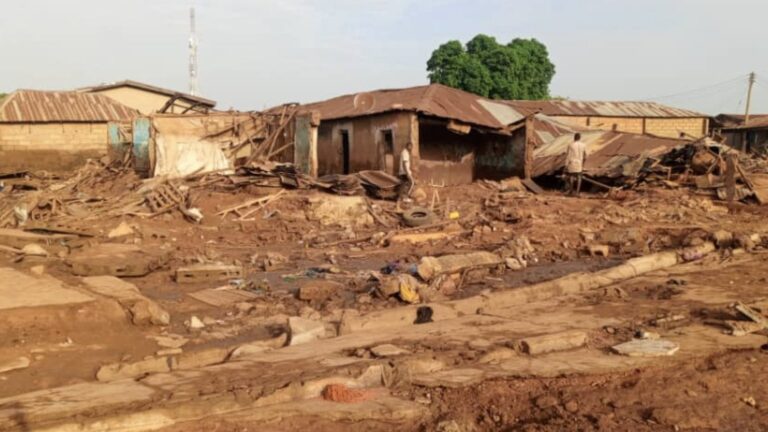
BORNO State Governor, Babagana Zulum, has donated N300 million to support victims of recent flooding in Mokwa Local Government Area of Niger State.
The governor announced the donation during a condolence visit to the Government House, Minna, where he led a delegation from Borno State.
A press release by Bologi Ibrahim, the Chief Press Secretary to Niger State Governor Umar Bago, said the donation intended to complement the government’s response to the disaster.
“We are deeply saddened by the scale of destruction caused by the flooding in Mokwa. This contribution is to support the recovery efforts and express our empathy with the people affected,” Zulum said.
While expressing sympathy with the government and people of Niger State, Zulum emphasised the importance of subnational collaboration in addressing climate-related disasters. He also called on the Federal Government to establish a comprehensive framework for disaster prevention and management.
Responding, the Niger State governor appreciated his Borno State counterpart for what he described as a “timely and generous intervention.”
“This donation is timely and will go a long way in aiding our response and rehabilitation efforts,” he said, adding, “It also reflects the strong ties and shared challenges between our states.”
Bago further assured that the funds would be utilised transparently.
He noted that efforts were being intensified to discourage people from settling in flood-prone areas to prevent future tragedies.
The ICIRreported the state government as saying 1,000 residents were missing, while death toll from the disaster had exceeded 200.
THE Securities and Exchange Commission (SEC) has asked companies and their registrars who default on paying unclaimed dividends to shareholders to honour the provisions stated in the Finance Act 2020.
The apex regulator in the capital market issued a directive in a statement on Tuesday, June 10, and also stated that shareholders can now claim up to 12 years of unclaimed dividends.
It said its directive aligns with Section 60 of the Finance Act 2020.
“The attention of the Securities and Exchange Commission has been drawn to the fact that paying companies and their Registrars have continued to treat unclaimed dividends of public companies that are older than 12 years as being “statute-barred” without recourse to the provisions of the Finance Act 2020.
“Pending the setting up and operationalisation of the (Unclaimed Fund Trust Fund), UFTF by the Federal Government, under its powers under Sections 3 (4) (e) and 93 of the Investments and Securities Act 2025, the Commission hereby directs public companies and their Registrars to continue to honour all requests by shareholders for the payment of unclaimed dividends as described above, with effect from December 31, 2020,” it stated.
The SEC stressed that public companies and registrars are required to effect immediate compliance with this directive and submit periodic reports on the same in the manner prescribed in the Commission’s rules and regulations.
It clarified that the import of the provisions of Section 60 of the Finance Act 2020 is that where dividends declared by a publicly quoted company on the Nigerian Exchange Limited remained unclaimed for six years or more, such dividends are expected to be transferred to the Unclaimed Funds Trust Fund (UFTF).
The fund is to be held in trust and managed by the government until the shareholder presents a claim for the unclaimed dividends.
As such, it explained that shareholders are entitled to continue to claim dividends that were not statute-barred, that is, not more than 12 years before December 31, 2020, when the Finance Act 2020 came into effect.
The commission had claimed that the lack of proper identification of investors is a key factor contributing to unclaimed dividends, despite the launch of its revamped e-dividend mandate management system (e-DMMS) portal in June 2024, aimed at curbing the growth of unclaimed dividends.
The portal e-DMMS features a self-service interface, allowing investors to mandate their accounts for e-dividend virtually without visiting a registrar or bank.
The ICIR had in November 2023 reported that the SEC’s new e-dividend mandate portal might fall short of expectations if certain flaws are not addressed.
Over the years, the SEC has failed to curb the escalating issue of unclaimed dividends in the capital market, as the figure keeps rising.
At his first Capital Market Committee (CMC) meeting in Lagos, upon assumption of office, the SEC director general, Emomotimi Agama, disclosed that the total unclaimed dividend in Nigeria’s capital market has risen to N215 billion as of March 2024.
IN what has now turned into long-running violence, many villages in Benue have been caught in a deadly cycle of violence, with families torn apart, homes reduced to rubbles, and communities forced to flee. In this report, The ICIR looks at the deadly wave of violence that has swept through the State
On the early hours of Friday, April 18, 2025, a day to commemorate the crucifixion and death of Jesus Christ, residents of Tse Shawa, a small town in Ukum Local Government Area (LGA) of Benue State were still at their homes, preparing to go to farm or market when they were attacked by gunmen. They had earlier heard news about the attacks in some of the neighbouring villages and were prepared to flee in the event of such attacks on their village.
By 9 a.m., armed men descended on the village wielding sophisticated weapons. They fired indiscriminately at the villagers. During the attack at least 11 people were confirmed dead. Among them were two sons of Zumwua Shawa who had barely survived the attack. As soon as she heard that both of them had been killed, she collapsed and eventually died.
Her sons. Ahumbe and Chieryol, were killed in their rooms during the attack, after which they were macheted by the gunmen.
Simon Udeti, an in-law to Shawa and the two victims now in Afia, was also forced to flee the village with his wife after the gunmen’s attack. Photo: Mustapha Usman.
Simon Udeti, a close relative of the victims, said he, his wife, and other members of the household escaped through the bush and walked to Afia in Tsaav ward, Ukum LGA.
“They just came in and started shooting at us like wild animals. My two brothers-in-law, Ahumbe and Chieryol, were shot dead right there in their rooms,” he recalled.
“When we broke the tragic news to my mother-in-law, she couldn’t take it,” Simon said, adding that, “She died right there from the shock.”
The familyquickly buried the two siblings, afraid the attackers might return. While retrieving the bodies, Simon said they discovered five more victims nearby.
From Thursday April 17, until early April 19, 2025, the gunmen, believed by the residents to be Fulani (due to the language they speak and their appearances), conducted a systematic village by village attack to remove them from their homes, including killing of residents in both Logo and Ukum LGAs.
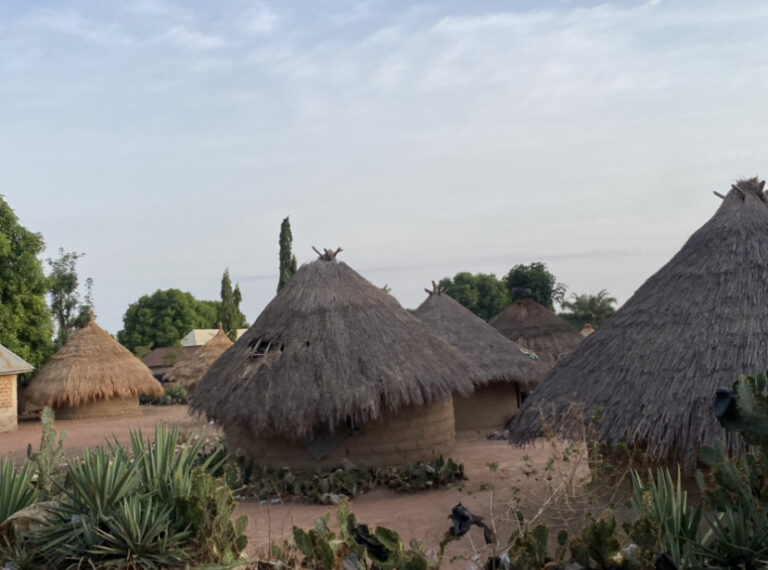
One of the affected villages in Ukum
The attack began on Thursday afternoon in the Gbagir axis of Ukum and continued in phases and coordination for at least three days, peaking on Friday. The killing that Udeti survived was just one in a deluge of atrocities that the gunmen had carried out in the areas in the last few years.
On the same day in Tyuluv village, the sun had barely risen, and the people were busy preparing for the day that would include farm work and church services to mark Easter weekend. Around 9 a.m., Sarah Shiaondo, a 62-year-old, noticed unfamiliar men entering the village. She noted that the strangers wore face masks before they started attacking the villagers.
Sarah Shiaondo, narrating her plight to The ICIR. After the attack, she is now forced to take shelter in Afia
“Having sensed this we started finding a way to raise alarm,” she narrated, adding that, “they laid ambush on paths to farms where we could run for safety.”
During the ensuing attack, Shiaondo lost two of her children and five stepchildren.
“Attempts to escape through the paths were abortive as they already laid barricades. “Two of my children of about thirty-two and thirty-four were killed including five of my stepchildren,” she narrated.
The ICIR could not independently verify the total number of casualties, as there are conflicting figures ranging from 100 to 200 deaths in the affected villages in Ukum.
The village heads said it was hard to confirm the actual number as of press time as many people were believed to still be in the bush lying lifeless. Afia village head representative, Evern Ngutor said the number presented on social media by people and the government did not represent the actual casualties as bodies of the deceased were still being recovered almost every day.
Mourning four siblings
Robert Tokpo sat quietly in a front of a modest house in Afia, surrounded by a few surviving relatives and neighbours. He had barely spoken since the Friday attack in which he lost four siblings.
On Thursday evening, April 17, Tokpo and his brothers were working on their farm when he noticed some men approaching. They were gunmen, whom he said killed his two siblings.
Robert Tokpo, one of the survivors of the attacks that befell their communities in April, 2025.
“It was around 5 p.m., I saw them from a distance. They didn’t look like our people. I immediately hid in the bush and tried to call my brothers’ attention to them. But my brothers were still working, unaware.”
By the time they realised what was happening, it was too late. They caught them and started cutting them with machetes. I watched helplessly as they were butchered on our farm,” he told The ICIR.
His brothers were among those ambushed as the gunmen moved through the forests from Ukum to Logo on Thursday night. Ukum and Logo are neighbouring LGAs in Benue State that share a common boundary that links their communities. The ICIR gathered that at least 16 people were ambushed and killed that night, as the attackers left a trail of blood in their march.
But the horror didn’t end there for Tokpo.
“The next morning, two more of my brothers were coming back from church after the Easter activities. They ran into some gunmen on their way home. They were also killed,” he added.
All four of Tokpo’s brothers were buried together the following Monday. “We buried them in the morning,” he said, adding, “That same attack claimed six lives in my immediate village. In the entire Tsaav community, more than seventy people were killed.”
Living in constant fear
Thirty-nine-year-old Mseer Boniface Kazever, a resident of Anyinlamo, now finds herself clinging to survival with her 10 children in a small room allocated to her by a pastor in Anyin, after fleeing a violent attack on her community.
Mseer Boniface Kazever, 39, in front of the pastor’s house in Anyin.
“Since the day of the Fulani attack, I’ve been here with my children. My husband had to travel to Taraba State in search of food. We left everything behind, our home, just to stay alive.”
Kazever recalled the evening in April as one that changed their lives. Her community was hit hard in the wave of attacks that swept across villages in Logo and Ukum. According to her, many of her neighbours were murdered in their sleep, with no chance for the victims to flee or fight back.
“Our neighbours were killed. Only God can tell how we were spared. Our huts were not difficult for them to get in, they would have quietly broken the door and killed us silently,” she said.
“We used to sleep in the Pastor’s house since the eve of Easter when Fulani(gunmen) did a massive killing in Logo here,” she said.
A church in Anyin where most displaced residents fron Anyilamo and other villages sleep at night
Kazever’s story mirrors the growing situation among many villagers in Anyinlamo and nearby communities. Some of the villagers now live a life split in two. By day, they return to what’s left of their homes and farms. By night, they flee to Ugba, the headquarters of Logo LGA to seek safety in churches, IDP camps, or the homes of pastors with ‘iron doors.’
The Benue insecurity
The recent wave of violence that swept through Logo and Ukum LGAs in April and May was only the latest in a long series of attacks that have devastated communities across Benue State.
The state has experienced recurring cycles of violence and insecurity in recent years. It has been plagued by herder-farmer conflicts, banditry, and kidnapping, leading to a significant decline in the standard of living of its residents. Often times farming communities are repeatedly targeted by gunmen believed to be herders, leaving a trail of destruction, displacement, and trauma.
In Logo, Ukum, Gwer West, Guma, and other conflict-prone areas, residents said they have lost count of the number of attacks over the years. Some entire villages have been razed, and those who once thrived on subsistence farming now depend on aid or live in IDP camps with no clear path to reintegration with their homes.
In 2024, Amnesty International stated that about 2,600 persons, mostly women and children, were killed following attacks on 50 Benue communities between January 2023 and February 2024.
The organisation revealed that armed attacks posed ongoing security threats in 18 out of the 23 local government areas in Benue State. It further stated that, as of the last assessment in March 2023, a total of 489,245 internally displaced persons (IDPs) were being housed across camps and host communities in the state.
However, since then, there have been numerous reported deaths from a series of coordinated attacks.
During the recent attacks on the eve of Good Friday and the following day, over 65 residents were reportedly killed by marauders who unleashed mayhem on communities in Ukum and Logo Local Government Areas of the state, according to official data.
However, local residents contend that the official figures fall short of the true toll, as more bodies have continued to be discovered even weeks after the massacre.
Ambushed on the way to farm
Just weeks before the heartbreaking attack, Aondonengen Ushade, survived a gunshot attack from gunmen ravaging Anyin, in Logo LGA.
Aondonengen Ushade, showing the gunshot wounds on his abdomen and thigh, sustained when gunmen ambushed him and his friends on their way to the farm.
On April 1, Ushade, a young farmer heading to his farm, was riding a motorcycle alongside four others when he was shot by unknown assailants. Ushade sat on the motorcycle’s fuel tank along with the the rider and three passengers behind.
While on their way to the farm, two gunmen laid ambush for them. They pointed guns at them to stop but did not stop as they believe that will be more dangerous. Ushade recalled how the men opened fire on them thereafter. During that incident, two bullets hit him—one lodged in his abdomen, the other in his thigh.
Ushade said his survival was a miracle. After being hit by the bullets, he explained that he had to endure the pain till they were out of the danger zone before alerting his colleagues of his condition.
“I was shot in the stomach, and another bullet hit my thigh. But I did not tell others because the gunmen were still chasing us. By the time we got out of the danger and wanted to inform them, I was already collapsing,” he explained.
During The ICIR’s visit to Logo LGA, locals had strongly advised this reporter against going to Anyinlamo village, describing it as a hotspot for gunmen attacks.
Although this reporter heeded to their advice and decided not to visit, during the journey back to Makurdi, the local taxi driver had to pass through the road leading to the village and true to their words, there were gunshot heard in the village around 4 p.m.
The scene was one with many villagers on the road running for safety. They were in their numbers heading towards the police station in Anyinlamo to find safety, while others decided to move in the other direction of the gunshot.
The ICIR observed several young men armed in their local guns running towards the direction of which the attackers were firing shots to resist any attempts of attacking their village. Not long after soldiers were sighted moving in the same direction.
“This is the life they live here. Every day, they take arms to defend their homes,” said Fred Hule, who is resident in the State “The area is the most prone to insecurity and they are always on the run nearly every day. The gunmen moved from one village to another, killing the locals.”
More victims narrate ordeal
At 84, Zakin Mbaterem is no stranger to the insecurity that has befallen his hometown, Anyin but nothing could have prepared him for the horror that unfolded on April 17.
Mbaterem explained that the evening was supposed to be a quiet one for him and members of his family as they prepared for Easter celebration. Instead, it turned into a bloodletting night. That night, Mbaterem sat with his family, including his son Bem, who had just turned 40 when the gunmen attacked Anyin.
Zaki Mbaterem lost his son, Bem, who had come to the village for the holidays, during the attack in Anyin.
During the attack, his son was killed, alongside 10 others. “My son Bem just came back from Abuja for holiday, and he was killed a day after his arrival by the gunmen. They shot him in front of the house, and I barely escaped death,” he said.
For 65-year-old Lydia Ate, the memory of that night still feels like a nightmare she can’t wake up from.
It was April 17. The gunmen stormed their neighbourhood, shooting everyone in sight. Lydia was outside the house when the incident started, but her husband, an 80-year-old man, was taking an afternoon nap inside his room.
Lydia Ate, anotehr survivor of the attack on Anyin village
He had no idea what was coming.
“I tried to raise the alarm before taking to my heels. I called his name, knocked on the door,” she said, “but before he could even get up properly, it was already too late.”
“They just shot him right there while he was still struggling with his underwear,” she added.
Lydia said she survived by sheer luck. She had hidden behind some banana trees, just a few steps from their house as the attackers ransacked the place.
‘No one came to help us’
The villages of Ukum and Logo LGAs have suffered repeated attacks in recent years. Residents, who spoke to The ICIR stated that they have reported threats and suspicious movements to local authorities in the past, but little has changed.
Sarah Shiaondo, who escaped from Tyuluv, said it was not the first time they had received reports of attacks in nearby villages, but they didn’t expect the violence would be so brutal.
“We have been shouting, begging the government to intervene,” she said adding, “But it’s always the same; they come after the damage is done.”
Sarah and many others now live in fear that the next attack could happen wherever they find temporary shelter.
Zakin Mbaterem, the district head of Anyin, also stated that they had repeatedly written to the security operatives, including the police and the civil defence in their town and in the local government headquarters to seek help to the attacks that have displaced thousands of residents but to no avail.
While he noted that the operatives in the town often try to resist or confront the gunmen, they are always overwhelmed with the number of the armed men attacking the villages.
Killers of Benue residents are foreigners – Gov Alia
Contrary to claims by residents who spoke with The ICIR that the attackers behind the recent wave of killings in Benue State are Fulani, Governor Hyacinth Alia has said the assailants are foreigners speaking unfamiliar dialects.
Benue State Governor, Hycinth Alia
Alia made this claim on Tuesday, April 22, during an interview on Politics Today, a programme aired on Channels Television.
Reacting to the recent attacks, particularly those in April, Alia stated that residents have reported hearing dialects not associated with local communities, suggesting that the attackers are foreign elements.
“Let’s have the narrative very correct. We know Nigerians—by our ethnicities, we can identify a Fulani man, a Yoruba man, a Hausa man—we know them,” Alia said.
“Even the regular traditional herders, we know them. They work with cows, herding them with sticks.
“But these folks [the attackers] are coming in fully armed with AK-47s and 49s. They do not bear the Nigerian look. They don’t speak like we do. Even the Hausa they speak is one sort of Hausa,” he said.
According to him, the assailants arrive heavily armed with sophisticated weapons like AK-47s and 49s, unlike traditional herders who he said move with sticks.
“It’s not the normal Hausa we Nigerians speak. So it is with the Fulani they speak. There is a trend in the language they speak, and some of our people who understand what they speak give it names.
“They say they are Malians and different from our people. But they are not Nigerians—believe it,” he added.
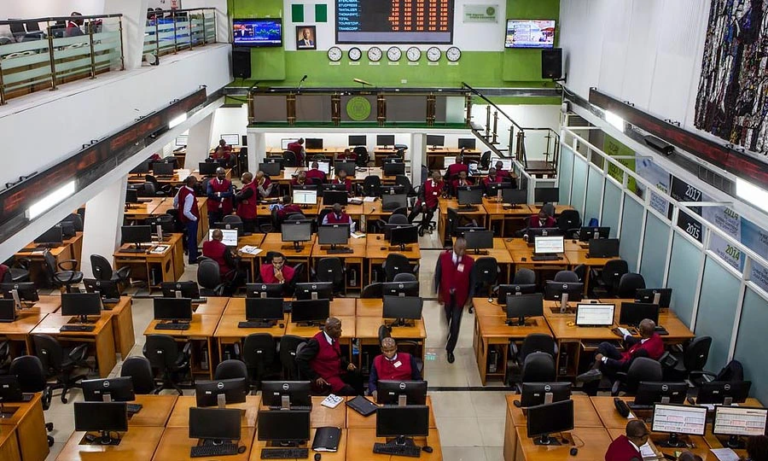
THE total value of listed companies on the Nigerian Exchange Limited (NGX) surged to over N72 trillion last week, reflecting sustained investor confidence and positive market sentiment.
This marks a significant gain from the N62.76 trillion recorded at the beginning of the year, translating to nearly N10 trillion in capital appreciation.
As of Thursday, June 6, the NGX All-Share Index (ASI) had climbed to 114,616.75 points, up from 102,926.40 at the start of 2024, delivering a year-to-date (YTD) return of 11.36 per cent.
The market closed on Thursday ahead of the public holiday declared for the Muslim Eid festival on Friday, June 7.
Domestic investors dominate trading activity
Market data continues to show a notable decline in foreign investor participation, with domestic investors increasingly taking the lead.
As of April, data shows domestic investors accounted for approximately 83 percent of total market transactions, significantly outweighing foreign participation, which stood at just 13 per cent.
The data further shows that the total value of transactions executed by domestic investors outperformed transactions executed by foreign investors by about 74 per cent.
Banking stocks lead sectoral performance
A look at how different sectors of the stock market performed between January 2 and June 5 shows that banking stocks recorded the highest gains. Their index rose by 400.19 per cent, jumping from 1,084.52 basis points to 5,424.62 basis points.
Consumer goods stocks followed with a 346.47 per cent increase, rising from 1,731.67 to 7,731.16 points.
Industrial sector stocks also performed strongly, gaining 139.02 per cent to reach 8,538.14 points from 3,572.17 points.
Oil and gas stocks saw more modest growth, up by 20.16 per cent from 2,712.06 to 3,258.87 points.
In contrast, insurance sector stocks declined by 1.43 per cent, dropping slightly from 718.00 to 707.76 points.
Analysts cite confidence, reforms, dividend season as growth drivers
Market analysts link the overall bullish performance to increased local participation, corporate earnings resilience, and ongoing market reforms. David Adonri, Executive Vice Chairman at Highcap Securities Limited, noted that technology deployment on the NGX is improving access and easing investment processes.
“The technology deployed by NGX in the primary market is increasing accessibility to the market and enhancing ease of investment in the capital market,” he said.
He also pointed out that foreign investor interest, though currently limited, is gradually recovering.
“The dual roles of the capital market, capital formation, and as an investment outlet, are being fulfilled. As a result, the volume of transactions done by both domestic and foreign investors is increasing. The economy is benefiting tremendously from this positive development,” Adonri added.
Patrick Ajudua, President of the New Dimension Shareholders Association, believes the rally is also driven by dividend season as investors are positioning to benefit from dividend payments. Even with foreign investors pulling back, local institutions – local portfolio managers, mutual funds, and pension funds- are stepping up.
He added that persistent FX issues have discouraged some foreign investors but expects the situation to improve with ongoing reforms.
“One of the fundamental decreases in foreign investors participation is the issue of repatriation of proceeds and foreign exchange accessibility. I want to believe that it is being handled by appropriate government agencies because we still need foreign investors in our market,” Ajudua pointed out.
He stressed that the continuous participation of local investors is a demonstration of unwavering confidence in the Nigerian capital market and a sign of an improved economy.
“The foreign exchange rate is getting stable, which will aid financial planning and improve returns on investment,” Ajudua maintained.
Innocent Peter Nwokocha, Chairman of the Noble Shareholders Association (Abuja branch), told The ICIR that the major driving force behind investors positive sentiments in the market can be traced to the lucid dynamics of the exchange.
For him, the continuous drop in the number of foreign investors would create more opportunities for the local investors because the level of return on investment in Nigeria is high and attractive.
“The continued increase in domestic investors signifies growth and overwhelming confidence in both the market and the economy.
“The level of awareness in the stock market is creating a positive spiral effect on the economy as investors are continually smiling at the Banks to either buy or sell. The advantages are inexhaustible and unquantifiable,” Nwokocha added.
What to expect in the coming weeks
Analysts at Cowry Asset Management expect the prevailing trend to persist in the near term as investors continue to realign their portfolios in anticipation of further earnings releases and macroeconomic data, particularly the first quarter of 2025 gross domestic product (GDP) numbers.
“The sustained momentum in the market is likely to be driven by a combination of sectoral rotation strategies and positive sentiment surrounding the resilience of the domestic economy,” they stated in their weekly report.
The Cowry researchers, however, anticipate that trading may remain moderate as some players adopt a cautious stance ahead of fresh catalysts.
“We maintain our guidance for investors to stay positioned in fundamentally strong counters with solid earnings prospects and defensive characteristics, particularly in light of macroeconomic uncertainty and evolving liquidity dynamics,” they added.
THE All Progressives Congress (APC) has reacted to remarks by former Senate Chief Whip Ali Ndume, suggesting that President Bola Tinubu could lose the 2027 election.
APC’s Director of Publicity, Bala Ibrahim, in an interview with Punch on Monday, said the ruling party was open-minded and welcomed different opinions.
He said, notwithstanding, the party had rules to discipline members who misbehaved.
Ndume, while appearing on Channels Television’s Politics Today on Sunday, June 8, said that despite growing endorsements and increased defections to the APC from opposition parties, Tinubu’s fate at the next poll could follow a similar pattern to that of former President Goodluck Jonathan, who in 2015 lost re-election despite enjoying endorsements from several governors and other political office holders.
Ndume said Jonathan had 22 Peoples Democratic Party (PDP) governors (out of 36) in 2015 and still lost his re-election bid.
“Tinubu could be given the Jonathan treatment because Jonathan also had 22 governors who endorsed him like we do now, and what happened? Jonathan lost woefully,” Ndume stated.
The senator cautioned against complacency by the president’s camp, warning that automatically giving tickets to federal lawmakers could alienate the party’s grassroots supporters and loyal members, who are crucial for winning elections.
“When the rumour came that National Assembly members might get automatic tickets, the party denied it. So, who will be the foot soldiers? You cannot rely on governors alone,” he said.
Responding to Ndume, Ibrahim, who referred to the lawmaker as a respected leader within the party, said the ruling party was open to differing opinions, provided they aligned with progressive social and political ideals.
He stated that Ndume was known for openly sharing his views on the country’s governance, “often expressing dissent or differing opinions because the APC is a party of liberal-minded people and doesn’t quarrel with diverse ideas, provided they do not violate the party’s constitution.”
“The party respects others’ beliefs and advocates for reforms that promote freedom and equality, but they must be done in a manner that is not injurious to the laid-down rules of acceptable behaviour. If they go contrary, the party has a machinery for censorship or punishment, which are beyond my powers as a director,” Ibrahim stated.
The ICIR reported that the Senate sacked Ndume as its Chief Whip following his criticism of Tinubu’s administration.
The upper legislative chamber consequently replaced him with Tahir Monguno.
Before his sack, the national secretary of the APC, Bashir Ajibola, and the national chairman, Umar Ganduje, had in a letter sought Ndume’s removal.
The APC accused Ndume of harmful remarks directed at Tinubu’s government.
He repeated the claim in an interview with Arise TV on July 12, where he alleged that former President Muhammadu Buhari was a more accessible leader.
Ndume accused Tinubu’s aides of “shielding and fencing in” their principal from lawmakers and ministers.
The ICIR reported that Ndume accused Tinubu of being out of touch with some of the issues plaguing the country, including the food crisis and insecurity.
He also said that poverty, insecurity, hunger, and other problems confronting citizens were not being addressed by the president.
NIGERIA and Saudi Arabia’s state-owned oil company, Aramco, are struggling to reach an agreement on a record $5 billion oil-backed loan following a recent decline in crude oil prices, according to a Reuters report on Tuesday, June 10.
It said the difficulties in finalising the agreement have raised concerns among banks expected to support the deal, as the declining oil prices might reduce the size of the agreement.
According to the report, President Bola Tinubu had first made an official approach on the loan in November 2024, when he met with Saudi Crown Prince Mohammed bin Salman in Riyadh at the Saudi-African Summit.
The loan would be Nigeria’s largest oil-backed facility to date and Saudi Arabia’s first significant involvement in such a deal with the country.
It stated further that the slow progress in discussions reflects the strain of the recent oil price drop, caused largely by a shift in OPEC+ policy to regain market share rather than curtail supply.
Brent has fallen about 20 per cent to around $65 per barrel from above $82 in January, it noted.
“A lower oil price means Nigeria could need more barrels to back the loan, but years of under-investment are complicating its ability to meet production goals,” it maintained.
It also hinted that Tinubu had last month sought approval for $21.5 billion in foreign borrowing to support the country’s budget, with the $5 billion oil-backed loan from Aramco expected to form part of that amount.
The banks expected to co-fund part of the loan alongside Aramco were concerned about oil delivery, which has slowed the negotiations.
“Gulf banks and at least one African lender are involved,” Reuters stated, but could not establish the banks’ identities.
“It’s hard to find anyone to underwrite it,” it added, pointing to concerns over cargo availability.
“Saudi Aramco declined to comment. Nigeria’s state-owned oil company NNPC did not comment, and neither did the finance or petroleum ministries,” it said.
The report noted that Nigeria has a history of securing and repaying oil-backed loans to support its budget, boost foreign reserves, or rehabilitate state-owned refineries.
At $5 billion, the Aramco loan would require at least 100,000 barrels per day (bpd) of oil for collateral, it said.
“However, it would almost double the roughly $7 billion of oil-backed loans taken in the last five years. Nigeria is using at least 300,000 barrels per day (bpd) to repay NNPC’s other oil-backed loans, though one facility is expected to be paid off this month.
“The amount of oil going towards repaying existing oil-backed loans is fixed, but when the crude price falls, it takes longer to repay them,” it also explained.
It cited further that lower oil prices had compelled the Nigerian National Petroleum Company Limited (NNPCL) to allocate more crude to joint-venture partners, ranging from international majors like Shell to local producers like Oando or Seplat, for operational costs.
It added that it is either Nigeria finds more oil, or finds a way to renegotiate those deals.
“Nigerian trading firm Oando is expected to manage the offtake of the physical cargoes,” the report hinted.
The ICIR had previously reported that the NNPCL had resorted to resource-backed loans and, at the time, sealed a deal for a $3.3 billion loan swapped with crude oil from the African Export-Import Bank (Afreximbank).
The move was to stabilise the naira against other foreign currencies; however, the naira has remained weaker against the dollar.
More so, there are questions about the long-term implications of the swap deal in the nation’s economy, amid Nigeria’s growing debt.
PUBLIC primary health centres across the Federal Capital Territory (FCT) have remained shut for over two months, along with all public primary schools and the six area council secretariats. The closures are the result of an ongoing strike by workers demanding the implementation of the N70,000 minimum wage approved by the federal government in 2024, as well as other outstanding entitlements.
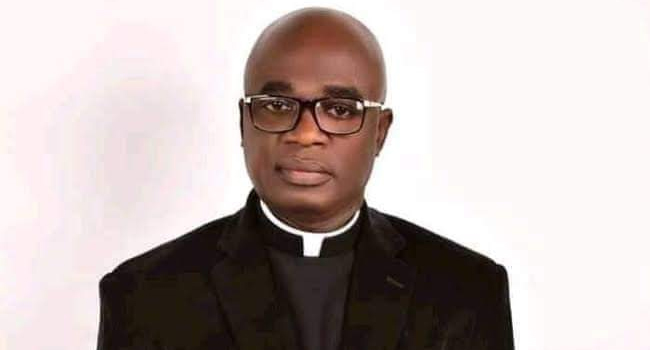
In this interview with The ICIR, Chairman of the National Association of Nigeria Nurses and Midwives (NANNM), FCT Council, Jama Medan, discusses the far-reaching impact of the strike and the inaction of the area council chairmen.
Excerpts:
The ICIR: Why has your union shut down all PHCs in Abuja for over two months?
Medan: You know we have been battling with this issue of primary health care centres being closed down for over two months, and it has become an issue that every Nigerian should be worried about. The death of one single person like this is a major issue of concern.
In developed countries, if one thing happens to one person, it becomes a serious thing. I’ll give you an example with the child that died in Lagos recently, a woman who died after delivery. The issue was in the news all over, but as I speak to you, all the primary health care centres in FCT have been under lock and key because of this strike for over two months, including schools and localgovernment secretariats, and nothing is happening.
Sadly, the area council chairmen are not even bothered, they don’t care, they are not even moved.
Another thing that is making these peoplebehave this way is the autonomy they have been granted. Ministers intervened in this matter. The minister intervened and released N4.1 billion to them to settle this issue. They said it when we were in the National Assembly, and they confirmed it. The Chairman of theHouse Committee on Area Councils invited us.
At the end, when they interrogated them, they said yes, money was paid, N4.1 billion.And the money that waspaid was for Signature. The House of Representatives asked them, ‘What is signature money?’ They said it is called signature money. So, the House said, how can N4.1 billion be money that is not known? They then ordered that this money should be investigated. From then on, we have not heard from them again, and this is where we are.
The ICIR: When did this meeting take place at the House of Representatives?
Medan: That was last month, three weeks ago. The National Assembly passed the autonomy law and the president signed it into law. Now, they are taking the autonomy for granted. They feel they are above everybody, above the law. I think it is only the National Assembly and the Presidency that can call these people to order.
They should either stop their allocation or impeach them out of that office, or we find a way of doing it.
If we are going to see an example from anywhere in this country, it is supposed to be from the FCT. This is because FCT is being ruled by the president and also the Minister, but they want to spoil it.
I think somebody should call these people to order. They just want to sabotage the president and the minister of FCT, and if nothing is done quickly on this, the people of FCT will start losing confidence in the current administration. The minister has tried, it’s just that there is nothing he can do.
Throughout the period, we went into an agreement with them, but they never respected that agreement. Apart from that, we presented that agreement to the minister, signed by all of them, that they were going to do all these things. They failed.
We went to the National Assembly—same thing. Let me tell you the truth: the Minister of State for FCT called us for a meeting. These people did not come.
When they were invited to the National Assembly, some of them went, but some refused to go. Since then, these people have never, on their own, shown concern or invited us as a union to say, ‘Please come, let’s talk.’
Chairman of the National Association of Nigeria Nurses and Midwives (NANNM), FCT Council, Jama Medan
The ICIR: Do you know those who didn’t go to the National Assembly?
Medan: The Kuje chairman did not come. I think another one sent his own vice. Let me just be honest with you; in every industrial dispute, negotiation must be ongoing. Usually, it is the union that would say, ‘We are not going for the negotiation.’
But in this case, they don’t even call. They don’t even care. They have never initiated anything like, ‘Come, let’s sit down. What is the problem?’
The ICIR: Would you attribute the imminent end of the chairmen’s tenure to why they are doing this?
Medan: Yes. Some of them are concluding their tenure, and some of them are going to continue. Some of them are willing to even pay some of these allowances, but they have come as a union to agree that even if you have the money, don’t pay because their allocations differ. What AMAC gets is bigger than what the Kuje Area Council will get. Even if AMAC is ready to pay, they will say no, don’t pay.
We are actually on this strike for these issues: One, we say non-implementation of the minimum wage. It is a law that everybody should pay, in every state. Even some states have gone ahead to implement something more than the N70,000 that we are talking about.
Even the FCTA has gotten their own with the arrears. We don’t have problems with the minister. It is the area councils. We have almost 14 items. With the current hardship and the cost of living in the country, anything that the federal government or the government says they should pay, they refused to pay in the FCT. They refused to implement it in the FCT.
The N70,000 minimum wage, they have refused to implement it. Even the N35,000 wage award that the government gave after the removal of the subsidy, they refused to pay.
They have given them all this money, but they refused to pay. Then, the implementation of the 25 per cent and 35 per cent salary increase, and the arrears, they have refused to also pay.
They also refuse to implement the N35,000, N25,000 CONMESS adjustments. Every level of government in this country has paid this one. Some people are even paying more than that, but the area councils have refused to implement.
The promotion arrears, since they came on board, they have not been paying the promotionarrears. No promotion, even, and for the few that have had a promotion, they are not paying them.
So, we have so many issues here.Even the pension that you know, the employercontributes, the employeecontributes, but they don’t even remit their own.
The National Housing Fund and all those things that we are talking about, the hazard allowances that were paid to everybody,have not been paid. We don’t understand what is wrong with them.
FCT is supposed to be, at least, where every other person will at least copy from.
File: Inside a PHC, in Nigeria.
The ICIR: What happens to cold rooms where you store vaccineswhich are donated by partners, including Global Fund and WHO?
Medan: Let me tell you the dangers and what these people have caused this country. Tuberculosis patients are not supposed to miss even one medication because of the risk of them developing resistance to their drugs. Since we closed these facilities for the past two months, those TB patients have not been getting their drugs, and they stand the risk of infecting other people.
At the end of the day, even if they resume, that resistance will still continue, and the drugs may not work for them anymore. Similarly, all the people who were receiving their HIV drugs through this primary health care have not been getting their drugs. You can imagine those drugs are not in the market. Even if they are in the market, they cannot afford it.
Let me talk about the vaccination, like the oral polio vaccination that just happened.In our thinking, as good Nigerians, when the issue of polio vaccination came in, we met, and we went to the National Assembly. The National Assembly pleaded with us. The Mandate Secretary of Health called us and pleaded with us that please we should look at the innocent children in FCT. She urged us to give a waiver so that this vaccination against polio would take place, so that the FCTshould not be the one to infect the neighbouring states.
We met at the level and said even if we are fighting the government, for the sake of these innocent children—so that someone doesn’t wake up tomorrow crippled or disabled because we went on strike—we said no. That was how we called all our colleagues, resumed work, and gave them access to all the cold chain rooms. We didn’t just permit them; we participated in the immunisation. That was how we concluded that.
The ICIR: Let’s look at the failure to utilise the vaccines, distribute TB, HIV drugs and others. What message is this sending to the donors like the WHO, Global Fund, and others supporting us?
Medan: That was why I said this issue should be dealt with at the National Assembly and the Presidency. They should not overlook it because it sends a signal that maybe the government is not serious about these diseases they claim to want to prevent. That’s exactly what these partners will think. But just because of ignorance or the selfish interests of Area Council chairmen, the whole country will now be looked down upon because the FCT Area Council chairmen refuse to comply with or pay civil servants the money the government has already provided.
So, it’s sending the wrong signal, not just in the FCT but across the entire country. If there’s a resurgence of polio and the resistance comes from here, even if we get support next time, they’ll say we’re unserious.
The ICIR: Can you estimate how many children and mothers could have died due to a lack of access to health facilities in the FCT?
Medan: We went on strike in late March. As of February, I may not share the document because it’s confidential, but I can produce it at any time if needed.
For example, there’s Karamajiji Primary Health Care near the National Stadium. As of February, 104 pregnant women delivered there. That tells you that if these women had come in March, they would have been in trouble.
Then there’s a PHC Kuchigoro, 28 women put to bed there before the strike.Kuje Health Centre had about 23.In Alu-Mamaji PHC, there were 11 deliveries in February. If these women had come in March, they wouldn’t have accessed care. You can imagine the implications.
I have statistics for over 70 primary health care centres – what happened within the past three months before the strike. You can use those figures to estimate how many women and children were at risk from March till now.
The ICIR: Do you have the number of PHCsin Abuja?
Medan: We have 270 primary healthcare centres in the FCT. As of today, we have only 117 nurses and midwives. If you share them, they can’t go round the PHCs. We’ve been complaining about the shortage of manpower.
Let me tell you the truth; the last recruitment of nurses and midwives done by the Area Councils was in 2008. Since 2008, there’s been no recruitment. People have retired, some have died, and others have left the country. That’s why the numbers have dropped.
In some places, they’ve closed down PHCs because the government doesn’t care. How can you have 270 PHCs with only 117 nurses and midwives?
Chairman of the National Association of Nigeria Nurses and Midwives (NANNM), FCT Council, Jama Medan
The ICIR: If one goes to a PHC today in the FCT, one could see many workers wearing nurses’ and midwives’ uniforms. Who employed them?
Medan:Most likely, they are CHEW or JCHEW (community health extension workers or Junior Community Health Extension Workers).In fact, most PHCsare expected to have at least one doctor. But where there’s none, nurses should be there. And we know there’s a shortage, but at least nurses should be present.
The ICIR: Do you have the number of doctors in these PHCs?
Medan: I don’t have the doctors statistics, but call me at midnight, I’ll tell you even if one nurse or midwife retires tomorrow, I’ll know. I keep track.
That’s why I know the number of deliveries for every area council. I can give you nurses’ and midwives’ data for each area council at any time. Let me give you an example—go to Area 3. There’s a PHC there but just one nurse is posted there. That’s the city centre.
That place is big enough for deliveries and minor surgeries, but only one nurse. What can she do? Even administrative work will overwhelm her, not to mention clinical duties. There are many such examples; the manpower shortage is pervasive. It’s not that there aren’t graduates. We’ve got many nurses the government can employ.
The ICIR: From your data, do we have employable nurses and midwives?
Medan: My recent survey in the FCT showed over 3,000 unemployed nurses. I have their contacts, addresses, everything. They’re roaming the streets of Abuja jobless. If you need them, I’ll bring them for recruitment tomorrow.
The ICIR: Are they licensed?
Medan: Yes. I have their current licence numbers. Over 3,000 are still here, jobless. The last recruitment was in 2008. How many have graduated since then? Even in the FCTA, the last official recruitment was around 2015. We don’t have a shortage of nurses in Nigeria.
People leaving the country don’t affect the population of those not employed. ‘Japa’ is not affecting us, it’s because they are not recruiting.
When we did a recruitment exercise last, even at the national level, we recorded thousands of unemployed nurses – more than 50,000. So, we have the manpower. Even if you decide to recruit a large number today, we already have the nurses available.
A FEDERAL High Court in Ikoyi, Lagos, has convicted and sentenced nine Chinese nationals to one year imprisonment each for cyber-terrorism and internet fraud.
The court, headed by D. E. Osiagor, sentenced the Chinese following their arrest in a major sting operation by the Economic and Financial Crimes Commission (EFCC).
This was disclosed in a statement by the EFCC via X on Tuesday, June 10.
The convicts include Deng Wei Qiang, Huang Bo, LI Dong, Xiong Zhen, Lai Rui Feng, Zhao Xiao Hui, Du Ji Feng, Lui Gang, and Lui Hai Rong.
According to the EFCC, the convicts were part of a syndicate of 792 alleged cryptocurrency investment and romance fraud suspects apprehended on December 19, 2024.
The EFCC stated that its Lagos Zonal Directorate 2 charged the Chinese in February 2025 with one count of separate charges of cyber-terrorism and internet fraud.
The charge stated, “That you, LI Dong, Deng Wei Qiang, Huang Bo, Xiong Zhen, Lai Rui Feng, Zhao Xiao Hui, Lui Hai Rong, Lui Gang, and Du Ji Feng, sometime in December 2024 at Lagos, within the jurisdiction of this Honourable Court, conspired amongst yourselves to commit an offence to wit: cause to be accessed a computer system used for the purpose of destabilising and destroying the economy and social structure of Nigeria, and thereby committed an offence contrary to Section 27(1)(b) and punishable under Section 18(1) of the Cybercrimes (Prohibition, Prevention, etc.) Act 2015.”
The anti-graft agency said the defendants initially said “not guilty” but changed their pleas to “guilty” in court on June 5, 2025.
Prosecution counsel, Nnaemeka Omewa, pleaded with the court to convict and sentence them accordingly, a request supported by the defence counsel.
The judge, Osiagor, afterwards sentenced each defendant to one year in prison, effective from their arrest date of December 10, 2024, and imposed a fine of N1 million on each.
The court further directed that the convicts be returned to their country of origin within seven days of completing their sentences, as directed to the Comptroller General of Immigration.
Additionally, the EFCC seized the convicts’ phones, computers, laptops, and routers during the “Eagle Flush Operation.” The items were forfeited to the Federal Government.
THE Take-It-Back (TIB) movement has requested police protection on Nigeria’s Democracy Day – Thursday, June 12 – the day it plans to protest across the country.
Citing its constitutional rights to freedom of expression and assembly under Section 40 of the 1999 Constitution, the group emphasised its commitment to a peaceful and lawful demonstration on Democracy Day.
“We are dedicated to keeping this protest peaceful, organised, and in full compliance with Nigerian laws,” the group stated.
It added, “We also urge the police to cooperate by providing security support, as they have done during our previous protests against poor governance.”
The TIB further expressed its willingness to dialogue with law enforcement agencies to facilitate a safe and seamless protest.
The ICIR reported that the movement vowed to stage a peaceful demonstration on this year’s Democracy Day.
The group’s National Coordinator, Juwon Sanyaolu, announced this in a statement on Tuesday, June 3.
He said the movement “rejects the hollow ceremonies and official pageantry” typically associated with Democracy Day.
“This June 12, we march not just for ourselves, but for the slain in Benue, the displaced in Plateau, the silenced in detention, and the starving masses abandoned by the corrupt elite”, Sanyaolu said.
The group’s leader appealed to all Nigerians to stand up against “undemocratic forces in power.”
“We will not participate in the hypocrisy of celebrating freedom where none exists. Instead, we declare this day a National Day of Resistance, a day to stand against tyranny and bad governance.
“Freedom of speech is under attack. The state has turned on its citizens with an unrelenting campaign of intimidation and censorship,” the group stated.
A claim that a man selling vultures allegedly as chickens for consumption in Abuja has been arrested.
The claim, which surfaced online on June 2, 2025, was posted by an X user @drpenking.
The post featured an image showing a man squatting beside an animal from the bird family, with sacks nearby from which birds’ beaks were visibly seen.
The post alleged that the man was selling these wild birds as chicken in Nigeria’s Federal Capital Territory (FCT).
The post read:
This guy was said to sell the biggest chicken thighs in Abuja. Today he was caught and it turns out he sells vultures as chicken.
It has garnered over 2.6 million views, with over 23,000 likes, more than 3,600 reposts and 2,300 comments as of June 4, 2025.
CLAIM
Image shows man arrested in Abuja for selling vultures as chickens.
THE FINDINGS
Checks by The FactCheckHub show that the claim is FALSE!
When our fact-checker conducted a Google Lens search on the image, the results led her to previous appearance of the image on X alongside a press release by the Uganda Police Force posted in 2023.
The statement noted that the incident occurred in Kiteezi and expressed concern over the illegal possession of wild species, particularly the Marabou stork, by four individuals.
They confirmed that all four suspects had been arrested and charged, and added that prosecution would follow in line with the law. This was also widely reported by local media outlets in Uganda as seen here and here.
Screenshot of the claim on X. Insert: FALSE verdict.
Additionally, our researcher compared and contrast storks and vultures and noted that storks typically have long, straight beaks and fully feathered heads and necks, while vultures have hooked beaks adapted for tearing flesh and often have bald or sparsely feathered heads to stay clean while feeding.
Further checks show that storks have sleek bodies and long legs suited for wading in water, whereas vultures are bulkier with broad wings and strong claws adapted for soaring and scavenging.
THE VERDICT
The claim that the image showed a man arrested in Abuja for selling vultures as chickens is FALSE; the incident took place in Uganda and the birds in the image were storks, not vultures.