Home Blog Page 2638

Sagay: A man who sought third term can’t tell another not to seek a second


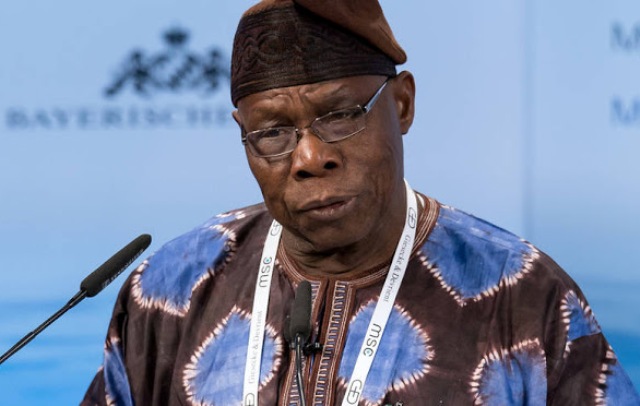
Itse Sagay, Chairman of the Presidential Advisory Committee against Corruption (PACAC), says Olusegun Obasanjo’s statement asking President Muhammadu Buhari not to seek re-election in 2019 is disrespectful.

He said Obasanjo, who did all he could to secure a third term in office, has no justification to ask Buhari not to seek a second term.

“I saw Obasanjo’s comments and I could not believe my eyes, that a man who tried to get a third term is discouraging someone else from getting a second term. It doesn’t make sense,” Sagay said.

“I think Obasanjo should try and respect other people. He has achieved a lot. He is a great man and I respect him. But he should learn to respect other people and think of them as being, at least, as good as himself.

“I think it is insulting for a man who wanted third term to tell somebody else not to want second term. It is most inappropriate, and for a former head of state to say so is most improper.”

Neither the presidency nor the All Progressives Congress has issued an official reaction to Obasanjo’s statement.

Fake news dates back to the book of Genesis, says Pope Francis

0


Pope Francis wants journalists around the world to restore the dignity of the profession by sticking to the truth and doing away with fake news, which he said dates back to the creation of humanity when the “crafty serpent” lied to the woman.

This was the core of a message he delivered at St Peter’s Square on Wednesday, for the 52nd anniversary of the Vatican-sponsored World Communications Day, which will be officially marked on May 13, the Sunday before Pentecost.

“We need to unmask what could be called the ‘snake-tactics’ used by those who disguise themselves in order to strike at any time and place,” Pope Francis said.

“This was the strategy employed by the ‘crafty serpent’ in the Book of Genesis, who, at the dawn of humanity, created the first fake news, which began the tragic history of human sin, beginning with the first fratricide and issuing in the countless other evils committed against God, neighbour, society and creation.

“This biblical episode brings to light an essential element for our reflection: There is no such thing as harmless disinformation; on the contrary, trusting in falsehood can have dire consequences,” Pope Francis said.

Pope Francis described “fake news,” as a “sign of intolerant and hypersensitive attitudes, (which) leads only to the spread of arrogance and hatred”.

“Disinformation thus thrives on the absence of healthy confrontation with other sources of information that could effectively challenge prejudices and generate constructive dialogue; instead, it risks turning people into unwilling accomplices in spreading biased and baseless ideas,” the Pope’s message read.

“I would like to contribute to our shared commitment to stemming the spread of fake news and to rediscovering the dignity of journalism and the personal responsibility of journalists to communicate the truth.

“Praiseworthy efforts are being made to create educational programs aimed at helping people to interpret and assess information provided by the media, and teaching them to take an active part in unmasking falsehoods, rather than unwittingly contributing to the spread of disinformation.”

The theme chosen by Pope Francis for the 2018 World Communication Day is “The truth will set you free’ (Jn 8:32). Fake news and journalism for peace.”

Catholics have been observing World Communication day since 1967, and the Pope’s message is traditionally published on January 24 on the feastday of St. Francis de Sales, the patron saint of journalists.

Pope Francis has fallen victim to fake news himself. First when a fake news site falsely reported the Pope endorsed Hillary Clinton for President. And then again, when another fake news site falsely reported he endorsed Donald Trump for President.

How wide is Obasanjo’s way out?

0


By Kayode Komolafe

Any response that is less than charitable to former President Olusegun Obasanjo’s yesterday’s “Special Statement” stands the grave risk of being misunderstood given the widespread mood of despair in the land. This is because of the complexity of the situation.

In the statement entitled “The Way Out: A Clarion Call for Coalition for Nigeria Movement,” Obasanjo calls for a third political force having ruled out the All Progressives Congress (APC) and the Peoples Democratic Party (PDP) as forces capable of dealing with the problem at hand. Yet what the nation sorely needs is a critical engagement with the moment and its definitions from various perspectives. The mood also calls for a sincere political introspection.

To start with, the former President deserves a salute for his courage of conviction. His voice came yesterday when such a loud voice was needed from such quarters. The voice would doubtlessly resonate with many people who are legitimately displeased with the state of things. It was as someone put it, “Obasanjo said what the people want to hear and his statement is well timed.”

Now, the beauty of Obasanjo’s politics is that he has emerged as a historical figure that cannot be ignored in any circumstance. Maybe, that is because he is the luckiest political figure ever in Nigeria despite his moments of tribulations. Yesterday’s statement again justifies a tribute often paid to Obasanjo of which even his harshest critic cannot deny him: in any situation Obasanjo would stand up for Nigeria.

His entire career is a proof to this assertion. Obasanjo is as constant as the northern start on the side of national unity. That cannot be said of many political figures in Nigeria. President Muhammadu Buhari said this much in his contribution to a book of tributes published in 1995 to celebrate Obasanjo’s birthday while the General was imprisoned by General Sanni Abacha, who probably was preventing this sort of statement being made by Obasanjo about his regime. The book edited by Hans’s d’Orville is entitled Leadership in Africa. That is the stuff for a statesman’s profile.

So the wise thing to do is for political actors and even observers is not to dismiss Obasanjo’s powerful intervention. The statement should reinvigorate the needed national conversation at this time. There should be a critical reflection on Obasanjo’s own definition of the moment and his prescription of what should be done to solve the problem.

It is salutary that even at his age Obasanjo has put himself in redoubtable position of being part of the solution. After all, historically he has been a central part of the problem. It is important to stress that Obasanjo’s narrative of how Nigeria got wet in the rain is not a complete picture. Well, self-criticism may not be one of the virtues of Obasanjo. While his sharp criticisms of APC and PDP as well as the administrations that have come after him are quite valid, his answer to the question of where the rain began to beat this nation is not quite correct. In order to tackle the crisis of governance bedevilling Nigeria, that question should be answered honestly and fully.

For instance, an uncritical reader of the statement might go away with the impression that 1999-2007 was the Golden Age of economic management and politics in Nigeria. That would be a blurred reading of the nation’s recent economic and political history. In the statement, Obasanjo laments the state of underdevelopment and poverty in the land. No rational person can fault the grim picture he has painted. Who can deny the mass poverty, ignorance, disease, poor housing and hunger in the land? However, it is worth stressing that development is a process with stages. That is why in the developed capitalist world, contemporary leaders do not have to restart the stages of development already accomplished by their forebears.

Perhaps, if certain development efforts were accomplished at the stage when Obasanjo was responsible for governance, the succeeding administrations would not have to be repeating the same steps. Despite his best efforts at governance and the recorded achievements, Obasanjo’s economic management had its profound flaws. The Obasanjo administration only began to articulate an economic strategy during his second term. As a result, it was late in the day when he began to take the policy steps in some sectors and the programmes could not be consummated before his exit. The most poignant monument to this late policy implementation was, perhaps, in the power sector.

This legacy of failure is very conspicuous in the economy. Obasanjo came into office in 1999 in a Nigeria of poor electricity supply; by the time he left in 2007 there was hardly any improvement in the power sector. In 1999, Nigeria had the national shame of importing fuel; by the time Obasanjo left office the illogic of a crude-oil exporting country that is importing fuel continued. In his eight years, Obasanjo never took any remarkable step of infrastructural revamp. Even Obasanjo is on record to have admitted at the twilight of his administration that he was ashamed of the state of federal roads.

The collapse of public education continued steadily during those eight years due poor funding and an ill-conceived market solution to the problems of the social sector. His administration had a running battle with university teachers with intermittent strikes with the resultant effects on the quality of education. Joblessness defined the Obasanjo years just as it did in the periods before it and as it has defined the periods following it.

There was no appreciable poverty reduction during the period as Nigeria rated poor in the global Human Development Index. The story is the same in some other sectors. On the political front, the spectre of the allegation of a quest for a third term would continue to haunt his legacy. Above all, given his formidable political weight in 2007, if his management of the politics of succession had been imbued with the type of vision he now enunciates, maybe the post-Obasanjo political landscape would be different.

The historical opportunities of the eight years of Obasanjo as President and his huge political stature as a national rallying point placed him squarely at a vantage point to recast the political economy and enhance the polity. He failed in these respects.

For sure, the fact that Obasanjo failed to advance development in some areas does not disqualify him from making the sort of intervention he is making at the moment. Yes, Obasanjo is a positive force for national unity any day. On that note, his pronouncement could be as magisterial as much as possible. However, it is doubtful if he is suited to be the arrowhead of a third force for the type of change being canvassed in many serious quarters.

Obasanjo’s important statement would be read by many discernible minds with a lot of caveats. He is too prominent a figure in the old order for any fresh intervention to make him an exponent of change for the sake of progress. It is a contradiction that Obasanjo with his ideological mindset is now the symbol of a third force which hopes to draw on the demographic asset of the youth. In any case, his prescription is rather ambiguous. He says he is out of partisan politics, but the Coalition for Nigeria (CN) would aim at power employing the ballot. However, only registered political parties can field candidates for elections. Apart from the APC and PDP there are dozens other political parties waiting with their virtually empty political sacks to be filled with contents so that they can stand in 2019. So shouldn’t the energy, time and resources be put on strengthening the existing parties for elections rather forming fresh ad hoc coalitions?

In sum, Obasanjo is entitled to his own diagnosis of the Nigerian condition. He has fulfilled a patriotic duty by making this intervention. However, the way out of the problem that he has prescribed for Nigeria looks narrow. A wider way out is what is needed at this time. It is also important to put the prescription in the context of the recent history of this country in order to understand it better and possibly predict its efficacy.

Seven things we learnt from Obasanjo’s letter to ‘brother Buhari’


The most dominant feature of Olusegun Obasanjo’s ‘special press statement’ issued on Tuesday is without doubt his advice to President Muhammadu Buhari to consider retiring after the expiration of his tenure in 2019.

However, the former President raised several other salient points in the statement that resonate with majority of Nigerians. Here are a few of them.

DISAPPOINTMENT WITH BUHARI

Obasanjo expressed regrets at how Buhari’s administration has fared, especially given that he took over at a time when Nigerians were totally fed up with bad governance.

“The situation that made Nigerians to vote massively to get my brother Jonathan off the horse is playing itself out again,” he said.

“First, I thought I knew the point where President Buhari is weak and I spoke and wrote about it even before Nigerians voted for him and I also did vote for him because at that time it was a matter of ‘any option but Jonathan’ (aobj).

“I knew President Buhari before he became President and said that he is weak in the knowledge and understanding of the economy but I thought that he could make use of good Nigerians in that area that could help.

“I know his weakness in understanding and playing in the foreign affairs sector and again, there are many Nigerians that could be used in that area as well.”

Alas, Obasanjo’s expectations were dashed.

BUHARI’S GOVT REEKS OF POOR PERFORMANCE

Obasanjo did not mince words when he said that Buhari’s administration is characterised by “poverty, insecurity, poor economic management, nepotism, gross dereliction of duty, condonation of misdeed – if not outright encouragement of it, lack of progress and hope for the future, lack of national cohesion and poor management of internal political dynamics and widening inequality”.

The last straw that seemed to have broken the camel’s back was the New Year’s Day massacre in Benue State by suspected Fulani herdsmen, where over 80 lives were lost.

“It is no credit to the Federal Government that the herdsmen rampage continues with careless abandon and without finding an effective solution to it,” Obasanjo wrote.

“And it is a sad symptom of insensitivity and callousness that some Governors, a day after 73 victims were being buried in a mass grave in Benue State without condolence, were jubilantly endorsing President Buhari for a second term! The timing was most unfortunate.”

For Obasanjo, Buhari’s abysmal performance can be summarised in three subheadings namely:

  1. His “nepotic deployments’  and inability to discipline “errant members of his nepotic court”.
  2. His “poor understanding of the dynamics of internal politics” which has further divided the country.
  3. His penchant for “passing the buck”;  always blaming everything on past administrations.

“If things were good, President Buhari would not need to come in. He was voted to fix things that were bad and not engage in the blame game,” Obasanjo stated.

IT IS TIME TO REST

Obasanjo advised Buhari that what he needs at this time is “a dignified and honourable dismount from the horse”.

“He needs to have time to reflect, refurbish physically and recoup and after appropriate rest, once again, join the stock of Nigerian leaders whose experience, influence, wisdom and outreach can be deployed on the side line for the good of the country.

“His place in history is already assured. Without impaired health and strain of age, running the affairs of Nigeria is a 25/7 affair, not 24/7.

“I only appeal to brother Buhari to consider a deserved rest at this point in time and at this age. I continue to wish him robust health to enjoy his retirement from active public service.

“President Buhari’s illness called for the sympathy, understanding, prayer and patience from every sane Nigerian. We all thanked God for President Buhari for coming back reasonably hale and hearty and progressing well in his recovery.

“But whatever may be the state of President Buhari’s health today, he should neither over-push his luck nor over-tax the patience and tolerance of Nigerians for him, no matter what his self- serving, so-called advisers, who would claim that they love him more than God loves him and that without him, there would be no Nigeria say.”

NEITHER APC NOR PDP IS THE ANSWER

While Obasanjo stressed the need for Nigeria to keep moving forward as a country, he was quick to point out that none of the two major political parties in Nigeria – APC and PDP – can offer the credible leadership required for this forward movement.

“I have had occasion in the past to say that the two main political parties – APC and PDP – were wobbling. I must reiterate that nothing has happened to convince me otherwise. If anything, I am reinforced in my conviction,” he said.

“If neither APC nor PDP is a worthy horse to ride to lead Nigeria at this crucial and critical time, what then do we do?

“Remember Farooq Kperogi, an Associate Professor at the Kennesaw State University, Georgia, United States, calls it “a cruel Hobson’s choice; it’s like a choice between six and half a dozen, between evil and evil. Any selection or deflection would be a distinction without a difference.”

COMPLAINTS ALONE WILL NOT HELP

“Wherever I go, I hear Nigerians complaining, murmuring in anguish and anger. But our anger should not be like the anger of the cripple,” Obasanjo advised.

“We can collectively save ourselves from the position we find ourselves. It will not come through self-pity, fruitless complaint or protest but through constructive and positive engagement and collective action for the good of our nation and ourselves and our children and their children.

“This is no time for trading blames or embarking on futile argument and neither should we accept untenable excuses for non-performance.

“Nigerians are committing suicide for the unbearable socio-economic situation they find themselves in. And yet Nigerians love life. We must not continue to reinforce failure and hope that all will be well. It is self-deceit and self-defeat and another aspect of folly.”

COALITION IS THE ANSWER

Only one choice is left to take Nigerians “out of Egypt to the promised land”, according to Obasanjo, and that is a “coalition of the concerned and the willing – ready for positive and drastic change, progress and involvement”.

“We need a Coalition for Nigeria, CN. Such a Movement at this juncture needs not be a political party but one to which all well-meaning Nigerians can belong.

“That Movement must be a coalition for democracy, good governance, social and economic well-being and progress. Coalition to salvage and redeem our country. You can count me with such a Movement.”

SACRIFICE IS INEVITABLE

Obasanjo acknowledged that for things to begin to normalise, the citizens need not only to pray, but also to be willing to make sacrifices.

“Last time, we asked, prayed and worked for change and God granted our request. This time, we must ask, pray and work for change with unity, security and progress. And God will again grant us.

“What is called for is love, commitment and interest in our country, not in self, friends and kinship alone but particularly love, compassion and interest in the poor, underprivileged and downtrodden.

“It is our human duty and responsibility so to do. Failure to do this will amount to a sin against God and a crime against humanity.

We all “must be ready to make sacrifice for the nation and pay the price of being pioneers and good Nigerians for our country to play the God-assigned role for itself, for its neighbours, for its sub-region of West Africa, for its continent and for humanity in general.”

Obasanjo to Buhari: Don’t contest in 2019… you need to rest at your age


Olusegun Obasanjo, former President, has told President Muhammadu Buhari to consider “a dignified and honourable dismount from the horse” of the presidency rather than re-contest in 2019.

Obasanjo made this known in a lengthy statement he issued on Tuesday, saying that what Buhari needs at the moment is “time to reflect, refurbish physically and recoup”, after which he may “once again, join the stock of Nigerian leaders whose experience, influence, wisdom and outreach can be deployed on the side line for the good of the country”.

“I only appeal to brother Buhari to consider a deserved rest at this point in time and at this age.  I continue to wish him robust health to enjoy his retirement from active public service,” he said.

Obasanjo, however, noted that whether Buhari heeds his advice or not, “Nigeria needs to move on and move forward”.

He pointed out that even “without impaired health and strain of age, running the affairs of Nigeria is a 25/7 affair, not 24/7”, hence the need for the President to pay deaf ears to “self-serving so-called advisers who would claim that they love him more than God loves him and that without him, there would be no Nigeria”.

Enumerating the three major areas where Buhari’s government has performed abysmally, Obasanjo stated:

“One is nepotic deployment bordering on clannishness and inability to bring discipline to bear on errant members of his nepotic court.  This has grave consequences on performance of his government to the detriment of the nation.

“It would appear that national interest was being sacrificed on the altar of nepotic interest.  What does one make of a case like that of Maina: collusion, condonation, ineptitude, incompetence, dereliction of responsibility or kinship and friendship on the part of those who should have taken visible and deterrent disciplinary action?  How many similar cases are buried, ignored or covered up and not yet in the glare of the media and the public?

“The second is his poor understanding of the dynamics of internal politics.  This has led to wittingly or unwittingly making the nation more divided and inequality has widened and become more pronounced.  It also has effect on general national security.

“The third is passing the buck.  For instance, blaming the Governor of the Central Bank for devaluation of the naira by 70% or so and blaming past governments for it, is to say the least, not accepting one’s own responsibility.

“Let nobody deceive us, economy feeds on politics and because our politics is depressing, our economy is even more depressing today.  If things were good, President Buhari would not need to come in. He was voted to fix things that were bad and not engage in the blame game.”

‘Road, railway, power, airport’… Buhari lists his ‘focus’ for 2018


President Muhammadu Buhari says infrastructure upgrade is his “focus for 2018”; therefore, there will be major action in “roads, our railway projects, power, and airport concessions”. 

The President also assured Nigerians that his administration would intensify its efforts at making life better for Nigerians, and that the result will be visible for all to see.

In a number of tweets on Tuesday, he said that in 2018, the government will focus more on infrastructural development and security.

He commended the Chinese government for its financial and technical support to Nigeria.

Buhari also expressed delight that the economy has become a lot more stable, thanks to falling inflation rate, rising external reserves and rising harvest in the agriculture sector.

“Our focus in 2018 is infrastructure: roads, our railway projects, power, and airport concessions. We will intensify our efforts, and you will see progress,” the President tweeted.

“In this regard we are very grateful for what the Chinese are doing to support us, in financial and technical ways.

“Security will also continue to be a priority. We have increased the deployment of security forces, to halt the attacks by herdsmen on communities, and bring to an end the sorrow and hardships that vulnerable communities have had to endure.

“On the economy I’m pleased with the progress we’re making, the stable Naira, falling inflation, rising external reserves, rising harvests, an improving business environment as demonstrated by our rise in the World Bank’s Doing Business Index, and growing manufacturer confidence.”

This is coming less than 24 hours after a delegation of South East members of the All Progressives Congress (APC) paid Buhari a courtesy visit at the State House, where they assured him of unalloyed support especially as the 2019 general election approaches.

“The APC leadership in the south-east met on December 31 last year and endorsed the President for a second term,” Ogbonnaya Onu, Minister of Science and Technology, told State House correspondents after the meeting.

“We have come today to reaffirm that and to assure Mr. President that the party is working very hard to win future elections.”

Ochekpe, ex-water resources minister, arraigned over N450m Diezani bribe


Sarah Ochekpe, former Minister of Water Resources, has been arraigned to court by the Economic and Financial Crimes Commission (EFCC) over a N450 million bribe she allegedly received from Diezani Alison-Madueke, former Minister of Petroleum Resources.

Ochekpe and two other accused persons were arraigned before Justice H. M. Kurya of the Jos division of the Federal High Court, on two-count charge bordering on money laundering.

The two others, Leo Sunday Jitong and Raymond Dabo, were the State Deputy Director for Goodluck/Sambo 2015 election campaign and former Acting Chairman of PDP, Plateau State, respectively.

According to the EFCC, the defendants were alleged to have received the sum of N450 million out of N23 billion deployed by Alison-Madueke to influence the 2015 presidential election.

“Investigations showed that after receiving the money in their custody, the headquarters of Fidelity Bank Plc used its state branches to channel the distribution of the election loot through CBN to individual states of the Federation,” read a statement signed by Samin Amaddin, EFCC’s Acting Head of Media and Publicity.

One of the charges read: “That you, Sarah Ringim Ochekpe, Evan Leo Sunday Jitong, Raymond Dabo and Mrs Diezani Alison Madueke (now at large) sometimes in March, 2015 at Jos, Plateau State of Nigeria within the Jurisdiction of this Honourable Court, without going through the Financial Institution, did conspire amongst yourselves to accept cash payment of the sum of Four Hundred and Fifty Million Naira (N450,000,000.00) from MRS. DIEZANI ALISON MADUEKE through Fidelity Bank Plc which sum exceeded the amount authorised by Law and thereby committed an offence contrary to the provisions of Section 18 (a), Section 16 (1) (d) of the Money Laundering  (prohibition) Act 2012 (as amended) and Punishable under Section 16 (2) (b) of the same Act.”

The defendants pleaded not guilty to the charge.

The presiding judge granted the bail on self-recognition, but added that the bail bond must be countersigned by the defence counsel.

He subsequently adjourned the case to February 13 and 14 for hearing.

Keep the promise on AIDS to Nigerians

0


By Steve Aborisade

The last decade witnessed great uncertainty in Nigeria’s HIV treatment program – a period of pseudo-scientists laying claims to cures and operating without checks. A time that help was assumed to be more in miracle centres than in hospitals. A phase of general and entrenched misconception of what HIV really is, its routes of transmission and of lived realities of being HIV positive.

It was a time of unending stigma – at home and in healthcare settings, discernible with rejection by loved ones and by society at large. It was a period of recurrent drug stock-outs, of expired antiretroviral medications in circulation.  It was cruel faith at those times to be HIV positive, while it took even greater courage and strong will to survive.

I have lost some wonderful friends to AIDS, just like other Nigerians who also lost loved ones. The death of one of my friends was particularly painful, having shared of her struggles and passion to live. This friend was a fighter. She endured unimaginable rejection by almost everyone in her life. She first lost her marriage, was driven away from her place of worship, rejected and ejected from her family home where she returned to seek refuge, and later lost her only daughter. She had to battle with a co-infection of TB-HIV at a time that it was simply enough to deal with HIV. Eventually she could no longer fight, she gave it all up. She was one courageous woman who lived by hope despite her many challenges. At the period I referred, very few survived the twin onslaught wrought, first by the virus itself, and, of societal rejection which tends to kill more than the virus. Her story is the story of many Nigerians, which a lot of people can readily relate to.

But today, we have a much improved environment, such that someone who is HIV positive but receiving recommended treatment is no longer able to transmit the disease to another person. Young ladies and men that I met then are now happy mothers and fathers, living life with great vitality, with their children growing up without HIV. Some of these men and women are today occupying various leadership positions they never assumed possible. There is no gainsaying the fact of what has been achieved.

As a confirmation of the changed fortune, and according to UNAIDS, since 2010, new HIV infections in Nigeria have declined by 21% and AIDS-related deaths by 6%. Among people living with HIV, almost 24% are reported to have attained suppressed viral loads, which means they cannot transfer the virus to others while more people are becoming tolerant of the normalcy of living with HIV.

Put in context however, these remains modest gains compared to the impressive achievements of nations that prioritized health funding, especially where promises on AIDS are being kept.

With AIDS in Nigeria, there are yet big challenges to be surmounted, while it is also imperative to not roll back on the modest gains made. Nigeria’s HIV situation is a peculiar one demanding a peculiar solution. For instance, majority of Nigerians who are HIV positive in the country are unaware of their status, having not tested at all.

Dr. Sanni Aliyu, the Director General (DG) of the National Agency for the Control of AIDS (NACA) put the figure of Nigerians who have ever taken an HIV test once at 10% of the population, for a country of 180 million people. Whereas, Nigeria’s HIV epidemic impacts all population groups and geographic areas of the country. It remains the second largest epidemic globally at 3. 2 million, while only 30% of those needing treatment can access it, according to UNAIDS.

In 2016 according to UNAIDS, Nigeria recorded 220, 000 new HIV infections, one of the highest rates in sub-Saharan Africa. Same year, she recorded 160, 000 AIDS-related deaths. Among pregnant women living with HIV, only 32% are on treatment. The fate of the remaining 68% and their unborn babies is best imagined. No wonder, about 37, 000 children became newly infected with HIV in 2016 while only nine states of 36 have surpassed 50% Antiretroviral Therapy (ART) coverage.

To bring it home properly, let me illustrate the scope of the problem at hand with this program of the government of Nigeria which my organisation, AIDS Healthcare Foundation (AHF) is an important partner. Called the Fast Track Initiative, and launched by President Buhari in December 2016. program aims to fast track HIV treatment, including the elimination of mother-to-child transmission of HIV in Nigeria by getting an extra 100, 000 HIV positive persons (children, adults and pregnant mothers) on treatment in Benue, Nasarawa, Cross River and FCT by the end of 2018.

In Benue state, one of the states with the highest HIV prevalence in Nigeria, Fast Track estimated data pegs the number of children living with HIV at 17, 259, with only 6, 367 on antiretroviral treatment. A treatment gap of 10, 892 exists. 278, 225 adults are HIV positive, with 129, 092 on ART and a gap of 149, 133. Likewise, 20, 396 pregnant women are HIV positive, with 1, 540 on ART and a gap of 18, 856.

In Cross River, 6, 106 children are HIV positive, with 1, 434 on ART leaving a treatment gap of 4, 672. Whereas 77, 547 adults live with HIV, while 21, 219 of that figure are on ART with a gap of 56, 328. Cross River has 4, 815 pregnant women who are HIV positive, with 326 on ART and a gap of 4, 489.

Nasarawa comes with 7, 545 HIV positive children, of which 1, 434 are on ART and a gap of 6, 420. Similarly, 111, 080 adults are HIV positive with 21, 986 on ART and a gap of 90, 003. For pregnant women, 7, 220 are HIV positive with only 148 on ART leaving a treatment gap of 7, 072.

This situation is not limited to the states mentioned here. There are similar gaps in every state of Nigeria needing urgent attention if we are desirous of not returning to that phase in time described earlier.

However, the chances that we will not return to that era of uncertainty is simply a function of the funding to AIDS programs. Commentators have suggested that funding must be commensurate to the ‘challenges of our health system infrastructure, unmet need for commodities, data quality and human resource for health.’ Presently, inadequate funding for these constitutes key barriers to universal access to HIV/AIDS services in Nigeria. Dr. Aliyu, DG of NACA is of the view that Nigeria may require nothing less than N150 billion annually to achieve and maintain full ART coverage.

Without doubt, this reality underscores the need for state governments and the organized private sector to join the federal government in its effort to rid Nigeria of AIDS. At the same time, it is crucial for nations who are funding AIDS to keep up their efforts, while nations like China who are yet to support the Global Fund, a fund which supports nations in tackling AIDS, TB and Malaria must contribute their quota.

It is heart-warming to see renewed commitments on the part of government to treat more Nigerians, as it is encouraging to see the National Assembly resolved commitment to the implementation of the National Health Act provision of 1% of the consolidated revenue fund for health from 2018 and state governors who are considering between 0.5% to 1% of their monthly federal allocations to sustain HIV funding.

What we expect, which serves the Nigerian people right, is for these commitments to not end up as mere rhetoric. Keeping the promise made is the only way to guarantee and sustain the national HIV intervention and safeguard the health of Nigerians.

Steve Aborisade is Advocacy & Marketing Manager, AIDS Healthcare Foundation (AHF) Nigeria.

‘I’ve had such a rotten life’ — psychiatric woman picks date of death by euthanasia

Life is good. So goes a popular saying, but that is not the case with Aurelia (surname undisclosed) who has chosen Friday January 26 as her death day after battling severe psychological problems from an early age.

Though Aurelia has no terminal illness, she knows she will die in three days’ time; her option for euthanasia was granted on New Year’s Eve after a rigorous process.

Aurelia says she is comforted that she would be surrounded by friends and in her own bed as she finally reunites with her mother, who died in August after a heart operation.

“I have been so devoured by my psychiatric disorders that I am completely broken,” Dutch television, RTL Nieuws quotes Aurelia as saying.

“I want to die in a dignified way. I think that after such a rotten life I am entitled to a dignified death — people who have a serious illness also get a chance for a dignified end, so why is it so difficult for people who are to be psychic? I think I have the right to die dignified; I am a human being.”

It was a long and difficult road before Aurelia’s euthanasia was approved and that is why she wants attention for her story. Not for herself, but for others who also find life psychologically too heavy, have no chance of recovery and want to die in a dignified way.

Aurelia has had a death wish for years. The 29-year-old made her first suicide attempt when she was 21. In the past eight years, she has attempted it more than 20 times.

All these times she was found just in time by people around her. For the people who found her, including her parents and a friend, “that is horrible for them”.

“I became depressed from the age of 12,” she says. “I had thoughts about myself but my parents thought it would be okay.”

Scars from injuries Aurelia inflicted on herself

Aurelia actually started damaging herself at the age of 15. She cut her body in her arms.

“I had to lose my emotions, I did it when I had a lot of mental pain. You get a physical reaction, a hormone goes to your brain, you feel a relief, and you can focus on that pain, and taking care of the wounds with bandages and bandages, instead of the pain in your head.”

It was December 2003 that Aurelia received medicine for the first time against her mental problems. “They (the Doctors) thought: everything will be fine, we’ll put a pill in it.”

But it did not stop. She still cuts herself to this day. “Most people stop after four or five years, but I still do it, sometimes three times a day.”

In 2013, Aurelia set fire to a shed under an apartment where many people live. She ended up in prison where she spent two and a half years.

“The arson I did during a psychosis, I hear and see things that are not there, I always have voices in my head, there are three, sometimes they are noisy and at other times they are quiet.”

In the prison, where she spent two and a half years, there was no therapy.  She was released in December 2016.

Aurelia looks out the window of her house

At the beginning of 2017, Aurelia, in consultation with her psychiatrist and psychologist, wanted to try a final therapy that would see her hospitalized for three months, “but after an intake interview, they said they could not help me, my problem was too complicated.”

“Because they could not help me, I was untreated and that is an important condition for euthanasia, when I quickly started the euthanasia process,” she says.

Aurelia’s euthanasia will be carried out by personnel from the End-of-Life Clinic, and the procedure has been explained to her.

It will happen on January 26, at 2 pm. The doctor will come to prepare a drink that Aurelia will gulp herself. She will then sink into an ever deeper sleep for the next hour; eventually, her heart will stop.

“I thought it was very intense, they explain how it works, how it works with the drink, how your body responds, and then they tell you that your body and lips are turning blue and what your body is going to do. And then you’re dead, but I was shocked by those words: blue, death,” says Aurelia.

Until that happens, it will be special days.

“I would like to do something nice with my friends the night before, when the weather is nice: a barbecue or other gourmet, and my friends want a night watch that night.”

Though Sara’s friends will be there during her last moments, her parents will not. Her mother is late; her father, still alive, will not be there either.

“It is too difficult for him,” she says. “He has lost two people in a short time, he accepts it, he knows me and knows that I have this wish for so long. He says: ‘I can be happy for you, but I will be at the cremation’, which I think is very important.”

“Then I see my mother again. I believe in God and in heaven and I want to see her again. I was very angry when she died, but a friend said ‘she has created a kind of house for you and is waiting for you, you’re not alone.’ That’s a nice thought; I’m going to her. ”

In the Netherlands, euthanasia is permitted under strict conditions. There must be unbearable and hopeless suffering and the person making the request must be competent. This suffering can be the result of a physical illness, but can also be psychological.

However, Euthanasia Prevention Coalition — a group working to lower the trend of assisted suicide — wants Aurelia, whose real name is Aurelia, to live.

“Aurelia — we want you to live,” Alex Schadenberg, its Executive Director, said in an email blast to collect signatures in a last-ditch attempt to force the impeding euthanasia.

“At this moment, life may seem dark and without a future, but we want her to know that there is help and there are people who want to care for her. Many people have experienced similar pain and struggles and yet life can change and happiness is possible.”

The group is encouraging the public to sign its ‘Letter of Hope to Aurelia’ here.


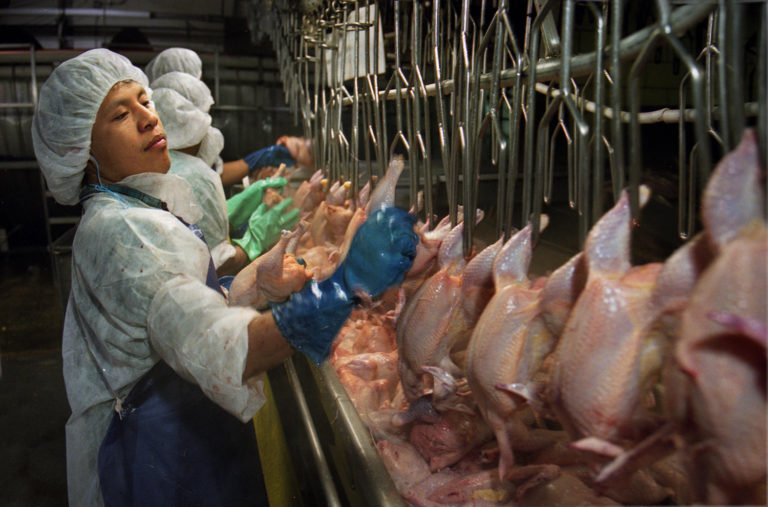
Oxfam reveals how US women poultry workers wear diapers because they’re not afforded toilet breaks


A new report by Oxfam has documented how “women working in the US poultry industry are forced to wear nappies because they are denied toilet breaks”.

The report, titled ‘Reward Work, Not Wealth’ and launched on Monday, documented the various acts of inequality that besetting the world.

It revealed how 82 percent of the wealth generated in 2017 was grabbed by the richest one percent of the global population, also stating that 3.7 billion people who make up the poorest half of the world saw no increase in their wealth.

The report is being launched as political and business elites gather for the World Economic Forum in Davos, Switzerland.

‘Reward Work, Not Wealth’ reveals how the global economy enables wealthy elite to accumulate vast fortunes while hundreds of millions of people are struggling to survive on poverty pay.

Citing Nigeria as an example, the humanitarian organization remarked that the legal minimum wage for workers has to be tripled for workers to live decent life.

According to the report, the number of billionaires rose at an unprecedented rate of one every two days between March 2016 and March 2017.

Winnie Byanyima, Executive Director of Oxfam International, said: “The billionaire boom is not a sign of a thriving economy but a symptom of a failing economic system.

“The people who make our clothes, assemble our phones and grow our food are being exploited to ensure a steady supply of cheap goods, and swell the profits of corporations and billionaire investors.

“Billionaire wealth has risen by an annual average of 13 percent since 2010 – six times faster than the wages of ordinary workers, which have risen by a yearly average of just 2 percent.

“The number of billionaires rose at an unprecedented rate of one every two days between March 2016 and March 2017.

“It takes just four days for a CEO from one of the top five global fashion brands to earn what a Bangladeshi garment worker will earn in her lifetime. In the US, it takes slightly over one working day for a CEO to earn what an ordinary worker makes in a year.”

The Oxfam report outlined the key factors driving up rewards for shareholders and corporate bosses at the expense of workers’ pay and conditions.

These include the erosion of workers’ rights, excessive influence of big business over government policy-making, and the relentless corporate drive to minimize costs in order to maximize returns to shareholders.

“Women workers often find themselves off at the bottom of the heap. Across the world, women consistently earn less than men and are usually in the lowest paid and least secure forms of work. By comparison, 9 out of 10 billionaires are men,” the report said.

“Oxfam has spoken to women across the world whose lives are blighted by inequality: women in Vietnamese garment factories who work far from home for poverty pay and don’t get to see their children for months at a time, women working in the US poultry industry who are forced to wear nappies because they are denied toilet breaks, women working in hotels in Canada and the Dominican Republic who stay silent about sexual harassment for fear of losing their jobs.”

Oxfam called on governments to “ensure that economies work for everyone and not just the fortunate few:  Limit returns to shareholders and top executives, and ensure all workers receive a minimum ‘living’ wage that would enable them to have a decent quality of life”.