Ayodele Fayose, Governor of Ekiti State, says herdsmen in the state must register with the sum of N5,000 in their host communities to make for easy identification.
Fayose made this known via his Twitter handle while sympathising with Olu Falae, former Secretary to the Government of the Federation, whose farm was allegedly set ablaze by herdsmen. The attack on Sunday allegedly affected hectares of land where Falae planted palm trees, yams and cassava.
Also, a bill will be sent to the Ekiti State House of Assembly seeking a five-year prison sentence for anyone found guilty of protecting or harbouring “killer-herdsmen”.
Fayose also said that the head of the Fulani community in Ekiti State will be held personally responsible for further attacks in his domain.
“Henceforth, to operate in Ekiti State, herdsmen must have to register with N5,000 in host communities. We must know the identity of all herdsmen operating in Ekiti and who should be held responsible in the event of any further attacks in the state,” Fayose twitted.
“Also, the Sarkin Fulani (Head of Fulanis) in Ekiti State, Muhammad Abashe, will be held personally responsible for any further attacks in his domain.
“Besides, I will forward an executive bill to the House of Assembly proposing a five-year jail term for anybody found guilty of harbouring ‘killer’ herdsmen in the state.”
Henceforth, to operate in Ekiti State, herdsmen must have to register with N5,000 in host communities. We must know the identity of all herdsmen operating in Ekiti and who should be held responsible in the event of any further attacks in the state.
Besides, I will forward an executive bill to the House of Assembly proposing a five-year jail term for anybody found guilty of harbouring ‘killer’ herdsmen in the state.
Fayose expressed regrets that an elder statesman lika Falae, who should be enjoying his retirement but has chosen to continue active life as a farmer, is still made to undergo hard times at the hands of herdsmen.
“I sympathize with one of our leaders in Yorubaland, Chief Olu Falae on the reported burning of his farm by suspected herdsmen. I am worried about the incessant attacks on Chief Falae by herdsmen and government should act decisively to curb the menace,” he wrote.
“If Chief Falae is still farming at his age, what he needs from govt and Nigerians is support, not destruction of his crops by herdsmen. Methinks government at all levels should protect Nigerians, especially our elders statesmen from criminal elements like the herdsmen.”
If Chief Falae is still farming at his age, what he needs from govt and Nigerians is support, not destruction of his crops by herdsmen. Methinks govt at all levels should protect Nigerians, especially our elders statesmen from criminal elements like the herdsmen.
Sunday’s attack was not the first of Falae’s encounters with herdsmen. In September 2015, he was kidnapped from his farm assailants believed to be acting on information supplied by herdsmen.
Two of the kidnappers were arrested and paraded by operatives of the Department of State Services (DSS) and one of them, named Usman, confessed to the crime.
“I then told him that I know one man who used to bring a Hilux vehicle to his farm and I used to see him as I move my cows about,” Usman narrated to journalists as he was being paraded in October 2017.
Five more of the kidnappers were later arrested and all seven were charged to court, with Falae himself one of the witnesses during the trial.
Tatu Kamau, a Kenyan medical doctor, has filed a petition in court seeking to legalise Female Genital Mutilation (FGM).
Kamau argued that a ban on the practice is unconstitutional and that adult women should be allowed to do what they want with their bodies.
In the petition, filed at the Machakos High Court in eastern Kenya, Kamau asked the court to order that women who willingly opt to undergo circumcision should be allowed to access the best medical assistance.
“If women can decide to drink, to smoke, women can join the army, women can do all sorts of things that might bring them harm or injury, and yet they are allowed to make that decision, I think that even for the decision of female circumcision, a woman can make that decision. And once she has made that decision, she should be able to access the best medical care to have it done,” Kamau told Kenya Television News (KTN).
The court will hear the petition on February 26.
Reacting to the development, Njoki Njehu, Director of the Daughters of Mumbi Global Resource Centre, an NGO pushing for the eradication of FGM in Kenya, said it is “one of the worst ideas I’ve ever heard, and it’s even more shocking that it is coming from a medical doctor”.
“Everything we know about FGM is that it has no benefit and causes a great deal of harm. We also know the majority of those who undergo FGM are young girls, not adults. We — all women’s rights groups — are ready to fight this if it comes to that.”
Kenya outlawed FGM practice in 2011 but the practice continues, as communities believe it is necessary for social acceptance and for increasing their daughters’ marriage prospects.
An estimated one in five women and girls between 15 and 49 years in Kenya have undergone FGM, according to a study by the United Nations.
Also, about 200 million girls and women worldwide have undergone the practice, which usually involves the partial or total removal of the female genitalia and can cause a host of serious health problems.
FGM is still being practised in at least 27 African countries, including Nigeria, and parts of Asia and the Middle East; it is usually carried out by traditional cutters, often using unsterilised blades or knives.
In some cases, girls can bleed to death or die from infections. FGM can also cause fatal childbirth complications later in life, health experts warn.
Godwin Emefiele, Governor of the Central Bank of Nigeria (CBN), says Nigeria’s exit from recession and the increasing price of crude oil in the international market are positive indicators of the rising strength of the country’s economy.
Emefiele said Nigerians and the international community have every reason to keep being optimistic about the economy.
This opinion was contained in a statement he issued on Monday in Abuja, explaining why the first meeting of the Monetary Policy Committee (MPC) for the year, fixed for Monday and Tuesday, was cancelled.
Other indicators, according to Emefiele, are the decline in inflation rate to 15.37 per cent and the increase in foreign exchange reserves, which now stands at $40.78 billion.
Emefiele said the positive indicators had boosted investor confidence in the country, attracting about $13 billion through the Investors’ and Exporters’ (I&E) window opened by the CBN in 2017.
“We have also seen Market Capitalisation of our Stock Exchange improve by 22.3 per cent from N13.21 trillion on Nov. 30, 2017 to N16.15 trillion as at Jan. 19, 2018.
“Also, the All-Share Index (ASI) rose by 18.8 per cent from 37,944.60 to 45,092.83 over the same period,” he said.
Emefiele explained that the MPC meeting was called off in adherence to the provisions of the CBN Act, which stipulates that the MPC shall meet at least four times in a year and that the quorum shall be six members; two of whom shall be the Governor and a Deputy Governor or two Deputy Governors.
According to Emefiele, the Senate is yet to screen and confirm the MPC nominees appointed by President Muhammadu Buhari in October 2017.
As a result, Emefiele said the CBN would maintain the key monetary variables as decided in the last MPC meeting of November 2017.
The Monetary Policy Rate (MPR) was retained at 14 per cent, CRR at 22.5 per cent, Liquidity Ratio at 30 per cent and the Asymmetric Corridor at +200 and -500 basis points around the MPR.
A new schedule for the MPC meeting will be made known to the concerned stakeholders as soon as the statutory requirements are met, Emefiele stated.
Since Professor Umar Labdo Muhammed of Northwest University, Kano, wrote a short piece on his Facebook wall with the foregoing title, some of us expected his narrative to have elicited serious intellectual debates from renowned academics in the Middle Belt in order to counter what appears to be the rewriting of history. Sadly, not much of this has been seen aside demeaning exchanges and reproduction of counter-history that is misleading, which failed to address what is conspicuously falsehood.
Could the failure to engage Prof. Muhammed by academics be borne out of fare, giving the religious tone of the matter!! For this reason, I have decided to clear the air since our professors have stopped professing knowledge as evidenced in Muhammed’s misleading narrative.
By conquest, Prof. Muhammed was referring to the aftermath of the Jihad War prosecuted by Usman dan Fodio, which led to the founding of Sokoto Caliphate in 1804, after capturing Hausa kingdoms – Katisna, Daura, Kano (1807), and later Gobir (1808). This event saw the linking of over 30 Emirates in present-day nrthern Nigeria under the Sokoto Caliphate.
Since Benue was part of the defunct Northern Region, there is this belief in northern circle, especially among the Fulani, that it was also part of the conquered territories by Usman dan Fodio. In fact, Prof. Muhammed’s misleading thesis that “half of Benue is part of Bauchi Emirate and also half Adamawa Emirate” stems from this belief.
However, it is interesting to note that during the period of Usman dan Fodio’s war of conquest, the Tiv and Idoma-speaking areas in present-day Benue state were never conquered by the Jihadist, let alone annexed to Sokoto Caliphate like the conquered Hausa kingdoms. If anything, the Tiv resisted Fulani occupation of their territory, which explains why conservation to Islam, as it was the case among the Hausa, did not happen in Benue. The bravery of the Tiv people halted Jihadist expansion into Benue in the early 19th century.
A careful reading of John Paden’s – renowned scholar and apologist of northern Nigeria – Muslim Civic Cultures: The Challenges of Democratic Federalism in Nigeria will provide detail insight on this issue, and many more concerning Dan Fodio’s purification moment.
If Prof. Muhammed has a contrarian historical account concerning this issue, or any other Fulani who feels by virtue of conquest Benue belongs to the Fulani, they should please refer us to their accounts for further scrutiny. If not, Prof. Muhammed should retract the falsehood he publicized because it is not dignifying of an academe of his status.
Instead of opening the Pandora’s box, which would likely consume us all, he should concentrate on publishing what would earn him more laurels. That’s what scholars do – not fan the embers of violence.
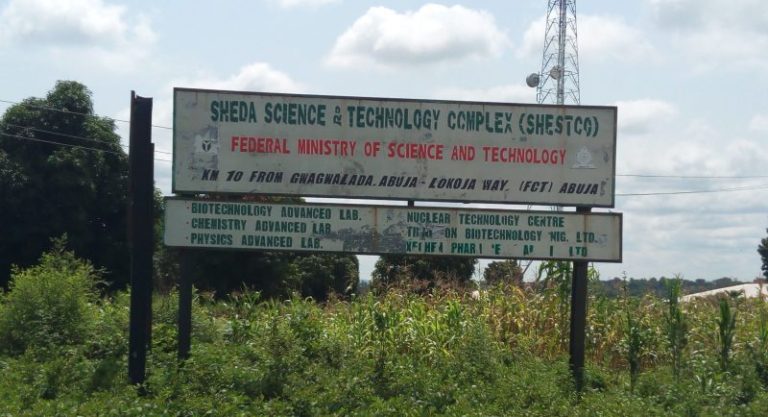
The clouds rolled by and the sun soon burst through. The day is bright, and so is the mood of the people – technocrats, researchers, politicians, scientists – waiting for the great event. The date is 23rd December 1988 at the virgin acres of Kilometre 32, Lokoja-Abuja Road, Abuja where the Sheda Science and Technology Complex, SHETSCO is to be located.
The mood is explainable; the country is about to commence the construction of its first ever national science and technology complex and the first ever nuclear technology centre in Africa.
To be modelled after the likes of Tsukuba Science City in Japan, Taedok Science Town in South Korea, Serpong facility in Indonesia, the nuclear technology centre is the progeny of a 17-man panel of professors, doctors and technocrats who met for about 8 months and recommended to the Federal Government the need to establish the centre.
Perhaps the mood could be better captured in the words of the President and Commander-in-Chief of the Armed Forces, Ibrahim Badamosi Babangida who turned the first sod for the establishment of the centre.
“I am glad to be here this morning for an epoch making event; to perform the turning of the sod for the construction, establishment and take off of a National Science and Technology Complex,” President Babangida said in his address.
“At this juncture, it is necessary to remind ourselves that all the facilities in this complex are being provided at great expense to the Nigerian public. The expectation of the public will not be unnaturally aroused by our action because expectations result in either criticisms if success or improvement is not achieved or adulation if otherwise.”
The Nuclear Technology Centre, NTC, first ever in Africa, sprang up at the complex same year and five years later, the biotechnology, chemistry and physics Laboratories followed.
Fast forward to 2017, 29 years after its establishment, nothing seems to be working at the NTC as uncompleted and abandoned projects litter the expanse of land.
THE MANDATE
The first significant step at establishing the NTC materialised in 1987 when the Ministry of Science and Technology received a proposal for establishment of the centre.
To consider this proposal, the then Minister, Emmanuel Emovon, constituted a 17-man panel, which after an 8 months deliberations, recommended to the government that the centre be established and fashioned along the kinds in countries visited such as Germany and Indonesia.
The recommendation of the panel led by Prof. Awele Maduemezia, the Vice Chancellor of Bendel State University, Ekpoma, resulted in the constitution of a project team by the Ministry.
Apart from it use in agriculture, pharmacy, power generation and other sectors, the NTC was conceived to create opportunities for world-class research and development, thus obviating the frustration plaguing scientists and technologists due to lack of facilities.
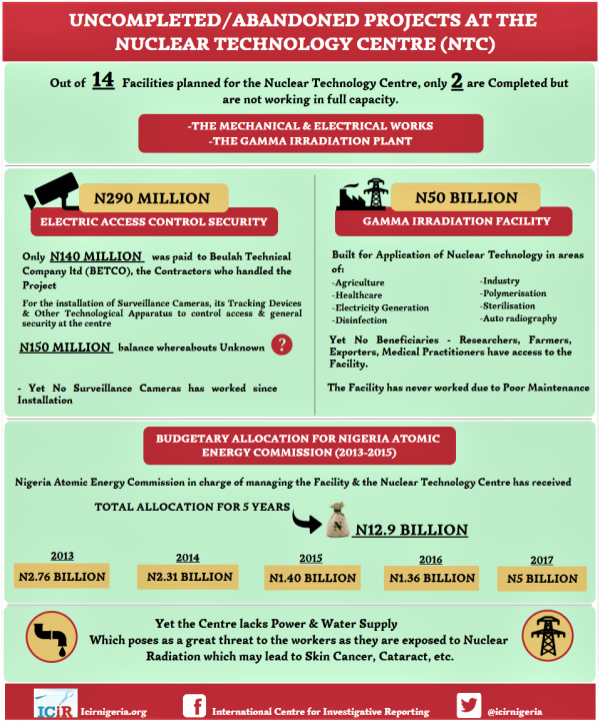
By design, 14 different facilities were planned for the NTC but only two, the mechanical and electrical workshop and the Gamma Irradiation Plant have been completed, and yet they are not working in full capacity.
While majority of the other facilities planned for the centre have not been established by the government, investigation revealed that not less than four of the projects budgeted for, cash-backed and awarded to contractors are now abandoned within the centre.
ZERO SECURITY
When this reporter first visited the NTC in September, it was obvious nothing much was going on inside the premises. There was no single security guard on sight and the centre looked like any regular property in terms of security.
This reporter, who expected security checks before visitors are allowed entry into the facility, walked in freely without being stopped or questioned.
A member of staff of the centre, who did not want his name mentioned for fear of victimisation, said it was shameful that a nuclear centre in which the government invested heavily does not have reliable security. He said in neighbouring Ghana, it would take a visitor more than a week of processing and security checks before gaining access to their nuclear facilities.
Free entry and exit, no security personnel on sight at NTC entrance
Perhaps, security at the centre would have been better if the N290 million electric access control security project handled by Beulah Technical Company Limited, BETCO, was completed and functional.
In April 2008, the project was awarded to BETCO in a subcontract by Rosuli Tech Logistics and Support Services Nigeria Limited who dealt directly with the clients- Ministry of Science and Technology and SHETSCO.
Three months later, in July 2008, BETCO received an initial payment of N140, 000, 000 on a contract term that stipulates that the balance of N150, 000, 000 would be paid after the completion of the project.
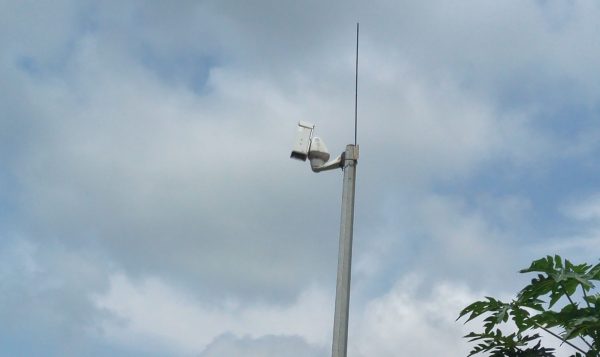
The project which BETCO executed in partnership with a South African firm includes installation of surveillance camera, its tracking devises and other technological apparatus to control access and general security at NTC.
But the surveillance cameras have never worked though they had been installed at the centre.
Business started getting sour by mid-2009 when BETCO fell out with the contractor, Rosuli Tech and thus, dragged the company to court in 2010.
The contention lies in sharing of the proceeds from the contract.
BETCO argued that it prosecuted the project without assistance from Rosuli Tech and therefore, demands such as retention fee, consultancy fee, deductions for Value Added Tax, VAT, and other deductions which the contractor requested shouldn’t be mentioned. Bola Akinola, the then manager of BETCO who appeared before the court as first witness said that the company is entitled to N150, 000, 000 balance according to agreement.
Rosuli Tech on the other hand argued that the contract was never awarded to BETCO. That the security project is part of an existing contract between SHETSCO and one German company, AREVA NP GMBH, and due to AREVA’ s inability to deliver, the project was re-awarded to BETCO. On this basis, Rosuli Tech expected BETCO to work according to its terms and pay its dues to ensure proper delivery.
The company stated its dues in a conditional letter of acceptance dated July 1, 2008 to include; N6, 000, 00 consultancy fee, a 5% tax deduction to amount to N14, 500, 000, a 5% VAT deduction of N14, 500, 000 and retention fee for one year calculated at N29, 000, 00.
With this arrangement, Rolf Schneider, the Managing Director of Rosuli Tech maintained that the balance after completion of contract was N86, 000 and not N150, 000,000 as claimed by BETCO.
Further, the company argued that the project was not executed appropriately in manner and time and therefore maintained that a certificate of completion would not be issued to BETCO.
Installed by BTECO but these cameras have never worked
The court proceedings dragged on for about 6 years, and in a final judgement delivered in May 2015, Justice Donatus Okorowo of the Federal High Court Abuja ruled that BETCO be paid the balance of N150, 000, 000.
“By the tenor of exhibit B, the defendants (Rosuli Tech) accepted payment of the sum of N290, 000, 000, the total sum of the contract. Having earlier found that the plaintiff have performed the contract, they are entitled to payment of the balance of the contract sum which is N150, 000, 000,” Justice Okorowo said while delivering the judgement.
The court ordered Rusoli Tech and its CEO to pay the balance due and an interest of 21% per annum from November 2009 until the judgement debt is liquidated.
WHERE IS THE N150 MILLION BALANCE?
Also worrisome and unresolved is the location of the N150, 000, 000 balance for the project.
By the tone of the court judgement, the full amount for the contract was deposited with Rosuli Tech but the company has failed to balance the project executor neither did it remit the balance into the coffers of the federal government.
The Chief Executive Officer, CEO, of BETCO, Olumide Braithwaite, in an interview said his company has not received any fund other than the initial payment.
“No, we haven’t been paid,” he said. “Despite completion of the contract and successful hand over to the parastatal and the Ministry of Science and Technology. Nothing has been paid.”
On inquiry about why the cameras were not working, Mr. Olumide said that his company handed over the facility in good condition.
“We successfully handed over the project. If they (the cameras) were not tested, they would not have been successfully handed over.”
He added that his company did not have a contract for maintenance and operation, thus, they can’t be held responsible for the non-functioning of the cameras.
Mr. Olumide said every attempts by his company to track down Rosuli Tech has not been successful.
“Rosuli disappeared. Rosuli was being ran by a German national. All attempts to reach them now has not been successful. They just vanished. I understand that the German man has returned to Germany. So we are faced with the problem of executing the court judgement.”
But the Director General of SHETSCO Mr. Sunday Thomas disagreed. He stated that the project was never handed over to SHETSCO.
“It was never handed over to SHETSCO as a completed project,” he replied to enquiry by this reporter. “There was a misunderstanding between Rosuli and BETCO. The case dragged on for years before a judgement was given but it was never really handed over to us as a complete project.”
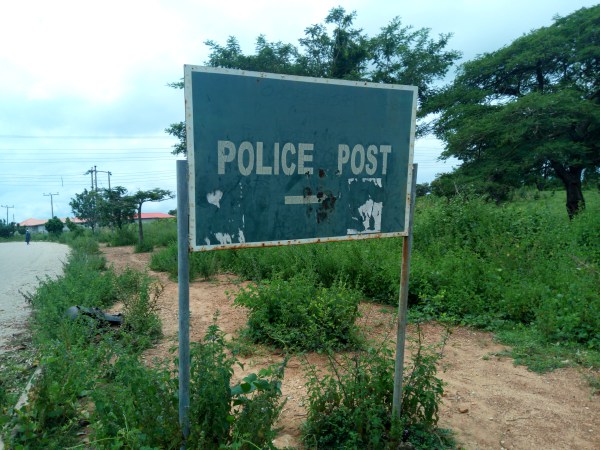
This is a police post but there is no policeman on sight
Efforts to reach the management of Rosuli Tech also hit a brick wall.
When this reporter visited the No. 28, Amazon Street, Maitama, Abuja address quoted on the website of the Corporate Affairs Commission, CAC, there was no trace of the company. The building has been occupied by new residents.
The security man who simply identified himself as Abubakar, and claimed to have worked for Rosuli Tech said the company folded up more than six years ago.
“They left this place in 2010,” Abubakar said “They paid off all their staff. Even the German Oga is no longer in Nigeria. You can’t see anyone of them. I’m surprised that you are still asking about Rosuli.”
However, lying between the claims and counter claims is a perennial issue of insecurity at a nuclear technology centre in an insurgency ravaged country, and the whereabouts of a company in custody of such huge public fund.
In October 2017, Nigeria’s Minister of Agriculture, Audu Ogbe, shocked the nation when he announced that the United States of America, USA, rejected yam exports from Nigeria because of their poor quality.
“Some consignment of yams were exported from Nigeria to the United States and according to reports we have today, they were found to be of poor quality” he said. “We will be investigating both the company that exported it and our quarantine department to check and find out why such a consignment left here.”
Ironically, a multi-billion naira Gamma Irradiation Facility, housing a 340 kilocure cobalt-60 irradiation source, which would have been efficient in preserving the yam tubers is rotting away at the NTC.
Inaugurated by former President Olusegun Obasanjo shortly before leaving office, the over N50 billion facility built for research and commercial purpose never worked as expected as it has remained under poor maintenance, and almost redundant, since 2006.
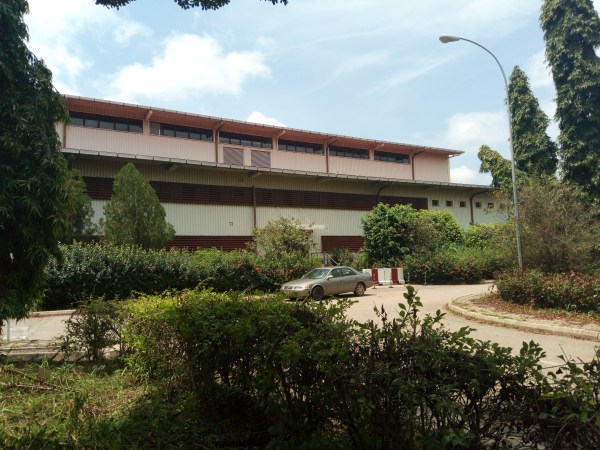
The Gamma station
The facility was built for the peaceful application of nuclear technology in areas of agriculture, industry, health care, polymerisation, electricity generation, sterilisation, disinfection and autoradiography.
Potential applications of the facility in agriculture include; increased food production through the use of fast neutrons to induce mutations in seeds, sprout inhibition of onions, potatoes etc., insect disinfestations of grains, reduction in microbial load of spices, genetic engineering and breeding disease resistant plant varieties.
With a controlled amount of Gamma radiation from cobalt-60 source, the shelf-life of perishable agricultural produce such as yam, cassava, tomatoes, beans, oranges etc. are prolonged thereby reducing the enormous sloss of food harvest.
Despite the huge economic prospect of the facility, none of the beneficiaries – researchers, farmers, exporters, medical practitioners – have access to it as it remains non-functional due to poor maintenance.
Workers at the NTC who spoke with this reporter said the high rate of fund mismanagement by the management of the centre accounts for the poor state of the facility.
Beyond this, the dichotomy of management between, SHETSCO and the Nigeria Atomic Energy Commission, NAEC, is also responsible for the poor state of the facility.
“Before, this centre used to be under the management of SHETSCO and things still work well,” one of the workers who doesn’t want his name mentioned said, adding that everything became destabilised it was ceded to NAEC.
When it was inaugurated in 2006, the Gamma Irradiation facility was managed by SHETSCO who was in control of the whole complex.
Three years later, in 2009, the management was transferred to NAEC and thus, the facility and others at the NTC, including the staff became the responsibility of NAEC.
“The centre is under NAEC and NAEC receives the budget for the centre,” Deputy Director, Budget, Ministry of Science and Technology, Mr. Ken Biko told this reporter during a follow-up to an FOI requesting for the budget of the centre.
“SHETSCO is under the Ministry and their budget is quoted in the Ministry’s budget but the budget of the Nuclear Technology Centre goes directly to NAEC which is under the Presidency. So we don’t have their budget here.”
Efforts to obtain information on the budget of the centre proved abortive as the Ministry couldn’t provide the budget details despite delaying reply to an FOI request for over a month.
Investigation however revealed that NAEC is culpable in the poor management of the Gamma Irradiation Facility.
According to plan, NAEC was to take over nuclear activities at the centre, which includes in totality the maintenance of the Gamma Irradiation facility, while the non-nuclear ones remain the responsibility of SHETSCO.
Further, the bulk of the fund budgeted to run the centre ended up with NAEC.
“Since 2009, the budget goes into NAEC,” Mr. Thomas said.
A check into the budgetary provision for NAEC revealed that about N13 billion has been appropriated for personnel, recurrent and capital expenditure for the commission in the past 5 years.
Quoted as budget of ‘NAEC and its centres,’ the commission had the following budgetary provision between 2013 and 2017; N2, 776, 896, 318 in 2013; N2, 315, 119, 915 in 2014; N1, 409, 066, 797 in 2015; N1, 369, 738, 204 in 2016 and N5, 007, 892, 714 in 2017.
For the 5 years, a total of N12, 878, 713, 948 was budgeted for the commission to run it’s headquarter and centres, NTC inclusive. However, there was no specific breakdown on what each centre received.
But the Chairman of NAEC, Simon Mallam was quick to defend the commission.
While admitting that the facility is not in proper care, Mr. Mallam noted that the dearth of fund has incapacitated the commission to carry out its work.
“There is nothing like NTC budget fundamentally,” Mallam stated during an interview. “What we do, government funds projects and they allocate funds for the project. On the recurrent, even under SHETSCO, NTC never had a separate budget, it was SHETSCO budget. Somehow, we have one line budget without specifying which centre has what.
“For instance, our overhead cost (received) in the last two, three years is less than N12 million monthly, for all the headquarters and all these centres, you have to manage it. Last year we had an overhead of only 8 months, this year we have had only six months. So there is no magic we can do.”
LOOMING DANGER
Beyond the economic loss at the Gamma Irradiation Facility, the about 50 workers of the centre and residents of the Federal Capital Territory have a great deal to worry about.
The facility exists as a gun powder waiting to be ignited if not properly taken care of, especially in areas of power and water supply.
The power supply station
Until October 2017 when two more (150KVA and 100KVA) were added, the centre’s power supply station has one 1500KVA, one 750KVA, one 275KVA, one 100KVA and 50KVA generators.
Of these generators, only the 100KVA and 50KVA are in working condition and they are usually powered by SHETSCO. The conditions of the bigger generators could not be ascertained as they have not been used over a long time due to the non-availability of fund to fuel the engines, this reporter learnt when he visited the station disguised as an engineer.
However, the danger of shortage of power at the centre goes beyond the explanation of a layman. A source at SHETSCO explained that government intended that the centre be owned by NAEC so that all the maintenance should be done by NAEC. He said the allegation should be directed to NAEC, adding that the allocation goes to NAEC, and that it was only recently that NAEC bought the two generators. He stressed that SHETSCO has been the one supplying power to the facility from its meagre budget, and that it had to abandon the effort due to lack of funds.
He stated: “Supply of power to the Gamma facility is supposed to be 24 hours but we only power it during the day. We have left it for almost one month before and this is extremely dangerous. You cannot leave it not powered for a long time because the Gamma facility has a source and the source cannot be outside, once it’s outside, there is danger. That is why every building here is padded with aluminium.
“Because of the potential danger, they put this source inside water and once it is inside water, it will be disintegrating the water to oxygen and hydrogen. Now, hydrogen is a very dangerous gas. If you have a little accumulation of hydrogen, a little spark can ignite anything. So, the purpose of powering that place is that every time, there should be a fan that will be pumping the hydrogen out. The more you leave it, the more the accumulation. It will get to a point that the concentration within that environment become very high and so it can just spark up. You hear of hydrogen bomb and the likes. It means that there will be great explosion.
“If such occours, everybody around here and up to like five kilometres radius are in danger. If there is any explosion here they will have the effect in as far as Garki. That’s if there is explosion. If there is no explosion, all of us here will just be working and after sometime, like six months, you’ll see somebody fall sick and die, another month, another person die.”
Apart from power supply, the existing poor water supply to the facility has the potential of igniting the same explosive effect.
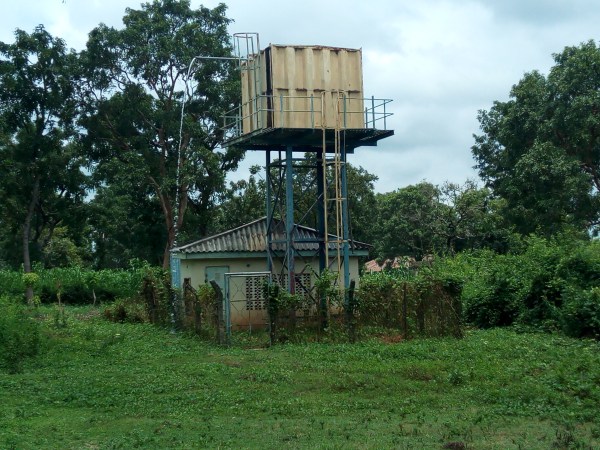
Water supply station at the centre
Our source explain further, “The cobalt is under water, like a very big pool. Because the water is disintegrating into hydrogen and oxygen, the water level is reducing and you have to be topping it every time. The water that we use in topping it is a very high pure water. It must not have any impurity. If it has any impurity, it can react with that cobalt-60 and there will still be problem.
“If the water level is not enough, it means you are having your cobalt-60 into the environment and it’s very dangerous. It will have the same effect as that of power supply.
“After the change in management, SHETSCO and NAEC was to jointly manage the workshop, water supply supply and water supply station to power the Gamma Irradiation Source and other parts of the NTC,” the DG Mr. Thomas said.
“We were supposed to be doing it together but we do the bulk of the powering. At that time, we buy a tanker of diesel every month, it was quite expensive. We were doing the bulk of it because we had moved our temporary admin office from the federal secretariat to the NTC. We feel we are the one there so we couldn’t afford to let anything happen.”
Experts who spoke to this reporter say this situation poses a great health risk to anyone around the centre. Aladese David, a nuclear and atomic physics scholar at the Obafemi Awolowo University said the supply must be constant or the management adopt other radiation shields.
“Water always stand as a hindrance to radiation. Gamma radiation is harmful to the body so the water should always be there as a shield. And you also need power to pump the water,” David said.
“The risk of radiation is very high. Skin cancer is one of the major problems that may arise. There is the tendency of cataract of the eye and many others. Most of the effects are health related. Nuclear radiation kills faster than any other radiation. It kills gradually. It is best to have excess water supply to the facility to avoid the radiation.”
He added that there are other Gamma radiation shields aside water to include copper and lead. “lead is the best gamma radiation shield,” he concluded.
Again, the Chairman of NAEC Mr. Mallam blamed the commission’s inability to contribute to funding of power supply on dearth of fund. He however, downplayed the potential of radiation risk.
“We have known the difficulties in terms of power and water supply. The main challenge is that we are running on diesel. SHETSCO will supply and we share the cost but sometimes, we both run out of resources and there is very little we can do.
“The issue is not that they are dangerous to workers or people living there, radiation sources will not fly, but the key thing is to keep the source in its particular condition. We are gradually improving and we are hoping that with releases of more funds, we’ll be able to do one of two things,” he concluded.
This investigation is supported by the John D. and Catherine T. MacArthur Foundation and the International Centre for Investigative Reporting, ICIR.
There is some unease at the National Intelligence Agency (NIA) following President Muhammadu Buhari’s appointment of Ahmed Rufai Abubakar as the new Director General of the agency.
Reports say about nine senior directors at the NIA could be retired in order to make for a smooth administration for Abubakar, who was a middle-level staff of NIA when he retired in 2012.
Premium Timesquoted “a reliable NIA source” as saying that the senior directors “cannot” work under Abubakar, who was way their junior when he was in service.
According to the report, Abubakar joined NIA in 1995. He had worked with the Katsina State Government before then.
At the time Abubakar joined NIA, the DG of the agency was Zakari Ibrahim – a relative of his — who allegedly placed him two steps higher than his level 12 grade. Abubakar left the NIA in 2013.
Now that Abubakar has returned as head of the NIA, insiders say many members of the agency’s Senior Management Committee (SMC) who were his superiors may find it difficult working under him.
“Nine directors who are members of the SMC are also seniors to the new DG and cannot therefore operate under him,” the report said.
Abubakar is said to be considering seeking the approval of the National Security Adviser to mass-retire all those who were his seniors while he was in service and are now to be his subordinates.
But those who know say the mass retirement, if approved, will be a huge loss to the agency.
“These are highly experienced and well-trained pillars of the institution; retiring them on the altar of an inappropriate appointment will be harmful to the service and the country,” the source said.
The report also said Abubakar’s appointment was against the recommendations of a panel, which Buhari himself formed to “review operational, technical and administrative structure” of the NIA, after Ayodele Oke, the former DG, was sacked on allegations of corruption.
The committee, headed by Babagana Kingibe, former Minister of Foreign Affairs, with Abubakar as Secretary, submitted its report to Buhari on December 19, 2017.
The committee recommended, among other things, that the person to be appointed as new DG “must” come “from the corps of serving directors”, adding that seniority among the directors “should be a criterion, but not a determining factor”.
According to the report, this will “stabilize the agency, restore staff morale and challenge their professionalism, improve operations and sound financial management.”
But curiously, these recommendations were overlooked by Buhari when he named Abubakar as new NIA DG on January 10
When contacted, Femi Adesina, Special Assistant to the President on Media and Publicity, directed the reporter to Kingibe, Chairman of the NIA review committee, saying he is the right person to comment on the issues as the report is yet to be made public.
Premium Times said Kingibe could not be reached, as calls to his phone were not answered and a text message sent to him was not replied.
Also, Abubakar, the new NIA DG, could not be reached.
Four foreigners — two Americans and two Canadians who were kidnapped in Kaduna State on Tuesday — have been regained their freedom.
Their names were given as Nate Vangeest (Canadian), John Kirlin (American), Rachael Kelley (Canadian) and Dean Slocum (American).
They were rescued by a squad, made up of members of the Inspector-General of Police Intelligence Response Team, the Counter Terrorism Unit and Kaduna State Police Command.
A police source told newsmen that the rescue operation was carried out on Saturday and that the foreigners are currently at the American Embassy in Abuja.
“Two suspects have been arrested and efforts are being made to arrest other members of the gang,” he added.
The victims had visited Kafanchan, a city in Kaduna State to inspect some projects, and were on their way to Abuja when they were kidnapped on Tuesday.
Two policemen who were escorting the foreigners were killed during the attack.
The Nasarawa State Police Command has released Austin Idoko, a 42-year old who allegedly raped his three-year-old relative in Masaka, a border town not far from the Federal Capital Territory (FCT) Abuja, the ICIR can authoritatively report.
Idoko (third from right, spotting black cap), a graduate of Ahmadu Bello University (ABU), Zaria, was allegedly caught naked by neighbours and parents of the little girl at a nearby riverside where he allegedly had canal knowledge of her. The incident happened on November 9, 2017 at about 9pm.
Wanda Adu Foundation, a non-governmental foundation seeking justice for the little girl and her parents, told the ICIR that the suspect was released on bail without the knowledge of the victim’s parents.
“The Police released Austin on bail without informing the complainant,” Wanda Adu, Executive Director of the foundation, said.
“On January 15, 2018, at about 3pm, the father of the girl received a call from the Superintendent of Police in Lafiya asking him to come to the station stating that the suspect was released because his family pleaded for long,” Adu said.
“Information got to us that he was released on December 23, 2017 (but) we are working to ensure that this little and innocent girl gets justice after being defiled by a man who is old enough to be her father. It is so sad how some men have turned to beasts in recent times.”
The victim’s father, who asked not to be named because of the girl, is seeking justice for his traumatized daughter.
Meanwhile, a medical report has revealed how the suspect allegedly defiled the three-year-old Kindergarten girl.
The report, issued at Asokoro General Hospital, Abuja, and exclusively obtained by ICIR, gave a clear illustration of how the toddler was harassed by her supposed uncle.
Witnesses said Idoko admitted to assaulting the girl, following which he was beaten by the search team before being dragged to Masaka Police Station, where he was detained that evening.
The father of the victim, a former chef for a one-time Governor of Bauchi State, told ICIR that he left his daughter in the care of her older siblings to take a neigbhour’s child, who had collapsed in the morning, to a hospital.
But Idoko came to pick the girl from her parents’ apartment in the evening while the father was still away. He told her older siblings, seven and 12 years old respectively, that he was going to buy snacks for their sister.
That was the last they saw of him and the girl until about 9pm when their father came back and inquired about the little girl’s whereabouts.
When none of her older brothers could say the whereabouts of their little sister, a search party was hurriedly formed and a house-to-house search began. Eventually, the party came upon both Idoko and his victim at a bush by a river.
According to the little girl, Idoko, who is not married but has a 12-year-old son, “put his finger in her private part, and later pressed her body on his lap and pushed himself in her in spite of her screams and requests for him to stop”.
The search team, comprising community members, rescued the girl, who was said to be bleeding at that moment, and she was rushed to Masaka Central Hospital immediately.
The little girl’s narrative was corroborated by a medical report signed by Uzochi Oje, a medical doctor on behalf of the head of the Pediatrics Department of Asokoro General Hospital, Abuja.
According to the report, “gynecological examination revealed, brownish sticky discharge and dried blood were seen on the vulva and vagina.
“Based on the assessment of the victim, the report concluded that “findings were consistent with sexual assault in a child.”
Another report, the Police Medical report issued at Masaka Central Hospital, where the little girl was first rushed immediately after the incident, confirmed that she was molested.
The report, issued on November 10, 2017 and signed by Nwagu V.C, a medical doctor, stated that the little girl was brought to the hospital bleeding. It also confirmed traumatic vaginal penetration of the girl by the suspect.
The girl, who is in Nursery II, was taken afterwards to the Asokoro General Hospital, run by the Federal Capital Territory administration, with a referral from Nyanya General Hospital for alleged sexual assault.
She had been taken to Nyanya General Hospital three hours after the incident but was referred to Asokoro Hospital due to lack of bed space.
In his statement at Masaka Police Station, the girl’s father said she was found with Idoko in a bush looking dirty and crying with blood stains on her body and clothes.
He told ICIR that Idoko came to his house after he was granted bail to boast about having regained his freedom.
“He was released on December 23, 2017 and he even came to my house to tell me that I thought he would die in the jail. He was insulting everyone that took part in beating and taking him to the station,” he said.
The suspect, he added, had since been hiding somewhere in Gwagwalada.
When contacted, Kingsley Anokwute, the Investigating Police Officer (IPO) who handled the case when it was first reported at Masaka Police Station, said it had been transferred to Nasarawa State CID.
Asked if he was aware that Idoko had been released, he said: “I don’t know because I’m not in Lafiya, but it is possible that he might have been released. You can go to Lafiya to confirm.”
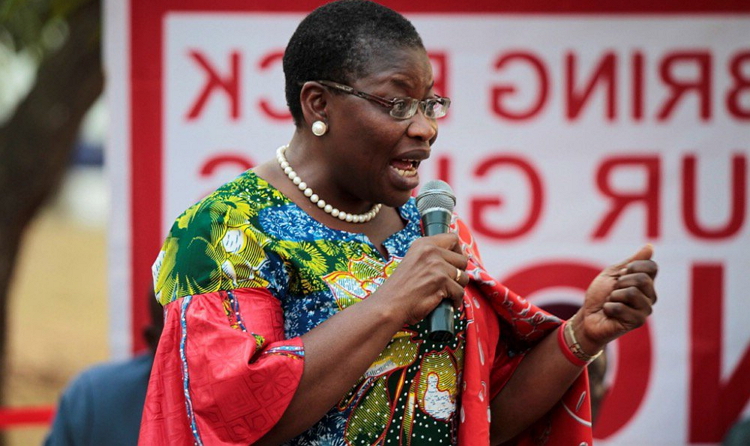
Oby Ezekwesili has remained a news staple in the country. Among the miscellany of yesterday’s men and women, she exudes the most coruscating charm. And she is like a pop-star with an affective reckoning.
I would compare Ezekwesili to Madonna, queen of pop, who for decades has kept her magic for controversy. Government will come and go, but Ezekwesili will not go out of season. She works her “relevance industry” well.
In the build-up to the 2015 presidential election, the former minister stood apart. She did not stutter in addressing the failures of the Jonathan administration. And I believe her position impacted greatly on voters in the election. I must add, she has also not spared the rod for the Buhari administration.
Ezekwesili’s words and actions hold great potency, perhaps, owing to her personal achievements and indisputable integrity. Her helming of the Bring–Back-Our-Girls (BBOG) movement gave the group the needed oomph to trudge through the mine-field of Jonathan’s government. As a matter of fact, she and members of the group did a self-less, thankless and immense job with the citizen movement. More than 100 of the abducted Chibok girls have been released owing to their campaign.
However, it does appear that the BBOG movement is scaling down its activities. If this is so, it is not out of place. The group has been on the advocacy for the rescue of the Chibok girls for more than three years. I presume one of the longest citizen advocacies in the annals of the country. Lethargy is bound to set in.
My worry is that Ezekwesili has amplified another movement (the Red-Card Movement), but which is lacking in sensibility and purposeful mission. From what I have gathered, the mission of the amorphous group is to kick out the PDP and the APC. Ezekwesili once served under a PDP government. This is by the way. The point is; that the PDP and the APC as parties share an umbilical cord of impunity is just a reflection of our society and its people. No political party in Nigeria is unblemished. Give KOWA party the government and it will do worse than the APC. This is because people make political parties; if the people do not change the situation will remain the same. This is why I urge the former minister to invest more of her time in teaching leadership to the Nigerian youth – as she does occasionally. Her amplification of the vapid “Red-Card Movement” makes me think she is on a relevance chase.
On Thursday, Justice Abdu Kafarati, Acting Chief Judge of the Federal Capital Territory, upheld the designation of the Indigenous People of Biafra (IPOB) as a terrorist organisation.
Kafarati struck out an application by Ifeanyi Ejiofor, counsel to the IPOB, who argued that since the IPOB, as an organisation was not registered in Nigeria, it could not be sued in Nigeria.
He ruled that since a foreigner who commits a crime in another country could be arrested and prosecuted in that country, then IPOB, thought not registered in Nigeria, could be sued here if found to have violated the law.
With that judgement, the status of the IPOB as a terrorist group has been affirmed, with its attendant implications.
One of the implications is that anyone found guilty of belonging to IPOB, could be liable, upon conviction, to a prison sentence of up to 20 years.
According to section 2 (3) (i) of the Terrorism (Prevention) Act, 2011: “a person who belongs or professes to belong to a proscribed organization commits an offence under this Act and shall on conviction be liable to imprisonment for a maximum term of 20 years.”
However, Subsection (4) of the Act states that “It is a defence for a person charged under Sub-section (3) of this section to prove that the organization had not been declared a proscribed organization at the time the person charged became or began to profess to be a member of the organization and that he has not taken part in the activities of the organization at any time after it has been declared to be proscribed organization.”
Also, participation in activities of a proscribed organisation may fetch one a death sentence, especially when such activities lead to the death of another.
“Without prejudice to sub-section (2) of this section, where death results from any terrorist act, the penalty shall be death sentence,” states section 4 (2) of the Terrorism Prevention Act (2011).
However, in section 33 (e) of the Act, under the ‘Penalties’, it was stated that “where death results from any terrorist act, the penalty shall be life imprisonment”.
Other penalties listed in Section 33 are as follows:
(a) in the case of an offence under Sections 1 and 10 of this Act, to life imprisonment or to a fine of not less than 150 million Naira or both;
(b) in the case of an offence under Sections 2, 3, 4, 5, 8, 9, 12 and 14 to an imprisonment for a term of not less than 3 years and not exceeding 20 years;
(c) in the case of an offence under Sections 6 and 7, to an imprisonment for a term of not less than 2 years and not exceeding 15 years;
(d) in the case of an offence under Sections 25 and 29 to a fine not exceeding N1,000,000.00 or an imprisonment for a term not exceeding five years or both.