Home Blog Page 2656

Court extends ‘killer wife’s’ prison stay to February 2018

Justice Yusuf Halilu of the FCT High Court, Jabi, has refused to grant bail to Maryam Sanda, who is standing trial for allegedly murdering Bilyamin Bello, her husband, in their Maitama, Abuja, residence last month.

Sanda is the daughter of Maimuna Aliyu, former Executive Director of Aso Savings and Loans, whose nomination to the Board of the ICPC was overturned after the ICIR revealed she was being investigated for alleged corruption by the same agency.

Though Sanda had initially been arraigned on a two-count charge of culpable homicide and tampering with evidence, to which she pleaded not guilty, the charges were later amended to include her mother, Maimuna; his brother, Aliyu, and another suspect whose name was given as Sadiya.

According to the prosecution, the newly-added defendants were the ones who had tampered with the crime scene before investigators arrived.

At Thursday’s hearing, they all pleaded not guilty to the charges against them.

Joseph Daudu, counsel to the accused persons, presented a medical report before the trial judge, urging him to grant the defendants bail, especially as Maryam, the principal suspect, is a nursing mother.

However, the prosecution team, led by Jacob Idachaba, opposed the bail application, saying that though he sympathizes with the baby, it is insufficient reason to ask for bail for the principal suspect.

As for the other three defendants, Idachaba argued that they should be in prison custody, adding however that the court should use its discretion to determine whether to grant them bail or not.

In his judgement, Justice Yusuf Halilu held that the principal suspect was strong enough to face trial, adding that the medical report presented by the defence counsel did not state that her ailment could not be adequately treatedat the prison’s medical facility.

“I have gone through the arguments of counsel for the defence and that of the prosecution as well as section 161 (2) of the ACJA relied upon by Daudu with regards to exceptional cases,” Justice Halilu said.

“However, there must be cogent evidence to show that the sickness the first defendant is suffering from is that which cannot be taken care of within the medical facility. It is not enough to include a medical certificate.

“Effort must be made to show that the defendant cannot be treated in the medical facility at the detention camp.

“I have seen from where I am, which is close to the duck that the first defendant is strong enough. The first defendant who has been inside the duck for over an hour is very strong.

“On the whole I am not favourably disposed to granting the first defendant bail. My discretion in her favour is hereby withheld.”

For the other defendants, Halilu granted them bail on the condition that they must produce “two sureties with evidence of residence within the centre of Abuja”.

“They shall deposit their travel documents in court. The two sureties shall deposit documents for their landed properties to the registrar of the court,” he said, before  adjourning the case to February 5, 6 and 7, 2018.
Governors approve $1bn from excess crude account for Boko Haram war

0


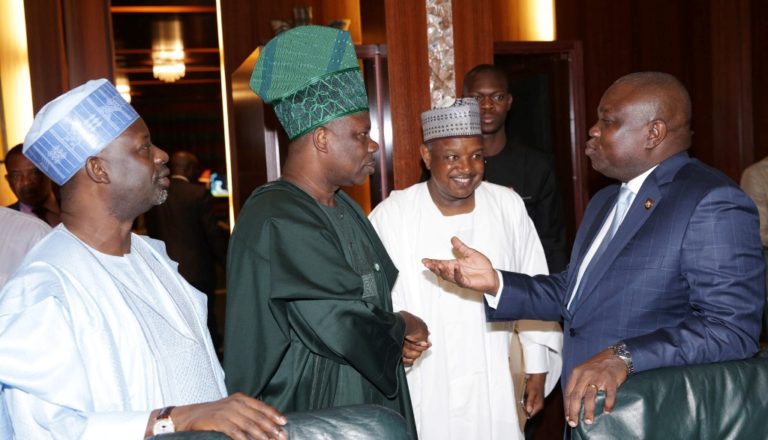
The 36 state governors of the federation have approved the release of $1 billion from the Excess Crude Account (ECA) to boost the Federal Government’s fight against Boko Haram.

Godwin Obaseki, Governor of Edo State State, disclosed this on Thursday to State House correspondents after the meeting of the National Economic Council (NEC)) at the council chamber of the Presidential Villa Abuja.

The meeting, attended by all the state governors, was chaired by Vice President Yemi Osinbajo.

“We are pleased with the Federal Government achievements in the insurgency war; and in that vein, state governors have approved that the sum of $1 billion be taken from the Excess Crude Account by the Federal Government to fight the insurgency war to its conclusion,” Obaseki said.

Hassan Dankwambo, Governor of Gombe State, who spoke earlier, said the Excess Crude Account had a balance of $2.317 billion as of December 13, 2017.


Jibrin to Buhari: Don’t let Dogara get away with the falsehood in his biography


Abdulmumin Jibrin, suspended former Chairman of the Appropriations Committee of the House of Representatives, says President Muhammadu Buhari has never met with him over the budget padding allegations he made against Yakubu Dogara, Speaker of the House.

Jibrin, who made this known in a series of tweets of Thursday, called on Buhari to “make clarification if indeed such event ever took place”.

He was replying to comments attributed to Dogara in his biography, written by Dele Momodu and set to be presented to the public on December 22.

The biography, titled ‘A Reed Made Flint’, claimed that after Jibrin had accused Dogara and other principal officers of the house of budget padding, Buhari met him and warned him never to raise such arguments again if he had no evidence to substantiate his claims.

“Although Hon. Jibrin himself had subtly blackmailed Mr President on a Channels TV interview, he still managed to get some elements in the security services to ferry him before Mr. President where he made the allegations of padding against us,” Dogara was quoted as saying in the book.

“As a principled and experienced leader that the President is, he sought to know where the other leaders of NASS were when the budget was padded by just four leaders of the house.

“None of our traducers could answer the question. Since he does not suffer fools gladly, he told them that except they answer the question nobody should bring up the subject matter to him again.

“That was how the lying cowards left him and never returned. They dare not mention anyone in the Senate or the House Leadership when every informed person knew that no position on any aspect of the budget can be taken without the concurrence of the Senate.”

But in his reply, Jibrin said: “Mr President is known for his integrity and disdain for lies. It will be in the public interest if he respectfully makes clarification if indeed such event ever took place. It will be a huge disservice to the country if Speaker Dogara is allowed to get away with such falsehood.

“Moreso that Mr President wrote the forward to the book and by implication giving some validity to such falsehood against himself as well.

“After writing 3 letters to Mr President seeking audience without response, I gave up. I did my best and left everything to the anti-graft and security agencies.

“The false allegations in the book has left me with no choice than to speak out as my last resort to clear such lies.

“It will be unfair to me if we allow Speaker Dogara in continuation of his witch hunt against me after keeping me illegally away from the House for 15 months to use the name of Mr president in his expensive image laundering in an attempt to clear himself of any wrongdoing.”

Jibrin said he had been in court for the past 15 months challenging his illegal suspension from the House. He called on Buhari “to appeal to Chief Justice of the federation on our behalf for speedy dispensation of justice in this matter of utmost national importance”.

“We challenged the suspension in court with an originating summons. It’s a constitutional matter. The case has been in court for 15 months,” Jibrin said.

“A similar case in respect of Sen Ndume was dispensed with within three months by the court! We don’t want to believe something is wrong.”

VIDEO: It’s a baby boy for Nigerian migrants who fell in love at Libyan cell

Two Nigerians, Stephen Ekhiator and Mabel Emmanuel, met at a migrants’ detention camp in Libya and fell in love with each other. Today, they have a son together.

Ekhator narrated to BBC Africa how he had tried several times to cross the Mediterranean sea into Italy but could not succeed.

“You cannot determine your wife to be, or where you can find her. It can just happen suddenly,” Ekhiator said.

“He [his son, David] was born inside the deportation camp. We were in the deportation camp together when she [his wife] was giving birth.

“I felt bad; every day I cried. I couldn’t even eat. I must say Libya is a prison, a life where there is no freedom.

“I have tried [crossing the sea] five times; I failed. Twice my boat capsized on top of the sea. What I will tell people that want to go (to Libya) is, ‘never even think about it.'”

Ekhiator then burst into a song in pidgin English: “Who no go no go know, who no go no go wetin we see.” Then he adds: ”That’s how we always sang it in the deportation camps.”

Thankfully, however, Ekhiator and Mabel are part of the migrants who were recently repatriated to Nigeria following the intervention of the International Orginisation for Migration (IOM)

Watch the video below, courtesy of BBC Africa:


My client has been paid and he didn’t run mad, says Ikoyi whistle-blower’s lawyer

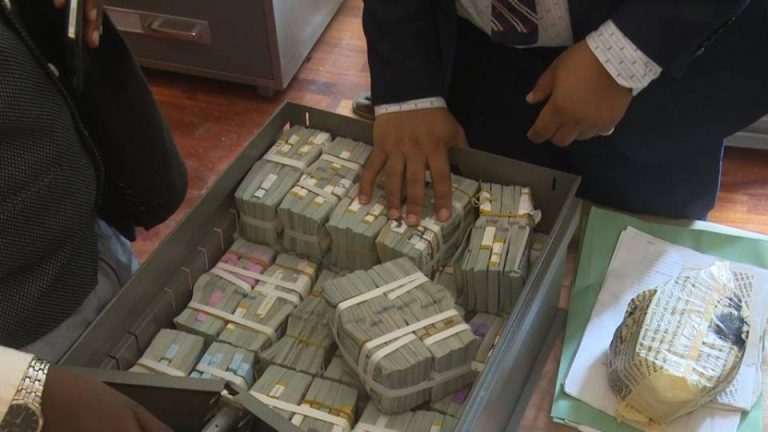
Yakubu Galadima, the lawyer of the whistle-blower who provided information that led to the recovery of about N13 billion from a residential apartment in Ikoyi, Lagos, says his client has received the first tranche of his reward by the Federal Government.

Galadima told journalists that his client did not run mad on receiving his payment, contrary to the predictions of Itse Sagay, Chairman of the Presidential Advisory Committee on Anti-Corruption (PACAC).

Sagay had said that FG delayed payment of reward to the whistle-blower because he could have run mad if such huge amount of money was paid to him at once.

Galadima also said the whistle blower travelled out of the country hours after receiving part of the N421m reward.

“My client confirmed to me that he had received a credit alert from the Federal Government. He travelled out of the country this morning (Wednesday morning).

“He has been paid the first installment but there were many tax deductions. Yes, we are happy.

“I will give you details later but I can confirm now that he has received some money. As you can see, my client did not run mad as predicted by Prof. Itse Sagay.”

Galadima praised the government for keeping its promise, adding that the payment of the reward to his client signifies government’s commitment to the whistle-blower policy.

A couple of weeks ago, Kemi Adeosun, Minister of Finance, had said the money for the payment of reward to whistle blowers had been approved.

She said the money would be paid directly into the whistle-blower’s account and not that of his lawyer or anybody else’s.

Adeosun also said that all the taxes accruable on the amount would be paid directly into the account of the state government where the beneficiary resides.

In April this year, the EFCC recovered huge sums of money in local and foreign currencies – totaling N13 billion – from flat 7bn, Osborne Towers, Ikoyi, Lagos State, following an intelligence from a whistle-blower.

Ayodele Oke, former Director-General of the National Intelligence Agency (NIA), laid claim to the money saying it belonged to the agency.

According to Oke, the money was approved for the NIA by President Goodluck Jonathan in 2015 to enable it carry out some “covet operations”. But Oke could not satisfactorily explain how and why the money ended up in a residential apartment allegedly owned by his wife.

Attempts to arrest Oke last week was unsuccessful, as DSS and NIA operatives stationed at his Maitama, Abuja residence refused to cooperate with the EFCC personnel that came for the operation.

In biography written by Momodu, Dogara addresses budget padding allegations

Yakubu Dogara, Speaker of the House of Representatives, says he never interfered with the 2016 budget or tried to exact undue influence on the House committee on appropriation, then headed by Abdulmumin Jibrin.

Dogara made this known in his biography — A Reed Made Flint — written by ace journalist Dele Momodu, a copy of which was obtained by TheCable newspaper ahead of its public presentation scheduled for December 26.

Sometime in July 2016, shortly after he was removed as Chairman of the appropriation committee, Jibrin began making series of allegations against Dogara and three other principal officers of the House: Yusuf Lasun, Deputy Speaker; Alhassan Doguwa, Chief Whip; and Leo Ogor, Minority Leader.

Jibrin alleged that the four lawmakers illegally inserted phantom projects worth hundreds of billions of naira into the 2016 budget.

He was later suspended from the House for 180 legislative days after he refused to withdraw the allegations.

But in his biography, Dogara said he never even knew what was in the budget, as he trusted that the appropriation committee, under Jibrin’s leadership, was competent enough to handle the budget.

“My kind of nature is not the kind that insists on breathing down your neck, having given you an assignment,” Dogara was quoted as saying in the book.

“So, attempting to interfere in everything committees are doing was not my line. I believe in giving everyone considered competent enough to handle posts to thrive in them.

“I don’t believe in making my colleagues feel distrusted. I give you that freedom to do your work. Having trusted you, I will not bother you too much. I never went to Jibrin to ask for anything in the budget. Never! Even once!”

“Occasionally both leadership of the Senate and the House would meet and ask [Danjuma] Goje [Chairman of the Senate Appropriation Committee] and Jibrin to give the position of things, how discussions on the 2016 Budget were going on, how they were doing and so on and so forth.

“But I gave him absolute free hand to operate. He did that up to a point that the Budget was written and compiled I hadn’t seen anything.

“I didn’t know what was there. As a matter of fact I didn’t even know the kind of projects that he has included for me or any other person in the Budget.

“I was even in London when they submitted the details to the President for his assent. It was only after I got back home that Jibrin brought the details of the budget to me for the very first time.

“Absolutely, I had no hand, no prior meeting with the committee. I didn’t sit with them at the secretariat to say ‘Oh, include these projects for me. You must do this. You must do that.’ Never! Even for a day.”

Dogara admitted that Jibrin, who had supported Femi Gbajabiamila in the run-up to the election of the House Speaker, later defected to his team and supported him 100%.

“I will say that although Honourable Abdulmumin Jibrin wasn’t with our team initially, he later supported me 100%, wholeheartedly. Luckily his secretariat wasn’t far from ours and he was handy.”

Dogara, however, added that people had warned him that “it is suicidal to entrust such an important post (of appropriation chairman) to such a man” as Jibrin, but he never listened.

SETBACK: Anti-NGO bill records zero support during public hearing

The Non-Governmental Organizations Regulatory Commission (Establishment) Bill has suffered its first major setback, recording zero support during Wednesday’s public hearing at the House of Representatives.

The bill, which was introduced by Umar Buba Jibril in June 2016, had passed the first and second readings despite several protests by NGOs.

At the hearing on Wednesday, Peter Akpatason, Chairman of the House Committee on Civil Society Organisations and Development Partners, asked the audience whether anyone supported the bill but no one answered in the affirmative.

Outside the national assembly complex, a crowd of protesters comprising members of the civil society and NGOs bore placards and chanted songs urging the House to kick out the bill.

Speaking at the hearing, Hassan Kukah, the Catholic Bishop of Sokoto Diocese, said he decided to lend his voice to the call for the withdrawal of the NGO bill because he was convinced that there are existing laws that already captured everything the bill seeks to achieve.

“I stand with civil society very firmly,” Kukah said. “We have enough laws already to cover every sphere of the country.

“The intentions might be right but I think we can channel our energy to other things.

“Without civil society, democracy will be in danger in Nigeria. We have so many laws covering what this bill is seeking to do.”

The NGO bill has been roundly criticised by many Nigerians who believe it was a sinister move by the legislature to gag civil society organisations.

Among the major opponents of the bill is Chidi Odinkalu, former Chairman of the National Human Rights Commission (NHRC), who has written extensively and produced video clips to sensitise Nigerians on the dangers of allowing the bill get passed into law.

Akpatason promised that his committee would make its recommendations to the House in plenary without prejudice.

I almost moved Nigeria’s capital to Jos, admits Gowon

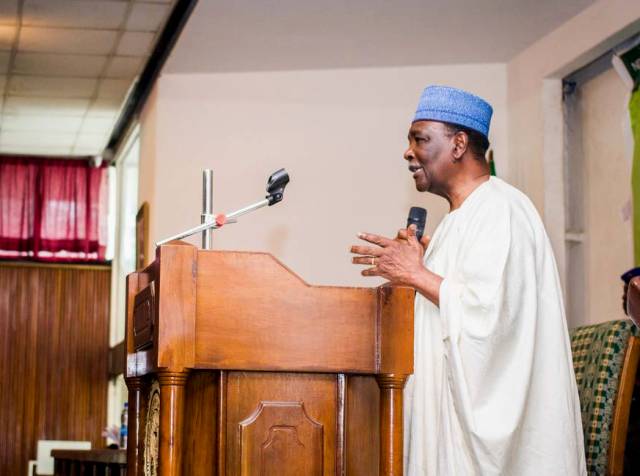
Yakubu Gowon, former Military Head of State, says he almost relocated Nigeria’s capital from Lagos to Jos, Plateau State, after his administration first mulled the idea in 1974.

Speaking at an exhibition organised to mark the 26th anniversary of the relocation of the capital to Abuja, Gowon regretted that he was not the one who eventually completed the movement.

He said the choice of Jos as a capital city appealed to him because of the beauty of the city, but he thought that Nigerians would have seen the decision as sentimental.

Gowon became Head of State in 1966 after the murder of Aguiyi Ironsi in a bloody coup d’etat. He was, however, overthrown in 1975 in a bloodless coup that ushered in Murtala Mohammed.

“I had powers to make Jos, and not Abuja, the capital of Nigeria but refused to do so because I was not prepared to be clouded by sentiments and selfishness,” Gowon said at the event, titled ‘From Dodan Barracks to Aso Rock’.

“One of the places I saw that attracted me was somewhere in Plateau. Those of you who know the place, especially close to Jos Forest, will agree that the area is beautiful and I thought that place was beautiful for the capital city.

“But I did not make that choice because I would have been accused of parochialism and favoritism, because it was very close to the original place where I come from.

“I must look at other places, the search for a new capital took me round the North-west, and in my state, I continued to look for other places. When I came to Abuja, I was attracted.”

However, it was not until December 12, 1991, under the regime of Ibrahim Babangida, that the relocation of the Nigerian capital from Lagos to Abuja was completed.


READ ALSO:


CLOSE-UP: Itodo, Odeogbola, the Nigerians short-listed for Global Teacher Prize

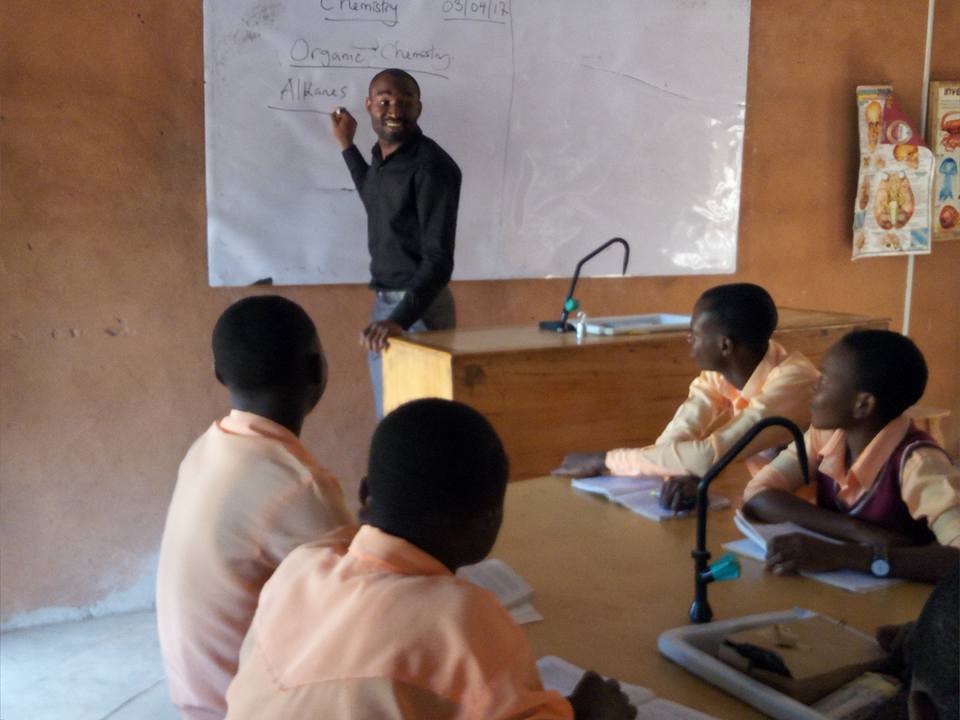
Two Nigerian teachers, Itodo Anthony from Gateway Excel College Otukpa, Benue State, and Ayodele Odeogbola from Abeokuta Grammar School, Ogun State, are among the 50 teachers shortlisted from across the world for the 2018 Global Teacher Prize.

The award, which comes with a $1 million prize money, was set up by the Varkey Foundation “to recognize one exceptional teacher who has made an outstanding contribution to the profession”.

ITODO, UK MASTER’S DEGREE HOLDER WHO TEACHES IN A VILLAGE

A young man who had his first degree in Petroleum Engineering at the University of Port Harcourt, and went ahead to Study Reservoir Evaluation and Management for his Master’s at Heriot-Watt University, Edinburgh Campus, Itodo Anthony is a Chemistry/Physics Teacher at Gateway Excel College, Ogeneago Otukpa, a small rural school in Benue.

Not many people understood why Anthony would get a Master’s degree from a UK university and end up teaching in a village for “peanuts”.

His mission is to elevate the teaching profession to a place of pride, to say with his own life that the profession is a noble one whose value is not tied to how much we earn.

In class, he introduces positive values from other parts of the world to broaden their view of life.

In May 2017, Itodo founded New Frontiers Youth Forum, a community-based organisation for the youth. This organisation welcomes membership from young people aged 13 to 35 , and the aim is to raise an army of young leaders who will act as positive change agents within the community.

Itodo is an exceptionally brilliant, multi-award-winning essayist. But his number-one strength is that he is a young man who breathes teaching. An avid Facebook user, majority of his posts are about his pupils and the teaching profession. He is reputed for consistently soliciting funds for indigent students, for prizes to endow awards of excellence for his outstanding pupils, for driving the kind of technology that simplifies teaching and eases learning for students.

ODEOGBOLA USES TECHNOLOGY TO IMPROVE STUDENTS’ OUTCOME

A graduate of Tai Solarin University of Education, with more than 10 years of experience in teaching in public-sector education, Odeogbola has an unparallelled passion for technology, innovation, and global best practices to transform the Nigerian education system.

Ayodele, who teaches STEM (Science, Technology, Engineering and Mathematics) Education and Global Studies at Abeokuta Grammar School, Ogun State to pupils aged 11 to 15, is passionate about developing his students to become future leaders and stakeholders in the world.

Rather than teach the same thing in the same way to all, he adapts his methods to match the different needs, potentials and learning paths of each pupil.

“For every human challenge in the new world we live, there is always a technological solution,” Ayodele believes.

He has brought technology industry experts into his classroom, and linked his class using Skype and social media to peers in schools in India and Lebanon.

Ayodele was nominated among the world’s best teachers in the Microsoft’s 2014 class of Mentor Schools and the Inaugural Class of Expert Educators.

In 2012, he was first runner-up in the category ‘Teaching as Innovator and Change Agent’ at the Microsoft Global Partners in Learning Forum.

“I hope to make a difference in education in Nigeria. There is not a lot of budget for education in the country, but I believe that access to technology can level the playing field for children from all backgrounds,” he said.

A total of 30,000 nominations were received from 173 countries of the world, out of which 50 persons were initially shortlisted.

The winner will be announced at the Global Education and Skills Forum in Dubai, the UAE, on March 18, 2018.

EXTRA: Mother and son called to bar one day apart

A rare story dream come true has seen two members of the Nwadiogu family being called to the Nigerian Bar just one day apart.

Uchechi Nwadiogu was already a level-15 civil servant as a court registrar when she decided to return to the university to pursue her girlhood dream of becoming a lawyer.

Coincidentally, her admission to study law at Abia State University, Uturu, coincided with that of her son Bernard, to study the same course at the Nnamdi Azikiwe University, Awka, Anambra State.

She narrated to BBC Pidgin how she had applied for law during her younger days, but was offered English Language instead.

All attempts to switch over to her course of first choice did not succeed, so she decided to finish her English programme while not discarding her dreams of becoming a lawyer someday.

After her first degree, Uchechi got married and started raising a family, and it appeared her dream may never be realized.

But as fate would have it, she summoned enough conviction to return to the classroom and even graduated top of her class. She was called to the Bar on Tuesday, while her son’s holds on Wednesday.

Describing the development as “dream come true”, Uchechi urged young people not to give up on their dreams as no time is late to pursue one’s passion.

“Young people must not limit themselves,” she told BBC pidgin. “Some people limit themselves, and if you limit yourself you will be limited.

“If I had limited myself, perhaps saying I’m already a level-15 civil servant, I won’t be a lawyer today.

“Some people may ask me what I’m still looking for, but I realized I could still achieve greater things and become better than I am presently. So everyone must always strive to improve as there is no limit to improvement.”