Home Blog Page 2659

COMPILED: Rape, violence, murder… the many sins of SARS

For days, Twitter has been agog with an online protest against the “unethical and unprofessional conduct” of men of the Special Anti-Robbery Squad (SARS) of the Nigerian Police Force.

The hashtag ‘#ENDSARS’, championed by popular Twitter user Sega Awosanya, has been trending on the social media for days, many narrating their ugly and sometimes near-death experiences at the hands of SARS officials.

They seemed to be endorsing the claims, in October, of Nyesom Wike, Governor of Rivers State, that SARS operatives were responsible for many cases of the armed robbery, kidnapping and murder in the state.

Though the allegation was denied by Ibrahim Idris, the Inspector General of Police, cases abound where ordinary citizens had been manhandled by men of the SARS.

“People are not supposed to be afraid of the people that are supposed to be looking after us. A couple weeks ago, at almost midnight, my friends and I had a gun pointed at us for laughing. For laughing. ,” wrote Simisola Ogunleye, a music superstar popularly known as Simi.

The #ENDSARS campaign started after a Twitter user narrated how a young man in his neighbourhood was gunned down on Thursday by SARS operatives.

But Abayomi Sogunle, an Assistant Commissioner of Police in charge of the Police Complaints Rapid Response Unit at the Force Headquarters in Abuja, waved the complaints aside, describing the complainant as a dreamer.

“To all those having frightening dreams- “shot/beaten by police”. Pray to God not to allow it happen + avoid areas where police are responding to incidents in real life. If such dreams persist, GO SEE A PSYCHIATRIST. We only deal with real life police complaints @PoliceNG_PCRRU,” Shogunle wrote.

But what followed was barrage of criticisms and similar narratives of SARS highhandedness on civilians.

Folarin Falana, the superstar son of Femi Falana, Senior Advocate of Nigeria, wrote “The entire police force needs some serious revamp. SARS are particular notorious for brutal attacks on innocent youth. The police is not our friend .”

Another musician popularly known as African China posted a video of a SARS operative pointing a gun at him and threatening to shoot him.


See a compilation of the anti-SARS tweets below:

Obstetrician reveals how FGM caused a couple to unknowingly engage in anal sex


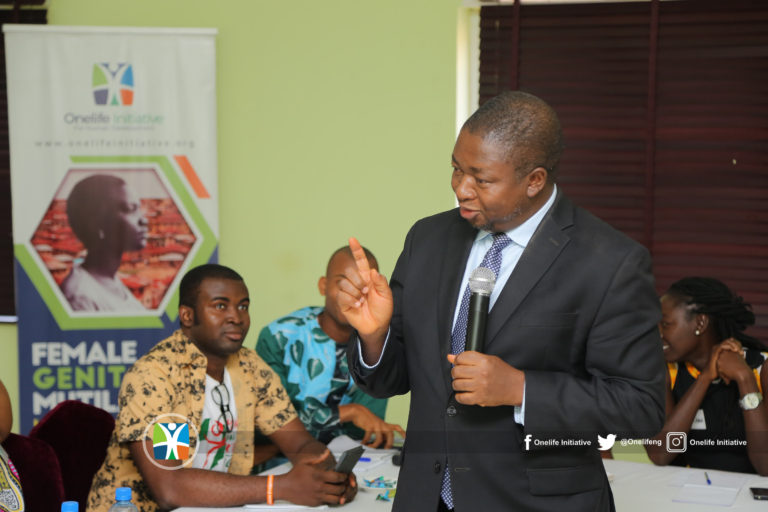
Ileogben Sunday-Adeoye, a Professor and Chief Medical Director of the National Obstetric Fistula Centre, Abakaliki, Ebonyi State, has charged journalists to tell the stories of survivors of female genital mutilation (FGM) in a bid to end the harmful traditional practice.

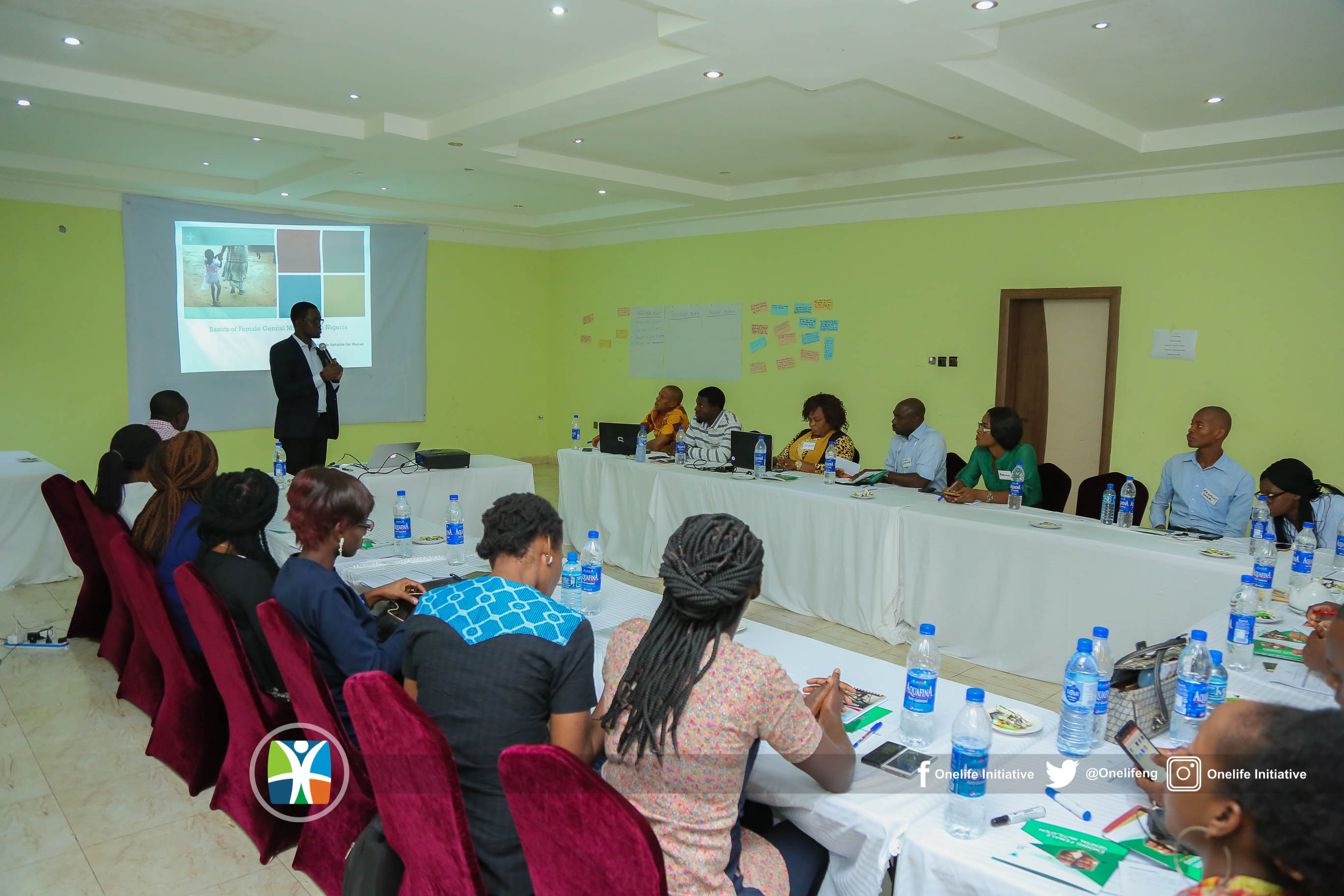
Speaking in Enugu at a three-day workshop for radio journalists from 19 states, organised by Onelife Initiative for Human Development, Adeoye shared various heartrending experiences with the participants, including that of a couple who had hitherto been having anal sex without knowing, as the woman’s vaginal opening was already blocked because of the type of FGM done on her.

“FGM aborts the reproductive career of girls even before the career starts,” Adeoye said.  “I know how much journalists can galvanise action towards ending this practice.

“You need to share FGM prevention messages and also get survivors to tell their stories. Your programmes should hold even traditional institution, clergies, and politicians accountable in a bid to end FGM.”

Sola Fagorusi, Programmes and Media Manager of Onelife Initiative for Human Development, said the training was the second edition of the End Female Genital Mutilation Media Campaign Academy supported by Human Dignity Foundation and the Global Media Campaign to End FGM.

Fagorusi addressing the participants

Fagorusi said the academy’s goal is to arm radio journalists with factual information on FGM in Nigeria with attention on the health, cultural and religious dynamics to the practice.

“Our choice of radio journalists is also premised on the last mile reach of radio and the accessibility of its channel to all stratification in society,” he said.

“The rich, poor and middle class all listen to radio and that’s why we hope radio journalists are best to take this information farther so that the behaviour change we anticipate can start, and we can end FGM in one generation.”

FGM refers to all procedures that involve the total or partial removal of all or part of the external female genitalia for cultural or non-medical reason.

Nigeria has the highest population of girls and women who have had FGM and recent figures show that about about 19.9 million girls and women in the country have been affected, out of the global estimate of 200 million.

A major concern at the training was the growing number of medicalization of FGM — a situation where FGM is practised by any category of healthcare provider, as Nigeria currently has a medicalization prevalence of 13%.

Facilitators at the academy came from within and outside the country while the participating journalists promised to use their platforms to reduce the FGM practice in the country.

BudgIT Tracka: Millions taken but projects abandoned in Delta, Cross River

0

CROSS RIVER

Every community has the right to social amenities, but these needs were not being met in several communities visited by the Tracka team.


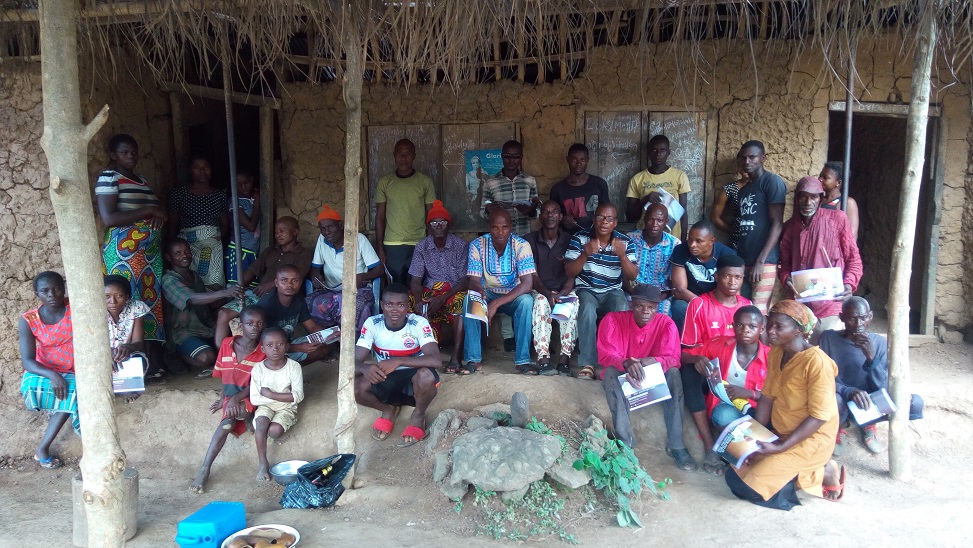
The sorry tale of Osakan, a community located about 15 kilometers on a muddy footpath accessible only with motorcycle from Obubra, headquarters of Obubra Local Government Area of Cross River State, is a classic example. Ordinarily, the proximity of the community to the headquarters should attract social amenities, but that is not the case.

The visiting Tracka team conducted a sensitisation exercise to create awareness on the construction of motorised boreholes with steel overhead tank, including 10 tap outlets and a 2.5kva generator worth N15 million captured in the Federal Government’s 2017 constituency projects, but which had not been implemented.

Tracka is a citizen-driven platform that allows citizens to monitor capital projects in their communities, in a bid to strengthen transparency and accountability in governance whilst compelling elected representatives to improve service delivery in their constituencies.

During the visit, Osakan residents were sensitised and encouraged to engage with their representatives and demand updates on project implementation. A youth in the community made a phone call to their representative, Hon Michael Irom Etaba, after reading through the publication shared to the residents which contained details of projects and contacts details of their representatives at the National Assembly. However, the representative did not answer the call. The young man reported that this had always been the case.

“The representatives usually don’t respond to our calls except during election campaigns when they need our votes,” he said.

While speaking with BudgIT’s Project Tracking Officer Obono Abel, Community Head Chief Andrew Ogar narrated the bitterness of life in the community.

He stated that there was no access to pipe-borne water, hence members of the community suffer from waterborne diseases such as cholera, diarrhea and guinea worm since they fetch water from a stream that is usually contaminated in periods of heavy downpour. He added that residents of the community always walked a long distance to access potable water, making life difficult for the indigenes.

Chief Ogar also stressed the healthcare gap caused by the non-availability of a good healthcare centre.

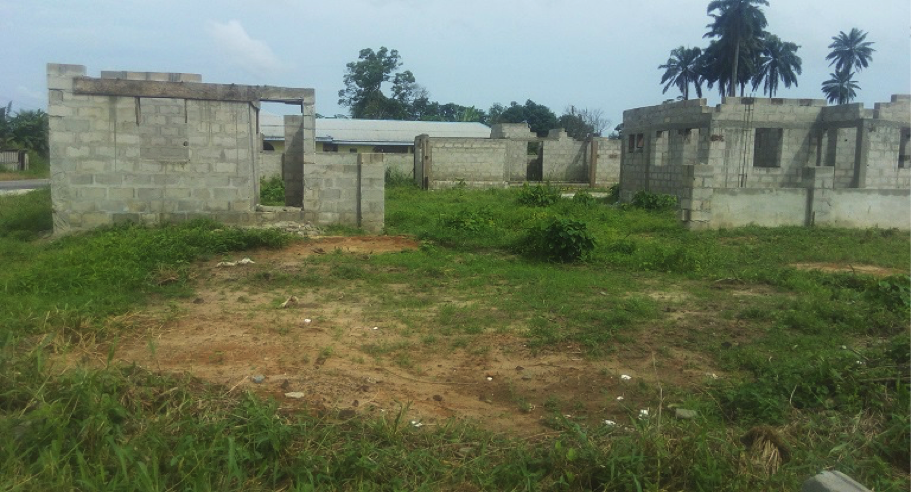
“A community healthcare centre, which has been under construction for over five years and has now been abandoned, would have saved pregnant women and members of the community the stress of travelling long distance to neighbouring communities for antenatal and other medical treatments,” he said. “This situation has been going on for a very long time and has made the health of the members of the community deteriorate as the years went by.”

Also, the absence of motorable roads in the community cannot be overlooked. It has limited public access to the community.

“As you must have seen on your way to our community, the roads have been like that for ages, Chief Ogar added.

“It has never been graded by the government. We have written to the local and state governments to help in the construction of roads in the community but up till date, nothing has been done.

“Another challenge we face is lack of electricity supply. We have been in darkness since the existence of this community. We exercise our civic rights but the government is not making any effort to give back to the people who got them elected and also pay taxes to sustain the system of governance.”

DELTA

Town hall meeting at Osakan, Cross River State

In the 2016 budget, N60 million was earmarked for the execution of a primary healthcare centre but remains undone in Ekrota even though the health conditions of residents continue worsening.

Tracka is a citizen-driven platform that allows people, irrespective of their locations, to collaborate, track and give feedback on public projects around them. It seeks to drive value out of the annual budgets, to ensure that allocations translate to real development in Nigerian communities.

The project line items bore three communities — Ophori-Agbaro, Erhuwaren and Ekrota — for N60 million. Its implementation is expected to create a swift access to healthcare treatment for the people of the communities and to free indigenes from travelling over three hours to neighbouring towns just to access medical treatment, especially for pregnant women in labour and emergency patients.

Health facility is an important safety-net healthcare delivery for vulnerable residents. It is geared at reducing maternal mortality rates and integrated service delivery for mothers and children, antenatal and postnatal.

BudgIT’s Project Tracking Officer Andrew Ebigwu visited the communities to inspect the project sites in August 2016; there was no visible construction in sight. As a result, we engaged the leaders and residents of the communities to write letters to the lawmaker representing Ughelli North/South/Udu Federal Constituency and the Ministry of Health.

The Tracka team re-visited the communities in March 2017 to the hearty discovery of ongoing construction work in Erhuwaren and project completion in Ophori-Agbaro. However, there was still no visible construction at Ekrota community; it was left deserted.

It was also observed that the construction work at Erhuwaren was abandoned halfway due to insufficient funds. The completed health facility at Ophori-Agbaro was also under lock with no medical equipment available; also, no healthcare worker had been mobilised to ensure functionality.

Research reviewed that construction of Comprehensive Health Centre was recaptured in 2017 Budget for N50 million in Ekrota community. We re-visited Ekrota to inform the people about this development and encourage them to persistently pursue the execution of the project, bearing in mind its economic importance to the indigenes.

The engagement exercises were repeated and letters were sent to Honourable Ahwinahwi Solomon and the Ministry in charge of the project. The proposed land for the primary healthcare centre had been made available by the community leaders since the first sensitisation visit by the BudgIT’s Officer. We await the response of the authority and we will simultaneously follow up the project closely to ensure execution as specified in the budget.


Court orders arrest of Chimaroke Nnamani, ex-Enugu governor

A Federal High Court in Lagos has issued a bench warrant for the arrest of Chimaroke Nnamani, former Governor of Enugu State.

Justice Chuka Obiozor issued the warrant on Monday, following Nnamani’s failure to appear in court for his corruption trial.

Nnamani was alleged to have embezzled N4.5 billion of Enugu State funds during his governorship tenure between 1999 and 2007.

He was first arraigned in 2007 alongside one of his aides, Sunday Anyaogu, but the charge was later amended to N5.3 billion

At Monday’s hearing, Nnamani’s lawyer informed the court that his client had undergone a heart surgery in the United States of America, and tendered pictures to support his claims.

However, the prosecution counsel told the court that the photographs tendered by Nnamani’s lawyer were taken in 2014 and can no longer be used as an excuse.

Delivering his ruling, Justice Obiozor said the defendant’s lawyer had not given any reasonable evidence as to why his client was absent in court.

PDP’s golden chance to become Nigeria’s ‘necessary evil’

0

We know already that life is filled with ironies, but no one would have imagined that the most important elective convention in the life of the Peoples Democratic Party (PDP) would coincide with the International Anti-Corruption Day. PDP and anti-corruption are like daylight and night-time; ordinarily, their paths should never interweave.

Without trying to excuse President Muhammadu Buhari’s unidirectional anti-corruption campaign, PDP is at the heart of corruption (and every other shortcoming of democracy) in the Fourth Republic. Since leaving power, Olusegun Obasanjo — and he should know, being the biggest beneficiary of PDP’s ascent to power — has been unable to hide his disdain for the pervasiveness of corruption in the legislature. The only thing he hasn’t done is to expressly blame his then party; not that we need that information — until 2015, the same legislature frequently maligned by Obasanjo was dominated by PDP lawmakers.

The lawmakers are quick to return the favours. Obasanjo it was who schooled them in the art of corruption, they often say, reminding him of how he wooed the legislature with cash in an attempt to push through his failed third term bid. None of this is new information.

PDP’s legacy of corruption has outlasted its 16-year rule. There is the Siemens bribery scandal, featuring shady payments of a total €1.3bn to a Minister, Senator and other Federal Government officials who, by the way, are still walking free. There is the stupendously messy Halliburton scandal involving the bribery of elected officials in the Fourth Republic, and dating back to the military era, to the tune of $182m. These are the more obvious, internationally-embarrassing cases. In states, ministries, agencies and the central government, there are so many PDP-era corruption cases that even the EFCC and ICPC must have lost count.

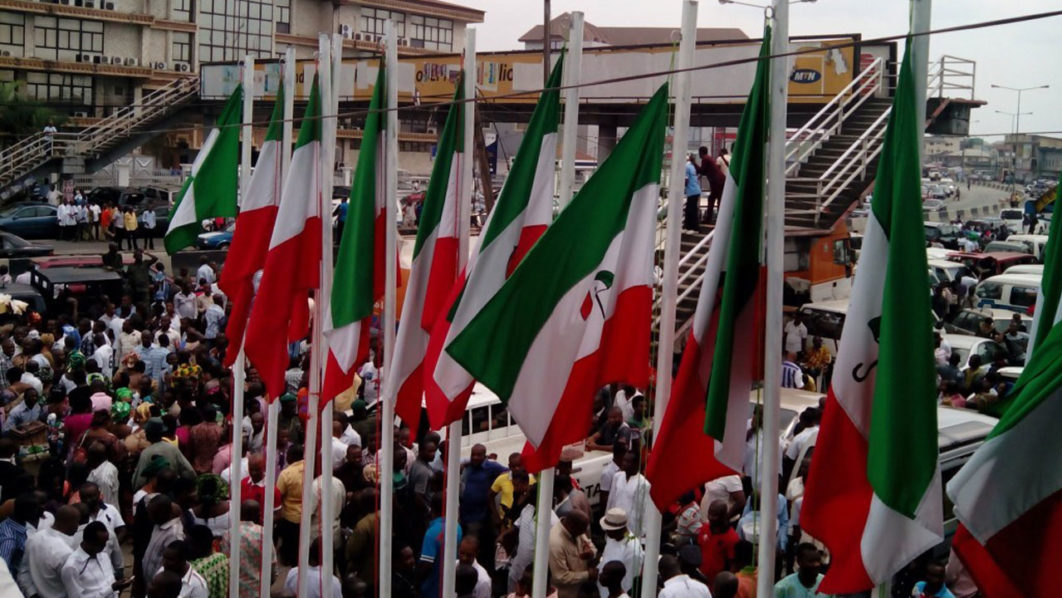
Yet, on December 9, the day set aside since 2003 by the United Nations to raise global awareness of the consequences of corruption, PDP will begin a two-day convention that will culminate in the emergence of its National Chairman and other principal officers. This is by far the party’s most crucial convention ever, and it’s not hard to explain.

For two-and-a-half years into his tenure, Buhari has operated in a one-and-a-half-party democracy. PDP, the half, has failed to muster a quarter of the engagement it endured from the APC in its own years of rule. Of course, the quality of that engagement was often lacking in intellectual depth and was more propaganda than fact-based, but there was something at least. So far, Buhari has, to a large extent, been unchallenged by an opposition; and it could worsen — not for Buhari but for our democracy — if PDP doesn’t speak with one voice from December 10. It could mean that Buhari walks into a second tenure practically unchallenged or maybe weakly challenged — a scenario that would defeat the very essence of democracy. If Buhari wants to be President in 2019, he must work hard for that ticket. Very hard. This is why even those who detest the PDP must be interested in this convention.

PRE-ELECTION BICKERING

The buildup to the convention has been a huge cause for concern. Desperation for the ‘juicy’ position of National Chairman is threatening to derail the progress recently made by the party, following a long stretch of internal tussle that clearly had the markings of APC pulling the strings from hiding. The zoning (or incomplete zoning) of the position to the South threatens to spark a post-convention crisis or the staging of a parallel convention.

The chairmanship aspirants from the South-West, led by old guard Olabode George, want the position zoned to their exact geopolitical zone, but Raymond Dokpesi and Uche Secondus, a former Acting National Chairman, argue that the South-South had never produced a substantive PDP Chairman.

While Dayo Adeyeye, National Publicity Secretary, has been boasting that the PDP would “organise the most credible party election in the history of Nigeria”, a convention Chairman has yet to be agreed upon due to aspirants’ suspicion about the interests and intention of possible candidates for the post. Calls for the resignation of Ahmed Makarfi, Chairman of the caretaker committee, have recently intensified, providing an extra reason to fear for the post-convention unity of the PDP.

SAME OLD, SAME OLD

Much as this won’t be in the interest of the country, it’s hard to see PDP playing anything more than the devil’s advocate in the 2019 presidential election. Just take a look at the chairmanship aspirants: Rasheed Ladoja, Jimi Agbaje, Tunde Adeniran, Raymond Dokpesi, Gbenga Daniel, Uche Secondus. Each of them has been Minister or Senator or Governor or governorship aspirant in the past. No breath of fresh air.

What, for example, is someone like Bode George doing anywhere close to places where serious conversations about the next PDP Chairman are holding? Someone of his public-office standing — he’s retired from the Navy, been Military Governor of Ondo State, been chairman of the Nigerian Ports Authority, been National Vice Chairman and Deputy National Chairman of the PDP, has gone to prison (for four years) and come back — should be working for the PDP from the background. Even Adamu Ciroma’s wife, Maryam, wants to be Deputy National Chairman! Husband and wife have been Minister of the Federal Republic at different times, just to mention one of the many plum national positions that have been shared between them.

Apparently, PDP has misdiagnosed the reasons for which it lost the 2015 election. Having been rejected by the people ‘against the run of play’, despite the war chest at its disposal in 2015, the party should have known, by now, that its desperately-needed rebranding cannot happen with the same faces that defined its most recent era. By now, the names associated with the party should be people brimming with ideas who haven’t been the faces of the party in recent years — people against whom the public holds no grudge as of yet.

If the PDP hopes to contest the 2019 election with the likes of Ahmed Makarfi and Atiku Abubakar, then the contest would have been over way before its start, and the PDP’s sojourn to political oblivion would have begun to earn some permanence.

But before then, its one final debt to Nigerians is to hold a free and fair convention on Saturday and stay united thereafter (or at least pretend to be). Nigerians will keep an eye on this convention — not necessarily because we love the party that PDP is, but because it’s our most realistic chance of not getting stuck in one-way election traffic in 2019.

The PDP can be Nigeria’s necessary evil for at least another two years; we can’t throw it away just yet, regardless of our misgivings against it. For once, this party cannot disappoint Nigerians. Having failed as a ruling party, it must not make a mess of opposition politicking.


Soyombo, Editor of the International Centre for Investigative Reporting (ICIR), tweets @fisayosoyombo

SERAP gives Buhari 14 days to investigate privatization under three ex-presidents


The Socio-Economic Rights and Accountability Project (SERAP) has asked President Muhammadu Buhari to revisit all the allegations of corruption and abuse of process in the privatisation of public enterprises between 1999 and 2011.

It also wants the President to forward these allegations of corruption and abuse of process that took place during the regimes of former presidents, Olusegun Obasanjo, late Umaru Musa Yar’Adua and Goodluck Jonathan, to the Economic and Financial Crimes Commission (EFCC) and the Independent Corrupt Practices and Other Related Offences Commission (ICPC) for further investigation.

In an open letter to the President, SERAP urged him to use his “good office and leadership position” in this regard, saying anyone suspected to be involved in those allegations of corruption and abuse of process should be made to face prosecution “if there is relevant and sufficient admissible evidence”.

In the letter, dated December 1 and signed by Adetokunbo Mumuni, its Executive Director, SERAP urged Buhari to “reform the Bureau of Public Enterprise (BPE) to remove opportunities for corruption in privatisation process, and to instruct the EFCC and ICPC to ensure the recovery of proceeds of corruption.

“We request that you take the steps within 14 days of the receipt and/or publication of this letter, failing which SERAP will institute legal proceedings to compel your government to act in the public interest,” read the statement.

“SERAP has obtained and carefully read the full report of the Senate Ad-Hoc Committee on Investigation of the Privatisation and Commercialisation Activities of the Bureau of Public Enterprise (BPE) from 1999 to 2011, which contains damaging allegations of corruption, presidential interference, and abuse of due process in the selection of core investor, valuation of public enterprises, pricing of shares/assets, determination of workers terminal benefits, and use of proceeds of privatisation.

“Many cases of presidential directives/interference during the period under review (1999-2011) affected the process of core investor selection. The BPE was negligent and ineffective in monitoring of privatised companies. In some cases, BPE never monitored the companies for the entire lock-in period and in other cases their reports were complete opposite of what was on the ground.”

The letter was also copied to Vice President Yemi Osinbajo, who chairs of the National Council on Privatization (NCP).

THE LETTER

It is in the public interest that any sales of public assets will get the best value but the Senate report shows exactly the opposite. By revisiting the privatisation process and referring the allegations of corruption documented in the report to the EFCC and ICPC, your government would be demonstrating that it’s willing and able to fight impunity of perpetrators of corruption, which is responsible for legacy of grand corruption and abuse of office in the country.”

Specifically, the committee among others found that: A total sum of N301 billion was realised as proceeds of privatisation from 1999 to 2011. N900 million of that was used as loan to Nigeria Re-insurance Plc for recapitalization, in violation of section 19(2) of the Public Enterprises (Privatisation and Commercialisation) Act 1999. Folio Communications Limited pledged the assets of Daily Times Nigeria Plc to obtain loan from bank(s) and utilized the loan to pay for the share of the company.”

Core investor converted the premises of Volkswagen Nigeria Limited into bonded warehouses for storage of contrabands mainly rice, vegetable oils, fertilizer, but was not reported by the BPE. Former Director-General of BPE, Mrs Irene Nkechi Chigbue sought and received direct approvals of former President Olusegun Obasanjo for many privatisation transactions, in violation of Section 11 of the Public Enterprise Act and the Bureau Procedure Manual.

Aluminium Smelter Company of Nigeria (ALSCON)—BFIG Corporation of the USA was declared preferred bidder and winner with a bid of $410 million after going through the bidding process but was denied its legal right to negotiate terms, sign Share Purchase Agreement and pay 10 per cent initial payment. However, BPE approved a Willing Seller Willing Buyer to Rusal/Dayson for $250 million and cancelled BFIG Corporation $410 million offer. Aluminium Smelter Company of Nigeria was grossly undervalued, having being built for $3.2 billion and was privatized by BPE for $130 million excluding $120 million Imo River Channel Dredging cost from the purchase consideration.

Michelle Nigeria Limited emerged as the preferred bidder of the Apapa Port Complex Terminal “C” but it was given to ENL Consortium Limited which already had one, in breach of Ground Rule 7, which states: “No single bidder/concessionaire would be allowed to have more than one concession in Apapa Port Complex.” BPE reversed the process instead and gave Terminal “C” to ENL Consortium Ltd without cancelling the Michelle Nigeria Limited offer, in breach of the core investor selection process.

 Former Director General of BPE Bolanle Onagoruwa abused the approval process in the sale of 5 per cent Federal Government’s residual shares in EPCL to Indorama Group, in contravention of the First Schedule of the Public Enterprises (Privatisation and Commercialisation) Act 1999. Indorama Group has already acquired the maximum 75 per cent shares reserved for core investor in EPCL as provided in the First Schedule Section 1(1) no. 6 of the Act.

The share purchase agreement created an escrow account into which all the monies shall be paid. However, the escrow account was not opened. The enterprise was handed over to the purchaser without payment of the purchase consideration. Former president Olusegun Obasanjo approved the addendum, in violation of the Privatisation Act and the share purchase agreement.

All former Directors-General of BPE (Nasir el-Rufai-1999-2003; Julius Baba-2003-2004; Irene Chigbue-2004-2009; Chris Anyanwu-2009-2010; and Bolanle Onagoruwa-2010-2012) established several accounts with various commercial banks, in violation of Section 19(1) of the Public Enterprises (Privatisation and Commercialisation) Act 1999.

All former Directors-General used privatisation proceeds to pay transaction expenses, consultancy fees and staff terminal benefits without appropriation by the National Assembly, in violation of Section 19(2) of the Public Enterprises Act. Former Director-General of BPE Mrs Irene Chigbue used privatisation proceeds to execute capital projects (Office extension) in 2007 in violation of this provision.

The process of privatisation of public enterprises was totally set aside in the concession to Global Infrastructure Holdings Limited and Global Infrastructure Nigeria Limited by the then Federal Ministry of Power and Steel Development in breach of Section 11(c) of thee Public Enterprises Act. BPE later converted the Concession Agreement to a core investor agreement, in breach of the transaction process.

The N1.9 billion Privatisation Proceeds loaned for recapitalisation of Nigeria Re-insurance Plc and Nicon Insurance Plc was not used for that purpose and the BPE is yet to recover the money. Contract for dredging Imo River Channel was overvalued at $120m by BPE. This would cost less than $100 today (2011). 43 enterprises of 122 privatised companies are not performing.

The core investor of Transcorp Hilton Hotel agreed among others to within 3 years construct a shopping mall within the Hotel grounds; and construct short/long stay serviced apartments on the available land within the hotel premises. However, to date the core investor has failed to deliver in breach of clause 8.4 of the share purchase agreement and BPE also failed to apply sanctions as provided in clause 10.

The core investor of Abuja International Hotels Limited (Nicon Luxury Hotel) agreed to invest at least additional N2 billion to complete the furnishing of the hotel and provision of ancillary services to a 5-year deluxe status within 9 months. However, the core investor has failed to comply, in violation of clause 7.3 of the share purchase agreement and BPE has failed to apply sanctions as provided in clause 9. Also, the core investor of Sheraton Hotel and Towers, Abuja has failed to comply with the share purchase agreement, in violation of clause 8.6 and the BPE has failed to apply sanctions as provided in clause 9.

 The core investor in Nigerian Cement Company Plc (Nigercem) has woefully failed to fulfil its technical and financial obligations several years after privatisation. The core investor in Delta Steel Company agreed to invest $100.65 million within 15 months but no evidence of such investment. The Delta Steel Township 1 Housing Estate is comprised of 4,500 housing units; 1,109 unauthorised plots were illegally sold/allocated by the BPE.

Julius Bala should be investigated by anti-graft agencies for giving approval to Folio Communication Limited for the illegal sale of assets of Daily Times Nigeria Plc. Ms Bolanle Onagoruwa showed gross incompetence in the management of the BPE and she illegally and fraudulently sold 5 per cent Federal Government residual shares in Eleme Petrochemicals Company Limited (EPCL).

Poor privatisation monitoring, skewed share purchase agreements in favour of investors in many instances and abuse of process in utilizing privatisation proceeds further marred the privatisation programme. Some of the share purchase agreements were skewed in favour of private investors against public interests. In the Nicon Insurance Plc share purchase agreement, the BPE deliberately removed the protective clause on sales of assets without BPE’s written consent within the first 5 years.”

Bid bonds are usually refunded to bidders after closure of bidding. In the case of crystallized bid bonds transaction expenses are deducted before refunds. BPE abused this process in the sense that National Council on Privatization (NCP) approvals for funds are kept for years without payment.

Terminal benefits of workers of companies slated for privatisation are usually computed by management or by an appointed BPE Actuarial Consultant before payment. The processes are often abused by BPE. In NITEL, workers were forced to accept less than 5 years pension buy-out where it was agreed earlier for 5 years. BPE owed workers in Delta Steel Company (N5.2 billion); and ALSCON (N2.7 billion). In Federal Superphosphate Fertilizer Company the Actuarist computed and recommended full payment of N457 million but BPE paid only N383 million leaving a difference of N73 million.”

Workers of National Steel Raw Materials Exploration Agency, Kaduna are owed gratuities of N150 by Nicon Insurance Plc. Workers often benefit from allotments of shares in companies undergoing privatisation on request. The reserve shares are however not granted on free carriage in compliance with provisions of the First Schedule Section 1(1) in line with Nigeria Individuals Participation as Percentage Post Privatisation.

Out of the 122 privatised public enterprises only 14 enterprises had shares reserved for workers. 11,000 jobs were lost in Nitel/M-Tel; 2000 jobs were in Daily Times; and 1000 jobs were lost in ALSCON.

Adesina to Atiku: Buhari was never forbidden from entering the US

Femi Adesina, Special Assistant to President Muhammadu Buhari on Media and Publicity, says there was never a time the President was forbidden from entering the United States of America as alleged by Abubakar Atiku, former Vice President.

Atiku, who recently decamped from the ruling All Progressives Congress (APC), was asked during a recent interview why he had avoided the US over the years but he replied that even Buhari could not go to the US until he became President.

“For about 15 years, Buhari could not enter America on account of religious considerations,” Atiku said, adding that should he become Nigeria’s President, he would be able to visit the US regularly the way Buhari now does.

But Adesina released a statement on Saturday evening countering Atiku’s narrative.

“This fictive concoction being passed off as truth is mind boggling, coming from a former Number Two man of Nigeria, who should know the truth,” Adesina stated.

“At no time was President Buhari, as a private person, ever forbidden from entering any country in the world.

“Rather, the rest of the world has always held Muhammadu Buhari as a man of sterling qualities, strong on integrity, transparency and accountability. The same testimony is still borne of the Nigerian President by many world leaders today.

“It is curious that former VP Abubakar had been asked why he had not visited America for over a decade, something that had been a stubborn fact dogging his footsteps.

“Instead of answering directly, he begged the question, saying Buhari also had been disallowed from entering the same country for 15 years, before becoming President.

“We hereby make it resoundingly clear that what the former Vice President said only exists in the realm of his imagination. If he has issues to settle with American authorities, he should do so, rather than clutch at a straw.”

Atiku was allegedly involved in at least one contract fraud in the US for which William Jefferson, an American Congressman was found guilty and jailed in 2009.

Jefferson had acted as a middleman in the deal, using his political connection to top Nigerian officials to get a broadband contract for iGate, a company linked to his immediate family members.

A sum of $100,000, which US federal agents found in Jefferson’s apartment during a raid, was allegedly given to him by Atiku.

The Mugabe in most of us (2)

0

By Martins Oloja

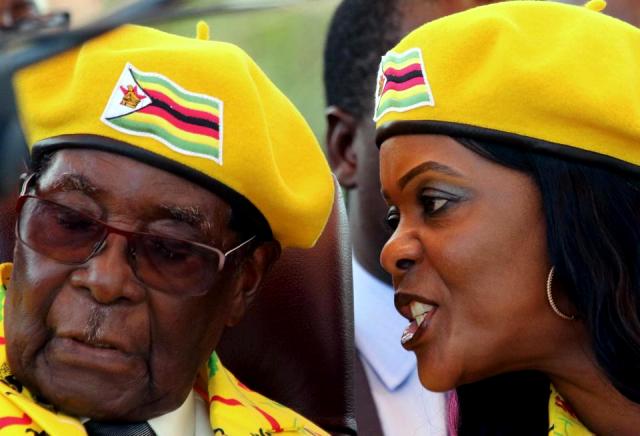
As I was saying, we need to purge ourselves of the spirit of hypocrisy that will not allow us to see the logs in our eyes before seeing others’. And so with the log in our eyes, we cannot see the Mugabe in most of our state actors; most of our power elite who keep blaming the Zanu-PF principalities and military powers that sustained the Mugabe regime in Zimbabwe for 37 years.

In the same vein, because there is still no art to find the mind’s hypocritical construction in our faces, we can blame the Gucci Grace in Zimbabwe without remembering the Grace Mugabe in most of our First Ladies, First Daughters, First Cousins, First Nephews and First Mistresses in Abuja, 36 states and 774 Local Government Councils in Nigeria.

Can we justifiably denounce Grace Mugabe’s ostentation, vanity upon vanity without remembering the graceless Grace all over the place? A governor who would use state resources to celebrate a noisy 50th birthday of his wife for more than two days on a continental and global television network when salaries of workers and pensioners remain unpaid for months is a Mugabe. And that First Lady (celebrator) that accepts that dirty gift is worse than the Gucci Gracein Harare.

There are governors and there are governors. The governors who would not pay even workers’ alaries and pensioners but could afford to organize lavish wedding for sons and daughters in Dubai, Lebanon, Morocco, London, America, etc are the Mugabes of Nigeria. Top members of the ruling party, the state actors and the opposition top shots who cannot invest in education quality in their country and regularly celebrate graduation of their children from top universities outside the country are the Mugabes in our midst that we should send packing too.

What is worse, all these visitors to federal and state universities (presidents and governors) who cannot enroll their wards in Nigerian universities they fund are remarkable hypocrites who should be designated as the Mugabes of Africa.

We have been writing about Gucci Grace because the loud but little Grace in poor Zimbabwe loves Gucci, a very cheap designer bad and watches, not more than $1000 USD. What do we say of the Imelda Marcos all over the place who are obsessed with the most expensive and famous designer handbags in the world such as Hermes, Fendi, Chanel Diamond,($261,000)Marc Jacobs, Louis Vuitton, Leiber, Lana Marks Cleopatra, The 1001 Nights Diamond Purse by House of Mouawad ($3.8 million), to mention just a few?
Are most people aware that spouses and even mistresses (who don’t work) of most of public officers regularly buy these very expensive designer handbags and wristwatches when they travel? It is fashionable to abuse Grace in far away southern Africa, but we need to ‘shine our eyes’ on the Mugabes in the poor country who earmark large sums of the state resources to take care of the ostentatious lifestyles of the Grace in most of our First-This, First-That.

Let’s clarify this: It is not only the age of Zimbabwe’s Mugabe that has made him an object of reproach and a blighter; the age of his ideas that could not revive the country’s economy and improve governance is a critical factor. But the most reprehensible of all his sins against his people is the old man’s sit-tight spirit that ruined his country. As a South African had noted here last week, the teacher, the revolutionary and the tyrant “left land and resources for his people while Mandela left quotes and poems”. But in contrast, the land and resources Pa Robert seized from the powerful and productive white minority could not create wealth, as they could not eat the good of the land for lack of knowledge and empowerment.

In the same vein, there are some former governors too who are so Mugabeic in all their ways. They want to remain in office and power forever even when no one can remember any remarkable achievements after eight years as governors. They get themselves elected as senators or get nominated as ministers, yet they are unfruitful and can’t be bothered. Some one-term former governors who are now ministers are warming up to return as governors for another term of four years without any blueprint on what to do to improve the once-misgoverned state’s critical infrastructure and education quality. They want to be governors again and have access to state funds they don’t account for. They want to make their First Ladies glow again. Some of the former state governors who hardly visit the states they under-developed are sleeping on duty at the Senate. Some who just left office are warming up to get (s) elected to the Senate. They don’t have any sense of entrepreneurship. The only thing they know is how to be at the Senate. The professionals such as lawyers, physicians, architects, engineers, journalists, etc don’t want to return to their first love. They want to remain in politics they hardly use to develop their country. There is but one mind in all these sit-tight, never-do-well dealers, sorry leaders, all bent against their country’s progress: They are the Mugabes in Nigeria we need to flush out in 2019.

Enough is enough! Yes, as I was saying, it is not the age of their tenure that complicates issues for us; it is their lack of creativity. After all, Lee Kuan Yew we all love to quote in motivational speaking on leadership quality was in office for 31 years. And behold, he led the multi-racial one-city country from Third to First World. He developed the country’s education to what is now a world-class through significant investment in quality teachers, learning environment and focus on science, technology, engineering and mathematics, (stem). Today the only resource they sell to the world is human capital. But the Mugabes in Africa can be there for 37 years and move their countries from Thirdto Failed World. They are neither Yew nor Mandela, the poet.

Is there any continent in the world that parades a galaxy of Mugabes at all levels? Is there any country in Africa that parades Mugabeic philosophy of build- and-also-ruin-your country than Nigeria? In the late 1980s in Abuja, it would take about 45 minutes to drive from Abuja city centre to Minna, capital of Niger state. But the state, (Niger) that has produced two former heads of state who live in Minna, is shamefully inaccessible from Abuja. The road from Abuja to Minna now takes about three hours drive because of terrible potholes. Same for Lagos-to-Ota road in Ogun state where a former head of state and formerpresident used to run Africa from his Ota farm. The story is not different from Port Harcourt, capital of River State to Yenagoa, capital of Bayelsa state where President Buhari’s predecessor hail’sfrom. The road is a sorry sight. But all these former presidents who could not build critical transportation infrastructure anywhere in the country they have ruled let alone in their home states have private jets to fly over all the bad roads that lead to their country homes.

So, they cannot talk about Mugabe and his Gucci Grace. Reason? The Mugabe in all of them is unspeakable. Some of them failed to invest in quality education the way Singapore’s Yew did but they have their private schools and universities, thanks to their country’s revolt against transparency and accountability. After all, Mugabe left land and other natural resources for his people. What have our ex-this and ex-that left for us since 1999? Tell me one unique item apart from huge debts that they left with absolutely nothing to show for the (debt) burden!

Why should we talk and write about Mugabe and Grace in Africa’s most populous country where there is a strange form of gerontocracy nurtured by peculiar silence and conspiracy of the power elite? There is also a Mugabe spirit in what drives diplomatic posting in Nigeria at the moment. Haven’t you just read that an 82-year old retired Judge of the Federal Court, Sylvanus Nsofor last week presented his Letter of Credence to the United States’ President Donald Trump as Nigeria’s Ambassador to the United States? Did you not also read the other day that a 77-year old retired Justice of Supreme Court, Justice George Adesola Oguntade (retired in 2010) was also posted to the United Kingdom as Nigeria’s High Commissioner?

What could have blackmailed the Senate to clear an 82 year-old Justice who retired from judicial service in 2005 to be designated as an ambassador to the United States? The Mugabe in the nominating and confirming authorities and the new ambassadors is also humiliating. There is no question, all of them, the presidency, the senate and the Nsofos and Oguntades are the Mugabes of our time that have also let their nation down at this critical time when very developed nations are being led by the Macrons of this world.

And so the conclusion of the whole matter is that before we raise our voices gain to condemn Mugabe and his graceless Gucci Grace, we need to readjust ourselves before the mirror in our rooms and judge what we see. As I was saying, that pastor who does not want to be posted out of the megacity’s pulpit after about two decades is a Mugabe in Christ. That unethical governor who cannot pay workers’ salaries and pensioners but releases millions of Naira to mark his wife’s birthday, celebrates his son’s or daughter’s weddingon national television is worse than Mugabe.

A 74- year president who in 21st century nominates an 82-year old retired public officer as an envoy to any country encourages gerontocracy (a form of oligarchical rule in which an entity is ruled by leaders who are significantly older than most of the adult population) and should be called a Mugabe. And an 82-year old retiree who accepts a sensitive diplomatic posting too should not blame his grand children’s classmates who call him a Mugabe when they organise protests against mass unemployment of their young fathers.

Oloja is a former Editor of The Guardian Nigeria from where this article was culled.

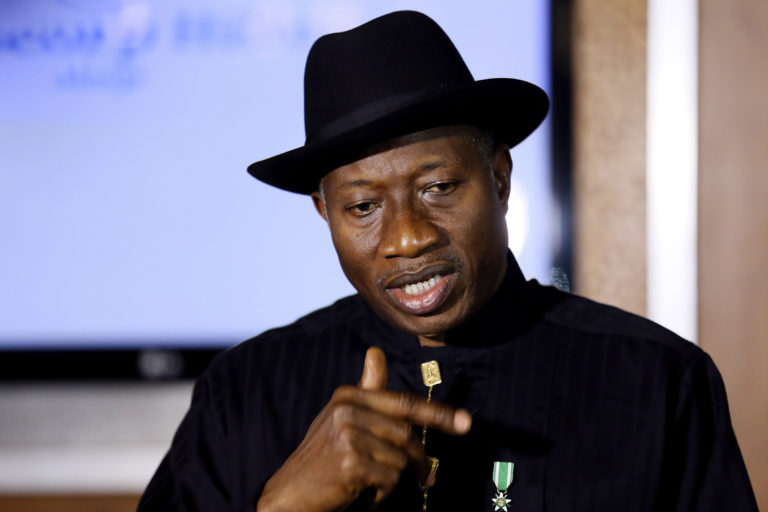
Jonathan asks Shettima: Why is Chibok principal now a commissioner in your govt?

Goodluck Jonathan, the former President, has asked Kashim Shettima, Governor of Borno State, to tell the truth about his role in the abduction of Chibok school girls by Boko Haram in April 2014.

On Thursday, Shettima had said Jonathan performed poorly in office because he surrounded himself with “an assorted crop of religious bigots, tribal kindred and reactionary elements.”

The governor spoke at the public presentation of a book, ‘On a Platter of Gold — How Jonathan won and lost Nigeria’, written by Bolaji Abdullahi, who was Minister of Sports in the Jonathan administration and is now the spokesman of the ruling All Progressives Congress (APC).

Reacting to Shettima’s comment, Jonathan said he knew the role played by the governor in the abduction of the schoolgirls that caused international outrage, including why the principal of the abducted girls’ school is now a commissioner in the state.

“We didn’t expect anything less from Governor Shettima, knowing the ignoble roles he played in frustrating the war waged by the past administration against Boko Haram, even in his own Borno State,” read a statement by Ikechukwu Eze, Jonathan’s spokesman.

Jonathan wondered why Shettima did not comply with the federal government’s directive that students writing external examinations at the time should be relocated to safe environment.

Jonathan also questioned why the principal of the Chibok school was rewarded with a post of commissioner by Shettima.

“He should be able to tell us if it was Jonathan’s poor choices that led the governor to expose students of Government Girls Secondary School in Chibok to avoidable danger, in total disregard of a federal government directive to the governors in the three states most affected by Boko Haram to relocate their students writing the West African School Certificate Examinations to safe zones.

“The governor is now denying that he had no hand in the kidnap of the Chibok girls even before anybody accused him of culpability. However, we share the view of those who insist that the governor had other things up his sleeve when he promised the West African Examinations Council (WAEC) that he would secure the girls and ended up doing the very opposite by deliberately abandoning them to their fate, without any security presence in their school.

“It is instructive that while other governors in the zone heeded the security advice, Shettima remained the only one who flagrantly flouted it.

“Should we also fail to point out that his decision to reward the principal of Chibok Secondary School, who was uncharacteristically absent on the night terrorists stormed the school, with the post of a commissioner, did throw up more questions than answers?”

Returnee migrants narrate how they were sold in Libya by fellow Nigerians

Some of the Nigerians who were recently repatriated by the International Organisation of Migration (IOM) have narrated how most of the trafficking syndicates in Libya are being run by Nigerians.

The IOM facilitated the return of 1,295 Nigerians from Libya In November alone, and a total of 5,578 in 2017.

CNN had shown chilling images obtained undercover, of African Migrants being sold in an auction at a trafficking camp in Libya, some of them for as low as $400.

On Thursday, about 150 Nigerians were flown back from Libya, courtesy of the IOM. Some of them spoke to journalists, sharing horrifying stories about how Nigerians are championing the sale of fellow Nigerians into slavery.

“When I was kidnapped with others and held for some weeks, the Arabs asked if I wanted to be taken to a Nigerian and I readily said yes. I was very happy that I was going to someone from my country. But it was a lie,” Odion Saliu, one of the returnees, told The Punch.

“The Nigerian they took me to locked me in a cell and told me to call my mother and ask for N60,000.

“The man said he would sell me to a connection house if my family did not get the money. I called to inform my mother and the trafficker who facilitated my journey from Nigeria.

“But the trafficker spoke with them on the phone and told them the amount they demanded was too small.

“They increased it to N200,000. My mother paid into an account after they provided her with the account number over the phone.

“The Nigerian said if I wanted to cross the sea, I had to pay him again. But when we got to the seaside, he sold me again.”

According to her, the same Nigerian resold her for 3,000 dinars (about N794, 000).

Another returnee, Sunday Anyaegbunam, said he embarked on the journey to Europe through Libya along with his wife in April, and during their nine-day journey through the Sahara desert, they were sold twice by Nigerians.

He narrated that their Nigerian “burger” (trafficker) first sold them to another set of Libyan traffickers at Agadez, Niger, who then resold them to another Nigerian who took them to Sabha, Libya, where they were eventually separated in different cells.

“We were made to contact our families on the phone and I had to ensure the payment of N400,000 for my release and N300,000 for my wife,” Anyaegbunam said.

“The Nigerians selling people in Libya are more wicked than many of the Arabs. I have never seen people so heartless as the Nigerians who bought and sold me.

“There are many of them in Agadez and Sabha, who are making so much money from selling their own people. But there are other West Africans doing the business too.

“When you approach them and say, ‘Please, my brother, help me.’ They would tell you, ‘No brother in the jungle.'”

Esosa Osas, a 25-year-old woman who was in Libya for six months, said she also met many Nigerians selling their countrymen.

“You dare not talk to them, else they would beat you and lock you up. They sell women for 5,000 dinars and men for N4,000 dinars. I noticed that the connection houses were also controlled by Nigerian women.”

Anyaegbunam’s narrative corroborated the story of Foka Fotsi, a Cameroonian Migrant who told journalists that he was kept in camps run by Nigerians and Ghanaians.

“There was torture like I’ve never seen. They hit you with wooden bats, with iron bars,” Fotsi had told journalists.

“They hang you from the ceiling by (your) arms and legs and then throw you down to the floor. They swing you and throw you against the wall, over and over again, 10 times.

“They are not human beings. They are the devil personified.”

Thirty-five-year-old Harrison Okotie, another returnee who lived in Libya for three years until his repatriation, put the whole narrative in better perspective.

“Nigerians and Libyans are doing the business like they are one big happy family,” he said.