Home Blog Page 2666

What is the worth of a Nigerian migrant’s life?

0
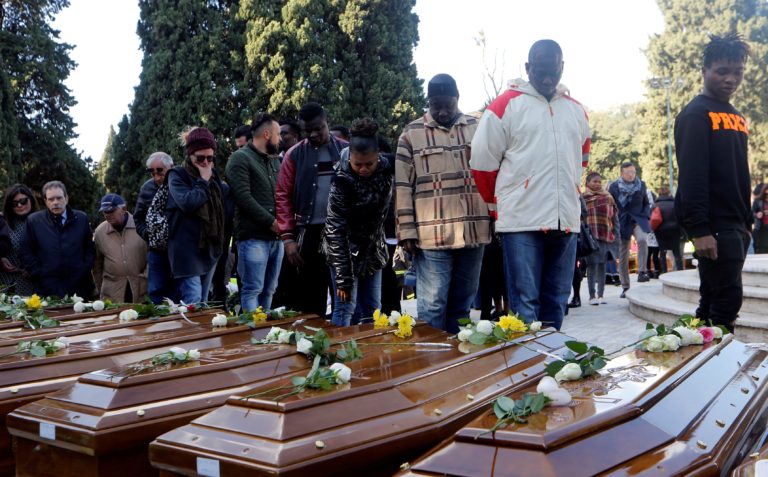
People pay respect at the funeral service for 26 female Nigerian migrants who died last week while crossing the Mediterranean Sea, at the Salerno cemetery, Italy. Credit: REUTERS/Ciro De Luca

In April, a former Nigerian public official lost his daughter under questionable circumstances. The young lady’s death was avoidable, and who knows, maybe her spirit is already haunting a UK hospital and another one in Nigeria. A hospital in Birmingham misdiagnosed her condition; the one in Nigeria performed surgery on her without having a life support machine. When her condition deteriorated post-surgery, the hospital could not artificially ventilate her heart. She died as a result.

I was hurt to read about that needless loss of life; anyone should. A premature death is hurtful enough, but an avoidable one is shattering. In seven months of this tragedy, the father has written two public notes on his grief. One could tell he deeply loved his daughter. In the letter, he talks of bereavement hallucination and its redemptive and therapeutic powers. It is clear that this father will not get over his daughter’s death anytime soon; it is an agony no one should experience.

In that same piece, he urges the government to “grade and classify” hospitals as “first, second and third tier, the same way banks are categorized in Nigeria”. He wants a first-tier hospital to have “an agreed high standard of medical equipment installed and top-quality personnel working there” so that “patrons can know the level of service to expect when attending any hospital based on its classification as 1st, 2nd or 3rd tier”. To rewrite his thoughts, the rich should be able to patronize truly first-class hospitals; the poor can settle for the second or third-tier. Or, who would third-tier hospitals serve? The rich? First-tier hospitals will care for first-tier lives; third-tier hospitals for third-tier lives. But this is not where I am going.

26 ‘THIRD-TIER’ LIVES

Two weeks ago, 26 Nigerian “third-tier” lives perished at sea while attempting to cross the Mediterranean from the north coast of Africa. All 26 were women, two of them even pregnant. This wasn’t the first time that Nigerian migrants would die, or the first time the public would get a sniff of their travails while on the risky sail in search of green pastures. Anyone interested in knowing the grim dangers of the average migrant journey should please google ‘Europe by Desert: Tears of African Migrants’. Thank me for the link if you wish, but you should compulsorily thank Emmanuel Mayah, the writer, one of the most daring journalists to ever emerge from Africa. At great risk to his life, Mayah went undercover for 37 days with illegal migrants, travelling across seven countries in an attempt to cross the Sahara Desert. On his return, he documented the dangers involved in such journeys: rape, armed robbery, fraud, blood oaths, hunger, dehydration, death.

That was in 2009. Eight years after, very little has changed. Year on year, migrants keep dying in their thousands — from the hundreds of thousands who’d rather die than remain on the continent. This year alone, 150,985 have arrived in southern Europe via North Africa, according to the International Organisation for Migration (IOM); 2,639 others died while trying to.

In May, Nigerians were among the 44 migrants to have died of thirst after their truck broke down in the Sahara Desert in northern Niger while en route to Libya, where they were to cross to Europe. Ghana was the only other nation represented in that tragedy. In August, Nigerians in Diaspora Organisation (NIDO), quoting data from the IOM, said Nigerians formed the majority of the 1,500 migrants to have died in the first seven months of 2017. Both NIDO and IOM have always acknowledged that these figures are an underestimation of migration casualties; it is never easy to account for deaths in the desert, at sea, and at the various stages of an illegal trip.

Migrant casualties are literally an everyday affair, but the latest round is generating above-usual notice for various reasons. This is one of the very few cases where Italian officials are suspecting that migrants were deliberately murdered after they had been sexually assaulted. An investigation is already ongoing and five people are in detention already. The nature of this investigation has to be harped on: Italy is investigating the death of 26 Nigerians who tried to enter Italy illegally; given the circumstances, it is under no obligation to do so. Italy also gave dignity to the migrants, organising a burial ceremony for them, even going ahead to place a picture and an information card with copies of dental scans and a list of traits like tattoos and scars “that might someday be used to identify the victim if a family member ever comes looking”.

THE MIGRANT’S LIFE DOESN’T COUNT

In all this, the Nigerian government was conspicuously absent. The girls were buried without Nigerian presence at the solemn ceremony. Meanwhile, the Embassy of Nigeria in Rome has been sleeping — no interest in the investigations into the cause of the deaths. On the day the 26 were buried, Geoffrey Onyeama, the Foreign Affairs Minister, was quiet. Meanwhile, when Nigeria beat Argentina in an international friendly three days earlier, he was quick to pen a congratulatory message to the Super Eagles, announcing: “Russia, here we come!”

Okay, Abike Dabiri-Erewa, SSA to the President on Foreign Relations and Diaspora, issued a statement describing the death of the girls as “avoidable and preventable… tragic and lamentable… just not worth it ultimately”. But to know what she truly feels, look no further than her Twitter engagement with those implicitly blaming the tragedy on the government. When one person tweets that “Everybody is trying hard to blame the gov for their death as if they were sent on a mission by the gov,” Dabiri-Erewa retweets. When another berates the Federal Government for its absence at the interment, she asks if the Nigerian mission was “duly informed of the time, date and venue”. Finally, as contained in the press release, and as she generously argued on Twitter, Dabiri-Erewa believes the solution to persistent migrant deaths is to educate Nigerians on the dangers of such journeys. Absolutely not!

Talk to anyone in Edo — the state with the highest contribution to Nigeria’s migrant population — and you will hear that migrants are well-aware of the risks. The problem is that they are in so much suffering already that they wonder if death can be any worse. There is something migrants are running away from; and unless the government addresses it, more deaths are bound to happen. What they are chasing after are the simple things of life: food, shelter, clothing, employment, dignity, a sense of belonging in their own country. Only people who have experienced the lack of these basics can understand and interpret the frustrations of migrants.

The ex-public official who lost his daughter, for example, was failed by the health system. Seven months after, he hasn’t healed. Now, consider a poor Nigerian who has been failed numerous times by the health system, uncountable times by the job industry, many times by the education system. Imagine the travails of a man who has lost his wife because he couldn’t afford first-tier healthcare, whose children are out of school because he couldn’t pay their fees, whose family has been thrown out by his landlord because he could’t pay his rent. Many years of multiple frustration will convince him that there is better life abroad, and he’d rather die trying to get it than remain in penury in Nigeria.

BLOOD ON THEIR HANDS

In case Nigerian public officials do not know, many of them are culpable for the death of these migrants. By their daily abdication of their responsibility to take decisions in public interest, by filling their pockets at the expense of building the structures that could have kept the dead migrants back in the country, by constantly travelling abroad and experiencing the way normal societies work yet failing to replicate the same at home, by their blithe contempt for the life of the common man so long they and their families are sorted, so many Nigerian public office holders — not all — have blood on their hands. The migrant’s life doesn’t mean a thing to the government, but no problem; karma hasn’t stopped being a bitch!

Soyombo, Editor of the International Centre for Investigative Reporting (ICIR), tweets @fisayosoyombo

Obaze rejects Anambra election result, says APGA couldn’t have won all LGAs

Oseloka Obaze, candidate of Peoples Democratic Party (PDP), in the just concluded Anambra State governorship election, has rejected the result announced by the Independent National Electoral Commission (INEC) on Sunday.

According to a statement he released later on Sunday, Obaze said the result announced by INEC was not a true reflection of what happened at the various polling units.

He insisted that Willie Obiano, the incumbent Governor, who was declared winner of the election with 234,071 votes, could not have won in all the Local Government Areas in the State

“The Anambra governorship election results just released by INEC, does not reflect the realities of the votes cast on Nov. 18 by the Anambra electorate,” Obaze stated.

“The over voting and inconsistencies between the counted ballots and card reader data remains exceedingly worrisome.

“The uniformity of the incumbent governor wining twenty-one local governments is a political aberration in the context of Anambra politics.

“The election result as reported shows that nothing matters to the Anambra electorate.”

Meanwhile, Osita Chidoka, former Minister of Aviation and candidate of the United Peoples Party, said he has accepted the results, adding that he lost, not because his ideas did not resonate with the people, but because he could not match the other political parties’ financial strength.

“I have accepted defeat in the Anambra governorship election even as result is still being announced by the INEC,” Chdioka said in a statement.

“Our campaign attracted the finest and brightest of Anambra. The bold and the courageous were with us as we exerted our best in running the most robust issue-based and technology-driven campaign in the history of our dear state.

“We believed and we dared; we engaged with all patriotic vigour as we held strongly that the long awaited time for our people to experience a new opportunity had come and we laboured for it.

“But from the ballots, we heard the voice of our people. We heard it loud and clear.

“While our message resonated with the people they doubted that the political class cared about them. They voted for the highest bidder.

“I insisted we will not pay for votes. The decision not to pay ended our good run.

“In all, we hold our heads high; high because we did not lose the poll due to paucity of ideas or lack of “structure”.

“We lost to superior financial firepower. As Democrats, we concede to the voters’ choices.”

UPDATED: Obiano wins Anambra election

Willie Obiano, incumbent Governor of Anambra State and candidate of the All Progressives Grand Alliance (APGA) has won the Anambra governorship election held on Saturday.

Obiano won in all the 21 local government areas of the state with a total of about 234,071 votes.

Tony Nwoye, candidate of the of All Progressives Congress (APC), came second, followed by Oseloka Obaze of the People’s Democratic Party (PDP).

Osita Chidoka, former Minister of Aviation and candidate of the United Progressives Party (UPP) came a distant fourth.

Zana Akpagu, Vice Chancellor of the University of Calabar who also acted as the Returning Officer for the election, said that a total 448, 771 votes were cast during the election on Saturday, out of which 422, 314 votes were valid and 26,457 were rejected.

Nwoye, who came a distant second in the poll, garnered a total of 98,752 votes, while Obaze and Chidoka had 70,293 and 7,903 votes respectively.

Speaking after the results were declared, Obiano said victory for APGA also signifies victory for to every Igbo individual who is concerned about the place of Ndigbo in the nation’s polity.

He also called on the other contestants in the election to join forces with him in building a state that would be the envy of the South East region.

Obiano, while expressing gratitude to all members of APGA for their steadfastness, also commended INEC for conducting a transparent exercise, and also the law enforcement agencies for ensuring “that the people’s mandate is not thwarted”.

He further said that his government is open to new ideas and vision and is willing to work with anyone who has something to share that will make Anambra State greater.

He assured citizens of Anambra that “the state has stepped into its finest hour and its journey into greatness is now assured”.


Card-reader malfunctioning, buying of votes characterise Anambra election

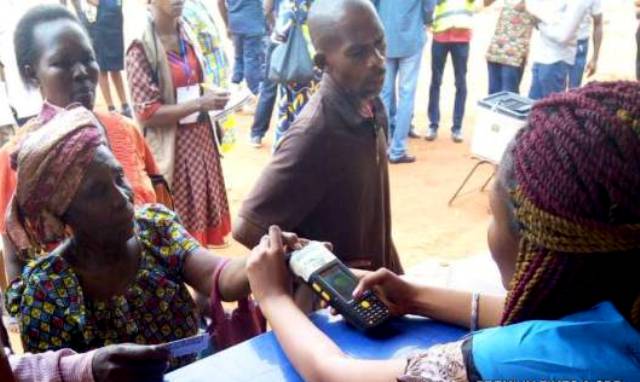
Reports from journalists and civil society groups monitoring the ongoing Anambra governorship election indicate that smart card readers deployed by the Independent National Electoral Commission (INEC) are malfunctioning in several polling centres.

The election observers also report that many political parties offered money and food to voters in exchange for votes.

Also, Willie Obiano, the current Governor of Anambra State, who is running for a second term in office, was said to have addressed voters after he had cast his vote, an action which is tantamount to campaigning.

The electoral act stipulates that all forms of campaign must stop 24 hours to the day of voting.

Abiola Akiyode, a member of the Transition Monitoring Group, witnessed the incident and described it thus: “The most worrisome aspect (of this election) is that the governor came with a microphone to address the people.

“I think it is a sort of campaign. Since I have been observing, I have never seen any governor go to that extent to talk to people on election day.

“I think he should have avoided the temptation even if people are pushing him to do something”, she said.

“What he spoke about is a sort of campaign, saying that at the end of the day he would have cause to be happy. I think these are not things one should expect on election day.”

It was also reported that the card reader could not read Obiano’s fingerprints but it authenticated his voter card, so he had to resort to manual accreditation.

Voters turned out in good number in Otuocha, ward 1, Eri, Anambra East LGA.

Also, many polling unit, including the one at Central School Onosi, Idemili North LGA, which is the polling unit of Osita Chidoka, one of the contestants in the election, electoral materials arrived late.

“I hope the late arrival would be taken into account in considering when the election would end,” Chidoka told Premium Times.

“We are also awaiting reports from our situation room to find out if the same thing was experienced across the state.”

At St Lous Catholic Church, Uruagu which also serves as Uruagu Ward 2, INEC officials arrived at 10.30 am, more than two hours late. Accreditation was supposed to kick off by 8 am.

CARD READER MALFUNCTIONING

8.50 am: Card reader not working at Bishop Patterson Junior Seminary Mbosi Ward 20, Polling unit 004. Incidence form is being used.

10.11 am: Ward 015, Ihiala, some voters are threatening to beat up ad-hoc staff, pressurising them to use manual method as the card reader is faulty.

10.30 am, voting had commenced at Ily Abito square unit 001, Nsugbe, but Card reader not detecting finger prints or voters cards of some people.

11.08 am: At Okija Ward 2, PU 009, Umuohi Community Primary School, Okija, the Card Reader is experiencing difficulty reading some finger prints. The INEC Ad-hoc staff provided toilet tissue for people to clean their thumbs.

11:49 Card reader is not working polling unit 003 St Peters Ogidi.

MONEY FOR VOTES

Freshly pasted poster of the APC candidate, contrary to the electoral act

This poster is freshly pasted around this unit. A voter said it is to reiterate their stand and that so far the money has been good, but he refused to state how much he was given.

Another voter is seen showing a man his hand and insisting he has voted for APC.

In Ihiala, it was vote and write your name in order to collect money from APC and APGA. APGA is N2000, APC is N2500.

At Amaudo/Umeze Primary School 1 in Isseke, Ihiala LGA, both PDP and APGA candidates were seen ‘hustling’ for voters.

The PDP agent say he has been paying with his money to match APGA’s N3000 per vote.

At Umedim ward 1 in Otolo, Nnewi, people queue up to collect money from APGA after voting, same for APC.

At CPS Odekpe, ward 5, Ogbaru LGA, party agents believed to be working for the PDP were seen sharing N2,000 each to voters.

COOKED RICE FOR VOTES

The reporters on ground termed the situation at Illo Abito Square in Nsugbe as “Stomach Infrastructure”, as APC agents were seen encouraging people to vote by sharing plates of cooked rice.

TWO FACES OF MALNUTRITION (1): Breeding undernourished children in North West

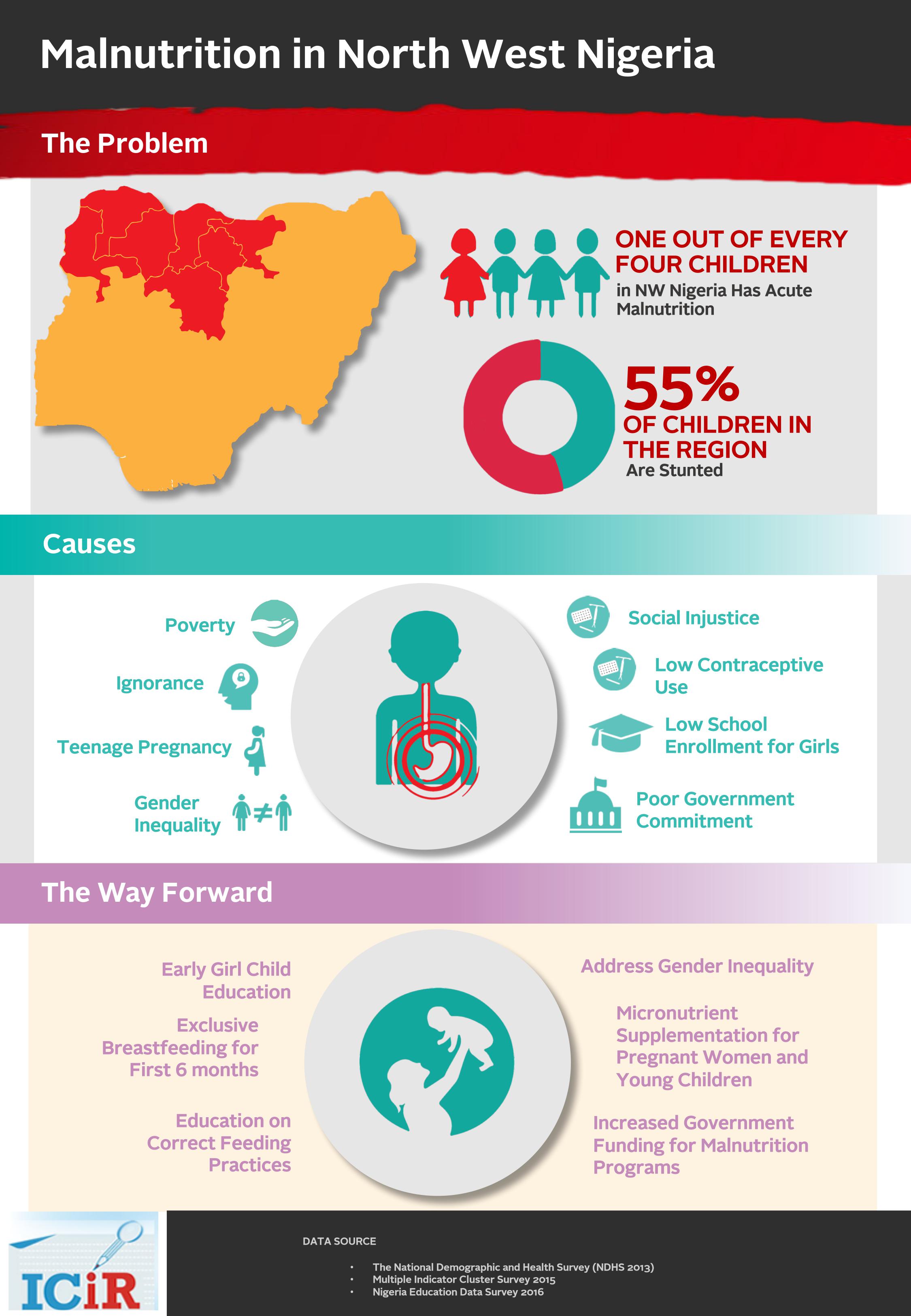
North West, the most populated region in Nigeria, has the highest undernourished children. Fifty-five percent of children in the region are stunted, suggesting they are not growing proper physically or mentally. The region is not affected by the Boko Haram conflict, yet one out of every four children has acute malnutrition. Health facilities are overwhelmed by malnourished children, many of whom do not survive beyond their fifth birthday. In this first of two-part series, CHIKEZIE OMEJE reports that the causes of this silent crisis of malnutrition are not just hunger and poor knowledge of nutritious foods. Rather, the region’s problem stems from deeply rooted gender inequality and social injustice.


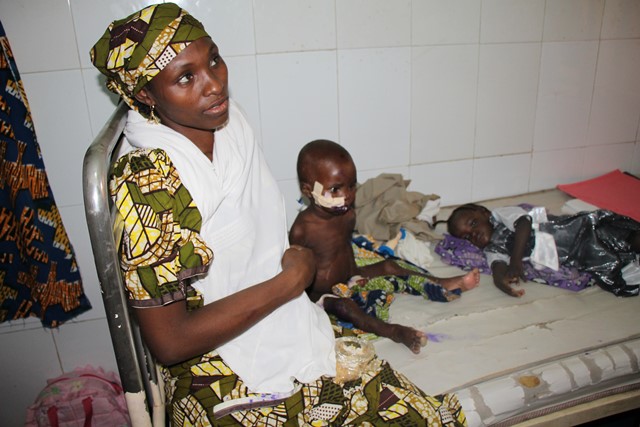
Fatima spoon-feeds her two-year-old son, Bashir Kamilu, with Kwashi pap for breakfast.  Moments after eating, he excretes it in loose stool, seeping through his oversize diaper. Fatima lets the stream of watery faeces drop on a sheet she has spread beneath his buttock on the hospital bed.

Kwashi is a polite and short-term that health workers have adopted for Kwashiorkor, a severe protein-energy deficiency that Kamilu began to suffer after Fatima weaned him from breast milk and put him on a diet high in carbohydrates.

Kwashiorkor was a commonly-used word in Nigeria about 50 years ago during the Biafra-Nigeria Civil War, when about a million children died of malnutrition in the eastern region. Pictures of the 30-month war showed starving children with emaciated bodies or bloated stomachs.

Almost five decades after the war, similar pictures of malnourished children are creeping in from every part of the country, but have assumed a darker dimension in the North West.

The region is breeding undernourished children. A half of the children are stunted and one out of every four children has acute malnutrition.

“More than 80 percent of the children we see in this hospital are malnourished,” says Salma Suwaid, the head of paediatric ward at Muhammadu Abdullahi Wase Specialist Hospital, Kano. “It’s consuming the system.”

Each morning, Kwashi pap is brought to Kamilu and more than 20 other children in the hospital. The pap, which contains millet, suya beans, groundnut, palm oil and crayfish, is supplied by the nutritional unit of the hospital. It is meant for families who cannot afford packaged – and usually imported – nutritional supplements.

Malnourished children have weak immunity which makes them vulnerable to infectious diseases.

Kamilu suffers diarrhoea and he has a cough and skin infection. When ICIR met him, he had been admitted to the hospital eight days earlier. After the diarrhoea started, Fatima had given him local herbs.  She later took him to a local drug store, which gave him medicine. The diarrhoea persisted, and eventually, the cough and skin infection took hold. Fatima obtained the consent of her spouse to take Kamilu to the hospital where he was diagnosed with severe acute malnutrition.

Fatima, Kamilu, and his elder sister in the hospital

Severe acute malnutrition is the most extreme and visible form of undernutrition. Children who have this condition are frail and skeletal.  They have very low weight relative to their height and severe muscle wasting. They may also have nutritional oedema – characterized by swollen feet, face and limbs.

Undernutrition is indicated in three ways: “Stunting,” which occurs when a child’s height is low for his or her age; “underweight,” when the weight is low for the age; or “wasting,” which is when the weight is not proportionate to the height.

Here in the hospital, Fatima sits beside Kamilu on the bed and replenishes the lost pap with Awara, a local suya beans cake. When he coughs, tiny Awara with saliva flows out of his mouth. He is in a daze, struggling to eat the Awara that his mother is stuffing into his mouth. His ribs are visible, and the skin on his fingers and feet is peeling off.

“I was giving him Tuwo and other foods in the house,” says Fatima in Hausa.

At 25, she has given birth five times but has four surviving children. Married at 17, she is a second wife to the man who has come to the hospital just twice since Kamilu was admitted.

WHY ARE THEY BECOMING MALNOURISHED?

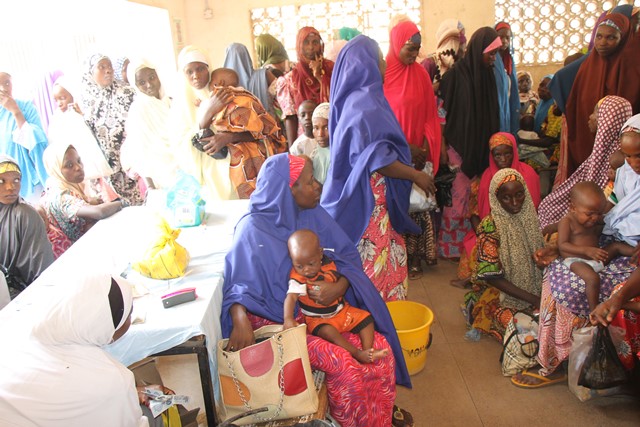
A mother with her malnourished child, waiting to receive RUTF at Yan’Awaki PHC, Kano

Health workers often attribute malnutrition in North West to poverty, noting that at times parents are simply too poor to afford nutritious foods. But even when they can pay to give their children better diets, some people have too little knowledge to do so.

“Our normal culture here is that you give them pap,” Kabiru Ibrahim, the Executive Secretary of Jigawa State Primary Health Care Development Agency told the ICIR. “The pap has no nutrients whatsoever. A child who continues to take the pap will become wasted.”

Children also are improperly weaned from breastfeeding, he adds. “One day, the mother will decide to wean the child off breast milk and the child will be taken to the grandmother several villages away from the mother. The child who had been fed just breast milk up to that morning no longer gets breast milk but only pap. Children cannot cope.”

But to say that young children are not fed properly misses a deeper truth. The underlying problem is that many women never get the opportunity to learn how to feed their children. Often, entitled polygamous men marry underage girls, impregnate them and keep them in seclusion, never caring for the many children they produce.

In Kano and other cities in the North West, hundreds of thousands of the boys born this way end up roaming the streets, begging for alms in tattered clothes and often without footwear. The girls are married off at teenage, continuing the cycle.

On the day ICIR visited Muhammadu Abdullahi Wase Specialist Hospital, a teenage mother, Aisha Murtala, gathered her son on her lap while sitting on a chair in the consultation room at the emergency section. Her son had been diagnosed with severe acute malnutrition and would require admission to the hospital.

Murtala, a second wife, did not have her spouse’s permission to stay in the hospital. So she had to go back home to seek his consent and obtain money from him. Since she got married, she had been kept in Purdah and was not allowed to go anywhere without the husband’s permission.

Before the son turned six months, Murtala had started giving him water, and later pap.

“Whenever the weather became very hot, I often gave him water because he would be thirsty,” says Murtala  in Hausa.

A lot of teenage mothers in the region are naïve about child care. This is why malnutrition is common among the children of underage mothers.

Salma Suwaid, the head of paediatric ward in the hospital, told the ICIR that malnourished children either come from teenage mothers or women with a lot of children and inadequate resources to take care of them.

“The younger the mother is, the more likely the child will be malnourished because she is naïve about child caring. If a 12 to 13-year-old is having a child, that’s a big problem because she hasn’t finished knowing about herself, let alone taking care of a child.”

The National Demographic and Health Survey (NDHS 2013) indicates that almost a half of women in the North West have their first child when they are still adolescent.

If Murtala eventually obtains the consent of her spouse for her son’s admission, she still may not be lucky enough to secure a bed space for him. On the day ICIR visited, there was no bed space to admit children who were being diagnosed with severe acute malnutrition at the emergency section of the hospital.

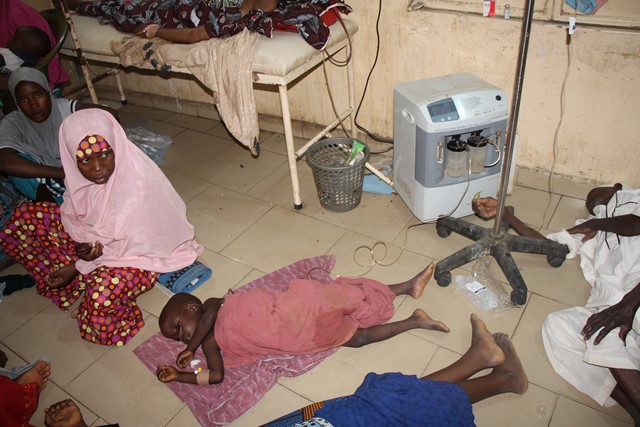
In the corridor of the emergency section of the hospital, Bilkisu Sadik watches over her six-year son, Abdullahi, who lies on her wrapper on the floor with a cable that extends from his nose to an oxygen machine. Another cable extends from the oxygen to an elderly man lying on the floor beside him. Sadik brought him to the hospital with a complaint of malaria but diagnosis confirms that he has severe acute malnutrition.

Sadik does not know her age, but she appears to be in her late twenties. She was a teenage bride and has had seven babies, but only five are still alive. Though she is the husband’s first wife, he has married a second wife whom he shows more attention, she says.

Sadik looks after her sick and malnourished son, lying on the floor in the hospital

At the other end of the corridor is Aisha Ubah, whose hands are on her cheeks, looking after her five-year-old son, Hamidu, who is placed on a bed. He was having a headache and shaking when Ubah brought him, her sixth child, into the hospital, but diagnosis confirms that he too has severe acute malnutrition.

The hospital emergency is crowded with mothers and their children who are mostly suffering from malnutrition. From the emergency room to the paediatric ward, women and their sick children are sleeping on mats they spread on the floor.

An average woman in the North West will have five births under the age of 27. Only 1 percent of women aged 15-49 use any method of family planning in the North Western states of Jigawa, Kano, Katsina, Kebbi, and Sokoto.  Overall, only 4.3 percent of the women of reproductive age use any method of contraception in the region.

Health workers say the high birth rate increases the risk of malnutrition. Most of the women stop breastfeeding when they realise that they have become pregnant.

When the girls are married, they are denied education. Most are married to older men who already have wives. The women are subjected to Purdah. They do not earn income and they depend on whatever foods that the spouses provide.

Girls’ school enrolment in the North West is still less than 50 percent. Uneducated women are more likely to have undernourished children and bear large numbers of children.

On the day that ICIR visited Yan’Awaki Primary Health Centre along the IBB Road in Kano where hundreds of women bring their malnourished children to receive nutritional supplements, none of the women attended secondary school. They neither understand nor speak English, which is the language of instruction in schools.

A LOW PRIORITY FOR GOVERNMENT

Mothers waiting to receive RUTF for their malnourished children at Yan’Awaki PHC, Kano

Unicef, the UN children’s agency, introduced Community-based Management of Acute Malnutrition (CMAM), a pilot programme in Gombe State in 2009. The programme was later extended to 12 other states in the north.

Under CMAM, malnourished children who are six months to five years are given Ready-to-Use Therapeutic Food (RUTF) for about two months.  The RUTF is a peanut-based paste, which contains milk powder, sugar and multiple micronutrients.

More than two million children with severe acute malnutrition have been rehabilitated since this programme began, according to Unicef.

Currently, an estimated 2.5 million Nigerian children under five have severe acute malnutrition. To survive, they need urgent treatment.

Unicef puts the cost of treating a malnourished child under the CMAM at N50, 000. To cover all the affected children in the country, it would cost about N95 billion.

For the first time since Unicef began the programme in the selected states, the Federal Government provided N1.2 billion in the 2017 budget to purchase RUTF. This is a substantial improvement considering that only N2 million was budgeted for nutrition in 2016, and the money was never released.

CMAM has largely been financed by the British charity, the Children’s Investment Fund Foundation (CIFF) with counterpart funding from the states that are benefitting from the programme.

However, the continuation of CMAM is threatened by the inability of the states to meet its financial obligations.

Kano State is expected to contribute N320 million out of the N826 million for the implementation of CMAM in the state this year. But as at last month, just two months to the end of the year, the state has not made this contribution.

Ibrahim Maryam, the acting chairman of Partnership for Advocacy in Child and Family Health (PACFAH) in Kano State told the ICIR that the government is not committed because decision-makers are not affected by malnutrition.

“They don’t see this kind of problem in their homes, and they are far away from the rural communities who are the major victims,” says Maryam.

“Can you imagine an organisation like Unicef will be giving higher support to fight malnutrition while the government is not even paying its counterpart funding?

“Then the programme will stop and we will come back to zero. Those already on treatment will deteriorate and die.”

The state is already facing a stock out of RUTF. Last month, Yan’Awaki Primary Health Centre along the IBB Road in Kano suspended the admission of malnourished children into the CMAM programme.

Bilkisu Waziri who is in charge of the programme at the health centre told the ICIR that they decided to stop admitting new patients so that the remaining stock of RUTF will cover the children who are already receiving treatment. But even at that, the quantity being given to the children has been slashed by a half. Those who used to get 14 pieces are being offered seven pieces. A child is fed two sachets of RUTF per day.

“We only have 14 cartons left and we have more than 300 children to cover today,” says Waziri. Each carton of RUTF contains 150 pieces.

On Thursdays, when mothers bring their children to receive their RUFT, Waziri says they attend to about 500 hundred malnourished children. The health centre is one of the 30 CMAM centres in six local government areas in the state.

Some health workers allege that Unicef has stopped supplying the imported RUTF because the government refused to pay its counterpart fund.

Halima Yakassai, the Kano State Nutrition Officer, says the state has not stopped the programme, adding that it is making arrangements to launch a new version of RUTF to be branded with logos of Kano State Government and Unicef.

She points out that she has just received a new supply of about 6,000 cartons from Unicef which she will start the distribution very soon.

However, Auwal Mohammed, a member of the Civil Society for Scaling Up Nutrition (CS-SUN) in Kano State told the ICIR that tackling malnutrition in the region requires addressing inequality of women and addressing the social issues have that created worsening conditions for children.

Mohammed says the men who marry young girls do not provide adequate nutritious foods for the women and children.

He argues that the RUTF programme is not sustainable because the number of malnourished children keeps increasing.

“RUTF is helpful,” says Mohammed. “Even though it’s not a sustainable solution, those who are malnourished need to be remedied.

“The women have to be educated. Instead of getting married, they should be sent to school.”

According to Unicef, steps to prevent children becoming malnourished include supporting and encouraging mothers to breastfeed their babies exclusively for the first six months of life; educating families about the correct feeding practices for older babies and children; and providing micronutrient supplements and vitamins and fortified food for pregnant women and young children.

Fatima Maiyalli, a public health nurse and former coordinator of child health in Kano State’s ministry of health, told the ICIR that massive education is needed to reverse the trend of malnutrition in the North West because there is so much ignorance

“Our men believe that family affairs are just for the women,” says Maiyalli. “If the men can support their wives in providing care to the children, it will solve most of the problems of malnutrition.”

This report was made possible by Early Childhood Development Reporting Fellowship, a project by the International Center for Journalists (ICFJ).

Voting underway in Anambra Governoship election amidst heavy security

Voting has commenced in several polling units in Anambra State as the governorship election gets underway amid heavy security presence.

Reports from journalists on ground as well as civil society groups monitoring the process indicate that everything is moving smoothly without any hitches.

Voters have turned out to exercise their constitutional responsibilities despite the threat by the proscribed Indigenous People of Biafra (IPOB) to deal with anyone who comes out to vote.

However, there appears to be certain areas where business activities are going on as usual with local petty traders displaying their wares and commercial motorcycle operators going about their usual business.

Okada riders out for business in Awka Etiti, Iedmili South LGA, Anambra State
People buying and selling at Emejulue /Ajasa market, Onitsha

There have also been some cases of soldiers being a little too harsh with voters who were on their way to their respective polling units.

“The army are conducting a thorough stop and search, they even asked people to go back in some case, I just managed to come out”, Ifeanyi Okoro, a voter, told journalists.

Also, in some polling stations, there were reported malfunctioning of the smart card readers.

“There are many cases of verification failure in the ward 1, polling unit 002, 003, 004 at All Saints primary school Onitsha. Voters are complaining about the delays,” reports Premium Times, whose correspondents are live in several polling stations across Anambra State.

“Card reader not working at Bishop Patterson Junior Seminary Mbosi Ward 20, Polling unit 004. Incidence form is being used,” another update read.

Journalists also report that some people were being paid to vote for various candidates.

“A voter said… so far the money has been good. He refused to state how much he was given. Another voter is seen showing a man his hand and insisting he has voted for APC,” Premium Times reports.

The governorship election in Anambra State will be keenly contested between four major candidates.

Photo credit: Elombah.com

They are: Willie Obiano, the current Governor who is running for a second term in office under the All Progressives Grand Alliance (APGA).

Then Oseloka Obaze of the Peoples Democratic Party (PDP). Obaze is strongly backed by Peter Obi, former Governor of Anambra State, who still commands enormous followership in the State.

There is also Tony Nwoye of the All Progressives Congress (APC), whose candidacy has been endorsed by President Muhammadu Buhari himself, who attended his final campaign in Awka on Tuesday. Nwoye was the candidate of the PDP in the last election.

Osita Chidoka, former Corps Marshall of the Federal Road Safety Corps (FRSC) and former Minister of Aviation, is also a strong candidate.

Chidoka, who flies the flag of the United Peoples Party (UPP), was adjudged the winner of the electoral debate organized by Channels Television for the contestants in the election.

His younger brother is a member of the House of Representatives under the PDP. It is left to be seen whether the younger Chidoka, who has remained very silent since the campaigns began, would put party loyalty over family ties when he goes out to vote on Saturday.

There is also Yul Edochie, a Nollywood super star and son of Pete Edochie, a veteran actor. He is, however, not considered a very strong candidate.

There is also Godwin Ezeemo, candidate of the Progressive Peoples Alliance (PPA), who has contested for the Anambra governorship post several times.

The Independent National Electoral Commission (INEC) is expected to announce the election result by Saturday evening or Sunday morning.

The other pension bodies that are not scandalised

0

By Eric Teniola

I am not surprised that the story on the former boss of the Presidential Task Force on Pension Reforms, Alhaji AbdulRasheed Maina is still running, after the Premium Times broke the story about his comeback to Government about seven weeks ago.

To anyone who knows how the Federal Civil Service works, the story must be strange that someone in Maina’s position as Assistant Director, could have such wide powers and connections and have access to such huge amount of money which is far more than three years Capital votes budget of some states in the Federation.

Incidentally, three of my friends have featured in the Maina’s saga. Dr Goke Adegoroye whom Maina served in the Ministry of interior as Assistant Director when Dr. Adegoroye served as Permanent Secretary in that Ministry. Dr. Adegoroye handed Maina to Steve Orasanye when he was serving as Head of Service. Steve later handed Maina to another friend, Professor Dapo Afolabi who took over from him as Head of Service. Thereafter like an oak tree, Maina started to spread his tentacles all around the “powers” that be.

Maina is a clever guy. He played everyone he met while in service like a violin and he was two steps ahead of others. He studied the system and exploited it. I don’t know whether the full story of the Maina saga will ever be known. I also don’t know how the story will end.

No fugitive Civil Servant accused of embezzlement has been celebrated like Maina – in this country -thanks to the MILITARY that destroyed the fabric of the Federal Civil Service unlike in the United Kingdom and India where the Civil service is the greatest pillar and asset of those nations.

The Maina’s saga was unthinkable in the days of Charles Olatunde Lawson, Ali Akilu, Simeon Olaosebikan Adebo,Samuel Layinka Ayodeji  Manuwa, N.N. Akpan,Jerome Udoji, Peter Odumosu,Olubunmi Thomas, Sule Katagun, Micheal Ani,Allison Ayida,Phillip Asiodu and others.

Like all mortals, when you over reach your hubris, you are bound to face insurmountable problems and suffer irreversible defeat. No matter how powerful or rich or well-connected or famous or strong one can be, the defeat must come. I don’t know whether or not Maina has faced his waterloo. But he has fewer cards to play to his advantage right now.

But while talking about Maina, there are other pension bodies that are still scandal free.

Then there is the Pension Transitional Arrangement Directorate (PTAD), an agency under the Federal Ministry of Finance established in August, 2013 to manage pensions under the Defined Benefit Scheme (DBS), for federal pensioners who retired on or before June 30th 2007 and did not transit to the new Contributory Pension Scheme (CPS) which came into effect July 1st 2007. PTDA is regulated by the National Pension Commission (PenCom). The agency was established in line with  Section 30(2) (a) of the Pension Reform Act (PRA), 2004 now PRA, 2014 to consolidate and manage the defunct pension offices of Civil Service Pensions, Police Pensions, Customs, Immigration and Prisons Pensions and Treasury Funded Federal Government Parastatals.

The agency is presently headed by a female lawyer, Sharon Olive Ikeazor, from Anambra state. Her family has had a long history of service. Her brother, Chief Phillips Ikeazor was former Managing Director of Keystone Bank and had earlier served as Executive Director of Union Bank. He is now the Izoma of Obosi. Her grandfather, Chief Eugene Akosa Ikeazor (1907-1975) was a London trained Police officer. He was appointed Assistant Commissioner of Police in 1959 in the old Eastern region. He led the Nigerian Police contingent of the United Nations Peace Keeping Force to the troubled Congo Kinshasa. Her grandmother, Mrs Eunice Ikeazor was the first mid-wife of Igbo origin and the first daughter of King of Obosi Israel Eloebo Igwe Iweka I,. She trained under Dr. Abimbola Awoliyi,Nigeria’s first female doctor. King Iweka was the first Igbo Engineer (educated at Imperial College,London) and first indigenous author of Igbo history.

Her father, Chief Timothy Chimezie Ikeazor, SAN, (1930-2012) from Obosi in Anambra state read law at Kings’ College,University of London. He was the founder of the Nigerian Legal Aid Association, alongside Chief Solomon Lar, Chief Solomon Asemota (SAN) and Chief Debo Akande, which evolved into a full creature and Statute via the Legal Aid Decree 1977 (later the legal Aid Act). Till he died in October 2012, Chief Ikeazor was my friend. On October 18 1979, President Shehu Shagari nominated him along with Chief Daniel Chukwuma Ugwu, a lawyer from Ichi in the old Anambra state to the then Senate, headed by the now ailing Dr. Joseph Wayas as a Minister. Chief Ugwu later served as Minister of Health between 1979 and 1983.

The then Governor of Anambra state, Chief Jim Nwobodo prevailed on President Shehu Shagari to drop Chief Ikeazor’s name. That was why he never became a Minister.

Sharon Ikeazor was appointed by President Muhammadu Buhari on September 26 2016 in succession to Neilie Mayshak who served as the Director General. Since her resumption to office on October 6, 2016, she has tackled  issues including prompt payment of monthly pensions, completion of the verification process for the Civil Service and Parastatals, payment of outstanding arrears (including the 33% arrears), digitization of pensioner’s data and records for the creation of a clean DBS database, automation of the pension payment processes and the use of Government-Integrated Financial Management System (GIFMIS), introduction of a client-focused service orientation that shows care and empathy, automated computation of benefits and tackling pension scammers/fraudsters.

There is also the National Provident Fund (NPF) which metamorphosed into the Nigeria Social Insurance Trust Fund (NSTIF) following the promulgation of the NSTIF decree No 73 of 1993 by General Ibrahim Babangida. The National Provident Fund was established by the Former Prime Minister, Alhaji Abubakar Tafawa Balewa in 1961.

The Act of the decree mandated all employers of labour in the Organised Private Sector (OPS), with a workforce of not less than 5 persons to register as members of the scheme and remit monthly contributions. The NSITF was a Defined Benefits Scheme and the initial monthly contribution was 7.5% of basic salary, of 2.5% to be home by the employee, and 5% by the employer. This was reviewed upwards in 2001 to 10% of gross salary, 3.5% to be borne by the employee and 6.5% by the employer. The Act established the Contributory Pension Scheme for employees in the public and organized private sectors to correct failures of the Defined Benefit Scheme. The present Chief Executive of the Nigeria Social Insurance Trust Fund is Mr. Adebayo Somefun. He succeeded Alhaji Umar Munir Abubakar.

The negativity of the Maina saga does not represent the full story of the Pension Scheme in Nigeria.

Eric Teniola, a former Director at the Presidency, stays in Lagos.

BURIED: The 26 Nigerian female migrants who died in Italy

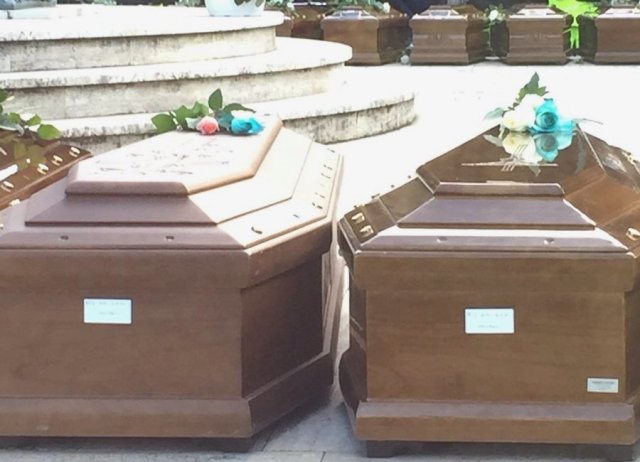
The funeral of the 26 Nigerian female migrants who died at the Mediterranean sea held on Friday in Naples, Italy.

Italian prosecutors say they are investigating the deaths of women – most of them teenagers – whose bodies were recovered at sea on November 6.

Investigators suspect that the women, aged 14 to 18 years, were sexually abused and subsequently murdered while trying to cross the Mediterranean.

Paraic O’Brien, a reporter with Channel4 television, London, tweeted pictures of the funeral on Friday.

According to him, two of the 26 women were pregnant at the time they were allegedly killed.

Investigation into the death of the women has already led to the detention of five migrants who are being questioned in the southern port of Salerno.

Six death-row inmates in Bauchi still in prison 10 years after conviction


Sulaiman Suleiman, Controller of Prison in Bauchi State, says six death row inmates and 10 others who were sentenced to amputation are still awaiting their fate more than 10 years after their conviction.

Suleiman made this known in a statement he issued on Friday, explaining that the inmates were convicted by sharia courts on various offences.

The six death-row inmates were supposed to die by stoning.

Suleiman commended the Bauchi State Chief Judge, Rabi Umar, for her frequent visits to the prisons and her commitment to ensuring that the convicts know their fate soonest.

He said Umar had assured that a team of lawyers were studying the cases in order to come up with the appropriate legal steps to bring an end to the prolonged incarceration.

According to Sulaiman, some of the inmates had spent more than 13 years in the prison without the execution of their sentences.

“The chief judge has also promised to review the cases of other inmates as part of the 3rd quarter jail delivery exercise before the year runs out,” he stated.

The Bauchi State prison service also said it had written to the state governor on the inmates’ plight.

Osinbajo: Buhari’s salary less than N2m yet he collects only half of it

Vice-President Yemi Osinbajo says President Muhammadu Buhari’s monthly salary is just over N2 million yet the he receives only half of it.

Osinbajo said this on Friday at the public presentation of a book, ‘Making Steady, Sustainable Progress for Nigeria’s Peace and Prosperity’, at the State House, Abuja.

He said that it was Buhari’s decision to halve his salary that made him (Osinbajo) to do the same.

“Some things have not been included in the book and I might just supply some of that,” OSinbanjo said.

“One of such things is the exemplary frugality, the honesty and humility, and sense of humour of Mr. President.

“That frugality can sometimes be a problem. As you know, Mr. President decided that since government provides accommodation, food and transportation for the President and the Vice-President, we didn’t need a full salary.

“Now, how much is this salary by the way? It is public knowledge and I think it is N1, 750,000.00 or so, which is under N2m. He said he would take only half of his salary and so I had no choice but also to take half of my own salary.

“In a country where politicians sometimes want to be as wealthy as Dangote, it is refreshing to have a President who most people won’t even dare to discuss any private benefit on a project with let alone a bribe or a kick-back.”

Osinbajo said that Buhari, by his prudence and honesty, has been able to support state governments with bailouts, spending over N1 trillion on capital projects and meeting other obligations in spite of the recession.

“Mr. President’s unassuming personality and humility, is in my view, probably his greatest strength. This is why he is never flattered, or carried away by praise or adulation,” Osinbajo said.

“He has always said ‘I don’t pretend to know all the answers. I am here to provide stability and leadership, to a generation, a group of people, determined to run this country honestly, to provide jobs and prosperity to the poor, and our huge youth population’.

“I remember when he was on medical vacation, and I was speaking with him on the phone fairly regularly and giving him a rundown of what was going on, especially when he was on the first medical vacation.

“He said to me, ‘Don’t worry about telling me all that is happening, I rely on your judgment keep doing your best, what if I drop dead? You would have to run it anyway’. I had to say to him that his dropping dead was not part of the plan.

“The greatest challenge is how to take the tough decisions, do the difficult things, and keep the people’s support.

“I suppose you cannot be a Buhari and shy away from tough decisions, and the President has not been afraid to take the bold decisions even when they are criticised.

“What has happened so far under this government is the tough business of laying strong foundations. The first, is honesty and good governance, and prudence in government spending.”


READ ALSO: