Climate change is the latest challenge to sustainable human development.
“It is no longer a question of whether the earth‘s climate will change but rather when, where and by how much,” says Robert T. Watson, Chairman of the United Nations Inter-Governmental Panel on Climate Change.
Arguably, Nigeria is the African state of greatest strategic importance to the global world. It is home to about 20 percent of the people living in Africa south of the Sahara. However, Nigeria is currently under siege. Its security challenges include a radical, Islamist insurrection in the northeast of the country called Boko Haram, restiveness in the Niger Delta, the heartland of Nigeria’s petroleum-based wealth, and ethnic and religious conflict centered in the middle belt but found elsewhere as well. Nigeria’s present security challenges are related, directly and indirectly, to the consequences of climate change.
Adequate adaptation and mitigation could help to protect public health, development, security, and land and water resources from the potential threats posed by climate change.
The risk to humans being displaced through sudden natural disasters is 60 percent higher today than it was 40 years ago.
Lagos is now one of the largest cities in the world, and its population is exploding; it grew from 5.3 million in 1991 to 16 million in 2006, and reached 21.3 million in 2015 (These figures are estimates only.). Much of the Lagos metropolitan area is only slightly above sea level and several neighborhoods consist entirely of shacks built on stilts in the lagoon. As sea levels rise, millions of inhabitants and millions of dollars in assets will be threatened by flooding.
The flooding in 2012 also had a serious economic impact. It disrupted petroleum production in the Niger Delta by about 500,000 barrels per day, causing a substantial loss in government revenue just when it was most needed for humanitarian relief.
Consideration of the social and political consequences of climate change are often based on future projections. In the case of Nigeria, however, the effects of climate change are already visible. It is an important contributing factor in ethnic and religious conflict, quarrels over land use, and the disaffection of at least some Nigerians from their government.
Trouble ‘Looms’ for the Nation’s security
According to an estimate, communal violence, mostly involving contest for resources, killed at least 10,000 Nigerians in less than a decade and this is strongly linked to climate change. A case is the frequent farmer-fulani herdsman clash, which has to do with the contest of resources which is greatly affected by climate change.
Clashes between Fulani herdsmen and farmers over land claim hundreds of lives in Nigeria’s central region every year.
The largely agrarian Christian communities in the state maintain the predominantly Muslim Fulani herdsmen are engaged in a prolonged battle to take over land from the areas of so-called indigenous people.
Desertification, which has Nigeria’s northern neighbour, Niger, firmly in its grip, is also forcing herdsmen in Nigeria to migrate southwards. This has made herdsmen who used to depend on the green pasture they had in past had to start moving down to the Middle Belt areas
The Middle Belt is a loosely defined area between the Muslim and Hausa-dominated north and the predominately Christian Igbo and Yoruba areas of the southeast and southwest of Nigeria.
Earlier this year heavy rains and thunderstorms caused havoc in Benue state. The aftermath of the torrential rainfalls in Makurdi left close to 3,000 houses submerged and thousands of residents were rendered homeless and had to flee. Also in Lagos, Nigeria’s economic nerve centre and one of Africa’s most populous cities. Residents woke up in many parts of the city to find their streets and homes flooded and their property, including cars and other valuables, submerged.
Lagos and Benue states were not alone. Suleja, a town near the capital city Abuja, suffered its own flooding challenge in early July. Heavy rains washed houses away and caused others to collapse, trapping occupants. Thirteen people were said to have died. Other states that affected by flooding this year includes, Ekiti, Osun, Akwa Ibom, Kebbi, Niger, Kwara, Ebonyi, Enugu, Abia, Oyo, Plateau, Sokoto, Edo and Bayelsa.
Some of the worst flooding in recent memory happened five years ago in March 2012 when 32 of Nigeria’s 36 states were affected, 24 severely. More than 360 people were killed and almost two million people were displaced.
The first factor aggravating flooding is climate change, which has been shown to contribute to more extreme storms and rainfall. Another factor contributing to flooding in cities is that Nigeria has experienced rapid urban growth and planning is poor.
Climate change and its effect on agriculture
The concern with climate change is heightened given the linkage of the agricultural sector to poverty. It is anticipated that adverse impacts on the agricultural sector will exacerbate the incidence of rural poverty. Climate change has the potential to affect Nigeria agriculture in a range of ways leading to an overall reduction of productivity which could result to a loss in GDP.
Over 80% of Nigeria’s population depends on rain-fed agriculture and fishing as their primary occupation leading to a high risk of food production system being adversely affected by the variability in timing and amount of rainfall. Climate change degrades yields from agriculture, cattle rearing and fisheries, many people are left unemployed, with few economic opportunities and low levels of education.
The agricultural sector contributes some percentage of the Nigerian Gross National Product and majority of the rural populace are employed in this sector. The dominant role of agriculture makes it obvious that even minor climate deterioration can cause devastating socioeconomic consequences. Policies to curb the climate change by reducing the consumption of fossil fuels like oil, gas or carbon, have significant economical impacts on the producers or rather the suppliers of these fuels.
Climate change and its effect on health
Nigeria is experiencing adverse climate conditions with negative impacts on the welfare of millions of people. In addition, climate change also negatively affect human health in developing country like Nigeria. Climate change affects human health directly or indirectly in many ways. Changes in temperature, precipitation, rising sea levels, increasing frequencies have great implications on human health in the area of injury, illness, morbidity and mortality. Rising sea level is anticipated as a result of climate change Hence flooding may result which is likely to increase the vulnerability of the poor to malaria, typhoid, cholera and pneumonia. Also, temperature and rainfall dynamics may increase the distribution of disease vectors such as dengue, malaria and incidence of diarrhea disease.
‘Wider implications of climate change’
The conflict between herdsmen and farmers is one of the wider implications of climate change in Nigeria.
Climate change does not create terrorists or insurgents, but it does create an environment that lets them thrive and grow. In areas where the state lacks the authority or the capacity to provide security and basic services, non-state armed groups operate more freely. They use the weaknesses of the state to undermine it further.
Another implication is the encroachment of the Sahara, which also fuels the insurgency by the jihadist group Boko Haram, while the rise in ocean levels and flooding were also affecting the south of Nigeria.
Dino Melaye, the senator representing Kogi West at the National Assembly, says a total of $350 million has been pilfered in the Ministry of Power, Works and Housing, between 2014 and 2017.
Melaye made the allegation during Thursday’s senate plenary, adding that two companies, General Electric and IBEX, were involved in the fraud.
“Mr. President, in line with the anti-corruption posture of this chamber and especially now that our cries, observations are yielding dividends as expressly manifested in the case of Babachir Lawal, today, I bring to the attention of this Senate a monumental fraud in the power sector,” Melaye said.
“In July 2013, the federal Government raised $1 billion from Eurobond issue. From the proceeds, $350 million was given to IBEX in 2014.
“Mr. President, this money was stolen in installments. As I speak to you, some time last year again, the Ministry of Power came up with a term they call fast power. This indigested project is supposed to build new generating plants to add power to our grid.
“Mr President, there are few questions we need to ask and that is why I need the nod of the Senate to bring a substantive motion to move in the next legislative day.
“These are the few questions: Up to date, there is no detail to build this new generating plant or a feasibility study, there is no appropriation by the National Assembly for these projects.
“The Ministry has spent so far $35 million on the Afam fast power project that has no appropriation or feasibility studies. How and when was this money appropriated, we need to find out.
“Out of this money, $29 million was purportedly paid to General Electric for turbines while $6 million was paid to others. These, among many other monumental frauds, are taking place. We need the Senate to investigate this.”
Bukola Saraki, the Senate President, granted Melaye permission to present the issue as a motion during the next sitting.
Cornelius Adewale, a former vegetable farmer and current Ph.D. candidate at Washington State University, has won the Bullitt Foundation Environmental Prize for 2017 for his leadership role in developing an app and web tool that can measure a farm’s carbon footprint and help farmers reduce the impact of that footprint.
Before he left Nigeria six years ago, Adewale was just a vegetable farmer in Ikorodu, Lagos State.
He used the money he made from farming okra and other vegetables to apply for his Master’s degree in the university.
The Obafemi Awolowo University graduate was, at a time, President of the National Association of Agricultural Students.
According to Seattle Times, Adewale moved to Pullman with $6,000 in his pocket — money he’d earned from the vegetable harvest at his farm in southwest Nigeria. It was just enough to pay for the first semester of classes in organic agriculture at Washington State University (WSU).
Before his money ran out, he secured a research position at WSU to help fund his master’s degree and, later, his Ph.D.
On Monday, Adewale accepted the prize, usually awarded to graduate students pursuing leadership positions within the environmental field.
He plans to use the money to build a phone app that will help Nigerian farmers grow more crops, using fewer resources, with a lighter touch on the planet.
The app will be a portal to research and information about organic farming specific to Nigeria’s climate. And farmers will be able to measure the quantity of organic matter in their soil just by taking a picture of it, using their phones.
Adewale, 34, is described as an enthusiastic talker whose ideas spill out in rapid succession.
“Cornelius just had a magnetism and energy and charm that made him irresistible,” Denis Hayes, President and CEO of the Bullitt Foundation, said.
“He came with rave recommendations from his professors, who believe he can be a transformational force in agriculture.”
The Bullitt prize money comes with no strings attached.
“It is a gesture of faith that this is a guy who’s deeply committed to getting something done in the world,” Hayes said, “and we’re trying to give him a financial boost to help him do it.”
For the past two years, Adewale has been working with a team of students at WSU to create a web-based tool that helps Washington farmers measure their carbon footprint, and gives them ideas on how they can reduce that footprint by adjusting the way they farm.
“The thing that is really unique and wonderful about Cornelius is his humility — he really relates to everyone as individuals,” said Lynne Carpenter-Boggs, an Associate Professor at WSU’s Department of Crop and Soil Sciences.
“He’s there to help, but in a way that’s about empowering the individuals, not telling people what to do … he truly is a natural leader.”
He will be returning home to Nigeria when he finishes his degree with the hope of using his app and web tool to improve organic farming in the country.
He thinks Nigerian farmers need more information about ways to use organic methods to build up their soil, making their farms more fertile and productive, without using chemicals.
His innovation will offer framers less costly organic methods to build good soil and boosted their yields. This will be the alternative to using expensive chemical fertilizers and herbicides.
Adewale is inspired by his grandmother, Abigail Abike Aluko, who raised him at Ilesa in Osun State.
“Every time I make these crazy decisions, I hear my grandmother’s voice in my head,” Adewale said. “She said ‘Dare to make a difference.'”
Bolaji Abdullahi, National Publicity Secretary of the All Progressives Congress (APC), says the act of leaking confidential government documents cannot be excused on the basis of freedom of information.
Abdullahi was reacting to the memo written by Winifred Oyo-Ita, Head of Service of the Federation, to Abba Kyari, Chief of Staff to the President, explaining the series of events that led to the reinstatement of Abdulrasheed Maina, which managed to find its way to the press.
Buhari had instructed Oyo-Ita to submit to Kyari a written explanation on why Maina, a wanted former Chairman of the Pensions Reform Task Team (PRTT), was reinstated into the nation’s civil service.
That memo, which was presented to Kyari on October 23, was leaked to the media — an action believed to be the cause of a heated argument between Oyo-Ita and Kyari before Wednesday’s Federal Executive Council meeting.
Speaking on AIT’s Focus Nigeria on Thursday, Abdullahi said the development is bad for governance and for national security.
“There’s a reason confidentiality is an essential element of governance,” he said, “because government should also be allowed to make mistakes and correct those mistakes.
“But when every single mistake you make is in the open, then you find that government prioritises symbolism; the need to look good then takes precedence over the need to do the right thing.
“Because if you can make mistakes and correct those mistakes, then you can focus on what really matters. At the same time, we are not advocating for total opacity, but we are saying that there’s a need for balance.
“I think the trend of memo to the President or from the President getting out to the public domain cannot be excused on the basis of freedom of Information. I don’t think it is good for governance and I don’t think it is good for national security.”
Abdullahi said public officers must abide by their oath of office to protect government information, as total demystification of government weakens the institution.
“I was a Minister (of sports), and we swore to an oath to protect government information. It’s an oath that we took and we must remember this,” he said.
“I held the Quran in my hands and swore to that oath, my Christian colleagues held the Bible in their hands and swore to that oath. So if you feel you are no longer able to keep to the requirements or the demands or the boundaries set by the oath, I think the honourable thing to do is to go out and then pursue all those interests that you want to pursue.
“There’s a reason secrecy is an important element of governance, and as long as total demystification of government may suit initial interests, for whatever those interests are… but ultimately, the institution is weakened, the institution is destroyed. And the institution should be bigger than all of us.”
Contributing to the discussion, Femi Adesina, media aide to President Muhammadu Buhari, said the frequency of leaks of confidential government documents in recent times should be a cause for worry.
“Naturally, it should worry one if you have that spate of leakages, but then, that is the trend in most parts of the world now,” Adesina said in an interview during AIT’s Focus Nigeria.
“There’s hardly any secret anywhere in the world now. Even in the most advanced democracies you see leakages everywhere.
“So I think we should learn lessons from it and know how to conduct ourselves and conduct government businesses.”
The Oyo-Ita/Kyari saga is coming few months after a memo written to Buhari by Ibe Kachikwu, Minister of State for Petroleum Resources, alleging acts of insubordination and misconduct by Maikanti Baru, Group Managing Director of the NNPC, also mysteriously got leaked to the press.
Similarly, a letter written to Buhari by Nasir el-Rufai, Governor of Kaduna State, was leaked to the media.
Femi Adesina, Special Assistant to President Muhammadu Buhari, and Bolaji Abdullahi, spokesman of the All Progressives Congress (APC), say there was never a time during the 2015 presidential campaign when Buhari promised not to embark on medical tourism.
Both men were guests at Thursday’s edition of Focus Nigeria on AIT, where they spoke on the achievements of the Buhari administration so far.
Abdullahi, who worked as a Deputy Director in the Buhari’s presidential campaign team, said it was “one gentleman” who came up with a list containing 100 promises that Buhari was supposed to keep if he emerged President.
“I was the Deputy Director of the policy directorate of the campaign, I was there from the beginning to the end,” Abdullahi said.
“So many people came to join the group, some from even outside the country. Then one day, we were in a meeting, then one gentleman who heads one of the international NGOs in the country brought this list of 100 items that he was proposing that we should push out as the promise of Mr President to Nigerians.
“We circulated and asked everyone to study it and come back the following day so that we look at which ones we can own and which ones we need to reject.
“I recall that Number 1 on that list was to make the President say that ‘when I become President, I will not travel abroad for medical treatment’.
“And I remember we rejected that immediately, because we said we din’t know what this man was dealing with, we didn’t know who his doctors had been, how could we say this for him?
“But do you know what happened? One of us in the group just released the document.”
Contributing to the discussion, Adesina said he could confirm the incident because he had raised the issue with Buhari when he first read it.
“I can confirm that even the President himself, who was a candidate then, was not aware,” Adesina said.
“The very week I resumed this assignment, I raised some things with the President. I said, this and this and this were promised, and the President said ‘when did I promise these things’?
“I said there is a document titled ‘100 things Buhari will do in 100 days’. He never knew about that document. He had to ask people to fetch that document for him, and it was the first time he was seeing it.
“So there were promises that people made during the campaign on his behalf.”
Adesina agreed that a serious government should be able to provide adequate healthcare for its citizenry, but added that at present, the Nigerian government cannot afford it.
He blamed previous governments for not doing anything with the nation’s resources when crude oil sold for more than $100 per barrel.
“There was a time we could have afforded it, but the money was not properly spent,” he said.
“That’s why the President keeps lamenting that for a certain number of years consistently, oil prices stood at $100 per barrel, going as high as $120 per barrel at a time, and we were producing about 2.1 million barrels daily.
“Then when he [Buhari] came, oil prices plunged to $37 per barrel, so he called the Central Bank Governor and said, ‘do we have savings?’ and the Governor said ‘no savings’.
“The question is ‘What did they do with that money? Why didn’t they fix our hospitals in all those years that we had boom?’
“And you know that since 2015, things have been down and they are just looking up now. As things look up, if they ever ever get back to where we were, if we ever get back to $100 per barrel for oil under the Buhari administration, it’s doubtful, but if we ever get there, you can be sure that a lot will get done, because this is a prudent administration and the money of Nigerians will be used to serve Nigerians.”
“Everything can be made in Aba,” says Uche Jumbo, a Nollywood actress, on a billboard along the Aba-Owerri road in Aba. Wearing a headgear and beaming with a bold smile, Jumbo announces she is proudly “Nwa Aba” — a child of this commercial city in Abia State, southeastern Nigeria. And she proudly supports products manufactured in the town she grew up in.
There are other billboards along this road with pictures of celebrities expressing confidence in Aba products. The campaign, “Proudly Made in Aba”, is partly to change a negative tag, “Aba Made”, with which Nigerians derided goods manufactured in the town. Ironically, those who reject the Aba products sometimes buy the same products at higher prices when foreign labels are attached.
Remaining undaunted over the decades, the Aba manufacturers have succeeded in making the town a popular international destination for finished leather and garment products.The volume of trade between Aba and the rest of West and Central Africa is high, as tens of truckloads of manufactured goods depart the commercial city to the ports for onward export to Cameroun, Ghana, Togo, Equatorial Guinea, Central Africa Republic and other African countries.
“There is no documentation,” says a senior staff in the Nigerian Export Promotion Council, Aba Smart Office, who wishes to remain anonymous because he is not authorised to speak to the press. “There are no records of trade for us to know the exact volume of trade between Aba and these countries, but we are working with the associations to urge them to keep records of their individual sales.”
Manufacturing in Aba is informal, likewise the sale. The manufacturers are mostly in their houses, on the streets and market stalls. There are tens of thousands of individuals who are actively manufacturing different types of products but nobody knows for certain the quantity of these goods that are produced in the city.
The evidence of manufacturing in Aba cannot be ascertained by the number of factories because there are too few of them.The evidence is, however, ascertained by the number of trucks that transport manufactured goods out of the town and the presence of Aba products in all the markets in Nigeria and many African countries.
In Aba, the markets, the roadsides, the streets, and the backyards have been turned to manufacturing sites for different products where quality is maintained by fierce competition for sale.
“Aba is textile and leather,” Okechukwu Isiguzo, the Public Relations Officer of Aba Chamber of Commerce, Mines and Agriculture, told the ICIR.
He classifies the industries in Aba into four: micro, small, medium and large. He, however, points out that it is the micro industry that makes Aba unique in the manufacturing of goods.
“It is this micro industry that employs the people and pushes out the goods,” Isiguzo says. “Most of the products you see in the markets are produced by the micro industrialists inside their houses. You will see three tailors come together in one room but day and night, they are producing quality goods and putting labels that you won’t believe are coming out from there.”
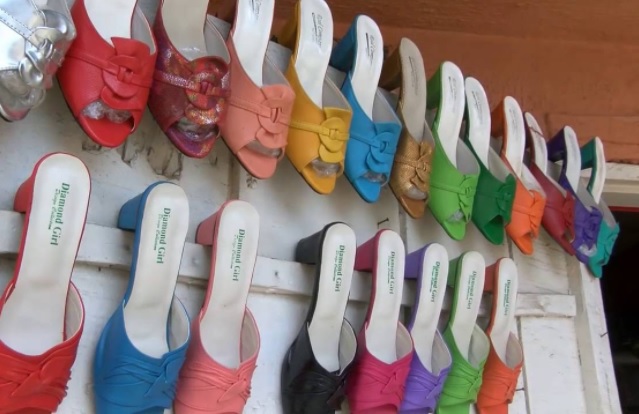
Aba has a niche as a manufacturing hub for shoes, belts, bags and clothes but for those who understand the people’s creativity and entrepreneurship, manufacturing in the town goes beyond leather and garment products.
A N50 MILLION DREDGER FOR N8 MILLION
Adiele stands by the dredger he is constructing with Detroit-built engine to power it
A passer-by may think that Ugwueze Adiele is welding a tank or container but he is actually constructing a dredger that will be deployed to Imo River at Owerrinta for a large-scale sand scooping business from the river.
His workshop is so ordinary that the only conviction that he is building a sand dredging machine is a Detroit-built engine that will power the dredger. The engine is propped up on two iron bars while the top is covered beside the room-size dredger under construction.
Adiele specialises in the fabrication of engine boat, barge and dredger; he has more than 15 years of experience. The last dredger he constructed before this has already been deployed to the site in Oguta Lake, close to the home of Arthur Nzeribe, a former senator from Imo State.
“If it is salt water, we have engine for that but Imo River is not salt water and that is why I’m using this engine,” Adiele says in a mixture of English and Igbo, rubbing his stained hand on his polo before lifting the cover from the engine.
Last year, he was invited to Okirika, in Rivers State, to work on a new dredger that was imported from abroad but failed to start until he operated on it.
“If the Oyibos do their own, we also do our own here in Aba but I know you would not want to do a dirty work like this,” Adiele says with a smile, probing the interviewer to know if he could ditch journalism for “this dirty work”.
He explains that importing the dredger would cost about N50 million but he was constructing one with N8 million. Although he concedes the imported dredger will be finer, he says his will be more durable because he uses stronger local materials. It will also be easier to fix if it breaks down.
“The problem is that we don’t value what we have,” Adiele says, lamenting how Nigerians do not recognise the technologies made in Aba. “But those who understand come to us. Imagine a dredger that will cost you N50 million to import from abroad and you are getting it N8 million here in Aba.”
Due to the fact that machine fabrication is capital intensive, he usually produces whenever there is an order and he produces according to the specification of his client. He says it takes him about two months to construct a dredger.
‘WITH N800,000, I CAN SHOW YOU HOW TO SOLVE NIGERIA’S POWER PROBLEM’
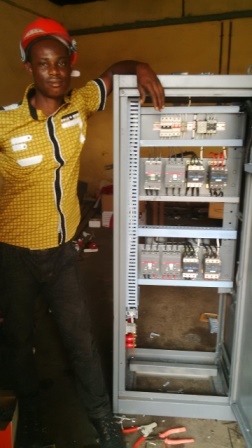
Emeka poses by one of the industrial power control systems he fabricated
Just as Adiele is building a dredger for N8 million in his little corner on the street, thousands of technicians like him in Aba are also into the fabrication of all kinds of industrial machines.
Godson Emeka, a 31-year-old graduate of Electrical Engineering from the Rivers State University of Science and Technology is challenging any investor to drop N800, 000 and he will come up with an innovation that will solve the country’s persistent electricity problem.
Emeka specialises in the construction of power factor systems and industrial controls but he has also constructed industrial food driers and other industrial machines for clients.The money he is asking for, is to develop a prototype for a generator that will run on improvised hydro system.
The 100 percent renewable energy technology will work by water pressure that turns an improved turbine, not the usual ones in the market. This particular turbine will have much more accelerated speed. The turbine will turn as water falls on it through a water jet from an overhead tank. As the water rotates the turbine, it will turn the alternator to generate electricity. The water from the overhead tank will quickly deplete but a pump coupled to the turbine will take the water back to the overhead tank from the underground tank. The water loss during this movement will be compensated through an interval refill from the underground water system. According to Emeka, this technology can run nonstop for over 50 years.
“The 800k is just to develop a prototype to demonstrate that this will work but the project itself will cost a lot of money,” Emeka says. Askedwhat is the guarantee that this will work, he says “If I see an investor who is willing to take a risk, for him it is a risk but for me it is not really a risk. I will guarantee 100 percent on this and if there is something like one million percent I will guarantee.”
Emeka is currently working on industrial fish drier for a local company in Aba. Machine fabrication in Aba is so vast that most businesses in the town use the machines fabricated by the local technicians. Emeka is suggesting that if there is a database that showcases the machines that can be manufactured in Aba and the contacts of the manufacturers, it will help to increase the visibility of thousands of technicians in the town who are looking for clients.
“That we still patronise foreign-made products is a deliberate choice, not that we can’t do it here,” he says. He argues that the machines designed and produced in Aba are simpler and more durable than the foreign machines which may be complex and their parts may not be readily available.
He explains that the most important thing about any technology is to understand how it works and then produce local technology that will get the job done. He adds that if Nigeria continues to depend on existing technologies without producing its own, it will never develop.
WINE FROM ABA
71-year-old Chima at his wine production room in Aba
A lot of entrepreneurs are producing wine in Aba. One of them is Onyema Chima, a 71-year-old that is pushing for new frontiers in winemaking. His Crispitas Wine, which has NAFDAC registration, is made up of pawpaw, orange, pineapple, mango, yeast, sugar and water.
“It is the nature of firewood in your place that you will use in cooking,” Chima says, responding to a question on how he could make wine from the aforementioned fruits. He explains that he crushes the fruits and allows them to ferment for 10 to 14 days, depending on the nature of the fruits, before filtering. After filtering, he allows it to age in airtight container for six months if it is white wine, or one year if it is red wine.
“There,” Chima points to a back door that leads to a corridor, “I have wine of 2009 and 2010 that I have not bottled.” After exiting the production room, he opens another room with airtight white plastic tanks that contain the wine. “Each tank gives me 280 to 300 bottles of wine,” he says.
Chima, who studied Biological Sciences for his first degree, told the ICIR that winemaking was his hobby when he lived in the United States for 14 years. But when he returned to Nigeria in the early 1990s, people were importing all kinds of wine into the country and he decided to demonstrate that good wine could be produced in-country.
The Imo-born scientist is not just a wine maker but also an inventor. In 2013, he was honoured by the Presidential Standing Committee on Inventions and Innovation for making yeast from plants. He has secured a patent for this invention. Again in 2016, he featured as one of the beneficiaries of Presidential Standing Committee on Inventions and Innovation awards for producing enzymes from animal source.
ABA SHOES
A line at Ariaria Market in Aba where shoes are manufactured
Shoemaking is the largest industry in Aba. An estimated more than 100,000 shoemakers are producing different kinds of shoes in the six shoemaking clusters in the town. The Aba shoe industry received a boost when it produced 60,000 military boots for the Nigerian Army last year.
The made-in-Aba shoes are competing in the Nigerian footwear market, estimated at nearly N700 billion annually.
“More than 60 percent of new shoes worn in Nigeria come from Aba but most Nigerians don’t know that they are wearing Aba shoes,” Ken Anyanwu, National Secretary of Association of Leather/Allied Industrialists of Nigeria, told the ICIR at his shop in Ariaria International Market.
In his shop, five shirtless men are making high-heeled shoes. One is applying gum on the already cut insole sheet and passing it to another, who places the sheet on the sole and flattens it with his fingers. The third man fixes the cover on the sole. Another workman picks up the shoe, examines it, and hovers it over a burning stove before passing it to the youngest among them, who controls the sole pressing machine. The shirtless young man brings the shoe under a protruding rod on the blue painted sole pressing machine, and when he presses a button, the rod comes down hard on the shoe. He does it twice on the shoe, the front and the back, before throwing it into a wide basket. A shoe is made.
The workmen are all Anyanwu’s apprentices, learning from the master who has spent 30 years in the business. “An average Aba shoemaker believes in quantity and quality. These two attributes culminate in huge profit,” says Anyanwu, who discloses that he supervised the production of 30,000 out of the 60,000 military boots ordered by the Nigerian Army.
Getting reliable data on production or even the producers seems impossible because every manufacturer is independent. However, rough estimates put production capacity of the Aba shoe industry at about 500,000 pairs daily. The industry is made of independent micro entrepreneurs with an average of three apprentices.
According to a popular story by the shoemakers, the Aba shoe industry started with a shoe cobbler who approached artisans that carved local mortars and pestles for a pair of lasts. He gave the wood carvers a drawing of the design and size. A few days later, the cobbler laid his hands on a pair of hardwood foot-shaped stretchers which he used to produce his first virgin shoes.
The cobbler continued to produce shoes after this successful experiment. People began to take notice of his ingenuity and showed interest in acquiring his skill. Apprentices swarmed his shop. Within few years, the number of people making shoes in Ekeoha Market in Aba expanded.
In 1976, Ekeoha Market was gutted by fire and the shoemakers were relocated to Ariaria.
The Aba shoe industry is still heavily dependent on manual production but locally-made machines have improved the quality of the shoes. One of such machines is sole pressing machine, which has contributed significantly to the durability of the shoes.
In the past, the soles of the shoes used to detach easily because the shoemakers used their bare hands to attach the soles. Now, most of them have now acquired the sole pressing machine manufactured by technicians in Aba. The Aba shoe industry is now semi-automated, with a lot of local machines that facilitate the production of the shoes.
‘ABA COMPETES WITH ITALY, NOT CHINA’
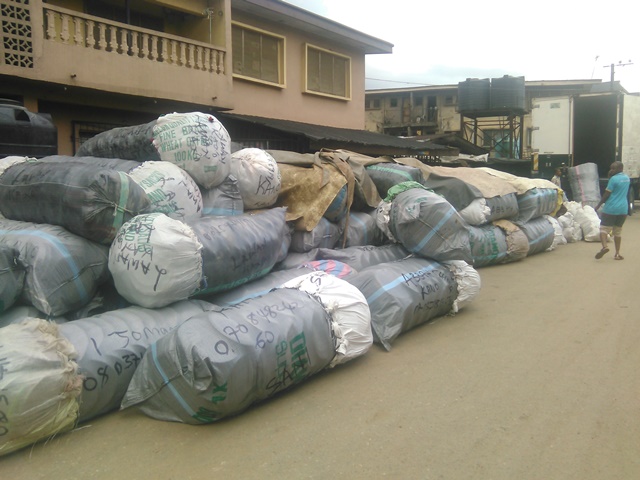
Bags of shoes for export at Ariaria Market, Aba
“I once went to Abuja where I saw one big man wearing my shoes. I told him they were my shoes but he doubted. He said he bought them from a boutique that sold Italian shoes. I asked if I could open the shoe, he agreed. I opened it and showed him my name inside the shoe. I left him with his mouth open so wide that I feared flies would go in.”
Chiemeka Ekezie narrates this story in Igbo amidst laughter from his colleagues on how Nigerians will reject their products as inferior but end up buying them at expensive price when they are packaged with a foreign label. The artisans say they do not understand how Nigerians will buy what they refer to as substandard Chinese leather products instead of their own, which are far more durable. They, however, agree that Chinese products are flashier.
“We are now competing with Italians, Brazilians, and Spaniards, the world’s renowned shoe manufacturers,” says Goodluck Nmeri, President of Powerline Shoe Manufacturers Association of Nigeria. He pulls off his footwear and squeezes it to demonstrate the durability of Aba leather products. In the association’s office, he presents a pair of military boots and good-looking pair of office shoes. These shoes are made by his members and he says there is no type of shoe they cannot make.
According to Nmeri, the influx of substandard Chinese products from 2000 to 2015 brought untold hardship to Aba shoe manufacturers. Many of them went into other businesses, including commercial motorcycle riding.
Those who left the shoemaking business began returning since last year, as the business has started picking up again. African countries have begun showing a high preference for Aba-made products. Also, Chinese products are no longer as cheap as they used to be because of higher tariff and naira devaluation. Aba manufacturers now offer competitive price with the Chinese products.
Nmeri, who has been in the business of making female footwear and bags for over 30 years, says Chinese products overshadowed leather products manufactured in Aba in the past. But not anymore. “Our women started going for Chinese-made shoes, which they were made from inferior materials even though they were shining. So women went for flashy shoes from China and abandoned us. So we suffered the defeat.They had machinery for mass production. You see it very flashy but use it for two weeks, you will throw it away but you can wear our own for two to three years.”
He says Aba is now enjoying high patronage because many African countries have recognised the quality of their leather products. “China is no longer our challenge,” Nmeri concludes.
‘IF YOU PUT A LABEL, IT BECOMES FOREIGN’
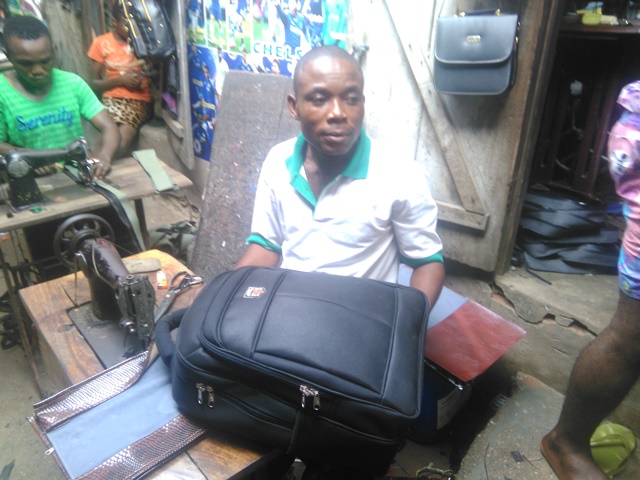
Nnaji displays a backpack he manufactured at his shop in Ariaria Market
Okechukwu Nnaji flips a backpack he has just finished making, and tosses it on his worktable.“This one is N2,500 nwanne,” he says. “But if you go back to Abuja with it and put foreign label, won’t you sell it for N10, 000?” The bag looks beautiful and without doubt can compete favourably with foreign-made bags.
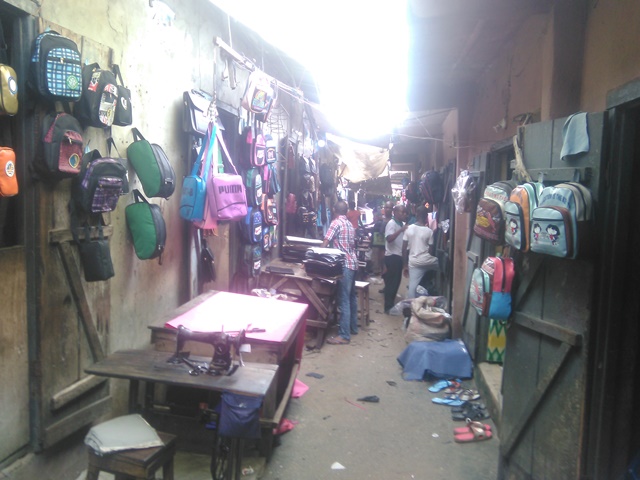
Nnaji’s shop is located at the Glorious Line in Ariaria Market where thousands of other bag makers display the designs they have produced in front of their shops. Colourful bags of all kinds, such as men and women’s bags, conference files, travelling and school bags are on display.
The most visible equipment they use in the production of the bags is just sewing machine.
SURVIVAL OF THE FITTEST
A line for bag makers at Ariaria Market, Aba
Tailoring is the second biggest industry in Aba after leather products, but it does not mean that there are factories that produce the clothes in the town.
At St. Michael’s Road, a group of five tailors told the ICIR that they sew for a boutique in London. They are just part of tens of thousands of tailors who are in their houses or the streets making clothes that are being exported informally to several countries.
John Amadi, Public Relations Officer of the Association of Tailors and Fashion Designers in Abia State, told the ICIR that the association has about 30,000 members.
“What makes Aba unique in tailoring is that an average Aba man strives for the best,” Amadi says. “If you do a bad job here, that will be the end of your business because nobody will give you clothes again to sew. So it is about the survival of the fittest. That’s why Aba is so popular for tailoring. That’s why many people come to Aba because you will get whatever design you want done perfectly.”
Amadi’s description of tailoring in Aba as a “survival of the fittest” captures the entire spectrum of making products in the town. The roads and power supply in Aba are probably among the worst in the entire country but the individual manufacturers strive to offer the best products in spite of the odds against them.
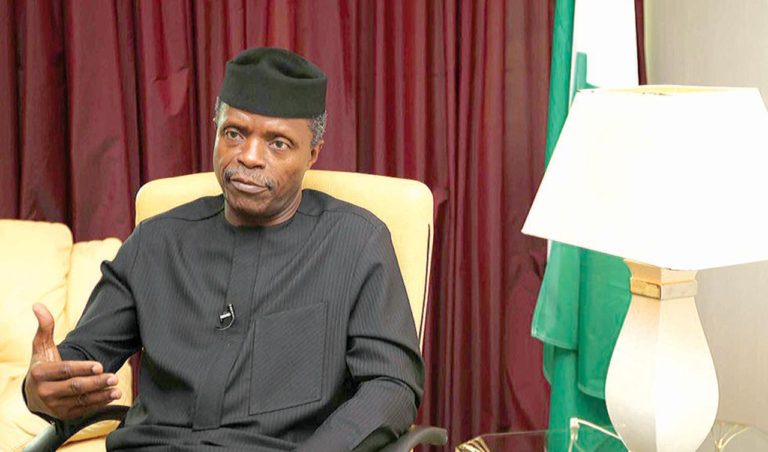
The Christian Association of Nigeria (CAN) on Wednesday lashed out at Vice President Yemi Osinbajo, accusing him of discrediting the association in his desperation to please President Muhammadu Buhari.
Samson Ayokunle, CAN President, asked Osinbajo to stop discrediting the association in his avowed resolve to douse religious tension in the country.
Last week, the Vice President had said at a public function that there was no agenda to islamise the country and that no one could possibly do so.
A statement issued by Adebayo Oladeji, Special Assistant, Media and Communications to Ayokunle said most Christian leaders in the country were taken aback by the remarks and had sought the intervention of the leadership of CAN to set the record straight with documented facts pointing towards the plot by the present government to islamise the country.
Ayokunle said the Vice President was talking tongue in cheeks, reiterating that the plot by the government of President Buhari to Islamise Nigeria was real, urging Osinbajo to cross check his facts well before making public remarks on the issue next time.
He noted that, Osinbajo, a Professor of Law, should use his good office to correct the imbalance in the Nigerian system and other alleged unconstitutional actions noted with the government in order to reduce tension in the polity.
He added that the body of Christians in Nigeria has long been aware of the grand plot to Islamise Africa, with Nigeria as a major focus, stressing that the Nigerian government had been working in tandem with the Organisation Of Islamic Countries (OIC) and Islam In Africa Organisation to achieve this.
“The OIC met in London in 1983, with a follow-up meeting in Nigeria in 1989, and had issued a communiqué to Islamize Africa, with Nigeria capturing a great attention. This is public knowledge while facts could be obtained from Wikipedia with links on OIC’s Conference in London, 1983 and Abuja Declaration of 1989.
“It is also a matter of fact that Nigeria was later made an observer member of the body (OIC) through General Ibrahim Badamosi Babangida. Under General Sani Abacha, another Muslim leader, Nigeria was made full member in total violation of the constitution that the nation is secular and our government should not be religiously partisan.
“From then on, conscious efforts were on to draw Nigeria into joining different Islamic organizations in keeping with the resolutions of OIC & Islam in Africa Organization (IAO). (See their communiqué tagged ‘Abuja Declaration of 1989),” Ayoukunle noted.
He stressed that CAN had not been opposing, and would not oppose Islamic evangelism in any part of Nigeria, even if done with the support of the government since Christians also evangelise. However, he said the Christian body would never support any government to make Islam a state religion under any guise.
“We are not opposed to Islamic evangelism by any Muslim group if done with a peaceful motive. The Christians also exercise their constitutional rights to do so through revivals and gospel rallies. But we are opposed to the government of Nigeria adopting Islamic resolutions aimed towards a compelling of this country, contrary to the dictates of the constitution.
“Our worry as a body is that Nigeria started getting active in international Islamic alliances and organisations in total violation of the constitution. But the Vice President seems not conscious of this and the motive behind adoption of the Sukkuk Bond. Then we ask, Is Sukkuk constitutional? Is Sukkuk not part of the resolutions of OIC & IAO, Is it not part of Nigeria’s adoption of Islamic sharia and financial system that it is mandatory for all governments in Africa subscribing to Islam?
“We also ask why the present government joined Islamic Military Alliance against terrorism? Are we an Islamic nation to so do? Can’t Nigeria fight terrorism without joining Islamic coalition? Why would the government continue to consciously heat up the polity?”
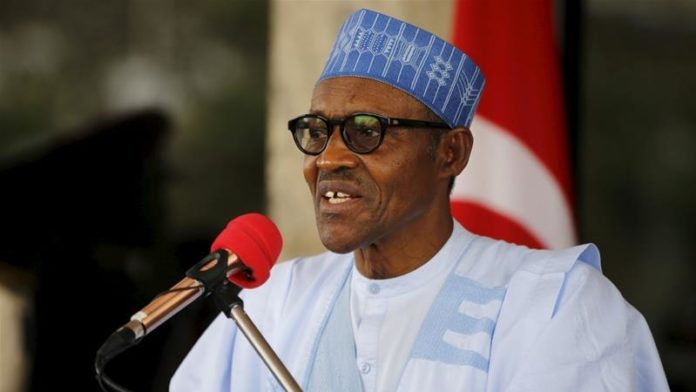
President Muhammadu Buhari says all Nigerians must decide not to allow the country witness another civil war by their actions and in-actions.
President Buhari stated this on Wednesday at the inauguration of the Armed Forces Remembrance Day Celebration 2018 emblem and appeal fund held at the Council Chamber of the Presidential Villa, Abuja.
He said Nigerians must look at the events that led to the civil war, the attendant human capital loss, and resolve that “never again shall we allow our dear nation by our actions or inactions to experience another war”.
The event, which also included the inauguration of Boss Mustapha as the new Secretary to the Government of the Federation (SGF), preceded the week’s edition of the Federal Executive Council (FEC) meeting.
The President said it is worthwhile to honour the memory of veterans who paid the supreme sacrifice to keep the country united.
“The resolve by our countrymen and women to remain in one indivisible and indissoluble nation, Nigeria, is at the centre of this celebration,” he said.
“Indeed, the remembrance day celebration is being marked on the 15th of January instead of 11th of November as in other Commonwealth nations to commemorate the end of the Nigerian civil war – a war that was fought to keep Nigeria one.
“We must, therefore, cast our minds back at the events that led to the civil war, the immense human capital loss of the tragic war, and resolve that never again shall we allow our dear nation, by our actions or inactions, to experience another war.”
He commended men of the Armed Forces for their courage and sacrifice, as they grapple with diverse and contemporary security challenges plaguing the country.
He promised that his administration would continue to do all within its power and resources to ensure that their welfare is adequately catered for.
The President said he looked forward to a time when business concerns and service providers in the country would give special recognition and consideration for the distinguished citizens and support the veterans’ cause in any way they can through voluntary donations, employment opportunities and welfare support.
“As a government, we desire to improve the capability of our Armed Forces. I am glad that our efforts are yielding positive results already in boosting the morale of men and women of the Armed Forces,” he added.
“We will continue to engage them in training and retraining to improve their capacity to discharge their constitutional roles.
“As I launch the Emblem today, I call on all Nigerians, the Diaspora and our friends to donate generously to the cause of the Nigerian Legion and families of the Fallen Heroes.
“I implore all to procure and wear the emblem with pride as a way of identifying with those that laid down their lives, the incapacitated and others still who are daily in harm’s way in order to guarantee our peace and security. We will always remember them and the respect we owe them.
“I also hereby launch the Partnership Scheme for the Armed Forces in which all Nigerians, corporate organisations and government agencies should support and partner with the Nigerian Armed Forces in appreciation of the sacrifices of these honourable men and women.
Buhari thereafter launched the emblem with N10million.
The plague in Madagascar — “the deadliest and most rapid form of plague” — suspected by the World Health Organisation (WHO) to be Pneumonic, could spread to nine other African countries: South Africa, Seychelles, La Reunion, Mozambique, Tanzania, Kenya, Ethiopia, Comoros and Mauritius.
Since the latest outbreak of the disease, health officials have setup quarantine facilities for affected patients.
The airborne disease has prompted warnings in nine African countries.
According to Daily Mail, more than 1,300 cases have now been reported in Madagascar and two thirds of those are suspected to be pneumonic, described by WHO as the “deadliest and most rapid form of plague”.
The deadly disease is caused by same bacteria that wiped out at least 50 million people in Europe in the 1300s. It is spread through coughing, sneezing or spitting and can kill within 24 hours.
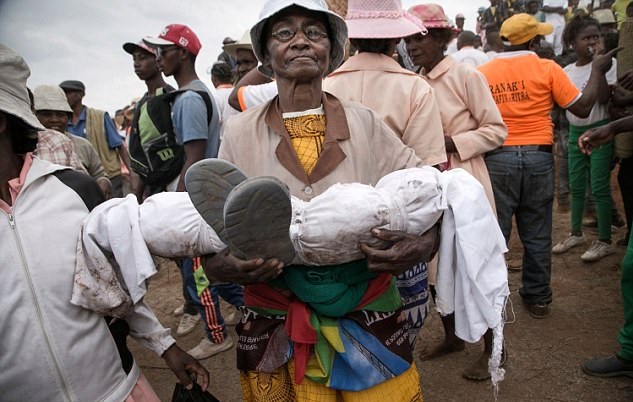
The spread of the disease is fuelled by relatives dancing with the exhumed dead bodies of their loved ones as part of an ancient ritual. The practice, known as the Famadihana tradition, involves digging up dead relatives, wrapping them in fresh cloth and dancing with them before putting them back underground.
The African division of the WHO says 93 people have so far lost their lives to the disease — a figure lower than the 124 noted in official UN figures.
About 50 aid workers are believed to be among the infected people.
A WHO official said that “The risk of the disease spreading is high at national level… because it is present in several towns and this is just the start of the outbreak”.
However, the lethal form currently spreading is different to the bubonic strain, which was behind history’s Black Death.
Despite the serious risks publicised by the authorities, few in Madagascar question the turning ceremonies and dismiss the advice
“I have participated in at least 15 Famadihana ceremonies in my life, and I’ve never caught the plague,” said participant Josephine Ralisiarisoa, who insisted the plague risk had been exaggerated. “I don’t want to imagine the dead like forgotten objects. They gave us life.”
Madagascar sees regular outbreaks of plague, which tend to start in September, with around 600 cases being reported each year on the island. However, this year’s outbreak has seen it reach the Indian Ocean island’s two biggest cities, Antananarivo and Toamasina.
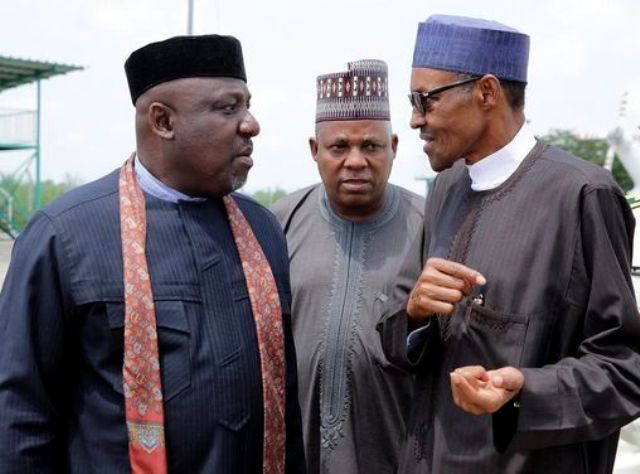
Rochas Okorocha, Governor of Imo State, says he will only give up his presidential ambition if President Muhammadu Buhari decides to seek reelection in 2019.
Okorocha said this at the National Executive Council (NEC) meeting of the All Progressives Congress (APC), which held in Abuja on Tuesday.
“If Mr. President wants to run for election, he will follow all the processes and if he is the person, we will all support him. In APC, there is no imposition of candidate,” Okorocha said.
“If Buhari is running, I will allow that man to continue but if he is not running, I won’t sacrifice my Presidential ambition.
“Mr. President is showing the right leadership and taking the very right steps and there is reconciliation going on even with nobody talking about it. There is the spirit of reconciliation and people understand their role.
“Our role is to make this party great and we are all trying to do that; but importantly, the governors have remained the pivot upon which this wheel of change has rotated so far.
“We have kept this party working and after this meeting, our congresses and convention will commence in the early part of next year and all party organs will be strengthened. We are in good mood and high spirits.”
Okorocha has been in the news recently after he unveiled a statue in honour of Jacob Zuma, President of South Africa.
Zuma was conferred with a chieftaincy title and the highest merit award in Imo State, while a street was also named after him.
The move earned Okorocha more condemnation than applause, as Nigerians wondered what Zuma did for Nigeria or Imo State to merit such humongous honour.
But Okorocha explained via a statementby his Chief Press Secretary that the decision to honour Zuma was part of efforts by his administration to attract more international attention to Imo State.