Home Blog Page 2675

Cleric tells Buhari: If I were you, I would pack my bags out of Aso Rock in 2019

Geoffrey Enyinnaya Okorafor, the Anglican Bishop of Diocese of Egbu in Owerri North Local Government Area of Imo State, says President Muhammadu Buhari should ignore political sycophants and not run for a second term come 2019.

Okorafor said this in his address at the first session of the eighth synod of the Anglican church, which held at the Cathedral Church of all Saints Egbu.

He said that the people mounting pressure on Buhari to seek re-election do not mean well for him.

“My dear President, if you have ears hear this, these are your worst enemies and sycophants of the highest order. Do not listen to them,” The Guardian quoted Okorafor as saying.

“If I were you, Mr. President, I would pack all my bags and baggage from Aso Rock, if by God’s grace I pull through the hazards of governing this difficult and complex entity called Nigeria.

“To my mind, you have achieved your life ambition as military Head of State and a civilian President.”

Okorafor said Buhari’s administration has no regard for the opinion of ordinary Nigerians.

“Last year, we urged the President to do a house cleansing, beginning with his own house and office before engaging in the fight against corruption, but it fell on deaf ears,” he continued.

“That was expected because we have a government that has no regard for the opinion of the ordinary citizens.

“May we ask, what has happened to the looted funds that have been purportedly recovered? When will Nigerians be given the account? Are we sure they are not passing from one corrupt hand to another? We need an answer.”

Okorafor wondered why herdsmen still go about freely, some of them armed with rifles, but the Indigenous People of Biafra (IPOB), whose members bore no arms, were declared a terrorist group and proscribed.

Dignitaries that attended the event include Benjamin Njemanze, immediate past Chief Judge of Imo State; Oliver Enwerem, a former representative of Ezinihitte Mbaise constituency in the Imo House of Assembly; and some government and top religious officials.

Ortom: I’m a victim of herdsmen… I lost my rice farm and ancestral home to them in 2013

Samuel Ortom, Governor of Benue State, says the state has lost over N95 billion worth of goods and property, including his rice farm, to attacks by herdsmen attacks.

“If you go to the rural areas, you see schools, churches, hospitals, houses, farmlands, all that destroyed,” Ortom told the Daily Sun in an interview.

“In 2013, I lost my rice farm and farm implements. My ancestral home was razed; my entire village was razed; more than 50 people were killed in one day. So, this is a very big challenge.”

He said the state has suffered untold hardship from herdsmen since 2012 and can no longer tolerate open grazing of cattle.

The governor said the anti-grazing law recently enacted by the state is the solution to the incessant clashes between the farmers and herdsmen.

He said a cattle ranching is the best way to rear cows and anybody who cannot establish ranch should quit the state for other states that do not have anti-grazing law.

Ortom pointed out that the argument of having grazing routes is not realistic, as there is no single hectare of land in the state that can be used for such purpose.

“In the 1950s, when people argue that they had cattle routes and grazing areas, the question is:  “What was the total population of Nigeria? [It was] less than 40 million people.

“Today, in 2017, I can approximate it to be over 200 million, because the projection in 2012 was 170 million. So, by today, we should be over 200 million. But what is the land mass now?  What was it in 1950? It’s still 923, 000 square kilometres, even less with the ceding of Bakassi to the Cameroon.

“So, we have a lesser land mass than what used to obtain when we were less in population than now. So, it’s unfortunate that we have kept sealed lips and, honestly, I feel so sad; but I will continue to do what is right, as far as I know, as a person.”

Ortom expressed sadness that instead of the herdsmen to abide by the law, they have been threatening to invade the state.

He warned that despite the threat of violence by the herdsmen, anybody that violates the law must go jail because the constitution empowers the state to make such laws.

“I have said that the security agencies should arrest them for threatening me and my state that they would make the law not to function.

“I am waiting to see who will trespass. I am waiting to see who will not respect that law in Benue State. I have said it; I am not forcing anyone to live in Benue State. If you want to do open grazing, you can go to any other state that land is available.

“For me, here we are farmers and we cannot pay salaries as at when due today, so we want to have food on the table for everyone, and we have massively encouraged our people to go into agriculture, and they have done that.”

He urged Nigerians to support the state in this effort to end wanton killings and destruction of property by herdsmen.


READ ALSO:

LEAKED: Maina’s 2015 letter accusing the senate of aiding ‘prevailing corruption and fraud’

Abdulrasheed Maina, former Chairman of the Pension Reform Task Team (PRTT), has leaked a letter he wrote in 2015 to Bukola Saraki, Senate President, wherein he accused the seventh senate of aiding and abetting pension thieves in the country.

The authenticity of the leaked letter was confirmed by Messrs Mamman Nadir & Co., the law firm representing Maina, whose office is located at 36 Ali Akilu Road, Kaduna.

Maina claimed that the PRTT, which he chaired between 2010 and 2013, discovered that over N3 trillion pension fund was stolen in 97 pension offices, adding that the team recovered N1.6 trillion in cash and assets from pension thieves.

The letter was titled: Pension Reform Task Team: Appeal for Review of Investigation by Senate Joint Committee on Establishment and Public Service and States and Local Government Administration 2011 – 2013.

In the letter, dated June 19, 2015, Maina asked Saraki to review his case and investigate the various actions taken against him by “people bent on intimidating me to submission”.

“We, members of Pension Reform Task Team (PRTT) wish to use this medium to apologise for our late response to reaching back to you,” Maina’s letter read in part.

“We had to put the issues together and source appurtenant materials. We appreciate your understanding.

“As a refresher, the PRTT was inaugurated on June 10, 2010 by the immediate past administration of former President Goodluck Ebele Jonathan, with a clear mandate to restructure the Head of Service Pension Office, Police Pension Office, among others.

“We did our utmost with precision and national interests as our guiding principles. The PRTT took off effectively by January 2011. We used financial intelligence skills to achieve our assignment.

“We recovered and saved cash and properties worth over N1.6 trillion. Our efforts led to the arrest and prosecution of 46 persons/firms involved in looting of pension funds, which we handed to the EFCC. The trials are still ongoing.

“As it is, there is a leakage of N256 billion monthly from the current IPPIS which needs to be blocked urgently.

“Some pensioners got a backlog of about 30 years paid into their accounts. All payments were ordered under the signature of the Head of Service monthly.

“We are also aware of some government’s hidden accounts, which needed to be mopped up. We can be used to engage any department of government in sanitising the financial workflow to avoid loose ends that remain susceptible to leakages.” the letter stated.

“Based on the revelations of monumental fraud and outright stealing of pension funds, which was brought to public attention by the PRTT, the 7th National Assembly by a resolution of November 2, 2011 mandated its Committee on Establishment and Public Service, State and Local Government Administration, to conduct a comprehensive investigation into the management and administration of Pension funds in Nigeria.

“There was general expectation that the various dimensions of irregularities associated with the management of Pension funds in Nigeria would come to an end as a consequence of the investigations being conducted by the Senate Joint Committee.”

However, the letter noted that the Senate Joint Committee ended up creating more problems than solutions to the endemic corruption and fraud prevailing in the system.

It accused the Senate of haunting members of the task team, while favouring pension thieves.

“The PRTT regrets to observe that rather than achieving the objectives of the spirit and its mandate, which in our view includes but not limited to identifying those responsible for the culture of fraud that characterised the system and bringing them to book, the Senate Joint Committee ended up creating more problems than solutions to the endemic corruption and fraud prevailing in the system,” the letter read.

“We became objects of corruption fighting us back. From our first appearance before the Senate committee, it was obvious that the entire exercise conducted by the Committee was geared towards discrediting the PRTT.

“In this context, the PRTT, wishes to state without any fear of contradiction that the Senate Joint Committee’s Report submitted, which was subsequently adopted by the 7th Senate but now quashed by the Federal High Court judgement of 13th March 2013 in favour of the PRTT’s Chairman, not only failed to address the issues at stake but succeeded in misleading the Senate and the generality of Nigerians about the true picture, nature and scope of problems militating against the efficient management and administration of Pension Funds in Nigeria. Copy of said judgement attached and marked “ANNEXURE1”.

“Today, it (pension fraud) is worse with the Police Pension Office, where millions are taken out of pension funds daily. We have pieces of evidence to substantiate this.”

Maina said he had to flee the country following numerous threats to his life.

He also said that the ICPC conducted an investigation into the matter but “till date, they have yet to commence the prosecution.”

“As we write to you, Abdulrasheed A. Maina has been dismissed from the Civil Service for being absent for three days, while his life was under threat following a gunshot attack on his person in front of the Head of Civil Service Office, where his office was located in February, 2013. Attached are copies of letters from the Nigeria Police Force. ANNEXURE 3 (a) and (b),” the letter concluded.

‘I didn’t love him’, ‘nobody wants to be pregnant away from home’… Boko Haram’s ex-wives recount ordeals

Very few girls have been able to continue their education following the Boko Haram crisis in the north-east, and many have taken to what seems to be the next available option – getting married.

Nigeria comes 16th in the number of teenage pregnancies, with about 111.89 births per 1000 women aged 15-19. It also has the highest maternal mortality rate in Africa.

Stories of the young mothers were captured by Dolce Pedroso, a consultant sociologist who is providing Medicaid and counseling to young girls in six states in Northern Nigeria under a United Kingdom-sponsored charity programme called ‘Maternal Newborn and Child Health (MNCH2)’.

While the programme addresses long-term issues in the health system, it has introduced community interventions such as ‘safe spaces’ (SSI) for women and girls and outreaches to provide antenatal care, family planning and immunisation services.

The report, titled “How to be a girl after Boko Haram”, chronicles the challenges of young girls between 15 and early 20s, who became mothers after their hopes for good education were dashed by the Boko Haram crises.

Narrating the story of one of the girls, Pedroso wrote: “I was divorced at 12,” Afra tells me, making a face when she talks about the man she had been forced to marry a few months earlier. “I didn’t love him.”

As is customary in the Hausa culture when a woman wants a divorce, her family paid the dowry – some 20,000 naira (£40) – back to the husband. Next time Afra was allowed to pick her fiancé. A year later she married a 35-year-old butcher.

“She was out of town with her husband when they heard the news about Boko Haram rampaging in the village. They ran away to Kano and didn’t return until a year later.”

Of another teenage mother, Pedroso wrote: “Halimat lived with her father in Hadejia, near the basin of the Chad Lake, an area that has been severely affected by reduced rain fall of recent years.

“When her father passed away, Halimat moved to Katarko. Her extended family started making marriage arrangements. Halimat ran away from home and stayed with her uncle, in whom she found an ally, until she was promised not be forced to marry.

“Like Afra, a year later she married a man she was in love with. “The other one, I didn’t love. But I loved Mohammed. He’s a teacher.”

The teacher would encourage his young bride to get an education, but Halimat – who had never been to school – thought that at 14 she was too old to start studying. Soon she was pregnant with her daughter.

When Boko Haram came, holding her toddler, she and her husband ran three kilometres into the night. Her neighbours got killed.

Hauwa18, was born in Maidiguri, the capital of Borno State. She was four when the family of twelve moved to Dikumari. They had struggled to pay rent. Her father knew people in the village, and there were no restrictions as to where to build a house. He died when Hauwa was six. Her mother moved to Damaturu, where Hauwa started attending Islamic School, until her mother remarried and they moved back,” Pedroso wrote of yet another teenage mother.

Hauwa was very close to her older sister. When her sister moved out to get married, Hauwa even left home to live with her and her brother-in-law. She loved them both, so it came as a huge shock to her when one day he left the family to join Boko Haram. When he got killed in an explosion, Boko Haram came for her sister.

The Nigerian Army has been operating rescue missions and Hauwa’s sister was one of the lucky ones. But when she came back she acted withdrawn. The two sisters no longer had long talks like they used to. Hauwa was let down for the second time, when her sister voluntarily returned for a life with the militants.

“The family no longer let themselves worry for their lost daughter. They just gave up on her. But the little sister is still praying that she would come back. “Although, I will never trust her again for what she did.”

She doubts the community will be as forgiving.

Hauwa had no other option but to get married. She had only finished primary school. Now she learns about food groups and how to take care of a baby at the Safe Space intervention.

“I would choose school over marriage. What I’d really like is to be a barrister,” she says.

She pauses to attach her baby back to her breast. Her husband is supportive, but not a rich man. “I want the truth and I want to fight corruption.”

Pedroso reports that contrary to the intention of the Boko Haram terrorists – to eliminate western education from Northern Nigeria – many young girls are willing to return to school, and has expressed willingness to allow their children get proper education.

Rebecca, a 20-year-old who is pregnant with her first child, says she would like to become a health worker in the future.

“I want to help my community,” she says. Fortunately, her husband supports the idea, but there is no money.

Rebecca believes what the community needs is a 24-hour health service and a hospital. She also wants to see schools, water and food and jobs.

Binta Adamu is a Community Health Extension Worker (CHEW)

Binta Adamu, who has worked as a Community Health Extension Worker (CHEW), attending to pregnant girls and women, said there are positive changes though it has been slow.

Adamu said the people only started returning to their communities last year.

“There were no schools left. Many girls had spent over six months with Boko Haram and were sometimes rejected by their husbands when they came back,” she said.

But she also observed a resilient spirit growing in the community. “Before the norm was to marry the girls before they turned 14. Now I’m starting to see more and more delaying until they are 17 or 18,” she said.

Binta says that many were introduced to family planning in the IDP camps. “No one wants to be pregnant away from home, especially in conditions like those on the camps,” she said.

There is no counselling, so it is left to health workers like Binta, to tell people that “the past is past, now you have to focus on the future.”

“I am one of the internally displaced people,” she explains. “I’ve seen with my own eyes what has happened. I lost my house and everything I owned, but I didn’t lose my children.”

Others were not as lucky. When she hears about girls and boys taken from their homes, she cries with the parents. “It will not happen again,” she tells them again and again.

Prosecution team desperate to convict me, says Dasuki

Sambo Dasuki, former National Security Adviser, says all his transactions with Olisa Metuh, former National Publicity Secretary of the Peoples Democratic Party (PDP), followed due process.

Metuh is facing corruption charges at the Federal High Court, Abuja, having been accused of receiving and misappropriating N400 million from the office of the NSA in 2015.

When Dasuki first appeared in court to testify on Wednesday, he told the court that he could not remember the transaction and needed more time to go through his documents.

But the request was turned down by Okon Abang, the presiding judge, who insisted that Dasuki must enter the witness box and testify.

Following the ruling, Dasuki was questioned by both defence and prosecution counsel.

He maintained that all his dealings with Metu followed due process, adding that he had never been charged no convicted over such transactions.

When presented with an electronic payment voucher indicating the transfer of N400 million in foreign denomination to Mr. Metuh’s company, Dextra Investment Limited, Dasuki said he could not authenticate the document without first going through his own records.

“What services did the company, Destra Investments Limited, the second defendant render to entitle the company, the payment of N400m,” Dasuki was asked by the prosecution counsel.

“If you want an answer, I still have to refer to my records,” he replied.

“These are simply documents from a prosecution desperate to get a conviction, that is why I insist on referring to my own records.”

After the cross-examination, Justice Abang permitted Dasuki to go.

The trial was adjourned to December 4, 5 and 6 to enable court officials discuss with the defence counsel on the service of a subpoena on former President Goodluck Jonathan.

The court had granted Metuh’s request to issue a subpoena on Jonathan t come and testify in the trial.

Metuh says that the N400 million he was accused of misappropriating, was disbursed to him on Jonathan orders.

However, court officials have not been able to serve the subpoena on Jonathan as he is said to be out of the country.

IGP seeks court order to arrest Innoson Motors boss over ‘N2.4bn fraud’


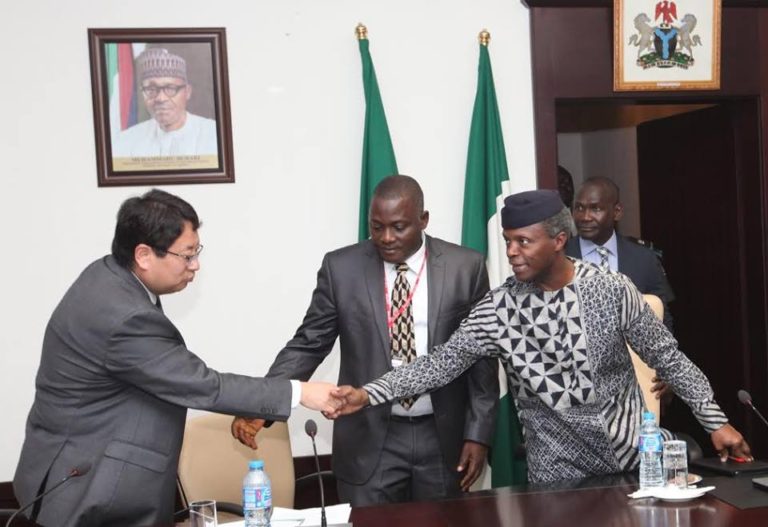
Chukwuma (middle) with VP Yemi Osinbajo and a foreign investor

The Inspector-General of Police has filed an application at the Federal High Court, Lagos, asking it to issue an arrest warrant against Innocent Chukwuma, Chairman of Innoson Nigeria Limited, for failing to appear before the court over charges of fraud.

According to an affidavit deposed to by Noma Wando, a litigation officer in the Department of Public Prosecutions, Federal Ministry of Justice, the IGP first filed charges against the accused persons on December 21, 2015, before the case was taken over by the Attorney General of the Federation in February 18, 2016.

Chukwuma, his company Innoson Motors, and four others, are charged with four counts of falsifying shipping documents amounting to N2.4 billion.

The other defendants in the case are Charles Chukwu, Maximian Chukwura, Mitsui Osk Lines, and Anajekwu Sunny.

The Police said that since the charges were served on the accused persons, only two of them, Chukwura and Mitsui Osk Lines, had continually made appearances in court, while Chukwuma and his company, as well as Messrs Chukwu and Anajekwu, had refused to appear in court and enter their pleas.

The Police allege that Innoson and his co-accused persons criminally conspired amongst themselves to alter shipping clearance documents belonging to Mitsui Osk Lines, and used the altered documents as collateral to obtain a loan of N2.4 billion from Guaranty Trust bank Plc for the purpose of clearing raw materials Polyvinylchloride for the production of roof ceiling and other imported items

The offence was said to have been committed between January 2010 and April 2011, at the Apapa Wharf, in Lagos.

All the offences alleged to have been committed by the accused persons are contrary to and punishable under sections 3(6),1(2)(C) of the miscellaneous offences Act Cap. M 17 Laws of the Federation, 2004.

Last year, the defendants filed an application asking Saliu Seidu, the then presiding judge, to recuse himself from the trial.

The case was later transferred to another judge, Ayotunde Faji.

When the case came up for continuation of hearing on October 10, the four defendants were still absent in court but were represented by their lawyers.

Justice Faji adjourned till November 21 for hearing of the application for issuance of bench warrant.

Aisha Buhari is a ‘wailing wailer’ just like me, says Sule Lamido

Sule Lamido, former Governor of Jigawa State, says since the All Progressives Congress (APC) calls anybody who criticizes the Muhammadu Buhari administration a ‘wailer’, then Aisha Buhari, wife of the President, is also one.

On more than one occasion, Aisha has openly criticized the Buhari administration, even threatening that she may not support her husband’s reelection bid in 2019.

Lamido, who has declared his intention to run for the presidency in 2019 under the Peoples Democratic Party (PDP) even though he is still facing corruption trial alongside his sons, said it is a sign of lack of leadership for a government to mock its citizens.

He said that the APC went into government unprepared and that is why it has failed to move on from its former position as an opposition party to one that is in charge of the nation’s affairs.

“Today in Nigeria, a citizen is mocked for saying his own right about his government. When you speak, they will call you a wailing wailer,” Lamido said during an interview with Premium Times.

“Now, if people are wailing because of what they see is wrong, the government should ask, why are they wailing? Instead, they make you a laughing stock. It doesn’t make sense. It means they don’t know what leadership is.

‘When your children are crying because they are hungry, what will you do? Are you going to provide food for them or you just simply call them wailing wailers?

“They are utterly irrational and don’t know what is called leadership. They are simply sitting there on privilege, but they are thinking the government is their own right.

“When President was sick, he was taken abroad, Lai and Adesina were saying he was taking some antibiotics, he is just resting, and he is healthy, bla, bla. But when Buhari came back, he said he was sick.

“When Yar’Adua was sick, the same Lai and others were demanding for their right to know their president’s health condition, even the way he ate. But now [that] they are in the government, we are now overwhelmed with tonnes of lies.”

Lamido further said that a fraction of the money that was allegedly misappropriated in illegal award of contracts at the NNPC could have been enough to solve the problem of incessant strikes in several sectors of the economy.

“Look at the issue that billions of dollars of NNPC contract at the same time ASUU were on strike. Now, if you take just one billion dollars to our universities, it will make sense there.

“Our roads are now terrible. If you put some reasonable amount there, it will also make sense. Look at Kaduna-Kano road for goodness sake.

“The medical doctors are also screaming. If you take something out of that money meant for NNPC contract, it will be OK to stop all these strikes.

“After budgeting over N3 billion to Aso Rock clinic, they now said there is not even a syringe there.

“But they kept on saying we are wailing. Thank God Aisha Buhari is among the wailers, she now wails like me. Even APC is now equally wailing. Nigeria is now a wailing nation,” Lamido said.

“I am not in any way celebrating APC’s failure as a government, because the government is not APC personal government, it is the Nigerian government.

“That government has a duty to perform [but] unfortunately they went into the government unprepared. Because they are unprepared, that is why they must continue churning out lies to mask their failure.

“During the campaign they kept saying PDP is Boko Haram, we are evil, and we were demonised. Now they are in government, they failed to move away from a political party seeking position to a party as an institution and a government.

“But because they have no simple sense of what is known as government and governance, they kept on with the same propaganda.”

How climate change is fueling conflicts in Nigeria

0

Climate change is the latest challenge to sustainable human development.

“It is no longer a question of whether the earth‘s climate will change but rather when, where and by how much,” says Robert T. Watson, Chairman of the United Nations Inter-Governmental Panel on Climate Change.

Arguably, Nigeria is the African state of greatest strategic importance to the global world. It is home to about 20 percent of the people living in Africa south of the Sahara. However, Nigeria is currently under siege. Its security challenges include a radical, Islamist insurrection in the northeast of the country called Boko Haram, restiveness in the Niger Delta, the heartland of Nigeria’s petroleum-based wealth, and ethnic and religious conflict centered in the middle belt but found elsewhere as well. Nigeria’s present security challenges are related, directly and indirectly, to the consequences of climate change.

Adequate adaptation and mitigation could help to protect public health, development, security, and land and water resources from the potential threats posed by climate change.

The risk to humans being displaced through sudden natural disasters is 60 percent higher today than it was 40 years ago.

Lagos is now one of the largest cities in the world, and its population is exploding; it grew from 5.3 million in 1991 to 16 million in 2006, and reached 21.3 million in 2015 (These figures are estimates only.). Much of the Lagos metropolitan area is only slightly above sea level and several neighborhoods consist entirely of shacks built on stilts in the lagoon. As sea levels rise, millions of inhabitants and millions of dollars in assets will be threatened by flooding.

The flooding in 2012 also had a serious economic impact.  It disrupted petroleum production in the Niger Delta by about 500,000 barrels per day, causing a substantial loss in government revenue just when it was most needed for humanitarian relief.

Consideration of the social and political consequences of climate change are often based on future projections. In the case of Nigeria, however, the effects of climate change are already visible. It is an important contributing factor in ethnic and religious conflict, quarrels over land use, and the disaffection of at least some Nigerians from their government.

Trouble ‘Looms’ for the Nation’s security

According to an estimate, communal violence, mostly involving contest for resources, killed at least 10,000 Nigerians in less than a decade and this is strongly linked to climate change. A case is the frequent farmer-fulani herdsman clash, which has to do with the contest of resources which is greatly affected by climate change.

Clashes between Fulani herdsmen and farmers over land claim hundreds of lives in Nigeria’s central region every year.

The largely agrarian Christian communities in the state maintain the predominantly Muslim Fulani herdsmen are engaged in a prolonged battle to take over land from the areas of so-called indigenous people.

Desertification, which has Nigeria’s northern neighbour, Niger, firmly in its grip, is also forcing herdsmen in Nigeria to migrate southwards. This has made herdsmen who used to depend on the green pasture they had in past had to start moving down to the Middle Belt areas

The Middle Belt is a loosely defined area between the Muslim and Hausa-dominated north and the predominately Christian Igbo and Yoruba areas of the southeast and southwest of Nigeria.

Earlier this year heavy rains and thunderstorms caused havoc in Benue state. The aftermath of the torrential rainfalls in Makurdi left close to 3,000 houses submerged and thousands of residents were rendered homeless and had to flee. Also in Lagos, Nigeria’s economic nerve centre and one of Africa’s most populous cities. Residents woke up in many parts of the city to find their streets and homes flooded and their property, including cars and other valuables, submerged.

Lagos and Benue states were not alone. Suleja, a town near the capital city Abuja, suffered its own flooding challenge in early July. Heavy rains washed houses away and caused others to collapse, trapping occupants. Thirteen people were said to have died. Other states that affected  by flooding this year includes, Ekiti, Osun, Akwa Ibom, Kebbi, Niger, Kwara, Ebonyi, Enugu, Abia, Oyo, Plateau, Sokoto, Edo and Bayelsa.

Some of the worst flooding in recent memory happened five years ago in March 2012 when 32 of Nigeria’s 36 states were affected, 24 severely. More than 360 people were killed and almost two million people were displaced.

The first factor aggravating flooding is climate change, which has been shown to contribute to more extreme storms and rainfall. Another factor contributing to flooding in cities is that Nigeria has experienced rapid urban growth and planning is poor.

Climate change and its effect on agriculture

The concern with climate change is heightened given the linkage of the agricultural sector to poverty. It is anticipated that adverse impacts on the agricultural sector will exacerbate the incidence of rural poverty. Climate change has the potential to affect Nigeria agriculture in a range of ways leading to an overall reduction of productivity which could result to a loss in GDP.

Over 80% of Nigeria’s population depends on rain-fed agriculture and fishing as their primary occupation leading to a high risk of food production system being adversely affected by the variability in timing and amount of rainfall. Climate change degrades yields from agriculture, cattle rearing and fisheries, many people are left unemployed, with few economic opportunities and low levels of education.

The agricultural sector contributes some percentage of the Nigerian Gross National Product and majority of the rural populace are employed in this sector. The dominant role of agriculture makes it obvious that even minor climate deterioration can cause devastating socioeconomic consequences. Policies to curb the climate change by reducing the consumption of fossil fuels like oil, gas or carbon, have significant economical impacts on the producers or rather the suppliers of these fuels.

 Climate change and its effect on health

 Nigeria is experiencing adverse climate conditions with negative impacts on the welfare of millions of people. In addition, climate change also negatively affect human health in developing country like Nigeria. Climate change affects human health directly or indirectly in many ways. Changes in temperature, precipitation, rising sea levels, increasing frequencies have great implications on human health in the area of injury, illness, morbidity and mortality. Rising sea level is anticipated as a result of climate change Hence flooding may result which is likely to increase the vulnerability of the poor to malaria, typhoid, cholera and pneumonia. Also, temperature and rainfall dynamics may increase the distribution of disease vectors such as dengue, malaria and incidence of diarrhea disease.

‘Wider implications of climate change’

The conflict between herdsmen and farmers is one of the wider implications of climate change in Nigeria.

Climate change does not create terrorists or insurgents, but it does create an environment that lets them thrive and grow. In areas where the state lacks the authority or the capacity to provide security and basic services, non-state armed groups operate more freely. They use the weaknesses of the state to undermine it further.

Another implication is the encroachment of the Sahara, which also fuels the insurgency by the jihadist group Boko Haram, while the rise in ocean levels and flooding were also affecting the south of Nigeria.

‘Monumental fraud’ — Melaye says ministry of power ‘stole $350m in installments’

Dino Melaye, the senator representing Kogi West at the National Assembly, says a total of $350 million has been pilfered in the Ministry of Power, Works and Housing, between 2014 and 2017.

Melaye made the allegation during Thursday’s senate plenary, adding that two companies, General Electric and IBEX, were involved in the fraud.

“Mr. President, in line with the anti-corruption posture of this chamber and especially now that our cries, observations are yielding dividends as expressly manifested in the case of Babachir Lawal, today, I bring to the attention of this Senate a monumental fraud in the power sector,” Melaye said.

“In July 2013, the federal Government raised $1 billion from Eurobond issue. From the proceeds, $350 million was given to IBEX in 2014.

“Mr. President, this money was stolen in installments. As I speak to you, some time last year again, the Ministry of Power came up with a term they call fast power. This indigested project is supposed to build new generating plants to add power to our grid.

“Mr President, there are few questions we need to ask and that is why I need the nod of the Senate to bring a substantive motion to move in the next legislative day.

“These are the few questions: Up to date, there is no detail to build this new generating plant or a feasibility study, there is no appropriation by the National Assembly for these projects.

“The Ministry has spent so far $35 million on the Afam fast power project that has no appropriation or feasibility studies. How and when was this money appropriated, we need to find out.

“Out of this money, $29 million was purportedly paid to General Electric for turbines while $6 million was paid to others. These, among many other monumental frauds, are taking place. We need the Senate to investigate this.”

Bukola Saraki, the Senate President, granted Melaye permission to present the issue as a motion during the next sitting.

From petty vegetable farming in Ikorodu, Nigerian scholar Adewale wins $100,000 agric grant in the US

Cornelius Adewale, a former vegetable farmer and current Ph.D. candidate at Washington State University, has won the Bullitt Foundation Environmental Prize for 2017 for his leadership role in developing an app and web tool that can measure a farm’s carbon footprint and help farmers reduce the impact of that footprint.

Before he left Nigeria six years ago, Adewale was just a vegetable farmer in Ikorodu, Lagos State.

He used the money he made from farming okra and other vegetables to apply for his Master’s degree in the university.

The Obafemi Awolowo University graduate was, at a time, President of the National Association of Agricultural Students.

According to Seattle Times, Adewale moved to Pullman with $6,000 in his pocket — money he’d earned from the vegetable harvest at his farm in southwest Nigeria. It was just enough to pay for the first semester of classes in organic agriculture at Washington State University (WSU).

Before his money ran out, he secured a research position at WSU to help fund his master’s degree and, later, his Ph.D.

On Monday, Adewale accepted the prize, usually awarded to graduate students pursuing leadership positions within the environmental field.

He plans to use the money to build a phone app that will help Nigerian farmers grow more crops, using fewer resources, with a lighter touch on the planet.

The app will be a portal to research and information about organic farming specific to Nigeria’s climate. And farmers will be able to measure the quantity of organic matter in their soil just by taking a picture of it, using their phones.

Adewale, 34, is described as an enthusiastic talker whose ideas spill out in rapid succession.

“Cornelius just had a magnetism and energy and charm that made him irresistible,” Denis Hayes, President and CEO of the Bullitt Foundation, said.

“He came with rave recommendations from his professors, who believe he can be a transformational force in agriculture.”

The Bullitt prize money comes with no strings attached.

“It is a gesture of faith that this is a guy who’s deeply committed to getting something done in the world,” Hayes said, “and we’re trying to give him a financial boost to help him do it.”

For the past two years, Adewale has been working with a team of students at WSU to create a web-based tool that helps Washington farmers measure their carbon footprint, and gives them ideas on how they can reduce that footprint by adjusting the way they farm.

“The thing that is really unique and wonderful about Cornelius is his humility — he really relates to everyone as individuals,” said Lynne Carpenter-Boggs, an Associate Professor at WSU’s Department of Crop and Soil Sciences.

“He’s there to help, but in a way that’s about empowering the individuals, not telling people what to do … he truly is a natural leader.”

He will be returning home to Nigeria when he finishes his degree with the hope of using his app and web tool to improve organic farming in the country.

He thinks Nigerian farmers need more information about ways to use organic methods to build up their soil, making their farms more fertile and productive, without using chemicals.

His innovation will offer framers less costly organic methods to build good soil and boosted their yields. This will be the alternative to using expensive chemical fertilizers and herbicides.

Adewale is inspired by his grandmother, Abigail Abike Aluko, who raised him at Ilesa in Osun State.

“Every time I make these crazy decisions, I hear my grandmother’s voice in my head,” Adewale said. “She said ‘Dare to make a difference.'”