Home Blog Page 2680

It’s ’embarrassing’! More than 100,000 ‘Nigerians have been deported in 2017 alone

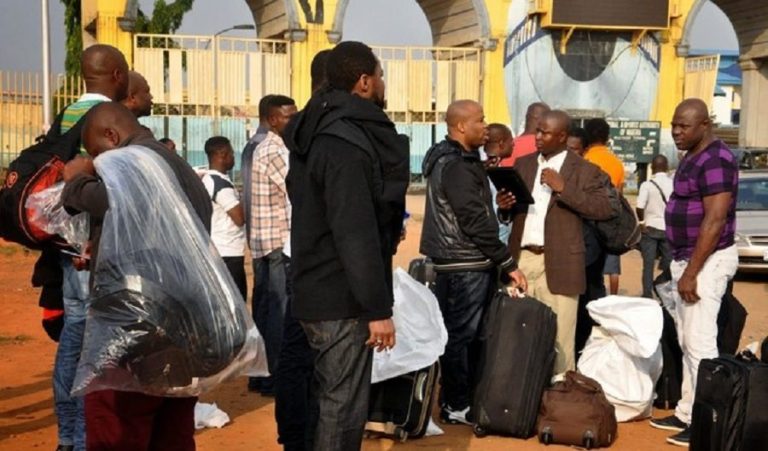
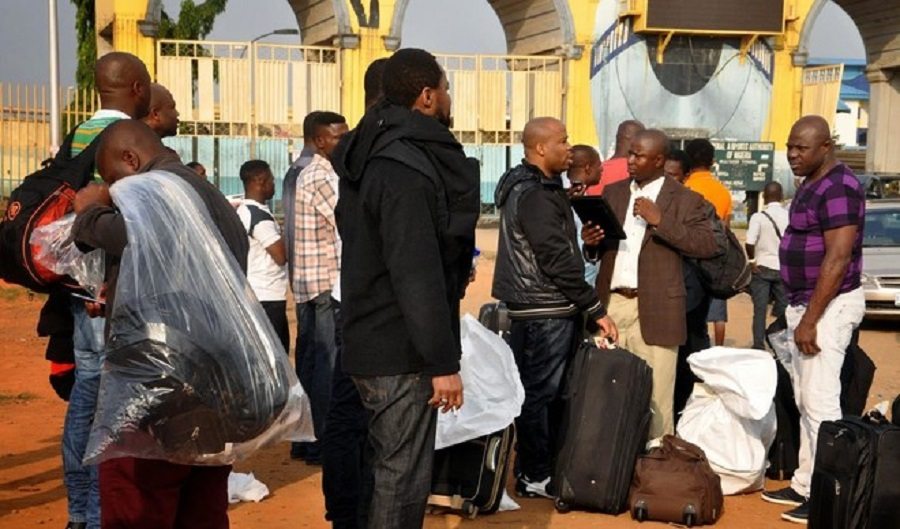
Lucy George, a development economist and former staff of the United Nations Economic Commission for Africa, is concerned about the growing number of Nigerians that are being deported from overseas.

She said the figure, about 1549 already, is embarrassing, especially when the over 100,000 deported from Cameroon are added.

In an interview with NAN, George said: “We have had an overwhelming number of Nigerians deported or voluntarily returned this year, which is embarrassing.

“The largest number of Nigerian deportees for this year comes from Cameroon, which deported about 100,000 Nigerians who escaped the Boko Haram disasters and sought refuge in Cameroon.

“That was seen to be an illegal deportation, which still is being denied by some Cameroonian officials, however, we are not including that in the embarrassing statistics.

“I am surprised by the number of Nigerians that have been deported and have volunteered to return to Nigeria from Libya just this week, as 161 people arrived on Thursday and 257 people did same on Tuesday.

“There were also 164 people deported in May, 171 in March and another 171 in February.

“In February and May, South Africa had deported 97 and 90 Nigerians respectively in midst of the xenophobic attacks.

“We saw it to be a discriminatory at first but later realised they actually did commit immigration-related offences causing them to be deported by the South African authorities.”

Advising Nigerians to stay back and develop their country, she said: “If everyone is leaving the country for greener pastures, who is expected to remain in Nigeria to develop it? Anyone who doesn’t grow in the system will lose out when the country becomes better.

“Imagine a scenario where a young man graduates from the university then leaves Nigeria in search of greener pastures but after arriving, fails to succeed in the new land.

“He realises that things are not as fabulous as portrayed in movies as these countries have tougher systems, especially because he doesn’t meet the requirements for career jobs in their country.

“He spends time being too embarrassed and broke to return to Nigeria but finally gets deported after many years.

“In that time, he has lost the opportunity to put his education to practice, develop productive skills and has lost contact with friends who would have helped him develop himself or place him in a prominent position.

“Nigerians should learn to be hardworking and patient to see their hard work reap its benefits because riches don’t come overnight.

“The countries they are running to didn’t develop overnight so you can’t expect to comfortably reap what you didn’t sew thinking the roads are paved with gold.

“In summary, I will emphasise on the fact that there is no place like home so I hope Nigerians learn from these numerous Nigerians that have been brought back home.”

A minimum of 1549 Nigerians have been sent back to Nigeria, with the exemption of the controversial 100,000 from Cameroon.

These include a minimum of 23 Nigerians deported from Spain, 187 from South Africa, 924 from Libya, 110 from Italy, 41 from the U.S, 146 from the UK and 118 from six other European countries: Austria, Germany, Hungry, Switzerland, Norway and Denmark.
Boko Haram fighters ‘kill’ three soldiers but miss out on commanding officer

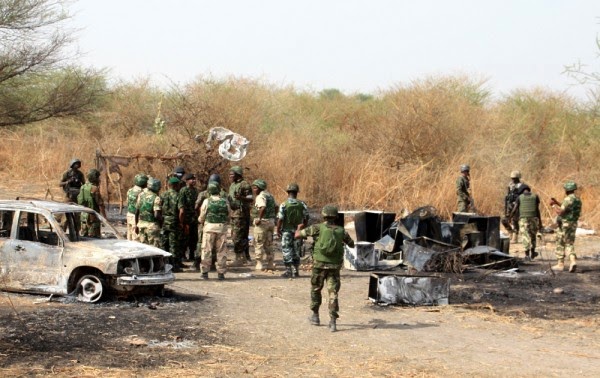
The Nigerian Army has confirmed that three soldiers were killed in a Boko Haram ambush on October 18.

The soldiers were part of a convoy escorting the Commanding Officer of 81 Battalion of the Nigerian Army when they were ambushed by the insurgents along Damboa-Maiduguri Road at about noon.

Onyema Nwachukwu, spokesperson of the counter-insurgency operation (Operation Lafiya Dole), said the lead vehicle of the convoy stepped on a landmine before the attackers opened fire.

“Yes, I can confirm that an ambush was sprung against a convoy of one of our Commanding Officers when the leading vehicle stepped on an improvised Explosive Device (IED) buried along the road at Teteri village while enroute Maiduguri,” Nwachukwu said.

“The escort troops fought bravely through the ambush, successfully defending the Commanding Officer and other civilians who were caught in the ambush.

“Unfortunately though, three of the escorts paid the supreme price with their lives and two vehicles were taken.

“Our Mobile Strike Team immediately mobilised to reinforce the troops and trailed the insurgents, recovering a gun truck, a Hilux and two motorcycles.

“Two AK 47 rifles abandoned as the insurgents fled in disarray were also recovered by troops.”

Nwachukwu, however, added that the military has intensified ground and aerial operations against the insurgents.

“May I also inform you that just recently troops conducting the Operation Deep Punch 2, in an artillery bombardment destroyed 10 Boko Haram vehicles concealed under thick foliage near Garin Manoma,” he said.

“Several insurgents were equally killed in that bombardment. Recall also that 15 insurgents were killed by our troops when the insurgents attempted an assault at Yamteke, near Gwoza.

“An armoured fighting vehicle, one Gun truck and two cars laden with improvised explosive device were recovered in that encounter. Be assured that our troops are relentless and not resting on their oars despite these successes.

“You must however also bear in mind that we are fighting terrorism and insurgency founded on perverted ideological indoctrination hence the remnants of the terrorists group strive to remain undaunted by carrying out isolated opportunistic rampages as they flee.

“This is apparently a far cry from those dark days. Our troops remain resolute and undeterred in ensuring that Boko Haram is finally brought to its knees.”

Court rules el-Rufai must pay Audu Maikori N40m over unlawful arrest

Audu Maikori

The Federal High Court in Abuja has awarded the sum of N40 million in damages against Nasir El-Rufai, Governor of Kaduna State, for unlawfully arresting and detaining Audu Maikori.

Also affected in the judgement are the Inspector General of Police, the Kaduna State Commissioner of Police and the State Attorney General.

John Tsoho, the presiding Jjdge, awarded the costs as compensation for Maikori’s “unlawful arrest and detention” between February 17 and 18, and between March 10 and 13, 2017.

He also ruled that the respondents must pay the sum of N1,430 to the applicant as the cost of instituting the suit.

The judgement followed a fundamental human rights enforcement suit filed by Maikori on May 5, 2017 following his arrest and detention by the Kaduna State Police Command.

Maikori, a lawyer turned businessman and owner of Chocolate City Entertainment, was arrested in February for circulating a false report on the social media about an attack by Fulani herdsmen in Southern Kaduna.

“My driver’s younger brother and five other students of college of education Gidan Waya were ambushed and killed by herdsmen yesterday #SouthernKaduna,” Maikori tweeted on January 23.

“They were in a commercial car going back to school when the driver stopped suddenly under the pretext of checking his engine.

“As soon as the car stopped the attackers shot all 6 students but let the driver who is Fulani go. He gave us these details.

“When we speak we are viewed as trouble makers by the Govt. Well I have seen the pictures and it’s a painful sight.”

The tweets went viral, as many of Maikori’s followers on twitter retweeted the story, and even some online news platforms published it.

But the story turned out to be false as the said College of Education released a statement denying any such attack on any of its students.

Maikori immediately issued an apology and pulled the earlier story down.

“I hereby tender an unreserved and sincere apology to the Management of the College of Education, Gidan Waya, His Excellency the Governor of Kaduna State and the Kaduna State Government, and also to the people of Southern Kaduna and the Fulani community and also VANGUARD newspapers whose source was my driver for the false statement by my driver which I also publicized believing same to be true,” he wrote on February 4.

But el-Rufai would have none of it, insisting that Maikori must be punished for trying to incite the public.

Maikori was arrested in Lagos and transferred to Kaduna, where he spent days in police custody before the case was transferred to court.

He was later granted bail on “very liberal terms” while the case was still on going.

Justice Tsoho, in his ruling on Friday, noted that his verdict does not preclude the ongoing trial of Maikori in Kaduna.

189 groups endorse Buhari for 2019 presidential election

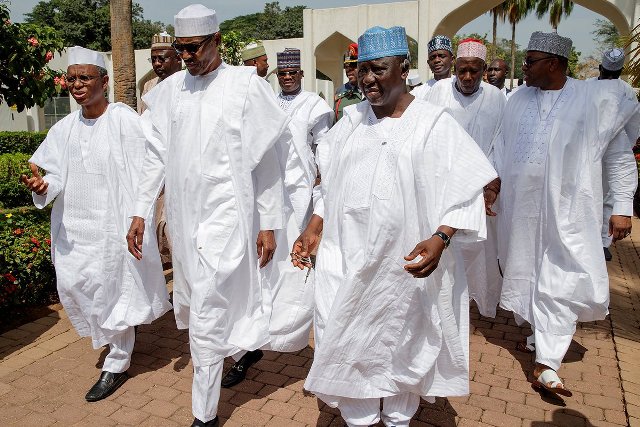
The Buhari Support Group, an amalgamation of 189 groups that worked for President Muhammadu Buhari in 2015, says it has endorsed him for the 2019 general election.

Abu Ibrahim, leader of the group, made this known after he led a delegation to meet with the President at the state house on Friday.

Ibrahim said the visit was to show solidarity and to let Buhari in on some of the activities of the group so far.

“We came here as members of the national committee of the Buhari support group. This is an amalgamation of about 189 different support groups that had worked for President Muhammadu Buhari and the APC to win the 2015 general election,” he said.

“We have been holding meetings, discussing the problems of this country, Nigeria. So, we thought it was high time we met with the President to intimate him about the activities of the group.

“We discussed with him about the plans to improve the situation in Nigeria. Mr President was very pleased with our programmes.”

Ibrahim said his belief in Buhari remained unshaken as he remains the man who can ensure the progress and stability of the nation.

Similarly, Ahmed Lawan, Senate Majority Leader, who joined the BSG on the visit, said Buhari’s “good works” would speak for him come 2019.

“We have issues we think that the administration will be dealing with very successfully, now that we have economic recovery and growth plan which encapsulates everything we need to move Nigeria forward,” he said.

“I believe we are going to achieve those things that we set for ourselves at the moment. I also believe that the future is bright and by the grace of God.

“By 2019, we would have achieved so much in this administration and Mr President will have no option but continue the good work he has started.

“We will continue to identify with and support all the programmes that this administration has set forward.

“And l believe that we have every justification to be happy because, the president campaigned on three major pillars of anti- corruption, fighting the insecurity across the country and revitalizing the economy of Nigeria.

“It has been a very good journey so far and also we believe that Mr. President and Nigerians have a future beyond 2019. What he has started, by the grace of God, he should be able to complete, up to 2023.”

Buhari has not said whether he would seek re-election, but Nasir El-Rufai, Governor of Kaduna State, had told journalists that a group known as ‘Buharists’ was working to ensure that the Presidents runs for a second term.

In September, Aisha Alhassan, Minister of Women Affairs, said she would support Atiku Abubakar, rather than Buhari, should both men indicate interest in running for the presidency in 2019.

In October last year, Aisha Buhari, wife of the President, also indicated that she may not support her husband if he decides to run for a second tenure.

French court sentences Teodorin Obiang, Equatorial Guinea VP, to jail

0

Teodorin Obiang, Vice President of Equatorial Guinea, has been handed a three-year suspended prison sentence by a court in France.

Obiang, who is also the son of Teodoro Obiang, President of Equatorial Guinea, was tried in absentia on charges bordering on embezzlement, money laundering, corruption and abuse of office.

The 48-year-old was also given a suspended fine of €30 million.

Spearheaded by two anti-corruption groups, the case, is the first of three targeting the families of African leaders for using ill-gotten gains to live it up in France.

Obiang was accused of spending more than 1,000 times his official annual salary on a six-storeyed townhouse in a posh part of the French capital, a fleet of fast cars and artworks, among other assets.

Prosecutors argued he could not have funded such lavish purchases without pilfering public money from his West African homeland.

The affair first made headlines in 2011 when French police raided Obiang’s mansion on the glitzy Avenue Foch in Paris, hiring trucks to haul away a fleet of Bugattis, Ferraris, a Rolls-Royce Phantom and other cars.

The property, valued at €107 million, was seized by investigators.

However, Obiang denies the charges, insisting that his money came from legitimate sources and that all his purchases were legal.

His lawyers accused France of “meddling in the affairs of a sovereign state”, and has lodged an appeal at the International Court of Justice in The Hague.

According to France24, Obiang’s counsels accused the French justice system “of trying to replace Equatorial Guinean judges with themselves”.

The court did not follow prosecutors’ recommendations on sentencing but did grant their request that his residence, which Equatorial Guinea protested was a diplomatic mission, and other assets be confiscated.

The ruling is seen as a victory for the French chapter of Transparency International France and its sister NGO Sherpa, which brought the complaint against Obiang.

“Every year, billions of euros are embezzled to fund the profligate lifestyle of a few corrupt leaders abroad, particularly in France,” Transparency International said in a statement ahead of the ruling, adding that it aimed “to ensure that France is no longer a place to launder money”.

Obiang was Agriculture and Forestry Minister before being promoted by his father to Vice President in 2012, putting him in pole position to succeed him as leader.

Many of his eye-popping purchases were made through Somagui Forestal, a forestry company that prosecutors called “an empty shell used solely to channel public money”.

His tastes included sharp suits from Paris’s top tailors, whom he allegedly paid with suitcases of cash.

Ayo Salami: Where was the judiciary when I was being harassed?

Ayo Salami, former President of the Court of Appeal, says he rejected the appointment offered him as Chairman of the Corruption and Financial Crime Cases Trial Monitoring Committee because the Judiciary abandoned him when he was “being harassed”.

Salami debunked reports that he refused to collect the job because he was uncomfortable with some members of the committee.

He made this known during a phone interview with The Punch on Thursday.

According to Salami, when Walter Onnoghen, the Chief Justice of Nigeria, announced the constitution of the committee, he was not in the country.

“I rejected the appointment because it is not in my interest,” Salami simply said.

When probed further, he said: “What I mean is that it is not in my interest; that was why I rejected it. It is because I don’t need it.”

The interviewer reminded Salami that it appears the judiciary needs his help now, to which he replied: “To do what in the judiciary? Where was the judiciary when they were harassing me? Where was the court when they were harassing me? So, let them continue to do it in their own way.”

Salami also said there was no truth in the reports that he rejected the appointment because of some persons in the committee.

“It is not; I don’t just feel like doing it. it is not because of anybody,” he replied curtly.

He also maintained that he had forwarded his rejection letter to the office of the Chief Justice, and wondered why the CJN and the NJC would say they had not received it.

“Let them look for it, I have sent it. If I have not sent it, how did they know?” he queried.

Salami was removed as President of the Appeal Court in 2011 under controversial circumstances.

He had alleged that Aloysius Katsina-Alu, the then Chief Justice of Nigeria, attempted to influence the decision of the Appeal Court in a Sokoto governorship election matter pending before the court at the time.

Salami was subsequently suspended, and a panel, headed by Justice Ibrahim Auta, was set up to investigate the matter.

The panel found Salami guilty of lying on oath against Katsina-Alu and among the recommendations of the committee, he was asked to apologise to the CJN within seven days.

Salami then approached the Federal High Court to challenge the recommendations of the panel, but while the matter was still pending in court, the NJC held an emergency meeting where Salami was suspended and immediately replaced with Justice Dalhatu Adamu.

However, Salami was later cleared in 2012 during the tenure of Dahiru Musdapher as the Chief Justice of Nigeria. However, then President Goodluck Jonathan refused to act on the recommendations of the NJC until Salami retired in 2013.

INTERPOL has just issued a warrant for Maina’s arrest, says Garba Shehu

Garba Shehu, Senior Special Assistant to the President on Media and Publicity, says the International Police Organisation (INTERPOL) has issued a warrant of arrest for Abdulrasheed Maina, the former pension reform boss who is also wanted by the EFCC and the Nigerian Police.

This is following reports that Maina may have fled to Niger Republic as a result of the manhunt launched against him by Nigerian law enforcement agencies.

Shehu told journalists that the investigation into Maina’s case has been extended to some foreign countries.

“Maina’s investigation has been expanded. This is beyond reinstatement. It has gone beyond that,” Shehu said.

“You know that the INTERPOL has just issued an international warrant on him. A Nigerian court has also issued yet another warrant of arrest.

“All those cases involving Steve Oronsaye (former Head of the Civil Service of the Federation) that are ongoing, you know Maina is also involved. Law enforcement agencies are looking at that too.

“You are also aware that the Senate is also carrying out its own investigation on the matter.

“The matter is being investigated from all fronts. The EFCC, for example, is discovering more and more properties and its officials are sealing them. They are also looking at banks and all that.

“In fact, this investigation will also touch some foreign countries.”

Meanwhile, Winifred Oyo-Ita has confirmed that she responded to the query issued to her by President Muhammadu Buhari, demanding explanation on the circumstances of Maina’s reinstatement.

She said that she forward her response to Abba Kyari, the President’s Chief of Staff, together with the response from the Permanent Secretary of the Ministry of Interior.

Oyo-Ita added that a third response was also sent to Kyari by the Acting Chairman of the Federal Civil Service Commission, whom, she insisted, issued the letter reinstating Maina into the civil service.

“The Chief of Staff to the President wrote directly to the Acting chairman of the Federal Civil Service Commission because it was the commission that sent out the letter,” Oyo-Ita told a State House correspondent.

“That letter people are saying was from the Office of the Head of Service did not come from me; it came from the Federal Civil Service Commission.

“The only persons that responded directly to me is the Permanent Secretary of the Ministry of Interior.

“I have sent my submission and the response from the Permanent Secretary of the Ministry of Interior to the Chief of Staff.”

On whether there has been an update on the matter, Oyo-Ita said: “I am not the right person to ask if there is any update on it. It is the presidential spokesmen that will know if there is any update.”

SHOCKER: The model school in Kebbi State where pupils learn in the sun


By all standards, Tarasa Model Primary School, Tarasa Village in Birnin-Kebbi Local Government, Kebbi State, does not qualify to be called a model school.

Although primary school enrollment in Nigeria has increased in recent years, net attendance is only about 70 per cent, says UNICEF. And 60 percent of 10.5million out-of-school children in Nigeria are in the North.

Nigeria’s 10.5 million out-of-school children are the world’s highest number.

As a model school, Tarasa Primary School is littered with classrooms with no roofs, or those overgrown with grasses. It is a good example of a school begging for government attention, especially in a village where perception about formal education is negative.

A resident of the village, who simply gave his name as Abubakar, told the ICIR that many children, especially, girls, prefer “tala” — that is hawking — to going to school. He blamed this on parents, saying they don’t force their children to attend school.

This explains why there are many school-age children roaming the village during the school hours while there are only few in the classrooms, yet under threatening condition.

In a state that has 70 percent of its children out of school, has spent N250million on provision of furniture in different schools, and has spent N3.6 billion on rehabilitating various primary and secondary schools in the state, a heartbreak like that of Tarasa Model Primary School is not expected.

Kebbi State has N1.04billion unaccessed intervention fund with the Universal Basic Education Commission (UBEC) out of the unaccessed N59.7billion by states of the federation between 2012 and 2016.

In March 2017, Muhammadu Magawata Aliero, Kebbi State Commissioner of Education, said the state had 398,000 children out of school.

According to Aliero, the state government had spent about N250 million on the provision of furniture in different schools across the state, while N3.6 billion was used to rehabilitate various primary and secondary schools in the state.

In late 2015, the United Nations for Children Fund (UNICEF) disclosed that 70 percent of children in the state were out of school.

But the condition of the supposed Model Primary School, Tarasa, doesn’t in any way make education an attractive prospect. The few children in schools are learning in a dilapidated building, sitting on benches and desks marked MDGs, which suggests that the state government’s rehabilitation exercise did not reach the agrarian village.

Nobody in the school was willing to talk, as a journalist was said to have been arrested and detained on the order of Seidu Dakingari, the immediate former Governor of the state, when he “reported what was considered an offensive report” about the same school.

“He was arrested and detained and later posted out the state because the state government said his report was meant to embarrass the government,” said a villager who declined to give his name.

No good learning and teaching can take place under these classrooms, whose roofs have been blown away since 2015. For two years, the innocent children have had to cope with rainfall and sun to acquire education, as no one has taken responsibility to repair the damaged roofs.

A security guard working in the school, who did not want to be mentioned, said a strong storm that accompanied a downpour wreaked havoc on the village and consequently left the roofs of a block of classrooms shattered.

He said nobody took action since the roofs were blown off, noting that other classrooms in the school had collapsed more than 10 years ago and nothing was done to repair them or construct new ones.

It was gathered that a former Chairman of Birnin Kebbi visited the school after the incident with a promise to fix the damaged roofs in 2016, but nothing was done.


READ ALSO:


Salami ‘rejects’ appointment as chairman of corruption cases monitoring committee

Ayo Salami, former President of the Court of Appeal, turned down the offer to be Chairman of the Corruption and Financial Crime Cases Trial Monitoring Committee on Thursday, barely a month after he was appointed to the position by Walter Onnoghen, Chief Justice of Nigeria.

Onnoghen had announced that special courts would be designated across the country to specifically try corruption and financial crime cases, as part of efforts at expediting such cases and giving more impetus to the anti-corruption campaign of the federal government.

He subsequently appointed Salami, who was controversially removed as President of the Court Appeal in August 2011, to head the committee.

However, Vanguard reports that Salami may have rejected the appointment because he was uncomfortable with some members of the committee.

The report quoted sources at the National Judicial Council as saying that out of the 15 members of the committee, Salami pointed out of three who had vested interests in some of the corruption cases that the committee was expected to monitor.

“Salami had, in his meeting with the CJN, pinpointed three members of the committee he said he would not be comfortable to work with,” Vanguard quoted the source as saying.

“He was said to have drawn attention of the CJN to the fact that the trio, who are senior lawyers, have vested interest in some of the corruption cases the committee would monitor in the exercise of its mandate.

“He further drew attention of the CJN to the fact that composition of the committee was already being queried by the public.”

Awassam Bassey, media aide to Onnoghen, confirmed to newsmen that Salami had resigned but he refrained from discussing the triggers of the resignation.

“I can confirm that it is true; I mean the resignation of Hon. Mr. Justice Ayo Salami (Retired) as the chairman of the Corruption and Financial Crime Cases Trial Monitoring Committee (COTRIMCO),” he said.

“However, besides what we see in the media, we cannot exactly say what the reasons are for Justice Salami’s decision not to undertake this all-important national assignment that he was called upon to perform.

“Hon. Salami (retired) says he has sent in a resignation letter to His Lordship the Hon Chief Justice of Nigeria but that letter has yet to get to the CJN.

“That’s all I can say at this moment. A more detailed explanation, if it becomes necessary, will be communicated to you when His Lordship receives Hon. Mr. Justice Salami’s letter.”

Indeed, the formation of the corruption trial monitoring committee was questioned by some civil society groups, most notably the Socio-Economic Right and Accountability Project (SERAP).

The group claimed that the composition of the committee was not in consonance with the advisory of the United Nations Special Rapporteur on the independence of judges and lawyers.

“SERAP urges your Lordship to urgently revisit, review, and reconsider the membership of the Salami committee to ensure that members currently handling high-profile corruption cases involving PEPs (Politically Exposed Persons) are removed,” the group had written in a letter to Onnoghen.

“This proposal aims solely to remove the risk of apparent and potential conflicts between the work of the committee and the private practice of some of its members who are handling high-profile cases of corruption involving PEPs and to ensure the independence, impartiality, integrity and accountability of the judiciary.”

Misau: I made allegations against the IGP, not against the ‘highly revered’ Aisha Buhari

Isah Misau has denied making any allegation against Aisha Buhari, wife of President Muhammadu Buhari, as was widely reported on Thursday.

Misau made the denial via his Twitter handle, saying his allegation was strictly against Ibrahim Idris, the Inspector General of Police.

The controversial senator had made several allegations of corruption and abuse of office against the Idris, but on Wednesday, while appearing before a senate committee investigating the allegations, Misau claimed to be in possession of documents detailing how Idris procured two Sports Utility Vehicles (SUVs) for Aisha Buhari’s personal use.

However, no sooner had the report broken than Aisha took to Twitter to deny the claims, saying that she still uses her personal cars.

Later on Thursday, Misau tweeted that he “did not make any allegations against the person of the highly revered Wife of the President”.

He said that it was rather the IGP who, in his quest to paint him black, “leaked” correspondence he had with the President in some “secret documents” he filed in court.

See Misau’s tweets below:

However, in a swift response, Jimoh Moshood, Force Public Relations Officer, issued a statement describing Misau’s claims as “outright falsehood” and “misleading”.

“It is pertinent to state that at no time did the Wife of the President and Commander in Chief of the Federal Republic of Nigeria, Mrs Aishat Buhari requested directly or indirectly for vehicles for her use from the Inspector General of Police and no vehicle whether Jeep or SUV has ever been given for her personal use,” the statement read.

“It is within the powers of the Inspector General of Police as stated above that when on the 17th January, 2017, SP Sani M Baba –Inna, the ADC ‘Wife of the President’ Federal Republic of Nigeria requested for Two (2) vehicles for Police Personnel in the convoy of Wife of the President for convoy movement and security purposes.

“Two (2) Police Vehicles (i) A Toyota Sienna Bus with Reg. No. NPF 2406D (ii) A Toyota Hiace Bus with Reg. No. NPF 3363D were approved by the Inspector General of Police to the ADC ‘Wife of the President’ SP Sani M Baba –Inna for the purposes requested and not to the person of the Wife of the President or for her personal use as alleged by Misau.