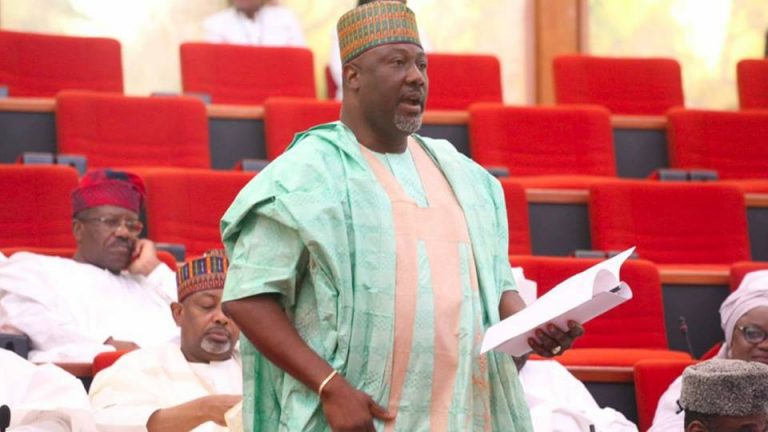
Dino Melaye, the senator representing Kogi West senatorial district at the National Assembly, has mocked the kogi state government for its “stupidity” in the handling of his planned recall from the legislature.
According to Melaye, for whom a petition has already been lodged at the Independent National Electoral Commission (INEC), some of the people listed to have signed the document are already dead.
“It can not succeed. It is a hoax and absolute comedy of errors. I’m laughing at the stupidity of kogi state government,” he tweeted on Wednesday.
“Many appointees will go to jail for forgery. Even dead people’s names on the recall register.
“A governor who does not know what double registration is may not as well know the procedure for recall. Every lie has an expiry date.
“This comedy of errors will soon end. No shaking at all. This won’t solve the problem of not paying salaries for over 15 months.No retreat no surrender. Truth is my only Defence.”
1)It can not succeed. It is a hoax and absolute comedy of errors. I’m laughing at the stupidity of kogi state government.
Celebrations erupted at the Lagos State High Court on Wednesday after Justice Surajudeen Onigbanjo ordered the state government to stop further demolition of Otodo Gbame, a waterfront community in the state.
Onigbanjo ruled that it was wrong for the residents to have been forcibly evicted without plans for their relocation.
He described the actions of the state government as unconstitutional, but urged both parties reach an agreement on how to resettle the residents before their homes would be demolished.
The presiding judge agreed that “the land occupied by the applicants is under the control and the management of the executive governor of the state” but he also pointed out that the residents “never claimed ownership of the land, but have over the years settled on the land”.
“It will be wrong for them to be forcefully evicted from a land they have been [on] for several years,” Onigbanjo said.
“The respondents’ failure to provide alternative settlement before embarking on the forceful eviction of the applicants is unconstitutional.
“Both parties are hereby ordered to carry out proper consultation on how to resolve the relocation of the applicants.
“The respondents are hereby restrained from further carrying out evictions of the applicants from the settlements, if alternative settlements are not made available.”
According to a report by Amnesty International, an international human rights organisation, more than 30,000 people were rendered homeless by the Lagos State government in Otodo gbame, Ilubirin and Ebute Ikate waterfront communities in November 2016.
And only last week, another demolition exercise was carried out at Badia East, another slum community in the state.
More than 500 persons, mainly women and children, were reportedly displaced in the exercise, and a policeman was reported to have injured a woman with a knife when she tried to retrieve some of her belongings from her apartment that was being destroyed.
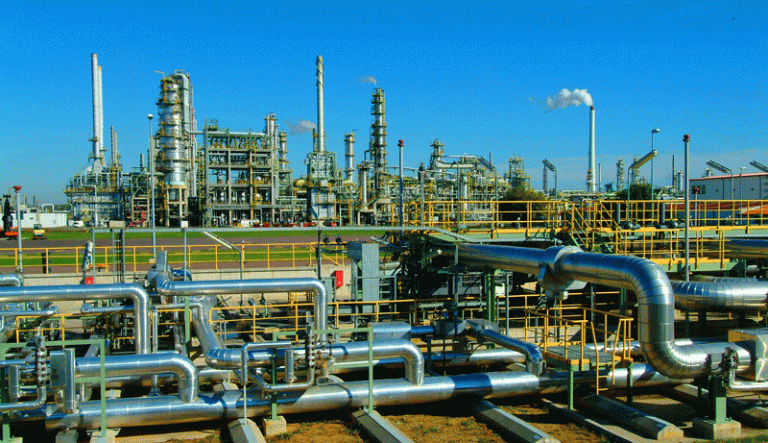
PT Intim Perkasa Nigeria Ltd, an Indonesian firm and subsidiary of PT Intim Perkasa, Indonesia, has indicated interest in building a refinery in Nigeria.
When completed, the modular refinery will have refining capacity for 10,000 barrels per stream day. It will be located in Akwa Ibom State.
Ndu Ughamadu, Group General Manager, Group Public Affairs Division of the Nigerian National Petroleum Corporation (NNPC) disclosed this in a statement on Wednesday.
THE FULL STATEMENT The Federal Government’s plan to attract investment in modular refineries as part of efforts to boost local refining capacity has started gaining momentum with an Indonesian firm, PT Intim Perkasa Nigeria Ltd, a subsidiary of PT Intim Perkasa, Indonesia, indicating interest to build a refinery in Nigeria.
Mr. Adi Hartadi, the Head of Investor Relations of PTPP (Persero) Tbk, partners to PT Intim Perkasa Nigeria Ltd, who disclosed this in Abuja during a business meeting with the Group Managing Director of the Nigerian National Petroleum Corporation (NNPC), Dr. Maikanti Baru, stated that the proposed refinery would be located in Akwa Ibom State.
The refinery, a modular one, will have refining capacity for 10,000 barrels per stream day.
Mr Hartadi stated that their company has more than 50 years of experience in construction and engineering and it was desirous of diversifying into downstream operations in Nigeria.
Responding, the NNPC Group Managing Director, Dr. Maikanti Baru, who was represented by the Chief Operating Officer (COO), Refineries and Petrochemicals, Engr. Anigbor Kragha, stated that NNPC placed high premium on investment in the nation’s refining sector.
The GMD stated that the Corporation had a Greenfield Refinery Department that specialized in new refinery projects and also provided professional support to potential investors in modular refinery in the country in line with the Federal Government policy on modular refineries.
He explained that the country’s three refineries with a combined capacity of 445,000bpd could not function optimally over the years due to lack of investment, adding that NNPC would give necessary support to the Indonesian Company interest in the downstream sector.
“On our end, we have embarked on ambitious plan to fast-track programmes to restore our capacity utilization from 30 per cent to a minimum of 90 per cent in the next 24 months. To do that, we are working on securing financing from third parties, not just funding, but also technical expertise to help us increase our performance to world class levels that they should be,” Dr. Baru stated.
He explained that given Nigeria’s expected population, by 2025, more than 40 million litres of petrol would be required for local consumption, adding that the combined capacity of the nation’s 3 refineries would only be able to satisfy just above 50 per cent of the projected local demand.
He expressed optimism that with this kind of investment coming steadily, Nigeria could serve as a regional hub of refined petroleum products for West Africa and beyond.
He called on the investors to be mindful of clean fuel policy across African countries and ensure that they produce fuels that meet specification with regards to sulphur content.
Earlier, Dr. Dwiyatna Widinugraha, Third Secretary for Economic Affairs, Indonesian Embassy in Nigeria and the leader of the Indonesian delegation, stated that the visit was a follow-up to the earlier visit by the Indonesian envoy to NNPC, the bilateral meeting between the Indonesian Trade Minister with his Nigerian counterpart as well as the visit of Indonesian Prime Minister to Nigeria.
It would be recalled that the Indonesian Ambassador to Nigeria, Mr. Harry Purwanto, had recently expressed interest in purchasing more crude oil from Nigeria during a courtesy call to the NNPC GMD, Maikanti Baru.
The independent National Electoral Commission (INEC) has received a signed petition from voters in Kogi West Senatorial District demanding the recall of Dino Melaye from the National Assembly.
According to Sahara Reporters, the document, addressed to Mahmood Yakubu, Chairman of INEC, was submitted on Wednesday and marked received the same day.
The Kogi State government says 188,588 voters, representing 52.3 per cent of the total number of registered voters in Kogi West senatorial district, approved Melaye’s recall from the Senate.
His constituents said they voted for him to represent them at the Senate and now they are using the same method to call him back home.
The submission of the petition is in line with the requirement in Section 69 of the 1999 Constitution that “A member of the Senate or of the House Representatives may be recalled as such a member if – (a) there is presented to the Chairman of the Independent National Electoral Commission a petition in that behalf signed by more than one-half of the persons registered to vote in that member’s constituency alleging their loss of confidence in that member”.
Ayodele Fayose, Governor of Ekiti State, has boasted that he is the speaker of the house of assembly.
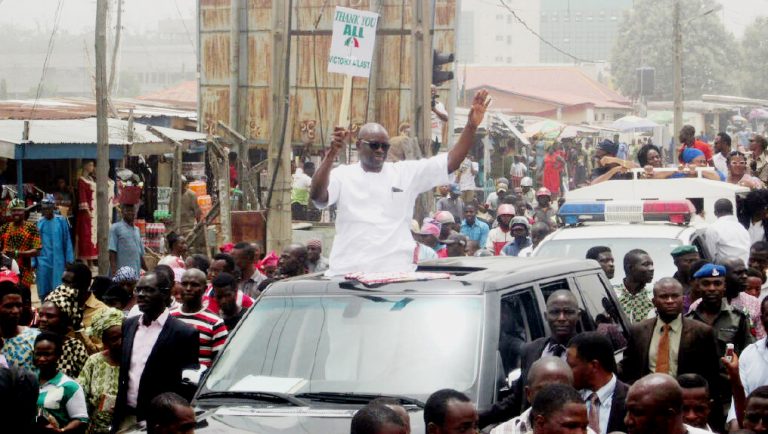
The governor made the boast on Wednesday while addressing citizens of the state at a ceremony to commemorate his third anniversary in office.
While introducing Kola Oluwawole, Speaker of the Assembly, Fayose said that he was the person directly in charge of the state’s legislature. He pointed the microphone in the direction of Oluwawole and asked him to confirm his claim; Oluwaole responded, “Yes, you are.”
Fayose pointed out that in other south western states, it was only in Ekiti State that all elective positions are being held by members of the Peoples Democratic Party.
“I am the Speaker of the house of assembly,” he said. “I am the speaker. Anyone who doesn’t like it should go and perish.
“Any opposition, we take it out. That other one too is going unpopular. That other one [the former speaker], we cannot glorify him by mentioning his name.”
Fayose also that the investigation into the Ikoyi cash claimed by the National Intelligence Agency (NIA), which was discovered by the Economic and Financial Crimes Commission (EFCC), has since been swept under the carpet.
Leaders, members and supporters of the Ekiti State chapter of the Peoples Democratic Party (PDP) have asked God to arise and scatter the All Progressives Congress (APC).
They made the call in a parody of a Christian song that they sang on Wednesday at a celebration of the third anniversary of the current governorship tenure of Ayodele Fayose.
After a lengthy address, Fayose momentarily paused to hand the microphone to a member who led the crowd in a song session. He had been expected to sing:
Let God arise and his enemies be scattered Let God arise and his enemies be scattered Let God arise and his enemies be scattered Let God, Let God arise
Instead, the crowd danced and joined him in singing:
Let God arise and the APC be scattered Let God arise and the APC be scattered Let God arise and the APC be scattered Let God, Let God arise
Curiously, PDP is the more scattered of the two parties. While APC has managed to maintain relative stability despite the indefinite absence of President Muhammadu Buhari, who is the UK attending to his health, PDP has been embroiled in a chairmanship supremacy battle between Ali Modu Sheriff and Ahmed Makarfi.
Yahaya Bello wants to get rid of Dino Melaye as the senator representing Kogi West at the National Assembly. Dino Melaye wants to get rid of Yahaya Bello as Governor of Kogi State. Two statements of fact — the former well and truly in progress, the later still awaiting take-off.
According to Pius Kolawole, Special Adviser to the State Governor on Political Affairs, 188,588 of the 360,098 registered voters (representing 52.3 per cent) in the senatorial district, have approved Melaye’s recall.
The figure is already a subject of controversy, but what else needs to be done to successfully boot Melaye out of the Senate? There’re quite a few of them.
THE PETITION
According to section 69 of the 1999 Constitution, A member of the Senate or of the House Representatives may be recalled as such a member if – (a) there is presented to the Chairman of the Independent National Electoral Commission a petition in that behalf signed by more than one-half of the persons registered to vote in that member’s constituency alleging their loss of confidence in that member.
It is this petition that Bello’s camp claims to be in possession of. And it is one that cannot be falsified. Why?
VERIFICATION
The answer is that INEC will verify the submitted petition. The constitution says the petition is thereafter, in a referendum conducted by the Independent National Electoral Commission within ninety days of the date of receipt of the petition, approved by a simple majority of the votes of the persons registered to vote in that member’s constituency.
To do this, INEC issues a public notice on the date, time and location of the verification of signatures on the petition.
REFERENDUM
If the number of verified signatures falls short of the required 51 percent, INEC will dismiss the petition. But if the condition is met, INEC conducts a referendum within 90 days of receipt of the petition. This referendum is a simple yes or no vote on whether the senator should be recalled.
CERTIFICATE OF RECALL
If a simple majority of the referendum participants elect to recall the lawmaker, INEC will then forward a Certificate of Recall to the President of the Senate to effect the recall.
THE RECALL
The Senate President will ensure that the senator in question is shown the way out of the Senate. Were this to become Melaye’s fate, it would be an awkward scenario for Bukola Saraki, the current Senate President, to lead his die-hard loyalist out of the upper chamber.
However, that is at the moment a tall order. Only collection of signatures has been done, and it could well fall like a pack of cards at the first hurdle of INEC verification.
On Tuesday, Musiliu Obanikoro, former Minister of State for Defence, defected to the All Progressives Congress (APC). No, he didn’t. Yes, he did.
Obanikoro himself has denied that he has officially left PDP. Back in May, there was a similar defection report. Again, he denied. But in all his denials, Obanikoro has never ruled out a move to APC from the Peoples Democratic Party (PDP); instead he keeps saying he won’t do it through the backdoor. There will be a big “press conference” where he would “announce it to the world”. It’s a question of ‘when’ rather than ‘whether’.
On Tuesday, the former Nigerian Ambassador to Ghana was “rumoured” to have joined APC alongside Lukman Ajose, another Lagos PDP chieftain. He has been accused by the Economic and Financial Crimes Commission (EFCC) of complicity in the arms fund scandal. Sylvan McNamara, a company allegedly owned by his sons, was said to have received N4.7bn from Sambo Dasuki, former National Security Adviser (NSA) — money alleged to have been used to prosecute the 2015 general election.
Obanikoro won’t be the first under-trial-for-corruption PDP politician to defect to the APC, perhaps to find a safe haven.
Below are a few others:
ADEBAYO ALAO-AKALA
Shortly after placing third in the 2015 Oyo State governorship election, Alao-Akala, former Governor of the state, announced his defection from the Labour Party, the platform on which he contested, to the APC.
Akala is currently undergoing corruption trial at the Oyo State high court, accused alongside two others of conspiracy and misappropriation of N11.5 billion from the state’s treasury.
ORJI UZOR KALU
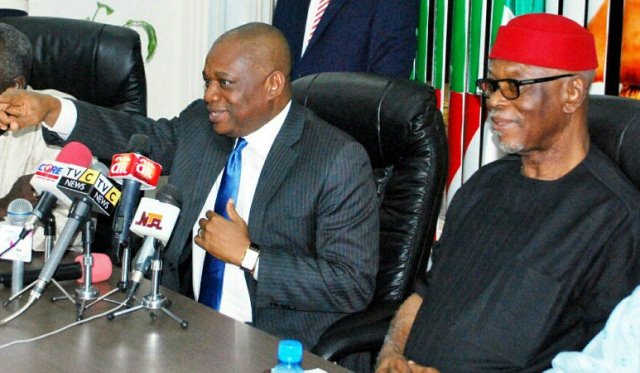
APC chieftains, including John Odigie-Oyegun, the National Chairman, were at the party’s headquarters in Abuja in November 2016 to welcome Kalu, a two-term governor of Abia State between 1999 and 2007 into the ruling party.
Kalu, alongside his company Slok Nigeria Limited, is facing a 34-count corruption charge at the Lagos State division of the federal high court. The charges border on money laundering and fraud amounting to N3.2 billion belonging to the Abia State government.
During his welcome party into the APC, he said: “I am coming in and God will help me to bring value. Between Sunday when I registered at Igbere and now, there are 4,000 members new members already registered with the APC in Abia.”
So far, Kalu’s trial has continued, but some Nigerians say it is just a matter of time before it is dumped as usual. Let’s hope they are wrong.
SULLIVAN CHIME
Sullivan Chime
A little over a month ago, Sullivan Chime, former Enugu State Governor, also declared he was joining the APC.
“This is the only party that can take any politician to their destination and I pray that what happened to the PDP does not happen to APC,” he told a press conference in Enugu. “I am moving to the APC because a lot of people are looking up to me for direction.”
But two weeks later, EFCC said Chime was still under investigation over alleged acts of corruption relating to the N23bn campaign fund money involving Diezani Alison-Madueke, as well as other cases of alleged corrupt enrichment linked to his time in office.
MARTIN ELECHI
The 76-year-old former Governor of Ebonyi State announced he was dumping the PDP on April 9, at an elaborate ceremony in his hometown, Ikwo, Ebonyi State.
He hinged the move on his love for Buhari and the current state of the PDP, occasioned by its protracted crisis.
He said: “I knew Buhari 49 years ago when I started the movement for the creation of Ebonyi as he intervened during my arrest with nine other comrades, by officers of the defunct Nigerian Security Organisation, NSO.”
After leaving office in 2015,Elechi was questioned by the EFCC on allegations of corruption and fraud but was granted bail the following day. Not much has been heard of the allegation since.
IFEANYI UBAH
It also said that while in detention, the chairman of Capital oil and Gas Limited “undermined national security and public order” through his conduct. However, the businessman, however, filed a lawsuit against the security agency for detaining him “unlawfully”.
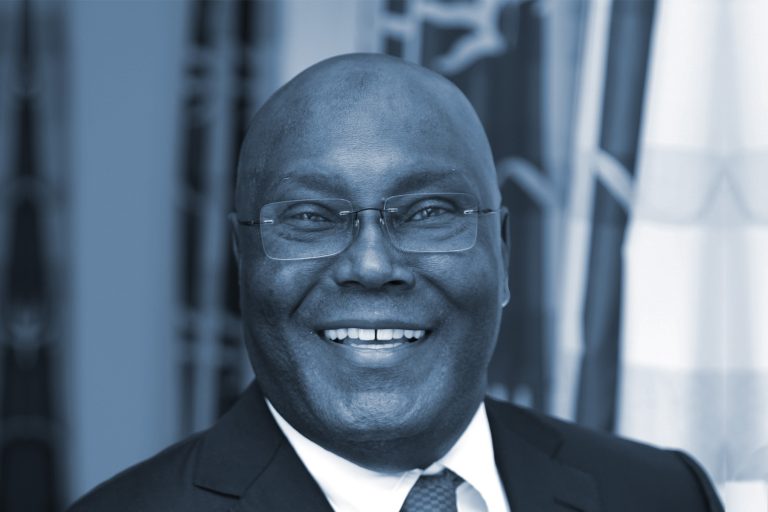
Atiku Abubakar, former Vice President, says Nigeria’s most pressing problem isn’t corruption or inadequate power supply, but disunity.
In a message he released on his website on Tuesday, entitled: ‘None of us is as great as all of us’, Atiku said all problems plaguing the country will be fixed if Nigerians are united.
He said it would be insane if a nation that once sang ‘Go On With One Nigeria’ should be seen to be singing a new and absurd song, ‘Go On Without Some Nigerians’.
“The number one problem plaguing Nigeria is not corruption or even the absence of regular power,” he said.
“The number one problem militating against the progress of Nigeria is her lack of unity. If we can fix this problem, Nigeria will herself be fixed.”
He warned against dividing the country, saying: “We can never have a Nigeria that fulfills her full potential when we have a divided Nigeria.”
Quoting copiously from both Bible and Quran, he argued that a divided Nigeria will lose momentum and its possibilities.
“In The Old Testament of The Bible, which Christians accept as the Divine scripture, God spoke about mankind in Genesis 11:6 thus: “If as one people speaking the same language they have begun to do this, then nothing they plan to do will be impossible for them,” he said.
“Similarly, The Holy Quran, the Divine scripture of Muslims also states: “Do not quarrel among yourselves lest you lose heart and your momentum disappear.” -Quran 8:46.
“From the above, it is clear that we can never have a Nigeria that fulfills her full potential when we have a divided Nigeria. Not only will we lose momentum as The Quran shows us, but we will also lose our possibilities as The Bible teaches us.”
He said all nations or regions that have expelled people from their landmass on the basis of race, religion or political affiliation have been the poorer for it, “whether you are talking of the Alhambra Decree which purged Jews from Spain in 1492, or of more recent events like the purge of Asians from Uganda in 1972”.
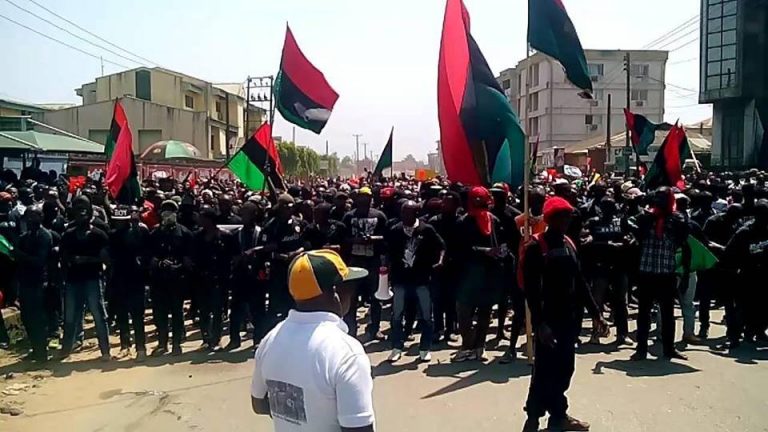
IPOB members in one of their rallies. Picture courtesy Ngyab.com
Many people are warming up for the breakup of Nigeria. Yes, let’s break up the country and go our separate ways; it’s that easy.
That’s what preoccupies their mind now. At the end, we can have Arewa Republic, Biafra, Oduduwa Republic.
And then we stop all these horse trading; there won’t be allegations of manipulation, monopolization and all the distrusts and mutual suspects that beset the present arrangement.
Okechuckwu will leave Aminu’s land and Adebayo will divorce Chizoba and everyone will bid one another farewell, whether they like it or not.
But before we slice the bread and plunge ourselves- infants, women, the weak and the elderly into an unending suffering in the name of secession, can we all pause for a moment. The elderly who witnessed the Nigerian civil war and its aftermath I’m sure are not among those increasing the drumbeat of war in the name of secession. They of course, know better than the younger generation who are possessed by youthful exuberance and fantasies of a country other than Nigeria.
Granted that Nigeria’s unity is a forced marriage, we should still ask if we are really ready for what we are gunning for.
Since the beginning of what has now gained global attention as agitation for Biafra, over 150 people have been reportedly killed between 2015 and 2016. Relatives of those who have so far died since the resurgence of campaign by the Indigenous People of Biafra (IPOP) for secession can explain better. A friend recently showed a picture of her classmate that was killed in one of the recent clashes with security operatives. Life has continued but he is no more to be part of the struggle; his family grieves as ever. To what end?
Perhaps, as the hoopla for the divorce of these entities continues, let the key actors and their sympathizers reflect over the scenario playing out in South Sudan. Then the next question should be: are we really ready for this? Breaking up Nigeria is not as difficult as the attendant fallouts. In the same token, remembering the vestiges of war in Monrovia, Liberia and Sierra Leone would serve as caution.
Today there are 22.5 million refugees worldwide. Syria remains the world’s largest producer of refugees with 5.5 million. South Sudan, the world’s newest country, now ranks third, after Syria and Afghanistan. That’s according to the United Nations High Commissioner for Refugees (UNHCR), also known as the UN Refugee Agency.
South Sudan became an independent state on 9 July 2011, following a referendum that was passed with 98.83% of the vote. It never enjoyed the gains of that independence; it has been in self-inflicted war-civil war since 2013, just two years after independence.
Over 300,000 people are estimated to have been killed in the war, including notable atrocities such as the 2014 Bentiu massacre. About 3 million people have been displaced in a country of 12 million, with about 2 million internally displaced and about 1 million having fled to neighboring countries, especially Kenya, Sudan, and Uganda. As of 2017, it had the highest score on the Fragile States Index (formerly, the Failed States Index), surpassing Somalia. Do you still consider secession an option?
South Sudan is acknowledged to have some of the worst health indicators in the world. The under-five mortality is 92.6 per 1,000, whilst maternal mortality is the highest in Africa at 789 per 100,000 live births (2015 est. CIA World Factbook).
According to Wikipedia, South Sudan was at war with at least seven armed groups in 9 of its 10 states, with tens of thousands displaced. The fighters accuse the government of plotting to stay in power indefinitely, not fairly representing and supporting all tribal groups while neglecting development in rural areas.
If we eventually have Oduduwa Republic, Biafra, Arewa Republic as being proposed by their agitators, these countries and their citizens, I’m not sure are also prepared for attendant similar disputes and war. Examples abound near and far. The end may not justify the means
As it would later happen here in Nigeria if we ever breakup as being demanded by the IPOB who really want to exit Nigeria and Northern Youths who have issued quit notice to southeasterners resident in the North, there have continued to be disputes between Sudan and South Sudan over sharing formula for their assets. So are we prepared for the attendant disputes? Are there institutions in place to cater for all the fallouts from any secession, can we actually live without one another?
Nigeria’s common wealth would be major source of disputes as currently is between South Sudan and Sudan- the division of oil revenues has been a major issue. Can we even point at one national issue that has not pitched Nigerians against one another since independence in 1960-petroluem, elections, population, sharing formula, federal character and so on and so on.
Suspicion and mutual distrust have led us to our present situation. Nigerians have not surmounted these problems and yet demanding new countries.
It might interest many Nigerians to know that 75% of all the former Sudan’s oil reserves are in South Sudan. The region of Abyei still remains disputed and a separate referendum will be held in Abyei on whether they want to join Sudan or South Sudan. The South Kordofan conflict broke out in June 2011 between the Army of Sudan and the SPLA over the Nuba Mountains.
Inter-ethnic warfare that in some cases predates the war of independence is still widespread. In December 2011, tribal clashes in Jonglei intensified between the Nuer White Army of the Lou Nuer and the Murle. The White Army warned it would wipe out the Murle and would also fight South Sudanese and UN forces sent to the area around Pibor. Don’t we have inter-ethnic clashes here? Have we addressed them? Ife and Modakeke people are Yoruba and it is fresh in mind how they killed one another in ethnic clash some years ago.
In March 2012, South Sudanese forces seized the Heglig oil fields in lands claimed by both Sudan and South Sudan in the province of South Kordofan after conflict with Sudanese forces in the South Sudanese state of Unity. South Sudan withdrew on 20 March, and the Sudanese Army entered Heglig two days later.
In December 2013, a political power struggle broke out between President Kiir and his former deputy Riek Machar, as the president accused Machar and ten others of attempting a coup d’état.
Fighting broke out, igniting the South Sudanese Civil War. Ugandan troops were deployed to fight alongside South Sudanese government forces against the rebels. The United Nations has peacekeepers in the country as part of the United Nations Mission in South Sudan (UNMISS).
Numerous ceasefires were mediated by the Intergovernmental Authority on Development (IGAD) between the Sudan People’s Liberation Movement (SPLM) and SPLM – in opposition and were subsequently broken. A peace agreement was signed in Ethiopia under threat of United Nations sanctions for both sides in August 2015. All to no avail; South Sudan is still in turmoil. Someone says Nigeria case is different from South Sudan, and I ask, how?
The order to quit the north issued by a coalition of Northern youths to the Igbos has caused more uproar and outcries than was before though it doesn’t seem that the Igbos resident in the north really want to be part of the IPOB agenda.
The Igbos have persistently cried foul and wanting to exit the entity called Nigeria. But besides the IPOB led by Nnamdi Kanu, whose immediate family is tucked in United Kingdom, majority of southeast people have professed quitting Nigeria than actually acting it. They know the consequences without being reminded of the aftermath of the 1966 Biafra war. Most of them don’t trust Nnamdi Kanu and apparently don’t share his vision.
If this is not true, visit Lagos and go to Kano where the ‘Nnas’ formed the nucleus of economic activities. Ask if they were prepared to relocate to the southeast. Many were born and brought up there and the only place they know as homes are these cities. They have married there, established businesses and courted friendships from different backgrounds over the years.
Rather than inciting more trouble, elder statesman, Ango Abdullahi should toe the line of Emir of Alhaji Abdulmumini Kabir, who said while reacting to the quit notice that Nigeria will continue to remain one in spite of its multi-ethnic diversity and recent calls for breakup.
The quit notice expires October 1, 2017 and Igbo traders, civil servants and of course politicians in the seat of power, Abuja are still going on their normal businesses. Are they not interested in the new Biafra Republic? You already know that who want secession are not living in the country, though some misguided youths have allowed themselves to be used to give voice to their sinister moves. So before we break up Nigeria, let’s think, think and think, then collectively address all our fundamental problems.