The Nigerian Communications Commission, NCC, has announced that it has suspended the new minimum pricing template for data services by mobile operators, following a directive by the Nigerian Senate on Wednesday.
The new rate, which would have led to price increase in data for some Nigerians, was scheduled to take effect from Thursday, December 1.
According to the commission, the suspension of the planned data tariff increase is to allow for further consultation with relevant stakeholders.
The NCC had directed that the floor plan for data should be 0.90k/MB effective December 1, 2016 “pending the finalization of the study on the determination of cost-based pricing for retail broadband and data services in Nigeria”.
Virtually all the big operators in the data market were hitherto charging below the new floor rate, meaning that the price for data subscription would automatically increase.
Smaller internet service providers and newcomers in the market, such as Spectranet, Ntel and Smile, are still allowed to charge below 0.90k/MB.
However, during the senate plenary on Wednesday, deputy senate leader, Bala N’Allah, raised a motion, condemning the planned data tariff hike and called on the lawmakers to put a stop to it.
Senate President Bukola Saraki criticized the NCC for not doing enough consultation before initiating the policy.
Saraki directed the senate’s committee on communication to investigate the matter as well as other allegations of non-compliance to regulations against mobile operators.
After NCC issued the directive, major telecommunication networks in Nigeria sent out messages to their customers, notifying them of the new data price regime.
The message from Nigeria’s biggest telecoms company, MTN, read: “Dear customer, please be informed that from December 1, some MTN data tariffs will be increased to reflect the new rates set by the NCC to operators.”
Etisalat in its own message said: “Dear valued customer, effective 1st Dec 2016, we will review our data plans and prices in compliance with NCC Directive.”
The minister of communication, Adebayo Shittu, was quoted as saying on Wednesday that he was not aware of the planned data tariff increased.
A radio station, Raypower FM quotted the minister as saying: “I heard of the Data tariff increase like every other Nigerian; I’m not party to It.”
The planned tariff hike has been roundly condemned by majority of Nigerians who described it as further worsening the hardship being experienced across the country due to the ongoing economic recession.
On Tuesday, the Trade Union Congress TUC, condemned the planned data price increase, saying it was an act of insensitivity on the part of government.
President of the TUC, Bobboi Kaigama in a statement made available to journalists in Lagos said: “We feel worried about the move because data is one of the cheapest ways to empower the teaming youth.
“This move if allowed will make it unaffordable. This is insensitive on the part of the parties involved.”
“What then will be the benefit of the policy to the self-employed who depend on data for their businesses?” he asked.
“Cheap internet data is a vehicle to economic development. It is very unfortunate and inhuman to come up with such idea at a period of recession.”
A drama of sorts played out on the floor of the Nigerian Senate on Wednesday when one of the Peoples Democratic Party, PDP, lawmakers from Ondo State announced that he was defecting to the ruling All Progressives Congress, APC.
Yele Omogunwa’s defection caused an uproar in the red chamber of the National Assembly leading to the lawmakers of the opposition PDP staging a walkout.
The letter of notification by the Ondo Senator was read at plenary by Senate President Bukola Saraki, saying that Omogunwa’s decision was due to the recent developments in Ondo State.
With the lawmaker’s change of party, all the three Senators from Ondo are now members of the APC.
Meanwhile, as Saraki was reading Omogunwa’s letter some APC Senators were seen rejoicing while their PDP counterparts were shouting “go, go, go” to Omogunwa, resulting into momentary rowdy session.
Senate Minority Leader and former Akwa Ibom Governor, Godswill Akpabio, then raised a Point of Order saying that Omogunwa’s defection to APC was without any cogent reason, urging the Senate President to declare his seat vacant.
However, Saraki ruled Akpabio out of order, citing another relevant section of the Senate Standing Orders.
Also, the Chairman of the Senate committee on the Federal Capital Territory, Dino Melaye, raised another constitutional point of order, insisting that the PDP was clearly factionalized both at the National level and in Ondo state, describing the situation in the opposition party as a very wide “gulf”.
Consequently, all the PDP Senators at the plenary staged a walkout to address the Senate Press Corps.
The Reuters Institute for the Study of Journalism is calling for applications from Mid-career journalists into its research fellowship program of either three or six months at Oxford University.
The Thomson Reuters Foundation Fellowship, founded in 1983, offers an opportunity for experienced journalists wishing to undertake research projects on a variety of subjects.
According to an information on the International Journalists’ Network, the fellowship program provides participating journalists from across the globe with an opportunity “to critically reflect upon their profession, to research a subject of their choice under the supervision of an academic specializing in that area, and to enjoy the breadth of academic, cultural and social life at the University of Oxford.”
Fellows are expected to complete an academic paper, with preference given to projects within the institute’s areas of focus: journalism and democracy; business of journalism; journalism practice; and media policy.
Also, fellows will be paid a “modest living allowance of £1,500 per month, for the three-month or six-month period their studies will last.
Applicants with at least five years of journalism experience and strong English skills are expected to submit a resume, personal statement, project proposal, references and work samples.
For any questions regarding the fellowship programme or application process, applicants should check the Frequently Asked Questions, FAQs.
The first National Conference on HIV Prevention in Nigeria, which held on Tuesday in Abuja witnessed a mild drama as some protesters under the aegis of Society for Women and Children Living with HIV/AIDS in Nigeria, SOWCHAN, invaded the venue of the conference in protest.
The protesters complained of the poor attitude of the federal government towards the funding of the HIV/AIDS in Nigeria.
They also want President Muhammadu Buhari to create the office of special adviser on HIV/AIDs which would be headed by someone living with the HIV virus, so that the president will be getting first hand briefing on the challenges being faced by HIV patients.
The conference, which was organized by the National Agency for the Control of AIDS, NACA, was aimed at proffering more solutions to effectively preventing the further spread of the disease.
Members of SOWCHAN, trooped out in their numbers to the podium where the Minister of State for Health, Osagie Ehanire, was about to deliver a keynote address.
Their spokesperson, Enya Attah, who has lived with the HIV/AIDS for 20 years and has three of her children negative to the disease, said the protest was to get the government to live up to its responsibility of catering for the health needs of the citizenry.
“There should be political will by both the federal and state governments to truthfully implement the many strategic plans and research recommendation developed by NACA,” she said.
“Nigeria is heavily dependent on external donors to about 75%, while domestic financing is 25 percent.
“There is dwindling global funding for HIV in developing countries; the Nigerian government must bridge this funding gap.”
NACA director-general, Sani Aliyu, pointed out that transmission of the HIV virus has largely reduced by at least 96% due to the use of the antiretroviral therapy.
“Following the 2011 landmark HTPN-O52 study, we now have very good evidence that ART is very effective in cutting HIV transmission by up to 96%,” he said.
“In addition to this, pregnant women who could take antiretroviral treatment and adhere to treatment up till post-partum period are able to reduce the risk of transmission from as high as 30 per cent to less than one per cent.
“This conference is an opportunity for us to review our approach to HIV prevention and learn from all the good work that has been going on from within and outside the country,” Aliyu added.
Also speaking at the conference, chairman of the House of Representatives’ Committee on AIDS, TB and Malaria, David Mbugadu, called on the private sector in the country to contribute its own quota in providing assistance to HIV/AIDS patients in the country.
He explained that “dwindling revenues to the government coffers might impede government’s capacity to ensure that over three million HIV positive persons in the country are placed on drugs.”
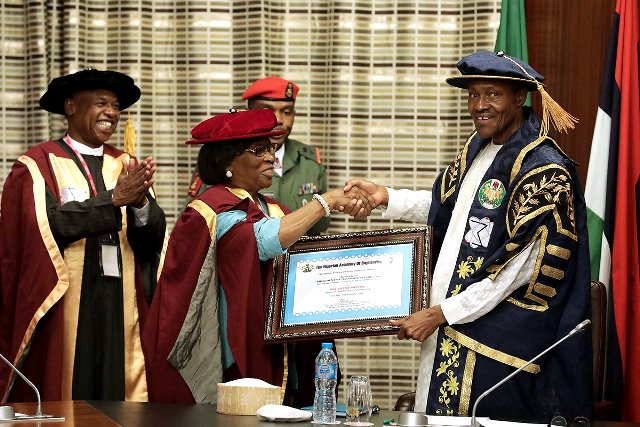
President Muhamadu Buhari was decorated as the Grand Patron of the Nigerian Academy of Engineers
President Muhammadu Buhari has said that he has total confidence in the ability and effectiveness of Nigerian engineers.
The President expressed this sentiment on Tuesday when a delegation of the Nigerian Academy of Engineers, NAE, paid him a courtesy visit at the Presidential Villa in Abuja.
The Academy also decorated President Buhari as its grand patron.
Buhari said he had been working with Nigerian engineers right from when he was a petroleum commissioner at the Petroleum Trust Fund, PTF.
“Nigerian engineers are competent and cost effective. I respect you all, it takes a lot to be a competent engineer,” the president stated.
He later wrote on his social media handle: “I have a lot of respect for Nigerian Engineers having worked with them over the years, from my time as Petroleum Commissioner, to the PTF.”
President Buhari said that it was not entirely true that Nigerian engineers are not being engaged in National projects.
According to Buhari, 99 percent of the engineers involved in the construction of the four refineries in the country were Nigerian engineers.
He reiterated that government has always taken Nigerian engineers seriously in the task of nation building, as they can compete favourably with their counterparts across the globe.
Buhari further said that the country’s leadership was to blame, not the engineers, for the fact that none of the four refineries in the country are currently working.
President of NAE, Joanna Maduka, commended the president for his administration’s commitment to correct the infrastructural deficit in the country.
She said: “This effort is very germane to the development of our nation. For this to be done effectively and efficiently, inputs are required from all cadres of engineering disciplines.
“The physical indices of development of any country are engineering based like roads, railways, water supply, power, housing and other infrastructure.
Maduka also said that “for the country to attain sustainable growth status, the Nigerian engineers need to be adequately engaged in planning, policy formulation, consultancy and construction as well as industrial processes of production and manufacturing.”
She added that Nigeria is currently “grossly under-engineered”, and even fewer professional engineers were in positions of authority unlike what obtains in other countries.
“Currently, about half of the cabinet ministers in Singapore are engineers and in China, 70% of the cabinet members are engineers,” She stated.
According to Maduka, the NAE is currently made up of 140 fellows.
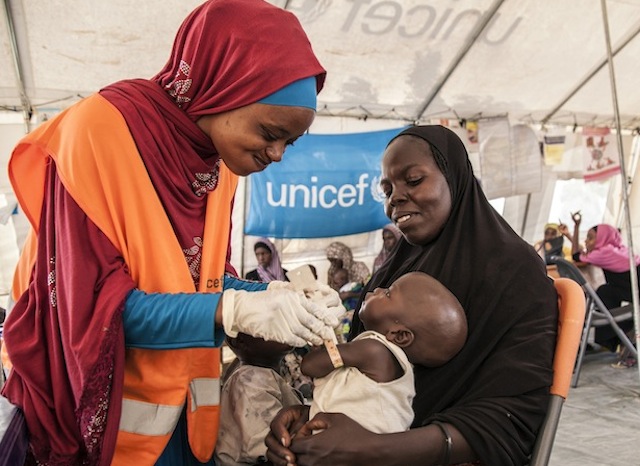
A UNICEF official assessing a 7 month old baby for malnutrition
A $20 million project to provide food and nutritional support to families affected by the Boko Haram insurgency in the North east is yielding positive results as over 1,000 families have been assisted with food and nutrition support.
According to the statement, the project, which began in April this year and runs through March 2019, has already treated 30,000 children for severe acute malnutrition.
“More than 100,000 pregnant women have received iron folate; 60,000 children have been treated for diarrhoea, which can cause malnutrition or make it worse; 350,000 children have been given vitamin A supplements, boosting their immune systems and helping to protect them from illnesses such as pneumonia, diarrhoea and measles, which are frequently fatal in the area; and 40,000 pregnant and breastfeeding mothers have been helped with information on the best ways to feed young children in the circumstances in which they live,” the agencies announced.
However, an additional part of the project is a system of providing funds directly to families with the lowest incomes to enable them to buy nutritious food to prevent relapse after children have been treated for malnutrition.
So far, more than 7,000 families have received this cash assistance.
The statement pointed out that with more than 4.4 million people struggling with crisis and emergency food security levels in Borno and Yobe , the two states worst-hit by the insurgency, the three organizations are working together to give families in the two states greater access to food and to protect children from malnutrition.
According to statement, the three-year project is being carried out in collaboration with the primary health-care agencies of the government of Nigeria and Borno and Yobe states.
It noted that the project is providing vitamin and mineral supplements for mothers and children, funding for families with severely malnourished children to buy nutritious food, treatment for children with diarrhoea, and advice for pregnant and breastfeeding mothers on how they can provide the best possible nutrition for their children.
Part of the statement reads: “With high levels of malnutrition even before the start of the Boko Haram conflict, the two most-affected states have seen food insecurity and malnutrition rates rise dramatically as a result of the fighting.
“In an already poor area, agriculture and markets have been disrupted by the fighting, which intensified towards the end of last year. The majority of food and seed stocks have been depleted, looted or destroyed, and many of the 1.8 million people who have fled their homes because of the conflict have had to leave behind what little stocks they had. Displacement has left many families with no means of earning a living.”
The agencies noted that despite the fact this is the harvest season when more food would normally be available, an estimated 55,000 people in Borno state are living in famine-like conditions and the number is predicted to double by the middle of next year, making longer-term interventions such as the DFID-funded project all the more important.
UNICEF said it would work with Nigerian authorities to administer the nutrition aspects of the programme in Borno state, which has the heaviest burden of malnutrition, while WFP is managing the cash transfers and AAH is handling both aspects of the project in Yobe state.
An estimated 400,000 children under the age of five in Borno, Yobe and Adamawa, will suffer from severe acute malnutrition this year, according to UNICEF.
The Federal Ministry of Agriculture has said that government is considering the idea of placing a ban on the importation of foreign tomato pastes into the country.
Minister of agriculture, Audu Ogbeh, disclosed this when the House of Representatives Committee on Agricultural Production and Services, visited the ministry.
Ogbeh stated that a report by the National Agency for Food and Administration and Control, NAFDAC, showed that foreign tomato pastes imported into Nigeria are not good for the body.
“The Chinese are the ones messing us up on tomato paste,” the minister said.
“Each time Dangote tries to produce, they lower their prices.
“There’s a report by NAFDAC on the quality of foreign tomato pastes. The report is very bad.
“We think we have every reason in that report to ban foreign tomato pastes into the country.
“If you don’t ban it on health ground, you have to ban it on any other ground,” he said.
Ogbeh also disclosed that the federal government was buying and storing food as a way of taking precautions to avoid food shortage.
Recall that the government had raised alarm over the rate at which farmers engage in the export of grains, saying it could trigger a severe food shortage.
“It’s time to fill our silos,” Ogbe said.
“The export is huge now, but if you stop it, farmers will get very angry.
“When you go round, they tell you they get so rich now. But if you stop it and the prices fall, you discourage farmers.
“We’re in the market now buying and storing.”
The House of Reps committee was led on the oversight visit by its chairman Mohammed Monguno.
The Central Bank of Nigeria, CBN, has said that the country will begin to export rice to other countries by the end of 2017.
The acting Director, Corporate Communication of the bank, Isaac Okoroafor, disclosed this on Tuesday during a sensitisation/awareness programme for farmers in Bayelsa State, to educate them on the CBN’s Anchor Borrowers’ Programme.
Okoroafor said that the rice harvest this year had exceeded the projections, adding that if the tempo was sustained, by the end of 2017, Nigeria would not only meet its national demands but would export to other countries.
He said: “We started a pilot programme in Kebbi State with 78,000 farmers, cultivating an average of one hectare and that was when President Muhammadu Buhari launched the programme in March last year.
“The programme was to enable farmers to plant three times in the year – two dry seasons cropping and one rainy season cropping. I am telling you now that Kebbi State has exceeded one million tonnes of rice.
“Not only Kebbi, Ebonyi State has keyed into it. We were there last week and Ebonyi is to give us over 1.2million tonnes of rice in one year. They are harvesting now, they are bagging and they are milling. Nigerians are booking their Christmas rice in Abakaliki,” he said.
The CBN spokesman disclosed that “Abia State has ordered rice from Ebonyi State Government. Other states are keying in.”
He called on Nigerians to patronize the locally produced rice which he said was far healthier as it contains no chemical preservatives.
“You need to taste Nigerian rice, it is fresh. Not the nine year old rice from Vietnam, Thailand and India. Let us feed ourselves. Our rice is healthier, it is not preserved with chemicals,” Okoroafor said.
He urged the people of Bayelsa State, as well as other Niger Delta States to take farming seriously and not rely only on oil.
“We have been to Anambra, Niger, Jigawa, Kebbi, Sokoto, Cross River and Ebonyi just to ensure that this is not another talk show,” the CBN spokesman said.
“We have seen harvest of rice which brought me to say that the harvest in rice for this year has so far outstripped our projections.
“By the end of 2017, Nigeria will not only meet our national demands which is between six and seven tonnes per year, but we will exceed it that we will have rice to export to other countries.”
The United States of America has revealed that it has committed more than $3.4 billion to support Nigeria’s anti-HIV/AIDS campaign.
This was made known by the US Consul-General in Nigeria, John Bray, during an event put together by the Public Affairs and Medical Sections of the Consulate in commemoration of the 2016 World AIDS Day in Lagos on Tuesday.
Bray explained that the amount dates back to 2004 when it began its President’s Emergency Plan For AIDS Relief, PEPFAR.
He said PEPFAR was an initiative of the U.S. Governmental aimed at addressing the global HIV/AIDS epidemic and saving the lives of those affected by the disease, especially in Africa.
According to the Consul-General, HIV was a death sentence in Nigeria and in Africa prior to the launch of the PEPFAR scheme, wiping out entire villages in some places.
“Some measures of success show that 600,000 men, women and children which are about 90 percent of the people living with HIV/AIDs are currently on HIV treatment,” Bray said.
“About 8.7 million people have received HIV counseling and testing; more than 55,000 pregnant women have been provided anti-retroviral drugs for the prevention of mother-to-child transmission of HIV.
“Also, 750,000 adults and children living with HIV/AIDs have received care to support quality of life and 700,000 children orphaned by AIDS have received care and support,’’ he added.
The US envoy expressed optimism that HIV/AIDS could be eliminated by 2030 if the current efforts by the Nigerian government in conjunction with the U.S. governments, as well as other critical stakeholders were sustained.
Director of the Lagos State AIDS Control Agency, LSACA, Oladipupo Fisher, commended the U.S. Government for their partnership in ensuring that the HIV/AIDS disease will be eradicated by 2030.
He added that more work need to be done in order to achieve the goal.
Emmanuel Olaoti, a member of the Society For Family Health, urged Nigerians to always go for regular testing in order to know their status.
He also advocated for a healthier lifestyle in order to prevent coming down with the disease.
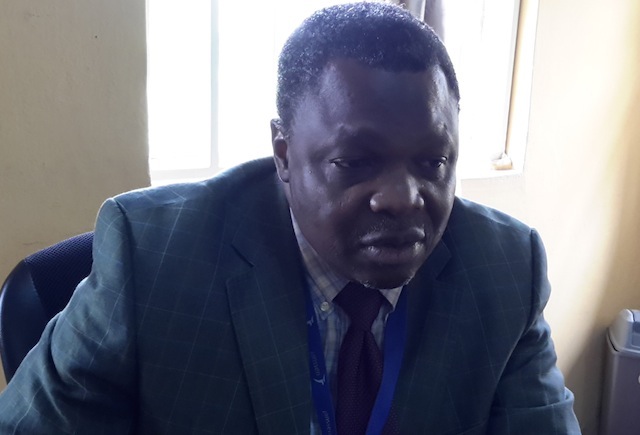
Dr Taiwo Sheik, Medical Director, Federal Neuro – psychiatric Hospital, Kaduna
Dr Taiwo Sheikh, a Psychiatrist and Chief Executive Officer/Medical Director, Federal Neuro- Psychiatric Hospital, Kaduna, in this interview speaks about the spike in drug abuse and addiction among youths, particularly girls in Northern Nigeria.
By Tajudeen Suleiman
We are looking at the abuse of illicit drugs among women.
[junkie-alert style=”grey”] When you say illicit, it means a drug that is being used against the law and what it is made for. It is more of a legal and social term. We in medical field do not use the term illicit. We rather use the term abuse of drug or substance or addiction to the substance or to the drug. But misuse does not carry legal connotation. Illicit means there is a law and the individual can be sanctioned. [/junkie-alert]
What can abuse of drug do to the human beings?
[junkie-alert style=”grey”]First let’s have a clear perspective on the issue. We realise that talking about drug narrows our understanding. To the layman, drug means tablet or capsules etc. But we in medical field know that when we talk of drug it goes beyond medicinal compound that you take. It also includes alcohol, cigarettes and even those not packaged like those who sniff latrine or waste fumes.
When we say substances abuse or drug abuse, we’re referring to a mental condition in which because of the way and manner the person is using the substance, it has resulted into loss of some function. And the person is not able to do things the way they used to do. Then we say the person is suffering from significant loss of function, which may be physical activities, movement, and general wellbeing.
Or it could be social activities – your interaction with people. Or it could be psychological; your ability to comprehend what is happening, your thoughts, what you say, your degree of happiness, degree of sadness, worry or fear.
So, where there is some loss of function in the person, you say the person is suffering from substance abuse. He has taken the substance to a degree to which he is not able to function well. In medical language we say there is significant impairment-the individual is impaired. So its now a sickness.
That is what we mean by abuse. It has become a condition that requires attention, in the sense that the person may not necessarily be hospitalised, but something needs to be done. The individual needs help.[/junkie-alert]
Does anybody in the condition you have described stand a chance of being reformed?
[junkie-alert style=”grey”]Yes. Definitely. Abuse is a very mild form of the kind of condition that could come as a result of illicit use of drugs and substances, and if you address it well, the individual can overcome it. There are more serious conditions that can come. Addiction is one of the more serious conditions that can result from the use of substances.
Some of these drugs exert their influence on the brain. So we call them psychoactive substances. So the use of such psychoactive substances could also lead to addiction. When we say someone is suffering from addiction, it is a very serious condition in the sense that the individual, because of the excessive and lack of control in the use of such substance, cannot function normally and effectively without the substance.
So it has become a situation where the user is no longer using the drug or substance to enjoy, but using it to live, to survive. That is addiction. He cannot even sit calm without the substance. He will start manifesting certain behaviours because of the lack of substance in his body. And once he takes the substance, the behaviour or symptoms will disappear.
You can now understand the extent the person will go when his body needs the substance. He will do anything to get the substance. This is a very severe form. Abuse is milder, but it is also a condition that requires attention. Addiction is a more serious condition.[/junkie-alert]
We have seen some young men and women with mental problems and people attribute to drug abuse. Can addiction lead to madness?
[junkie-alert style=”grey”] If you’re addicted and the drug or substance is not available, it means you will not be normal. You will start craving, wanting it, and your body will be responding. And that will now make you exhibit behaviours that would be considered abnormal in the society.
Not only that, some of the substances even changes the working of your brain. Addiction itself has changed the working of your brain, but it will further change the working of your brain to start experiencing things that are not there; to start hallucinating. You hear what is not there; you see what is not there and it will change your belief system and thinking process. It will change the way you link your thoughts together.
What would you call such a person? Of course you will say the person is mad. In medical field, we call it psychotic disorder.
There are stages in drug abuse and addiction that can manifest with psychosis (madness). And there are so many other conditions that could manifest as a result of addiction, which ranges from anxiety to depression, deliberate self-harm or suicide. Socially it could lead to poverty, loss of jobs diseases of the kidney, eye, nervous system, hearing loss and so on. Madness is one of them.[/junkie-alert]
From your experience, what are the causes of drug or substance addiction?
[junkie-alert style=”grey”] There must be interplay of these three: the drug must be available, the person and a conducive environment (challenges of living). These three will deliver drug addiction. Individuals also inherit certain tendencies from parents. You can inherit the propensity to develop the problem if some conditions are fulfilled. Your constitution is also important – your system, brain etc can also make you prone to addiction.[/junkie-alert]
How often do you get cases of victims of drug or substance addiction?
[junkie-alert style=”grey”]Drug addiction is quite common nowadays. We see cases every day, mostly young people-men and women. We see from mild cases to most severe cases. Many parents or relations will not bring their people when it is very early until it is late. Most of the cases that we see are the ones that have gotten out of hand. People don’t seem to appreciate that the earlier you bring them the better. They will be struggling to manage them at home, and by the time they come here it has become very serious. But we’re still able to deal with it. We’re one of the best centres in this country today to handle drug cases. There is virtually no day that one or two people will not come for drug addiction. They come from different parts of the North central and some states in the North west. People come here from other places too.[/junkie-alert]
What are the chances of complete rehabilitation for addicts?
[junkie-alert style=”grey”] The chances are bright if you come early enough. The earlier you come the brighter the chances … If you have good social support, a family that is ready to support you. Also, if you have a job that can keep you occupied, and you’re not in the industry of the drug. The way and manner you adhere to doctor’s advice will also determine whether you come out of it. Then the complications you have developed. Those who have fewer complications are likely to overcome it faster. We also know that the younger you are the better the outcome. Patients have to pay for food, drugs and number of tests. Bed is just N100 per day. Cost ranges between N3,000 to N28,000 depending on your condition.[/junkie-alert]
How did you come to the conclusion that there is an increase in the number of women who abuse drugs?
[junkie-alert style=”grey”]Its empirical, it is based on what we do and on our experience. Ten years ago, for every four or five men, we see one woman. But today, for every four or five men we see four women. That shows a trend that suggests increase in the number of women that come with substance abuse problems … specially now that the type of substance people abuse is also changing. Twenty years ago, we didn’t talk about things that people buy from the chemist and take home. Today, that is what we’re struggling with – cough mixtures. And that is the one women abuse most.[/junkie-alert]
Of course we have women taking alcohol and all that, but the cough mixture has now come. Cough mixture is readily available and it can change the working of the brain and give you some kind of feeling.
[junkie-alert style=”grey”] And there is no law that regulates that. They conceal it in bottles of soft drinks. They go to parties with it. You find it under their beds and inside their bags. And that is also responsible for the increase in the number of women we’re seeing with this particular problem.[/junkie-alert]
You know in this part of the country, its not easy for a woman to go to a beer parlour and drink bear or even buy and take home. But the cough mixture is easier.
[junkie-alert style=”grey”]This is one of the things that is responsible for the surge in gender representation of drug abuse in this part of the world today. It is increasing by the day.[/junkie-alert]