Home Blog Page 295

Court sentences singer Portable to 3 months imprisonment for assault

A Magistrate Court sitting in the Ifo Local Government Area of Ogun State has sentenced controversial hip-hop artiste, Habeeb Okikiola, popularly known as Portable, to three months imprisonment for assault, with an option of a N30,000 fine.

The judgment was delivered on Tuesday April 30, by Babjide Ilo, a chief magistrate Babajide Ilo, who found the singer guilty on two counts of conspiracy to assault and unlawful assault.

Both stemmed from an incident which occurred on November 18, 2022, in the Okeosa, Ilogbo area of the Ifo Magisterial District.

The ICIR reported in April 2023 that Portable was initially arraigned on a three-count charge under charge sheet No. MIF/192C/2023 and granted bail in the sum of N300,000.

However, after failing to appear in court for subsequent hearings, he was remanded in custody before returning to court for sentencing.

According to police prosecutor, Olumide Awoleke, an inspector, Portable and others now at large conspired to assault one Osimosu Emmanuel Oluwafemi. The singer also faced a separate count of theft involving musical equipment, although he was not convicted on that charge.

The court sentenced Portable to one month’s imprisonment with an option of a N10,000 fine on the conspiracy charge and two months’ imprisonment with an option of a N20,000 fine on the assault charge.

The ICIR reports that Portable has been involved in controversial issues recently, some of which have landed him in police net or caused him to be remanded.


Varsities swell in South-West as NUC issues 11 fresh licences

0

THE National Universities Commission (NUC) has issued provisional licenses to 11 newly approved private universities.

The licenses were formally presented today, Wednesday, April 30, at the NUC auditorium in Abuja.

While speaking during the presentation, the  Executive Secretary of the NUC,  Abdullahi Ribadu said there was a growing need for private universities to cater to Nigeria’s youthful population.

He stressed that private universities had significantly expanded the nation’s academic landscape since 1999.

“From just 49 universities in 1999, 23 of which were private, Nigeria now boasts of 298 universities, with 159 (53.3 per cent) being privately owned. The catalyst for this expansion is the increased participation of the private sector,” he said.

According to Ribadu, the provisional license is subject to permanent approval after thorough evaluation.

“The provisional status is subject to close monitoring by the NUC, with full licenses to be granted only after a thorough evaluation of each institution’s compliance with regulatory standards,” he said.

The latest development expands private universities in the South-West, South-East, and South-South regions, which already had the highest number of private institutions in the country, according to data on the number of private universities from the National Universities Commission (NUC).

The 11 new private universities include New City University, Ayetoro, Ogun State, University of Fortune, Igbotako, Ondo State; Eranova University, Mabushi, FCT and Minaret University, Ikirun, Osun Annexe.

It also consists of Abubakar Toyin University, Oke-Agba, Kwara State; Southern Atlantic University, Uyo, Akwa Ibom State; Lens University, Ilemona, Kwara State; and Monarch University, Iyesi-Ota, Ogun State.

Others are Tonnie Iredia University of Communication, Benin City, Edo State; Isaac Balami University of Aeronautics and Management, Lagos; and Kevin Eze, University, Mgbowo, Enugu State.

In March, The ICIR reported that the Federal Government has granted provisional licences to 11 new private universities, which brought the total number of private universities in Nigeria to 160.

The Special Adviser to the President on Media and Public Communication, Sunday Dare, announced the approval in a statement on Monday, March 3, following the Federal Executive Council (FEC) meeting chaired by President Bola Tinubu at the State House, Abuja.

With the approval of 11 new private universities and now the issuance of the licenses, the North-Central region now has 36 private universities, including the three new universities approved for it. 

The North-East and North-West did not benefit from the 11 new universities.

This means that the number of private universities in the North-West and North-East remains at 19 and five, respectively, according to data from the NUC.

Similarly, with the new approval, the South-West now has 52 private universities, up from its initial 47. The South-South has 25, with the addition of two new institutions, while the South-East hosts 23, having previously had 22.

Speaking with journalists after the FEC meeting, the Minister of Education, Tunji Alausa,  explained that the newly approved universities completed the NUC’s ‘rigorous’ 13-step assessment process before being granted their licences.

Meanwhile, Alausa, disclosed that a moratorium had been placed on the approval of additional private universities.

He further clarified that pending applications already advanced in the NUC’s approval process would still be reviewed.

dRPC announces grant for Nigerian NGOs affected by Trump’s aid cuts

0

AS the ripple effects of United States (US) President Donald Trump’s controversial aid cuts continue to negatively impact governmental and non-governmental organisations globally, the Development Research and Project Centre (dRPC) has announced an intervention to cushion the effects in Nigeria.

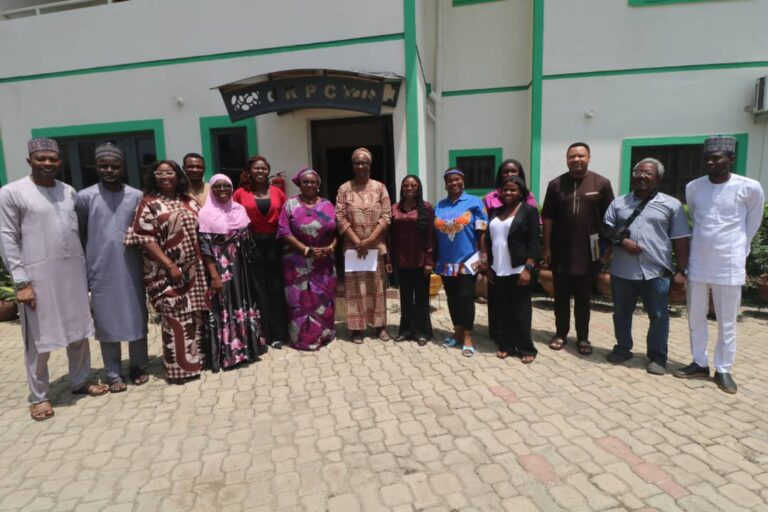
The Executive Director of dRPC, Judith-Ann Walker, said on Wednesday, April 30, during a press briefing in Abuja that the organisation’s Support Initiative (NSI) would support some of the affected non-governmental organisations (NGOs) in the country.

“Things have never been this challenging for NGOs. Local groups do not have funding, they can’t access funding. In response to the conjunction, the funding gap that we have seen, the dRPC has taken it upon itself, not just to provide funding, seed funding to CSOs (Civil Society Organisations), but training and capacity building, which we have been doing for over 30 years. So with the initiative, the NSI, local NGOs can apply for a grant of up to five million naira to execute a project in three months,” Walker said.

Walker, who noted that the centre was offering support with funding from the Ford Foundation, encouraged women-led NGOs that are working in the field of prevention of gender-based violence, women’s economic empowerment, safe schools and initiatives for girls, social justice and a cluster of five areas identified to apply.

“The process of application, selection, and award is an objective one based on performance, past performance, based on filling the criteria that we have put out there. It’s on our website, it’s in the newspapers. We will use technical, objective criteria to make selections and to award NGOs the support so that they can continue to do the great work that they are doing. We are particularly interested in women-led NGOs” she added.

The ICIR reported in February that the Trump administration announced its preparation to dismantle the US Agency for International Development (USAID) and other funding aids to Africa and the rest of the world.

The announcement came amid a growing controversy around USAID, with two senior security officials, John Voorhees and his deputy, Brian McGill, placed on leave after refusing to grant Trump’s inspection team – the Department of Government Efficiency (DOGE), headed by Musk access to classified materials.

Development sector insiders said the move has forced many community-based initiatives to scale back operations or shut down entirely as a result of significant cuts or total suspension of US aid.

The Public Relations Officer of the Association of Women in Trade and Agriculture, Amah Yemi-Samuel, a participant at the dRPC briefing, said the funding cuts had made it increasingly difficult for her organisation to operate effectively.

“Because of less money, we had to stop or reduce some important programmes. For example, we’ve scaled down training programmes for farmers, reduced support for small businesses, and cut back on trade promotion activities. This has slowed down our work and affected the women who rely on our help the most,” Yemi-Samuel said.

She acknowledged that the dRPC’s planned grant would provide much-needed relief by offering emergency funding to organisations like hers, but noted that her NGO has already begun exploring alternative means to sustain its work. 

“We are exploring new ways to raise funds, such as working with local businesses and community leaders who can support our work. We just started a garri processing centre, and these steps will help us continue our grassroots work even when foreign aid is less,” she added.

The ICIR reported how Trump signed executive orders on his inauguration day on Monday, January 20, reversing several policies of his predecessor, Joe Biden.

Some of the orders include pulling out the US from the World Health Organisation (WHO), the  Paris Climate Agreement, ending birthright citizenship for children of illegal immigrants, and recognising only two genders – male and female.

Tinubu’s aide uses out-of-context image to mislead about Obi’s governorship record

Dada Olusegun, Special Assistant on Media to President Bola Ahmed Tinubu, recently shared two contrasting images on X (formerly Twitter) to compare water transportation under Labour Party’s presidential candidate, Peter Obi, and Lagos State Governor Babajide Sanwo-Olu.

In one image, Obi is seen in a wooden canoe in a flood-ravaged area. The second image shows Governor Sanwo-Olu aboard a modern watercraft. Olusegun captioned the post: “Water transportation in Anambra under Obi Vs Water Transportation in Lagos under Babajide Sanwo-Olu.”

As of April 29, 2025, the post had received over 400 reposts and more than 1,000 likes.

CLAIM

That the image of Peter Obi in a canoe was taken during his tenure as governor of Anambra State.

screenshot of the viral post

THE FINDINGS 

Findings by The FactCheckHub show that the claim is MISLEADING. 

Peter Obi served as governor of Anambra State from 2006 to 2014 under the All Progressives Grand Alliance (APGA). The viral image, however, was not taken during his time in office.

A reverse image search conducted by The FactCheckHub revealed that the photo was taken in October 2022, eight years after he left office, during a visit to flood victims in Anambra State. At the time, Obi was a presidential candidate under the Labour Party for the 2023 general election. His emergence as a presidential candidate sparked the rise of the “Obidient” movement, driven largely by young Nigerians seeking political change. Although he lost the election, the movement contributed in reshaping conversations around youth participation in the civic space. 

In 2022, Anambra was one of several Nigerian states devastated by severe flooding. The floods displaced thousands and led to the creation of Internally Displaced Persons (IDP) camps.

Obi visited the Umueri Unity Hall in Anambra East, where some flood victims were sheltered. He toured affected communities by boat, accompanied by LP officials and community leaders, including Chief Metchie. During the visit, he donated food and medical supplies, and expressed solidarity with the victims.

The visit came shortly after a tragic boat accident claimed the lives of at least 76 people in the state. Obi publicly mourned the victims and offered his condolences.

VERDICT

The claim that the image shows flooding under Obi’s leadership in Anambra is MISLEADING, as findings show that the image has been online since 2022, eight years after he left the office.

No, this is NOT a Fulani boy eating human flesh

0

A video showing a young boy chewing what appears to be roasted meat has sparked outrage online, with claims that he is a Fulani child eating human flesh.

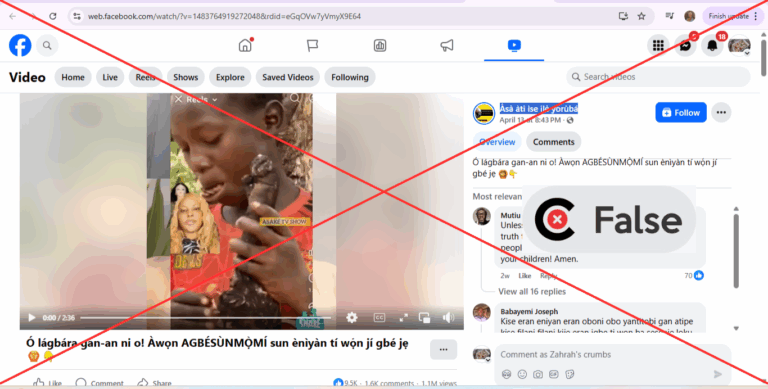
The video, originally posted by a Facebook page named Àsà àti Ìṣe Ilè Yorùbá, features a picture-in-picture clip of the boy eating the meat alongside a narration of a woman speaking in Yoruba. In her narration, she alleges that the boy is a Fulani herder living in the bush, and that kidnappers now burn and eat victims who can’t pay ransom.

She claims, the boy is eating the arm of one of their victims while his father records the video.

A second voiceover in Pidgin English, added to the clip, warns viewers to avoid such individuals, suggesting the boy might be dangerous. She says:

“My people, when we say we don see am all, we never see anything. Na human being this boy dey chop. He roast am o, e dey chop am na bush dem dey stay my people look at what someone is eating, fear no catch am, e come dey film am, human being like am hand dem don roast am cut am, na im pikin dey eat so see as fly dey pass am, dis kind one, na to cut person no go dey hard am again if you see such people for bush make you run if you see dem for road waka pass another road because dem fit use teeth chop you … what is this world turning into?

The video was also accompanied by a caption which was also written in Yoruba, when translated means; ‘This is troubling! kidnappers now burn and eat whoever they kidnap.’

The same video was also posted by another user @eniojajuni on Instagram with the caption : Fulani boy eating human flesh… God have mercy 🙆‍♂️ And we still call ourselves one Nigeria”

Since it surfaced, the video has received over 1 million views, 9,500 likes, and 1,600 comments.

CLAIM

That the video shows a Fulani boy eating human flesh.

THE FINDINGS

Findings by The FactCheckHub shows that the claim is FALSE!

An appearance of the claim as seen on Facebook; Insert; FALSE verdict

A reverse image search and analysis using Google Lens by The FactCheckHub traced the original footage to a TikTok account, @Hadzabe_Lifestyle, which documents the daily life of the Hadzabe people, an indigenous hunter-gatherer community in Karatu District in Tanzania’s Arusha Region, East Africa.

The original video, which is clearer and without any added voiceovers, is captioned: “Baboon’s Delicious BBQ! 🍖🔥 A Hadzabe boy enjoying a tasty baboon barbecue deep in the forest! Would you eat this?”

Audio in the original shows background forest sounds and the boy chewing, with no suggestion of human flesh. Additionally, close visual inspection reveals the meat is from an animal limb likely a baboon. 

Another video posted by the same account shows some women with the head of the animal. It has the caption “Hadzabe tribe enjoying a baboon head feast in the wild!”

A screenshot from a video on Youtube showing a human hand and a baboon.

Baboons are found in Tanzania and it’s been documented that the Hadzabe people hunt baboons.

THE VERDICT

FALSE: The boy is not Fulani, and he is not eating human flesh. The meat in question is baboon, and the video was taken in Tanzania not Nigeria.
This report is republished from the FactCheckHub.

Appeal Court affirms conviction of professor for rigging election for Akpabio

0

THE Court of Appeal in Calabar has upheld the conviction of Peter Ogban, a professor accused of rigging a senatorial election for Senate President Godswill Akpabio.

Ogban, a professor of Soil Science, was jailed for announcing false election results in favour of Akpabio during the 2019 general elections.

According to Premium Times, on Wednesday, a lawyer who participated in the case said the Court of Appeal upheld three-year prison sentence for Ogban for manipulating election results and criticised his actions despite being a university professor.

The Independent National Electoral Commission (INEC) prosecuted Ogban for election fraud, and after being found guilty, he pleaded for leniency.

A High Court in Akwa-Ibom State had sentenced the convict to three years in prison for election fraud.

The court, which found Ogban guilty of fraudulent manipulation of election results and announcing false results, also asked the professor to pay a N100,000 fine.

Ogban testified in the trial court that the election results were falsified to favour the APC, with thousands of fake votes added, despite the PDP candidate winning the election.

During the trial, Ogban admitted that he knew the figures on result sheets (forms EC8E1) were taken from results collated at the constituency level (form EC8D1).

When asked to verify the APC’s score in Oruk Anam Local Government Area, he confirmed it was 10,534 votes in the collation sheet (exhibit 2), but there were 15,534 votes in the declared result sheet (exhibit 3), indicating around 5,000 fake votes were added.

Despite this disparity, Ogban claimed he didn’t falsify the results, claiming he only collated results given to him by local government area returning officers.

The judge sentenced him, citing the prosecution’s strong case.

Ogban’s conviction followed a similar case where Ignatius Uduk, a professor, was jailed for three years for election fraud, including announcing false results and perjury, during the 2019 general elections.


Court orders EFCC to release Aisha Achimugu within 24 hours

0

THE Federal High Court in Abuja has ordered the Economic and Financial Crimes Commission (EFCC) to release businesswoman and socialite, Aisha Achimugu, within 24 hours.

Delivering a brief ruling on Wednesday, April 30, Inyang Ekwo, the presiding judge, directed all parties, particularly the EFCC, to appear before the court on May 2, to report on compliance with the order.

The EFCC arrested Achimugu on April 29 at the Nnamdi Azikiwe International Airport in Abuja. She was apprehended while returning to Nigeria from London.

Achimugu had been declared wanted by the EFCC in March, facing allegations of criminal conspiracy and money laundering. 

The invitation letter, dated March 4 and signed by the EFCC’s Acting Zonal Director in Port Harcourt, Rivers State, Adebayo Adeniyi, was sent to Achimugu’s residential address in Abuja.

However, instead of reporting to the EFCC, she travelled out of Nigeria. As a result, the EFCC obtained an arrest warrant to declare her wanted, reported Premium Times.

Her lawyer, Chikaosolu Ojukwu, confirmed the arrest, stating that Achimugu voluntarily returned to Nigeria to honour the EFCC’s invitation, only to be detained by the agency.  

The lawyer criticised the EFCC for what he called a violation of a court order and reported that Achimugu had since begun a hunger strike in protest.

Achimugu is a Nigerian businesswoman who serves as the managing director and chief executive officer of Felak Concept Group, specialising in various engineering fields and offering services like consultancy, maritime operations, and waste management.

Notably, she’s the first female consultant for the development of a deep-sea port in South-South Nigeria.

She’s a mother of three and made headlines with her lavish 50th birthday celebration in Grenada, reportedly attended by prominent figures, including Lagos State Governor Babajide Sanwo-Olu.

On Friday, March 21, Achimugu’s media aide, David Abakpa, said she was not under investigation by the EFCC and insisted that she had no issues with the anti-graft agency.

Did Tinubu order reinstatement of Fubara?

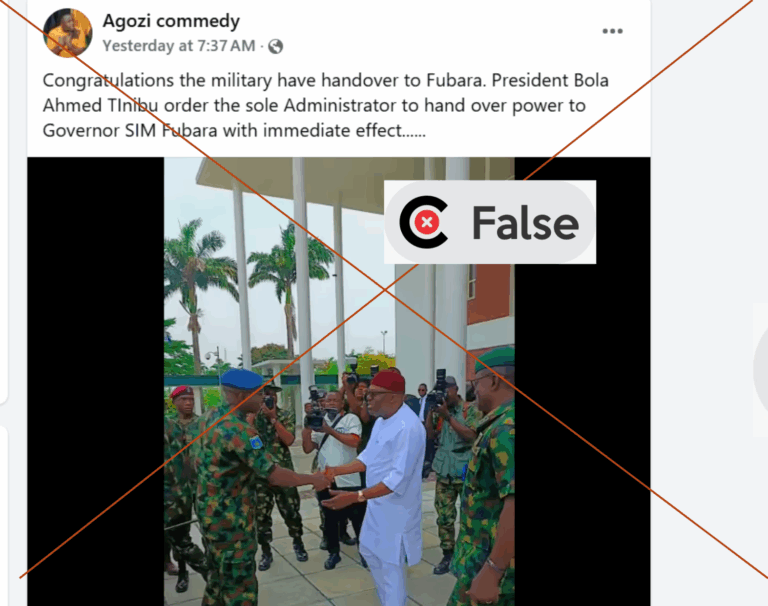
A Facebook user, Agozi Commedy, posted a video claiming that President Bola Tinubu ordered the sole administrator of Rivers State, Ibok-Ete Ibas, to hand over power to the suspended Governor, Siminalayi Fubara.

The video shows Fubara with military personnel and other individuals. The caption reads:
Congratulations the military have handover to Fubara. President Bola Ahmed Tinubu order the sole Administrator to hand over power to Governor SIM Fubara with immediate effect.”

The claim surfaced amid the ongoing political crisis in Rivers State, where Tinubu had declared a state of emergency following a power struggle involving Fubara, the legislative arm, and former governor (now FCT Minister) Nyesom Wike.

The claim also came shortly after reports that President Tinubu and Fubara met in London.

The post had garnered over 200 likes and more than 160 shares as of April 26, 2025.

CLAIM

President Tinubu ordered the Rivers State sole administrator to hand over to suspended Governor Siminalayi Fubara.

screenshot of the viral post

THE FINDINGS 

Findings by The FactCheckHub show that the claim is FALSE.

Checks reveal that no credible news outlet has reported any directive from President Tinubu to that effect.

A reverse image search and keyword investigation also showed that the video has been online since March 5, 2025, weeks before the latest political developments in Rivers State.

The video was first published by Symfoni Media with the caption: “Fubara lands at Air Force Base, meets with Chief of Army Staff.”

The video simply shows Fubara greeting army chiefs and other dignitaries and later inspecting military officers on parade.

Notably, Fubara was suspended from office on March 18, 2025,  nearly two weeks after the video was uploaded.

This confirms that the footage predates both the state of emergency declaration and Fubara’s suspension.

THE VERDICT

The claim that President Tinubu ordered the Rivers State sole administrator to hand over to suspended Governor Fubara is FALSE. No such directive was issued, and the video being circulated is old.

This report is republished from the Factcheckhub

Nigeria Police resume issuance of tinted glass permits nationwide

0

THE Nigeria Police Force (NPF) has resumed the issuance of tinted glass permits across the country.

This followed a directive from the Inspector-General of Police (IGP), Kayode Egbetokun.

The decision was announced in a statement on Wednesday, April 30, by the Force Public Relations Officer, Olumuyiwa Adejobi.

According to the NPF, the development followed rising complaints from the public over the harassment of vehicle owners by law enforcement agents for using factory-fitted tinted windows.

The statement reads,The Nigeria Police Force, under the directive of the Inspector-General of Police, IGP Kayode Adeolu Egbetokun, Ph.D., NPM, has reactivated the issuance of Tinted Glass Permits (TGP) nationwide through a secure and user-friendly digital platform available at https://possap.gov.ng”.

The police said the initiative was in response to public complaints about motorists being harassed over tinted windows.

The Force added that a formal system was needed to regulate the use of tinted windows, which are common in modern vehicles for comfort and aesthetics, to ensure public safety.

“Tinted vehicles have often been exploited for criminal purposes, including kidnapping, armed robbery,one-chancescams, and other forms of banditry,” Adejobi added.

The police said the misuse of tinted windows by criminals posed challenges for law enforcement and threatened national security, the reason attributed to the reactivation of the permit system to identify legitimate users.

The police said the decision would help to enhance investigations and improve overall security architecture in Nigeria.

They also added that to ensure authenticity and ease of access, the new platform features digital permits equipped with QR codes and a rapid processing window.

The police said applicants could process their permits online with identity verification integrated through the National Identification Number (NIN) and Tax Identification Number (TIN), alongside biometric capture and background checks.

To ensure a smooth transition, the police said a 30-day grace period had been approved, effective from May 1, within which motorists are expected to comply.

In addition, the NPF explained that law enforcement would begin active implementation after the grace period, warning that officers who misused the enforcement process would be sanctioned.

The police warned that officers engaging in extortion or harassment would face disciplinary action.

They also assured the public of the police’s commitment to transparency, accountability, and modern policing, urging citizens to support the initiative for safer roads and a more secure Nigeria.

In June 2021, former IGP Usman Baba ordered the suspension of the issuance of permits for tinted glasses and SPY number plates.

The police announced in 2024 that they would restart issuing the tinted glass permits for vehicles.


Calls for sale of PH, Warri, Kaduna refineries intensify as NNPCL sacks MDs

CALLS are growing louder for the sale of Nigeria’s three major refineries in Port Harcourt, Warri, and Kaduna, following recent reforms at the Nigerian National Petroleum Company Limited (NNPCL), which included the dismissal of their managing directors.

These refineries have gulped billions of dollars over successive administrations, yet they remain largely unproductive. Oil marketers now rely heavily on the Dangote Refinery to meet fuel demand, highlighting the chronic underperformance of government-owned facilities.

The ICIR reports that the new NNPCL leadership appointed after President Bola Tinubu dissolved the board in April has removed the managing directors of the three refineries, along with other senior officials close to retirement.

Oil sector governance expert Henry Ademola Adigun told The ICIR the changes are aimed at increasing efficiency. He urged the government to go further by removing the refineries from NNPCL’s books, describing them as “dead assets.”

“When you have a new management in place, they look at where they can strengthen and in strengthening those areas, they bring in more efficiency. The officials who are retired are almost sixty years old. The reason is more likely about finding new heads and putting the sector on the track of development,” Adigun, told The ICIR.

Adigun believes they were retired for “operational reasons” with a core focus on increasing operational efficiency in the sector.

He also stressed the importance of the national oil company dealing with dead assets and selling off the nation’s three aforementioned refineries, adding that, “every past government in power who had attempted to manage those dead assets like our three refineries have failed. If we are ready for reform, we must take a step further in getting rid of dead assets off our books.”

“What I think they need to do is to look at dead assets primarily, get rid of them from NNPCL books and get someone to manage those assets, as it’s almost given that the national oil company cannot manage dead assets,” he emphasised.

It would be noted that the move by the new management team at the state-owned oil firm came following President Bola Tinubu’s removal and replacement of the NNPCL board.

Tinubu had, on Wednesday, April 2, sacked the former NNPC Group chief executive officer (GCEO), Mele Kyari, along with board chairman Pius Akinyelure and other board members.

He replaced Kyari with Bashir Ojulari and appointed Ahmadu Musa Kida as the non-executive chairman.

The President’s move saw the complete overhaul of the 11-member board of NNPCL, replaced with new members.

Tinubu, who invoked Section 59(2) of the Petroleum Industry Act (PIA) 2021, said the decision became necessary to enhance operational efficiency, restore investor confidence, boost local content, and advance gas commercialisation and diversification.

He directed the new board to conduct a strategic portfolio review of NNPCL-operated and joint venture assets to align them with value maximisation objectives.

The tales of Nigeria’s crude oil output have remained worrisome over the years as the country has not been meeting its operational quota prescribed by the Organisation of Petroleum Exporting Countries (OPEC) and has been far away from meeting its budgetary benchmark every year.

Informed sources said Tinubu wants the new board to elevate NNPC’s share of crude oil refining output to two million barrels per day by 2027 and to reach five million by 2030.

The latest shakeup swept the managers of the Port Harcourt Refining Company, Warri Refining and Petrochemical Company, and the Kaduna Refining and Petrochemical Company came following the cleanup at the NNPCL and its subsidiaries.

The ICIR gathered that the three MDs of the refineries and some other senior managers had been asked to leave.

The continued poor performance of the refineries is said to have contributed to the exit of the managing directors.

Although the Port Harcourt and Warri refineries were recently said to have been revamped, there are reports that the refineries have not been functioning effectively, having been moribund for decades.

A report on Tuesday, April 29, citing a document on the midstream and downstream sector from the Nigerian Midstream and Downstream Petroleum Regulatory Authority (NMDPRA) spotlighted the NNPCL to be under fire over the $897 million Warri refinery revamp.

It also revealed that the Port Harcourt refinery had been struggling at under 40 per cent production capacity.

Meanwhile, industry experts have been questioning the operational integrity of the NNPCL regarding its transparency, efficiency, and overall management of the nation’s refineries under its purview.

The ICIR also reported recently that the Federal Government has revealed plans to carry out a forensic audit of the NNPCL to promote operational efficiency and address misappropriation claims.

The Minister of Finance and Coordinating Minister of the Economy, Wale Edun, hinted at this at the Nigerian investor forum, held on the sidelines of the International Monetary Fund (IMF)/World Bank Spring Meetings in Washington, DC, last week.