Home Blog Page 3184

Boko Haram Leader, Shekau Pledges Alliance to ISIS

The extremist Islamic group Boko Haram has pledged allegiance to the leader of the Islamic State, ISIS, Abubakr Al-Qurashi.

Abubakar Shekau,  leader of the Boko Haram group which is responsible for acts of terror and insurgency in the North east and in neighbouring country such as Cameroon, Chad, and Niger, made the pledge in an audio recording released on Saturday via the Internet.

The announcement was released in audio format, a marked departure from former instances in which the group released video clips to communicate with the public.

The audio message announced the group’s allegiance to the cause of ISIS, with a vow to obey ISIS leadership in times of prosperity and difficulty.

Shekau stated that the decision to form an alliance with ISIS was in accordance to divine provisions in the Quran and in obedience to the instruction of founder of Islam, Prophet Mohammed.

“We announce our allegiance to the caliph of the Muslims, Ibrahim ibn Awad Ibrahim al-Husseini al Qurashi, and will hear and obey in times of difficulty and prosperity, in hardship and in ease, and to endure being discriminated against, and not to dispute about rule with those in power, except in case of evident infidelity regarding that which there is a proof from Allah,” the group announced in the audio message.

The group also urged Muslims across the world to pledge allegiance to the caliph and support him, stating that it is their duty to submit to “an Imam that looks after them according to Allah’s rule and fights the enemies of Islam and those who fights the Rule of Allah” and that being united “under one Jamaa’ah” is prerequisite for success in their undertaking.

The group also encouraged unity amongst all Muslims, stating that it would “enrage the enemy of Allah, by Allah, our gathering under one banner, under one Imam, is more heavy to the enemy”.

Boko Haram has pursued an agenda of establishing an Islamic caliphate in Northern Nigeria while ISIS, which operates across the Middle East, has occupied large territories in Iraq and Syria.

Both groups have engaged in the devastation of cities and town, murdering thousands in their respective regions.

Boko Haram had recently adopted the ISIS media strategy, including the release of well-produced videos, which are sub-titled in French and Arabic.

The group also recently opened and operated a Twitter account like ISIS did, until it was shut down by the tech company.


Culture Versus The Girl Child

By Abiose Adelaja Adams

Shao town in a Kwara State is a tourist site known for its annual mass wedding festival, but little is said or known about the children among the scores of young women married off at a single event.

During a recent visit to the community, which is some 15 kilometers from Ilorin, the state capital, https://www.icirnigeria.org/ met the chief priest of the Awon Mass Wedding Festival, who told the tale of how a river goddess had instructed the founding fathers of the town centuries ago about requirements of marriage rites.

As the myth goes, the priest, Oloruntogun Ojetunde, popularly called Baba Alawon, said that a certain river goddess appeared to the town’s forebears and promised to bless them if they keep to her commandments.

“The Awon is a spirit from the river in Shao,” Ojetunde said in local Kwara dialect.

“But it appeared in the form of a woman in the community when the inhabitants were still few. It introduced herself as a spirit from the waters to two hunters and a certain elder that she has come to bless the people, and when she was about to disappear, she gave an order that all women in the village must be married to men in the same village, in one single day. It also blessed us that we will be fruitful and prosperous,” he further enlightened.

This age-long ritual, he toldour reporter, is responsible for the population growth of the town till date.

The priest said that the mass wedding ceremony has been conducted every year since the day the Awon goddess so instructed.

So strict is the adherence to her instruction that if there are no women to marry off in any particular year, girls from age 13, 15, even 12, are considered marriageable. This contravenes the Convention on the Rights of the Child which pegged marriageable age at 18.

Frail-looking, dark complexioned Ojetunde, who doesn’t know his real age but can be estimated to be in his 70s, sees absolutely nothing wrong with marrying off a 13-year old. He said it was a norm in the dark days when there was no education.

“Even today, once they are 13, we send them to their husband’s house so that they can be fruitful and multiply in the land,” he said with a tone of finality.

The uneducated man, who can neither read nor write, said his position is entirely based on the instructions of the goddess to keep the land fruitful.
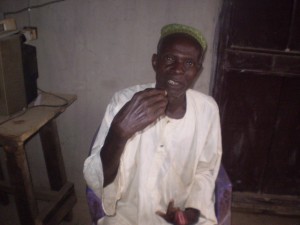
OLYMPUS DIGITAL CAMERA

Celebrated every October till date amidst pomp and fanfarethe number of brides has however dropped to about 40 in recent times.

“If it is so bad, we will wed at least 15,” said Ojetunde.

He, however, lamented that the advent of civilization and westernization has changed the hearts of the people against the tradition.

Many people have converted to Christianity or Islam. As a result of this, not all the women come to him, for wedding preparations anymore.

“Before, it was a taboo to organize your own wedding in Shao, but not so anymore,” he said gloomily.

However, he cannot change from the mandate given him. He said the government has left them to their tradition and that the Ministry of Tourism has even been supportive.

It is noteworthy that Kwara State is among the 24 Nigerian states which have signed the 2003 Child Rights Act, which prohibits betrothal and marriage of children and instructs parents or guardians to guarantee  them education, training and guidance.

The ceremony holds in October, thus on the day of her visit, our reporter did not see any child bride. When asked if the reporter could speak to any of the child brides, the priest said “the child brides of yesterday are now women today. The recent ones are in their husband’s house or dispersed to various towns.”

Even then, the reporter found some of the former girl bride to talk to.

Mama Yisa, 40, is from Shao and was given away in marriage at 16. She has seven children and till date she can neither read nor write, as she never had the opportunity of attending school because of her early marriage, she said.

However, one of the brides given out in October 2014 shared how she would have married as a child but delayed it because of schooling.

Oluwabunmi Adebayo is a 25 year-old high school leaver. She was part of the women given out in a mass wedding in the last Awon festival Day in October 2014.

Her reaction was “no”, when asked whether she was forced.

“It is our culture here for all women to marry same day. We are the ones that will bring our husbands ourselves. All young girls look forward to it,” she said.

“On my own wedding day, all of us that married that day were 31 in number.”

Adebayo said that she knows15 year old girls who were given out in marriage. She too would have married earlier had she not desired to study.

A 2014 UNICEF report, ‘Ending Child Marriage, Progress and Prospects,’ shows that though child marriage in Nigeria has reduced by one per cent annually in the last 30 years, hundreds of girls are still at risk due to the country’s peculiarly large population.

The report states that of the world’s 1.1 billion under aged girls, 22 million are already married. UNICEF, in the report, is worried that if there is no reduction in child bride practices, up to 280 million girls will be married before age 18. And due to population growth, this number will increase to 320 million by 2050.

Causes

Child marriage clearly violates the Child Rights Act and has multifaceted consequences on the society.

Betty Abah, the executive director, Centre for Children’s Health Education, Orientation and Protection, CEE-HOPE, who works in with girls and vulnerable children in Lagos said that the practice whereby children are given out in marriage is still very common in the country.

“Child marriage is prevalent in many rural settings. And, even in a cosmopolitan city like Lagos, we have seen it practiced in some of the poor neighborhoods.”

Lagos State is one of the states that have ratified the 2003 Child Rights Act.

“I will strongly say that the three most important contributory factors are poverty, lack of awareness and government’s indifference. Many are pushed by poverty to ‘dispose’ of their children in order to duck from parental responsibilities – and you know, of course, that the rate of child birth is usually quite high in poor and excluded areas).

She continued: “Also, there are virtually no forms of social welfare system for children in existence here in Nigeria so poor parents are always at their wits end and marry off their female children as soon as possible to have some economic relief.”

Consequences

According United Nations Children Fund, UNICEF, Child marriage has intergenerational consequences.  Girls who are married off early are not only denied of their education and childhood, but socially isolated from society and family.

They are also unable to negotiate safer sex, thus exposing them to sexually transmitted disease such as HIV.

Further lending her voice, Abah said: “Child marriage can be very traumatizing and degrading and that is exactly why we have seen instances of young girls rebelling against these inhuman systems by killing their husbands in recent times.”

Lots of medical problems can arise from child marriage, such as vesico-vagina fistula, VVF, a condition very prevalent in the northern states.

VVFarises from obstructed labour, after which a fistula (tract) is created between the bladder and vagina, thus the woman leaks urine.

“This is very common in the north where child marriage is also common. It’s a disease that damages our women. Many of the girls also die of other childbirth-related complications. It is one of the reasons for maternal mortality and also for child mortality in the country,”Abah remarked.

“Many are too young to take good care of their children as they themselves are children. And as we have seen that lack of care, that deficiency, shows in their children who are either not healthy or, like their mothers, may get little of no education and therefore face very bleak future prospects,” she added.

Cultural preservation

Adebisi Ojo, a 42 year-old man from Shao lamented that the influence of civilization is killing the culture of mass weddings.

“Its our culture, but civilization is killing it. Everybody wants to do their own (wedding),”

he observed. He and some youth association are planning a revival of the culture and plan to get government support to generate revenue for the town and solve unemployment issue.


READ ALSO:


While cultural activists are canvassing for the tradition to be treated with the same importance as the Osun Osogbo festival, Abah said the system that introduces, supports and propagates child marriage without any doubt “stabs at the heart of ‘womanity’ and is clearly inhuman, crude retrogressive and we should do all we can to fight it.”

The chairman of Moro local government area, AbdulRaheem Adisa, in a statement at the last Awon mass wedding day in October 2014, expressed the council’s readiness to support and promote the festival as it was capable of enhancing communal peace and harmony in the area. While the mass wedding may not be an infringement on human rights, Abah says this community should be given close monitoring by the state government to prevent children being out given as brides.

 

International Women’s Day : British Council To Honour Nine Women

By Abiose Adelaja Adams
THE British Council in collaboration with two of its development partners; Nigeria Stability and Reconciliation Programme and Justice for All  programme,  will honour nine Nigerian women advocates and champions as part of activities to mark this year’s International Women’s Day.

The women include those who have distinguished themselves in works related to peace building, women’s participation in public service and decision making and women in creative enterprise. .

According to a statement issued by Desmond Omovie, the council’s communications officer, the identified champions include Olabisi Kolawole, a Chief Superintendent of Police, CSP, Gender Adviser to the Nigerian Police Force; Rabia Salihu Said, a female scientist and deputy dean of student affairs Bayero University, Kano, Theresa Nnamdu,  Eseoghene Odiete, a multiple award-winning fashion entrepreneur, Emem Ema, a lawyer and singer of the KUSH fame, Risikat Muhammad, Grace Jerry, Huwaila Ibrahim and Nnaemeka Oruh.


Read Also:

The council will support a roundtable discussion at the Bayero University to sustain the discussion on the role of women in the academia, peace building and enterprise and then share the experience of the women champions with university students.

“This will encourage more persons to join the drive against violence against women and girls and support the participation of women in decision making and enterprise,” Omovie says.

“We will leverage the support of the university management to engage men on gender issues and establish networks to tackle gender based violence in campuses,” he added.

The female champions will be featured on radio programmes in Kaduna, Kano and Jos where they will share their experiences rising through the ranks and attaining success in a male dominated work environment.

March 8 of every year is celebrated globally as the International Women’s Day. It is a time to reflect on progress made regarding women’s security, rights and empowerment and to celebrate acts of courage and determination by women who have distinguished themselves especially in male dominated environments.

The overall aim is to encourage younger women and girls to find success stories from which to draw inspiration, said Omovie.

50 Killed In Bomb Attacks In Maiduguri

By Musdapha Ilo, Maiduguri

At least 50 people were killed and 100 others injured on Saturday following multiple attacks in different locations in Maiduguri, the capital of Borno State.

The bomb attacks occurred in Baga Market, Monday Market and the Borno Express Bus Terminal.

The three locations were apparently carefully selected because of the high human traffic they usually witness.

It could not be immediately determined if the bombs were planted at the sites or detonated by suicide bombers but the casualty figures at the

Baga Market were highest as 36 people were said to have been killed and about 70 injured.

It was gathered that 12 persons were killed at the Monday Market while over 20 were injured. At the Borno Express bus terminus two persons were killed and ten persons were injured.

The spokesman of the youth vigilante group in Borno State, Jubrin Gunda, believed that the attacks were carried out by suicide bombers.

Although he could not say if they were female or male, he said he believed that the bombs were detonated by suicide bombers.

“I cannot give you the details of dead persons now, but it was an unfortunate incident, the casualty figure is huge at all the spots,” he told journalists on the phone shortly after the blasts at about noon.

Reacting to the attacks, the Borno State governor, Kashim Shettima, has assured the people that the government will to put in place security measures that would put a stop to such attacks in the state.

The governor, who had to cut short a campaign trip to Marama, Hawul local government area in Southern Borno, condemned the attacks and condoled with the families of the dead.

Shettima, according to a statement released by his media aide, Isa Gusau, immediately directed the Attorney General and Commissioner for Justice of the state to visit all affected areas and ensure speedy evacuation of victims to hospitals.

The governor is said to be worried by the attacks against the background of recent successes recorded in the fight against insurgents in the North east.

Gusau said the governor will be meeting with stakeholders in markets, motor parks and other public places to strategise on measures to be taken to secure public places.


Chibok Parents Deny Meeting With FG

Residents of Chibok, in Borno State where over 200 schoolgirls were abducted in April, 2014 have debunked reports that representatives of the parents of the abducted schoolgirls held any meeting with officials of the federal government on Thursday.

This development comes on the heels of a statement released Thursday by the Minister of State for Power, Mohammed Wakil, through his special adviser on media, Olawale Rasheed, claiming that the he represented the federal government at meeting with some parents and relatives of the abducted schoolgirls in Maiduguri.

A press statement by the director of publicity of Kibaku Area Development Association, KADA, Allen Manasseh, stated that the minister had sold a lie to the media, who were never invited to cover such an important engagement.

“Barrister Mohammed Wakil, the State Minister for Power, was never in any meeting with any parent of the abducted Chibok schoolgirls.

“He met with some displaced people from his local government, Damboa,” Manasseh stated.

The Chibok leader further accused the minister of being biased in his dealings with Borno State indigenes.

He described the situation as “unfortunate because although the Minister actually gained political prominence as a member of the House of Reprentatives, representing Chibok, Damboa and Gwoza, he still does not have the heart to see himself as always welcome outside Damboa”.

Manasseh revealed that the few women from Chibok at the meeting were politicians and associates of the minister and not parents of the abducted schoolgirls or representatives of the people of Chibok town as presented by the minister’s aide in his press release.

“I know the details of the meeting and it was never intended for Chibok parents of the abducted girls. The Chibok people and many more from southern Borno are even very angry at this,” he said.


2015 Elections: We Are Not Afraid of Card Readers – PDP

The People’s Democratic Party, PDP, has dismissed accusations by the opposition All Progressive Party, APC, that it was opposed to the use of card readers in the forthcoming elections, insisting that the Independent National Electoral Commission, INEC, should ensure that it conducts adequate test runs on the machines  before deploying them for use on Election Day.

Speaking with journalists during a news briefing on Thursday, the deputy national chairman of the PDP, Uche Secondus, stated that claims that it was afraid of the use of Permanent Voter Cards, PVCs, and card readers were nothing but propaganda from the APC.

Secondus, who stated that the PDP was sure to comfortably win the polls by a wide margin, also said that its campaign measures had been further taken from wards to polling units in order to fully engage the electorate.

On allegations that the PDP is opposing the use of card readers because such a measure would prevent rigging, the deputy national chairman  that the ruling party is not against the use of card readers but had only insisted on the proper things being done for it to be successfully deployed.

“The PDP believes that INEC should test it and it should be in perfect condition, so that we don’t run into problems. So that on that day, we don’t have problems of it working in some areas and in other areas it won’t work,” he explained.

“Since it is the first time we will adopt this technology, it should be in perfect condition so that people will not have cause to complain,” he added.

Meanwhile, the APC has re-affirmed its position that the PDP’s opposition to the use of card readers in upcoming polls is a proof that the ruling party was doing all in its power to either prevent the election from holding or to ensure there are loopholes that would permit it to rig the polls.

In a statement issued in Lagos on Thursday by its national publicity secretary, Lai Mohammed, the party stated that it was “very curious the fact that the PDP, which had rushed to the press to deny the APC’s claims had turned around to confirm them”.

“At the press conference we addressed on Wednesday, which rattled the PDP and the Jonathan Administration so much, we listed the conditionalities of the PDP/Jonathan administration for holding the election: No PVCs, No Card Readers, No Jega and the fact that they want the military deployed to harass and intimidate voters.

“We mentioned ‘Card Readers’ at least three times during the press conference, and said they are doing everything possible to sabotage the machine and prevent its use,” the party further stated.

The party wondered why the spokesmen for the PDP and the Jonathan Campaign Organisation rushed to the press to deny any such ‘reprehensible’ plan and yet, a few hours later, the spokesman for the campaign organisation backtracked to tell the nation that they would oppose the use of card readers

According to the APC, this new position was assumed apparently after the spokesmen were overruled by the party.


More Than 20 Journalists So Far Killed In 2015

By Samuel Malik, Abuja

In a trend that has alarmed media practitioners around the world, 25 journalists have been killed between January and now across many nations, the International Press Institute has revealed.

In 12 countries, including South Sudan, the only African country, journalists were either shot, machetted, stabbed, or decapitated.

Only two of the 25 killed were involved in motor accidents. These are Gaye Cosar (Turkey) and Kazumi Takaya (Japan) who died from injuries sustained in motor accidents in Armenia and Turkey respectively.

In France, eight journalists were among the twelve people killed when two gunmen entered the offices of Charlie Hebdo, the French satirical newspaper, on January 14. Among those killed was the editor of the paper, Stéphane Charbonnier.

Four South Sudan journalists, Musa Mohamed Dhaiyah, Randa George Adam, Dalia Marko, Adam Juma, and Boutros Martin were killed on January 25 when the convoy they were traveling in was ambushed by heavily armed men in Western Bahr al-Ghazal State, South Sudan.

They travelled with a newly-elected County Commissioner Maradom James Benjamin, who visited victims of a previous attack in the area.

The gruesome decapitations of Avijit Roy, the American-Bangladeshi, and the Mexican, Moises Sanchez Cerezo, exposed the deliberate nature of some of the attacks.

Roy was attacked on his way from a book fair with his wife when they were attacked with machetes and sharp objects, while Moises was abducted by nine men in his country on January 2, 2015 and spent about three weeks before his body was found on January 24.

Islamic State, ISIS, the terrorist group threatening the Middle East, was responsible for the death of two Iraqi journalists, Ali Al-Ansari and Adnan Abdul Razzaq.

Al-Ansari was killed in crossfire between government troops and the terrorists while Adnan was killed by firing squad.

Other violent murders included the Colombian journalist, Edgar Quintero, who was shot seven times in a bakery and the Uzbek, Rakhmatilla Mirzaiev, severally stabbed in the backyards of his house.

Between 1997 and 2015, the IPI said a total of 1, 487 journalists have been killed in 75 countries, with 133 killed in 2012 alone compared to 28 in 1997.

A look at the statistics shows that Nigeria also saw a good number of journalists killed. Of the 168 killed in Africa during the period under review, Nigeria accounted for 13 per cent (22), behind the continent leader Somalia with 40 per cent (57).

Nigeria’s involvement saw it ranked 13th from 1997 to 2013, the second highest African country ranked, behind Somalia (8th).

However, the biggest casualty figure recorded in Nigeria is six deaths in 1999, followed by 2012 when five journalists lost their lives.

Surprisingly, African countries ranked low in the number of deaths involving journalist.

Zimbabwe, Zambia, Burkina Faso, Cameroon, Congo-Brazzaville, Madagascar, Mozambique, Seychelles, Sudan, Swaziland, Tunisia, and Uganda all had just one death each involving journalists.

Countries rife with armed conflicts, drug wars and intolerance of press freedom unsurprisingly ranked high. Iraq, Philippines, Mexico, Pakistan, Syria, and Somalia are all in the top 10.

Steven Ellis, director of advocacy and communications of the Institute, said more journalists are at risk as a result of their increasing coverage of unsafe territories.

“The number of journalists’ deaths so soon in 2015 shows that journalists are reporting in increasingly hostile environments, whether in conflict zones or not,” he said.


READ ALSO:


“These journalists and their families deserve justice, and one of the most important steps in ensuring that such crimes aren’t repeated is for authorities to show those who would attack journalists that they will be punished.”

The 12 countries where journalists have been killed so far in 2015 are: Armenia (1), Bangladesh (1), Brazil (1), Colombia (2), France (8), Iraq (2), Mexico (1), South Sudan (5), Turkey (1), Ukraine (1), Uzbekistan (1), and Yemen (1).


66,000 Nigerian Refugees in Cameroon- UNHCR

The United Nations High Commissioner for Refugees has reported a recent influx into Cameroon of 16,000 more refugees who are fleeing the insurgency ravaging the North east  of Nigeria.

According to UNHCR’s spokesman, Adrian Edwards, who spoke Tuesday to journalists at a press briefing in Geneva, Switzerland, this brings to 66,000, the total of Nigerian refugees in Cameroon.

Edwards also stated that Cameroonian authorities had reported a steady flow of refugees streaming in through the extremely volatile border regions of Makaria, Logone Birni and Fotokol, south of Lake Chad.

The journey, according to the Cameroonian authorities, is a very dangerous one, often leaving them vulnerable to attacks from the Boko Haram insurgents they were fleeing from.

The recent multi-national military campaign against the Boko Haram insurgents have seen the fighting spilling across borders as communities in neighbouring nations such as Chad, Niger, and Cameroon have been victims of attacks executed by the insurgents.

According to the UNCHR spokesman, the agency had already put in place strategic measures to mitigate the effects of the forced migration by scheduling daily transfers of 2,000 refugees to Minawao, a nearby town which houses an established refugee camp that is a temporary home to about 32,600 displaced persons.

Increased fighting across the region has obstructed efforts to provide humanitarian assistance to those in need. This has led the UN refugee agency to liaise with the Cameroonian government on how to relocate refugees away from the areas of active conflict to a nearby transit zone.

According to Edwards, the prospect of more refugees arriving had prompted the need for the creation of a new camp further away from the insecure border.

The spokesman who also spoke about water challenges being faced around Minawao stated that the agency was currently “looking to secure a second camp location that will provide adequate levels of potable water for a rapidly growing refugee population in the Far North region”.

The agency also noted that elsewhere in the region, refugee numbers were also rising, as about 18,000 people have reportedly sought safety in western Chad.

About 15,000 of this are reported to have arrived Chad since early January, fleeing Boko Haram’s offensive against Baga, Borno State.


We Know Shekau’s Hideout – Chadian President

President Idris Deby of Chad on Wednesday stated that he knew the hideout of Boko Haram leader, Abubakar Shekau.

According to an AFP report, the Chadian president also called on the leader of the insurgent group “to surrender, or be killed like his other comrades”.

“It is in Abubakar Shekau’s interest to surrender, we know where he is. If he refuses to give himself up, he will suffer the same fate as his comrades,” President Deby reportedly said.

Deby vowed to “wipe out” Boko Haram, responsible for more than 15,000 deaths, mainly in Nigeria.

Boko Haram kingpin Shekau has been an elusive target for security forces who have sought to bring him to book for terrorist acts that have targeted civilians, security officials, villages, schools, markets and places of worship.

Claims by the Nigerian military that Shekau had been killed have proved inaccurate as he is frequently featured in propaganda videos released on the Internet by the insurgents.

However, multi-national military operations by Nigeria, Chad, Cameroun and Niger have halted the advance of Boko Haram, and several towns and villages have been recovered from the terrorist group in the past few weeks.

The Chadian Army also announced this week that its soldiers have routed insurgents out of the key town of Dikwa in Borno State.

At the press conference on Wednesday, the Chadian leader said Shekau fled Dikwa after his troops chased out Boko Haram fighters on February 17.

According to the AFP, the Chadian army at the time said two of its soldiers and 117 Boko Haram Islamists were killed in the fighting.

“We are going to win the war and we are going to wipe out Boko Haram, contrary to what certain media think. The Chadian and Niger forces will continue their mission to finally put an end to this shadowy group,” the Chadian president said.

President Deby had been accused in the past of providing a safe haven for Boko Haram insurgents, and was purportedly the mediator in a ceasefire between the Nigerian government and the sect in 2014 which turned out to be phony.


Court Refuses to Stop INEC’s Proposed Use of Card Readers

Opposition to the use of Permanent Voter Cards, PVCs, and card readers in the upcoming general elections suffered a setback as a Federal High Court in Abuja refused an application seeking to restrain the Independent National Electoral Commission,  INEC, from using the electronic card readers in the conduct of the polls.

The application was filed by Alex Iziyon, Bolaji Ayorinde, Ikechukwu Ezechukwu and Adekunle Oyesanya, all Senior Advocates of Nigeria, SANs, on behalf of four registered political parties – the United Democratic Party, UDP, Action Alliance, AA, Allied Congress Party of Nigeria, ACPN, and Alliance for Democracy, AD.

The suit sought to challenge the powers of the electoral body, to introduce a process not specifically provided for in the statutes as it prepares to conduct the polls.

Iziyon, who argued the ex parte application, told the court that the proposed use of the card readers was contrary to the provisions of the Constitution as well as the Electoral Act.

Iziyon further argued that the National Assembly had legislated on the Electoral Act to govern the conduct of elections in Nigeria and that the “head is the Electoral Act while INEC is the body”, contending that the body could not be more important than the head.

He consequently submitted that the Electoral Act, in Section 52(1), prohibits electronic voting but the electoral body had gone ahead to introduce electronic voters’ card readers.

“My Lord, this is what brought us to this court. INEC wants Nigerian voters to subject themselves to electronic voters’ card readers, an electronic component which is expressly prohibited,” the counsel told the court.

“Anything to do with electronic magnetic capturing properties cannot be allowed in the conduct of the election,” he stated.

Iziyon urged the court to temporarily restrain the electoral body from implementing, commencing or directing the use of the card reader machine for the forthcoming election, pending the determination of the suit and further urged the court to bridge the time within which the electoral body would be allowed to file a response in view of the nature of the case which, according to him, has a robust electoral jurisprudence.

Relying on a suit decided by a Federal High Court in Ebonyi State in 2003, where the open secret ballot system was adopted by the state Independent Election Commission in the conduct of local government elections contrary to the provisions of the Electoral Act, he insisted that the card readers could not be allowed to take the place of accreditation as prescribed by the Electoral Act.

The trial judge, Justice Adeniyi Ademola, ruling on the ex parte application, however, noted that though the political parties had shown that they have legal rights and that the case was triable, he held that the parties would not suffer any irreparable harm if the electoral body was given the opportunity to be heard before the interim orders being sought could be granted.

Consequently, the court declined to make any interim order against the electoral body on the proposed use of the electronic card readers.

However, it abridged the time for INEC to file its response to four days after receiving court papers on the matter.

Hearing on the substantive motion on notice was thereafter adjourned to Tuesday, March 10.

The parties are among the 16 parties that supported the People’s Democratic Party, PDP, in objecting to the conduct of the elections as earlier scheduled.

They also have adopted President Goodluck Jonathan, the presidential candidate of the PDP, as their candidate.

The political parties based their prayers to the grounds that the use of card reader machine for the forthcoming elections was not in conformity with the Electoral Act and that their members across the country who have been enlightened on the accreditation procedure as contained in the Electoral Act would be disenfranchised as they are not educated on the use of card readers.