Home Blog Page 353

Ghana, Senegal, Liberia’s elections better than Nigeria’s, says Jonathan

0

FORMER President Goodluck Jonathan has said his experience as an election observer across Africa and around the world showed that elections in Ghana, Senegal and Liberia are better than those conducted in Nigeria and some other African nations.

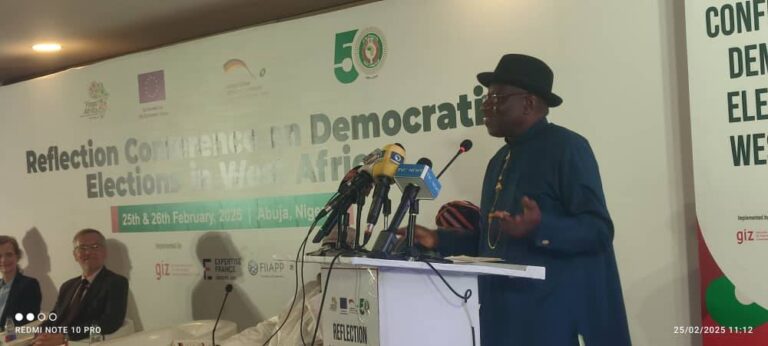
Addressing heads of electoral bodies, civil society groups, politicians, representatives of the European Union, Economic Community of West Africa States (ECOWAS), and other election actors across West Africa in Abuja, on Tuesday, February 25, Jonathan emphasised the need for political actors to see people’s will as the ultimate in all democratic settings.

Speaking as a guest of honour at the Reflection Conference on Elections in West Africa, convened by Yiaga Africa, Jonathan said West Africa had made significant progress in its democratic journey.

He argued that though there had been disruptions in Mali, Guinea, Burkina Faso, and Niger, which have experienced military putsches, such should not overshadow the fact that democracy thrives in other countries in the sub-region, adding that that the sub-region had transitioned from the dark days of absolute authoritarian rule.

He listed countries namely Nigeria, Senegal, Togo, Sierra-Leone, Liberia and Ghana which held elections during the 2023 and 2024 election cycles as those making West Africa proud in democratic governance.

While commenting on the Nigerian elections at the two-day conference, which sought to draw lessons from polls conducted in West Africa between 2023 and 2024, Jonathan said, “Despite the introduction of the bimodal voter accreditation system  (BIVAS) and the result viewing portal (IReV) to enhance transparency by the Independent National Electoral Commission (INEC), the processes experienced logistical issues (namely) delayed voting in some areas, violence and technical glitches with the BIVAS system, resulting in (an) avalanche of litigations.

“Sierra-Leone also introduced new technology, with the use of biometric voter accreditation ahead of its presidential, parliamentary and local council elections in June 2023. However, there were allegations of irregularities, including voter intimidation, ethnic tension and controversial results, which culminated in the opposition’s boycott of governance institutions…They used technology but the problems were not solved.”

He said in December 2024, Ghana conducted presidential and parliamentary polls, which he adjudged to be very successful despite the application of limited technology.

According to him, Ghana, with the reputation of being one of Africa’s most stable democracies, lived up to this billing by conducting peaceful elections and ensuring a smooth transfer of power.

“The Electoral Commission of Ghana and security authorities played a crucial role in ensuring the elections were free, fair and transparent, demonstrating that Ghana’s democratic institutions and processes have continued to be resilient even with limited technology.

“Two other countries, Liberia and Senegal also conducted elections with the deployment of limited technology. In these countries, the processes were generally peaceful, transparent and credible, with a high voter turnout. In the case of Liberia, the incumbent President George Weah conceded defeat to the opposition candidate, Joseph Boakai after a closely contested runoff, setting a positive example of a democratic transition in the region.

“The pre-election in Senegal was notably marked by protests and arrests of opposition figures, and concerns about the independence of the judiciary. However, it was pleasing to observe that once the election process kicked in, the polling process progressed without issues, resulting in a free and fair outcome. I must commend that the election in Senegal, to me, is one of the best I have observed in Africa and a few I have observed outside Africa.

“It is an election with almost zero technology. So, technology per se, we need it, I’ll emphasise that later, but the human factor is more important than the technology.”

European Union (EU) Ambassador to Nigeria and ECOWAS, Gautier Mignot (L), former President Goodluck Jonathan (m), and former INEC chairman, Attahiru Jega at the Yiaga Africa Conference on Tuesday, February 25, in Abuja. 

Jonathan opined that while the deployment of technology could be used to make polls transparent and advance democracy, it could also be used to undermine this system of government when humans manipulate the process.

The former leader recalled that in the past in Nigeria, there were no voter registers or any such documents that could help identify people of voting age. Despite this, he said election results were acceptable and democracy thrived.

He then went on to share his experience when he lost his bid to win re-election in the 2015 presidential election “When Jega was there, he introduced the card reader, but during the election, the card reader rejected me and almost set the country ablaze because the card reader rejected me, my wife and mother. Now, we’ve migrated above the card reader to the BIVAS which is supposed to be more advanced than the card reader but the problems are more than when we used the card reader.

“While we are progressing in terms of technologies, the outcome is retrogressing. This is not what we expect today.”

He challenged electoral bodies in the sub-region to ensure that only real and living humans are on their electoral registers. He also called for an impartial judiciary in adjudicating election disputes.

Some of his recommendations include an independent and impartial electoral commission, non-partisan security institutions and officers, periodic review of electoral laws, tolerance among parties and other stakeholders in the election process, and making national interests outweigh personal and regional interests.

He also questioned the level of independence of electoral bodies across West Africa.

Meanwhile, in his paper titled “Democratic Elections in West Africa: Challenges and Prospects,” the former INEC chairman, Attahiru Jega, who was the keynote speaker at the conference, gave the evolution, disruptions and transitions that democracy has witnessed in West Africa.

He listed such challenges to include desperate politicians, political interference in the appointment (and/or removal) of heads of electoral bodies; intimidation/targeting of electoral officials to ensure desired outcomes; introduction of rules that enable fraud or manipulation of polls; and withholding of funds and other resources from electoral operations.

The Executive Director of Yiaga Africa, Samson Itodo, said the conference was convened to reflect on key lessons from elections observed in the West Africa sub-region by his organisation in the past two years.

He said the discussions at the conference would provide useful information that would support elections scheduled for this year in the sub-region.

He explained that the conference was designed to discuss six key issues namely election administration, the role of technology, disinformation,  electoral justice, and implications of elections for governance.
Kano LG chairmen withdraw petition against ICPC chairman over corruption probe

0

THE Kano State chapter of the Association of Local Government Chairmen (ALGON) has withdrawn its petition seeking to strip the Chairman of the Independent Corrupt Practices and Other Related Offences Commission (ICPC), Musa Aliyu, of his Senior Advocate of Nigeria (SAN) title.

The group requested the Legal Practitioners’ Privileges Committee (LPPC) to discontinue all activities arising from the petition.

In the petition, the council chairmen accused Aliyu of defying a court order and using intimidation tactics under the guise of an anti-corruption probe against them. 

The petition, dated September 17, 2024, and filed by a lawyer, Shamsi Jibril, on behalf of the Kano ALGON, and the state government, claimed that despite a Kano State High Court ‘injunction’ restraining the ICPC from harassing or arresting the LG leaders, the agency insisted on probing them.

According to the petitioners, the ICPC, along with the Economic and Financial Crimes Commission (EFCC) and the Nigeria Police Force, has launched parallel investigations into the same allegations, which they argued violate their constitutional rights to personal liberty, dignity, and fair hearing. 

The petitioners specifically cited an incident on September 10, 2024, when ICPC officers allegedly attempted to arrest Zangina Galadima Zango, the caretaker chairman of Rimin Gado Local Government, despite the court order.

But in response, the ICPC chairman dismissed the accusations, insisting that the agency’s investigation is lawful and targeted caretaker committees, not elected council chairmen.

Aliyu, in a letter dated February 17, 2024, to the LPPC, stated that the ICPC was acting in line with a Supreme Court ruling in June 2024 (AG Federation v. AG Abia State & others), which declared that local governments must be headed by democratically elected officials.

He emphasised that the investigation focused on caretaker committees unlawfully holding power, as the tenure of the elected LG chairmen in the state had expired on February 12, 2024.

However, in a letter addressed to the Legal Practitioners Privileges Committee (LPPC) at the Supreme Court of Nigeria, legal representatives of the Kano ALGON Chairman confirmed the withdrawal of the petition.

The letter, dated February 25, 2025, was signed by Shamsi Jibril of Baba & Jibril, Attorneys at Law, representing ALGON and other concerned parties in Suit No. K/M1622/24 at the High Court of Justice of Kano State.

The legal team emphasised that the withdrawal of the petition was in line with the discontinuation of the case at the Kano State High Court.

“We humbly write to withdraw our petition dated September 17, 2024, with the above caption, against Dr Musa Adamu Aliyu (SAN), chairman of (the) Independent Corrupt Practices and Other Related Offences Commission (ICPC). We hope that this letter of withdrawal will bring to an end all measures occasioned by the letter under reference; the suit itself, pursuant to which the complaint was made, having been discontinued at the High Court of Justice of Kano State,” the letter read.

FG orders investigation into Nigerian footballer’s death in Uganda

THE Federal Government has expressed sadness over the death of Nigerian professional footballer Abubakar Lawal in Uganda.

In a statement released on Tuesday by the Acting Spokesperson for the Ministry of Foreign Affairs, Kimiebi Ebienfa, the government condoled with the deceased family and instructed the Nigerian High Commission in Kampala to collaborate with Ugandan authorities to investigate the circumstances of Lawal’s death.

Lawal, a former Nigerian Under-20 international footballer and a final-year Business Administration student at Cavendish University in Uganda, played for Vipers Football Club until his passing.

He was reportedly found dead after falling from the third floor of Voicemall Shopping Arcade in Kampala Monday morning.

The Nigerian government ordered a thorough investigation, including an autopsy, to determine the cause of his death.

“We are committed to ensuring that a thorough and transparent investigation is conducted, including an autopsy to verify the cause of death. The Ministry has also directed the High Commission in Kampala to provide all necessary consular assistance to support the family and ensure that justice is served,” part of the statement read.

The Nigerian government also expressed confidence in the capacity of the Ugandan authorities to handle the matter with sensitivity and professionalism, given the bilateral relations between the two nations.

While urging Nigerians to remain calm as the investigation unfolds, the Nigerian government pledged to monitor the situation closely.

An AFP report indicates that authorities are currently retrieving CCTV footage and conducting thorough interrogations to determine the cause of the incident.

Lawal’s friend, identified as Omary Naima, told police she had left him alone in the apartment preparing tea while she stepped out to a game centre within the mall. Shortly after, at approximately 8:00 a.m., he was found on the ground, after falling from the third floor.

“Preliminary reports indicate that Lawal arrived at the shopping mall in his vehicle, registration number UBQ 695G, to meet his friend, Omary Naima, a Tanzanian national residing in room 416 since February 20, 2025,” police stated.

The ICIR reports that the Nigerian government assured the public that it would offer necessary support to the deceased’s family.


Court jails 2 teachers 22 years each for raping minors in Ekiti

0

THE Ekiti State High Court has sentenced two teachers, Gbenga Ajibola and Ayodele Olaofe, to 22 years in prison each for raping minors and abusing their positions of authority.

The defendants were arraigned on March 2, 2022, on three counts bordering on rape and abuse of office. 

According to the charge, Ajibola raped a 17-year-old girl, while Olaofe raped a 15-year-old girl in November 2019.

The charge reads, “The first defendant, sometime in November 2019 at Ado Ekiti did rape a 17-year-old girl. Also the second defendant sometime in November 2019 did rape a 15-year-old girl, contrary to Section 31(2) of the Childs Right Law, Cap. C7, Laws of Ekiti State, 2012.

“The defendants sometime in November 2019 at Ado Ekiti did abuse their offices as public servants, contrary to Section 104 of the Criminal Code Law, Cap. C16, Laws of Ekiti State 2012.”

While testifying in court, one of the victims stated that Ajibola, her computer teacher, had instructed her to meet him at a filling station, where he and Olaofe took her and another student to a hotel. 

“On that fateful day, he told me to be in mufti, he gave me N200 to go and wait for him in front of a filling station along Bank Road, Ado Ekiti.

“He later came there alongside Mr Olaofe. Before they came, one of my classmates also came there, she told me that Mr Olaofe asked her to wait there for him.

“When they came, we all left for a hotel, around the Oke-Ila area of Ado Ekiti. At the hotel, we were taken to different rooms where Mr Ajibola had sexual intercourse with me. After that day, he continued to disturb me and when I could no longer bear it, I narrated what happened to my mother who later took the matter up,” the pupil said.

The prosecutor, Kunle-Shina Adeyemi, was reported to have presented four witnesses in the court while also tendering statements from the victims and defendants, medical reports, and reports from the panel of inquiry. 

According to him, the offence contravened Section 31(2) of the Child Rights Law, Cap. C7, Laws of Ekiti State, 2012.

Although the defendants denied the allegations, the judge, Adeniyi Familoni, found the teachers guilty of the offence.

“The defendants seared their minds and mulled the voice of the conscience as they took advantage of the victims with reckless abandon,” the judge said.

According to him, the teachers deserve severe sanctions for their misdeeds to serve as a warning to others who may want to follow in their footsteps.

“Therefore, Ajibola Gbenga is sentenced to 20 years imprisonment in count one without the option of a fine, and Olaofe Ayodele is sentenced to 20 years imprisonment in count two without the option of a fine. The two defendants are sentenced to two years imprisonment each in count three. The terms are to run concurrently,” he added.

The ICIR reports that Ekiti is among Nigerian states that name-shame sex offenders.

 This organisation further reports that several cases of sexual abuse against schoolchildren by teachers and school managers have been recorded in Nigeria over the years.

In 2021, a 14-year-old boarding student of Premier Academy, Lugbe, Keren-Happuch Akpager, died after she was raped and a condom was left in her vagina.

An autopsy report showed that the victim was also sodomised, and her mother, Vivienne Akpager, alleged that the rape occurred within the school premises.

In Nigeria, six out of every 10 children suffer from one or more forms of physical, sexual or emotional violence before clocking 18. More than 70 per cent of children experience this violence repeatedly, according to the United Nations Children’s Fund (UNICEF).

ICIR announces fellows for Countering AI-Enhanced Malign Influence Project

0

THE International Centre for Investigative Reporting (ICIR) has announced successful fellows for its Countering AI-Enhanced Malign Influence Project.

Supported by the US Embassy, the project is a one-year initiative aimed at reducing the dissemination and impact of AI-enhanced malign influence in Nigeria by promoting media literacy and responsible information sharing among citizens.  

Announcing the successful fellows on Tuesday, February 25, The ICIR Programme Officer, Chukwudi Iwuoha, noted that the project would train 120 journalists, influencers, and civic actors from six geopolitical zones in Nigeria through AI literacy workshops in Abuja, Lagos, Enugu, and Kano.

“The project will feature a two-day AI literacy workshop in four locations – Abuja, Lagos, Enugu and Kano, to build necessary skills for participants to identify and counter AI-enhanced malign influences in Nigeria, which will result in quality and responsible information sharing.

The ICIR is an independent, non–profit media organisation that aims to promote good governance in Nigeria through robust investigative, data-driven reporting.

“Our goal is to build a culture of investigative reporting for the media in Nigeria by training journalists to undertake investigative, data-driven reporting, thus strengthening accountability and engendering effective service delivery for the welfare of the citizens.

Click here to see the full list of the selected fellows

Natasha Akpoti-Uduaghan slams Akpabio with N1.3 billion defamation suit

0

THE senator representing Kogi Central, Natasha Akpoti-Uduaghan, has sued Senate President Godswill Akpabio for defamation.

In the suit, marked CV/737/25, Akpoti-Uduaghan, through her lawyer, Victor Giwa, alleged that defamatory statements were made against her by the Senate President and published by his aide on Facebook.

According to her, the post, titled “Is the Local Content Committee of the Senate Natasha’s Birthright?” included a statement suggesting she believed being a lawmaker was only about “pancaking her face and wearing transparent outfits to the chambers.”

Giwa argued that the statement was defamatory, provocative, and disparaging, lowering his client’s dignity in the eyes of her colleagues and the public.

The ICIR reported that Akpoti-Uduaghan raised concerns on February 20, after her seat in the Senate was reassigned due to a reshuffle caused by opposition members joining the majority wing.

She resisted the relocation, leading to a confrontation between her and the Senate President.

The ICIR reports that the disagreement sparked outrage as Nigerians lambasted Akpabio for the action and described his attitudes towards female senators as not only insulting but a denigration of the female gender and an attempt to stifle female voices.

Among others, Akpoti-Uduaghan is requesting the court to issue, “an order of perpetual injuction restraining the defendants, whether acting by themselves or through their agents, privies, assigns, or associates, from further publishing or causing to be published the said defamatory words or any similar publications about the claimant on social media or in any other manner capable of defaming her.”

Additionally, the lawmaker requested the court to compel the defendants to pay N100 billion in general damages and N300 million to cover litigation costs.

The ICIR reports that Akpabio and the female lawmaker had had confrontations in the Senate at least twice.

In July 2024, Akpoti-Uduaghan commented on a motion without Akpabio’s consent. In his attempt to correct her, he said the Senate was not a nightclub where anybody could talk anyhow.

Akpabio bowed to pressure as he apologised to the lawmaker two days later for comparing her conduct in the Senate to that of a nightclub.

Earlier today, this organisation reported that the Senate referred Akpoti-Uduaghan to its Committee on Ethics, Privileges, and Public Petitions for disciplinary review following the rift between her and Akpabio.

The committee, led by Neda Imaseun, was given two weeks to present its findings.

The decision was made through a voice vote after Yemi Adaramodu raised a motion under Order 1(b) and 10, condemning what he described as Akpoti-Uduaghan’s “extreme intransigence” during the Senate session on February 20.


FCCPC summons MultiChoice over price increase, threatens sanction

0

THE Federal Competition and Consumer Protection Commission (FCCPC) has summoned MultiChoice Nigeria, the parent company of DStv and GOtv, over plans to increase the prices of its packages effective March 1.

The FCCPC, in a statement on Tuesday, February 25, signed by its spokesperson, Ondaje Ijagwu, said the summon was for Multichoice to provide clarification regarding the planned increase in subscription prices.

The FCCPC said that in exercising its power under Sections 32 and 33 of the FCCPA, it had directed the chief executive officer of MultiChoice Nigeria to attend an investigative hearing at the Ccommission’s headquarters on Thursday, February 27.

The regulatory body said this followed MultiChoice’s formal notification of the price adjustment, which raised concerns about recurrent unilateral price hikes, potential market dominance abuse, and perceived anti-competitive practices in the pay-TV industry.

“The FCCPC is deeply concerned that Nigerian consumers continue to face frequent price increases, amid accusations that MultiChoice applies different pricing strategies in other markets, heightening questions about fairness and market abuse,the FCCPC stated.

It added that should MultiChoice fail to provide satisfactory explanations or be found in violation of fair market principles, the FCCPC would be left with no other option than to impose penalties or other corrective measures to protect Nigerian consumers.

The FCCPC said it was engaging other relevant agencies to ensure fair competition and consumer protection within Nigeria’s broadcasting and digital subscription landscape.

The ICIR reported that almost a year after its major price preview, Multichoice Nigeria announced plan to increase the prices of its packages effective March 1.

In a message to its customers on Monday, February 24, titledPrice Adjustment on DStv and GOtv Packages,MultiChoice chief executive officer, John Ugbe, explained the reasons for the hike.

According to the company, its latest price review would hike the DStv compact bouquet from N15,700 to N19,000, the compact plus to N30,000, and the premium subscription to N44,500.

Similarly, GOtv customers who currently pay N3,600 will now pay N3,900, while the tariff on GOtv Plus will rise from N4,850 to N5,800. The GoTV Max package will cost N8,500, while the Supa will jump to 11,400, while Supa Plus rises to 16,800.

The company claimed the price increase was due to the increasing cost of running business in Nigeria. It further pointed to currency depreciation, with the naira’s value dropping significantly and high inflation ballooning its operation expenses.

Meanwhile, there have been growing concerns about the price preview, despite the dwindling economic fortunes of most Nigerian workers.

Nigeria has been grappling with one of its worst inflationary periods in decades, with inflation reaching 24.48 per cent as of January 2025, according to the National Bureau of Statistics (NBS).

In September 2024, MultiChoice Nigeria defended its opposition to apay-as-you-watchmodel in court, stating that such a system was not commercially or technically feasible in satellite broadcasting due to current technological limitations. This stance was in response to consumer advocacy groups pushing for more flexible payment options.

Additionally, between April and September 2024, the company reported a loss of 243,000 subscribers, attributed to rising subscription costs and a shift towards more affordable streaming alternatives.

Natasha faces Senate disciplinary committee over rift with Akpabio

THE Senate has referred Natasha Akpoti-Uduaghan, the senator representing Kogi Central, to its Committee on Ethics, Privileges, and Public Petitions for disciplinary review following her recent rift with the Senate President, Godswill Akpabio, over sitiing arrangements last week, Thursday, February 20.

The committee, led by Neda Imaseun, has been given two weeks to present its findings.

The decision was made through a voice vote after Yemi Adaramodu raised a motion under Order 1(b) and 10, condemning what he described as Akpoti-Uduaghan’s “extreme intransigence” during the Senate session on February 20.

Adaramodu recalled the rift, which attracted nationwide outrage, as he urged the Senate leadership to enforce discipline and warned that “Where there is sin, there must be a penalty.”

“From that Thursday, the media was awash with this issue and I had to work on mending the perception of the 10th Senate. The Senate is not a platform for content creation but a place for lawmaking and oversight functions.”

Backing Adaramodu, another  senator, Opeyemi Bamidele, reaffirmed the Senate’s commitment to upholding its rules and maintaining internal order.

According to him, “There is no one who does not have an opinion on this issue, but we are unified by our rules. Under our watch, we will not allow this institution to be discredited beyond what we inherited. Integrity is non-negotiable.”

He dismissed claims that the dispute stemmed from gender bias or discrimination, pointing to senior senators who had accepted seat changes without objection.

Responding, Akpabio directed the Committee on Ethics and Privileges to review the incident and report back to the chamber.

He recalled that the Senate rules allow members to sit anywhere, but contributions must be made from their designated seats. He suggested that unfamiliarity with Senate procedures might have contributed to the altercation.

His words, “The first day she was sworn in, she stood up to contribute, and I was worried if she had even read the rule book. There is nothing wrong with being vibrant, but everything wrong with disobeying procedure.”

Citing Order 66(2) and Section 55 of Senate rules, he noted that all senators must conduct themselves with decorum, including prohibitions on chewing gum, drinking water or being disruptive during sittings.

“The rules empower the Senate President to suspend a senator for infractions for at least 14 days. It’s not me who made the rules, it’s in the rule book.”

The ICIR reported on February 20 that Akpabio ordered Akpoti-Uduaghan to be ejected from the Senate chamber during a plenary because she disagreed with a change in her seat.

The tension began during plenary when her seat was relocated upon resumption of the session, leading to heated arguments between her and the Senate leadership.

The ICIR also reported that the Senate President’s action caused social media outrage as Nigerians criticised him for the action and described his attitudes towards female senators as not only insulting but a denigration of the female gender and an attempt to stifle female voices.


NNPCL seals joint venture partnership on maritime transportation

0

THE Nigerian National Petroleum Company Limited (NNPCL) says it has sealed a new joint venture to transform Nigerian maritime transportation.

The partnership was signed between NNPC Shipping, Stena Bulk, and Caverton Marine Limited.

According to the state-owned oil company in a statement on Tuesday, February 24 by its chief corporate communications officer, Olufemi Soneye, the agreement was signed in London last week.

He said the partnership aims to create a new tanker operation serving Nigeria and West Africa crude oil and refined petroleum products’ regional and global shipping requirements.

The joint venture partners will create a new company whose objective is to provide top quality, reliable, and efficient maritime transport, Soneye stated.

The partners will also explore options to create a modern and efficient fleet of tankers, comprising both new and existing tonnage depending on market factors and commercial opportunities in the region.

The partners will evaluate opportunities for both vessel acquisitions and long-term charter arrangements, with a focus on maintaining competitive operating costs while meeting the highest standards of safety and sustainability.

“This fleet will primarily serve the logistics needs of NNPC (crude, clean, and LNG/LPG).

Additionally, the new company will cater to other oil producers and traders, offering the strategic advantage of a modern fleet, strong financial backing, and maritime pedigree and heritage,” Soneye stated.

He quoted the managing director of NNPC Shipping, Panos Gliatis, to have said that the strategic partnership is to modernise Nigeria’s maritime infrastructure.

“By combining our expertise with Stena Bulk and Caverton Marine, we are creating a robust platform that will enhance our domestic refining, import, and export capabilities and strengthen Nigeria’s position in global energy logistics,” Gliatis said.

The president and chief executive officer (CEO) of Stena Bulk, Erik Hånell, remarked, “This collaboration aligns perfectly with our pragmatic strategy of expanding our presence in key growth markets while maintaining our high standards of operational excellence and sustainability. Nigeria’s energy sector is undergoing a remarkable transformation, and we’re proud to be part of this journey.”

On his part, the CEO of Caverton Offshore Support Group, Bode Makanjuola, added, “This joint venture, the result of many years of planning, marks a significant stride in enhancing Nigeria’s maritime capabilities. By combining local knowledge with international best practices, we are establishing a world-class operation that will benefit not only Nigeria but the entire Sub-Saharan Africa region.”

The ICIR can report that stakeholders in the industry have been concerned that maritime transportation in Nigeria has been grossly underdeveloped.

A former secretary general of the Gulf of Guinea, Adenike Ukonga, during the 2023 Lagos International Maritime Week, pointed out that the majority of the ships providing maritime transportation services in the West and Central Africa region are from Europe, Asia, and the Far East.

It is a cause of great concern to maritime industry watchers that maritime transportation with so much potential for economic emancipation and the development of the coastal countries is virtually in the hands of non-Africans and solidly in their control, she said.

Meanwhile, the NNPC joint venture comes at a time when Nigeria is asserting its position as Africa’s largest economy.

It said Nigeria’s strategic location, growing population, and ambitious infrastructure developments are creating new opportunities for shipping companies.

By establishing the tanker operation, the NNPCL believes that the partners are not only meeting immediate logistical needs but also contributing to Nigeria’s long-term economic diversification and growth.

The NNPC Shipping, which is the shipping arm of NNPCL  spearheads the integral shipping logistics operations crucial for the country’s oil and gas distribution.

The  ICIR reported that the Nigerian Ports Authority (NPA) introduced the electronic call-up system, powered by the Eto App, to tackle the issue of truck congestion in Apapa ports and restore order to that economic gateway.

However, indiscriminate extortion and touting by hoodlums and corrupt security agencies along ports’ corridors have continued to impede the efficiency of the system.


Workers, NECA tackle Akpabio over claim on 30% tax payment by Nigerians

THE Nigeria Labour Congress (NLC) has refuted Senate President Godswill Akpabio’s claim that less than 30 per cent of Nigerians pay tax.

The group said its members represented the largest tax-paying community in the country.

Reacting to the claim while speaking with The ICIR on Tuesday, February 25, the NLC Head of Information and Public Affairs, Benson Upah, said while Akpabio’s claims could not be immediately verified, significant Nigerians in the informal sector, including livestock marketers, farm produce sellers and artisans paid taxes.

“Even if the so-called 30 per cent was correct, it is no justification to pummel Nigerians with this kind of multiplicity and degree of taxes, corporate and income. What I can categorically say is that Nigeria Labour Congress is the largest tax-paying community in the country, yet it was not consulted before these reforms were contemplated” he said in reaction to the new tax bills sponsored by the Federal Government.

Upah said accountability and transparency in the government’s use of tax revenues had been almost nonexistent.

Recall that the Senate President on Monday, February 24, at a two-day public hearing organised by the Senate in Abuja on the contentious tax reform bills said while many citizens failed to pay taxes, they expected the government to deliver top-notch infrastructure, education, security, and other essential services.

He said less than 30 per cent of the nation’s citizens paid taxes.

Reacting, the TUC faulted the claim, and NECA blamed the government for the low payments. 

Speaking with Vanguard newspaper, the Deputy President of Trade Union Congress (TUC), Tommy Okon, questioned the accuracy of Akpabio’s claim, pointing out that the Federal Inland Revenue Service (FIRS) consistently exceeded its revenue targets.

“We do not know where he got his facts from, in a country where there is a dearth of data. If what he is saying is true, how come the Federal Inland Revenue Service, FIRS, always surpassed its set target? ‘’This government has taxed the masses enough, and it is even the wealthy few that evade payment of tax, not the workers whose taxes are deducted from source” he said.

Okon challenged Akpabio to identify Nigerians evading tax payments rather than making a sweeping claim.

“We are very sure that when they were campaigning for election, the issue of taxation was not a condition precedent for good governance. Honestly, such a statement should not have emanated from the legislative arms of the government, whose major role is to make laws for good governance,” he added.

Similarly, the Nigeria Employers’ Consultative Association (NECA) said the government should be blamed for creating conditions that discourage citizens from paying taxes. It said the government shared responsibility by failing to provide visible benefits from collected taxes, “which discourages compliance.”

Speaking through its Director-General, Adewale-Smatt Oyerinde, NECA said: “ It is not far from the truth that the majority of Nigerians don’t pay tax. While this is quite unfortunate, the government too has been culpable in giving the citizens many reasons not to pay, especially as the benefits of the taxes collected are not seen by many” 

While supporting the new tax reforms and efforts to enhance tax collection efficiency, NECA stressed the need for a system that ensures government accountability for tax revenues.

The new tax reformation bill

The ICIR reported that President Bola Tinubu proposed tax reforms in 2024, which have sparked concerns among stakeholders, particularly in Northern Nigeria.

Despite opposition, the Senate went ahead and passed the four tax reform bills for a second reading in November 2024 after a heated debate.

The bills are the Nigeria Tax Bill 2024, expected to provide a fiscal framework for taxation in the country; the Tax Administration Bill, which provides a clear and concise legal framework for all taxes in the country and reduces disputes.

Others are the Nigeria Revenue Service Establishment Bill, which will repeal the Federal Inland Revenue Service (FIRS) Act and establish the Nigeria Revenue Service; and the Joint Revenue Board Establishment Bill, which will create a tax tribunal and a tax ombudsman.

After deliberations on the bills were suspended at the National Assembly in 2024, following outrage against it, especially in the North, the Senate kicked off a two-day public hearing on the bills on February 24.