Home Blog Page 357

Nigeria stock market sustains gain, rises by N196bn amid policy shift

0

THE Nigerian stock market value appreciated by N195.93 billion in the just concluded week as a bullish trend prevailed amid a mixed sentiment expressed by investors due to changes in key macroeconomic indicators.

The policy shift involved the rebased Consumer Price Index (CPI) data that significantly dropped headline inflation figures from 34.80 per cent to 24.48 per cent.

It also includes the retaining of benchmark interest rate and all other parameters for the first time in more than two years by the Central Bank of Nigeria (CBN).

Analysts had also anticipated that investors would closely monitor further corporate earnings releases and dividend declarations.

During the week’s trading sessions, these key events provided direction for investors as they assessed the potential impact on their portfolios and expressed mixed sentiments on the floor of the Nigeria Exchange Limited (NGX).

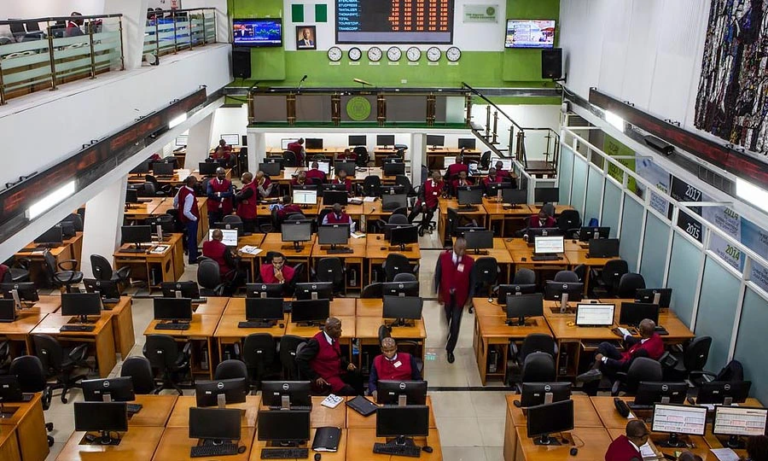
At the end of the week’s trading, the market capitalisation rose by 0.29 per cent to N67.61 trillion on Friday, February 21, from the N67.42 trillion it opened with on Monday, February 17.

The appreciation of the market capitalisation left investors with an N195.93 billion gain despite the cancellation of 166.95 million units of ordinary shares of Dangote Cement during the week.

According to the NGX, with the cancellation, the total issued and fully paid-up shares of Dangote Cement have now decreased from 17,040,507,405 to 16,873,559,252 ordinary shares.

However, the All-Share Index (ASI) similarly rose by 0.41 per cent to close at 108,497.40 basis points from 108,053.95 basis points.

While the ASI and market capitalisation appreciated, all other market statistics, including deals, volume, and value of traded stocks, closed in the red.

A total turnover of 2.001 billion shares worth N49.486 billion in 70,853 deals was traded during the week by investors on the floor of the exchange, in contrast to a total of 2.414 billion shares valued at N55.512 billion that exchanged hands in 80,988 deals.

Further analysis of the week’s trading activity showed that on the sectoral front, mixed reactions were witnessed as three indices rose relative to three others that declined.

The consumer goods index saw the highest increase by 6.55 per cent to 1,846.47 basis points from 1,732.99 basis points. This was followed by the insurance index’s 0.62 per cent rise to 744.27 basis points from 739.67 basis points. And the industrial index rose by 0.05 per cent to 3,638.55 basis points from 3,636.85 basis points.

In contrast, the banking index saw the highest decline by -3.42 per cent to 1,200.20 basis points from 1,242.75 basis points. The oil and gas followed with a -2.87 per cent decline to 2,546.46 basis points from 2,621.62 basis points, while the commodity index fell by -0.47 per cent to 1,008.43 basis points from 1,013.18 basis points.

But among the top-performing stocks of the week was BUA Food, whose share price appreciated by N44.50 to close at N418.00, and Dangote Sugar Refinery, whose share price rose by N5.40  to close at N41.40.

Other top gainers were Abbey Mortgage Bank whose share price rose by 50 kobo to close at N3.60, Smart Products Nigeria (by 0.04 kobo to 0.30 kobo), and Sovereign Trust Insurance (by 0.14 kobo to N1.32)

“The equities market demonstrated resilience over the week, recording a 0.41 per cent gain despite investors’ concerns regarding the latest inflation report.

“The positive sentiment reflects investors optimism as they assess the potential impact of the inflationary pressure on monetary policy and corporate earnings,” GTI research analysts said.

Measured by volume, the financial services industry led the activity chart with 1.199 billion shares valued at N26.325 billion traded in 30,527 deals and contributed 59.91 per cent and 53.20 per cent to the total equity turnover volume and value, respectively.

The agriculture industry followed with 234.002 million shares worth N1.683 billion in 3,191 deals, while the consumer goods industry recorded a turnover of 173.829 million shares worth N7.150 billion in 8,903 deals.

According to analysts at Cowry Asset Management, the sustained bullish trend was “driven by investors taking positions for portfolio rebalancing, prompted by pressured sell-offs across various counters and shaped by expectations and outcomes of the newly rebased CPI report and MPC decisions, where the policy committee unanimously decided to pause rate hikes.”

Anticipating how trading activity would fare in the coming week, the analysts at GTI Research said, “Investors will be eager to see if this momentum carries over into the coming week.”

On their part, Cowry Asset Management analysts added, “We anticipate mixed market sentiment in the coming week as investors await further corporate earnings releases and dividend declarations. Additionally, market participants will closely analyse the recently published macroeconomic data on the rebased CPI and the rate hike pause by the CBN to assess their impact on investment portfolios.

“However, we expect a flow of funds into the equities space as investors seek better investment opportunities, particularly in the near term. Investors are advised to remain vigilant, focusing on stocks with strong fundamentals to make informed investment decisions.”
From addiction to protection: An ex- cop’s journey to rehabilitation

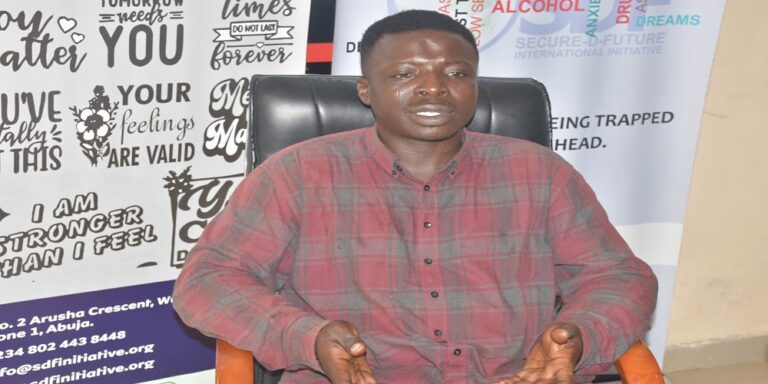
IT was a rainy Friday morning, last August when The ICIR crew met Emmanuel Ogwuche popularly known as ‘Emma Police’ while performing his duty as the Chief Security Officer (CSO) at a rehabilitation home for drug survivors in Abuja.


Follow The ICIR Addiction Series HERE.


Sharp and smart, he greeted and ushered the ICIR team  into the building with a pleasant smile.

“My name is Emmanuel Ogwuche, popularly known as Emma Police. What can I do for you?” he asked.

That was the beginning of a long conversation that took us through the life of a young man whose use of drugs drastically changed the trajectory of his life. 

Emma was born in the 80’s into a family of eight including his parents. His father was a security man, and his mother was a market trader.

He started his nursery and primary education at a private school in Kaduna, he wasn’t doing well academically, this led to a change in school. 

“I started school but in my family, I can say my brain was not ready for school; that was how everything started going bad in my life. When they moved me to a government school in Kaduna, my mates  laughed at me. My parents occasionally beat me so whenever I left home and got to my school gate, I would pull my uniforms and put in the bag and follow all these ‘bad boys'”, he said in an emotional-laden voice.

To avoid school, Emma started picking cans for sale to recyclers and was introduced to drug at that stage.

‘My entry into the world of hard drugs’

After avoiding school because he could not cope with academic rigours, Emma joined a group of young boys in his community and was introduced to hard drugs.

Within a short while he started smoking ‘solution gum’ and later graduated to ‘Indian hemp.’

Emma Police as a drug addict on the streets of Kaduna
Emma Police as a drug addict on the streets of Kaduna.
Emma after his rehabilitation and joining the workforce in his church.

According to him, his foray into drugs prevented him from furthering his education as all his other siblings graduated successfully.

Not wanting to be left out, he told his father he wanted to learn how to make furniture.

After completing his training as a furniture maker, he proceeded to join the Nigeria Police Force (NPF).

The journey into the Nigeria Police Force

In January 2000, Emma started his police training in Kaduna. However, instead of learning police rules and tactics, his attention was on illicit drug use. 

“I started using heroin, inside the police college; that’s where I found the substance,” he stated.

Emma police at the Police College, Kaduna.

Off to Lagos

After Emma successfully graduated from the police college he was posted to Lagos, to start his career as a policeman. His expectations were very high but he was shocked to discover something unique about Lagos.

“I didn’t know that Lagos State is the centre of crack and cocaine,” he stated in bewilderment.

Emma, who was posted to Area F in Ikeja, opposite police college area command, stopped using heroine for a short period, but on one sunny afternoon in his third month at the station, he was sent on an operation with some of his colleagues, and the unthinkable happened.

During the operation, he said they seized a consignment of cocaine and instead of declaring it at the station to his superiors, he hid it and started using it.

“I became worse after taking it but then I was still working until I got myself into trouble in Lagos Sate.

“I was the orderly to one Supol, who  was the OC in charge of works, at force headquarters, Obalende, Lagos.”

“I was locked up for days at Alagbon police station before one of my uncles intervened and I was freed and transferred back to Kaduna State.”

Life back to zero in Kaduna

After his ordeal in Lagos, Emma gladly arrived in Kaduna, his old base, and quickly reunited with his old friends.

He continued his drug abuse and was transferred to Kafanchan LGA.

In Kafanchan, Emma could not get drugs to buy. This means regular commute to kaduna to get the substance.

Fired from the police

His use of illicit drugs got to the attention of the Force and Emma said he was sacked. 

On leaving the police, he reunited with his old friends and continued his journey with drug abuse.

Emma as a police officer

He eventually got involved with activities that are on opposite side of the law, which included picking pockets.

According to him, whenever he was arrested, his former colleagues in the police, always found a way to free him and he became a police informant.

He would later move to Keffi where he said a became a junkie.

“I came back to Keffi and became a junkie and no more a user, a crack (cocaine) user. Anything I hustled for through stealing was just to smoke crack,” he said.

“There is a difference between a junkie and a user because the users are those who claim they have money. They come, buy, smoke and go, but me, I couldn’t control it; I stole to smoke. I could’t control it, but with the help of experts, I am free now,” he explained.

Emma as a junkie
Emma Police as a junkie on the streets of Kaduna


Bereavement 

As a result of Emma’s lifestyle and the troubles that came with it, his mother was frustrated to the point of death. Shortly after her burial, the father died too.

“I was in Black Street – an infamous area in Kaduna –  smoking when my mother died; we went for the burial and when we came back, my father too died. I lost my father in the process of this journey of taking drugs,” a sober Emma said.

His parents death made his other siblings to cut him off. 

Road to transformation

On one particular afternoon, while searching for drugs as usual, Emma met a woman named Gloria who promised to help him after he begged her for help.

After speaking with Gloria, he resolved to stop, but his resolution lasted for only two weeks. 

“I was good for that two weeks until I returned to the streets and it became worse,” Emma said,  but Gloria kept encoruaging him to stop, “she kept telling  me that I should stop taking drugs.”

One day she informed him that someone who could help him would be visiting Kaduna for a programme.

A life-changing encounter 

The person in question was Saadatu Adamu, a mental health counsellor and founder of Secure-D-Future International Initiative (SDF). 

“Before I met  Saadatu, I was a living dead.  If you saw me, you would know that I was not just a user, I was a junkie. I could stay for a year and six months without bathing.”

“She asked if I was determined, and she said she would help to rehabilitate me.” 

After the encounter with Adamu, Emma was taken to the Redeemed Christian God Church of God (RCCG) Drug Abuse Ministry (CADAM) for rehabilitation for one year.

Saadatu Adamu of SDF

According to him, he became good and returned to Kaduna but after staying without a job for two months, he returned to the dreaded Black street in Kaduna.

While on Black Street, he met a drug baron who advised him to start selling drugs, a request he gladly accepted until he met an encounter with a customer reintroduced him to taking drugs.

“I met a girl, [where] I went to deliver drugs to her in a hotel. She was a big girl. She said I should smoke crack worth N20,000 that she would pay, but I refused.

“Rather, I asked her to give me the money which she did but said if I won’t  smoke the crack, I should give her back her money.

After his encounter with the lady in the hotel, Emma went back to living on the street and under the bridge in Kaduna before Adamu came to pick him up for rehabilitation, this was his second time rehabilitation journey.

They took him to a medical doctor in Abuja. He stayed there for a week then ran away.  By this time Emma said all his legs were swollen from regular police and soldiers beating because he was always involved in petty theft to fund his drug use, again Adamu reached out and took him in for rehabilitation. 

From the streets to a CSO

After his rehabilitation, instead of letting him go, Adamu decided to give Emma a job and made him the Chief Security Officer at her facility.

“When it was time to leave, she kept me to work here. That was how I started working here,” he said.

As of the time of the interview Emma was almost a year on the job.

He was able to reunite with his siblings through effort by the SDF.

“I am having a very good time with my family more than before.”

Speaking about his wife he said “She is a good woman. But I don’t blame her for leaving me.”

At the peak of his drug use, his wife left him and took the two children with her.


Emma Ogwuche
Emma Ogwuche

Advice 

For people still battling with drug abuse, Emma said first need to have the belief that  they can be free.

“When I see some of my mates now, I hide. My mates in the Police are now ASP but look at me.

“Challenges will come; temptations will always come, but you have to stand strong. You can be free!

Adamu, a mental health counsellor and founder of SDF, said she met Emma for the first time at a Christmas outreach in Kaduna. 

According to her, there were over 80 people there, but she spotted Emma with his girlfriend.

“They came to us and were talking about help, but of course, I left.”

“One year later, I still got a message from that person that he needed help to get off the streets. That was how he came into our space,” she said.

“Two weeks later, he came back to SDF. We had an agreement before he came because they had told me his condition and how he was looking. So I told him he had to abandon the intake of drugs so he could get healed”.

After his rehabilitation,  as he had no place to go, Adamu said they opted to give him a job to ensure stability.

“So I said okay, why don’t we reintegrate this person back into the system because we know, if we do that, it will help. We also knew he needed a life. That was how we reintegrated him back into the system, and he is working now and doing extremely well,” the SDF boss stated. 

Odinkalu criticises Babangida’s autobiography, says it contains ‘unverifiable claims’

0

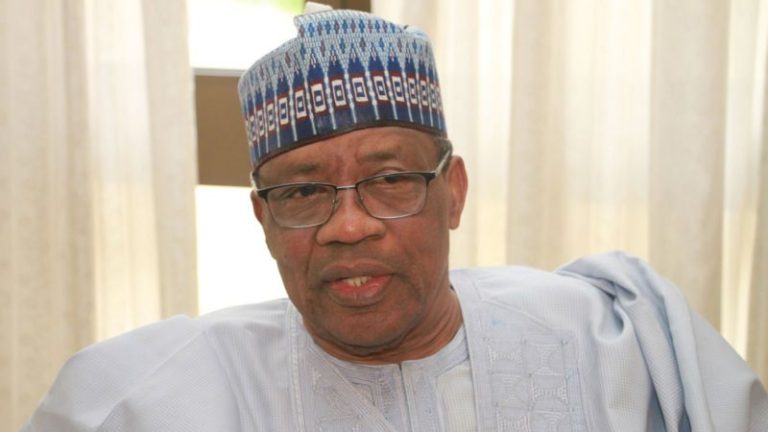
HUMAN rights lawyer and former National Human Rights Commission chairman, Chidi Odinkalu, has criticised former military president Ibrahim Badamasi Babangida (IBB) for making “unverifiable claims” in his newly released autobiography, A Journey in Service.

In a post shared on Friday, February 21, along with a screenshot from Babangida’s book, Odinkalu accused the former leader of levelling allegations against individuals who are no longer alive to refute or defend themselves.

According to Odinkalu, Babangida “waited until they were all dead” before portraying himself as a ‘victim’ of their actions.

He said “Ibrahim Babangida’s book is filled with allegations against dead men and women. He waited until they were all dead and none of them could controvert him and he portrays himself as a victim of all these dead men and women.” 

In the excerpt from the autobiography shared by Odinkalu, Babangida narrated events and controversies surrounding his time in office specifically with regards to the 1992 election.  He mentioned Sani Abacha who later became a head of state and also MKO Abiola.  Abacha and Abiola are both dead. 

“Conveniently, Babangida, a committed record-keeper, could not produce any contemporaneous records, minutes, notes or other evidence to corroborate any of the serious claims and allegations he makes about these dead men and women,” Odinkalu added.

The book has as appendix, some speeches, interviews and result of the 1992 election.

The ICIR reported that for the first time after nearly 32 years, Babangida admitted during his book launch in Abuja on Thursday, February 19, that Moshood Abiola, known by his name initials – MKO – won the June 12, 1993, presidential poll, which he (Babangida) controversially annulled. 

The launch doubled as fundraising for the presidential library for the former leader and raised over N12 billion in pledges and donations for the book and library.    

While reviewing the book, former Vice President Yemi Osinbajo, said Babangida dedicated a full chapter to the transition to military rule and the annulment of the June 12, 1993, election, widely believed as the most credible, freest and fairest in Nigeria’s democratic history.  

He wrote, “Although I am on record to have stated after the elections that Abiola may not have won, upon deeper reflection and a closer examination of all available facts, particularly the detailed election results published as an appendix to this book, there was no doubt that M.K.O. Abiola won the June 12 elections.”

Babangida, who ruled Nigeria from 1985 to 1993, often faces widespread criticism for key decisions he made during his regime, notably the annulment of the presidential poll won by Abiola and the murder of prominent journalist, Dele Giwa.

His new autobiography has sparked intense debate among political analysts and the public, with some lauding him for finally documenting his experiences in office, and others, like Odinkalu, decrying what they perceived as historical revisionism.

Reps reject proposals for creating 31 new states

0

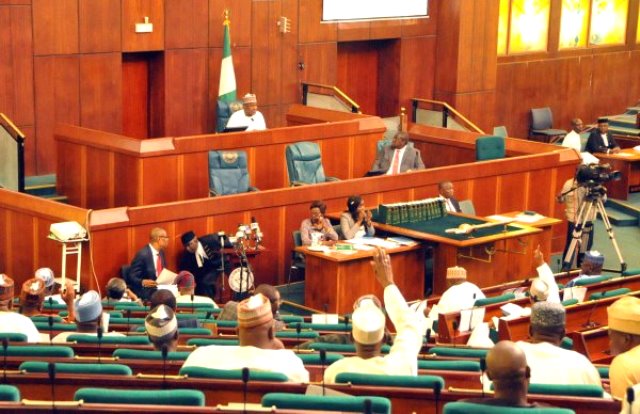
THE House of Representatives has rejected the proposals for the creation of 31 new states, citing their failure to meet constitutional requirements.

The chairman of the House Committee on the Review of the 1999 Constitution amendment, Benjamin Kalu, revealed this on Friday, February 21, while speaking at a retreat for the panel members in Uyo, Akwa Ibom State.

Kalu, the House deputy speaker, noted that while the proposals represented the aspirations of various regions in the country, none of them met the requirements outlined in Section 8 of the 1999 Constitution, which sets the criteria for state creation.

The ICIR reports that the committee proposed the creation of 31 additional states across Nigeria on February 6.

Kalu detailed the proposed distribution of the new states, with six allocated to the North Central, four to the North-East, five to the North-West, five to the South-East, four to the South-South, and seven to the South-West.

The ICIR explainer highlights the multi-layered process and requirements for creating new states in Nigeria.

New deadline for resubmission

Kalu in his latest update said that the proposals must be re-submitted in full compliance with the Constitution by March 5.

He said “Although we have received 31 requests for state creation, none of these requests met the constitutional requirements for amendment. Therefore, we have since extended the submission date to the 5th of March, 2025”

While noting that the committee was reviewing 151 constitutional amendment bills, the deputy speaker added that the committee might consider extending the deadline further, depending on discussions at the retreat.

He said that the 151 constitutional amendment bills the committee was reviewing would address issues of federal structure, power devolution, local government autonomy, revenue allocation, judicial and electoral reforms, security, gender rights, and human rights.

“A proactive, cooperative approach will ensure seamless legislative processes and comprehensive legal reforms,” Kalu said.

As part of the review process, zonal and national public hearings will be held across Nigeria’s six geopolitical zones, with sessions planned to hold in Nasarawa, Niger, Borno, Gombe, Kaduna, Sokoto, Enugu, Imo, Bayelsa, Cross River, Lagos, and Ondo states.

Kalu assured that the review process would be transparent and inclusive, emphasising the need for legislative reforms that reflect the will of the Nigerian people.


Adeleke defies Nigerian government, vows to proceed with Osun LG poll

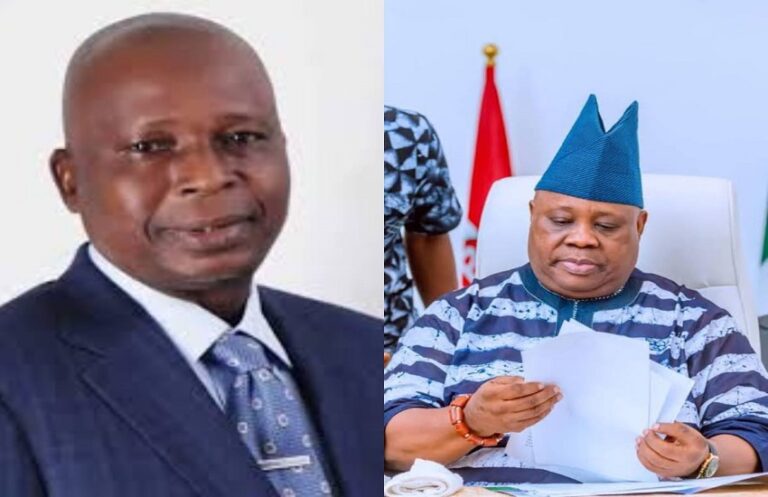
OSUN State Governor Ademola Adeleke has vowed that his administration would proceed with the local government election slated for Saturday, February 22, in the state, despite Federal Government’s warning that the exercise be suspended.

The ICIR reported the Attorney General of the Federation (AGF) and Minister of Justice, Lateef Fagbemi demanded that state government should not go ahead with the poll.

Hours after the Federal Government issued its directive, Adeleke said in a statement signed by his spokesperson, Olawale Rashee, don Friday, February 21, that nothing would stop the process.

The governor said the election, to be conducted by the Osun State Independent Electoral Commission (OSSIEC), would be held ‘unfailingly’.

The statement quoted the governor as saying this while receiving a delegation of civil society coalition members who were in the state to monitor the poll.

According to Adeleke, Osun voters are prepared to exercise their voting right, even as he expressed satisfaction with the level of preparation by the electoral body.

“I welcome you all to Osun State. Our people are prepared for elections tomorrow. They yearn to have their choices as chairmen and councillors.

“OSIEC has also done a marvellous preparatory job, according to reports at my disposal. Several political parties are participating and I believe there will be a level playing ground for all to test their popularity with the masses”, the governor said.

Reacting to controversies surrounding the exercise, Adeleke declared that “democracy is governed by the rule of law and that nobody can assume the authority of the courts.”

He advised all parties including local and national stakeholders to abide by democratic norms.

“As for me and my people, we stand by the rule of law, not illegal self-help. The election is going to hold and the outcome will fast-track development at the local level,he added.

The Federal Government had warned that conducting a new local government poll would be invalid and unconstitutional.

This, according to the attorney-general of the federation (Fagbemi), is because the Court of Appeal, Akure Division, recently ruled that the tenure of the ‘sacked’ council chairpersons of the local government area councils was still running.

The AGF stated that his attention was drawn to Adeleke’s public outcry regarding the Court of Appeal’s judgment in Akure.

He said the judgment, delivered on February 10, 2025, in Appeal No. CA/AK/272/2022, nullified the Federal High Court’s judgment in Osogbo, given on November 25, 2022, in favour of the state government.

Fagbemi explained that the controversy surrounding the local government elections in Osun State began during the tenure of former Governor Adegboyega Oyetola. He said elections were held in all local governments in the state, and the winners were sworn in.

He recalled that just before Adeleke’s swearing-in, the Federal High Court in Osogbo nullified the poll that brought the chairpersons into office.

He added that in response, Adeleke issued an executive order to remove the elected officials and replaced them with caretaker appointees shortly after assuming office.

The AGF noted that by this decision, the judgment of the Court of Appeal has, by implication, effectively restored the elected local government officials removed by the Federal High Court to their offices.

Fagbemi said the crisis in Osun State erupted when some disgruntled elements resisted the attempt by the officials to resume their positions on Monday, February, 17.

According to the AGF, Adeleke should have maintained law and order in the state rather than allowing the situation to escalate into a crisis.

The ICIR reported that seven people reportedly died as APC supporters and the Peoples Democratic Party (PDP) clashed in the state on Monday.

According to reports, the crisis led to the death of a former chairman of the Irewole Local Government Area, Aderemi Abbas, and others.

Adeleke had raised concerns on Sunday, February 16, about a plan by the Minister of Marine and Blue Economy, Gboyega Oyetola, and certain security agency heads to enforce the Appeal Court’s ruling and urged the public to hold them accountable for any violence that arose after the action.

Punches, applause trail Babangida’s book launch

0

THE launch of former military president Ibrahim Babangida’s autobiography, ‘A Journey in Service’, is generating reactions from prominent and other Nigerians.

While some knocked him for waiting for over three decades to shed light on issues such as the killing of veteran investigative journalist Dele Giwa and the annulment of the June 12, 1999, presidential election, others commended his contributions to national development and said the book would add to knowledge and support nation building.

For the first time after nearly 32 years, Babangida admitted during the book launch in Abuja on Thursday, February 19, that Moshood Abiola, fondly known by his name initials – MKO – won the poll, which he controversially annulled. 

The launch doubled as fundraising for the presidential library for the former leader and raised over N12 billion in pledges and donations for the book and library.    

While reviewing the book, former Vice President Yemi Osinbajo, said Babangida dedicated a full chapter to the transition to military rule and the annulment of the June 12 election, widely believed as the most credible, freest and fairest in Nigeria’s democratic history.  

He wrote: “Although I am on record to have stated after the elections that Abiola may not have won, upon deeper reflection and a closer examination of all available facts, particularly the detailed election results published as an appendix to this book, there was no doubt that M.K.O. Abiola won the June 12 elections.”

The former leader had in the past refused to admit that Abiola won the poll. Babangida in 2018 said there could have been consequences if he had allowed the election results to stand. 

Reactions from political leaders

Reacting to the book launch, Labour Party’s presidential candidate Peter Obi, who also attended the event, lauded Babangida’s economic policies while noting that Nigeria had regressed since his time in power.

“IBB’s contributions to Nigeria’s economy and his strong support for entrepreneurship and private sector growth remain immeasurable. Under his leadership, Nigeria witnessed substantial growth, particularly in the financial sector. He played a key role in fostering a united and equitable Nigeria, and economic landscape, ensuring policies that strengthened national cohesion and economic development,” Obi wrote via his handle.

He also described Babangida’s admission that MKO won the June 12 election as a crucial step toward national healing and democratic growth.

Shehu Sani, a former senator, who also attended the launch, acknowledged Babangida’s role in Nigeria’s history but lamented that many activists who fought against the annulment of the June 12 election were no longer alive.

“It’s commendable that he finally recognised that MKO won the 1993 June 12 elections. Sadly, Gani, Beko, Fasheun, Chima Ubani and other activists, journalists and unionists who led the struggle and made sacrifices for its validation have passed on. Now that the truth is out 32 years after. I hope that history will be kind to him,” he wrote on his X handle.

Criticism from activists, public figures

Omoyele Sowore, a former presidential candidate and publisher of Sahara Reporters, in his X post, dismissed Babangida’s book as an attempt to shift blame for the June 12 poll annulment to the late General Sani Abacha. 

He said this a few hours before the book launch.

Sowore also claimed that Babangida’s administration killed veteran investigative journalist, Dele Giwa.

While Babangida regretted annulling the presidential poll and admitted that the Social Democratic Party (SDP) candidate MKO Abiola won the election, he denied his government’s involvement in Giwa’s death.

He wrote in his book, “The hysteria of the media did not help the investigation of the Giwa murder. As is typical of the Nigerian media, the direction was marked by an adversarial attitude towards the government, which had remained the hallmark of the Nigerian media from its colonial heyday…

“When the Obasanjo civilian administration reopened the Giwa case at the Oputa Panel on Human and Civil Rights, I expected that the police and lawyers would come forward with new evidence as to their findings on the Giwa murder over the years.

“Nothing of such happened. The Giwa, like all mysterious murders, has remained unsolved after so many years. I keep hoping it will be uncovered in our lifetime or after us. More often than not, mysterious crimes are solved long after their commission.”

Also, a human rights lawyer and activist, Dele Farotimi, expressed outrage at Babangida’s continued acceptance in Nigerian political space despite his past actions.

“To die for a people devoid of memory is to be killed over and over, again and again. In a place inhabited by the conscious, IBB would not dare to show his face in public. But in the crime scene that doubles as our country, having been succeeded by even more villainous ruiners, Badamasi is installed in the seat of the statesman…”

Similarly, journalist and author Richard Akinnola, on his Facebook page,  questioned the credibility of former President Olusegun Obasanjo’s remarks at the event, recalling past tensions between the two former leaders.

“So, OBJ (Obasanjo) could admonish IBB to disregard critics and people with “pull him down syndrome”, the same OBJ that described IBB as a ‘fool at 70’ on August 19, 2011.”

The ICIR reported that Obasanjo, the chairman at the event, had urged Babangida to shun the book’s critics.

Akinnola, in another post, also listed all key figures involved in the June 12 annulment, who are now dead. He emphasised that Babangida’s version of annulment remained unverifiable.

Inibehe Effiong, a lawyer and activist, in a post on X, condemned the Nigerian elite for celebrating Babangida despite his role in Nigeria’s political and economic struggles.

“Nigeria is a country that demonises heroes and canonises villains. Look at the evil genius, IBB. He launched his autobiography today and tried to annul history the way he annulled June 12 election,” he wrote.


Nigerians lambast Akpabio for ordering fellow senator Akpoti-Uduaghan out of chamber

0

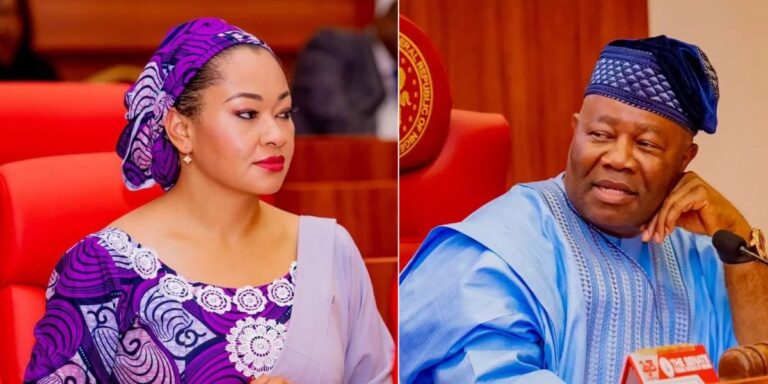
NIGERIANS have taken to social media to lambast Senate President Godwill Akpabio for ordering his fellow senator representing Kogi Central, Natasha Akpoti-Uduaghan, out of the Senate Chamber. 

The ICIR reported on Thursday, February 20, that Akpabio ordered Akpoti-Uduaghan to be ejected from the Senate chamber during a plenary because she disagreed with a change in her seat.

Social media users, especially on X, expressed anger after a video of the plenary session surfaced online. The video shows the Senate President attempting to silence Akpoti-Uduaghan as she questioned why her seat was changed without her consent.

Akpabio had re-assigned Akpoti-Uduaghan to a new seat because some senators from the minority parties to which she belonged had defected to the All Progressives Congress (APC) which has the majority of members.

The defectors had decided to change their seats from the minority wing to the area where senators in the majority sit. Consequently, there was seat re-arrangement, which Akpoti-Uduaghan said she was unaware of.

This sparked heated arguments when Akpoti-Uduaghan raised her hand to speak but was denied recognition for not addressing the chamber from her newly assigned seat.

Refusing to back down, Akpoti-Uduaghan, a member of the Peoples Democratic Party (PDP), raised her voice in protest, directly confronting Akpabio.

Akpabio turned off Akpoti-Uduaghan’s microphone in an attempt to silence her while she was still making her motion. She kept speaking and Akpabio ordered the sergeant-at-arms to walk her out, but after the intervention from various lawmakers, calm was restored, and the lawmaker stood her ground.

Nigerians reaction

Human rights lawyer Inibehe Effiong, shortly after the video surfaced, took to his Facebook page to say that Akpabio was aversed to the opposition and would not survive if he exhibited such behaviour in the South African Parliament.

Effiong argued that instead of assigning new seats to the defectors, Akpabio should have declared their seats vacant. He emphasised that the defection was illegal, making the justification for re-arranging seats invalid.

“Akpabio conveniently cited the Rules of the Senate but willfully ignored Section 68(2) of the Constitution that mandates him as Senate President to declare the defectors’ seats vacant. Having defected, they are no longer senators. They automatically lost their seats the moment they defected. Offering new seats to illegal defectors, who by the Constitution, have lost their membership, amounts to constitutional vandalism” he said.

The lawyer urged Nigerians to hold Akpabio accountable for enabling the violation of the Constitution if they genuinely cared about the country and the rule of law.

A social media user, @maybeks on X, urged Akpabio to refrain from targeting Akpoti-Uduaghan, describing her as one of the few senators who consistently prioritised public service over personal gain.

“Dear Akpabio, Natasha Akpoti is one of the few senators who has always prioritised public service over personal gain, delivering the true dividends of democracy to her constituents. Her position in NASS is of great value to Nigeria. Any action against Natasha is against many of us” the user said.

Another user, @ubando100, wrote: “Dear @Senator_Akpabio, I just want to inform you that Senator Natasha is more intelligent, brave and committed to serving for the betterment of her constituents than you.

Another user, @webtvgirl, said: “Dear Senate President Akpabio, You shall not silence Natasha Akpoti. It seems you believe Natasha is your wife or girlfriend—she is not. She is a democratically elected senator, just like you. Your repeated attempts to silence her have reached their peak today.”

@therealsimcard1 also wrote, “Senator Godswill Akpabio must be stopped. That man is not worthy to be a senator not to talk about being the Senate President. Nigerians and Kogites must protect Senator Natasha at all costs”

Meanwhile, several social media users commend Akpoti-Uduaghan for standing her ground against Akpabio.

Attack not Akpabio’s first on Akpoti-Uduaghan

During plenary In July 2024, Akpoti-Uduaghan commented on a motion without Akpabio’s consent. In his attempt to correct her, he said the Senate was not a nightclub where anybody could talk anyhow.

Akpabio bowed to pressure as he apologised to Akpoti-Uduaghan two days later for comparing her conduct in the Senate to that of a nightclub.

The ICIR reported that the Senate President’s comment caused social media outrage as Nigerians criticised him for the action and described his attitudes towards female senators as not only insulting but a denigration of the female gender and an attempt to stifle female voices.


Nigerian government orders Osun Governor Adeleke to suspend planned LG poll

THE Attorney General of the Federation (AGF) and Minister of Justice, Lateef Fagbemi, a senior advocate, has warned Osun State Governor, Ademola Adeleke, against proceeding with Saturday, February 21, local government election in the state.

The AGF told Adeleke to ask the Osun State Independent Electoral Commission (OSIEC) to suspend the election.       

In a statement signed by the AGF on Thursday, February 20, he warned that conducting a new local government poll would be invalid and unconstitutional.

This, according to him, is because the Court of Appeal, Akure Division, recently ruled that the tenure of the purportedly sacked council chairpersons was still running.

The AGF stated that his attention was drawn to Adeleke’s public outcry regarding the Court of Appeal’s judgment in Akure.

He said the judgment, delivered on February 10, 2025, in Appeal No. CA/AK/272/2022, nullified the Federal High Court’s judgment in Osogbo, which was delivered on November 25, 2022, in favour of the state government.

“It has become necessary to issue this public notice to remove doubts, fears, and uncertainties created by misrepresentations and disinformation concerning the legal effect of the judgment of the Court of Appeal,” the AGF stated.

Fagbemi explained that the controversy surrounding the local government elections in Osun State began during the tenure of former Governor Adegboyega Oyetola. He said elections were held in all local governments in the state, and the winners were sworn in.

Fagbemi recalled that just before Adeleke’s swearing-in, the Federal High Court in Osogbo nullified the poll that brought the chairpersons into office.

He added that in response, Adeleke issued an executive order to remove the elected officials and replaced them with caretaker appointees shortly after assuming office.

He said this move was met with resistance from the APC, which appealed the judgment before the Court of Appeal.

The AGF noted that by this decision, the judgment of the Court of Appeal has, by implication, effectively restored the elected local government officials removed by the Federal High Court to their offices.

Fagbemi said the crisis in Osun State erupted when some disgruntled elements resisted the attempt by the officials to resume their positions.

According to the AGF, Adeleke should have maintained law and order in the state rather than allowing the situation to escalate into a crisis.

The ICIR reported that seven people reportedly died as APC supporters and the Peoples Democratic Party (PDP) clashed in the state on Monday, February 17.

According to reports, the crisis led to the death of a former chairman of the Irewole Local Government Area, Aderemi Abbas, and others.

Adeleke had raised concerns on Sunday, February 16, about a plan by the Minister of Marine and Blue Economy, Gboyega Oyetola, and certain security agency heads to enforce the Appeal Court’s ruling and urged the public to hold them accountable for any violence that arose after the action.

Nigeria may miss 2025 eliminating open defecation target, experts proffer solutions

0

AS Nigeria ushers in 2025, the target to eliminate open defecation nationwide is still far from reality, with over 48 million Nigerians still lacking access to proper sanitation, according to WASHNORM 2021 report.

The 2021 WASHNORM report, which was published in 2022 by the Ministry of Water Resources and remains the latest data on the nation’s WASH, revealed that a quarter of Nigerians still lack access to proper sanitation facilities, and only 10 per cent of the population have access to basic water, sanitation, and hygiene services.

The situation remained largely unchanged as the 2025 deadline approaches.  

Experts, who spoke to The ICIR, expressed deep concern over the situation, citing systemic failures, insufficient funding, and weak implementation of policies as key reasons for the shortfall.  

In 2018, Nigeria declared a state of emergency in the WASH sector and launched the “Clean Nigeria: Use the Toilet” campaign with the goal of eliminating open defecation by 2025. However, nearly all the states are still in battle with sanitation and hygiene and open defecation, with only Jigawa ‘controversially’ free of open defecation.

The devastating cholera outbreak in 2024, which ravaged many communities across the country and with a sharp increase from the previous year, was also a result of the failure to eliminate open defecation. 

The Nigeria Centre for Disease Control (NCDC) attributed the outbreak to contaminated water sources exacerbated by widespread open defecation. Conflict, climate change, underdevelopment, and population displacement among others were said to have contributed to the rise in cholera outbreaks.

Cholera outbreak in 2024

Cholera, an endemic disease, is still one of the major diseases that affect Nigerians, particularly in the rural region of the country. The disease, according to the World Health Organisation (WHO), is an acute diarrhoea infection characterised, in its severe form, by extreme watery diarrhoea and potentially fatal dehydration.

The latest data from the NCDC shows that between January to September 29, Nigeria faced a worsening cholera outbreak, with 10,837 suspected cases and 359 deaths.

The figure represented a significant 220 per cent increase in suspected cases and a 239 per cent rise in deaths compared to the same period in 2023.

The outbreak affected all 36 states, with Lagos accounting for the highest number of suspected cases (4,667), representing 43 per cent of the national total. 

Other states with high case counts include, Jigawa (870), Kano (809), and Borno (588). 

Vulnerable groups, particularly children under five and those aged 5–14, were disproportionately affected. The data showed that the Case Fatality Ratio (CFR) stood at 3.3 per cent, an increase from 3.1 per cent in 2023. 

The most significant spikes occurred in June, August, and September, correlating with the rainy season, which exacerbates waterborne disease transmission due to flooding and poor sanitation.

The NCDC attributed the spike to multiple factors, including flooding in several states, increased population density in urban centres, and the slow implementation of preventative measures. 

WASHNORM

The nationwide Clean Nigeria: Use The Toilet campaign was launched alongside the creation of a National Roadmap aimed at achieving an open-defecation-free (ODF) Nigeria by 2025. A year later, the roadmap estimated that 50 million Nigerians, or 10 million households, practiced open defecation.

However, little progress has been made since then. The ICIR reported that approximately 48 million Nigerians still engage in open defecation, with only 8 per cent practicing clean handwashing, according to the 2021 WASHNORM report.

According to a report, with data from the WASHNORM 2021 survey sampling over 24,600 households across the country, only 10 per cent of Nigeria’s population had access to integrated basic WASH services.

The 48 million Nigerians practicing open defecation represents 23 per cent of the population. 

WASHNORM survey showed that 46 per cent of the population was found to have access to basic sanitation services in 2021 compared to 44 per cent in 2019, representing a 2 per cent (6.9 million people) increase in the number of persons accessing basic sanitation services. 

Despite the increase in the number of people with access to basic sanitation services, the proportion of people practising open defecation in the country has barely changed since 2019, with the number increasing from 46 million in 2019 to 48 million in 2021. 

Also, approximately 179 million Nigerians, which accounts for up to 87 per cent of the population, lack access to safely managed drinking water services. 

The situation is particularly dire in the North, where access remains insufficient, with the Northeast having the lowest access rate at just 2 per cent. In contrast, the Southwest region has the highest access rate at 29 per cent.

The predominant sources of drinking water were boreholes/tube wells, utilised by approximately 37 per cent of the households while 11 per cent of the population use pipe-borne water and just 4 per cent use water from a source that is piped into their premise. 

Likewise, about a quarter of the population (25 per cent) still depend on unimproved and surface water supply for their daily water needs.

Experts weigh in

Bolaji Adeoye, a public health expert speaking with The ICIR, lamented the setback, stating that the government has not put much effort towards ending open defecation in the country.

“Missing this goal highlights the lack of coordinated efforts and political commitment needed to tackle this public health crisis.”

According to him, the Nigerian government has failed to provide adequate facilities, orientation and sensitisation to curb the menace of open defecation in the country.

He warned that the consequences of this failure could be dire as he noted that the many Nigerians still drink unsafe water while also battling with flooding incident every year. 

“Open defecation fuels the spread of diseases like cholera, which we saw escalate last year. The inability to meet this target shows a deeper problem, with our approach to sanitation and hygiene remains fragmented and underfunded.”

The Head of Advocacy Policy and Communication, WaterAid Nigeria, Kolawole Banwo, speaking on Classic FM on the government ending open defecation by 2025, said that the Nigerian government has always prioritised spending on cure rather than prevention.

While highlighting the importance of safe water usage, he noted that about 50 per cent of diseases can be saved by proper hygiene and sanitation.

Banwo said the government would be investing less in medication if it provided proper WASH facilities to Nigerians.

“Science shows medically, and this is empirical, that you can prevent 50 percent of diseases by just having access to washing your hands regularly under running water with soap at critical times, before you eat after you use the toilets, when you touch surfaces and all. You can prevent 50 per cent of diseases. Especially upper respiratory diseases, diarrhoea, and so many others. That means that the cost of curing 50 per cent of diseases can then be saved with hygiene.”

He stressed that the government at each level is not doing enough in budget implementation, noting that the government has not demonstrated enough to achieving the goal.

“There are schools, institutions, public places and there are residences where people and households don’t have access to toilet facilities. All of these must have access to decent toilets because toilets must be decent and well maintained.”

He also stressed policies and programs often failed to reach rural areas, where open defecation is most prevalent, adding that many communities lacked an understanding of the health risks associated with open defecation, hampering behaviour change.

“Government is not investing. Communities are grappling with basic things and cannot see the linkage between these things and their health because we have not done sufficient sensitisation and so these toilets are falling behind. Resources are falling behind. So, the ODF progress is falling behind and lagging.”

Speaking on possible solutions, Banwo noted that the government at all levels, communities, and non-governmental organisations must collaborate and work together to stop the menace of open defecation in the country.

“It is important that we all put our heads together and be more serious. The government needs to contribute and bring more resources.Then all others should be involved. Everything must be in place. The infrastructure must be right. There must be access to water in the first place to either flush or to wash your hands,” he said.

He, however, recommended improved funding and public awareness and sensitisation, access to WASH facilities by Nigerians, state ownership, and preparedness.

Governors push for states representation in constitutional review

0

THE 36 State governors under the aegis of the Nigerian Governors’ Forum (NGF) have engaged the conference of speakers of state legislatures of Nigeria (COSLON) to strengthen the synergy between the state lawmakers and the NGF.

The synergy, the governors said seek to ensure subnational perspectives are well-represented in the ongoing constitutional review process.

The governors position was officially conveyed in a communiqué issued and signed by its chairman, and Kwara State governor, AbdulRahman AbdulRazaq after the 11th meeting of the NGF which lasted till the early hours of Thursday, February 20, 2025, in Abuja.

“The Forum engaged with the Conference of Speakers of State Legislatures of Nigeria (COSLON) to discuss key issues, including strengthening synergy between COSLON and the Nigeria Governors’ Forum (NGF), and ensuring subnational perspectives are well-represented in the ongoing constitutional review process.

“COLSON also informed the Forum of their partnership with Development Finance Institution (DFI’s) to digitise the State Houses of Assembly, aimed at enhancing legislative efficiency and transparency. Governors reaffirmed their commitment to collaborating with state legislatures to advance governance reforms and ensure effective policy implementation at the subnational level,” reads part of the communique.

The communiqué also noted that the the US Ambassador to Nigeria, Richard Mills, also shared his vision for a renewed partnership between Nigeria and the United States of America (USA) shifting from a donor-recipient model to mutual collaboration.

The NGF chairman also stated that the US Ambassador outlined four key areas to guide US engagement with Nigeria, focusing on: “Enhancing trade and investment: improving the business environment to attract investments and drive economic growth.

“Other key areas are promoting transparency and accountability, strengthening institutions through good governance; supporting subnational governments; bolstering development at the state level, and establishing sustainable healthcare,” he noted.

He also pointed out that governors welcomed these renewed approaches and emphasised the critical role of states in driving economic and social development, adding  that,” the forum looks forward to deepening cooperation with the United States on shared priorities.”

The forum also  received a briefing from the Minister of Women Affairs on the Nigeria for Women Project (NFWP) scale-up, expanding nationwide from its initial six-state
implementation.

The ICIR reported that the NGF has thrown its weight behind the proposed tax reform bills currently under consideration by the National Assembly, citing the need for comprehensive fiscal modernisation and equitable resource distribution.

The development reflects a sudden change in the previous. stance of the NGF, an umbrella body of all Nigerian governors.

In a communiqué signed by its chairman and Kwara State Governor Abdulrahman Abdulrazaq, after a meeting on Thursday, January 16, the governors emphasised their support for the reform, with key recommendations to ensure fairness and protect citizens’ welfare.