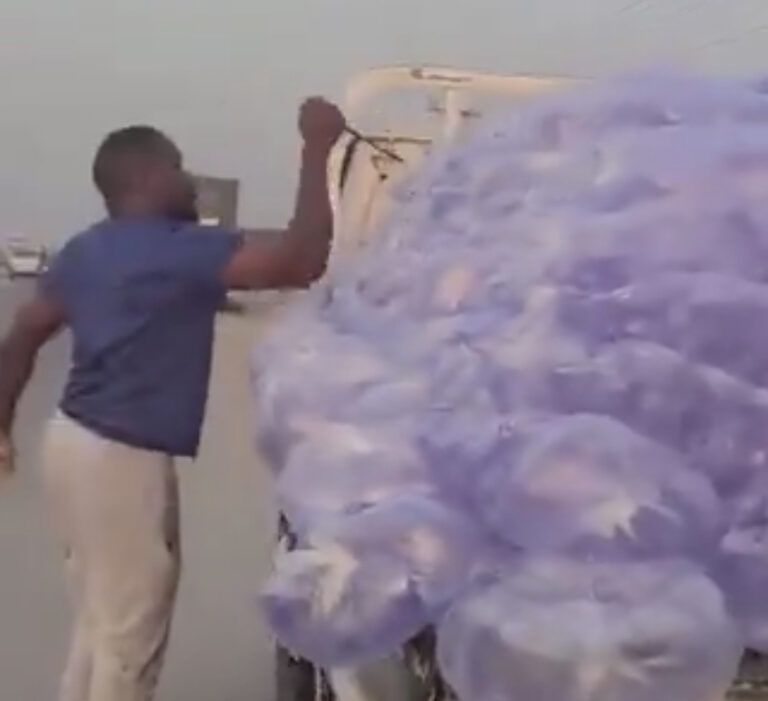
THE National Agency for Food and Drug Administration and Control (NAFDAC) has condemned the destruction of sachet water in Lagos State as seen in a viral video.
The agency also refuted claims by the Lagos State Government linking its officials to the incident.
In a statement on Sunday, December 1, NAFDAC said the people seen in the video, bursting sachet water packs in factories and on buses, were not part of its enforcement team.
The agency described the actions as ‘unprofessional’ and inconsistent with its standard operating procedures (SOPs).
“The videos circulating of individuals engaging in enforcement activities are not NAFDAC officials or part of our investigation and enforcement team.
“Furthermore, stopping vehicles to destroy products is unprofessional and does not align with any NAFDAC standard operating procedure,” the statement read.
The NAFDAC urged the public to verify enforcement activities through its official communication channels and reiterated its commitment to professional regulatory practices.
The ICIR reports that a viral video showed a man in plain clothes along the roadside bursting bags of sachet water stacked in a truck.
Reacting to this, the Lagos State Government, through its commissioner for environment and water resources, Tokunbo Wahab, alleged that the persons seen in the video were enforcement officers from NAFDAC.
Wahab stated that the actions were part of a regulatory exercise targeting sachet water that failed to comply with NAFDAC standards.
“Upon investigation, it was confirmed that the individuals in question are enforcement officers from the National Agency for Food and Drug Administration and Control (NAFDAC). Their actions are part of an enforcement exercise targeting sachet water that does not comply with NAFDAC regulations and in the interest of public health and safety.”
Wahab said the Lagos State Government had no involvement in the enforcement exercise, adding that the state had not banned sachet water nor planned to do so.
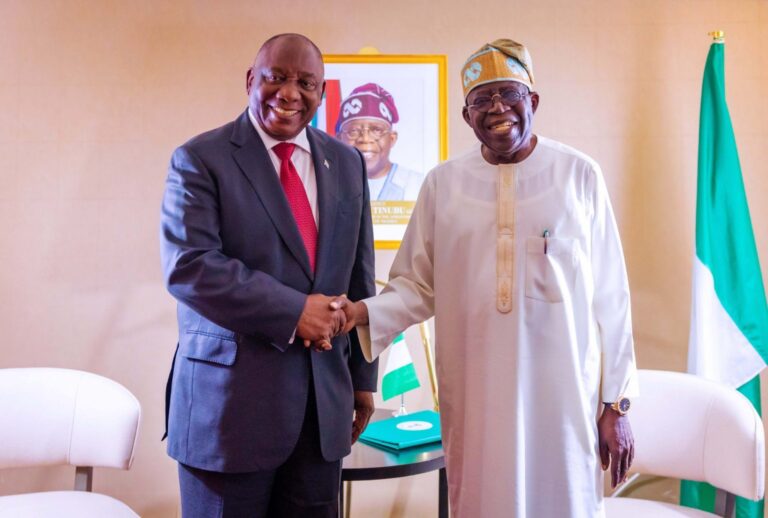
PRESIDENT Bola Tinubu will leave France on Monday, December 2, for Cape Town, South Africa, to co-chair the 11th Nigeria-South Africa Bi-National Commission with President Cyril Ramaphosa.
The Presidential Bi-National Commission, set for Tuesday, December 3, will be preceded by a ministerial meeting on Monday at the South African Parliament Building in Cape Town.
Tinubu’s spokesperson, Bayo Onanuga, in a statement on Sunday, December 1, announced that the President and Ramaphosa would engage in meaningful discussions on bilateral, regional, and global issues of shared interest.
“Building on the commitments from their meeting on June 20, 2024, in Johannesburg, shortly after President Ramaphosa’s inauguration for a second term in office, the two leaders will review the progress made since the 10th session of the BNC held in Abuja from November 29 to December 1, 2021.
The 11th session of the BNC will feature deliberations across eight working groups, each focusing on a specific area of mutual interest. These include political consultations, consular and migration, banking and finance, defence and security, manufacturing, social sector, mines and energy, and trade and investments,” part of the statement read.
Onanuga further stated that officials from both countries would sign several memoranda of understanding (MoUs) and agreements during the meeting.
He noted that the Nigeria-South Africa Bi-National Commission, established in 1999, sought to enhance friendship and cooperation between the two nations, with the first Heads of State-level session held in October 2019 in Pretoria.
The statement further explained that the Bi-National Commission was a platform for maintaining high-level dialogue and promoting collaboration in key areas such as diplomacy, trade, security, and economic development.
It highlighted the importance of this year’s meeting, which marks the 25th anniversary of the Commission, underscoring the enduring partnership between the two countries.
THE Federal Capital Territory (FCT) Council of the Nigeria Labour Congress (NLC) has ordered workers across the city’s six area councils to embark on an indefinite strike from December 1, 2024.
The directive was issued by the FCT NLC chairman, Knabanyi Adalo, in a statement released on Saturday, November 30, according to the News Agency of Nigeria.
The strike was in response to the refusal of area council chairpersons to implement the N70,000 national minimum wage and settle other outstanding entitlements.
Labour unions had threatened to embark on a strike starting November 30, citing the failure of the FCT Administration to engage with union representatives or address wage concerns since the FCT Minister, Nyesom Wike’s, inauguration in August 2023.
Following the threat,the minister approved the minimum wage payment for the FCTA workers.
In a statement issued by Anthony Odeh, the acting head of the FCTA civil service, Wike not only approved the wage increase, he also authorised the payment of three months’ arrears, effective November 2024.
The decision, Odeh noted, was made to ameliorate the plight of workers under the employ of the FCTA.
However, Adalo, who announced the strike for the area councils, said the strike aligned with a communique issued by the NLC National Executive Council (NEC) during its meeting on November 8, in Port Harcourt, Rivers State.
He noted that the communique called for strict adherence to the national directive if the minimum wage was not implemented by November 30.
The NLC FCT council also cited unresolved issues, including unpaid arrears owed to primary school teachers and other entitlements.
According to him, the area council chairpersons had refused to respond to the demand for implementation of the minimum wage in their respective area councils.
“The state administrative council also noted with deep frustration the persistent delay and outright refusal by the area councils’ chairmen to pay some pending entitlements to the workers, including the outstanding arrears of primary school teachers,” Adalo said.
He noted that the failure to implement the new national minimum wage constituted a blatant violation of the law and a complete disregard for the welfare and well-being of workers in the area councils.
“Therefore, all workers in the six area councils in FCT are hereby directed without hesitation to proceed on an indefinite strike beginning from December 1, until further directives,” he said.
Recall that President Bola Tinubu on Monday, July 29 signed the National Minimum Wage Act 2024 Amendment Bill into law, approving a minimum wage for civil servants from N30,000 to N70,000.
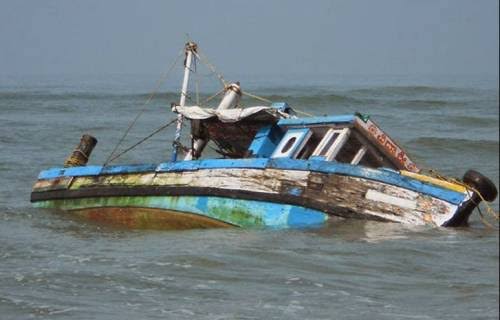
THE head of operations for the National Emergency Management Agency (NEMA) in Kogi State, Justin Uwazuruonye, has confirmed that 54 bodies were recovered from the boat accident involving about 200 traders in the state.
Speaking with newsmen in the state on Saturday, November 30, he explained that the number of fatalities reported by the Kogi State Emergency Management Agency, the Red Cross, and NEMA stood at 54.
He further pointed out that the lack of a passenger manifest made it challenging to ascertain the exact number of individuals on board.
“We tried to know if they could make the manifest available, but they said there was no manifest, and if there is no manifest, we can’t say the exact number of passengers on the boat. Besides, it was a night journey, and none of them had life jackets on.”
The ICIRreports that the National Inland Waterways Authority (NIWA) confirmed the boat accident on Friday.
Suleman Makama, the head of NIWA’s Media Department, stated that the traders were en route to a market in Niger State when the boat capsized at the Dambo-Ebuchi stretch of the River Niger.
Meanwhile, Kogi State Governor, Usman Ododo, has urged increased collaboration among agencies to prevent accidents on waterways.
In a statement issued by his special adviser on media, Ismail Isah, Ododo expressed deep sorrow over the tragedy, noting that many of the victims were women, petty traders, and artisans engaged in lawful business activities.
He also highlighted his concern about the hazards along the waterway connecting Kogi to Niger State.
“The waterway linking Kogi and Niger State is becoming increasingly dangerous as a result of frequent boat accidents,” he said.
The governor urged the relevant authorities to implement safety measures to reduce the risks of water transportation across the country. He extended his condolences to the victims’ families and promised that the government would assist the injured in their recovery.
Similarly, the minister of Marine and Blue Economy, Adegboyega Oyetola, called on the National Inland Waterways Authority (NIWA) to enforce adherence to its Waterways Transportation Code and take legal action against violators.
He also appealed to boat operators and community leaders to discourage nighttime travel in their communities.
Oyetola expressed delight with the prompt efforts of NIWA and the Kogi State Government, which contributed to the rescue of some survivors.
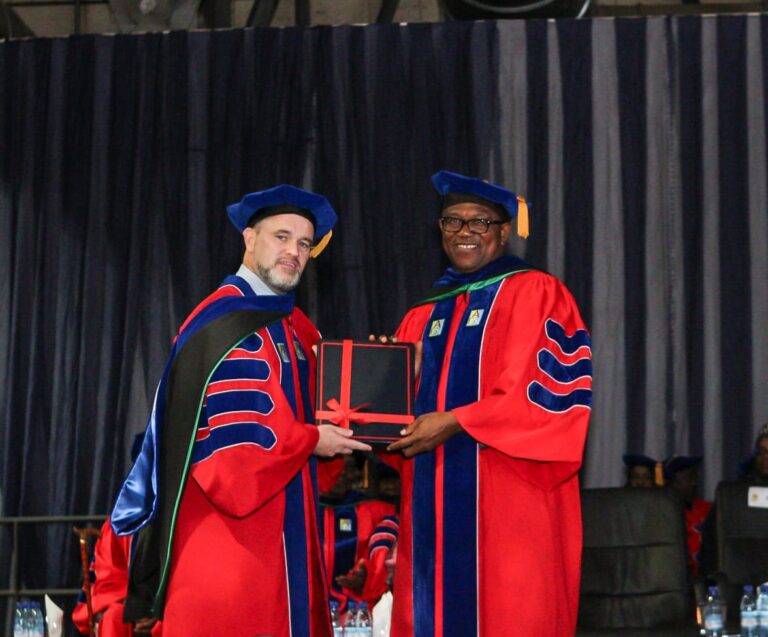
FORMER presidential candidate of the Labour Party (LP), Peter Obi, and former Vice President Atiku Abubakar have dismissed speculations of a potential political merger following their recent meeting on Saturday, November 30, in Adamawa State.
The leaders, who were together at the American University of Nigeria (AUN) in Yola, having breakfast together, emphasised that their encounter was purely a social and academic engagement, not a precursor to any political alliance ahead of the 2027 general elections.
The ICIRreported that Obi was to deliver a keynote address at the American University of Nigeria (AUN) 20th-anniversary celebration and 16th Founder’s Day on Saturday in Yola. Abubakar owns the university.
Obi praised the resilience of the university’s students for choosing to pursue their education in Nigeria despite the rising trend of emigration, popularly known as japa.
He lauded their commitment to education as a tool for national development, stressing the need for competent, compassionate, and visionary leadership to transform Nigeria’s fortunes.
Obi said: “I commended the students of the American University of Nigeria for their resilience and dedication to staying in Nigeria to study and learn, rather than joining the trend of ‘japa’ – a reality now prevalent among many young people in our land.
“During my address, I emphasised the critical role of leadership in national development, underlining the need for competence, compassion, and capacity to transform our nation from consumption to production,” he said.
Drawing comparisons with countries like Indonesia, Singapore, India, Vietnam, and the Philippines, Obi noted that transformational leadership enabled these nations to achieve significant improvements in their human development indices and gross domestic product (GDP) per capita within a decade.
He reiterated that determined and visionary leadership could achieve similar outcomes for Nigeria.
He lauded Abubakar for his contributions to advancing education and human development.
The ICIR reports that Abubakar and Obi’s public reunion fueled speculation of a possible political merger, given their shared history as candidate and running mate, respectively, for the 2019 presidential election under the Peoples Democratic Party (PDP).
However, representatives of both men were quick to dismiss such rumours.
Atiku’s spokesman, Paul Ibe, on Saturday, November 30, clarified that the meeting was a cordial reunion between two friends, and not a political strategy session.
He said, “Let us not jump the gun. The fact is that Obi accepted to be the keynote speaker at the 20th anniversary of AUN and the 16th Founder’s Day, which was a milestone. Obi is part of that celebration.
“The university was founded by Atiku Abubakar, who was more like his host. But people think it is because of politics. We all know our friends. The truth is that politics cannot separate friends.
“So Atiku invited him to breakfast and from there, they went for the programme. I think that is what happened.”
Similarly, Obi’s media aide, Ibrahim Umar, described the insinuations as laughable.
“No, there was nothing like that. They just invited him (Obi) to deliver a speech there. It has nothing to do with politics. Of course, you know people will always assume things,” he explained.
Obi and Atiku have taken divergent political paths since the 2019 election with Obi joining the LP in 2022 and finishing third in the 2023 presidential race behind Atiku and eventual winner, Bola Ahmed Tinubu, of the All Progressives Congress (APC).
FORMER Vice President Atiku Abubakar has called on the National Assembly to revisit and make public the resolutions of the National Economic Council (NEC) in its deliberations on the Tax Reform Bills.
In a statement on X, on Sunday, December 1, Abubakar said the council, a constitutionally empowered advisory body on economic affairs, has a critical role in shaping policies that promote fairness and equity in Nigeria’s fiscal system.
He argued that NEC’s input was essential for addressing concerns about uneven development among the country’s federating units.
“In this wise, I call on the NASS to revisit and make public the resolutions of the National Economic Council, a key stakeholder and an important organ of the State with the constitutional power to advise the President concerning the economic affairs of the federation.
“The NASS must be appropriately guided and ensure that in the final analysis, the contents of the bills align with the interests of the vast majority of Nigerians,” he wrote.
The former People’s Democratic Party’s presidential candidate further called on the National Assembly to ensure that the ongoing deliberations on the Tax Reform Bills reflect the interests of the majority of Nigerians.
While emphasising the need for transparency, inclusivity, and objectivity in the process, he urged lawmakers to avoid measures that could deepen regional disparities.
This came as the Senate on Thursday, November 28, passed the Tax Reform Bills for a second reading amidst controversies.
The Senate’s Majority Leader, Opeyemi Bamidele, defended the bills during the debate, describing them as a necessary step to modernise the tax landscape, support small businesses, and streamline revenue collection.
The Bills, submitted by President Bola Tinubu to the National Assembly on October 3, have sparked intense debate in the National Assembly, with many Nigerian lawmakers, particularly from the North voicing fears that they could exacerbate the economic disparities between resource-rich and less-endowed states.
The four proposed laws—the Nigeria Tax Bill 2024, the Tax Administration Bill, the Nigeria Revenue Service Establishment Bill, and the Joint Revenue Board Establishment Bill—aim to overhaul the country’s fiscal framework, simplify tax collection, and reduce disputes.
While proponents argue that the reforms will strengthen Nigeria’s fiscal institutions and align with the administration’s broader development goals, critics, including some northern governors and lawmakers, caution against provisions they believe could unfairly favour resource-rich states over others.
PERSONS Living with Disability (PWDs) were among the estimated one million victims affected by the flood that hit Maiduguri, the Borno State capital and its environs on September 9.
With over 10,000 members spread across the 27 LGAs of the state, findings indicate that no fewer than 5,000 were affected by the floodwaters that swept through the LGAs that were worst hit – Jere and Maiduguri Metropolitan Council (MMC).
In this special report, the ICIR exclusively recounts tales of physically challenged persons caught up in the fury of the rampaging flood.
A large-sized aluminium pot is standing on three big stones under which coal is burning. Peeping inside the pot, Hauwa (25) clears perspiration on her face even as she battles with the cloud of smoke that surged from the fireplace towards her. She is preparing tuwo (made from corn flour) for her blind mother and four siblings. Smaller clay pots, wooden mortars and pestles also lie about elsewhere just as logs of firewood lean against the ‘house pillars’ formed by tree trunks.
The interior is as damp as the bushy, murky marshes that surround the makeshift compound. The dingy corners inside provide sanctuaries for the multitude of malevolent mosquitoes and even rodents. The occupants of this shack, looking more like a medieval cage, located at London Ciki in Jere LGA of Borno State, are victims of the September 9 flood that ravaged Maiduguri and its environs when the Alau Dam burst its waters.
Relics of destruction caused by floodwaters from the house of the chairman, People Living with Disability (PLWD), Borno State
Little wonder, Hauwa complained that since they relocated here from their family house, which was swept in the wake of the flood, they have been left to their fate even as they are constantly faced with the sights and sounds of their amphibious neighbours that breed and luxuriate in the stagnant waters around them.
Tales of pain, sorrow across the bridges
When the legendary country singer, Jim Reeves, wrote his popular lyrics: “Across the bridge, there is no more sorrow; across the bridge there is no more pain…”, he certainly did not have in mind the plight of rural dwellers in Borno State, like Hauwa’s family, who are victims of climate disasters, including flooding.
Indeed, across the fragile bridges linking communities that were destroyed in Jere, Maiduguri Metropolitan and other areas, by the recent flood in the North-East state, sorrow and pain have remained enduring symptoms.
The ICIRreported that a large part of the city of Maiduguri, known for its isolation from the rest of the country in terms of distance, was submerged in the early hours of Tuesday, September 9, when the Alau Dam burst its banks after being overwhelmed by rainfall. This was not the first time Maiduguri residents have been put on the edge as a consequence of surging waters from the dam, which was built in 1986 to help farmers with irrigation.
The first surge occurred in 1994 when heavy rains caused it to burst and unleash devastating waters on the state capital and its surroundings. Again, in 2012, it reportedly broke and flooded its immediate communities, taking a heavy toll on households and farmlands.
However, the most recent collapse of the dam is considered to be Borno’s worst flooding in decades, in terms of impact.
Relics of destruction
Over two months after the devastating flood, the relics of destruction are still visible. At a sprawling settlement called Fori in Jere LGA, residents have been completely cut off due to the collapse of the main bridge even as heaps of damaged furniture, broken appliances and shattered glasses remain sad reminders of the destruction caused by the violent flood waters.
A physically challenged victim wading through floodwaters at the Gwange area of Maiduguri
Elsewhere in Gwange and the old Maiduguri areas in the state capital, broken bridges have left behind rivers of sewage and stagnant water, attracting swarms of disease-carrying insects. Plastic bags are still tangled in trees and power lines, flapping in the wind. Indeed, there is much for a visiting reporter to see, and write about these communities that were ravaged by the erosion of helpless tears in the wake of the Alau Dam collapse.
‘How we survived the fury of the flood’
Amidst the acrid smells of burning trash and toxic sewages, as well as the sweet, albeit putrid scent of decaying organic matter that has become the hallmark of the ancient city, vulnerable residents of these communities, among them the blind, the paralysed and the cripple, recount sad memories of how they survived the angst of the flood. Like extracts from the popular ‘Hammer House of Horror’, their stories are tales of pain, sorrow and anguish.
One of them, Abdulrahman Mohammed, a 45-year-old cripple, lived in a small, makeshift hut at Limanti ward on the outskirts of the Maiduguri Metropolitan city. Born with polio, he had learned to adapt and navigate life with crutches. But nothing could have prepared him for the flood disaster.
As the violent waters spread its destructive fangs, Mohammed’s hut began to disintegrate, he recalls. With determination burning within him, he clung tenaciously to his crutches. It was a case of “everyone to himself and God for us all”, as neighbours, fleeing for their lives, left Mohammed behind, assuming he couldn’t survive. He was the last man standing in his compound, having earlier heeded a warning announcement by asking his wife to move his two kids to a safer location.
Abdulrahman Mohammed, another physically challenged victim, narrates his ordeal
Undeterred, Mohammed, a cobbler, dragged himself through the swirling waters, crutches floating beside him. Debris battered him, but he refused to let go. The flood raged on, threatening to consume him.
Suddenly, a wooden door tore loose from a nearby house and hurtled toward him. He grasped it with all his might, using his crutches to steady himself. The door became his lifeline, buoying him above the churning waters.
Hours passed, with the door creaking under his weight. Mohammed’s body ached, his muscles screaming in exhaustion. Yet, he held on, fuelled by an unyielding will to live.
As dawn broke, and the waters began to recede, Mohammed spotted a group of rescuers, wading through the knee-deep waters. With a Herculean effort, he shouted for help.
The rescuers rushed toward him, amazed by his resilience. They carried him to the popular Bakassi Camp in Maiduguri where he later reunited with his wife and kids.
”A few days later, I rented a room within the neighbourhood for my wife and kids and returned to keep watch over my destroyed house because people were taking undue advantage of the situation to steal my belongings,” Mohammed said, adding that the situation has disrupted the schooling of his two kids who are in primary school.
Mohammed’s story of courage in the face of the flood inspired hope among the physically challenged community and the neighbourhood.
Although the government provided him with a ‘meal ticket’, Mohammed said: “They tried but we need more support. We want our destroyed homes rehabilitated so we can reunite with our families.”
A brave wife rescues her crippled husband
Aisha’s heart pounded as she watched the waters rise, threatening to engulf their small home at Shehuri North. Her crippled husband, Umar, lay helpless on the bed, his legs paralysed since childhood.
Panic gripped her, but Aisha refused to yield; conscious of the fact that she had to act fast.
Without hesitation, she tied a rope around her waist, securing herself to the door frame. The raging waters clawed at her, but she stood firm.
“Umar, hold on!” she shouted above the din. “I’m coming!”
As Aisha plunged into the chest-deep waters, fighting against the current, debris battered her. But she pushed forward, her eyes fixed on the bed where her fragile husband lay.
She lifted his frail body into her arms like a baby. The waters raged, but she stood resolute, shielding him from the deluge.
“Hold me, Umar,” she whispered. “We’ll get through this together.” Umar’s arms wrapped around her neck, his eyes locked on hers.
With Umar clinging to her, Aisha began the perilous journey back to safety. The waters buffeted them, but she dug deep, drawing strength from her love.
As they neared the door, the rope around her waist snapped taut, holding them fast. Aisha grasped it with all her might, pulling them forward.
Suddenly, rescuers appeared, wading through the waters. They lifted Umar to safety.
“Aisha and I were taken to a nearby camp, where medical teams tended to my needs. We spent a week there before relocating to my wife’s family home around the Customs area in Maiduguri”, Umar said, as his sweat-soaked face bore the furrows of sorrow.
The darkness of the storm
The stormy night had transformed the quiet Fori settlement of Jere LGA into a raging river. Water gushed through broken bridges onto the streets, sweeping away everything in its path. Amidst the chaos, a lone figure clung to a lamppost, the currents threatening to engulf him.
Bulama Kaka, a 37-year-old blind man, had been stranded in his small apartment when the floodwaters burst in. He had felt his way through the darkness, desperate to escape. Now, he was at the mercy of the torrent.
As the waters rose, Kaka’s grip on the lamppost began to slip. His fingers, numb and trembling, he struggled to hold on. The howling wind and crashing waves drowned out his cries for help.
Even the blind were not spared the fury of the flood: A blind victim takes shelter at the Gubio IDP camp in Maiduguri
Suddenly, a faint light pierced the darkness. A rescue boat, manned by volunteers, had spotted his desperate form. They expertly navigated the turbulent waters, fighting against the current.
Kaka’s exhausted arms were pulled aboard, and he collapsed onto the boat’s floor. The rescuers wrapped him in a warm blanket, shielding him from the rain.
The boat rescuing Kaka chugged through the darkness, carrying him to safety, to a world where darkness would no longer define him. The darkness of the flood had given way to the light of humanity.
Tales of agony, abandonment
At the Gubio internally displaced persons’ camp (IDP), located some thirty kilometres on the outskirts of Maiduguri where victims of the flood, among them the physically challenged, are currently camped, stories like those of Mohammed, Aisha and Kaka spread like wildfire, inspiring hope among the community of the disabled, albeit amid pain and sorrow.
Mohammed Danjuma (50), a petty trader who has been blind for over forty years, said his neighbours had to break the fence of his compound to evacuate him and his family of six from the torrents of the flood.
“We were home on that fateful night. At about 12: 45 pm, the flood waters came gushing into our home. As a blind man, I was helpless! It took the intervention of some kindhearted neighbours who broke through our fence and evacuated us to the Gwange primary school.
“We were later brought to this camp where we have so far spent four weeks. Although food items are provided here through the State Emergency Management Agency (SEMA), we are not strong enough to scramble for them like others. Besides we are exposed to mosquitoes which cause us malaria and other ailments.”
We appeal to Governor Zulum to look into our plight. Our houses are in ruins; the government should rehabilitate us so we can reunite with our families.”
Speaking in the same vein, Habiba Musa, a 70-year-old blind woman said the wall of her house at the Gwange area of Maiduguri was broken into by rescuers to evacuate them to the nearby primary school.
“We have currently spent four weeks at this camp. We get food supplies from NGO’s but not enough from the state government. I sleep on the floor in a tent with my children. We appreciate the effort of the state government but we want to go back home and be reunited with our families.
“Apart from sleeping on the bare floor, we are also exposed to mosquitoes even as the water we consume is not good for our health. We are vulnerable to malaria, typhoid and water borne diseases.”
For residents of Fori community in Jere LGA, there is pain, and sorrow across their collapsed bridge
At the Shehuri north area of Maiduguri Metropolitan, a 37-year-old cripple, Mohammed Bulama, who survives by selling kola nuts, said he was rescued by his younger brother on the fateful night when flood waters poured into their hut.
“My younger brother carried me on his back and took me out because I couldn’t withstand the water. Because of the bruises I had when our collapsed wall fell on me, I was first taken to a clinic for treatment before coming to this camp where I have so far spent one month. The walls of my house are badly cracked. I appeal to the government for assistance to rehabilitate my house so I can go back home.”
Elsewhere, a 22-year-old girl, Zainab Ibrahim, with cerebral palsy was trapped in a wheelchair at her residence in the London Ciki area of Jere LGA. Her family, desperate to save her, called for help. “We were in panic mode as water streamed in. My brother teamed up with rescuers and took me to safety in a neighbour’s house.
“So far, there has been no appreciable help from the government particularly for our members. We appeal to Governor Zulum to come to our aid as the walls of our house have been completely pulled down,” she said.
Falmata Mukhtar, the deputy women leader of the Joint National Association of Persons with Disability in Borno State, was not spared the fangs of the flood. The 27-year-old who is also the state chairperson of the Nigeria Association of the Blind, said: “I had just started sleeping at about 2:30 am on the fateful day when the flood waters came pouring in. There were ten people in my compound. Luckily I was rescued and taken to the camp even as water swept all our belongings.
“Assistance from the government for our members has not been encouraging. We depend on friends, well-wishers and NGOs. We know Governor Zulum as a kind-hearted person and appeal to him to come to our aid.”
The story of Umar Shehu, a 40-year-old paraplegic, is pathetic. He was almost swept away by the floodwaters while trying to escape. Rescuers found him clinging to a tree branch. At the Gubio camp, Umar’s story inspires hope among the physically challenged. “I thought I had lost everything, but I am alive. And this is all that matters to me,” Shehu said.
Alhaji Amodu Umar, the Borno State chairman of the Joint National Association of Persons with Disability (JONAPWD), described the impact of the flood on persons with disability as traumatising.
Umar, who has three wives and seventeen children, said he was also badly affected by the flood, adding: “If not for assistance from rescuers I wouldn’t be alive today.
“We have not received any assistance from the state government. We tried reaching out to the relief committee but nobody listened to us. But we know the governor to be a kind-hearted person who listens. We are appealing to him to specifically assist persons living with disabilities.
“Governor Zulum should also appoint our members as advisers to his government so that when there are issues like this, we can go through him directly.”
We lost 7 members, 15 were hospitalised–Borno PWD chairman
Mohammed Abubakar, the Borno State chairman of persons living with disability (PWD), said his members were adversely affected, stressing that he was personally rescued by his wife from the flood disaster.
“On the fateful day, some of my neighbours were busy running from the floodwaters. I couldn’t get immediate help until my wife rushed back home. Thank God she is physically okay. She evacuated my two children and me.”
Mohammed Abubakar, Borno State chairman of persons living with a physical disability (PLWPD) wants the state government to include his members in its cabinet
Abubakar said out of the over 10,000 registered PWDs in Borno State, no fewer than 5,000 were affected by the flood. “We lost about seven of our members while 15 others who sustained different levels of injuries were treated in the hospitals. Several other victims lost their wheelchairs while other valuables were swept away.
Abubakar also called for the inclusion of persons with disability in Zulum’s government, while appealing for special consideration for their members in the rehabilitation process.
On her part, Inna Galadima, the chairperson of Jere LGA, described the flood as devastating, saying over 50 per cent of the area was affected by the flood.
“Out of the twelve wards we have, seven were affected. Homes and farms were destroyed, thereby bringing untold hardship to the people.
According to her, even though a census of the physically challenged victims was not conducted, “we are dealing with everybody, including persons living with disability.”
When The ICIR visited the old Maiduguri Primary School in the state capital, where the flood disaster relief committee conducts victims’ verification and disbursement of relief, it was a beehive as hundreds of victims, including the physically challenged, were seen taking delivery of food and non-food items. The items include rice (25kg), spaghetti, noodles, blankets and mats.
Persons Living with Disability (PLWDs) receiving relief assistance from the North-East Development Commission (NEWD)
It was, however, observed that some persons who were not affected by the flood disaster also took undue advantage to pose as victims thereby collecting items not meant for them.
Physically challenged were given priority – NEMA, SEMA
The zonal coordinator of the National Emergency Management Agency (NEMA), Sirajo Garba, described the impact of the flood as overwhelming.
Garba admitted that the first 48 hours of the flood were very difficult in terms of rescue efforts by the search and rescue team.
Speaking on efforts to rescue persons living with disabilities, he said: “There were challenges rescuing this vulnerable group of victims. Some were on wheelchairs, some blind while others were with one form of disability or the other.
“After the camps were opened, I remember speaking with the chairman of the association of persons living with disability. They had a lot of challenges in the various camps; some had issues with their sights and collecting food.
“We directed the camp managers to give them special privileges because they could not have access to the assistance that was given.
Garba who admitted that victims of the flood who are living with disability are not adequately catered for, said: “I feel they are somehow left behind; however we have been receiving communication from them and we are making conscious efforts to step up assistance to them.”
On his part, the Director General of the Borno State Emergency Management Agency (SEMA), Barkindo Mohammed, said the task of dealing with the physically challenged was difficult. He, however, said special consideration was accorded them in terms of relief provision, adding: “We have our database and we will improve.”
The Chairman, Borno State Flood Disaster Relief Disbursement Committee, Baba Bukar Gujbawu, said there was no clear-cut demarcation by the committee in dealing with victims of the flood in relation with persons with disability.
He, however, said “We gave them special consideration before others, stressing that the committee has covered almost 70 per cent in providing relief to the affected persons.
The executive director, Network of Civil Society Organisations (CSOs), Borno State, Bulama Abiso, said even though the physically challenged were not included in the disaster disbursement relief committee, they were accorded preferential treatment.
“We have over 200 CSOs in Borno State and the PLWD is a member. When the disaster occurred, we swung into action by calling for assistance, specifically for the physically challenged. We visited them in their communities and provided relief from the North East Development Commission (NEDC).”
The Borno State government said it had been engaging PLWDs in activities to ensure the physically challenged benefit from the dividends of democracy, adding that their inclusivity did not start with the recent flood disaster.
Zuwaira Gamo, the state commissioner for women’s affairs and social development, said:
“The inclusivity of PLWDs did not start with the flood crisis. The state government has been engaging them in its activities to ensure they benefit from the dividends of democracy.
“These include giving them a monthly stipend of N30,000 with 4,000 beneficiaries for a period of four years; renovation and upgrading of blind production centres fully equipped to modern standards in Maiduguri and Biu; the establishment of e-learning centre for the blind and provision of special materials for the blind presently functioning effectively.”
Zuwaira Gambo, Borno State commissioner for women affairs and social development
According to her, in the last 16 years, the state government has sponsored the participation of PLWDs in their annual national and international conferences, including prayer programmes for the return of peace to the North-East and Nigeria.
“Under this administration, representatives of PLWDs have equal opportunities in the political space and decisions on who governs, hence some already hold executive positions as delegates, ward chairmen, members of executive committees across LGAs.”
FORMER Head of State, Yakubu Gowon, has revealed how he intervened to prevent the execution of former President Olusegun Obasanjo, who was sentenced to death by the late General Sani Abacha in 1995 over an alleged coup plot.
Gowon made this disclosure during the maiden edition of the Interdenominational Unity Christmas Carol and Praise Festival, organised by the Plateau State Government, where he served as the special guest of honour.
Recall that in 1995, Obasanjo, a former military Head of State, was accused of participating in a putsch to overthrow Abacha.
Despite pleading his innocence, he was arrested, tried, and sentenced to death by the Abacha-led junta.
He consequently spent three years in prison before his release in 1998 following Abacha’s sudden death.
The octogenarian went on to become a democratically-elected president who led Nigeria between May 29, 1999 and May 29, 2007.
Speaking of his intervention, Gowon explained how he wrote a letter to Abacha and sent it to him through his wife at night, pleading for clemency.
Gowon further expressed gratitude that Obasanjo was eventually released and went on to become Nigeria’s president.
“I wrote a letter to Abacha; I pleaded with him that God made him a leader to do good and not evil. I sent my wife with the letter in the middle of the night to Abacha in Abuja; I pleaded with him that such a thing should not happen.
“I’m glad that soon after that, things changed, and not only that Obasanjo left prison, he became our president in 1999.
“This is something that only prayers and sincerity can do; I’m happy that today myself and Obasanjo are here to celebrate the unity of Plateau,” he said.
During the event, Gowon commended the Plateau State Government for organising the carol, describing it as a platform to foster unity among citizens.
He noted that the state had faced significant security challenges in recent years and emphasised the importance of such gatherings in promoting communal harmony.
THE Central Bank of Nigeria (CBN) announced on Friday, November 29, that starting December 1, customers facing challenges withdrawing cash from bank branches or ATMs should report the issues directly to the apex bank.
The CBN Governor, Olayemi Cardoso stated this during the 2024 Annual Bankers’ Dinner in Lagos, organised by the Chartered Institute of Bankers of Nigeria (CIBN).
He encouraged customers to report such challenges, using the designated phone numbers and email addresses assigned to their states.
Cardoso, who was also awarded a fellowship by the CIBN, emphasised that the guidelines would be broadly distributed to enhance public awareness.
He urged all stakeholders, including mobile money operators and PoS agents, to ensure full regulatory compliance to enhance digital transaction channels and improve service quality.
“We also recognise the ongoing challenges with cash availability at ATMs, which disproportionately affect ordinary Nigerians. To address this, we are conducting spot checks across deposit money banks (DMBs) and will impose penalties on underperforming institutions.
“Effective December 1, 2024, customers are encouraged to report any difficulties withdrawing cash from bank branches or ATMs directly to the CBN through designated phone numbers and email addresses for their respective states,” Cardoso said.
The CBN governor noted that the apex bank would maintain a strong cash reserve to meet the country’s demands, especially during peak periods like the festive season and year-end.
He said the CBN was committed to ensuring smooth cash flow for Nigerians while reinforcing trust and stability in the financial system.
Highlighting the Payment System Vision 2025 initiative, he explained its goal to boost confidence in the nation’s payment infrastructure. He also assured that by 2025, payment gateways would be more efficient, with delays in transaction settlements significantly reduced.
He also revealed that Nigeria is expected to exit the Financial Action Task Force (FATF) grey list by the second quarter of 2025, while outlining enforcement measures to combat money laundering, cybercrime, fraud, and corruption, among other issues.
President and chairman of the Chartered Institute of Bankers of Nigeria (CIBN), Pius Olanrewaju, a professor, noted that 2024 had been a significant year for both the banking sector and the economy. He pointed out that various policies and regulations implemented by the CBN and the Federal Government had started showing positive results.
He said the Nigerian economy had been resilient, citing its steady growth from 2.98 per cent in Q1 to 3.19 per cent in Q2 and 3.46 per cent in Q3 of 2024.
Similarly, he acknowledged the banking sector’s resilience despite macroeconomic challenges such as rising inflation and exchange rate fluctuations.
The Governor of the Central Bank of Sierra Leone, Ibrahim Stevens, a doctoral holder, commended the efforts of the CIBN and CBN, noting their positive impact in Africa and globally.
He called for collaboration to create a robust financial ecosystem on the continent.
THE FCT Police Command has launched an investigation into an incident involving a local herbalist who injured himself while testing a failed ‘bulletproof’ charm in a community in the Federal Capital Territory.
In a statement issued by the command’s spokesperson, Josephine Adeh, on Saturday, November 30, 2024, it was revealed that on November 23, 2024, a disturbing incident occurred in Kuchibuyi Village, prompting the attention of the police.
A distress call from one Shandam Michael alerted authorities to the ‘shocking’ case of Ismail Usman, a local herbalist known for his unorthodox practices who attempted to test a self-made ‘bulletproof’ charm, shot himself in the stomach with a gun.
Unfortunately, the charm did not work as intended, and Usman sustained life-threatening injuries.
According to the police, officers from the Byazhin Division promptly arrived at the scene and found him in critical condition. He was rushed to Kubwa General Hospital for immediate treatment and later transferred to Gwagwalada Specialist Hospital for continued care.
Following the incident, the police conducted a detailed search of Usman’s residence, where they seized the homemade firearm and various charms involved in his dangerous experiment.
Investigations are still ongoing, and Usman will face charges for illegal possession of firearms and attempted suicide, as outlined in Section 231 of the Penal Code Law of Northern Nigeria.
The FCT Commissioner of Police, Olatunji Disu, condemned the incident, emphasising the risks of engaging in reckless behaviour and urging the community to refrain from such dangerous practices.
“This situation illustrates the serious risks of engaging in reckless behaviour. We strongly advise the community to avoid such dangerous practices.” Disu stated.
The police emphasised the need for community vigilance, urging residents to watch out for one another and report any suspicious activities.