Home Blog Page 535

World Bank debunks minister’s claim that its staff take 40% of loans to Nigeria

0

THE World Bank has denied a recent allegation by the Minister of Women Affairs, Uju Kennedy-Ohanenye, that the Bank’s staff in Nigeria pocket 40 per cent of all loans Nigeria receives from the financial institution.

The Bank refuted the claim in an exclusive mail sent to The ICIR, noting its staff did not receive 40 per cent of project funds in “consultation fees,” as alleged by the minister.

It also disputed the claim by the minister that Nigerian officials were entitled to five per cent of project funds after signing loan agreements.

The ICIR reported how Kennedy-Ohanenye accused the World Bank staff in Nigeria of pocketing 40 per cent of the loans given to Nigeria as consultation fees, while government officials who sign those loans get five per cent of the funds.

“All the loans they collect, including World Bank loans,  are you aware that the same World Bank staff in Nigeria take back 40 per cent and call it consultation fees?

“These are things you people should look into. You people should focus on where the problem is and let them leave me alone,” the minister said during a phone interview with THISDAY newspaper.

She also alleged that she was being victimised by the National Assembly and some cabals for refusing to sign a $500 million World Bank loan request.

“There is a $500 million loan that was meant to be signed by me, but I refused to sign. There was also a case of $100 million earlier as well. Find out what it was meant for,” the minister added.

World Bank reacts

Meanwhile, the World Bank, while responding to The ICIR’s queries on the issue, emphasised that projects funded by the Bank were implemented by recipient governments and were governed by strict policies designed to prevent the misuse of funds. 

The Bank also noted that it worked closely with borrowers to manage procurement processes, ensuring that funds are used transparently and efficiently. Key contract award information, including details about the recipients and the purposes of the funds, is required to be published as a condition of Bank financing, the Bank said.

“In response to your query, please note that World Bank staff do not receive 40 per cent of project funds as “consultation fees”. Nor are ministers entitled to five per cent of project funds for signing loan agreements. Both assertions are unequivocally false.

“World Bank-funded projects are implemented by recipient governments and are governed by rigorous policies meant to prevent the misuse of funds and ensure they are used for the purposes intended.

“Under our Procurement Framework, the Bank works with borrowers to carefully manage the integrity of procurement processes in line with core principles that emphasise fair competition, transparency, and efficiency.

“Borrowers are required to publish key contract award information – who the contracts were awarded to, where the money goes, and for what purposes – as a condition for bank financing,” the organisation wrote.

It further claimed that project staff involved in World Bank-supported initiatives are employees of the government ministry that hired them, not of the World Bank.

“Furthermore, it is worth noting that the World Bank does not recruit project staff. Such is purely the responsibility of the government ministry in charge of the project. Project staff in World Bank-supported projects are not employees of the Bank, but employees of the government ministry that hired them.

“The World Bank has zero tolerance for fraud and corruption and takes very seriously our obligation to ensure that our funds are used for clearly defined activities for the benefit of the poorest and most vulnerable,” the statement added.

Loan distribution based on claim by women’s affairs minister

Meanwhile, through media reports, The ICIR gathered that Nigeria has secured $4.95 billion in loans from the World Bank since the beginning of President Bola Tinubu’s administration in May 2023.

The amount was secured from six different loan requests: $750 million for the power sector, $500 million for women empowerment, $700 million for educating adolescent girls, another $750 million for renewable energy, $1.5 billion for economic stabilization reforms, and $750 million for resource mobilization reforms. 

With the claim by Kennedy-Ohanenye, of the $4.95 billion secured by the country, $1.98 billion went for consultancy fees to the World Bank staff, meaning that only $2.97 billion was for the federal government to execute projects.

Infographic on loans Nigeria took from the World Bank under President Tinubu and amount that allegedly went to World Bank staff as claimed by the Minister of Women Affair, Uju Kennedy-Ohanenye

Nigeria’s current loan status 

According to the Country’s Debt Management Office (DMO), Nigeria’s total public debt portfolio rose by 24.99 per cent in three months to N121.67 trillion as of March 31, 2024.

The DMO in its latest report released on Thursday, June 20, declared that the federal government and the 36 states, including the Federal Capital Territory (FCT), owe $91.46 billion.

“Central Bank of Nigeria’s (CBN) official exchange rate of $1 to N1,330.26 as of March 31, 2024, was used in converting external debt to naira,” the DMO noted.

Also, domestic debt rose to N65.65 trillion or $49.35 billion, representing 11.05 per cent increase relative to N59.12 trillion or $65.73 billion as of December 31, 2023.

External debt rose to N56.02 trillion or $42.12 billion, representing a 46.57 per cent increase compared to N38.22 trillion or $42.495 billion the debt office declared as of December 31, 2023.

Of the external debt, The ICIR reports that Nigeria’s current World Bank loan, as of March 31, is  $15.59bn, according to data from the DMO.
Despite Wike’s opposition, group writes minister to prepare Eagles Square for protest

0

DESPITE opposition from the Minister of the Federal Capital Territory (FCT), Nyesome Wike, to the forthcoming #EndBadGovernance Protest, a group has written to the minister for permission to use Eagle Square for the protest scheduled for August 1 to 10.

The group, Take It Back Movement, in a letter titled, “Request For Use of Eagles Square Abuja For #EndBadGovernance Protest,” addressed to Wike and dated Friday, July 26, notified the minister of its decision to use the Eagles Square as a point of convergence to “demand for better governance.”

In the letter signed by its Director of Mobilization, Damilare Adenola, the group said the request entailed using the venue day and night for the duration of the protest.

“Also, note that the protest may be prolonged beyond ten days as we embark on resolving the protracted national crisis occasioned by the ruling party.

“Further, your office must also ensure the provision of a 24-hour power supply, toilet facilities, water, and security for the convenience of Nigerian citizens who will be camped out at Eagle Square,” the letter stated.

In the letter, the group also demanded that the minister accord the protesters the courtesy given to foreign and local official dignitaries who frequently used the space.

In addition, it requested that the outer wire barrier facing the Aso Rock Presidential Villa be removed as the protesters may decide to visit the Presidential Villa during the protest.

Abuja not available for protest – Wike

Meanwhile, The FCT Minister, Wike, had warned against any planned demonstrations, saying no protest would be allowed in the nation’s capital under his watch.

Wike said this on Thursday, July 25 while addressing some FCT residents during an inspection tour in Saburi community.

“For those who want to protest on the 1st (of August), FCT is not available for such protests,” he said while urging residents to desist from embarking on such acts.

The minister claimed that protests would not address the problems facing the country, urging that instead, every well-meaning citizen must work together to find solutions.

He noted that prominent politicians and other leaders endorsing the demonstration had no good intentions for the nation, but rather were acting in their self-interest.

Wike acknowledged that there was widespread poverty in the nation but insisted that the administration of President Bola Tinubu was making every effort to solve the issue and enhance the quality of life for all citizens.

Letter to Wike
Letter to Wike

He urged Nigerians to be patient with the federal government.

The ICIR reports that Wike has issued a warning against the anticipated nationwide protest twice in the last week.

He labelled the planned protest as politically motivated on Tuesday, claiming that its purpose is to distract Nigerians from the programmes of Tinubu’s government.

Tinubu, the ruling All Progressives Congress (APC), governors, have all urged Nigerians to postpone the protest.

Food and basic commodities prices have skyrocketed in recent months as Nigerians struggle with one of the biggest inflation and economic crises the nation has ever experienced.

The crises have been worsened by the government’s policies including fuel subsidy removal and unification of forex windows.

Senate to investigate sabotage in Nigeria’s oil sector in past 10 years

0

THE Senate will soon investigate the disruptions that have hampered Nigeria’s oil and gas industry in the last 10 years.

The Senate majority leader, Opeyemi Bamidele, disclosed this at a press briefing in Abuja on Thursday, July 25.

He said the Senate would also wade into the face-off between Aliko Dangote and the regulators in the petroleum sector.

Dangote Refinery has been facing regulatory hurdles that have affected its plans to start petroleum production, setting its owner, Aliko Dangote, against the regulators over the control of the petroleum downstream market in the past couple of months.

Bamidele, who is chairman of the ad-hoc committee set up to investigate alleged sabotage in the petroleum sector, noted that its committee’s public hearings would start on September 10 to interrogate key stakeholders about the poor state of the country’s petroleum sector.

He said the committee would in the course of its investigation examine the pre-shipment and pre-discharge standard test parameters adopted by the Nigerian Midstream and Downstream Petroleum Regulatory Authority (NMPDRA) to uncover if loopholes were being exploited to get toxic cargoes into the country.

It will determine the level of compliance of the Nigerian National Petroleum Company Limited’s (NNPCL) direct sale and direct purchase arrangements in line with the provisions of the Petroleum Industry Act, including the extent of transparency and accountability in the oil sector.

He stressed that the committee would beam its searchlights on the activities of NMDPRA, including payments made to transporters in the last 10 years.

It will equally inquire from the NNPCL the state of the 22 depots built by the defunct NNPC to eliminate road distribution of petroleum products.

Further terms of reference include engagement with stakeholders within the oil and gas industry to identify possible gaps in regulating and strengthening the surveillance and monitoring structures in place to enable it to detect violations of best practice standards in the importation of products before entering the domestic supply chains.

It is also expected to engage with the NNPCL to understand the extent of its determination and timelines for the start-up of government-funded oil refineries.

The committee will also investigate how institutions across the importation and distribution chain failed to conduct quality sampling, shipped in products without auditing, and performed port validations by the Nigeria Customs Service (NCS), NMDPRA, Nigerian Maritime Administration and Safety Agency (NIMASA), Standards Organisation of Nigeria (SON), and Nigerian Ports Authority (NPA).

Bamidele said further that the committee would interact with the minister of state for petroleum, finance minister, trade and investment minister, and NNPCL, among others.

The Central Bank of Nigeria, National Engineering and Technical Company Limited and Contractors, NMDPRA, Nigerian Upstream Petroleum Regulatory Commission, and SON are expected to testify before the committee.

Others include the Dangote Group, NIMASA, NCS, Nigerian Navy, Obat Oil and Petroleum, Matrix Energy Depot, Independent Petroleum Marketers Association of Nigeria (IPMAN), International Oil Companies (IOCs), Depot and Petroleum Products Marketers Association of Nigeria (DAPPMAN), Major Oil Marketers Association of Nigeria (MOMAN), NPA, modular refineries, and Capital Oil.

As part of its assignment, the committee will visit the facilities of some identified stakeholders, especially the state-owned refineries, to ascertain their status, considering the huge funds already invested in their various turnaround maintenance over the years without commensurate results.

“The committee is particularly interested in understanding why local refineries are not working despite the substantial amounts of money spent annually on their maintenance and operations. We will closely examine what the Nigerian National Petroleum Corporation Limited (NNPCL) has been doing to address this persistent problem.

“Additionally, the committee will meet with stakeholders in their various zones to gather localised insights and feedback. To ensure broad participation and transparency, the committee will create a platform for the general public and stakeholders to submit memoranda before the public hearings.”

“Our investigation seeks to identify and hold accountable parties involved in the importation and distribution of adulterated petroleum products (PMS and AGO). This includes suppliers, importers, regulatory bodies, and any other entities that may have contributed to this serious lapse in quality control,” Bamidele was quoted to have said.

FG woos diasporans with $500m domestic FX-denominated bonds

TO maximise diasporans’ economic contributions to the Nigerian economy, the federal government said it would issue $500 million in domestic foreign currency-denominated bonds in August.

The Minister of Finance and Coordinating Minister of the Economy, Wale Edun, said this on Thursday, July 25, in Abuja during a quarterly press briefing to review the first half of 2024.

The meeting had the theme ‘Economic Recovery And Growth: Progress and Prospects 2024’.

The minister had earlier informed that the domestic foreign-denominated bonds would be issued in the second quarter (Q2) of the year to shore up supply for foreign exchange and address Nigeria’s volatile currency market.

Providing an update at the meeting on Thursday, Edun said the government needed to attract savings Nigerians held abroad.

“We have an open exchange rate system, it’s not illegal and so we have the issuance of a dollar-denominated security, not depending on the financial architecture of the western world, not depending on the kind of architecture that you use to raise euro bonds.

“We’re using the Nigerian financial system, the Securities and Exchange Commission (SEC), the banking system, the investment bankers to issue $500 million in the first instance that will be available and will attract foreign currency held by Nigerians abroad and anybody else who buys into the macroeconomic reform efforts of President Bola Tinubu,” he added.

He further said the  issue is a challenge to the best and the brightest in the financial markets, adding, “It is due to open in the next three to four weeks maximum.”

Recall, the  Bola Tinubu administration floated the currency and removed subsidies at the onset of his administration which caused lots of problems for the economy.

For instance, the unification of forex rates hits the national economy through debts, with the profile rising to N121 trillion following the floating of the naira and the resultant devaluation by the Central Bank of Nigeria (CBN).

The devaluation saw the local currency, which was exchanged at N430 to the dollar at the official window before Tinubu assumed office, and as of July 25, 2024, exchanged  N1,603/$ at the official window.

To worsen the concern, Nigeria is not meeting up with the supply side of the foreign exchange because of its inability to meet its crude supply of 1.5 million barrels per day as prescribed by the Organisation of Petroleum Exporting Countries (OPEC). This, economic analysts said is affecting the dollar supply to the economy as oil remains the mainstay of the economy.

In addressing these problems, Edun said, the government was not planning to raise euro bonds, adding that moving forward with the idea would depend on the success of the domestic foreign currency-denominated bonds.

“Right now, depending on the success of that issue, there is no talk of looking to go to the international markets to raise the euro bond. It is one of the options that we have. It is the markets are open to us. Our ratings and our performance merit it.

“The market is open to us but we prefer in the first instance to challenge Nigerians to come home with their money and be part of the Nigerian reform success story. That we believe is where the economy is headed,” he further said.

The year 2022 recorded an increase whereby the remittances stood at $20.3 billion and 3.5 per cent of the Gross Domestic Product (GDP) in Nigeria.

In 2023, it witnessed a small decline and amounted to $20.1 billion with a corresponding 3.2 per cent of the GDP.


AGF warns LG chairmen against tampering with FAAC allocations 

0

THE Attorney General of the Federation (AGF) and Minister of Justice, Lateef Fagbemi, has warned local government chairmen and councillors against tampering with the Federation Accounts Allocation Committee (FAAC) allocations.

Fagbemi, a senior advocate, issued the warning on Thursday, July 25, at the 17th-anniversary annual lecture event of the Human Rights Writers Association of Nigeria (HURIWA) in Abuja.

He told the gathering that for more than 20 years, the majority of the 774 local governments had nearly crippling governance and attempts by previous administrations to address the issue had failed.

He claimed that the administration of President Bola Ahmed Tinubu filed a case before the Nigerian Supreme Court regarding the LGs’ autonomy because it understood the importance of good governance to security and human rights.

He stated that the apex court’s ruling guaranteeing autonomy for the LGAs would greatly increase security and access to human rights in addition to enhancing local government governance.

He clarified that before the Supreme Court ruling, it was anticipated that state authorities would permit local governments to operate in accordance with the 1999 Constitution, but that never happened.

“We now thought, this money is still coming from the federation, and in a way, the money is meant for the local governments; the federation now says, states be our agents, hold this money for onward transmission to the local government.

“There are two issues: the states were the agents of the federation; when the money got to the states, they became trustees of the local government. So either way, they are to do their utmost to ensure that the funds were not tampered with,” Fagbemi stated.

The ICIR reported that the Supreme Court granted the nation’s 774 Local Governments Areas (LGAs) financial autonomy in a judgment passed on Thursday, July 11.

The judgment was passed in a suit filed by the Federal Government through Fagbemi against the 36 state governors in the country, seeking full autonomy for local governments.

The Federal Government sought the court to authorise the direct transfer of funds from the federation account to local governments in line with the provisions of the Constitution against the alleged unlawful joint accounts created by governors.


READ ALSO:


Calls for local government autonomy in Nigeria have increased in recent years, as interference by the state has been identified as a reason for its underperformance.

Former president Muhammadu Buhari had signed an Executive Order in May 2020, to grant financial autonomy to the judiciary, legislature, and local government councils.

Although the governors were opposed to Fagbemi’s institution of the case, the Supreme Court held that the federal government was right in filing the suit to protect the Constitution.


Lawmaker, mining host communities push for increased benefits from mining firms

0

THE Chairman of the House Committee on Solid Minerals, Gaza Gbefwi, said the committee is working to ensure that mining host communities receive five per cent of total benefits from minerals in their domains in the bill seeking amendment of the Minerals and Mining Act.

Gbefwi said the committee arrived at the decision having realised the critical need for mining host communities to receive a fair share of benefits from their natural resources. 

The lawmaker, disclosed this on Thursday, July 25, at a press briefing organised by the Federation of Nigerian Mining Host Communities in partnership with Global Rights, and other civil society organisations.

Gbefwi, also emphasised the significant development the allocation would make in the development of the communities, noting that “the host communities of oil companies have been able to get three per cent as a result of the PIB. Imagine if they had been able to get that three per cent earlier. There would have been massive development all around.”

“The host communities deserve to benefit from their God-given resources. And that is why we are pushing for it. That is why we are proposing five per cent of whatever is gotten for #MiningHostCommunities,” he added.

In addition to the proposed five per cent allocation, Gbefwi discussed the Environmental Remediation Fund, which he said aimed to address the environmental damage inflicted on mining host communities. 

He, however, acknowledged that the predominance of artisanal mining in Nigeria posed a significant challenge.

Addressing concerns about the proposed five per cent allocation being insufficient, Gbefwi argued that it was a meaningful contribution. 

“It’s not small. Bear in mind that mining is very capital-intensive. The government (State and Federal), the mining company and the community share proceeds as is deemed necessary.  So, it’s better a community gets five per cent of something rather than getting 100 per cent of nothing. Now, one mining site has the capacity to make 1 trillion every year. Now imagine five per cent of one trillion every year. It will really go a long way.

Stakeholders’ demands

Meanwhile, the Federation of Nigerian Mining Host Communities and its civil society partners, applauded recent attempts by the National Assembly, to strengthen the legal and policy frameworks to ensure the equitable distribution of benefits derived from the sector.

The CSOs said it had on numerous occasions advocated for the Act to be amended, particularly to reflect the intent of Section 17(2)(d) of the Nigerian Constitution which provides that “the exploitation of human or natural resources in any form whatsoever for reasons, other than the good of the community, shall be prevented.” 

Highlighting their demands, the host communities federation’s chairman, Habeeb Abubakar Wushishi said the CSOs made 12 appeals at the public hearing, which he said bordered around the security and welfare of the mining host communities.

The appeals are:

  • The expansion of environmental impact assessments to environmental and social impact assessments. 
  • Inclusion of civil society organisations and mining.
  • Chairmanship of, and acknowledgment of state autonomy in MIREMCO. 
  • Clarity and specificity on the definition of the term “community”. 
  • Clarity and specificity of the term ‘community development associations’.
  • Community development agreements (CDs). 
  • Regulation of artisanal and small-scale mining. 
  • Separation of regulatory and administrative functions of the ministry.
  • Derivative allocation for mining host communities. Five per cent derivative to host communities and 13 per cent allocation to the state. 
  • Inclusivity in board and committee composition. 
  • Completion of social and environmental impact assessments before issuance of licenses.

Corruption among law enforcement agencies slowing fight against human trafficking, NAPTIP says

0

THE NATIONAL Agency for the Prohibition of Trafficking in Persons (NAPTIP) has identified corruption among law enforcement agencies and weak legislation as some of the factors militating against the fight against human trafficking in Nigeria.

The agency condemned the rising number of Nigerians who are victims of trafficking and assured that it was revving its efforts to curb the menace.

The Director-General of NAPTIP Fatima Waziri-Azi, represented by the agency’s Director of Public Enlightenment, Kehinde Akomolafe said these at an anti-corruption radio programme, Public Conscience, produced by the Progressive Impact Organisation for Community Development (PRIMORG) in Abuja.

Speaking on an investigation that revealed the extent of brutal treatment and exploitation of Nigerians trafficked to Egypt, the NAPTIP boss said the organisation was aware of such cases and had already started taking action to save the victims.

He also cautioned the public not to accept offers that could jeopardise or dehumanise their lives.

She said long court cases, weak legislation and dishonest law enforcement officers contributed to human trafficking in Nigeria and other parts of the world.

“Corruption is endemic and cuts across other countries of the world, and that’s why trafficking is easily perpetrated in Nigeria and around the globe. You find law enforcement officials aiding and abetting traffickers. Some of them know these traffickers from their operations either at the entry or exit point. They give them something or become too familiar with them.

“Apart from the bribery aspect, we also have officials turning a blind eye to trafficking activities, and that’s why for us at the agency, we are not resting,” the agency’s boss stated.

According to her, the agency, from inception, has secured 672 convictions, 67 in 2023, and 35 persons so far in 2024.

She added that “NAPTIP is winning the war against trafficking but still wants stiffer punishment for traffickers and the support of the judiciary in hastening cases.

She added that the agency was pushing for stiffer punishment against traffickers that would lead to confiscation of their proceeds and other wealth.

She declared that the agency would not take it lightly whenever law enforcement officials were found complicit.

Speaking on the programme, the Editor of Southern Operations, Human Angle Media, Kabir Adejumo said many Nigerians trafficked to Egypt engaged in forced labour and also lived in fear as authorities go after illegal immigrants.

Adejumo said victims who were interviewed during the investigation were eager and willing to return home, but their sponsors threatened to expose them and wouldn’t give them their passports.

He also disclosed that a Nigerian was rescued by the Nigerians in Diaspora Commission (NIDCOM) and NAPTIP among several victims.

In her contribution, the Director of the Human Angle Foundation, Angela Umoro-David, encouraged NAPTIP to stick to its mission by promptly responding to cases of human trafficking..

Public Conscience is a syndicated weekly anti-corruption radio program PRIMORG uses to draw government and citizens’ attention to corruption and integrity issues in Nigeria.

The programme is supported by the MacArthur Foundation.

Like, military, police, SSS reads riot act against planned nationwide protest

0

THE State Security Services (SSS) has issued a stern warning to parents, guardians, and community leaders, to advise their children and wards against participating in a planned protest scheduled to take place in various parts of the country, from August 1.

The secret police sounded the warning in a press statement released by its Director of Public Relations Peter Afunanya, via its X handle on Thursday, July 25.

This is despite the constitutional provisions of the constitutionally guaranteed right for Nigerians to protest and assemble.

Under Section 40 of the 1999 Constitution of the Federal Republic of Nigeria (as amended), every person is entitled to assemble freely and associate with other persons.

“Every person shall be entitled to assemble freely and associate with other persons, and may form or belong to any political party, trade union or any other association for the protection of his interests,” Section 40 reads.

Also the United Nations Human Rights law stressed on the right of peaceful assembly.

 The law states: “Everyone has the right to freedom of peaceful assembly. The right of peaceful assembly includes the right to hold meetings, sit-ins, strikes, rallies, events or protests, both offline and online.”

The riot acts

Meanwhile, with this latest alarm, the SSS has joined the Nigerian military and other state actors in threatening the ‘organisers’ of the nationwide protest scheduled for the first week of August this year.

The service raised concerns over potential infiltration by elements aiming to incite chaos and extreme violence.

According to the SSS, the planned protest has political motivations with the ultimate goal of discrediting both the federal and sub-national governments, leading to a change in regime.

“The plotters desire to use the intended violent outcome to smear the federal and sub-national governments; make them unpopular and pitch them against the masses. The long term objective is to achieve a regime change especially at the centre.

“The Service has also identified, among others, the funding lines, sponsors and collaborators of the plot. However, it does not think that aggression should be the first line action in the instance, in handling the emerging scenario.

“It has instead, variously applied non kinetic and conflict resolution strategies, including moral suasion, stakeholder engagement and other multi-track diplomatic shuttles, to dissuade the planners from actualising their undesirable objective. 

“Based on the foregoing, the service wishes to warn all the protest groups to eschew any form of proposed rage, anarchy and spoliation,” the statement added.

The secret police urged the agitators to use ample ways available to them to channel their grievances without resorting to violence.

It further called community, CSOs and market leaders to reject any invitations to participate in orchestrated violence

“Similarly, parents, guardians, heads of traditional and academic institutions are respectively urged to advise their children, wards, subjects and students not to take part in the planned protest. Let us all join hands to build a Nation without rancour, bitterness or stained banner,” the statement added.

Military, police, presidency warn against planned protest 

Meanwhile, earlier the Nigerian military had joined other state actors to threaten organisers of the nationwide protest against embarking on the strike.

“The armed forces on its part will not stand by and allow anarchy to befall our nation,” the director of defence media operations, Major General Edward Buba, said at a media briefing in Abuja, on Thursday, July 25.

According to him, organisers of the planned protest intend to replicate the recent demonstration in Kenya, which led to deaths, destruction and drastic actions from the country’s president.

The military’s stance also aligned with the positions of a few other state actors, including the presidency and the police, who also issued stern warnings against any protest.

The Inspector General of Police, on Tuesday, July 23, expressed similar sentiments, warning that: “Some groups of people, self-appointed crusaders and influencers, have been strategising and mobilising potential protesters to unleash terror in the land under the guise of replicating the recent Kenya protests.”

Also, reacting to the different calls for the protest, the Special Adviser to the president on Information and Strategy, Bayo Onanuga, on Saturday, July 20, said the presidential candidate of the Labour Party (LP) in the 2023 elections, Peter Obi, should be held responsible for his supporters’ alleged plans to cause mayhem in the country.

According to him, the IPOB and Obi’s supporters are the people spreading the hashtags ‘EndBadGovernance’, ‘Tinubu Must Go,’ and ‘Revolution2024’.

He further described them as anarchists and not democrats, noting that they were attempting to call out their people via propaganda due to Obi’s failure to win the presidency in the 2023 election.

Planned protest: Tinubu meets traditional leaders, after meeting with governors

0

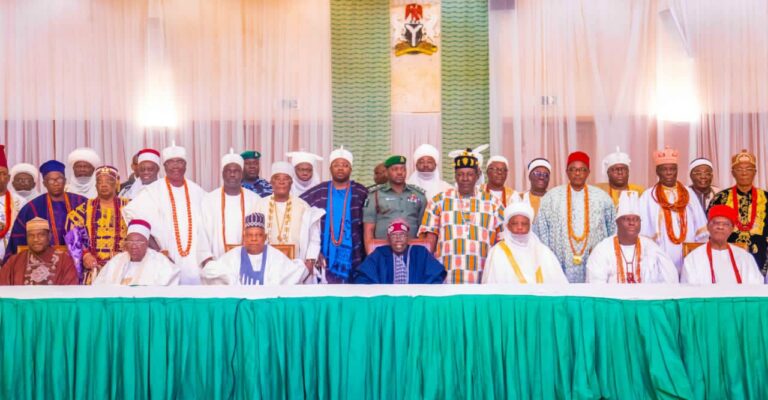
PRESIDENT Bola Tinubu is currently holding a closed door meeting with traditional rulers at the Presidential Villa in Abuja.

The meeting began at about 2:30 pm when the President arrived at the Council Chamber.

The delegation of royal fathers is led by the Sultan of Sokoto, Muhammad Sa’ad Abubakar III, and the Ooni of Ife, Oba Adeyeye Enitan Ogunwusi.

Also at the meeting are Kwara State governor and chairman of the Nigeria Governors’ Forum, Abdulrazaq Abdulrahman, and Hope Uzodinma of Imo State, who doubles as chairman of the Progressives Governors Foru

While the agenda for meeting remains undisclosed, it may not be unconnected with the planned nationwide protests scheduled for the first week of August against economic hardship ravaging the nation.

This latest development came some minutes after Tinubu and All Progressives Congress (APC) Governors also held a closed door meeting at the Presidential Villa.

According to a report by Daily Trust, the meeting held was also unconnected with efforts by the government to stop the planned nationwide protest.

The ICIR earliier reported how the governors under umbrella of  Progressives Governors Forum (PGF), pleaded with Nigerians to shun the nationwide protest 

At a closed-door meeting with members of the forum on Wednesday, July 25, the group’s chairman and governor Uzodimma, admitted that the policies of Tinubu’s government had caused pains and economic hardship for the citizens.

He expressed confidence that the issues would be resolved by the government.

“We have looked at the various policies of this government, and we acknowledge a teething problem associated with the initial stage of the programme and agree that because we are very hopeful, it is also the solution to the current problem and economic hardship that has befallen our country.

“In a very short time, we are confident that the situation will be restored. Prosperity would come at the end of the day. We use this opportunity to advise our young boys and girls, young men and women, to desist from being instigated into causing crisis or chaos in the country, he said.

Meanwhile, he blamed opposition parties for instigating attacks on the government and harped on patriotism among citizens.

The ICIR reported that some Nigerians, along with a group led by former presidential candidate, Omoyele Sowore, have been mobilising to start nationwide protests in the first week of August.

Reacting to the plans earlier, Tinubu had asked Nigerians to shelve the protests.

He called on the citizens to await his administration’s response to all their demands.

The ICIR reported that the Nigerian military joined other state actors to threaten the protest organisers, warning that the Armed Forces would not stand by and allow anarchy to befall the nation.

APC governors urge Nigerians to shun protest

0

THE Progressives Governors Forum (PGF) has pleaded with Nigerians to shun the nationwide protest against hardship slated for the first week of August.

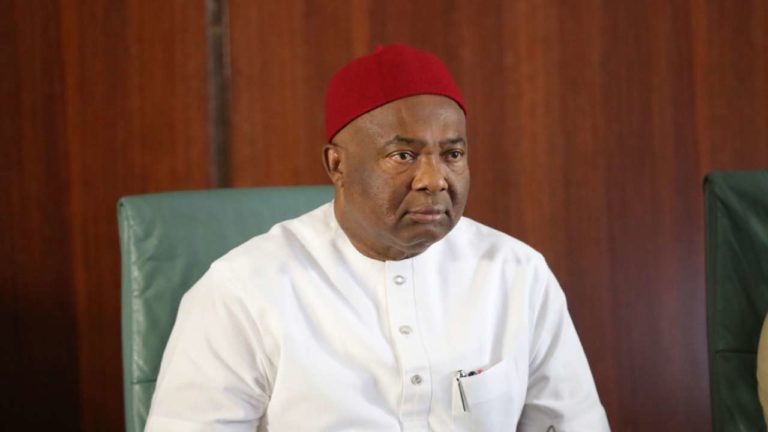
At a closed-door meeting with members of the forum on Wednesday, July 25, the group’s chairman and Governor of Imo State, Hope Uzodimma, admitted that the policies of President Bola Tinubu’s government had caused pains and economic hardship for the citizens.

He expressed confidence that the issues would be resolved by the government.

“We have looked at the various policies of this government, and we acknowledge a teething problem associated with the initial stage of the programme and agree that because we are very hopeful, it is also the solution to the current problem and economic hardship that has befallen our country.

“In a very short time, we are confident that the situation will be restored. Prosperity would come at the end of the day. We use this opportunity to advise our young boys and girls, young men and women, to desist from being instigated into causing crisis or chaos in the country, he said.

He blamed opposition parties for instigating attacks on Tinubu’s government and harped on patriotism among citizens.

“Already, Nigerians have suffered enough. The global economic recession, insecurity in Nigeria, political tension occasioned by instigations and campaigns of calumny by the opposition party, and social media attacks on various policies of the government.

“We want to advise for the interest of the country and a show of patriotism. Our citizens must take ownership of this country. We have no other country we can call our own. We took the opportunity also to agree to explain to the larger Nigerians that this government is doing well, he added.

Uzodinma further said that the body was committed to the country’s unity and doing whatever would make Nigerians live better lives.

He however stated that the governors were not aware of the motive behind the planned protest, and it was unwise for anyone or group to protest under whatever guise.

The ICIR reports that some Nigerians, along with a group led by former presidential candidate, Omoyele Sowore, have been mobilising to start nationwide protests in the first week of August.

Reacting to the plans, President, Bola Tinubu asked Nigerians to shelve the protests.

He called on the citizens to await his administration’s response to all their demands.

The ICIR reported that the Nigerian military joined other state actors to threaten the protest organisers, warning that the Armed Forces would not stand by and allow anarchy to befall the nation.