THE Benue State Police Command has arrested 18 suspects in connection with the violent protest at the Ukum Local Government Area (LGA) of the state on Wednesday, June 3.
The command’s Public Relations Officer, Catherine Anene, disclosed this in a statement on Thursday, July 4.
According to her, the state Commissioner of Police, Hassan Yabanet, has moved to the troubled LGA to stop the protest occasioned by bandits attack on a the community in the LGA.
The command explained that it had deployed more security operatives to the area.
The police said Ukum is a boundary area between Benue and Taraba states, adding that the area is notorious for crisis.
Anene added that the crisis grew after the death of the dreaded Gana and the area has the highest deployment of security agents in the state.
“The deployment is made to curtail activities of bandits that are found in three LGAs; Ukum, Logo, and Kastina-Ala collectively called Sankera axis.
“At about 0800hrs, violent protesters in hundreds began a protest sponsored by criminals to unleash mayhem on the people and destabilise the security network that has prevented them from operating freely in the area, especially with recent successful operations that dislodged several bandit camps in the last two months.
“During this violent protest, personal and government properties were destroyed. These hoodlums also attempted to invade the Ukum Police Division but were repelled by officers on guard duty.
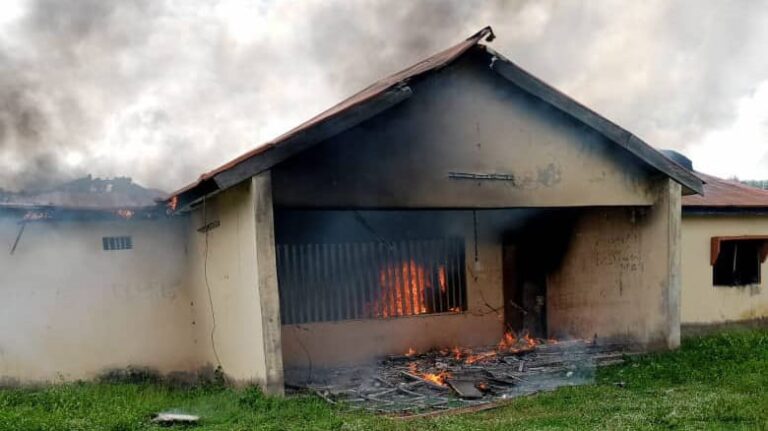
The ICIR reported that some youths had protested the killing of people in Ayati village by local bandits resulting in the destruction of personal and government properties including the office of the Independent National Electoral Commission (INEC) in the LGA by the protesters.
Following the protest, the state governor, Hyacinth Alia, declared a 24-hour curfew in the LGA.
The Resident Electoral Commissioner (REC) for the state, Sam Egwu, informed the INEC headquarters in Abuja of the attack on its office during the protest.
According to a statement by INEC on Wednesday, signed by the National Commissioner and Chairman, Information and Voter Education, Sam Olumekun, the incident happened when the youths in the area said to be protesting against the activities of bandits attacked government facilities, including INEC.
The protest and curfew followed the Tuesday, July 2, attack on Ayati community in Borikyo Council Ward of the LGA by suspected armed bandits. The attack claimed about 11 lives and left others with severe injuries.
The attack resulted in protests by the youths of the area who took over and made bonfires on the Sankera – Ayati-Sai road.
FOR keen watchers of the Nigerian political landscape, the recent outburst by Nyesom Wike, minister of the Federal Capital Territory (FCT), to unseat Ireti Kingibe, the senator representing the nation’s capital, in 2027 is hardly surprising. The reason for this is not far-fetched; the ex-governor of the oil-rich Rivers States is someone who courts controversies like the moth to the naked light.
The story of the supremacy battle between Wike and his estranged godfather, Rotimi Amaechi, who served as governor of Rivers State from 2007 to 2015 cannot be forgotten in a hurry. Wike served him as a chief of staff, after which Amaechi nominated him for appointment as a minister under President Goodluck Jonathan.
However, the two politicians, who hail from the same Ikwere ethnic nationality, fell out after Ameachi defected to the APC and supported Muhammadu Buhari for president in 2015, while Wike, a governorship candidate of the PDP then, supported Jonathan’s re-election bid. Wike later won the 2015 governorship election against Amaechi’s preferred successor, Dakuku Peterside.
In the build up to the last general elections, Wike was engaged in another political battle with the PDP presidential candidate, Atiku Abubakar, for refusing to pressure the ousted PDP National Chairman, Iyorchia Ayu, to relinquish his position for the sake of a “regional balance”.
With another supremacy battle to control the FCT ahead 2027, coming at a time when the dust raised by the power tussle between him and the Rivers State governor, Siminalayi Fubara, is yet to settle, the question is being raised as to how Wike would remain focused on his current mandate in the nation’s capital.
The ICIR reports that in the run-up to the 2023 general elections, the relationship between Wike and Fubara, who was the state accountant-general then, was like that of the proverbial palm oil and salt.
Even against the wishes of many party bigwigs and faithful in the state, who argued that Fubara was a political underdog and should not have been given the plum job, Wike did everything to ensure that he anointed a loyal successor, which he found in Fubara.
How things fell apart
However, no sooner had the footsteps of Wike and Fabura’s supporters who trooped in to congratulate the latter after his inauguration faded away than the relationship between them went awry.
Even though things had started going on smoothly within the first few months between the duo, things started falling apart.
Visible within the cracked wall was the ex-governor ensuring that four commissioners; works, education, justice, and finance, who worked under him, were reappointed and assigned the same portfolios by his successor.
Siminalayi Fubara and Nyesom Wike
While subsequent appointments of commissioners were reportedly determined by Wike, Fabura was limited to appointing special advisers and aides, even as major decisions were subjected to the express approval of his predecessor.
In an apparent move to assert his independence Fubara resorted to relating his travails to some top politicians, including known political foes of his predecessor. This was followed with private visits to Governor Douye Diri of Bayelsa State in Yenagoa, and his Edo counterpart, Godwin Obaseki in Benin.
Also, against his godfather’s advice, Fubara was said to have started attending PDP stakeholders’ meetings outside the state, where he interacted with bigwigs, a development that Wike found confrontational.
Impeachment option
The result was the commencement of the moves to unseat the governor, who was barely six months in office, by the state Assembly, led by Wike’s kinsman from Obio/Akpor Local Government Area, Martin Amaewhule.
Even though the impeachment plot failed Wike had alleged that there was an attempt by Fubara to change the leadership of the state legislature and install one loyal to him in an effort to start building his political structure as a sitting state chief executive.
While the stage was set for 27 members of the state assembly loyal to the FCT minister to execute their plan, the night before the planned impeachment proceeding, precisely on October 30, 2023, an explosion rocked the state Assembly complex and destroyed the hallowed chamber.
The recrimination between Wike and Fabura further escalated even after the peace deal facilitated by President Bola Tinubu as the political godfather and his estranged son intensified strategies to strengthen their respective support bases in the state.
Another supremacy battle?
Although the FCT minister has said he is not distracted by the political crisis in Rivers State, and that he remains focused on his duty as minister, tongues have started wagging over his recent threat to unseat Senator Ireti Kingibe in 2027.
Wike who spoke in Abuja on Monday, June 1, 2024 at the flag-off ceremony of the construction of the Mabushi bus terminal, said: “If we have done well, we have done well. If we haven’t done well, we haven’t done well. I am proud to say that in the short time that President Tinubu has appointed us, we have done well.
In a veiled reference to Ireti Kingibe, the current senator representing the FCT, Wike said: “You said there are no schools and hospitals. You, as a legislator, what have you done? How many bills have you sponsored for us to improve our education and health sectors?
“I challenge that legislator. If you are very popular, in 2027, come and run under Abuja; we will fail you.
“You think that what happened last time will happen again? It will not happen again. If you are popular, come and run. Luckily for me, I am the FCT minister now. So, here is my territory, and I am not afraid.
“People should be able to accept the truth. We are not begging for anybody to be our friend. We have so many friends that we cannot even carry them along. So, how can we go and beg people to be our friends? We are not interested in that.”
The ICIR reports that Kingibe, a member of the Labour Party (LP), defeated Philip Aduda of the Peoples Democratic Party (PDP) in the 2023 general election to takeover as the current senator in the FCT.
Aduda, an ally of Wike, was a senator from 2011 to 2023.
Kingibe and Wike have not had a cordial working relationship since they assumed their respective offices as the former had repeatedly accused the latter of sidelining her, despite being the senator representing the FCT.
On various occasions both politicians have lashed out at each other with Wike maintaining that senator Kingibe’s anger stemmed from his constant companionship with her predecessor, Aduda, and because she was not appointed as the senate chairperson of the committee on FCT.
The ICIR reports that in September 2023, Kingibe said Wike lacked the executive powers to make threats of demolition of “illegal buildings” in the federal capital territory.
Similarly, the lawmaker claimed earlier in January that Wike had failed to respond to her letters and messages amid rising insecurity in Abuja.
The senator also claimed that Wike did not have the interest of the FCT at heart, claiming that residents were battling water scarcity amid other challenges.
Not a few Nigerians have reacted to the threat by Wike, to unseat the FCT lawmaker for criticising his performance.
A former leader of the G-5 governors, Wike is a member of the Peoples Democratic Party (PDP) but serving in the ruling All Progressives Congress (APC), while Kingibe belongs to the Labour Party (LP), a major opposition candidate.
Reacting to Wike’s threat, Moses Paul of the Free Nigeria Movement in a post on X described the minister’s action as ‘disgraceful’.
“It is a tragic reality that in Africa, particularly in Nigeria, public officials misappropriate government funds for trivial projects and then tout them as achievements. A perfect example is the recent use of public funds to merely paint streets, which is then egregiously touted as a remarkable accomplishment.
“This is the evidence of how entrenched corruption, impunity and mismanagement have become in our society,” he tweeted.
He said Kingibe’s stance on Wike’s performance highlighted the importance of prioritising critical sectors and ensuring that public funds are used effectively and efficiently, rather than being squandered on superficial projects and political grandstanding.
‘Sheath your swords, work together’
Responding to the threat by the FCT minister, Nana Kazaure, an ex- aide to Senator Kingibe, said Wike cannot speak for the people of Abuja, stressing that the federal capital territory was not the same as Rivers state.
Nana, a former spokesperson of the Obi/Datti presidential campaign team, however, advised Wike and Kingibe to sheath their swords, put their differences aside and work for the common good of the people of the FCT.
“Minister Wike was appointed to serve the people of the FCT, Senator Kingibe was elected to serve the people of the FCT. They should stop playing like children and think about the greater good of the people of the FCT.
“We are in the FCT and there are places without basic running water; places where children trek eight kilometres to and from school. Therefore, sheath your swords, come to the drawing board and work together,” she said.
ON Thursday, July 4, the United Kingdom (UK) will hold its national election for the first time in five years to elect a new Prime Minister.
All 650 members of the House of Commons will be elected by voters nationwide, with one representative elected for each local district and the results decided by a single round of voting.
Even though three major candidates are running on the Conservative, Labour, and Reform parties’ platforms, the Conservative and Labour parties are the front-runners.
The Conservative Party has ruled for 14 years, hence this election has the potential to significantly change the political landscape of which the Labour Party is currently perceived to have the strongest candidates.
While the Labour Party centres its campaign around change, the new Reform Party which is also contending with the Conservatives is focusing on the party’s failure to control immigration.
In this report, The ICIR profiles the two major contending candidates vying for the position of prime minister in the UK.
Rishi Sunak- Conservative Party
Rishi Sunak is the current and first British- Asian Prime Minister of the United Kingdom and the leader of the Conservative Party.
He assumed office in October 2022 after the former Prime Minister, Liz Truss resigned. He is the 56th Prime Minister of the United Kingdom.
Under Boris Johnson, Sunak had previously served in two cabinets and recently, he served as Chancellor of the Exchequer from 2020 to 2022.
From 2015 to date, he has been the Conservative Member of Parliament (MP) for the Richmond Constituency in North Yorkshire.
Announcing the election date, Sunak said that the exercise served as a time for Britain to choose its future, adding that it would be about “how and who they trust to turn that foundation into a secure future.
Sunak is 44 years old.
Keir Starmer- Labour Party
Keir Rodney Starmer is a 61-year-old British politician and lawyer who has led the Labour Party since 2020.
Before becoming a member of parliament in 2015 for Holborn and St. Pancras, he served as the Director of Public Prosecutions for England and Wales from 2008 to 2013.
If elected as Britain’s prime minister, Starmer pledges to bring about change and stability.
Asserting that a Labour government would not rejoin the now-27-member group, he opposed Britain’s choice to quit the European Union.
His party’s manifesto prioritises issues namely expanding childcare, hiring 6,500 more teachers, and offering free breakfast clubs in primary schools.
By improving housing laws, reorganising Universal Credit, and generating more steady employment, he hopes to increase economic security.
DESPITE the concerns raised by the Nigerian Labour Congress (NLC) over the upward review of tariffs, the electricity distribution companies (DisCos) announced the upward review of electricity tariffs for Band A customers on Wednesday, July 3.
The tariff was increased from N206.80/Kilowatts(kWh) to N209.5/kWh.
The upward review takes effect from July 1, as seen by official statements issued by some of the distribution companies.
Taking to its X account, the Port Harcourt Electricity Distribution Plc (PHED) said:
official notice for tariff increment by Kaduna DisCo
“Dear esteemed customers, Please be informed that there is an upward tariff review for our Band A feeders from N206.80/kWh to N209.5/kwh effective 1st July 2024. The guaranteed availability of a minimum of 20 hrs per day still stands.
“The tariff for Bands B, C, D, and E remains unchanged.”
Similarly, Kaduna Electricity Distribution Company (Kaduna Electric) said:
“Dear esteemed customers, the management of Kaduna Electric informs the public of an upward review in the tariff of Band A feeders from N206.80/kWh to N209.5/kWh.
“The review is effective from 1st July 2024 and affects prepaid and postpaid customers. Kaduna Electric assures customers on its Band A feeders of the continued availability of 20-24 hrs daily as stipulated in the service-based tariff regime”.
“Effective immediately, the tariff will be adjusted from N206.80/kWh to N209.50/kWh. This review has been duly approved by the Nigerian Electricity Regulatory Commission (NERC) as captured in the mIn April, the Nigerian Electricity Regulatory Commission (NERC) ordered the immediate upward review of electricity tariffs. multi-year tariff supplementary order,” a statement signed by Acting Managing Director, IBEDC, Francis Agoha, read.
Similar posts were made by Ikeja Electricity (IE) and Abuja DisCo (AEDC).
the official notice for tariff increment by Ikeja DisCo
In April, the ICIRreported the directive by the Nigerian Electricity Regulatory Commission (NERC) on the immediate upward review of electricity tariff for customers under Band A, a directive affirmed by the Minister of Power, Adebayo Adelabu who had earlier raised concern over the Nigerian government’s unsustainable power sector subsidy.
Most industrial areas, highbrow estates, and residences are classified under Band A.
Findings have shown that gas pricing, foreign exchange rate variables, and inflationary pressure are key factors considered by electricity sector stakeholders before upward tariff review.
Already, the decision has attracted criticism from industry stakeholders and Nigerians who said the increment would not solve the power sector crisis if NERC does not give targets to the DisCos and follow the signed agreement with a performance improvement plan.
Secretary of the Network of Electricity Consumers, Uket Ubong, said the tariff hike for band A customers to ₦250/unit wouldn’t solve liquidity problems in the power sector.
“Tariff increase will never solve the liquidity crises. I have said it severally. It’s certainly not the silver bullet. Increasing the tariff to ₦1000/kWh will not solve the problem if the power distribution companies remain rent seekers/ collectors. What happened to the Performance Improvement Plan (PIP) signed by the power distribution companies with the NERC under the service-based reflective tariff? he asked.
Commenting further on the development, the President of the Electricity Consumer Protection Advocacy Centre (ECPAC), Princewill Okorie, said the DisCos did not consult with stakeholders over the tariff increment.
”Have they finished implementing the former Multi-Year Tariff Order (MYTO)? We are talking about tariffs, what about some unlawful collections in billing? Where is the meter acquisition fund? Is it not the same consumers that are buying the meters? Have they refunded those who paid for meters under the Meter Acquisition Fund?
“Now, who is asking questions about their capital expenditure (capex) and operating expenditure (opex)? How much opex has the Nigerian Electricity Regulatory Commission (NERC) been approving for them every year?” he queried.
THERE are growing concerns as the Nigerian Purchasing Managers’ Index (PMI) dropped to 50.1 points in June, showing inflation has weighed down business and economic activities to a seven-month low.
Investopedia described PMI as the monthly indicator of economic activity based on a survey.
The monthly PMI index from Stanbic IBTC is a widely used economic indicator that assesses the health of a country’s manufacturing or services sector.
In June, business activity fell to a seven-month low of 50.1 points, easing from 52.1 in May and indicating a broad stagnation in the Nigerian private sector.
The PMI reading of above 50.0 points signals expansion in business conditions while below 50.0 points a contraction.
Economic analysts believe that the the drop in the PMI may not be unconnected to the hike in interest rates by the Central Bank of Nigeria (CBN) through the MPC meeting which has affected lending to businesses and the overall economy.
The last MPC meeting held in May saw the rate hiked to 26.25 per cent.
“We have been hiking the rate and it has not solved our problems and it is even suffocating lending to businesses. We must find a wholistic solution to the economy while prioritising lending to businesses and the manufacturing sector at the single-digit interest rate,” an economist, Muktar Muhammed said.
The ICIR can report that in December 2023, the PMI was at 52.7 points, it rose to 54.5 points in January 2024, dropped to 51 points in February and March consecutively, and slightly rose to 51.1 points in April.
The report stated, “June data signaled a broad stagnation of the Nigerian private sector as subdued demand and intense price pressures led to slowdowns in growth of output and new orders. In turn, employment rose only fractionally. There were signs of inflationary pressures picking up, with purchase prices, staff costs, and selling charges all increasing more quickly than in May.
“The headline PMI registered only fractionally above the 50.0 no-change mark in June to signal broadly unchanged business conditions at the end of the second quarter. At 50.1, the index was down from 52.1 in May and the lowest in seven months.”
Further analysis of the report shows that new orders and output grew at slower rates due to weakening domestic demand and increasing price pressures.
The rate of input inflation remained elevated in June, ticking higher for the second month running to the strongest since March which was linked to currency weakness and higher raw material costs, particularly those related to animal feed.
As a result, companies increased their selling prices rapidly again in June, with the pace of inflation quickening slightly from that seen in May.
Commenting on the report, the head of equity research at Stanbic IBTC, Muyiwa Oni said, “The PMI reading in the quarter is consistent with a likely slowdown in non-oil sector’s growth to 2.6% y/y (year-on-year) in Q2:24 from 2.8% y/y in Q1:24.
“Nonetheless, headline inflation is likely to peak in June, with moderation expected in H2:24 (second-half 2024) as the year-on-year effects of PMS subsidy removal (which induced higher fuel prices) and significant currency depreciation (which accompanied the FX unification) fade.”
In addition to the commencement of the primary harvest season in September, Oni said this was likely to provide some respite for consumers in the second half of the year.
On June 15, The ICIRreported that Nigeria’s headline inflation consistently increased in the last year of President Bola Tinubu-led administration.
According to the latest data from the National Bureau of Statistics (NBS) the country’s inflation rate increased to 33.95 per cent as of May 2024.
The Thomson Foundation is organising and inviting applications to its 2024 Young Journalist Award, in partnership with the Foreign Press Association (FPA).
Three finalists will be flown to London for the gala award night.
Journalists working in countries with a Gross Domestic Product (GDP) per capita of less than US$20,000 are eligible.
Journalists aged 30 and younger working in developing countries can compete for this award.
Entrants should submit a portfolio of three published pieces of work (print, audio, video, multimedia or a combination of all four) produced in the 12 months preceding August 9, 2024.
Entries can be in any language but should be accompanied by a verbatim English-language translation
The organiser says, “All entrants should be reporting from their home country as defined by the GNI or, if not in their country of origin, in another country fitting the same criteria”.
“Applicants also need to provide an explanation of any collaboration undertaken with colleagues or external organisations on the stories they submit”.
The deadline for the submission of application is August 9, 2024. i
IRATE youths in Benue State have set ablaze the Independent National Electoral Commission (INEC) office in Sankara, the headquarters of Ukum Local Government Area.
The Resident Electoral Commissioner (REC) for the state, Sam Egwu, informed the INEC headquarters in Abuja that the incident occurred at 2 pm on Wednesday, July 3.
According to a statement by INEC on Wednesday, signed by the National Commissioner and Chairman, Information and Voter Education, Sam Olumekun, the incident happened when the youths in the area said to be protesting against the activities of bandits attacked government facilities, including INEC.
“Although no casualties were reported, the building has been extensively damaged. Office furniture and other movable and immovable materials, including 10 electric generators, 300 ballot boxes and 270 voting cubicles, were destroyed in the attack.
“The attention of security agencies has been drawn to the incident and they have already deployed their personnel to the area,” the INEC commissioner stated.
Meanwhile, the Benue state governor, Hyacinth Alia, has imposed a 24-hour curfew on the affected local government.
The protest and curfew followed the Tuesday, July 2, attack on on Ayati community in Borikyo Council Ward of the LGA by suspected armed bandits. The attack claimed about 11 lives and left others with severe injuries.
The attack resulted in protests by the youths of the area who took over and made bonfires on the Sankera – Ayati-Sai road.
The ICIR reports that repeated efforts by the previous administration in the state to curtail herders’ attacks on the state residents have yielded only little result.
On January 1, 2018, attacks were carried out by the suspected herders in Logo and Guma LGAs of the State, with over 70 people killed.
Witnesses said the coordinated attacks began around 9 p.m. and continued until the early hours as the herders had a field day killing people and burning down houses without any intervention by security agencies.
The attacks have continued since then and every effort to curtail them has failed.
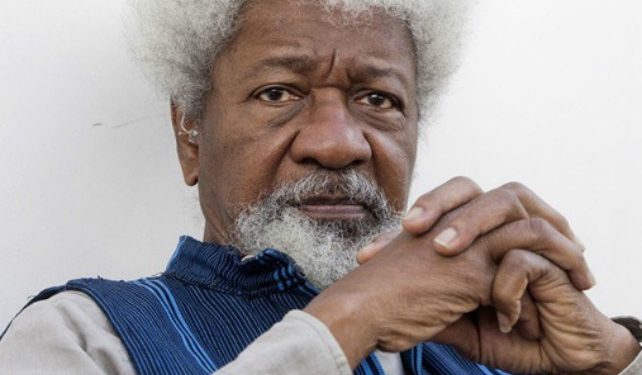
THE Foundation for the Promotion of Documentary Film in Africa plans to hold a special premier screening of the movie “The Man Died” an adaptation of a play by Africa’s first Nobel laureate, Wole Soyinka, to celebrate the author’s 90th birthday.
According to a press release by the foundation, the screening will be held on Friday, July 12, 2024, in Lagos State.
“This is not the premiere yet but a special screening to commemorate the 90th birthday of Professor Wole Soyinka,” said the organisers, stressing that guests would only be admitted based on invitation and RSVP. A later date will be set for the formal premiere of the film, assures the managers of the event,” part of the statement read.
The movie will also be screened at The Africa Centre in London, United Kingdom, on July 25.
The film was shot in Lagos and Ibadan, and produced by Femi Odugbemi for a film company, Zuri 24 Media.
It received financial support from the New York University, in Abu Dhabi, the Lagos State Government, Providus Bank and some individuals.
“Through this film, we aim to inspire young people to embrace their role in demanding humanistic ideals from our nation’s political leadership.
“In a world where authoritarianism and corruption often threaten democratic values, we hope the film will resonate as a call to action for citizens to remain vigilant and proactive in pursuing justice and equity. We hope it sparks meaningful dialogue to inspire positive change in our country,” the statement quoted Odugbemi as saying.
Although based on Soyinka’s prison notes, the film is not a biopic of the author’s prison life. It, however, includes narratives on his prison experiences among others.
“As you probably know, it is a very intimate account of Soyinka’s 22 months in solitary confinement for his role in trying to bring a halt to the civil war. I hope this narrative of resistance and courage inspires this generation,” Odugbemi further said.
The ICIRreported that a multi-media literary theatre and movie company Adubiifa Network Company (ANC) would present a stage play, titled “The Noble Warrior – Eni Ogun” to commemorate Soyinka’s 90th birthday celebration.
The play will premiere on Monday, July 15 by 6:00 p.m. at the Hubert Ogunde, Hall of the June 12 Cultural Centre in Abeokuta, Ogun State.
THE Inspector-General of Police (IGP) Kayode Egbetokun has directed the expansion of the activities of the Nigeria Police Force (NPF) National Cybercrime Centre (NCCC) to the existing Force Criminal Investigations Department (FCID) annex offices.
The expansion is to enable the efficient handling of matters related to Cybercrimes (Prohibition, Prevention, etc.) Amendment Act 2024.
This was disclosed by the spokesperson of the NPF, Olumuyiwa Adejobi, in a statement on Tuesday, July 2.
According to the NPF, the development followed the recent increase in the creation and circulation of misinformation and disinformative materials and other cyber-related crimes, capable of causing a breakdown of law and order.
In addition, it is an attempt to tackle attempts to discredit the country through various social media platforms.
The IGP said it had become reasonable to take bold and strategic steps to nip the habit in the bud to prevent damage to the peaceful coexistence of well-meaning citizens and residents of the country.
“Consequently, the NCCC will now have operational offices at the FCID annex offices in Lagos, Kaduna, Gombe, and Enugu States. This will help in professionally coordinating and monitoring smooth investigations of cyber-related infractions reported to the police.
“The Inspector-General of Police therefore reiterates that the expansion of the Centre will significantly enhance the NPF’s ability to combat cybercrime, enabling prompt and coordinated responses to cyber threats across the nation”.
He reassured the public of the NPF’s steadfast commitment to securing digital spaces and ensuring the safety and security of all Nigerians.
Egbetokun reiterated that the Centre’s expansion would significantly enhance the NPF’s ability to combat cybercrime, enabling prompt and coordinated responses to cyber threats.
The ICIRreported that following the IGP’s order, departments previously investigating cybercrimes now operate under the Force National Cybercrime Centre.
The Centre is domiciled in the Force Criminal Investigations Department (FCID) at the national headquarters in Abuja.
The ICIR reports that the Centre has been used to hound and harrass journalists, despite the constitutional mandate given to the media practitioners to hold the government and its agencies to account.
In May, the Centre invitedThe ICIR management and one of its reporters, Nurudeen Akewushola, over an investigation that exposed the corrupt acts of two former Inspectors-General of Police, Solomon Arase and Ibrahim Idris and other top officers of the Force.
On Wednesday, May 1, a journalist with the Foundation for Investigative Journalism (FIJ) Daniel Ojukwu was abducted by officials of the Nigerian Police and detained at the NPF-NCCC for ten days.
Before his abduction, former editor of First News Segun Olatunji was also abducted and detained for nearly two weeks by operatives of the Nigerian military before being released.
A foremost lawyer, Femi Falana, declared that arresting journalists based on cyberstalking and criminal intimidation charges is unlawful.
SOME energy experts are seeking actions on oil theft as the Nigerian National Petroleum Company Limited (NNPCL) has declared a state of emergency in the country’s oil and gas industry to increase crude oil production and grow its reserves.
The state of emergency declaration was contained in a statement on Tuesday, July 2, signed by NNPCL’s chief corporate communications officer, Olufemi Soneye, posted on the company’s official X handle.
According to Soneye, the NNPCL Group Chief Executive Officer, Mele Kyari, made the declaration at the opening ceremony of the 23rd edition of the Nigeria Oil & Gas Conference and Exhibition (NOG Energy Week) in Abuja, on Tuesday.
“We have decided to stop the debate. We have declared war on the challenges affecting our crude oil production. War means war.
“We have the right tools. We know what to fight. We know what we have to do at the level of assets. We have engaged our partners. And we will work together to improve the situation,” he quoted the GCEO to have said.
According to Kyari, a detailed analysis of assets revealed that Nigeria can conveniently produce two million barrels of crude oil per day without deploying new rigs, lamenting that the major impediment to achieving it remains the inability of players to act promptly.
The “war” will help NNPC Ltd and its partners to speedily clear all identified obstacles to effective and efficient production such as delays in procurement processes, which have become a challenge in the industry, Kyari maintained.
The NNPCL boss said the company would replace all the old crude oil pipelines built over four decades ago and also introduce a rig-sharing programme with its partners to ensure that production rigs stay in the country for between four and five years which is the standard practice in most climes.
He also called on all the players in the industry to collaborate towards reducing the cost of production and boosting production to target levels.
Kyari added that the NNPCL was committed to investing in critical midstream gas infrastructure to boost domestic gas production and supply for power generation, industrial development, and economic prosperity of the country.
Commenting on the state of emergency declaration, a former President of the Nigerian Society for Petroleum Engineers, Joe Nwakwue, told the ICIR that every Nigerian should be worried about the output level of its oil production with the rise in the price of crude oil at the International market.
“It is a shame that we are unable to take advantage of an extended period of global high oil prices that we have seen since at the global oil market. We are not meeting up with our OPEC quota. The issue of insecurity in the oil-rich region is still a concern.
“Declaring a state of emergency doesn’t change anything. We must ask what are the deliverables for respective agencies and task them on the achievement. We need to expand investments in the upstream level and the relevant agencies create the enabling environment for that,” he added.
An economist, Kalu Aja, believes the Nigerian government is not doing enough to curb oil theft and create an enabling environment for petroleum investors.
“This is our major source of revenue for now and we need to guard it jealously. Our inability to meet up with our OPEC quota is a major concern. This is a major setback in having a maximum supply of dollars in Nigeria’s foreign exchange market. We need to stop crude oil theft of our national oil,’ he said.
The ICIRreported recently that Nigeria’s crude oil production volume has been dropping consecutively since the beginning of the year.
In January, Nigeria produced 1.43 million barrels per day (bpd) below the OPEC-assigned quota.
It dropped to 1.32 million bpd in February, to 1.23 million bpd in March, to 1.28 million bpd in April, and to 1.25 million bpd in May.
The ICIR also analysed in the report that Nigeria was losing over N16 billion in revenue daily from crude oil production amounting to N1.62 trillion between January and May 2024 as oil production volume dropped rapidly.