THE Central Bank of Nigeria (CBN) said it would sanction deposit money banks (DMBs) and authorised forex dealers rejecting old and lower denominations of the United States Dollar (USD) bills from customers.
The apex bank gave the warning in a circular on Monday, July 1, signed by its acting director of Currency Operations Department, Solaja Olayemi, emphasising the mandatory acceptance of old and lower denominations of dollar notes.
According to CBN, the directive comes in response to findings from consumer market intelligence, which revealed a continued pattern of selective rejection of these bills by financial institutions and forex dealers.
In the circular dated June 27, the apex bank reiterated the necessity for strict adherence to its earlier directive and referred to it early directive.
The ICIR reports that CBN had on April 9, 2021, explicitly prohibited the selective acceptance of deposits and required all relevant parties to comply fully.
“The outcome of the consumer market intelligence conducted by the Bank revealed the continued rejection of old/lower denominations of United States (US) Dollar bills by Deposit Money Banks (DMBS) and other authorised forex dealers.
“Kindly be reminded that the Central Bank of Nigeria (CBN) circular referenced COD/DIR/INT/CIR/001/002 and dated 9th April 2021 which explicitly frowned at this selective acceptance of deposit is still in force and must be adhered to and complied with by all relevant parties,” CBN stated.
It said that based on the earlier directive, all DMBs and authorised forex dealers were henceforth required to accept both old series and lower denominations of USD bills that are recognised as legal tender.
The CBN directive is to ensure customers deposit the dollar bills without facing unnecessary rejection.
It is also intended to enforce compliance and ensure uniformity in handling foreign currency deposits.
It further advised the DMBs and authorised forex dealers to cease the practice of defacing or stamping on the USD banknotes as such actions often result in the notes failing authentication tests during processing and sorting, causing further complications.
The apex bank urged the DMBs and authorised forex dealers to comply with its directive.
RESIDENTS of Mpape, a suburb surrounded by mountains adjacent to the highbrow Maitama district in Abuja, the nation’s federal capital territory, are currently living in fear of attacks from criminal gangs, phone snatchers, armed robbers and kidnappers.
Mpape, a well-known communityis largely inhabited by low-income households.
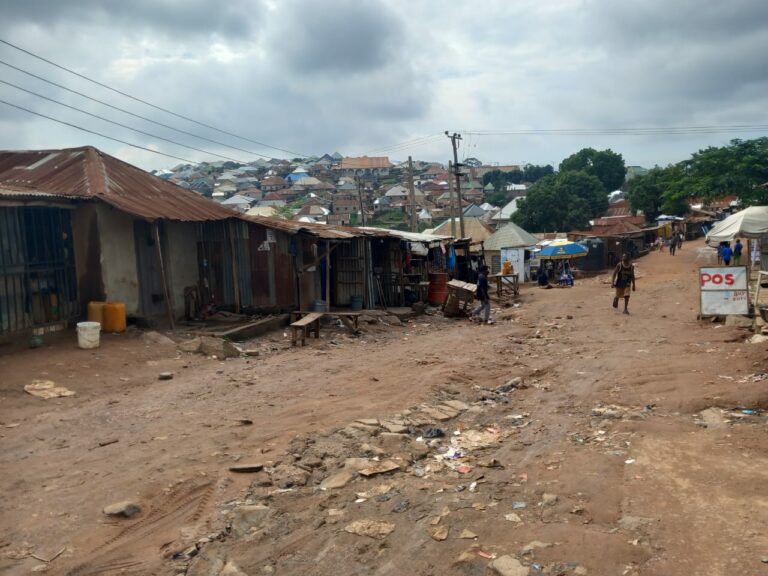
The community is a highly populated area with a distinctive terrain. It is connected to the city by a long, twisting, narrow road that is mountainous and overlooks a large rocky area where granite has long been exploited by construction companies.
In recent months cases of insecurity and criminal activities like kidnapping, armed robbery, phone snatching and cultism are constantly reported
FCT Police Commissioner, Benneth Igwe
As a result of the rampant attacks, Mpape residents now live in palpable fear and tension. The area which is filled with shanties and bad roads is the complete opposite of the nearby highbrow Maitama district, where the high and mighty in the FCT live.
While some residents are left with no option than to cry for help others have simply relocated from the community.
Residents speak
A resident, Grace Abah who spoke to The ICIR said her family left Mpape after her house was attacked by armed robbers in May.
She said the family had to relocate from Mpape due to the incident.
“They came in their numbers around 3am and attacked us. They removed the burglary proof to gain access to our flat.
“We escaped through the back door. They were fully armed and took all our phones and laptops,” she said.
In a similar fashion in May, some residents of Katampe 2 a relatively new are in Mpape were attacked repeatedly by armed robbers.
Katampe 2, Mpape FCT under siege from armed robbers
Two of the affected persons who spoke to The ICIR confirmed that the hoodlums gained access to their apartment by breaking the kitchen door.
According to one of them, Idowu, the incident has left him and his family traumatic and in constant fear.
“It was around 3am, they held us hostage and collected all we have. It was a traumatic experience. They went to another building to rob them on the same night,” Idowu stated.
Another resident of Katampe 2 who chose to remain anonymous stated that residents of Katampe 2 and 3 in the Mpape community are under constant attacks from criminal gangs.
According to him, the lack of police presence in the community is another factor that has aided the activities of criminals in the area.
“Katampe 2 with all its population does not have a single police post. The citizens are left on their own.
“Once in a while, police patrol the area at night but it has not stopped the hoodlums from operating freely at night.
“We have vigilantes, but they have not been well organised in recent months,” the resident said.
Also referring to the rampant armed robbery attacks in Katampe 2 and 3, an X user Mum Favour tweeting from her handle @favored_g called the attention of FCT police to the crime level in the area.
“We have been experiencing daily armed robbery attacks in Katampe 2, Mpape, FCT in the last months. It is unfortunate that Abuja is not safe at all. We need urgent Police protection in KATAMPE 2/3. @FCT_PoliceNG @Dhavidote@Jossy_Dannyking@Princemoye1@AishaYesufu,” she posted.
Findings show that phone snatching is another common security issue in Mpape.
In June, The ICIR reported that anAbuja-based journalist, Joel Waksi, was found dead on Wednesday, June 19, five days after he was declared missing.
Waksi, an On-Air Personality (OAP) with Atar Communication, owners of Liberty TV/Radio reportedly left the office around 9p.m. on Friday, June 14, and was supposed to return to work at the station’s Mpape office by 2 p.m. the following day.
Abuja-based journalist Joel Waksi. Image courtesy Voice of Liberty NG
The group general manager (GGM), Atar Communication, Balarabe Muhammad, in an interview with Daily Trust, said the police in Mpape division of the nation’s capital had declared that Waksi’s body was found near the Panteka neighbourhood and had been transferred to the morgue at Kubwa General Hospital.
According to Muhammad, the deceased was stabbed around his neck, and his phone could not be found. He said his organisation assumed that phone snatchers had attacked him.
Muhammad added that the victim had escaped a similar attack in which he had been stabbed below the belly two months earlier.
The ICIRmade attempts to confirm the details of the incident from the police, but calls and messages sent to the Spokesperson of the FCT Police command, Josephine Adeh, were not picked up or replied to.
The Panteka and Beger Quarry area of the community is notorious for phone snatching and other criminal activities.
For instance, there were reports in May that a skit maker, Chidike Emmanuel, was killed by around the Berger Quary area of Mpape.
An X user, Loveline Imaobong, raised the alarm that Emmanuel was found lifeless in a mortuary.
“The guy in the picture is lying lifeless in the mortuary, he was attacked by Fulani men. Any lead to his family members would be appreciated. They should please go to Mpape’s new police station, Berger Quarry. Please repost till it gets to them,” she posted.
Imabong further disclosed that Chidi was among six persons allegedly attacked by the suspected herdsmen.
Police reaction
When contacted on the rampant attacks in Katampe, Mpape, the spokesperson of the FCT Police command, Adeh directed The ICIR to the Divisional Police Officer (DPO).
“Go to the DPO covering that area with this complaint, please. They are the ones to act. I have done mine by forwarding your complaint to them but you should go to them directly please,” she stated.
Meanwhile, a reliable police source told The ICIR that the Mpape police division lacks adequate manpower and resources to tackle the ongoing crime level in the community.
The source also said that the lack of a police station in Katampe contributes to the rising cases of criminal activities in the area
He added that to successfully bring the crime rate down, the FCT police command must send more resources in the form of vehicles and other logistics and increase the number of operatives in the division.
In January, the minister of FCT, Nyesome Wike berated the council chairpersons while addressing stakeholders at an emergency security meeting in his office, he expressed concern over the apparent lack of proactive measures taken to address the rising insecurity issues within their jurisdictions.
A few months later, in March, Wike was grilled by the National Assembly over the the spate of insecurity in the FCT.
AT least 63 persons have died as a result of cholera and 2,102 suspected cases of the disease have been recorded across 33 of Nigeria’s 36 states.
This was disclosed by Director-General of the Nigeria Centre for Disease Control and Prevention (NCDC), Jide Idris, on Tuesday, July 2.
He said the top ten contributing states are Lagos, Bayelsa, Abia, Zamfara, Bauchi, Katsina, Cross River, Ebonyi, Rivers and Delta.
Idris also said cholera had spread to 122 local government areas as of June 30 and there had been a fatality rate of three per cent since the beginning of 2024.
He further stated that the NCDC had activated the National Cholera Multisectoral Emergency Operation Centre (EOC) to better respond to suspected cases nationwide.
“In response to the rapidly increasing cholera cases, a dynamic risk assessment was conducted by subject matter experts on the cholera outbreak situation in Nigeria last week.
“The subject matter experts were drawn from relevant ministries (Health, Environment, Agriculture, Water Resources, etc.), departments, agencies, stakeholders, and major partners. The outcome of the risk assessment placed the country at ‘high risk’ of increased risk of cholera transmission and impact,” he said.
The centre will also see to the effective mobilisation and distribution of resources to affected areas.
Speaking on the cause of the spread, Idris identified open defecation and poor sanitation as major issues.
Weak regulation on the construction of soak-away and boreholes (some sunk close to a water source and boreholes sunk in the wrong location), inadequate implementation and enforcement of public nuisance law and other relevant public health laws are some other challenges,” he said.
The director-general also said that inadequate knowledge and practice of basic hygiene and some other issues were hindering efforts to contain the outbreak.
As Nigeria struggles with the latest cholera outbreak, the World Health Organization (WHO) announced that there was an increase in the spread of cholera, globally.
The highest number of cases was recorded in the Eastern Mediterranean Region, followed by the African, American, South-East Asian, and European regions.
DAYS after the anti-tax hike protests that led to deadly clashes in Kenya, some youths activists have called for a fresh protest which took many Kenyans to the streets under a heavy police watch.
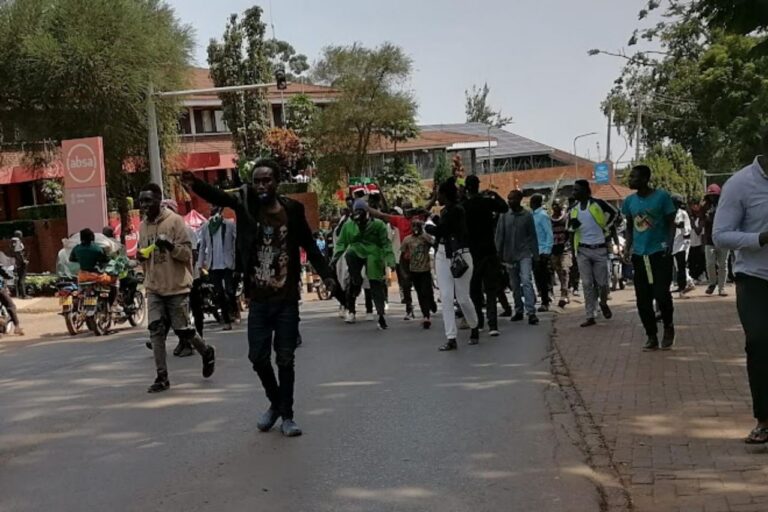
The protesters on Tuesday, July 2, started another protest demanding that President William Ruto step down despite declining to sign into law the controversial Finance Bill.
According to the Kenya National Commission on Human Rights (KNCHR), the last protest led to the death of about 39 people, leaving 361 persons injured.
The commission condemned the use of force against demonstrators.
The Central Business District of Nairobi, one of the venues of the earlier protests, was empty on Tuesday morning as the police were on the streets, with only a few people sighted.
Addressing newsmen on the issue, a local politician, John Kwenya, said although there had been lootings since last Thursday, there was “no alarm” despite the businesses shutting.
“They are scared. I told people to open their businesses, but most are afraid, they even moved their goods from the shops. This is economic sabotage, the last protest wasn’t Gen-Zs, they were goons,” he said.
However, NTV, a Kenyan local TV showed larger crowd demonstrating in Mombasa, the opposition’s coastal stronghold, and smaller gatherings with a noticeable police presence were seen in Kisumu, Nakuru, and Nyeri.
Along with the dead and injured from the earlier protests, the state-funded KNCHR reported that there had also been 627 arrests of protestors and 32 occurrences of “enforced or involuntary disappearances.”
“The unjustified use of force and violence against protestors, medical professionals, attorneys, journalists, and safe areas like churches, medical emergency rooms and ambulances is still condemned by the commission in the strongest terms possible,” the KNCHR stated.
The ICIRreports that on Thursday, June 27, some protesters returned to the streets demanding that the President and other leaders step down from their positions despite the President bowing to pressure and declining to sign the controversial Finance Bill. The protesters claimed they no longer believed in the administration, and it must quit.
The protests in Kenya began about two weeks ago following the controversial Finance Bill which the citizens believed would hike taxes and worsen the already harsh economic realities.
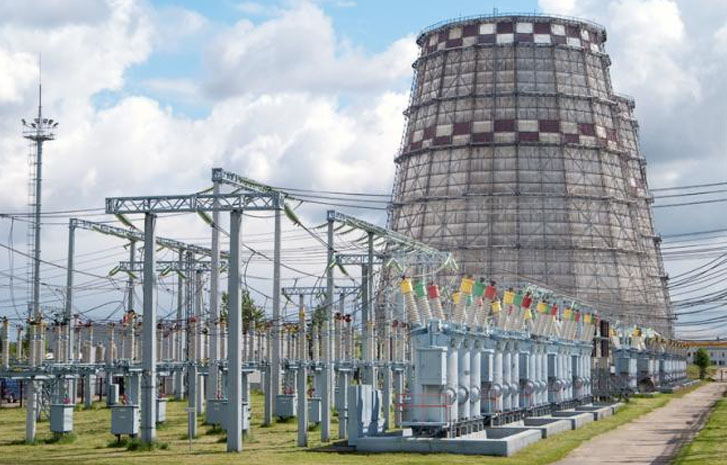
THE Transmission Company of Nigeria (TCN) has suspended the two-month planned power outage on the Oshogbo/Akure and Ado-Ekiti 132KV lines.
The official spokesperson of Benin Electricity Distribution Company (BEDC), Evelyn Gbiwen, in a s statement issued on Tuesday, July 2, said the outage was earlier scheduled for two months.
“We wish to announce that we have just received a further update from TCN to the effect that TCN has suspended the planned outage on Osogbo/Akure and Ado-Ekiti 132KV lines.
“The planned power outage which was previously scheduled for July 1 to August 31, has been suspended till further notice. Our service will therefore continue without interruption,” the statement added.
According to her, BEDC remains committed to serving our customers better.
it would be noted that BEDC has earlier informed its customers in Ondo and Ekiti that TCN is scheduled to carry out maintenance work on the 132KV Osogbo-Akure transmission lines for two months.
It said the maintenance would involve the installation of optical ground wire and other activities that required an outage for a safe workspace.
The ICIR has earlier reported the official unbundling of the Transmission Company of Nigeria (TCN) into two entities – the Nigerian Independent System Operator Nigeria Limited (NISO) and the Transmission Service Provider (TSP).
THE Federal Government of Nigeria has approved the exemption of withholding tax for small businesses, manufacturers, and farmers.
The chairman of the Presidential Committee on Fiscal Policy and Tax Reforms, Taiwo Oyedele, disclosed this on his official X-handle on Tuesday, July 2.
He said the approved regulation was expected to be published in the country’s official gazette in the coming days.
According to Oyedele, a simplified and business-friendly withholding tax regime has been approved as part of the ongoing fiscal policy and tax reforms.
He said the committee introduced some critical changes to address the identified challenges in the withholding tax system.
The key changes, he said, include the exemption of small businesses from withholding tax compliance; reduction of tax rates for businesses with low margins; exemption of manufacturers and producers such as farmers; and measures to curb evasion and minimise tax avoidance.
Other changes made are ease of obtaining credit and utilisation of tax deducted at source; changes to reflect emerging issues and adopt global best practices; and clarity on the timing of deduction and definition of key terms.
Giving a background to the withholding tax regime, Oyedele said, “Withholding tax was introduced into the Nigeria tax system in 1977 to serve as an advance payment of income tax on specified transactions.
“It was designed to provide the government with regular revenue flow and to serve as a means of curbing tax evasion.”
He explained that the challenge with the tax regime has been its expansion over time to cover more transactions, as such, various ambiguities and complications crept in.
“This resulted in many businesses, especially SMEs, being exposed to excessive burden of compliance and a strain on the working capital of low-margin businesses,” the tax expert maintained.
He highlighted other unintended consequences including ambiguities regarding persons required to comply, eligible transactions, applicable rates, and timing of the obligation for remittance, among others.
It also includes challenges regarding obtaining refunds for excess withholding tax, and treatment of the deduction as a separate tax, thereby adding to the list of multiple taxes and cost of doing business.
He noted the lack of an exemption threshold as making the cost of compliance by taxpayers and the cost of enforcement by the tax authority uneconomical.
Other unintended consequences are some emerging and contemporary issues that are not properly addressed; and the overall structure of the withholding tax regime that promoted tax inequity, Oyedele added.
The ICIR reported that President Bola Tinubu appointed Oyedele to lead the tax reform team with the mandate to reform and harmonise the country’s fiscal policy and tax system.
The organisation had also reported that the committee had proposed a reduction in multiple taxes and made other changes in the draft copy of the ‘National Fiscal Policy Framework,’ it submitted to the National Assembly.
THE Kwara State Command of the Nigeria Security and Civil Defence Corps (NSCDC) has nabbed a fake ministry official, Ganiyu Yusuf Olalekan, for allegedly collecting N4.5 million from one Ibrahim Mustapha for three hajj pilgrimage slots.
The NSCDC said Olalekan falsely proclaimed to be a senior staff worker in the Ministry of Finance and promised the victim three Hajj slots in exchange for the payment.
The Publicity Secretary of the NSCDC, Ayoola Michael, in a statement on Tuesday, July 2, said during the investigation, it was discovered that the suspect is a swindler who deceives unsuspecting Nigerians for financial gain.
He added that two other suspects were arrested for alleged stealing and burglary.
He explained that that following a report by one Mumini Kabir about multiple burglaries at his home where valuable items including a motorcycle, two Android phones, and a home theatre systemwere stolen among other household items, detectives from the command tracked down one Ibrahim Wasiu, 31, a resident of Eyenkorin.
He added that another suspect, 33-year-old Soliu Jimoh, was located and taken into custody on June 30 for regularly stealing electrical cables and fixtures from uncompleted buildings in the Gaa Ajanaku neighbourhood of Ilorin, the state capital.
“All the suspects have confessed to the crime and will be prosecuted in a court of competent jurisdiction once the investigation is completed.
“The NSCDC commandant, Dr. Umar Mohammed, assured the public that the corps will not rest in its quest to combat criminality in the state,” he stated.
The state NSCDC spokesperson said all the stolen goods, including the cables and tools used in the activities, had been recovered.
Meanwhile, on Friday, June 28, officials of The Economic and Financial Crimes Commission (EFCC) arrested a fake official of the State House in Abuja and other suspects for employment scam.
The EFCC spokesman, Dele Oyewale, revealed this in a statement. He said the suspects were apprehended and charged with criminal conspiracy, false representation, and employment scam.
The suspects were listed as Augustine Enamegbai Umogboi, Eleojo Josephine Idakwo, and Kingsley Onuh.
While Onuh was reported to have completed his National Youth Service Corps (NYSC), Umogboi claimed to be a former Aso Rock employee, and Idakwo claimed to be a phoney employee of the Ministry of Information in the Registry Unit.
Oyewale said suspects were arrested separately following an investigation on petitions by various victims who were promised jobs at the Ministry of Communication, Nigerian National Petroleum Corporation Limited (NNPCL) Fede,ral Road Safety Corps (FRSC) and other government agencies.
The Foundation for Investigative Journalism and Social Justice (FIJ) is inviting applications for its one-day training for 20 young journalists.
The opportunity is open to undergraduates and early-career journalists who have a passion for defending public interest.
training aims to expose successful applicants to the use of journalism for social justice.
The programme aims to enlighten trainees about the need to produce quality, critical and impactful social justice stories.
At the end of the training, participants will understand why social justice journalism is important and how to profitably practice it.
They will also learn how to measure the impacts of their stories.
Undergraduates with an interest in using journalism to fight social injustice and journalists in the first years of their careers who want to integrate social justice reporting into their work can apply for this opportunity.
The deadline for application submission is Sunday, July 7, 2024.
NIGERIANS on X have reacted to the threat by the Minister of the Federal Capital Territory (FCT), Nyesom Wike, to unseat an unnamed lawmaker for criticising his performance.
Wike issued the threat at the opening of the Mabushi Bus Terminal Phase I construction on Monday, July 1 in Abuja.
He claimed to have heard a federal legislator lamenting on the commendations he allegedly received from Abuja residents since he became minister.
“You, as a legislator, what have you done? How many bills have you sponsored for us to improve our education and health sector?
“I challenge that legislator. If you are very popular, in 2027 come and run under Abuja, we will fail you. Do you think that what happened last time will happen again? It will not happen again.
“Luckily for me, I am the FCT Minister now. So that is my territory and I’m not afraid,” Wike said.
Meanwhile, the senator representing the FCT, Ireti Kingibe, had earlier appeared on Arise TV on Monday where she criticised Wike for sidelining her.
She also claimed that her constituency was being marginalised and that Abuja residents lacked access to clean water.
She added that most basic people’s needs like healthcare, water, education, and security were not provided for by the Federal Capital Territory Administration headed by Wike.
The ICIR reports that Wike is a member of the Peoples Democratic Party (PDP) but serving in the ruling All Progressives Congress (APC). Kingibe belongs to the Labour Party (LP), a major opposition candidate.
Reacting to Wike’s threat, Moses Paul of the Free Nigeria Movement in a post on X described the minister’s action as ‘disgraceful’.
“It is a tragic reality that in Africa, particularly in Nigeria, public officials misappropriate government funds for trivial projects and then tout them as achievements. A perfect example is the recent use of public funds to merely paint streets, which is then egregiously touted as a remarkable accomplishment.
“This is the evidence of how entrenched corruption, impunity and mismanagement have become in our society,” he tweeted.
He said Kingibe’s stance on Wike’s performance highlighted the importance of prioritising critical sectors and ensuring that public funds are used effectively and efficiently, rather than being squandered on superficial projects and political grandstanding.
A presenter with The Arise TV, Rufai Oseni reacted to the incident with a question on his X handle.
“So has Mr wike become the lord of Abuja Wike to Ireti Kingibe: We’ll unseat you as FCT senator in 2027?” he asked.
“They want everybody to remain quiet while they carry out their impunity. This is real fascism playing right in front of us.
Another X user Kolade KayodesaidKingigbe should learn to educate her people on how much the minister has gotten and what could have been done with such money.
“No time for gentlewoman politics. She must be seen standing with and for the people. She should tactically put the minister on the spot,” he tweeted.
Wike has been at loggerheads with Kingibe since he assumed office as the FCT minister.
LATEST data from the National Bureau of Statistics (NBS), showed that only Lagos, Ekiti and the Federal Capital Territory (FCT) generated $3.38 billion as capital importation for Nigeria in the first quarter(Q1) of 2024.
Capital importation is the influx of external resources into the local capital resources for investment, trade, and business production.
Compared with the first quarter of 2023 which was $1.13 billion, the latest figure increased by 198.06 per cent in one year.
This means that 34 states in Nigeria did not generate any capital importation between January and March 2024.
Lagos state pulled a total of $2.78 billion, FCT pulled $593.58 million and Ekiti state generated $12,750.
The NBS divides capital importation into three main investment types: Foreign Direct Investment (FDI), Portfolio Investment, and Other Investments, each comprising various sub-categories.
The NBS report showed that Portfolio Investment ranked top with $2,075.59 million, accounting for 61.48 per cent, followed by Other Investment with $1,181.25 million, accounting for 34.99 per cent.
The FDI recorded the least with $119.18 million (3.53 per cent) of total capital importation in Q1 2024.
Meanwhile, the Banking sector recorded the highest inflow with $2,067.44 million, followed by the Trading sector, valued at $494.93 million, and the Production/Manufacturing sector with $191.92 million.
By country, the United Kingdom had the largest import. The Republic of South Africa followed this with $582.34 million and the Cayman Islands with $186.21 million.
The ICIRreported how Lagos, FCT generated 94 per cent of Nigeria’s capital importation in 2023. However, in a separate analysis, the surge of the foreign trade volume value of N85.69 trillion failed to impact Nigeria’s currency market as Nigeria’s foreign exchange reveals scarcity of supply and periodic interventions by the apex bank.