THE Federal Government has advised Nigerians to avoid locally-made drinks such as fura, zobo and Kunu to stem cholera outbreaks.
The government also urged the citizens to adopt proper hygiene and sanitation at home and workplaces.
According to Punch, the order was issued in a statement on Monday, June, 24 in Abuja by the Minister of State for Environment, Iziaq Salako.
Salako tasked citizens to maintain a clean workplace and appropriately dispose of rubbish at designated locations.
He added that water from suspicious sources should be well boiled or treated.
“Wash hands regularly with soap under running water, especially after using the toilet, cleaning a child who has gone to the toilet, before preparing food, before and after eating, and after playing with animals,” the minister stated.
He also urged state and local governments to step up environmental health surveillance in locations where food and beverages are served.
These locations include stores, parking lots, schools, dining establishments, stadiums, places of worship, and sports venues.
Salako stated that the actions would contribute to the prevention of the disease and hinder the spread and transmission of cholera.
He urged all local government leaders and commissioners for the environment to assist environmental health officials in stepping up sanitation and hygiene initiatives through improved community-led complete sanitation.
Salako pointed out that the Nigeria Centre for Disease Control (NCDC) recently released a cholera situation report with 1,159 suspected cases, 65 confirmed cases, and 30 deaths spread over 30 states.
According to him, the most affected states are Bayelsa, Lagos, Zamfara, Abia, Bauchi, Cross River, Ebonyi, Delta, and Katsina, which account for 90 per cent of all cases.
Salako said the illness still posed threats to public health worldwide, affecting both adults and children and having the potential to be fatal if left untreated.
The ICIR reportedthat the Lagos State Government said its officials traced the current cholera outbreak in the state to the consumption of unregistered tiger nut drink sold in the Eti-Osa Local Government Area (LGA).
Special Adviser to the Lagos State Governor on Health, Kemi Ogunyemi, disclosed this in an interview with PUNCH published on Saturday, June 22.
Ogunyemi said the discovery was made during investigations conducted by the Ministries of Health and Environment following the outbreak.
She also disclosed that there were other contributory factors to the outbreak including open defecation and a lack of potable water.
She warned Nigerians to desist from self-medication upon noticing such symptoms, but report immediately to a hospital.
Cholera, an endemic disease, is still one of the major diseases affecting Nigerians, particularly in the rural region of the country.
The disease, according to the World Health Organisation (WHO), is an acute diarrheal infection characterised, in its severe form, by extreme watery diarrhoea and potentially fatal dehydration.
It is largely caused by unsafe water and poor sanitation.
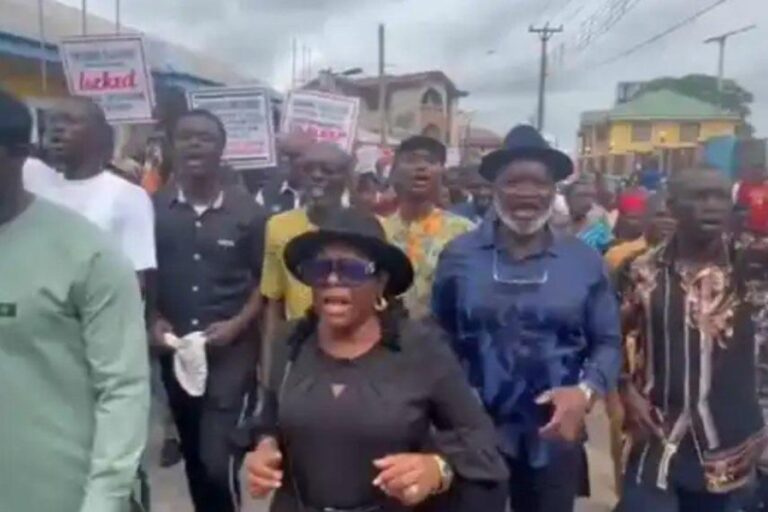
AT LEAST, 21 of the 23 sacked council chairmen in River State took to the street in their various council areas on Monday, June 24, to protest their ouster.
Former chairman of Buguma, the council headquarters of the Asari-Toru LGA, Onengiyeofori George, gyrated to songs played in solidarity with the Minister of the Federal Capital Territory (FCT), Nyesom Wike, alongside his supporters.
The protesters waved placards with inscriptions demanding that Governor Siminalayi Fubara allow them to continue occupying their offices rather than being fired.
Some of the inscriptions read, “Sim Fubara Can’t Continue to Act As He likes,” “There’s No Vacancy in Asari-Toru Council.”
The protest however almost turned violent when some men known as Amama soldiers, believed to be operatives of Asari Dokubo’s private military company, attempted to attack the protesters, Channels TV reported.
The Amama Soldiers were swiftly restrained by policemen who were on the ground at the council. The demonstrators later presented a protest letter to the police.
The ICIRreported that Fubara directed the Heads of Local Government Administration in the state’s 23 LGAs to take charge of the area councils. The directive came after the expiration of the three-year tenure of the elected chairmen.
This organisation also reported that the governor swore in caretaker chairmen for the 23 LGAs in the state following the chairmen’s ouster.
The actions came after the state’s LGA chairmen disclosed that they would remain in office beyond, citing the Rivers State Local Government Amendment Law passed by the Martin Amaewhule-led 27 State House of Assembly members.
The development was widely believed to be an escalation of tension between Fubara and Wike, as the law was passed by the lawmakers loyal to the former governor, in April.
Fubara refused to sign the law when it was sent to him for assent, but the lawmakers overrode him and passed the bill.
To further prove to Wike they were in charge of the state, Fubara’s supporters destroyed Wike’s statue in the Obio Akpor Local Government Area (LGA) of the state where his hometown is situated, on June 18.
THE Dangote Industries Limited (DIL) has accused the International Oil Companies (IOCs) operating in Nigeria of frustrating the supply of crude oil to local refineries including the Dangote Oil Refinery and Petrochemicals.
The Vice President of Oil and Gas at Dangote Industries, Devakumar Edwin, asserted during a one-day training programme for energy editors organised by the Dangote Group.
Edwin’s assertion came barely three weeks after the chairman of the Dangote Group, Aliko Dangote, voiced out the company’s frustration in getting crude oil from the IOCs.
“The NNPC is doing its best, but some of the IOCs are struggling to give us crude, everybody is used to exporting and nobody wants to stop exporting,” Dangote told CNN, an international cable news network.
The DIL vice president said the IOCs intentionally obstructed the Dangote refinery’s efforts to purchase local crude.
He claimed that IOCs were inflating the premium prices above market rates, compelling the Dangote refinery to import crude from distant countries like the United States.
This leads to higher production costs and is unhealthy for the country’s floated foreign exchange market.
“While the Nigerian Upstream Petroleum Regulatory Commission (NUPRC) is trying their best to allocate the crude for us, the IOCs are deliberately and willfully frustrating our efforts to buy the local crude.
“It would be recalled that the NUPRC, recently met with crude oil producers as well as refinery owners in Nigeria, in a bid to ensure full adherence to Domestic Crude Oil Supply Obligations (DCSO), as enunciated under section 109(2) of the Petroleum Industry Act (PIA). It seems that the IOCs’ objective is to ensure that our Petroleum Refinery fails.
“It Is either they are deliberately asking for ridiculous/humongous premium or, they simply state that crude is not available,” Edwin was quoted to have said.
He stressed that at some point, the company had to pay $6 over and above the market price.
“This has forced us to reduce our output as well as import crude from countries as far as the US, increasing our cost of production,” Edwin maintained.
A development economist, Kalu Aja, on his X handle, reacted that it was amazing to hear that the IOCs are manipulating the price of crude oil sold on an open, transparent market in Chicago.
“The end game is to force the Nigerians to cry out and push the IOCs in Nigeria to sell crude oil to Dangote,” Aja said, noting that crude oil is sold via contracts bought in advance or futures.
He expressed worries that Nigeria, the largest oil exporter in Africa, cannot produce enough oil for the Dangote refinery, suggesting that the NNPC Limited support its 20 percent investment by giving Dangote its oil equity.
“This is why multinationals flee Nigeria,” Aja added.
The ICIR reports that section 109(1) of the PIA Act states that the supply of crude oil and condensates for the domestic market shall, subject to subsection (2), be on a willing supplier and willing buyer basis.
The 109(2) states, “The Commission may issue regulations or guidelines on the mechanism for the imposition of a domestic crude oil supply obligation on lessees of upstream petroleum operations, including applicable penalties.”
Earlier in January, the NUPRC mandated oil producers to supply around 483,000 barrels per day (bpd) of crude oil to local refineries for the first six months of 2024.
In its new regulations, ‘Domestic Crude Supply Obligation guidelines,’ the NUPRC allocated a volume of 325,000 bpd to Dangote refinery.
According to a policy analyst, Joe Nwakwue, poor implementation is the most likely challenge in the PIA.
“There are many reasons that could happen; hijack of the implementation process by special interests, incompetence, etc. One hopes that we are able to faithfully implement the law with its objectives in constant view,” he said.
The PIA is aimed to overhaul and transform Nigeria’s oil and gas industry.
On June 12, The ICIRreported that the Dangote refinery scheduled its plans to commence the production and sale of petrol to local marketers amid the concern of NNPCL’s price control regime despite the deregulation of the petroleum downstream sector.
THE desire by Nigerians to sleep with their eyes closed may remain elusive for a long time due to the high level of illicit arms and ammunition in circulation. Analysts and other security stakeholders say this situation, coupled with the nation’s porous borders, have worsened insecurity in the country.
The proliferation of arms is a major security threat to Nigeria because it aids organised crimes, and threatens national security and development, security analysts have said.
The ICIR reports that violent crimes such as armed robbery, religious crises, communal conflicts, terrorism, insurgency, militancy, and electoral violence as a result of the spread of illegal weapons abound.
According to analysts the availability of small arms and light weapons (SALWs) which usually found their way through the country’s porous borders, put pressure on the security of the nation.
Governor, Uba Sani of Kaduna State, lent credence to the point that arms proliferation poses a major threat to the security of Nigeria. While speaking on Channels Television’s “Sunday Politics” on Sunday, February 18, he claimedthat there were about 200 million illegal firearms in Nigeria.
The Kaduna State chief security officer maintained that the number represented 80 per cent of 250 million illegal firearms in West Africa.
Consequently, Sani demanded that Nigeria’s gun laws be reviewed.
Uba Sani/PC: Punch Newspaper
He attributed the country’s growing insecurity to the widespread possession of illegal firearms.
The governor’s statements came on the heels of the kidnapping of school children and bandit attacks, which have persisted in the northwest region.
Also speaking on how the proliferation of firearms have aided insecurity in Nigeria, a security analyst with the SBM Intelligence, a research firm collating data on insecurity, Emeka Okoro, said allowing criminal groups and individuals to obtain and use illegal weapons with relative ease has contributed largely to insecurity across the country.
Okoro said the proliferation of light weapons in Nigerian border towns aids illicit operations like drug trafficking, gun running, and human trafficking, among others.
He said anytime a violent crime is committed, it is as a result of illegal arms in circulation,.
Arms recovery by security agencies
Findings show that the high percentage of illicit acquisition and usage of illegal arms in Nigeria is related to the number of weapons periodically seized by security agents.
For instance, on Thursday, February 29, the National Centre for the Control of Small Arms and Light Weapons (NCCSALW) said it had recovered 20,000 small arms and 60,000 units of ammunition in Nigeria.
The centre’s north west zonal coordinator, Haruna Mohammed, said the illicit circulation of weapons was contributing to banditry and other criminal activities.
The ICIR reports that north west states like Zamfara and Kaduna, where Mohammed covers, have been the hotbed of kidnapping and banditry activities.
In another development, the Nigeria Army, in a statement on Thursday, March 21, said during an operation by troops of Sector 2 of the Joint Task Force Ebonyi, operatives seized weapons including AK-47 rifles, two AK-47 magazines, 54 rounds of 7.62mm special ammunition, while three Sienna buses were also recovered.
The southeast region where the seizure occurred had witnessed violent activities allegedly perpetrated by the proscribed Indigenous People of Biafra (IPOB), and other criminal organisations that led to high casualties.
Similarly, the troops of the Nigerian army also conducted a targeted raid on a suspected criminal enclave at Zamtip village in Wase local government area of Plateau State.
The operation led to the recovery of one AK-47 rifle, five rounds of 7.62mm (special) ammunition, two empty cases of 7.62mm, three sim cards and one jackknife from the criminals.
The ICIR reports that Plateau State, located in the north central region of Nigeria, has witnessed an upsurge in violent banditry attacks in recent times
On Monday, December 25, The ICIR reported how assailants attacked several communities in the state, killed scores of residents, looted farm produce, and set homes ablaze.
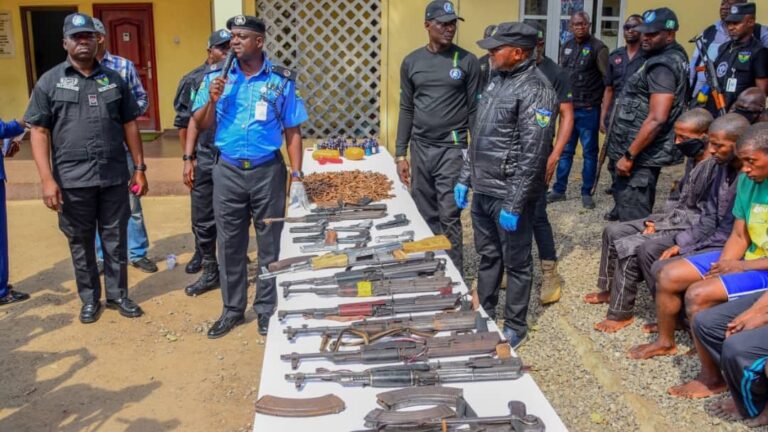
On March 6, The Nigeria Police Force, in a statement by its spokesperson Muyiwa Adejobi, said operatives recovered 44 arms and 477 ammunition within two weeks.
A factory in Kuru, near Jos, where rifles are fabricated, was also discovered by the Police, and a total of 2 AK-47 rifles, nine automatic pistols, and 1,800 rounds of live ammunition were recovered.
Police guns and army uniforms recovered by the Police. Image courtesy @Princemoye1
Recent incidents of arms proliferation
On March 16, the Defence Headquarters (DHQ) said some military personnel were killed during a communal clash in Delta State.
The personnel were said to have been killed by some youths while the troops were on a peace mission to the Okuama community in Bomadi Local Government Area (LGA).
Experts say this killings happened because there are many weapons in the wrong hands in Nigeria.
The ICIR reported on March 16 that despite promises of security by President Bola Tinubu, 703 persons were abducted within eight days under his watch.
Stakeholders say these developments are clear evidence of the high proliferation of small arms and light weapons in the country.
Porous borders, other factors identified
According to Okoro of SBM Intelligence the proliferation of illegal weapons and firearms in Nigeria could be attributed to various factors, including porous borders, political instability, widespread poverty, corruption, and ethnic and religious conflicts.
He said these factors create an environment that is conducive to the trafficking and proliferation of arms, leading to their widespread circulation in the country.
The way forward
According to Okoro, to curb the spread of illegal firearms in Nigeria, the focus must be on strengthening law enforcement, improving border security, and aising public awareness.
He listed other measures to include community policing, implementing stricter regulations, fostering international cooperation, offering disarmament and demobilisation programmes,.
He said addressing the root causes like poverty, unemployment and would also reduce the demand for illegal firearms.
In his contribution, a source from IPCR said illicit arms proliferation in Nigeria involved the unauthorised transfer, trafficking, and circulation of firearms across borders or within countries.
“Illicit weapons proliferation is often linked to criminal organisations, terrorist groups, and other non-state actors who use these weapons to advance their interests, perpetrate violence, and undermine stability.
“These groups may acquire illegal arms through black markets, dealers, or corrupt sources within government or military institution,” he said.
He blamed weak border control, ongoing conflicts within Nigeria, corruption, crime and political violence as reasons for the proliferation of illegal weapons and firearms in the country.
He listed the measures to curb the spread of illegal weapons and firearms in Nigeria to include; law enforcement; public education and awareness; firearms control legislation; community engagement; integrated approaches; rule of law and accountable governance;i
He also called for disarmament and demobilisation programmes; international cooperation and strengthening of border security.
THE Oyo State chapter of the Medical and Health Workers Union of Nigeria, (MHWUN) has declared a seven-day warning strike set to commence on Monday, June 24.
The workers stated this in a statement addressed on Sunday, June 23, through their president, John Fabunmi, to members across all health institutions, including ministries, departments, and local government areas in the state.
The strike is intended to pressure the state government to address the union’s demands, which have been ignored despite a 14-day ultimatum issued on May 27.
“Sequel to our letter with Ref. No. OYSC/MHWUN/ADM/INDU.ACT/05/24 dated 27th May 2024 on the above subject matter, giving the state government a 14-day ultimatum to attend to all our grievances, we wish to draw the attention of your excellency to the fact that up till now, nothing has been done to assuage the present situation.
“In view of the present situation and agitations from every quarter in our union, the union has therefore resolved to embark on a seven-day warning strike to further press for the attention of the government to attend to our agitations.
The group directed its members in all health institutions, ministries, departments and all local governments to participate in the strike billed to commence at the midnight of Monday June 24, “after which further actions may be embarked upon”, the union vowed.
Recall that the organised labour in Nigeria, earlier this month embarked on a nationwide strike over the federal government’s failure to meet its demand for a new minimum wage.
The strike grounded socio-economic activities in virtually all states in the country, leading to the shutting down of various public institutions including, airports, schools, train and power stations, among others.
THE Nigerian Army, on Saturday, June 22, arrested a man posing as an Army recruitment officer while allegedly attempting to deceive prospective military recruits in Jalingo, Taraba State.
This was made known in a statement released on Sunday, June 23, by the spokesman for the Troops of 6 Brigade Nigerian Army/Sector 3 Operation Whirl Stroke (OPWS) Jalingo, O. Oni, a lieutenant.
The arrest occurred after a visit to the recruitment centre at 114 Battalion Jimilari by the Brigade’s commander, Kingsley Chidiebere Uwa, who inspected the ongoing recruitment process and guaranteed its transparency.
“The impostor was arrested today, 22 June 2024, as he tried to collect money from hopeful recruits, promising them guaranteed entry into the Nigerian Army. The swift action of the troops thwarted his plans, preventing the candidates from falling victim to fraud,” the statement read in parts.
Uwa, speaking after the alleged impostor’s arrest, lauded the soldiers’ diligence and emphasised that maintaining the integrity of the recruitment process is the Army’s top priority.
He added that the suspect would be taken to the appropriate authorities for further questioning and prosecution.
He also addressed the recruits, assured them of a fair and transparent recruitment process and urged them and the general public to report any suspicious activities related to the recruitment exercise to the authorities.
He said doing so would help ensure that only the best candidates are inducted into the Nigerian Army.
“We are committed to maintaining a level-playing field for all candidates. Our recruitment will be based solely on merit, and we will not tolerate any fraudulent activities,” he added.
THE Federal Capital Territory (FCT) Police Command has commenced investigations into the killing of a retired Brigadier-General in the Nigerian Army, Uwem Harold Udokwere.
Udokwere died after gunmen invaded Sunshine Homes Estate, Abuja, where he lived until his demise, for a robbery operation.
This was contained in a statement the Public Relations Officer (PRO) of the FCT Police Command Josephine Adeh sent to journalists late Saturday, June 22.
”In response to the tragic and unprecedented attack at Sunshine Homes Estate by armed robbers, resulting in the untimely demise of one Brigadier General Uwem Harold Udokwere (rtd.) on June 22, 2024, at approximately 03:00 a.m, the Commissioner of Police, FCT, CP Benneth C. Igweh, psc, mni, has promptly ordered a thorough and discreet investigation into the circumstances surrounding this regrettable event.
“Expressing profound condolences to the bereaved family, CP Benneth Igweh psc, mni, assures the family and the public of swift justice, with every effort in conduit to ensure the perpetrators of the atrocious act are apprehended and brought to justice,” Adeh noted.
She also disclosed that further updates would be provided on the incident as investigations progress while assuring residents of the FCT of safety.
In January, barely six months ago, gunmen invaded the Army Estate in Abuja and abducted two residents in the process.
According to residents of the area, the kidnappers invaded the estate, shooting sporadically in the air and fled with the abductees before soldiers arrived at the scene.
The FCT Minister, Nyesom Wike, had warned Area Council Chairmen in the FCT to be proactive about issues concerning security, vowing that insecurity would not be tolerated under his administration.
The warning came after FCT residents were confronted with an increase in the spate of abductions and insecurity within the Area Councils, especially Bwari and Kuje, towards the end of 2023.
The ICIRreported that some FCT residents had abandoned their homes due to several successful abductions by bandits within their communities.
Several kidnap cases were recorded in the FCT during the last Yuletide festivities, including the mass abduction of about 23 residents of Dei-dei, Bwari, and 12 others in Gbaupe, a rural community along the Airport Road.
CROSS RIVER State Governor Bassey Otu has banned logging in all parts of the state.
The ban was contained in a statement by the Secretary to the State Government (SSG), Anthony Owan-Enoh, on Saturday, June 22.
“In spite of the forbearance by government on the activities of timber loggers in the state, government notes the persisting refusal and or neglect to keep to the terms stipulated by government for the felling of trees.”
“Consequently, Governor Bassey Otu has suspended further logging activities in the state. Security agencies are to arrest offenders and confiscate any log and machinery deployed thereto,” the statement read.
This comes about a year after the state lifted a previous ban on logging after about 15 years.
Otu had lifted the ban shortly after becoming governor of the state, saying the state was losing revenue to illegal logging activities as woods being cut and taken out of Cross River were being stamped in other states.
He had said the state Forestry Commission would begin to regulate logging activities in the state, but according to the statement by Owan-Enoh, the aim of lifting the ban has not been achieved over the past year, as trees are being felled illegally, even within protected areas like parks.
Owan-Enoh also urged stakeholders within the industry to contact the Forestry Commission in Cross River for further information.
Logging activities have been identified as one of the major causes of deforestation, which can also lead to flooding, especially in coastal areas like Cross River.
The state residents, especially farmers, have been confronted with regular incidents of flooding.
In 2022, several farms, houses and other properties in the state were swept away by floods.
Lives were also lost as a result, and many people were displaced due to the 2022 flooding incident, which affected several states in Nigeria.
PRESIDENT Bola Tinubu has ordered that any civil servant receiving salary from the federal government after relocating abroad should be made to refund the money.
The President gave the order at the Civil Service Award Night held on Saturday, June 22.
The event was organised by the Office of the Head of the Civil Service of the Federation (HOCSF) to commemorate the 2024 civil service week and honour outstanding civil servants in core ministries.
Expressing dismay over the attitude of ghost workers, the President, who was represented by the Secretary to the Government of the Federation, George Akume, also ordered that supervisors and heads of departments of ghost workers involved must be sanctioned for aiding the fraudulent act.
“During my recent visit to South Africa, I kept abreast of the week’s activities. I was particularly struck by the revelations the Head of the Civil Service shared regarding employees who had relocated abroad while drawing salaries without formally resigning.
“It is heartening to hear that measures have been taken to address this issue, but we must ensure those responsible are held accountable and restitution is made. The culprits must be made to refund the money they have fraudulently collected. Their supervisors and department heads must also be punished for aiding and abetting the fraud under their watch,” Tinubu vowed.
Acknowledging the challenges faced by the civil service, Tinubu reaffirmed his commitment to addressing these issues in order to make the civil service achieve utmost performance.
“Our administration acknowledges the challenges the civil service is facing. I want to assure you that we are committed to ensuring the welfare and development of all civil servants to deliver optimal performance for the growth of our nation,” he said.
He stated that over the past year, he had provided all the necessary support to the Head of the Civil Service of the Federation to ensure the continued stability of the civil service, and that he had also supported the office in implementing far-reaching policies and reforms to improve efficiency and service delivery.
Among other activities to celebrate the night was the prize presentation to the top best officers and additional N500,000 cash prizes to 40 workers by the HOCSF, Folasade Yemi-Esan.
“The star prize is a brand new 2023 JAC JS4 Luxury Model SUV,. The second is a two-bedroom semi-detached bungalow, and the third top prize is a serviced plot of land measuring 400 sqm.
“I am also pleased to announce that the Nigeria Customs Service has graciously committed to donating six Toyota Camry Cars in support of the 2024 Civil Service Week. The office has started receiving the vehicles, and these will be presented as prizes to the next set of runner-up best-performing officers,” she said.
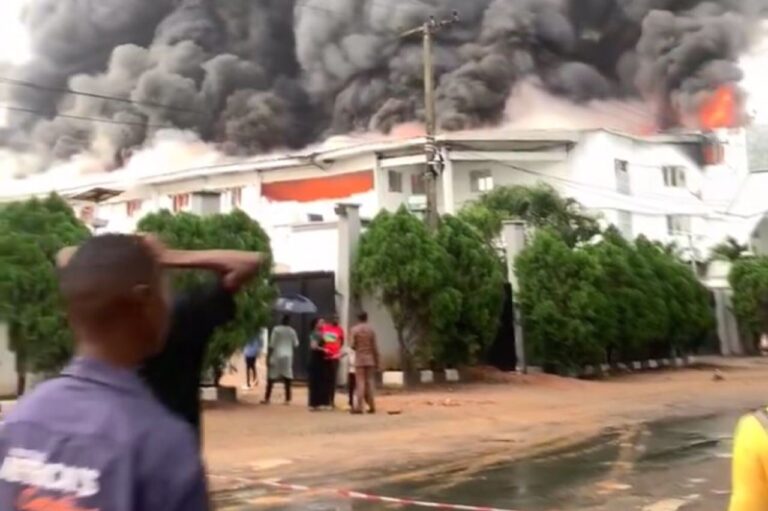
THE headquarters of Christ Embassy Church located at Oregun, Lagos State, was engulfed with fire in the morning of Sunday, June 23.
Several videos from the scene were shared on social media by different users and some members of the church.
Officials from the Lagos State Fire and Rescue Service were on the site battling the inferno.
Among the people who took to social media to share the news was @bigwig_autin on X who posted, “A serious fire outbreak in Christ Embassy Headquarters Lagos. Fire Service help needed ASAP!”
“Fire guts Christ Embassy Church Headquarters In Lagos. Hope people are safe and no one’s hurt,’ wrote @Midifilo
“The interior view of the Christ Embassy Oregun church that’s currently on fire. I really hope they recover from this loss,” another account user @temitotepr said on X.
The ICIR reports that given several reactions from eye-witnesses, services were yet to commence fully when the fire broke out, and it remains unclear if people were trapped in the lush white buildings.