Home Blog Page 615

Court frees ex-NIMASA DG Akpobolokemi of N8.5bn fraud claim

0

A FEDERAL High Court in Lagos has dismissed a fraud case worth N8.5  against the former director-general of the Nigerian Maritime Administration and Safety Agency (NIMASA), Patrick Akpobolokemi.

The court discharged and acquitted Akpobolokemi of the case brought against him by the Economic and Financial Crimes Commission (EFCC) on Monday, April 22.

The trial judge, Ayokunle Faji, dismissed the case while ruling on a no-case submission he and four other defendants filed in a 22-count charge against them.

Akpobolokemi was arraigned before the court alongside Emmanuel Atewe, a retired Major-General and the former Commander of the Joint Task Force Operation Pulo Shield, with two other employees of the agency, Kime Engonzu and Josphine Otuaga. 

Faji resolved that the EFCC had not produced a prima facie (sufficient evidence) case against Akpobolokemi and Josephine Otuaga, leading to their discharge and acquittal.

However, the judge decided that the second defendant, Atewe, and the third defendant, Kime Engonzu, a staff member of NIMASA, had to open their defence because they had a case to answer in counts 12 to 22 of the charge.

In his ruling, the judge stated that not a single piece of evidence presented by the prosecution connected Akpobolokemi and the fourth defendant to the offences they were accused of. 

In a no-case submission, Akpobolokemi’s lawyers, Joseph Nwobike (SAN) and Collins Ogbonna, begged for Akpobolokemi’s acquittal before he could offer a defence.

The lawyers said that despite all the witnesses and evidence the prosecution had presented, it could not connect him to the alleged crimes.

The defendants are being prosecuted for an updated 22-count allegation which relates to conspiracy, conversion, and theft.

One of the counts reads: “That you, Patrick Ziadeke Akpobolokemi, Major General Emmanuel Atewe, Kime Engozu, and Josphine Otuaga sometime in 2014, in Lagos, within the jurisdiction of this court, with intent to defraud, conspired amongst yourselves to commit an offence to wit: conversion of the sum of N8,537,586,798.58 property of the Nigerian Maritime Administration and Safety Agency and you thereby committed an offence contrary to Section 18 (a) of the Money Laundering (Prohibition) Act 2012 and punishable under Section 15 (3) of the same Act.”

Their trial had started when they entered a plea of “not guilty” to the allegations.

Following the prosecution’s case, each defendant chose to submit a no-case submission.

The ICIR, in an investigation published on Saturday, April 13, named Akpobolokemi as one of the actors in a feud that degenerated and led to the death of 17 soldiers in the Okuama community in Ughelli South LGA of Delta on March 14. 

According to the report, a feud between an illegal oil bunker, Endurance Okodeh alias Amangbein and a sophisticated cartel of illegal oil bunkers worsened and caused the soldiers’ killing.

Findings unmasked how the leader of the cartel, ex-militant leader Government Ekpemukpolo alias Tompolo who operates a private security company, in a bid for total control of the creeks of Niger Delta, earlier warned Amangbein, who is an ally of a sitting governor in one of the Niger-Delta states, to stay off illegal oil business, a development the latter saw as oppression.

Amangbein, a known ex-militant, hails from the Igbomotoru community in Bayelsa’s Southern Ijaw Local Government Area (LGA).

He is also a leading voice against Tompolo and Akpobolokemi in the creek business and the Okuama/Okoloba land dispute.

The former NIMASA chief allegedly built a mansion in the disputed land between Okuama and Okoloba communities. The building is said to be the genesis of the debacle that led to the soldiers’ killing.

 

26 states, FCT, failed to access N36.17bn UBEC grant in 2023

MORE than 27 states, including the Federal Capital Territory (FCT), failed to access the Universal Basic Education Commission (UBEC) matching grants in 2023, with approximately N36.17 billion lying fallow at the Central Bank of Nigeria. 

According to the UBEC report, each Nigerian state was entitled to N1.395 billion in 2023, but only 12 states accessed the grants. They are Borno, Cross River, Delta, Enugu, Jigawa, Nasarawa, Ondo, Sokoto, Taraba and Zamfara.

Meanwhile, Rivers and Kano states only accessed N697.89 million and N814.21 million, respectively. 


Read Also:


The UBEC’s matching grant is a counterpart funding between the federal and state governments earmarked to tackle illiteracy and accelerate national development.

The fund is deployed to improve the quality of basic education in all 36 states. Each state government is responsible for providing 50 per cent to match the annual disbursement provided by UBEC.

With the fund, UBEC seeks an uninterrupted and compulsory nine years of primary and junior secondary school education for all Nigerian children.

According to the report, N51.64 billion ought to be accessed across the 36 states and FCT for 2023, but only N15.47 billion was collected. 

The breakdown of the un-accessed funds by geopolitical zone shows that North-Central has N8.37 billion un-accessed funds, North-East has N5.58 billion, and the North-West region has N4.77 billion. For the Southern region, the South-East has N5.58 billion, the South-South has N3.49 billion, and the Sout-West has N8.37 billion.

This development is coming despite Nigeria having over 19 million out-of-school children. This figure, according to a report by The ICIR, makes the country have the third highest number of children deprived of education worldwide, according to the United Nations Educational Scientific and Cultural Organization (UNESCO) 2020 Model Estimates.

In Nigeria, 60 per cent of over 10 million out-of-school children are girls, whereas the global figure is 118.5 million girls out of school.

Also, The ICIR reported that 24.67 million children in the country were engaged in labour activities injurious to their physical and mental development in 2022. This figure represents 39.23 per cent of the total population of 62.90 million children in the country. 

However, several investigations (here, here and here) by The ICIR have exposed how UBEC funds to execute projects were mismanaged.

Experts query Nigerian government over fresh $2.2 billion loan

THE Nigerian government is set to receive around $2.2 billion single-digit interest loan from the World Bank and another budget support facility from the African Development Bank.

Minister of Finance Wale Edun disclosed this at a press briefing on Saturday, April 19, at the end of Nigeria’s activities at the World Bank/International Monetary Fund Spring meeting in Washington, D.C.

The Minister, however, failed to give specific project targets for the loan, as Nigeria’s debt stood at N97.34 trillion at the end of 2023.


Read Also:


Economy watchers said it would be difficult to monitor its effective usage if the loan is not tied to specific projects.

“The Minister of Finance calls this almost free money. The loan is priced at one per cent for about 10-20 years moratorium. The question is, what will it be used for?” an economist Kalu Aja asked.

Expressing similar concern, a development economist, Celestine Okeke, told The ICIR that the National Assembly needed to give clearance on the propriety of the loan to avoid plunging Nigeria into further debts.

“The National Assembly needs thorough oversight before we access this loan facility. The country is deeper in debt, and we must not put ourselves into a deeper debt trap,” he said.

Okeke recalled that the National Assembly’s poor oversight had led to Nigeria’s rising debt. The recent N23 trillion loan by the Central Bank of Nigeria (CBN) to the Federal Government is currently under scrutiny at the National Assembly.

Commenting on other international funding sources for the Nigerian economy, the minister listed diaspora remittances, foreign portfolio investments, facilities from the World Bank, and other international development partners.

He stated, “We have qualified for the processing just this week to the Board of Directors of the World Bank of a total package of $2.25 billion of what you can call ‘the closest you can get to a free lunch’- virtually a grant. It’s for about 10- 20 years moratorium and about 1% interest.

“In addition, there is a similar budgetary support – low-interest funding from the African Development Bank (AfDB) and there are ongoing discussions with foreign direct investors across many sectors.”

Edun also tapped issuing dollar-denominated securities specifically targeted at Nigerians in the diaspora and those with foreign-denominated savings in Nigeria as another measure to attract forex inflows into the country.

He further highlighted the efforts of the fiscal side of the economy in complimenting the recent monetary policy reforms by the Central Bank of Nigeria.

According to the minister, the issuing of government securities at an interest rate closer to the CBN’s monetary policy rate is an indication of the collaboration between both sides of the economy in tackling inflation in the country and attracting forex inflows.

FG launches CNG vehicles to mark Tinubu’s first year in office

THE federal government is set to launch and deploy compressed natural gas (CNG) vehicles for mass transit starting this May as part of activities marking President Bola Tinubu’s one year in office.

Special Adviser to the President on Information and Strategy, Bayo Onanuga, disclosed this in a statement on Sunday, April 21.

Onanuga said the government, while considering buses and tricycles, also targeted about one million automobiles by 2027. He said the committee led by Michael Oluwagbemi was set to deliver cheaper, safer, and more climate-friendly energy vehicles.


Read Also:


He explained that all was ready to deliver the first set of critical assets for deployment and launch of the vehicles ahead of the first anniversary of the Tinubu administration on May 29.

He stated, “Also, a safety policy document on 80 standards and regulations that must be strictly adhered to by operators has been developed and approved to ensure CNG conversions are done safely and reliably.

“The deployment of CNG buses and tricycles and the vision to get at least one million natural gas-propelled vehicles on our roads by 2027 will mark a major energy transition in our country’s transportation industry.

“The use of more expensive diesel and PMS will gradually be phased out, when many vehicles, including trucks, run on natural gas, which our nation has in abundance in at least 30 out of the 36 states of the federation,” he added.

He further stated that with necessary tax and duty waivers approved by Tinubu in December 2023, the private sector partners in the Presidential CNG Initiative (PCNGI) had responded with over $50 million in actual investments in refuelling stations, conversion centres, and mother stations.

He also disclosed that the federal government provided N100 billion, as part of the N500 billion palliative budget, to purchase 5,500 CNG vehicles as part of the intervention programmes to cushion the effect of an increase in petrol pump prices on the masses. This included buses and tricycles, 100 electric buses, and over 20,000 CNG conversion kits, spurring the development of CNG refilling stations and electric charging stations.

According to Onanuga, “Four plants owned by JET, Mikano, Mojo, and Brilliant EV located in various parts of the country are involved in the assembly of the semi knocked down (SKD) components of the CNG buses.

“JET, which has received the SKD parts, is coupling the buses in Lagos and is working towards delivering 200 units before the first anniversary of the Tinubu administration.

“Brilliant EV will assemble electric vehicles. It is awaiting the SKD parts, which will arrive in due course. The electric vehicles it will produce are meant for states, such as Kano and Borno, which do not have access to CNG for now.

He said over 600 buses were targeted for production in the first phase, which will be accomplished this year, while a new plant on the Lagos-Ibadan Expressway will assemble thousands of tricycles.

The SKD parts manufactured by the Chinese company LUOJIA in partnership with its local partner to support the consortium of local suppliers of CNG tricycles are set for shipment to Nigeria and are expected to arrive early in May. About 2,500 of the tricycles will be ready before May 29, noted the official.


First Bank: Adeduntan’s resignation flouts CBN’s guidelines, elicits concerns

Kenyan police arrest Binance executive who fled Nigeria

0

THE Kenya Police Service has arrested a Binance executive, Nadeem Anjarwalla, who escaped from custody in Nigeria on March 25.

According to the Punch, the International Criminal Police Organisation (INTERPOL) is concluding plans to extradite him to Nigeria soon.

Anjarwalla had escaped from detention in Nigeria and reportedly fled to Kenya, where the Nigerian Government tracked him down.


Read Also:

The ICIR reported that the Office of the National Security Adviser (ONSA) confirmed Anjarwalla’s escape from custody.

In a statement signed by the head of strategic communication at the ONSA, Zakari Mijinyawa, the Office said a preliminary investigation showed that he fled Nigeria using “a smuggled passport”.

According to a Premium Times report, the Binance executive fled a guest house where he and his colleague were kept in Abuja on March 22.

Anjarwalla allegedly escaped after being brought by the on-duty guards to a nearby mosque for prayers in observance of the recent Ramadan fast.

He reportedly took a Middle East aircraft out of Abuja. However, it is unclear how he left on an international flight, given that the Nigerian government had seized his only passport – the British passport on him when he was arrested.

The Office added that the suspect escaped while under a 14-day remand order by a court in Nigeria and was scheduled to appear before the court again on April 4.

Binance employed Anjarwalla, a 37-year-old British Kenyan who serves as its regional manager for Africa, and Tigran Gambaryan, a 39-year-old US citizen who oversees the firm’s financial crime compliance.

The ONSA seized their passports after they were arrested.

The ICIR reported on Monday, March 25, that the Federal Government, through the Federal Inland Revenue Service (FIRS), filed criminal charges against Binance at the Federal High Court in Abuja.

The charges accused Binance of a four-count tax evasion.

The trial judge, Emeka Nwite, sent Gambaryan to Kuje Correctional Centre pending the determination of his bail application.

The judge made the order after he pleaded not guilty to the money laundering charges the EFCC preferred against him on Monday, April 8.

The EFCC had charged Binance, Gambaryan, and Anjarwalla, who was on the run, with hiding the source of the $35,400,000 in revenue Binance made in Nigeria while knowing that the money was the product of illegal activities.

The FIRS stated that the action was intended to protect Nigeria’s economic integrity and maintain budgetary sustainability.

The ICIR reported on March 5 that Binance pulled its services out of Nigeria.

The platform asked Nigerians trading on it to remove all their naira assets, indicating that it was terminating its services in the country.

The Federal Government has been taking harsh measures against Binance management recently. 

In response to the severe actions taken against it by the Nigerian government, Binance, on Tuesday, March 5, deleted all assets linked to the naira.

Manufacturers seek fixed rate for Customs duty to address inflation

MANUFACTURERS have called for a fixed Customs import duty-exchange rate to combat Nigeria’s rising inflation, currently at 33.02 per cent.

The nation’s inflation spike has been partly linked to the incessant hike in import duty, as the country is largely import-dependent.

The Nigeria Customs Service (NCS) through the Central Bank of Nigeria (CBN) has consistently fixed the exchange rate to reflect the official market rate on the Nigerian Autonomous Foreign Exchange Market (NAFEM) window, hence the regular changes in rate.


Read Also:


Analysts say this puts a lot of pricing uncertainties on businesses, which could spur “price gouging”.

“We should have a fixed rate for our Customs import duty. It should be a fixed rate of maximum of N1,000 and let it remain like that for the next six months or a year,” a Board Member of the Nigerian Customs Service and former Director-General of Lagos Chamber of Commerce and Industry (LCCI), Muda Yusuf, told The ICIR.

According to Yusuf, the fixed rate makes the whole system more predictable, reduces uncertainties in commodity pricing, and aligns the country with global trade facilitation.

“Different import duty puts different prices, week in, week out, and it’s not good for business.

“For purposes of trade, let’s stabilise the rate. Our tariff book is a seven-year book. The whole essence is to make trade predictable. We seem not to be following our tariff book on this, and it’s not good for trade,” he said.

He noted that the foreign exchange component for import duty disrupted trade certainty and did not position Nigeria well for global trade.

“We already have enough issues with FX volatility and currency management. For the import duty, we can fix the rate to ensure that international trade is more predictable. A fixed rate will help bring down import costs and help moderate inflation,” he added.

The Director-General of the Manufacturers Association of Nigeria (MAN) Segun Ajayi-Kadir told The ICIR that the association was rooting for N800/$  as basis for the import duty calculations. This, he said, would make businesses make proper projections and have a moderate cost of production, which would bring down the cost of the end product.

“We have been engaging the government on this because if we keep having price uncertainties with the import-duty rates, it will be passed to the consumers at higher prices, leading to low sales. The disposable income of Nigerians  is low and prices  are up.

Commenting further, he said, “It will lead to moderate cost of production and raw materials inputs, and it will bring down cost of end products and  increase volume of sales. More production and sales means more revenue for the government  and overall moderate inflation.”

Concerned about consumer exploitation, the Federal Competition and Consumer Protection Commission (FCCPC) has intensified supermarket supervision to address possible price gouging concerns.

On Thursday, April 18, an enforcement team led by its acting executive vice chair, Adamu Ahmed Abdullahi, the FCCPC raided several supermarkets.

Before the raid, the FCCPC, on April 17, urged Nigerians to report businesses hiking prices of goods, saying that despite the naira appreciating against the dollar, costs of commodities were still soaring.

The commission said it would monitor and investigate price hikes in the markets to protect consumers from exploitation.

Checks by The ICIR showed that the rate has risen more than six times since the inception of Tinubu’s administration, raising concerns about possible arbitrary hikes in the prices of commodities by importers.

The NCS has reduced the exchange rate for import duties collection from N1238.1 to the dollar to N1,147/$.

The Customs exchange rate for duties collection has remained at N1238/$ for over a week now—the longest it has stayed at a particular rate in recent times.

An economist and business consultant, Franklin Akinyosoye, told The ICIR  that the Customs should focus on discouraging goods that could be produced in-country with higher import duties.

“I don’t have issues with the constant rate review for Customs duty. I wish they could do it more for only the goods and services we don’t need that much to discourage importing all sorts.

“There are items that shouldn’t have import duties at all, those goods we can’t produce at all in Nigeria. That way, items with high Customs duties will be discouraged. We are too dependent on foreign goods or items. I suspect the CBN is also using it to manage the foreign exchange rates, discourage imports of what we don’t need, and to also raise revenue to fund other aspects of the economy,” he said.

Is Air Peace the ‘largest’ African airline in terms of passenger traffic?

0

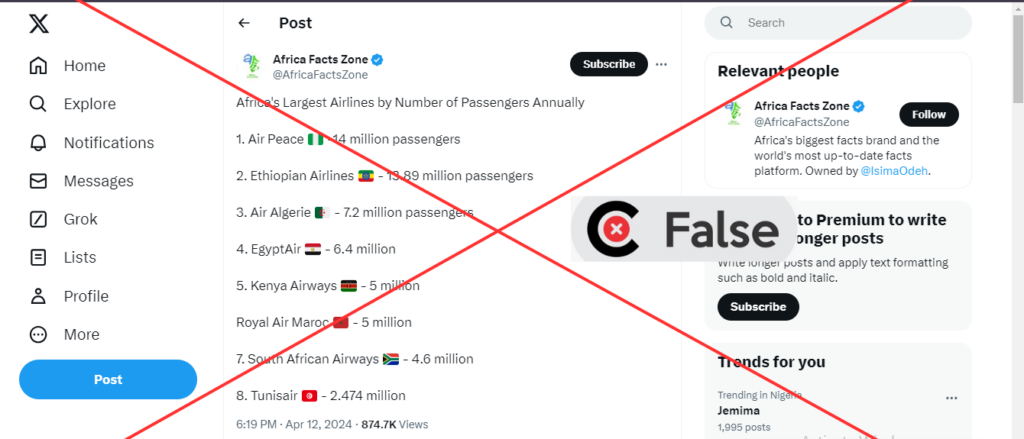
AN X user, @AfricaFactsZone, has claimed that Air Peace is Africa’s largest airline in terms of annual passenger traffic.

In the ratings, he listed Air Peace (Nigeria), Ethiopian Airlines (Ethiopia), Air Algerie (Algeria), EgyptAir (Egypt), Kenyan Airways (Kenya), Royal Air Maroc (Morocco), South African Airways (South Africa), and Tunisair (Tunisia) as having the largest airlines by number of passengers annually.


Read Also:


The post read:

Africa’s Largest Airlines by Number of Passengers Annually

1. Air Peace -14 million passengers

2. Ethiopian Airlines – 13.89 million passengers

3. Air Algerie – 7.2 million passengers

4. EgyptAir – 6.4 million

5. Kenya Airways – 5 million

Royal Air Maroc – 5 million

7. South African Airways – 4.6 million

8. Tunisair – 2.474 million

The post has garnered over 800,000 views, with over 8,000 likes and 1,700 reposts as of April 19, 2024.

CLAIM

Air Peace is the largest African airline in terms of passenger traffic.

THE FINDINGS

Findings by The FactCheckHub indicate that the claim is FALSE!

Screenshot of the claim retrieved from X. INSERT: False verdict.

The 2023 air transport report released by the African Airlines Association (AFRAA), showed that the top 5 airlines with the highest passenger traffic are: Ethiopian airlines (11.3 million), Egyptair (8.2 million), Safair (6.6 million), Royal Air Maroc (5.7 million) and Air Algerie (4.7 million). While Air peace ranked 7th with 2.6 million passenger traffic on the list.

A 2023 report by Cirium, an aviation analytics company which highlighted Cirium Diio as its data source, ranked Ethiopian airlines (Ethiopia) as the busiest airline in Africa.

A 2024 report published by Simple Flying also noted that Ethiopian Airlines remains Africa’s largest carrier of air passengers as it played a critical role in the 20.7% increase on international passenger traffic by African airlines.

THE VERDICT

The claim that Air Peace is the largest African airline in terms of passenger traffic is FALSE; findings revealed that Ethiopian Airlines is the largest African airlines in terms of passenger traffic.

This is republished from the Factcheckhub.

Aiyedatiwa declared winner of Ondo APC governorship primary

ONDO State Governor Lucky Aiyedatiwa has been declared the winner of the All Progressive Congress (APC) Primary for the forthcoming November 16 governorship election.

The Primary committee chairman and Kogi State governor, Ahmed Ododo, declared him the primary election winner in the early hours of Monday, April 22.

By the declaration, he is now the party’s candidate in the coming governorship election in the state.


Read Also:

The governor gathered 48,569 votes, while fellow contender Mayowa Akinfolarin polled 15,343, and Olusola Oke came third with 14,865 votes.

According to Ododo, the electoral process went” smoothly”, with little skirmishes recorded.

Aiyedatiwa won 16 of the 18 LGA, losing out on Ilaje LGA to Oke.

The primary, which took place on Saturday, April 20, saw several contestants allege the elections didn’t take place anywhere.

In addition, some party supporters staged protests in Akure’s streets, calling for Ododo to be removed as the committee’s chair and the exercise to be cancelled.

The protesters brought their grievances to the APC state secretariat in Akure, where they claimed that there had been anomalies in how the 203 state ward primaries had been conducted.

They called the procedure a “daylight robbery” and pleaded with the APC national leadership to prevent the state from becoming entangled in a conflict.

According to the ruling APC, 171,922 members from the 203 wards of the state’s 18 local government areas participated in the Primary.

Ododo, who chaired the organising committee, declared the election inconclusive late on Saturday.

Ododo noted that the exercise would continue on Sunday, April 21, especially in Okitipupa, where violence by rival supporters within the party disrupted the process.

The ICIR reported that rival supporters of two party aspirants stirred up violence on Saturday at Ward 1, Stella Maris College, Okitipupa.

According to the News Agency of Nigeria (NAN), the violence between two groups of supporters disrupted the voting process, leaving voters who had gathered at the ward scampering for safety even before the accreditation process began.

Eyewitnesses also told NAN that a party agent had arrived on the scene, snatched accreditation documents, and run away, leading to the unrest in the area.

Other irregularities during the process also led some aspirants to call for the exercise’s cancellation.

They alleged that the APC Electoral Committee, led by Kogi state Ododo, was not transparent and asked the party’s leadership to replace the committee chairman immediately.

The Ondo state governorship election is scheduled for November 2024.

Police probe alleged killing of man by officer in Lagos

0

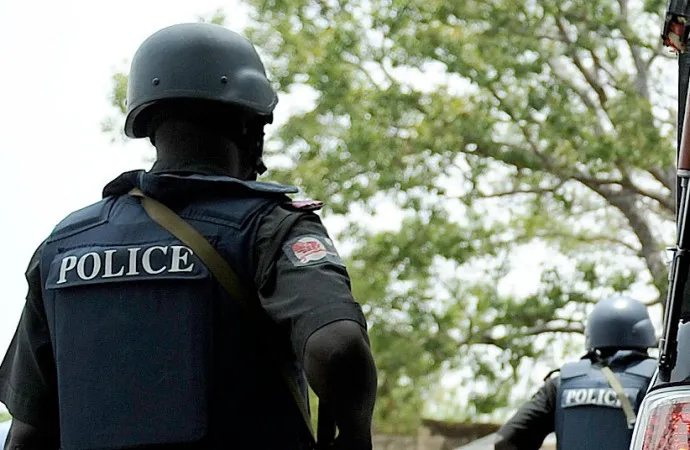
THE Lagos State Police Command has commenced an investigation into the death of one Anosikwa Patrick.

Patrick was allegedly stabbed by a police officer, now identified as Inspector Taofeek, at Skymall Shopping Mall in the Ajah area of the state on Saturday, April 20.

The command’s Public Relations Officer, Benjamin Hundeyin made this disclosure in a statement issued on Sunday, April 21.


Read Also:


An X user, NotMentus, had on Saturday, April 20, tagged the Force PRO, Olumuyiwa Adejobi, in a post, seeking assistance in obtaining justice for the demise of Patrick.

He wrote, “#Princemoye1, good morning sir, my brother got stabbed to death by one of the police officers attached to Skymall at Sangotedo, Lekki. 

“The officer is currently on the run. His colleague, too, is on the run.”

This alleged case of police brutality was coming a few hours after Abiriba-born businessman Emmanuel Michael Okocha was shot dead along Aba-Owerri road in Aba, Abia, state for refusing to bribe some policemen at a checkpoint.

The officer who killed Okocha was attached to the Abayi Police Division before the incident happened.

Reacting to the latest development, the Lagos police PRO said the manager and chief security officer of the mall are already in custody to assist with the investigation.

The statement partly read, “The manager and chief security officer of the mall are already in custody assisting with the ongoing investigation. 

“Meanwhile, the police officer has been identified as Inspr. Taofeek, member of visiting 12 PMF squadron to Lagos.

“The Commissioner of Police, Lagos State Command, Adegoke Fayoade, has directed detectives of the Homicide Section of the State Criminal Investigation Department to ensure a speedy and diligent investigation towards ensuring that the culprit is brought to book.” 

The ICIR reports that the tragic killings of both Okocha and Patrick are not an isolated incident but a troubling pattern of police brutality and misconduct that has plagued the country over time. 


READ ALSO:


Over the years, The ICIR has documented several instances of police brutality in the country and how it has led to the loss of lives and properties.

In December 2022, The ICIR reported how Nigerians expressed outrage over the death of a female lawyer, Bolanle Raheem, who was shot by an assistant superintendent officer in the Ajah area of Lagos State on Christmas Day.