Home Blog Page 744

Why Nigeria needs whistleblower law – stakeholders   

0

STAKEHOLDERS advocating for good governance and a corruption-free, decent society in Nigeria have called for an effective whistleblower law to protect citizens who volunteer information on wrongdoings.

They made the call recently at a policy roundtable meeting organised by the African Centre for Media & Information Literacy (AFRICMIL), the Progressive Impact Organisation for Community Development (PRIMORG), and the Shehu Musa Yar’Adua Foundation (SMYF) in Abuja.

“Whistleblowers play a positive, legitimate, and crucial role in the prevention of, and in the fight against corruption and the promotion of human rights in Nigeria and around the world, said Chido Onumah, AFRICMIL Coordinator at the event.


Read Also:

While noting that the United Nations laws recognise whistleblowers’ roles, he said instead of being appreciated for what they do, they are hunted by people whose interests they threaten.

“Regrettably, in Nigeria, whistleblowers face a lack of a safe and enabling legal environment that allows them to report wrongdoing without fear of reprisals.

“This lack of effective whistleblower protection regime is compounded by the existence of ineffective access to information laws that would enable citizens to obtain information held by public institutions and empower them to hold powerful individuals and entities to account,” Onumah added.

We urgently need the law – Government

Deputy Director and Head of Whistle-blowing at the Federal Ministry of Finance, Johnson Oludare, said stakeholders had been on the bill for a long time, and it couldn’t scale through the Ninth National Assembly.

“We have put up a memo to the new Minister (of Finance) on what has been done on the bill to enable him to have an audience with Mr. President…By the time he’s done with the President, we’ll put up another memo,” he stated.

He appealed to civil society organisations and other stakeholders working on the bill to sustain the deliberation.

He said the bill might take only some of what they expected, but they should allow it to pass first, adding that they could call for its review after signing it into law.

“There is no bill that can meet all people’s expectations. Let’s just get it passed. Once it is passed, we can call for amendment.”

He said he was aware that whistleblowing is very risky. He urged the public to remain firm in supporting it to enable the nation to expose more corrupt and illicit activities.

He listed whistleblowing’s benefits, including improvement in the nation’s ratings by Transparency International and related institutions, blocking sleazes, boosting investments, and transforming the nation’s economy. 

Law will boost Nigeria’s anti-corruption rating, investment – OSIWA

In his remarks, Maxwell Kadiri of the Open Society Initiative for West Africa (OSIWA) spoke on the need to use the existing policies and frameworks to continue to push for whistleblowing in Nigeria.

He cited the reports on the current crisis between BUA and Dangote Groups and The ICIR report on the United Bank of Africa, which he attributed to products of whistleblowing. 

He said whistleblowing should be more of patriotism and not of reward.

Kadiri called for a whistleblowing law that promotes citizens’ freedom to share information on perceived wrongs, which ultimately tackles corruption and improves governance.

Law must be detailed – Lawyer

Addressing the participants, Principal Counsel, Godwin Chigbu & Associates, Godwin Chigbu, called for the need to include relevant information in the bill before its transmission to the National Assembly for passage and consequently to the President for assent.

The lawyer said there was no wisdom in signing a bill that the stakeholders would call for its review days after being signed into law.

“I want to say that this bill should be looked into the second time. If not, those efforts will amount to a waste. We will have a law that has no substance in it,” he stated.

He described the proposed law as an “incentive to the whistleblower,” adding that you must accord protection to the whistleblower. One of the protections is the confidentiality of the whistleblower. If I’m not sure that I’m protected, I will not come out to talk,” he added.

Chigbu noted that the law should specify penalties for whoever breaches the whistleblowers’ protection.

He also stated that the rewards for whistleblowers should be clear.

Whistleblowing not just about corruption – Onumah

In an exclusive interview with The ICiR, Onumah said whistleblowing is not just about corruption. “Whistleblowing is multifaceted. The idea is to address wrongdoing, whether corruption or any form of malfeasance in the public and private sectors…

“Whistleblowing is essentially an all-embracing concept that seeks to address wrongdoing in the society, whether it is related to financial wrongdoing or other wrongdoings such as in educational institutions where sex-for-grades or sexual harassment can occur.

“There are also gender-based issues. The other thing that is rooted in the concept is freedom of expression, which is the right of the people to report things, to have access to information, and to be able to share information in the public interest.”

He said people should be able to come out and talk in an atmosphere devoid of harassment and intimidation.

He added that people could report issues of public interest to security and anti-corruption agencies, including the Police, Economic and Financial Crimes Commission, Independent Corrupt Practices and Other Related Offences Commission (ICPC), among others.

 

Deutsche Welle offers intensive training for journalists

DW Akademie is inviting applications for its 18-month traineeship beginning January 2025. 

The programme combines academic study, on-the-job training, and a trainee salary.

The selected candidates will work for nine months in various editing divisions of Deutsche Welle (DW) in Bonn and Berlin. 

Trainees then spend one month at a DW foreign bureau in Brussels or Washington, followed by six months of theory and practice-based seminars. 

The program is open to journalists speaking English, German, and other languages.

Applicants must have professional proficiency in English or German. Journalists who are native speakers of another language that is part of DW’s language services are encouraged to apply.

The deadline for applications is November 27, 2023. Interested applications can apply here

Tier-1 banks’ liabilities hit N57.81trn as devaluation erodes banks’ capital base

0

NIGERIA’s tier-1 banks’ total liabilities rose to N57.81 trillion as of September 30, 2023, as the depreciating value of the naira is eroding banks’ capital base.

A cursory look at Zenith Bank, United Bank for Africa (UBA), Access Holdings, and Guaranty Trust Holding Company’s (GTCO) nine-month financial statements revealed that the tier-1 banks’ total liabilities rose by 44.07 per cent to N57.81 trillion from N40.12 trillion on December 31, 2022.

The ICIR analysis of the statements shows that Zenith Bank’s total liabilities increased by 48.91 per cent, from N10.91 trillion to N16.24 trillion, followed by UBA, whose financial obligation rose by 45.52 per cent, from N9.94 trillion to N14.46 trillion.

Access Bank’s total liabilities rose by 43.57 per cent, from N13.77 trillion to N19.77 trillion, while GTCO’s financial obligation also rose by 33.13 per cent, from N5.52 trillion, to N7.34 trillion in the review period.

Total liabilities are the combined debts and obligations the tier-1 banks owe in short-term, long-term, and other liabilities.

Ecobank Transnational Incorporated (ETI), which joined the tier-1 banks’ league this year, having moved away from a tier-II ranking in 2021/2022, according to Proshare Bank Strength Index (PBSI) ranking for 2023, has yet to release its third-quarter results.

Before the Proshare ranking, tier-1 banks were captured under FUGAZE, a collective acronym for FBN Holdings, UBA, GTCO, Access Bank, Zenith Bank, and ETI.

Analysing its ranking, Proshare lamented that if measured based on market capitalisation, one or two tier-1 banks would be in and out of the categorisation, depending on share price movement.

But if based on share capital, all the banks listed on the Nigerian Exchange Limited (NGX) have their share capital below the N25 billion statutory minimum prescribed by the Central Bank of Nigeria (CBN).

“None would qualify as a tier 1 bank,” the report clearly stated.

Meanwhile, in the review period, the banks’ total assets rose by 44.47 per cent, from N44.59 trillion to N64.42 trillion, a relatively slight difference compared to the percentage rise in total liabilities.

UBA’s total assets rose by 49.54 per cent, from N10.86 trillion to N16.24 trillion as of September 30; Zenith Bank followed with a 47.82 per cent rise, from N12.29 trillion to N18.16 trillion, Access Bank by 42.72 per cent, from N14.998 trillion to N21.41 trillion, and GTCO by 33.65 per cent, from N14.998 trillion to N8.62 trillion from N6.45 trillion.

Weakening value of naira eroding banks’ capital base

The continued weakening of the naira value against other currencies, mainly the United States dollar, has been a concern, especially since the recent exchange rate unification, making financial analysts worry about the banks’ soundness and call for the banks’ recapitalisation.

Some analysts even argued that the 2004 recapitalisation of the banking industry, which increased banks’ capital base from N2 billion to N25 billion in 2004, had weakened.

“The minimum capital requirements of the banking industry need to be reviewed in the light of the considerable loss of value amid depreciating domestic currency.

“During the banking consolidation exercise of 2004, the minimum capital requirements for banks were raised from N2 billion to N25 billion. The revised capital requirement was an equivalent of $187 million,” an economist, Muda Yusuf, said.

Yusuf, the director/chief executive officer of the Centre for the Promotion of Private Enterprise (CPPE), explained that in today’s reality, the current N25 billion banks’ capital base is the equivalent of just $32.5 million.

“This is a clear indication of the phenomenal erosion of the capital base of the banks. Recapitalisation of the banks has, therefore, become imperative.

“It is important to ensure that the capital base of banks can support their current exposures in the interest of the financial system’s stability,” he said.

For Yusuf, steps should be taken to reduce concentration risks in the banking system as a strategy to manage systemic threats to the system.

“The top ten banks account for over 80% of bank assets, total loans, and deposit liabilities. This structure poses systemic vulnerability risks. Better spread of assets and liabilities in the banking system is desirable,” the renowned economist added.

At its last Monetary Policy Committee (MPC) meeting held on July 24 and 25, the CBN noted the potential impact of the recent policy reforms on financial system stability and called on its management to act proactively to “ringfence” the banking system from any possible “second-round effects,” amid the tight global and domestic economic conditions.

Due to the overhauling of the apex banks’ leadership, the MPC could not hold the two-day bi-monthly statutory meeting in September, which it uses to consider, recommend, and take critical economic decisions.

The change saw the suspension and resignation of the CBN governor at the time, Godwin Emefiele, the removal of the four deputy governors by President Bola Tinubu, and the subsequent appointment of a new set of committee of governors, now headed by Olayemi Cardoso for the apex bank.

Since resuming office, Cardoso and his team have not hinted Nigerians of the banking system’s resilience.


INEC declares Diri winner of Bayelsa poll

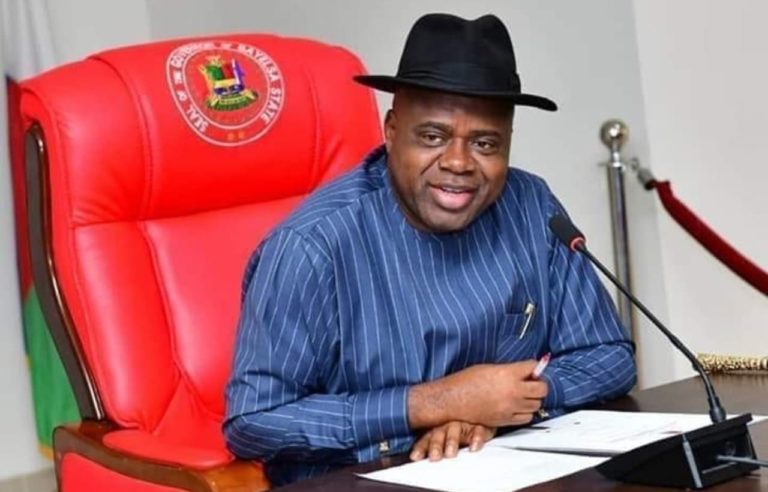
THE Independent National Electoral Commission (INEC) has declared the incumbent governor, Douye Diri, winner of the governorship election held in Bayelsa state on Saturday, November 11.

Diri, who’s a candidate of the Peoples Democratic Party (PDP), defeated his closest opponent and candidate of the All Progressives Congress (APC), Timipre Sylva, having polled 175,196 votes.

The APC candidate won in only two LGAs and scored a total of votes of 110,108 across the state, while the Labour Party counterpart polled 905 votes.

The returning officer for the election, Farouk Kuta, declared Diri the winner of the election amidst several uproar in the state, particularly in the collation centre, earlier today.

The collation of results by INEC was adjourned by INEC about five times since the conclusion of the voting process on Saturday.

Most of the adjournments were due to the non-readiness of the LGA results, which stretched the collation process from Saturday to Monday.

The ICIR reports that before the last adjournment, party agents clashed following the collation of the Brass LGA results.

Agent of the Accord party, identified as Victor, said there was a riot in the Brass LGA that claimed the life of a party agent and blamed it on the utterance of the deputy governorship candidate of the APC, Joshua MacIver.

MacIver recently came under fire for making inciting statements during campaigns in the Twon Brass area of the state, urging his supporters to attack opposition supporters.

Diri won six out of the eight LGA results collated, including Kolokuma/Opokuma, Ogbia, Yenegoa, Sagbama, Ekeremor and Southern Ijaw.

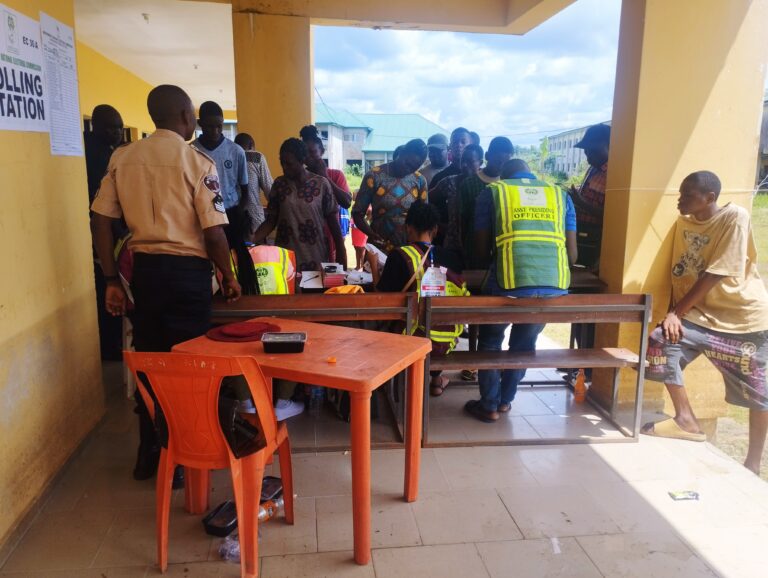
The ICIR reported that Diri won the election in his polling unit with a landslide, clearing 218 out of 219 votes cast. He also cleared all the votes in nearby polling units, taking all the 150 votes cast in polling unit 003, Ibaba Wari primary school, Sampur community, Kolokuma/Opokuma LGA.

Diri also won the polling unit of the Labour Party candidate in the election, Udengs Eradiri.

Meanwhile, Diri’s closest opponent and candidate of the All Progressives Congress (APC), Sylva, won two LGAs.

Sylva won Brass Local Government Area, polling 18,431 votes while PDP’s Diri got 12,602. APC also won in Nembe LGA, having scored 22,248 votes. Diri had 4,556 there.

The election in Bayelsa is one of the three off-cycle governorship polls held on Saturday.

The other two states are are Imo and Kogi.

Bus driver allegedly chased by LASTMA officers kills 2 cleaners in Lagos, flees

0

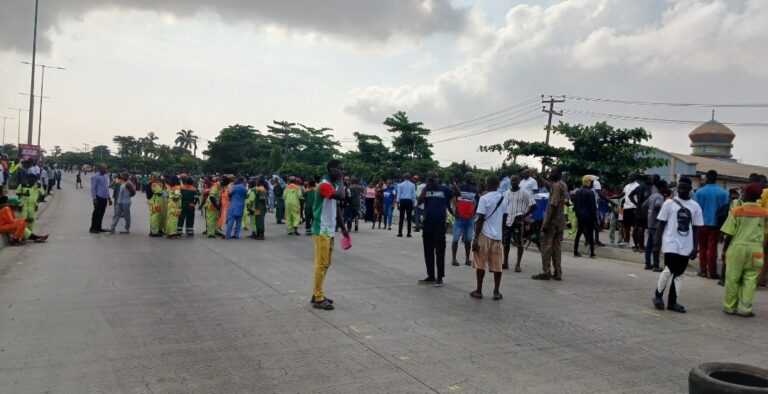
THERE was pandemonium Monday morning in Lagos State after a hit-and-run commercial bus hit two street cleaners while attempting to escape arrest by the state traffic management agency (LASTMA).

The two cleaners’ lifeless bodies were laid inside the gutter at the Charley Boy Bus Stop via Oshodi- Gbagada expressway, inward Iyana-Oworo.

Eyewitnesses’ accounts blamed LASTMA officers for the tragedy.

The officers fled as the driver vanished with his bus after the incident to escape a possible mob action.

One of the witnesses, who identified himself as Friday, said the officers were unprofessional in their bid to apprehend the bus driver.

“Every morning, the LASTMA task force and some men from the Gbagada Police unit come here to raid. They come here to collect N10,000-50,000 from people they arrest.

“Look at what happened: two family members died because a LASTMA official was chasing a bus. This has been happening for a very long time,” he said.

Other street cleaners were seen mourning the death of their colleagues as vehicular movement stalled, leaving commuters stranded.

Many commuters trekked to the nearest bus stop to continue their journey.

The ICIR contacted the LASTMA spokesperson, Taofiq Adebayo, on Monday morning to get his reaction to the allegation against the agency’s officers.

He said, “We are trying to put a press statement. You will get it very soon.”


SDP’s Ajaka accuses INEC of manipulating Kogi poll, says won’t go to court

0

THE candidate of the Social Democratic Party (SDP) in the just concluded November 11 governorship election in Kogi state, Murtala Ajaka, said he would not challenge the election result in court.

Ajaka said that INEC had cheated the state’s voters by ‘manipulating’ the election results to favour the All Progressives Congress (APC) candidate.

He said this while appearing on Channels Television’s “The 2023 Verdict” programme, on Sunday night. 

The SDP candidate added that going to court to contest the poll’s outcome would be a waste of time, claiming INEC would come as a witness to defend the poll result.

“What am I going to court to do when the same INEC that did this will come as a witness to defend what they did? So it is a waste of time,” he stated.

He added, “You allowed me to waste my time, spend my money, mobilise my people, only for you to write the results.”

He said that by allowing the result to stand, INEC called for chaos in the state.

The ICIR reported that INEC declared the APC candidate, Ododo, winner of the election Sunday night.

Ododo, a former auditor-general of local governments in the state in the administration of the incumbent Governor Yahaya Bello, defeated the candidate of the Peoples Democratic Party (PDP), Dino Melaye, and his SDP counterpart, Ajaka, by a wide margin.

He polled 446,237 votes, Ajaka won 259,052, and Melaye garnered 46,362 votes.

Eighteen candidates participated in the exercise.

The INEC, through its returning officer in the state, Johnson Urama, the Deputy Vice-Chancellor (Academics) of the University of Nigeria, Nsukka, declared Ododo the poll winner.

Both Melaye and Ajaka rejected the election and called for its cancellation while it was ongoing on Saturday.

The INEC confirmed the malpractices and ordered fresh elections in the affected locations on Saturday, November 18.

However, the commission said the fresh election was subject to the returning officer’s decision on applying the Margin of Lead Principle, which implies that if the margin of lead in the election is more than the number of registered voters in the polling units where the election is yet to hold, the returning officer could declare the candidate with the highest votes the winner.

With Ododo’s declaration as the winner, the election will no longer occur.

Bello’s tenure expires on January 26, 2024, when Ododo is expected to take the oath of office.

The election in Kogi is one of the three off-cycle governorship polls held on Saturday.

The other two states having the election are Imo and Bayelsa.

The ICIR reported Kogi State Governor Yahaya Bello boasting after casting his vote in his hometown of Okenne that his party’s candidate, Ododo, would win the election.


Bayelsa polls: Again, collation of results adjourned as Sylva wins second LGA

0

COLLATION of the 2023 governorship election results in Bayelsa has been adjourned for one hour.

The returning officer for the election, Farouk Kuta, adjourned the collation after resuming for less than an hour at the collation centre in the state’s capital, Yenagoa on Monday, November 13.

Kuta, who represented the Independent National Electoral Commission (INEC), had adjourned the collation about five times since the conclusion of the voting process on Saturday, November 11.

Farouk said the latest adjournment was due to the unavailability of the Southern Ijaw local government area (LGA) result, which is the last being expected out of eight LGAs.

“We have just finished collating Brass local government. The information available is that Southern Ijaw is still not ready. So we will plead that we return to this hall in the next one hour,” he said.

Party agents clash

Before the adjournment, party agents clashed following the collation of the Brass LGA results.

Agent of the Accord party, identified as Victor, said there was a riot in the Brass LGA that claimed the life of a party agent and blamed it on the utterance of the deputy governorship candidate of the APC, Joshua MacIver.

MacIver recently came under fire for making inciting statements during campaigns in the Twon Brass area of the state, urging his supporters to attack opposition supporters.

“On the 11th, don’t joke with anybody. If anybody misbehaves in Twon Brass, chase them away into the sea so they can die. Did you hear? Chase him so he can die. After all, he won’t be the first person to die.

“This time around, when we take it (governorship), we are taking it for final,” he said in Pidgin, a corrupted form of the English Language.

The reference to MacIver’s statement led to an altercation between the APC and Accord party agents, degenerating into a physical fight that security officials stopped.

Seven out of the eight Local Government Areas (LGAs) have had their results collated with the incumbent governor, Douye Diri, who is seeking a second and final term, maintaining a lead.

Diri has won five out of the six LGA results collated, including Kolokuma/Opokuma, Ogbia, Yenegoa, Sagbama, and Ekeremor. He has 150,512 votes.

Meanwhile, Diri’s closest opponent and candidate of the All Progressives Congress (APC), Timipre Silva, won his second LGA so far, polling 91,934.

The ICIR reported that Diri won the election in his polling unit with a landslide, clearing 218 out of 219 votes cast. He also cleared all the votes in nearby polling units, taking all the 150 votes cast in polling unit 003, Ibaba Wari primary school, Sampur community, Kolokuma/Opokuma LGA.

Diri also won the polling unit of the Labour Party candidate in the election, Udengs Eradiri.

Although there are nearly 60,000 votes between Diri and Silva, the APC candidate holds more sway in the remaining LGA yet to be collated.

INEC declares Ododo winner of Kogi poll

0

THE Independent National Electoral Commission (INEC) has declared the All Progressives Congress (APC) candidate, Usman Ododo, winner of the governorship election held in the state on Saturday, November 11.

Ododo, a former auditor-general of local governments in the state in the administration of the incumbent Governor Yahaya Bello defeated the candidate of the Peoples Democratic Party (PDP), Dino Melaye, and his Social Democratic Party (SDP) counterpart, Murtala Ajaka, by a wide margin.

He polled 446,237 votes, Ajaka won 259,052, and Melaye garnered 46,362 votes.


READ ALSO:
#KogiDecides2023: Collation of results to commence at 10 a.m.

Imo Guber Poll: Uzodimma clears all 27 LGAs

Bayelsa poll: Collation adjourned for three hours


Eighteen candidates participated in the exercise.

The INEC, through its returning officer in the state, Johnson Urama, the Deputy Vice-Chancellor (Academics) of the University of Nigeria, Nsukka, declared Ododo the poll winner Sunday night.

Ododo’s victory came amidst the expectation that elections would be held in parts of the state where the INEC suspended election because of malpractices.

Both Melaye and Ajaka rejected the election and called for its cancellation while it was ongoing on Saturday.

The INEC confirmed the malpractices and ordered fresh elections in the affected locations on Saturday, November 18.

However, the commission said the fresh election was subject to the returning officer’s decision on applying the Margin of Lead Principle, which implies that if the margin of lead in the election is more than the number of registered voters in the polling units where the election is yet to hold, the returning officer could declare the candidate with the highest votes the winner.

With Ododo’s declaration as the winner, the election will no longer take place.

Bello’s tenure expires on January 26, 2024, when Ododo is expected to take the oath of office.

The election in Kogi is one of the three off-cycle governorship polls held today.

The other two states having the election are Imo and Bayelsa.

The ICIR reported Kogi State Governor Yahaya Bello boasting after casting his vote in his hometown of Okenne that his party’s candidate, Ododo, would win the election.


INEC announces fresh election in Kogi

0

The Independent National Electoral Commission (INEC) has announced fresh elections in wards where elections were cancelled in Kogi state on Saturday, November 11.

In a statement signed by the INEC National Commissioner & Member Information and Voter Education Committee, Mohammed Haruna, Sunday night and shared on the commission’s X handle, the election would be held on Saturday, November 18.

“We received reports of similar and other incidents in Adavi (five polling units in Okunchi/Ozuri/Onieka Ward), Ajaokuta (five polling units in Adogo Ward), Okehi (one polling unit in Eika/Ohizenyi Ward) and Okene (five polling units in Obehira Uvete Ward). Results from the affected polling units have been accounted for in Form EC40G for the four LGAs.

“However, in the case of Ogori/Magongo LGA, only the result of Oshobane Ward II with eight polling units and 2,264 registered voters has been collated. Election in the other nine Wards (Eni, Okibo, Okesi, Ileteju, Aiyeromi, Ugugu, Obinoyin, Obatgben, and Oturu) involving 59 polling units and 15,136 registered voters remain suspended.

The commission said in line with Section 24(3) of the Electoral Act 2022 and Clause 59 of INEC Regulations and Guidelines on the Conduct of Elections 2022, a fresh election would be held on Saturday, 18th November 2023, in the affected polling units.

It stressed that the decision to conduct a fresh election depended on the returning officer’s decision on the application of the Margin of Lead Principle.

“The decision to hold fresh elections is subject to the Returning Officer’s determination of the application of the Margin of Lead Principle.

“However, this decision is without prejudice to our avowed commitment to follow the audit trail of personnel and materials to ascertain those who may have been complicit in undermining the process and apply appropriate sanctions where necessary,” the commission added.

While the election was ongoing on Saturday, November 11, the candidates of the Peoples Democratic Party (PDP) and the Social Democratic Party (SDP) claimed the poll was marred by malpractices.

Both candidates claimed there were pre-filled election results in some LGAs in the state, including Okenne, Okehi and Adavi local government areas, when elections had yet to start.

They urged the Independent National Electoral Commission (INEC) to question the people involved.

The ICIR reported INEC admitted the malpractices and cancelled the election in parts of the LGAs.


Dino Melaye loses LGA to APC

0

THE governorship candidate of the Peoples Democratic Party (PDP) in the ongoing election in Kogi state, Dino Melaye, has lost his Ijumu Local Government Area (LGA) to the All Progressives Congress (APC).

The APC candidate, Ahmed Ododo, polled 10,524 votes in Ijumu LGA against Melaye, who had 6,909 votes as announced by the Resident Electoral Commissioner for the Independent National Electoral Commission (INEC) in the state, Gabriel Longpet.

The ICIR reported that the collation of results commenced at 10 a.m. today, Sunday, November 12. The election was held across the 21 LGAs in the state on Saturday, November 11.


Read Also:

Melaye, on Saturday, took to his official X account to demand the cancellation of the elections in five LGAs of the state.

“INEC must cancel the election in the five local governments of Kogi Central.  The election in Okene, Okehi, Ajaokuta, Adavi, and Ogori/Mangogo is a scam coordinated from the highest level of INEC”, he said.

The election in Kogi governorship poll is one of the three off-cycle elections held on Saturday. Other states with a similar exercise are Imo and Bayelsa.