SEVEN members of the Peoples’ Democratic Party (PDP) State Working Committee in Imo State have resigned.
The members blamed their exit from the party on Samuel Nnaemeka Anyanwu, the party’s governorship candidate in the state for the election coming up on November 11.
Anyanwu, a former senator fondly called Samdadday, was the PDP National Secretary before picking the governorship ticket in April.
He represented Imo East in the 8th Senate.
Addressing journalists on Sunday, June 18, the departing party members said Anyanwu hired thugs to assassinate them, among other grave accusations.
The group comprises the publicity secretary, Collins Opurozor; secretary, Ray Emeana; deputy chairman, Martin Ejiogu; youth leader, Greg Nwadike; state women leader, Maria Mbakwe; state vice chairman, Orlu zone, Chibuisi Obido; and treasurer, Josiah Eze.
“Since Senator Anyanwu became the National Secretary of the party, he has never relented in deploying the powers of his office to fight members of this Working Committee and intimidate even ordinary members of the party. Endless strife, mindless wars and erosion of all democratic values and principles have now defined and defiled Imo PDP.
“It is heartbreaking to inform you that some of us in the State Working Committee have severally escaped assassination attempts because of the wicked lies which our National Secretary sold to his violent supporters that we misappropriated Party funds,” the group claimed.
The angry chieftains alleged that Anyanwu imposed himself on the party in the state to enable him become governor.
According to them, the candidate’s emergence as governor would worsen insecurity in the state.
Besides, they claimed that the governorship candidate was responsible for “hundreds” of party chieftains dumping the PDP.
According to the group, four serving Federal lawmakers also dumped the party “along with thousands of their supporters in a single day.”
They said things worked well in the party when the former Deputy Speaker of the House of Representatives, Emeka Ihedioha, led the party in the state.
Besides, the politicians accused Anyanwu of ill-preparedness for the coming election.
“To be very clear, Senator Anyanwu is not running for governorship in November. If he claims to be running, it is not to our knowledge as members of the State Working Committee. The party does not know what his programme looks like, that is if he has any. Governorship campaigns have started, yet the party does not know if there is anything like a campaign council,” they said.
The ICIR contacted Anyanwu on the telephone on Sunday, June 18 afternoon, but he did not pick up the calls. He did not also respond to text, Whatsapp and e-mail messages sent to his number, which Truecaller, a caller identification application, confirmed belonged to him.
The ICIR reports that the seven aggrieved members said they would announce their new party soon.
This organisation further reports that the ruling All Progressives Congress (APC), headed by Governor Hope Izodinma, will seek to retain power in the state.
Izodinma is the party’s candidate in the coming election.
The Labour Party (LP), which has dominated elections in the South-East since the 2023 general elections, will hope to cause another major upset for the APC and PDP, as it did in Abia State, which the PDP had ruled since 1999 before it lost it to the LP.
The ICIR reports that the LP claimed several National Assembly seats in the region in the last election.
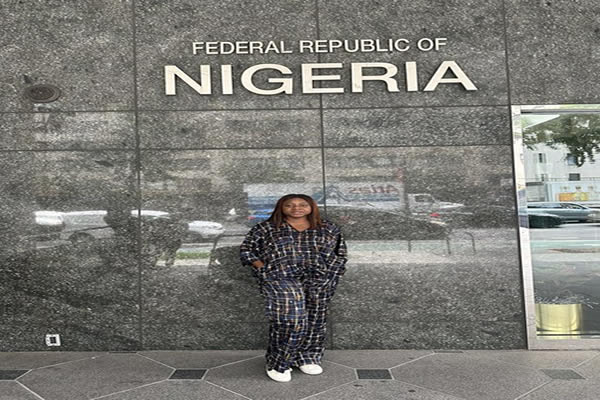
A Nigerian citizen residing in the United States of America, Addy Olubamiji, shared her harrowing experience at the Nigeria House in New York while attempting to obtain passports for herself and her family.
In a tweet on Friday, Olubamiji expressed her frustration with the disrespectful treatment, inconsistent processes, delayed employee arrivals, and lack of empathy she encountered during the application process.
She recounted feeling belittled and moved to tears by the demeaning treatment she received.
“Let it be known that when diasporans try to stay patriotic to our country Nigeria, the systems kept making it difficult for us. We shouldn’t have to cry or plan to bribe or know that the system will not work,” Olubamiji said.
She said her ordeal led her to question her motivation for passport renewal and her desire to obtain one for her child, calling for a thorough examination and improvement of the structures and systems within Nigeria’s embassies worldwide.
In response to Olubamiji’s experience, several individuals shared similar accounts of their encounters with Nigerian embassies.
For example, a twitter user @im_ayodejiRN described the London embassy’s crowded conditions, where people were made to wait on the roadside and were confined to a cramped basement.
@amuta_ann shared her encounter at the Atlanta embassy, where staff members offered assistance in exchange for personal favours to expedite passport processing.
On a more positive note, another user, Babs Adewumi, mentioned his experiences with Nigeria’s embassy in New York and the comparatively smoother operations at the Ottawa office.
He, however, highlighted the challenge of reaching the Ottawa office by phone and emphasised the need for benchmarking, standardization, and performance tracking across Nigeria’s global embassy network.
An investigation by The ICIR [read here] shows that the issue is also obtainable within the country.
The criticisms shed light on the frustrations faced by Nigerians trying to obtain passports both within Nigeria and abroad, underscoring the urgent need for reforming the passport application process, ensuring consistency and efficient service delivery that respects the dignity and rights of all applicants.
Meanwhile, the Acting Comptroller General of the Nigeria Immigration Service (NIS) Caroline Wura-Ola, Adepoju, has announced a state of emergency on passport matters.
Adepoju emphasised the need to address the challenges faced by Nigerians in obtaining passports and has directed all relevant personnel to work tirelessly towards eliminating hindrances to prompt passport access.
IT was a tale of insipid performances by Nigerian players as 11 out of 13 of them failed to win their games in the first round of the main draw at the World Table Tennis (WTT) Contender Series in Lagos.
The ICIR had reported that the WTT Contender Series in Lagos began with the preliminaries stage, which featured 64 table tennis players competing for the 32 alloted slots in the main draw.
At the completion of the preliminaries stage, 32 players that qualified from that stage will join the top-ranked 32 players who automatically were at the main draw to sum up 64 players.
After the commencement of the main draw on Thursday, 11 Nigerian players could not cross the hurdles in the rounds of 32 for both men and women’s singles, and also in the rounds of 16 for both men and women doubles and mixed doubles.
Mixed doubles
Chinese Zhou Ka and He Zhuojia defeated Nigeria’s Orok Etim and Fatimo Bello 3-0 (11 – 3, 11 – 4, 11 – 6).
Also, it was a stroll in the park for India’s Snehit Suravajjula and Diya Parag Chitale as they eased past Nigeria’s Amadi Omeh and Esther Oribamise 3-0 (11 – 4, 11 – 5, 11 – 8).
The Chinese continued their dominance as Nigeria’s Olajide Omotayo and Offiong Edem lost to Xiang Peng and Liu Weishan 0-3 (8 – 11, 7 – 11, 5 – 11).
Likewise, Nigeria’s Taiwo Mati and Ajoke Ojomu lost to Lubomir Pistej and Barbora Balazova from Slovakia 0-3 (3 – 11, 9 – 11, 4 – 11).
Men’s Singles
Nigeria’s fast rising tennis player Taiwo Mati bowed to the artistry of Germany’s Patrick Franziska 0-3 (4 -11, 1 – 11, 7 – 11).
India’s Manav Vikash Thakkar had a tough one against Nigeria’s second best rated player Olajide Omotayo, but it went in favour of the Indian player 3-1 (11 – 7, 11 – 9, 10 – 12, 11 – 8).
Women doubles
Korean Jeon Jihee and Shin Yubin dominated Nigeria’s Ajoke Ojomu and Esther Orobamise 3-0 (11 – 1, 11 – 3, 11 – 3).
China’s He Zhuojia and Wang Xiaotong overpowered Nigeria’s Cecilia Akpan and Offiong Edem 3-0 (11 – 9, 11 – 3, 11 – 4).
Women Singles
Korean Lee Eunhye waltzed through Nigeria’s Fatimo Bello 3-0 (11 – 6, 11 – 7, 11 – 6).
Nigeria’s Offiong Edem lost to Chinese Li Yake 0-3 (6 – 11, 1 – 11, 3 – 11.)
Another Korean sensational Kim Nayeong also knocked out Nigeria’s Esther Oribamise in a straight set, 11 – 8, 11 – 6, 11 – 7.
Mens Doubles
It was all Nigeria’s affair as Amadi Omeh and Azeez Solanke defeated Taiwo Mati and Olajide Omotayo 3-2 (8 – 11, 11 – 7, 11 – 8, 2 – 11, 11 – 8).
It was only Amadi Omeh and Azeez Solanke that qualified to the next round and ended their campaign in the round of 8.
Indian Jeet Chnadra and Snehit Suravajjula overpowered Akinwale Fagbamila and Joshua Oladiran 3-1 (11 – 6, 11 – 6, 7 – 11, 11 – 7).
The ICIR analysed that 12 out of the 14 games the Nigerian players played, they were unable to win a set out of five.
Stakeholders react
The Executive Vice-President, International Table Tennis Federation (ITTF), Wahid Oshodi, described the early exit of Nigerian players in the tournament as “underwhelming”.
Oshodi advised the NTTF to employ the services of a foreign coach that would harness the potentials of the pool of young talents in the country.
“The NTTF has a lot of work to do, I am hoping they will get a coach and I mean they need to bring in someone with international experience, especially because we have good young players. They need someone with the charisma who can lead them through,” he said.
The NTTF president, Ishaku Tikon, in an interview with newsmen, attested that the Nigerians players lost to top ranked players in table tennis.
Tikon said, “It sounds funny that at this time of the event, all Nigerians are out. Of course, it is not out of context, it is something you are aware of; we have the world’s best here.
“The ones that crashed out have done their best. In table tennis, if you take the wrong route, you will retire early, and this applies to all players around the world.
“I commend those ones that are out now; they have done their best. We will go back to the drawing board. We have a few tournaments coming up at the corner, which I am sure we are going to participate in.”
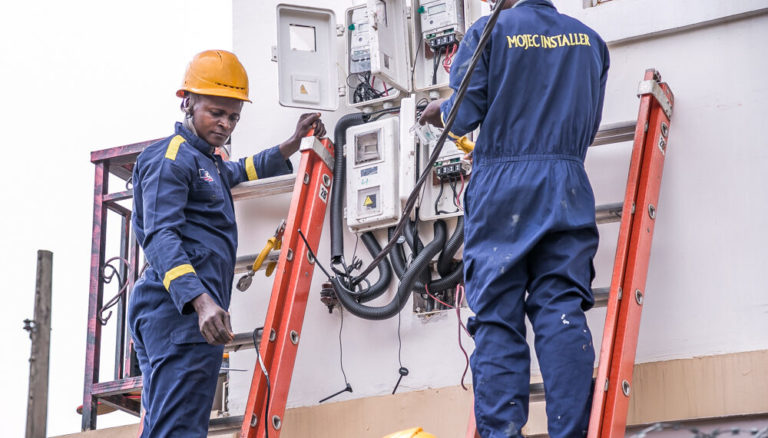
NIGERIAN electricity consumers are yet to explore full options from the ‘capping order’ by the Nigerian Electricity Regulatory Commission (NERC), with a poll showing that 57 per cent of consumers are still being overcharged.
The Electricity Poll was conducted in May by NOI, a polling research and analytic agency.
The report disclosed that majority of Nigerians polled (94 per cent) stated they were connected to the national grid.
According to the report, of the proportion (43 per cent) of respondents not metered, 62 per cent claimed they pay for electricity bills by distribution companies’ estimation or direct billing method.
The report further said that monthly electricity consumption expenditure showed 44 per cent of respondents spend between N1,000 and N5,000 per month, while 24 per cent spend between N6,000 and N10,000 per month.
The report revealed that respondents who do not have electricity meters (57 per cent) accounted for the proportion that pay the highest amount due to estimated billing.
While most respondents (69 per cent) reported that the amount they spend on electricity bills was not commensurate with consumption, it was found out Nigerians were willing to pay more to get 24 hours of electricity.
The poll has also shown that ownership of pre-paid meters is low as only 37 per cent of electricity customers in Nigeria have access to it.
The ICIR had reported how electricity distribution companies were exploiting unmetered power consumers through estimated billing.
The NERC Assistant General Manager, Market Analysis, Emeka Onyegbule, reacting to the development advised electricity consumers to explore options with the NERC Consumer Forum Office in their respective states to seek redress on overbilling.
“The NERC Consumer Forum Office should provide succour to consumers in the respective areas of concerns in the electricity supply industry. It is in every state and consumers should explore the options there,” Onyegbule said.
The ICIR recalls that effective from February 20, 2020, the NERC issued order No/NERC/197/2020 effectively capping the amount that certain categories of unmetered electricity consumers in Nigeria should pay for their monthly electricity consumption.
This was done at the time as a further measure to push the distribution companies (Discos) to fulfil their obligation to meter their customers.
OPERATIVES of the National Drug Law Enforcement Agency (NDLEA) have arrested two Qatar-based drug kingpins, Eyah Celestine Nnamdi, alias Murphy, and Peter Oluchukwu Ugwuoke, following the interception of their methamphetamine consignment at the Murtala Muhammed International Airport (MMIA), Ikeja, Lagos.
The agency said it arrested Ugwuoke on June 9 during the outward clearance of Qatar Airways passengers at the departure point, Terminal 2 of the Lagos airport.
According to a statement the NDLEA spokesperson, Femi Babafemi, issued on Sunday, June 18, the agency said the suspect was travelling to Doha with an Ivorian international passport with the name Hien Narcisse when a scrutiny of his black carry-on luggage led to the discovery of a false bottom concealment of two parcels of crystalline substance that tested positive to methamphetamine, weighing 1.00kg.
Part of the statement read, “Preliminary investigation revealed that the suspect is a Nigerian who had gone to obtain an Ivorian passport for his travels. He confessed that he travelled to Qatar in August 2022 and returned from the Arab nation about two months ago to perfect arrangement for the movement of the drug consignment.
“A further probe led operatives to discover that his Qatar-based senior partner in the trade simply identified as Murphy was lurking around in Eziani, his home town in Nsukka LGA, Enugu State. Ugwuoke, who hails from Igboeze North Local Government Area of the state, claims he holds a National Diploma in Electrical Engineering from the Federal Polytechnic Oko.
“A prompt deployment of NDLEA operatives on 10th June to Eziani community of Nsukka Local Government Area of Enugu State, led to the arrest of ‘Murphy’, whose true identity was later discovered to be Eyah Celestine Nnamdi, who had lived in Indonesia for some years before relocating to Doha, Qatar.”
Similarly, the agency arrested a female pharmacist, Ikwebe Ori Helen, in Kaduna following her attempt to use forged documents to purchase and distribute six cartons of pentazocine injection with 2,000 ampules.
She confessed to have used fake documents of a Kaduna hospital to order the drug, which she planned to distribute in Kaduna, Abuja and Sokoto. The consignment was initially intercepted at the local wing of the MMIA, Ikeja, while being sent to Kaduna by a freight agent, according to the statement.
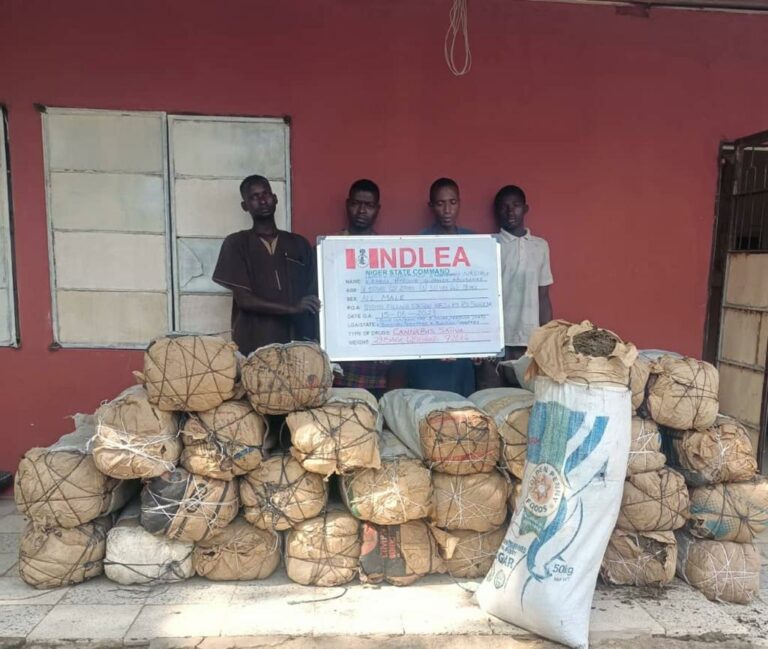
“In the same vein, NDLEA operatives in Niger state have seized a total of 1,072 kilogrammes of cannabis in two raids. On Thursday 15th June, 726kg of the illicit substance was recovered at Oyoyo filling station along the Kaduna-Abuja express road where four suspects: Aminu Mohammed, 50; Nasiru Mohammed, 30; Rabiu Haruna, 29, and Hamza Abubakar, 18 were arrested. The following day, 16th Friday, operatives intercepted a Mercedes 1422 truck marked MKD 116ZM on its way from Umunede, Delta state with gallons of palm oil to be delivered at Garki market in Abuja.
“However, the truck driver, Jekwe Udenze, 38, along with his two assistants: Gabriel Nzekwube, 43, and Chima Uzoma, 42, stopped over at Uromi, Edo State and loaded 19 jumbo bags of cannabis weighing 346kg, to be delivered at Dumez Luxury Park along Kaduna road, Suleja, to Ignatius Mokwe, 47. Both the driver and his two assistants, as well as the owner of the illicit consignment, Ignatius Mokwe, have been arrested.”
The NDLEA further stated that a total of 30.9 hectares of cannabis farms were destroyed in Delta, Edo and Ondo states in the past week.
In Delta, 18 hectares of cannabis farms were destroyed on Monday June 12, in Umuchime village, Ogume, Ndokwa West LGA by NDLEA operatives supported by soldiers, while four suspects, comprising two men and two women, were arrested on the farm.
They are Kingsley Atuola, 40; Okikiolu Adekunle, 44; Osai Doris, 40; and Ublenu Joy, 28,
“In Edo state, operatives on Wednesday 14th June stormed Awakpa forest in Owan West LGA where they arrested Malachy Amaechi, Nanmua Peter, Ojo Momoh, Afam Luke and John Danladi, who were apprehended inside a hut located on 2.5 hectares of a cannabis farm, which was destroyed, and 102 kilogrammes of the substance already harvested recovered. Another farm measuring 1.294870 hectares was also destroyed with the three farms razed totalling 3.978217 hectares.
“Similarly, operatives on Saturday 17th June raided the house of a dealer, Godwin Ejiro, 45, at Uyiwnendi community, Ikpoba Oka LGA, where quantities of illicit drugs including cocaine, heroin, meth, swinol and cannabis were recovered. In Ondo state, John Emmanuel, 30, was arrested at Ofosu, with 81kg cannabis on Thursday 15th June while operatives on same day nabbed Gideon Akoh at Ala forest, where a total of nine hectares of farm were destroyed and 12kg harvested substance recovered.
“While 93.7kg of the psychoactive substance was evacuated from a shop in Enugu metropolis on Saturday 17th June, a wanted notorious dealer, Kwada Vendi, 37, was arrested with 30.6kg cannabis at Mamari, Maiduguri, Borno state on Tuesday 13th June. In Bauchi state, 87,000 pills of tramadol and exol-5 were recovered from a suspect, Tony Ogbonna, 40, by NDLEA operatives at Yelwa, Bauchi town on Saturday 17th June.”
The NDLEA said it recovered a total of 13,800 pills tramadol consignment abandoned by a suspect going to Geidam, Yobe State, were recovered at Yankaba Park, Kano, on Wednesday June 14, while on the same day in Benue state, a suspect, Chidera Gabriel, was arrested with 22,100 pills of the same pharmaceutical opioid at an NDLEA check point in Vandeikya.
The chairman/chief executive of the NDLEA, Brigadier-General Mohamed Buba Marwa, charged his officers in all state commands to remain vigilant and keep their focus on the corporate goal of the agency.
THE Human and Environmental Development Agenda (HEDA) has defeated the Nigeria Customs Service (NCS) in a case on the NCS’ refusal to respond to a request HEDA made through the Freedom of Information (FoI) Act.
According to the Abuja Federal High Court’s proceedings and judgment on the case obtained by The ICIR during the week, HEDA had on December 17, 2021, written to the NCS to provide information on the recruitment exercise it (NCS) had done that year, and on details of contract of the renovation of its headquarters in Abuja.
Information that HEDA sought, using the FoI, included:
The name of the company/firm that the NCS contracted for its recruitment screening exercise in 2021;
The amount the NCS agreed to pay the contractor for the exercise;
The process/guidelines for selection of the contractor company/firm in the recruitment exercise.
Another request was the name of the company/firm the NCS contracted to renovate its headquarters in Abuja and the amount the contract was awarded.
Weeks after the NCS failed to provide the information, HEDA headed to court and filed a suit against it, according to Section Six of the FoI, which says, “A person entitled to the right of access conferred by this Act shall have the right to institute proceedings in the court to compel any public institution to comply with the provisions of this section.”
The ICIR reports that the FoI Act, signed by former President Goodluck Jonathan in 2011, is viewed by many as the boldest effort made by any government in Nigeria to make public officials accountable to the citizens.
Section One (1,2 and 3) of the Act states citizens’ right to request any information of public interest from any government-funded institution or public organisation receiving funds from the government.
The ICIR further reports that like the NCS, many institutions fail to honour the law.
To promote responses by ministries, departments and agencies (MDAs) and private organisations taking funds from the government to FoI requests, The ICIR, in collaboration with partners, had consecutively given awards to institutions adjudged to have responded most promptly to FoI requests over the past years. Here are the 2020, 2021, and 2022 winners.
HEDA’s suit, filed on March 28, 2022, sought an order of mandamus compelling the NCS to provide the information it requested.
Lawyers Saidu Muhammad Lawal, Abdulrazak Abdulganiyu, Joshua Ifeanyi Onuekwusi, Paul Adedapo Adewuyo, Abdulrahman Uwais, and C. B. Yakubu, represented HEDA, while the NCS hired Smart Akande, Abiola Olowoniyi, Jayeola Dada, and A. S. Adeyemi.
On April 12, the respondent filed a counter affidavit to the applicant’s motion on notice and also filed a notice of preliminary objection challenging the court’s jurisdiction to entertain the suit on the following grounds, to wit: that the application/ suit did not disclose any reasonable cause of action against the respondent, and that the suit/applicant constituted an abuse of court process.
The NCS also said it refused to provide the information sought by HEDA because it fell within Section 15 (1) of the FoI, which empowers institutions to deny information that could cause harm to third parties on issues relating to trade secrets.
After both parties had filed their written addresses, the trial judge, Emeka Nwite, first dealt with the preliminary objection before going into the case’s merit.
Nwite, recalling related cases, held that “the applicant has a reasonable cause of action against the respondent upon a careful examination of the facts as deposed in support of the present application for judicial review.”
Also, on the issue of abuse of court process, the judge said, “I have carefully examined the present suit, and I must state right away that the basis upon which the respondent argued that the present suit is an abuse of court process is not only watery but bereft of any iota of merit. The present suit is geared towards informing the citizenry of the country on how public funds are used and by whom.
“It equally aimed at exposing any corrupt practices within the public institution by promoting transparency and accountability. Therefore, it will be difficult to hold that the present suit is an abuse of court process when the definition of an abuse of court process is considered. There is absolutely nothing before this court to show that the applicant is acting maliciously towards the respondent as it relates to the present suit.”
The judge declared as untenable and inconsequential the respondent’s argument that the information sought must be denied because it was exclusively between an employer and employee bound on the personal information in line with Section 15(1) of the FOI.
He consequently dismissed the preliminary objection by the NCS.
In his ruling, the judge, after referring to various similar cases, granted HEDA’s prayers and issued an order of mandamus compelling the NCS to provide the information the applicant requested.
Information the NCS must provide, as ordered by the court, included the name of the company/firm it contracted to conduct the said recruitment, the process/guidelines for selection adopted by the contracted company/firm and the NCS in the said recruitment exercise, and the name of the company/firm contracted to renovate the NCS’ headquarters in Abuja, as well as the amount awarded.
The judge said, “In my humble view, the information sought is the most simplest and harmless information that an applicant is expected to get from a public institution like the respondent. Where an institution like the respondent denies an applicant the instant information sought, it will not only defeat the very purpose of the Act, it will also encourage corruption and financial recklessness. The respondent has no valid reason to deny the applicant the information sought.”
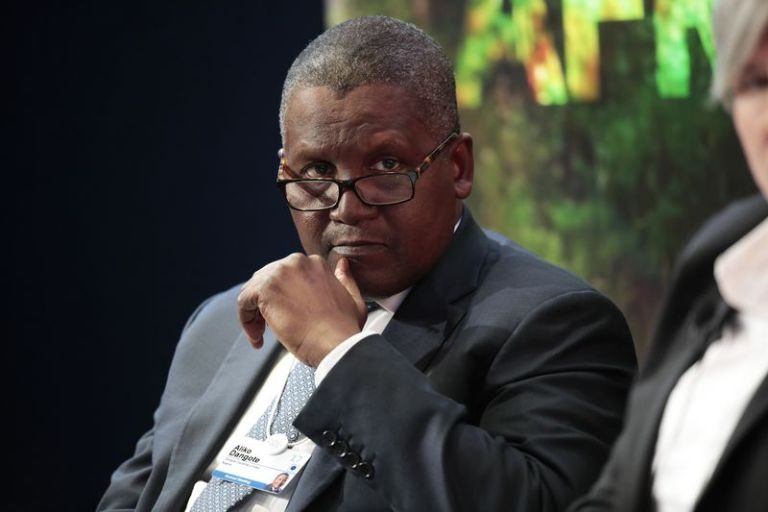
SOUTH AFRICAN Johann Rupert has displaced Nigerian billionaire businessman Aliko Dangote to become Africa’s richest man, Forbes Magazine said.
This development is not unconnected with the recent unification of foreign exchange rates being enforced by the Central Bank of Nigeria (CBN) under the promised reforms of and stands of President Bola Ahmed Tinubu, analysts say.
Media outlets in Nigeria reported how Dangote lost $4.12 billion since the naira devaluation and has dropped off from the top 100 richest people.
“Aliko Dangote’s wealth has decreased by $4.12 billion since the liberalisation of the naira and the unification of exchange rates by CBN,” a report by Nairametrics was quoted to have said.
The devaluation of the Nigerian naira affects the valuation of Dangote’s assets, including Dangote Cement, Dangote Sugar , and Bascom Allied Industries.
Meanwhile, Rupert’s net worth is currently $12 billion according to Forbes Real-time Global Billionaires Ranking, while Dangote trails behind him with a net worth of $10.8 billion as of Friday, June 16, 2023.
Dangote’s net worth dropped due to the recent operational charges on the foreign exchange market carried out by the Central Bank of Nigeria, which led to the depreciation of the Naira against the US dollar.
Consequently, Forbes and Bloomberg had to recalculate the fortunes of all Nigerian billionaires leading to the significant drop in the wealth of Dangote, Abdul Samad Rabiu, the founder of BUA cement, and Mike Adenuga, the Chairman of telecommunications giant Globacom Limited.
Meanwhile, with the expected kickoff of the $20 billion Dangote refinery commissioned last Month, Aliko Dangote is expected to bounce back.
Upon assumption of office, Benue state governor Hyacinth Alia and his counterpart in Plateau Caleb Mutfwang revoked last-minute appointments by their predecessors.
A few weeks to the end of his tenure, former Benue governor Samuel Ortom appointed five new Permanent Secretaries in addition to previous appointments he made recently, which Alia revoked on Wednesday, June 7.
Former governor of Plateau state, Simon Lalong, also made some last-minute appointments of permanent secretaries and employment of civil servants.
Barely 48 hours before the end of his tenure, he appointed Rauta Dakok as the new Head of Service of the state.
However, Mutfwang reversed all appointments made into the state civil service from October 1, 2022.
Alia and Mutfwang also ordered retired civil servants who are yet to vacate office to exit their duty posts, while those due for retirement to proceed on retirement immediately.
Similarly, the first directive from Sokoto governor Ahmed Aliyu after his inauguration was to nullify last-minute appointments made by the last administration of Aminu Waziri Tambuwal after March 19, 2023.
Aliyu issued the directive on May 31, hours after his inauguration.
He nullified the appointments of 23 permanent secretaries and 15 directors general and suspended 14 traditional rulers, 13 district heads and the Magajin Garin Sokoto, Sama’ila Abdulkadir Mujeli, who was recently appointed.
Although the new administration did not state the reason for this directive, the spokesperson to the governor, Abubakar Bawa, assured that the appointments would be reviewed to fit public interest.
The governor has also ordered the review of auctions by the last administration.
To this effect, Aliyu set up a committee to probe all auctions and sales of Government assets by the former governor.
An illustration of key decisions by new governors.
Cross River directs verification of civil servants
Cross River governor Bassey Otu directed that a re-verification exercise of civil servants in the state be carried out, and workers were ordered to present themselves for screening and documentation at the office of the Secretary to the State Government.
He also ordered the immediate suspension of ongoing recruitment of workers into the civil service till further notice.
No more sit-at-home –Enugu governor
Enugu state governor Peter Mbah banned sit-at-home in the state on June 1, saying it was restricting entrepreneurship and productivity in the state.
Mbah, however, said his administration was ready “to engage in dialogue with people, who have genuine grievances towards bringing lasting peace and security to Enugu State.”
He also called on Nigerian President Bola Tinubu to release the leader of the Independent People of Biafra (IPOB), Nnamdi Kanu, to quicken the healing process in the region.
However, residents defied the governor’s directive due to previous cases of killing people who defied the unauthorised sit-at-home order.
Demolitions in Kano, Niger
The first 20 days in office of the new Governor of Kano state, Abba Yusuf, have been marked by various activities ranging from demolishing several buildings, revoking sales of Government properties and sacking all government officials appointed by his predecessor, Abdullahi Ganduje.
The Governor gave an executive order sacking all political appointees heading government MDAs and companies while also dissolving all boards of Ministries, Departments and Agencies (MDAs), companies and institutions of higher learning with immediate effect.
Yusuf also vowed to ensure that all perpetrators and those that aided them are brought to justice through the institution of the Judicial Commission of Inquiry.
On Wednesday, June 14, Yusuf ordered the demolition of the popular Tumbin Giwa roundabout constructed by the previous administration.
Secretary to the State Government of the State (SSG), Baffa Bichi, said the demolition was a result of the presence of a cross sign on the roundabout which he described as anti-Islamic.
In Niger state, Governor Umar Bago, aside from appointing key officers, ordered the demolition of the Chanchaga Police Station in Minna, the state capital. Bago stressed that the police station was illegally constructed on a major water pipeline.
Under Bago’s administration, the state government has also warned that organisations, institutions and individuals must obtain approval from constituted relevant authorities in the state before erecting any building.
Rivers revokes road construction award
On Saturday, June 10, Rivers State Governor Siminalayi Fubara said his government would revoke the contract for the Andoni section of the Ogoni/Opobo/Nkoro/Andoni Unity Road construction project.
He said the contract would be re-awarded, as the contractor in charge of the project has failed to deliver after several years.
Ebonyi appoints first female SSG
Ebonyi Governor Francis Nwifuru appointed the first female SSG in the history of the state.
Nwaifuru appointed Grace Umezurike, Umezuruike, a professor of Philosophy and Religion at Ebonyi State University, Abakiliki, as the SSG on Friday, June 9.
A day after he was sworn in, Nwaifuru ordered the freezing of all bank accounts operated by the state government.
He made certain other appointments since he assumed office, including 21 special assistants on internal security, new media and other focused areas of his administration.
State of emergency on refuse declared in Abia
Abia State Governor Alex Otti, in his inaugural speech on May 29, declared a state of emergency on refuse disposal in Umuhaia, the state capital and Aba, the commercial nerve of the state.
On June 1, he appointed one Ogbonnia Okereke as the head of the task force to implement the refuse disposal emergency. The governor participated and supervised in the flag-off of the exercise in both Aba and Umuahia.
“I wish to thank all those working pro-bono to ensure that our towns are clean and all who braved the rain to give effect to the directive we gave two days ago, declaring an emergency on the cleanup of Aba and Umuahia.
“I wish to thank all those working pro-bono to ensure that our towns are clean and all who braved the rain to give effect to the directive we gave two days ago,” Otti said during the occasion.
In his first 20 days in office, the governor had met with the permanent secretaries of different ministries and agencies in the state.
Otti, in a statement by his spokesperson, Kazie Uko, directed them to take charge of the various ministries until a new set of commissioners are appointed by the new government but warned them against undermining the new government.
Otti also froze all bank accounts belonging to the government and its agencies and directed that banks desist from honouring cheques, documents, or other instruments expressly approved by or emanating from him.
He also dissolved all boards of agencies and parastatals of the state government.
Kebbi inaugurates 10th Assembly, clears outstanding allowances for security personnel
In Kebbi, State Governor Nasir Idris dissolved the 9th assembly and inaugurated the 10th assembly within his first 20 days.
He ordered heads of security agencies to clear all outstanding allowances to security personnel in the state.
Under the administration of Dauda Lawal, the former governor, Bello Matawalle, is being probed.
Lawal accused his predecessor Bello Matrawalle of stealing official vehicles from the Government house before handing over the state’s leadership.
Under his administration, the state police raided Matawalle’s residence and recovered 40 government-owned vehicles.
He also ordered the state water board to commence water pumping to residents of Gusau, the capital. He issued this directive one week after his inauguration.
The governor has also prohibited the re-emergence and unlawful display of billboards bearing his pictures in the state capital and local government headquarters.
Katsina revokes land allocations
Since the inauguration of the new administration under Zamfara Governor Dikko Radda, the state has revoked all lands illegally allocated to individuals by government officials in MDAs within the state.
The government also approved N80 million to compensate musicians whose homes were attacked and destroyed by political thugs during the electioneering period.
Kastina is set to partner with United Nations International Children’s Emergency Fund (UNICEF) to end hunger across the 34 LGAs.
Taraba declares state of emergency on education
Taraba Governor Kefas Agbu declared a state of emergency on primary and secondary education and said his administration would turn the sector around within 100 days.
He described the conditions of basic schools in the state as pathetic and promised to focus on infrastructural development and welfare of teachers.
He also ordered the immediate closure of the Government Science Secondary School, Jalingo, over the dilapidated condition of the building.
Minimal activities in Kaduna, Jigawa, Akwa-Ibom, Delta
Meanwhile, Kaduna State governor, Uba Sani, has not made any major decisions since he took over the affairs of the state two weeks ago. However, days after taking his oath of office, the governor chaired ministerial briefings to receive reports from various ministries and agencies in the state.
Uba Sani was the candidate anointed by the immediate former governor, Nasir El Rufai.
Beyond that, Governor Sani promised to work with other governors in Nigeria to make state police a reality and also restated his administration’s commitment to ensuring the spread of development projects to rural areas of the State.
Akwa-Ibom state governor, Umo Eno, said his administration will focus on economic development, education, healthcare, infrastructure, and good governance through accountability and transparent leadership.
Apart from a few appointments, the governor has not achieved any policy milestones since he assumed office.
The new Jigawa state Governor Umar Namadi, in the same vein, has not yet publicly taken any significant decision apart from appointing top government officials.
Similarly, Delta State Governor Sheriff Oborevwori has also not undertaken any policy milestone apart from appointing the Secretary to the State Government and his Chief of Staff.
Oborevwori, however, pledged to continue the economic development of Delta State. He also promised to focus on education, healthcare and good governance.
THE Africa No Filter, in partnership with the MasterCard Foundation, is looking for storytellers in Africa and the Diaspora to create exciting content that show acontinent taking action against climate change.
Individuals who are African podcaster, blogger, TikToker, or vlogger passionate about telling stories of climate change in Africa beyond news that focus on disasters and climate crises, should upload content that are original, and cut across a diverse range of topics.
Content creators will receive grants worth up to $5,000 to produce new content. They will also receive networking opportunities and support to amplify their content. All content shall be delivered in English, Arabic, or French.
The deadline for this opportunity is June 29, 2023. Interested applicants can click here.
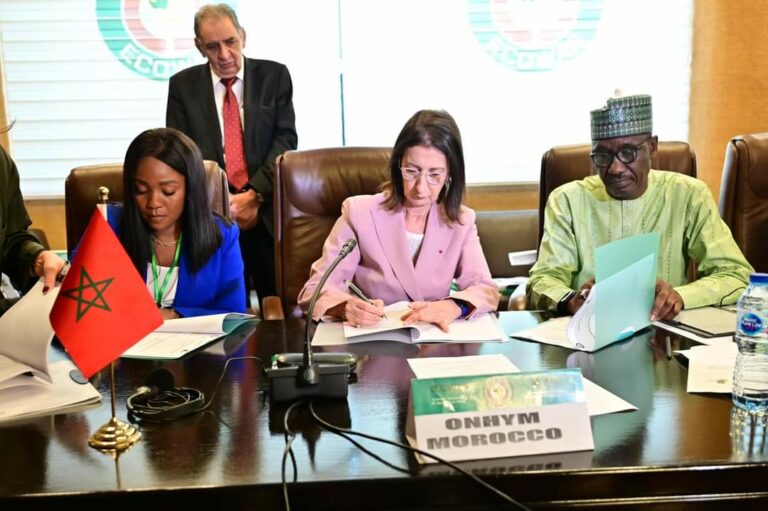
THE Nigerian National Petroleum Company Limited (NNPCLtd.) said four Memoranda of Understanding were signed on Friday, June 16 in Abuja as part of the Nigeria-Morocco gas pipeline project.
The MOUs were signed between the NNPCLtd and the Office National des Hydrocarbures et des Mines (ONHYM) of Morocco on one hand, and the Société Nationale des Opérations Pétrolières of Cote d’Ivoire (PETROCI), the National Oil Company of Liberia (NOCAL), the Société Nationale des Hydrocarbures of Benin (SNH-Benin), and the Société Nationale des Pétroles of the Republic of Guinea (SONAP) on the other.
NNPCLtd said in a statement on Friday, June 16 that the memoranda, similar to those signed with the Economic Community of West African States (ECOWAS) on September 15, 2022; Mauritania and Senegal on October 15, 2022; and The Gambia, Guinea-Bissau, Sierra Leone, and Ghana on December 5, 2022 reaffirmed the commitment of the parties to the strategic project.
Once completed, the project is expected to enhance the monetisation of the natural gas resources of the affected African countries, and also offer a new alternative export route to Europe.
The signings took place on the sidelines of the Steering Committee meeting of the project, which was attended by representatives of ECOWAS and those of all the participating countries, comprising Nigeria, Benin, Togo, Ghana, Côte d’Ivoire, Liberia, Sierra Leone, Guinea, Guinea-Bissau, The Gambia, Senegal, Mauritania, and Morocco.
The partners hoped the project would contribute to accelerating access to energy for all, improving the living conditions of the populations, integrating the economies of the sub-region, and mitigating desertification.
The goals are hinged on provision of sustainable and reliable gas supply that aligns with the continent’s new environmental commitments, while providing Africa with a new economic, political, and strategic dimension.
The NNPCLtd’s group chief executive, Mele Kyari, lauded President Bola Ahmed Tinubu and the Nigerian government for entrusting NNPC Ltd. with the strategic project.
Kyari added, “As a commercial enterprise, NNPC Ltd. sees this project as an opportunity to monetise Nigeria’s abundant hydrocarbon resources by expanding access to energy to support economic growth, industrialisation, and job creation across the African continent and beyond.”
The Director-General of ONHYM, Amina Benkhadra, also said at the event that the gathering represented a progressive step in ensuring social and economic development through energy security and accessibility geared towards attaining total development of Africa by Africans.
The ECOWAS Commissioner for Infrastructure, Energy and Digitization, Sédiko Douka, remarked that the gas pipeline project was significant as it would help strengthen the region’s electricity production/generation capacity, stimulate industrial and agricultural development, and contribute to the energy transition by using a source of energy that is cleaner than other fossil fuels.