NIGERIA’S tallest man, Afeez Oladimeji Agoro, passed on Wednesday, June 14 after a prolonged illness, aged 48.
He died at the Lagos University Teaching Hospital (LUTH) after battling with an ailment known as acromegaly, a disorder in adults in which the pituitary gland produces too much growth hormone.
Agoro, who hailed from Lagos State, was born on December 13, 1975.He was known as the tallest man in Nigeria at 7ft 4.58in, and second tallest in Africa who measured 7ft 5in.
He featured in some Nigerian movies and started a Reality TV show in August 2018. The show titled, ‘I Am Agoro’, centred around his life and what it feels like living as the tallest man in Nigeria.
In an interview with BBC News pidgin in 2019, Agoro talked about some of the difficulties he faced as a giant, including not being able to board a public transport, and finding it difficult to get his shoe or clothe size in the market.
During an interview he had with Linda Ikeji in 2018, he explained that his growth could have been halted if only the Nigerian doctors he consulted had been able to identify and treat his condition.
Regrettably, they were unable to diagnose his condition or provide appropriate medical intervention. It was not until he encountered doctors in the United States that a potential solution was discovered. However, by that time, the opportunity to address his condition had already passed.
THE Independent Corrupt Practices and Other Related Offences Commission (ICPC) has again arraigned the former Registrar of the Joint Admission and Matriculation Board (JAMB), Dibu Ojerinde, on allegations bordering on official corruption, abuse of office and forgery.
A statement signed on Thursday, June 15 by the spokesperson of ICPC, Azuka Ogugua, revealed that Ojerinde was docked alongside his children: Mary Ojerinde, Olumide Ojerinde, Adebayo Ojerinde, and Oluwaseun Ojerinde.
The linked six companies docked with him are Doyin Ogbohi Petroleum Limited, Cheng Marbles Limited, Sapati International Schools, Trillium Learning Centre Limited, Standout Institutes Limited, and Esli Perfect Security Printers Limited.
ICPC in a charge No: FHC//ABJ/CR/119/2023 presented before Justice Inyang Ekwo of the Federal High Court 7, sitting in Maitama, Abuja, informed the court of the multiple layers of fraudulent identities and conspiracies designed by the defendants to conceal crimes.
Presenting one count out of a 17 charge, the ICPC counsel, Ebenezer Shogunle, revealed to the court how the former JAMB boss conspired, allegedly, with three of his children (Oluwaseun Ojerinde, Olumide Ojerinde and Adebayo Ojerinde) to sell off property worth $150,000 situated at House No. 4 Ahomko Drive, Achimota Phase 2, Accra, Ghana, even after the property had been forfeited to the Federal Republic of Nigeria.
According to the statement, “Ojerinde was also accused of incorporating the aforementioned companies and taking up simultaneous appointments as Chairman and Director, while being a public officer on full-time appointment as Registrar/Chief Executive of National Examinations Council (NECO), Minna, and the Joint Admission and Matriculation Board (JAMB), Bwari, knowing very well that the Code of Conduct for public officers forbids them from engaging in private business other than farming or participating in shareholding of joint stock companies.”
Ojerinde was alleged to have deployed this to avoid various anti-corruption and anti-money laundering policies of the government like the Know Your Customer (KYC) and Bank Verification Number (BVN).
ICPC noted that the actions are punishable under sections 17, 19, 22 and 24 of the Corrupt Practices and Other Related Offences Act, 2000.
It is also contrary to, and punishable under Section 1 of the Advanced Fee Fraud Act, 2006 and Section 1 of the Miscellaneous Offences Act, CAP M17 of the Revised Laws of the Federation, 2007.
The accused persons pleaded not guilty and were granted bail.
“Bail was granted to the ex-JAMB boss on terms earlier granted to him by the Federal High Court, Abuja, where he is standing trial, while the four children were admitted bail in the sum of N20,000,000) each and a surety in like sums who must have landed properties not below the value of the bail sum and within the jurisdiction of the court,” the statement said.
The judge ordered the other defendants to surrender their international passports to the court and avoid travel abroad without recourse to the court.
The case was adjourned to November 13, 14, 15 and 16, 2023 for hearing.
THE Lagos State gubernatorial election took place on Saturday, March 18 2023 to elect the Governor of Nigeria’s commercial capital. It happened simultaneously with the State Houses of Assembly election and 27 other governorship elections nationwide.
The election was postponed from its original date of March 11 to March 18.
The Presidential election earlier on February 25 saw the Labour Party (LP) candidate, Peter Obi, winning the state with a slim margin.
According to the State Returning Officer, Adenike Oladiji, Obi garnered 582,454 votes, while Tinubu, who later won the presidential election, secured 572,606 votes.
The fear of who will win the governorship election in Lagos generated a lot of controversy and created anxiety and panic among many residents.
The three major candidates in the contest were the incumbent Babajide Sanwo-Olu of the All Progressives Congress (APC), Jide Adeniran of the Peoples Democratic Party (PDP), and Gbadebo Rhodes-Vivour of the Labour Party (LP)
From left to right – Gbadebo Rhodes-Vivour, Abdul-Azeez Olajide Adediran and Babajide Sanwo-Olu
Weeks before the election, the atmosphere was filled with tension; supporters were seen throwing jabs at one another.
Introduction of Oro cult
A few days before the election, news of some traditional rulers trying to scare people with the Oro cult emerged. Reacting to the reports, the traditional ruler of the Ikate-Elegushi kingdom in Lagos state, Saheed Ademola, assured that the festival would not affect the governorship election.
His media aide Temitope Oyefeso stressed that the restriction of movement for the Oro rites in the kingdom would commence on Wednesday, March 15 and end on the eve of the election, Friday, March 17.
“The restriction of movement for the Oro rites in the Ikate-Elegushi Kingdom, Eti-Osa is from Wednesday to Friday; Election Day is not included.
“This clarification is necessary for those peddling falsehood as to the motive for the rites. The peace and progress of our land is the responsibility of all of us, and we must be alive to this responsibility,” Oyefeso said.
The LP governorship candidate Gbadebo Rhodes-Vivour (GRV), described reports that the Oro Cult festival would hold during the election as an attempt to disenfranchise voters.
The election day arrived, and despite the security fears, many voters went out to exercise their franchise. However, it ended with a sad tale for some.
One such individual is *John Kadiri (not his real name), who resides in Lagos.
The indigene of Lagos, surrounded by two of his daughters when The ICIR visited, said he had never been humiliated as he experienced after the governorship election.
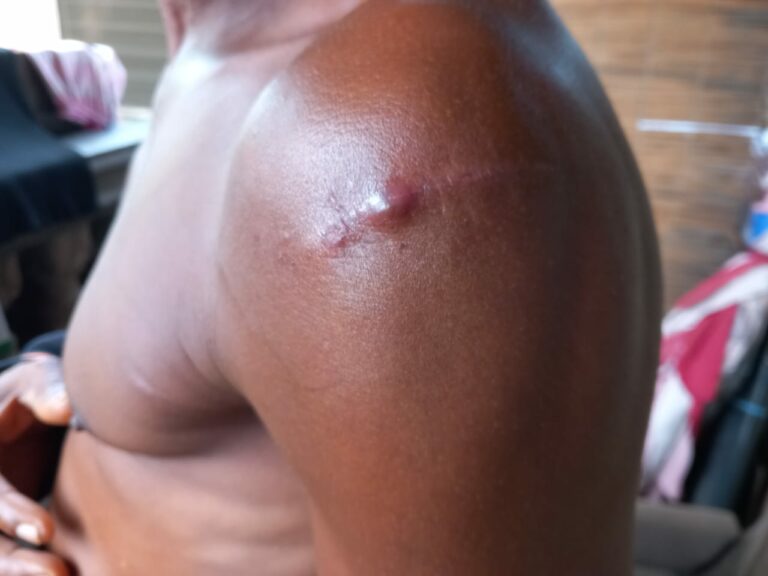
Picture of Kadiri* after the attack
Kadiri, who spoke in Yoruba, claimed he is not a politician but supports the PDP because a one-time party governorship candidate, the late Funsho Williams, once picked his relative as a deputy governorship candidate.
He claimed there was no trouble during the presidential and governorship elections in his area apart from little skirmishes that saw some military men chasing some boys.
“There were a few skirmishes, and the soldiers came. We enjoyed ourselves; the election went well,” he said.
But trouble started for Kadiri on the night of Sunday, April 19, a day after the election, when he heard a heavy knock on his door a few minutes before midnight.
According to him, he opened the door because he could recognise the voice at the door. With only a wrapper tied around his waist, he went out to see the people looking for him.
Healing scars of Kadiri’s wound Picture by The ICIR 16/04/2023
“The Kabiyesi wants to see you now,” they told him.
He asked them, “At this time of the night?”
He then pleaded, “Let me quickly put on something,” a request he said they rejected.
“They insisted I must go with them like that immediately. I was tying only a white wrapper and holding a torchlight. Since I had a clear conscience, I said ok, let’s go,” he said.
Kadiri said that shortly before getting to the palace of the Oniba of Iba, Sulaimon Adesina, he felt a sharp pain in his back; his captors had macheted him.
Oniba of Iba Ekun, Sulaimon Adeshina. Courtesy of Kabiyesitv on Facebook
He narrated, “I was tying only a white wrapper and holding a torchlight. So as we were going, when we almost got to Hajji, suddenly someone struck me with a cutlass on my back. I looked back and shouted, ‘This boy, why are you stabbing me?’ By this time, my white wrapper was already soaked in blood.
“We kept going, I thought the Kabiyesi was waiting somewhere, but as we went, the team leader instructed one of the boys to blindfold me.
“He held my hands until we got to the palace.”
Kadiri’s back after the attack
He said that immediately they got to the traditional ruler’s palace in Iba Town, he heard the voice of the Kabiyesi saying, “It serves you right. A whole me the King of the town, I begged you, I pleaded with you, but you refused and went to gather Igbo people to vote against me on election day. You also invited soldiers to chase my boys into the swamp; what if they died?”
Kadiri said he replied to the King that he had no hand in inviting the soldiers.
He added that at that point, the traditional ruler, surrounded by some of his chiefs and his biological father, became furious and called him a liar.
“He ordered his boys to deal with me; cutlasses and sticks were used on me. I was seriously beaten,” he alleged.
At this point, Kadiri started crying. It took the intervention of one of his daughters and this reporter to console and calm him down.
“See where they stabbed me. I prostrated; I was crying. I said what was my offence? I have never been dealt with like this in my life before.
“Without committing any offence. I did not collect any kobo from him. This Sule Maito, he has never done anything for me, but he was oppressing me,” he cried.
Fined for not obeying the King’s order to vote for a particular party
Kadiri said apart from being beaten; he was also given a list of items to bring to the palace after he was beaten and stabbed.
“After this, he gave me a list of items I must buy to appease him.”
The list seen by The ICIR includes a bag of Garri, 10 litres of oil, two white rams, four cartons of Schnapp drink, and a tax of N200,000.
The daughter interjected during the interview, saying, “They told my dad if he can’t find a surety to stand for him, he should be thrown into the river.”
“Somebody stood for me on that day; he is the [a *neighbour]. He lives behind me. This is my hospital card; my file is in the hospital,” Kadiri said.
He also showed The ICIR the handwritten surety signed by his *neighbour.
Explaining later how the father got home that night, Kadiri’s daughter added that they took her father to a *hospital after the incident.
“We took him to *hospital, his friend dropped him at home, he called him on the phone, and he got back around 2 or 3 am”, she said.
The ICIR also sighted Kadiri’s hospital card.
Rumour of ‘Operation you must win your territory.’
A Lagos resident, Christopher Olalekan, who said he witnessed electoral violence in the Igando axis of the state, said he heard the rumour that many traditional rulers and politicians had been instructed to do everything to win their polling unit.
“The way they were all acting and behaving, you will know something has happened. The rumour came out that most of the Obas and politicians have been instructed to go and win their polling units at all cost, so I am not surprised by the level of violence,” Olalekan said.
Although this claim cannot be substantiated, a resident, who gave her name simply as Chidinma and claimed to be a victim of electoral violence in the Okota area of Lagos, said a councillor confessed to her that because he lost his polling unit in the presidential election, he had been mandated to win it at all costs in the governorship election.
“At my polling unit at Okota Oshodi/ Isolo Balogun Ward 034, the councillor on the street told his thugs and some of us that he failed to deliver his constituency during the presidential election and that if he failed again in this governorship, they would demote him,” she said.
However, an APC supporter in Badagry, Bashiru, dismissed all the talks about ‘Operation you must win your polling unit.’ According to him, all the talks about electoral violence were mere fabrications concocted by the opposition.
“I don’t believe in that because why didn’t that work in the presidential election?” he asked.
Adeshina reacts to allegations
Iba is a semi-rural town located in the Ojo local government of Lagos state.
A check by The ICIR showed that the traditional ruler (Oba) of the town Adeshina is also the chairman of the Lagos State Parks committee. In October 2022, he asked committee members to mobilise widespread support for the election of Bola Ahmed Tinubu of the APC for President and Babajide Sanwo-Olu, for governor of Lagos State.
Reacting to the allegation levelled against him in a telephone chat with The ICIR on Thursday, June 8, Adeshina denied the accusation and claimed that as a king, he does not involve in skirmishes with anyone.
“Who said so? With my calibre, I will go and beat somebody? the King asked.
When told that the victim said he did not participate physically in the incident but sent some boys to deal with him, the Kabiyesi said, “I don’t understand what that person is saying. There is nothing like that in this Iba Town. The election was in March, and who won has won; that’s the main thing. Who do I want to fight with? We are all one; I am a king; I can not play tribalism. I don’t have a problem with anybody at all.”
We saw people being prevented from voting – Election Observers
Commenting on the attack of voters in Lagos, the head of the election programme of the Youth Initiative for Advocacy, Growth and Advancement (YIAGA), Paul James, said observers deployed by the group saw people being prevented from voting because they did not look like indigenes of the community,
“This violates the freedom of association by the provision of the constitution, especially if these persons have satisfied the legal process of being electorates in the states they are domiciled.
“Also, you will see politicians are beginning to weaponise electoral violence.
“The build-up to the elections was overheated; you could see the rhetoric everywhere was heated up,” James said.
He feared that if issues like this persists, people would begin to stay off and not participate in elections.
To reverse the trend, James said people must be engaged, “The engagement we need to start early. We must begin to enlighten people on offences associated with electoral violence because, most time, people are ignorant. Ignorance should not be an excuse, though,” he said.
Lagos Police declined to comment.
Several attempts to get the view of the spokesperson of the Lagos State Police Command, Benjamin Hundeyin, including a request to meet with him in his office for an interview on the issues raised, were unsuccessful.
After so many attempts to get him to speak on the matter, he responded with a message on Wednesday, April 26, saying, ” I decline doing that interview.”
Further efforts were made to find out why he was unwilling to talk about the matter, but he kept mum.
Meanwhile, The ICIR reported on March 27 that the Inspector-General of Police (IGP), Usman Baba met with senior police officers to discuss the high degree of violence recorded during the 2023 general elections.
The meeting, which appraised security measures implemented during the polls, was held at the Goodluck Jonathan Peace Keeping Centre, Force Headquarters, Abuja,
Lagos Police spokesperson, Benjamin Hundeyin
Senior officers in attendance included Deputy Inspectors-General of Police (DIGs), Assistant Inspectors-General of Police (AIGs), and Commissioners of Police (CPs).
The meeting agenda included a general review of the elections, electoral offences and suspects detained during the elections, as well as reported and recorded cases of police misconduct.
The publicity secretary of the Labour Party, Bunmi Odesanya, commenting on the role of security agencies during the election, said only the military worked efficiently while other security agents watched on.
“Aside from the military, all other security agencies watched as violence was unleashed on supporters of other political parties. The mayhem unleashed on opposition parties’ supporters by APC thugs on 18/03/2023 was unprecedented in the history of Nigeria. The police, the principal security agency for elections, stood by and did nothing to stem the mayhem,” Odesanya stated.
NOTE: Names of people or places with asterisk were deliberately changed or omitted to protect sources.
NIGERIA has officially floated its currency after many years of multiple exchange rates, which many financial experts viewed as lacking a good direction for investors to bet on the economy.
President Bola Tinubu has taken steps on unifying the country’s multiple exchange rates and scrapping a costly petrol subsidy regime as the most immediate tasks within the first two weeks of his Presidency.
The moves are being cheered by many players in the financial markets.
Already, the markets have resounded positively to these bold reforms, but analysts warn there are consequences.
Economic watchers believe that what is going on now is a swift convergence of the rates, meaning that the exchange rate, which is the price, would trade closely with market-determined rates.
Senior analyst, Financial Derivatives Company, Dumebi Oluwole, said that the implications to Nigeria’s exchange rate is that prices would be more reflective of whatever that is happening in forex demand and supply.
“The issue with the forex market is that supply has not been able to meet demand. Companies, individuals, and even the government will now access forex in market-determined rates,” Oluwole said.
How businesses will respond to the unification
Already, businesses have been using blended rates to get fired up at the parallel market, findings have shown.
Dumebi, however, said the rates unification move has implications.
“We won’t see so much change in the price that they will get forex. What we will see is change in the accessibility, and speculation would be weak,” she said.
She added, “Such commodities like pasta, noodles, and foreign rice are going to see an uptick in their prices. Most imported products will experience an uptick in the prices till local production is incentivised and our oil production remains appreciably stable.”
She noted that remittances and foreign direct investments would experience an appreciable surge once the government sustains consistency in policy.
“It is also expected that cross-border transactions with other countries will be easier and will support forex supply,” she said.
Issue of round-tripping will be addressed
To many economic watchers, a framework that is more transparent and will remove the unwholesome practice of round-tripping and associated corruption around foreign exchange markets has been established and needs to be sustained.
“The former official price of N416 was not accessible as many people sourced their foreign exchange from the parallel market despite the wide gulf between the official and the parallel market rate,” an economist and chief executive officer of the Centre for the Promotion of Private Enterprise, Muda Yusuf, told The ICIR.
“The reality is that the operating exchange rate for the past two years has been above N700 to the dollar. If we have a unification regime, it is better for everyone to access from a common market, but we have to improve the supply,” Yusuf added.
He explained that what the government is doing is allowing the rates to reflect the fundamentals of the forces of demand and supply.
“It will be better to have the rates at N664/$1 than to make the official rate N416/$1 while it is difficult for real sector players to access it.”
“To make matters worse, those who have the rates at N461/$1 will take it from the official window and sell it in the parallel market window. We had this going on for a long time, and the system created billionaires through round-tripping,” he said.
Companies with existing loans in dollar to be negatively affected
For companies with existing loan portfolios, there are consequences, an investment expert said.
“I should mention that companies that have existing foreign exchange loans pendency, the Eurobond obligations, will have to take massive 40 per cent cut from this adjustment,” a development economist, Kelvin Emmanuel, told The ICIR.
Commenting further on the good part, Emmanuel noted that tech companies would see a resurgence of investment in start-ups.
He further said that venture capitalists would be able to price and manage risks better.
He said that venture debts would also become more attractive to start-ups not interested in raising equity through safer funding rounds.
“I expect that in time, the CBN will be able to settle foreign exchange swaps for currency withdrawals through naira cards abroad since the major roadblock has been round-tripping that was due to the wide gulf between the official and parallel markets,” he said.
Experts weigh implications as CBN floats naira
Following CBN’s directive to banks to sell dollars at market rates, experts shared their thoughts with The ICIR on what might happen.
The executive vice chairman of Highcap Securities Limited, David Adonri, said the move signalled the deregulation of the foreign exchange market.
Adonri said, “It means that the naira is now floated, and as a result, the actual value of the naira at any point in time will be market-driven and determined.
“This will enhance the allocative efficiency of hard currency resources, eliminate rent-seeking, and curb the scarcity of forex.
“It can also enhance revenue to the Federal government. A market clearance rate determined by forces of supply and demand signals the unification of the exchange rate.
“This is a giant stride in deregulating the economy, coming on the heels of subsidy removal. The structural rigidities in the economy and pressure points are gradually being eliminated.”
To the Head of Investment Research at Parthian Securities, Oluwaseun Dosunmu, the directive is in line with the policy direction of the current administration.
“We have seen the administration’s policy direction; however, the modalities for implementation are yet to be communicated.
“We anticipate that the liberalisation of forex rates will create an incentive for banks in their capacity to support trade and offer facilities to credible businesses with forex needs,” Dosunmu said.
According to him, strategic banks seek to create value and diversify their earnings by playing in the forex market, boosting economic productivity.
At the same time, he pointed out, it would likely hit the black market worse as more transactions would be directed towards commercial banks.
The president of the Association of Bureau de Change Operators of Nigeria (ABCON), Aminu Gwadabe, said the removal of the cap at the Investors & Exporters (I&E) window was done to allow for a true market clearance rate, which he said had been the agitation of several stakeholders in the economy to harness and increase various sources of supply of dollars into the economy.
Gwadabe listed such sources of supply as portfolio investment, foreign direct investment, diaspora remittances, and export proceeds.
“The directives, in my opinion, are to checkmate various illegal economic behaviours like rent-seeking, currency substitution, forex holding positions, and frivolous demands,” he said.
He added that Nigerians are awaiting the rules of engagement on the new directives, and foresaw the likely unintended consequences, in the short run, to be panic and a mild spike in the market that would push rates up.
“In the medium term, we will begin to see our sources of dollars inflow increasing in the market to provide the needed liquidity in the market for rates stabilisation.
“Being a definite free market structure, as supplies increase the rates, we’ll definitely come to settle down at a level of N600/N650 to the dollar with a somehow very little margin in both markets,” he said.
Gwadabe pointed out that the challenge would be injecting liquid into the critical retail end of the market.
He said, “In solving this problem, the bureaux de change are primarily licensed to deepen the markets and inject liquidity into the critical retail end of the market.”
“They provide the role of reducing spreads between buy and sell offer rates, which helped the naira’s stability.”
“I, therefore, advise the acting CBN Governor to leverage on BDC operators on diaspora remittances that are huge, cheap and constant to harness and achieve their desired objectives.”
A global development economist, Kazeem Bello, said the country needed to tread softly with the new directive as it could backfire and create more complex problems.
“We cannot handle the dollar market pricing like the petrol pricing. It will have severe dislocation for the market system, especially when there is acute scarcity of the commodity. People familiar with this should advise the government to tread softly.
“It will inflict pains and unnecessary costs skyrocketing. It may create a serious upset for the economy, especially in the short and medium term,” he added.
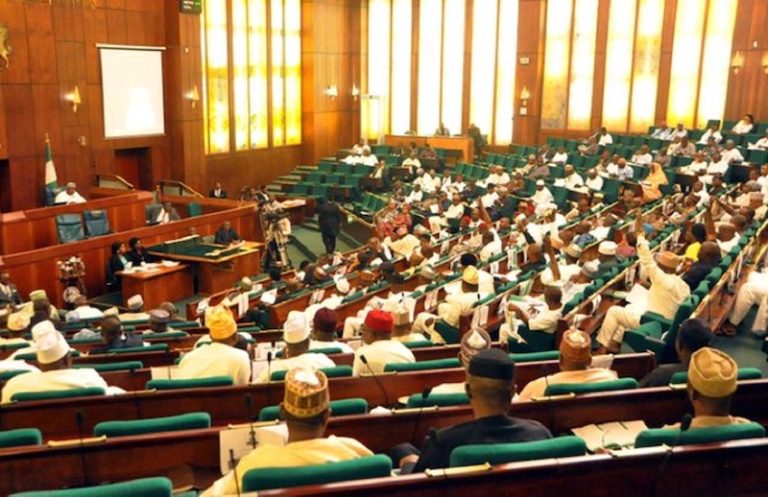
THE House of Representatives has rejected a motion to declare a state of emergency on migration of Nigerians to other countries.
The lower legislative chamber voted against the bill when it came up for debate during the plenary on Thursday, June 15.
The motion, titled, ‘Need to Declare Emigration of Young Nigerians Abroad, aka, Japa syndrome, a National Emergency’, sought to address the growing rate of migration from the country.
Victor Agbese, the lawmaker who moved the motion, asked that the House declare the migration (japa) syndrome’ a national emergency and hold a national summit to address the matter.
According to him, the increasing numbers of Nigerians relocating abroad threaten the country’s intellectual, social and economic well-being.
Agbese pointed out that reports by African Polling Institute indicated that 69 per cent of young Nigerians would opt to relocate abroad if they had the opportunity, while reports by the United Nations Department of Economic and Social Affairs reported that international emigration from Nigeria in 2020 totalled 1.7 million.
Agbese asked that the situation be contained to prevent skilled personnel from leaving the country.
“The eagerness to migrate to countries that offer hope seems to have a compelling influence. Those leaving Nigeria are not just the poor but the middle class who possess skills/workforce, including bankers, lecturers, health care practitioners, doctors, nurses, and trained manpower, all of whom were trained in Nigeria and emigrating at a time when their services are needed to build a strong and vibrant economy in Nigeria,” he said.
However, some House members kicked against the motion, calling it a violation of the Constitution.
Speaking on the motion, Sada Soli, a lawmaker from Katsina, kicked against the move, saying it breached the fundamental human rights of the movement as contained in the Constitution.
“This motion, as it is, looks nationalistic but contravenes the provision of the Constitution. It is the liberty of a Nigerian. If he is qualified, he has all the grand rights to move anywhere he wants to source for a living,” he said.
The former deputy speaker, Idris Wase, also said any law or motion that conflicts with the provisions of the Constitution is null and void.
However, most lawmakers rejected the motion when it was put to a voice vote.
Meanwhile, a bill seeking to address the migration of medical professionals in Nigeria passed second reading in the House of Representatives in April.
The ICIR reported that the bill proposed that medical or dental practitioners be denied from being granted full licences until they have worked for a minimum of five years in the country.
The bill also sought to halt the increasing numbers of medical doctors leaving Nigeria for greener pastures.
SOME civil society organisations (CSOs) have called on the Nigerian government to focus on non-custodial measures that will allow convicts serve prison sentences outside detention facilities.
This, the CSOs posited, would hasten decongestion of custodial centres in the country.
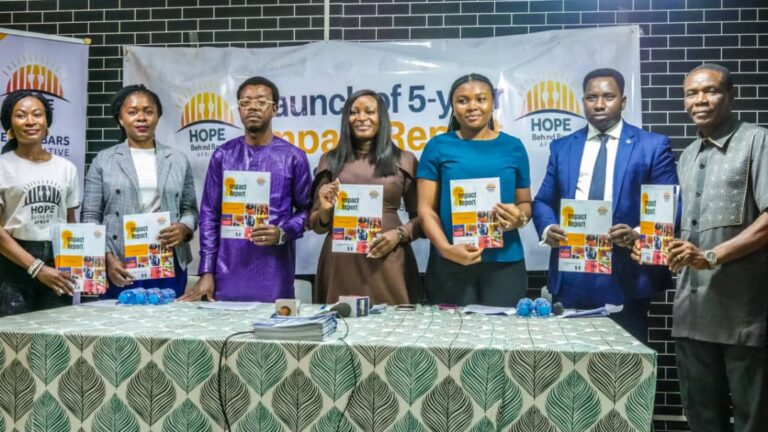
Representatives of CSOs who were present at the launch of a ‘Five-Year Impact Report and Strategic Plan’ by Hope Behind Bars Africa (HBBA) on Wednesday, June 14, decried the congestion of correctional facilities in Nigeria and its economic impact on the country.
Speaking at the event, the Programme Coordinator, Legend Golden Care Foundation, Ogonna Okeke, said non-custodial sentences could serve as a short-term means of decongesting correctional facilities in Nigeria.
Okeke said, “There is advocacy for correctional facilities to move towards adopting non-custodial measures. These measures are sentencing that allow convicted people to serve their sentences outside of the custodial centres.
“Not every crime needs to be punished with incarceration. Someone commits a petty offence, you can sentence them to community service instead of throwing them into custodial centres.”
She noted that there should be more advocacy for speedy trials, as many criminal cases often span decades, leaving suspects in prolonged detention, and putting a strain on the nation’s resources.
The Legal Aid Officer at the Legal Aid Council of Nigeria, Jenny-Joyce Bob Samson-Akpan, also decried the continued grant of remand orders by lower courts without starting the trial process.
“We find that law enforcement agencies use this means to get people into custodial centres and they spend a lot of time investigating cases. Instead of charging these people and making sure that the case is brought to a conclusion, they spend time on investigation while the suspects continue rotting in prison,” Samson-Akpan said.
The Executive Director, Hope Behind Bars Africa, Oluwafunke Adeoye, noted that defendants are often presumed guilty before trial, leading to long imprisonments, and indigent members of the public mostly fall victim due to a lack of access to proper legal representation, a challenge Adeoye said the HBBA is working to address.
She said the death penalty that obtains in Nigeria is against International Human Rights Laws and treaties to which the country is a signatory.
“In a country like Nigeria with a justice system that has several challenges, the death penalty is final when it is done. It cannot be changed. And so if there is room for a shadow of doubt that something might have gone wrong in the process of trial and prosecution, then we should be very careful with imposing something final like the death penalty on people,” she said.
A member, Board of Trustees, HBBA, Stanley Ibe, said most convicts end up in prison mainly due to poverty.
Ibe noted that the incarceration of suspects due to petty offences amounts to a penalisation of poverty, which also has adverse socio-economic effects on citizens.
“If you have a male household leader in prison and the entire family is dependent on him, the entire family is impacted.
“There are lots of institutions arresting people on a daily basis and not enough checks in those institutions to make sure that when people go past those institutions, they are actually people who should be going past the institutions,” he said.
In May 2023, The ICIRreported that over 52,000 inmates were awaiting trial in Nigerian custodial centres, according to the Federal Ministry of Interior, which contributed to overpopulation of the facilities nationwide.
Congestion of correctional facilities consumes a significant part of Nigeria’s revenue.
The budget to feed prison inmates in 2023 is N22.44 billion, more than 1 per cent of the year’s N21.83 trillion budget, and much of which will be funded by international loans.
TEN governors, who were re-elected into office for a second term, increased the debt profiles of their states by a total of 54.9 per cent during the first four years of their administrations.
This means that, cumulatively, the 10 states had a combined debt figure of N1.8 trillion in 2019, but the figure increased to N2.8 trillion at the end of 2022, according to figures obtained from the Debt Management Office (DMO) and the National Bureau of Statistics (NBS).
By this data, it means the states borrowed more debts than they serviced during their first term.
The 10 governors are Seyi Makinde (Oyo), Mai Mala Buni (Yobe), Inuwa Yahaya (Gombe), Babajide Sanwo-Olu (Lagos), AbdulRahman AbdulRazaq (Kwara), Abdullahi Sule (Nasarawa), Ahmadu Fintiri (Adamawa), Babagana Zulum (Borno), Bala Mohammed (Bauchi) and Dapo Abiodun (Ogun).
The governors were re-elected for a second term in office on March 5, 2023, alongside 18 newly elected governors, after serving their first term from 2019-2022.
The total domestic debt figure of the 10 states as of December 2019 was N1.2 trillion, but this increased to N2 trillion in December 2022.
Also, in 2019, the external debt stood at N620.5 billion at an exchange rate of N360.42 to $1. But, at an exchange rate of N423 for $1, the debt increased to N803.7 billion. However, without the exchange rate conversion, the external borrowings dropped from $2 billion in 2019 to $1.8 billion in 2022, a 6.2 per cent drop within four years.
While the states amassed a debt figure of N1.8 trillion in 2019, they only generated a revenue figure of N582.7 billion in the same year. Also, the latest NBS data on states’ internally generated revenue showed that the 10 states generated a sum of N1.02 trillion in 2021.
The ICIRreported how the newly elected and re-elected state governors would be confronted with problems of massive debts and high unemployment levels as they take office. A report also captured how the newly elected governors would inherit domestic and external debt figures of N2.1 trillion and $1.9 billion respectively upon their assumption of office.
Introspection on the data
Within the first four years, Yobe, Ogun, Lagos and Oyo states had the highest domestic borrowings with a percentage increase of 213.3 per cent, 90.1 per cent, 81.8 per cent and 76.0 per cent respectively.
Yobe state’s domestic debt figure increased from N29 billion to N91 billion, Ogun state’s from 142.3 billion to N270.5 billion, Lagos state’s from N444.2 billion to N807.2 billion, and Oyo state’s from N91.6 billion to N161.2 billion.
Meanwhile, Borno and Adamawa states had the lowest domestic debt figures with a percentage increase of 15 per cent and 21.1 per cent respectively.
On external debts, without the conversion, Ogun state recorded the highest increase of 35.4 per cent from $100.6 million to $136.3 million. It was followed by Bauchi and Borno states with 23.8 per cent and 5.8 per cent increase respectively.
On the other hand, Oyo, Yobe and Gombe states’ external debts dropped by 27.9 per cent, 16.1 per cent and 10.7 per cent respectively.
The ICIR analysis revealed that Ogun state had the highest debt profile both on external and domestic debts in four years.
Debt will reduce fiscal space – expert
The Senior Research & Policy Analyst for BudgIT, Vahyala Kwaga, told The ICIR that the increasing debt figures means that the states would spend more of their revenues on debt servicing, a situation Kwaga said would in turn reduce fiscal space for expenditure activities.
“If the borrowing increases without adequate safeguards, especially in the form of parliamentary scrutiny, this will mean the fiscal space of states will continue to shrink. More of the revenues of the state will be used in offsetting debts (and interest), which means less will be available for actual government activities,” he said.
Kwaga noted that the states needed to ensure that their debts stay within reasonable levels, and also ensure that the money is spent efficiently and effectively.
He also advised that state ministries should at the budget formulation stage, be guided by the highest standards of existing medium-term plans, fiscal transparency and budget realism.
NIGERIA’s inflationary rate increased to 22.41 per cent in May from 22.22 per cent in April, according to the National Bureau of Statistics (NBS) Consumer Price Index for May 2023.
The report was released on Thursday, June 15.
The figure showed that the inflation rate increased by 0.19 per cent in May.
Compared to the same month in the previous year, the headline inflation rate rose by 4.70 per cent, higher than the 17.71 per cent recorded in May 2022.
The food inflation rate, a key component in the basket, rose to 24.82 per cent from 19.50 per cent in May 2022.
According to the statistics office, the rise in food inflation in the last one year, May 2022 to May 2023, was caused by increases in prices of oil and fat, yam and other tubers, bread and cereals, fish, potatoes, fruits, meat, vegetable, and spirit.
For instance, depending on the size, a loaf of bread which sold at about N600 as of May last year has risen to between N1,000 and N1,300, while at the same time, the minimum wage has remained static at N30,000 since December 2019.
The NBS further stated that the food inflation rate rose to 2.19 per cent in May, higher than the 2.13 per cent rate recorded in April.
Analysts are not expecting the rate for June to go lower following the Federal government’s removal of the fuel subsidy regime on May 29, and the unification of the exchange rate on June 14, with all the inflationary implications.
Arising from the development and the release of the May inflation figure, analysts who spoke with The ICIR examined the impact the policies would have on households, businesses and the economy.
According to the executive vice chairman of Highcap Securities Limited, David Adonri, the inflationary figure showed that the inflation rate had started moderating gradually.
Adonri believed the new policies that came in May and June would reverse the moderating trend in the interim until the economy adjusts to the new price levels.
He explained further that the inflation the policies (fuel subsidy removal and exchange rates unification) would precipitate should reduce the disposable income of households and escalate the cost of production.
“Businesses with inelastic demand for their products may not be able to pass the increased cost to consumers and will have to bear it,” he said.
He added that the policies, which he said are essentially demand management measures, may stifle aggregate demand in the short term but, in the long run, would eliminate structural rigidities and make the economy flexible.
He added, “If the economy is fully deregulated as the policies suggest, it will become more efficient and less corrupt. The economy can only enjoy these overdue corrections if the environment is secure.”
A lecturer at the Department of Finance, University of Lagos, Abu Noruwa, saw the exchange rates (forex) unification policy as having both negative and positive implications.
“Overall, this is a positive move. However, the government must manage the dynamics to restore confidence. The backlog of forex demands needs to be addressed, and government should be ready to supply forex to stabilise the exchange rate in the short term,” he said.
He also believed the government should relax capital control and administrative bottlenecks, including unbanning the list of about 41 items prohibited for forex and complementing that with higher import duties, removing the need for certificate of capital importation, and preventing the parallel market rate from simply moving further away from the official market rate.
Government, he said, should stop the demand for certain taxes and levies in foreign currency as it creates unnecessary forex demand without adding to supply.
“The aggregate demand for forex across markets should reduce as a round-tripping incentive is removed, for instance, people who fake foreign travels just to get forex at discounted rates.
“Also, Nigeria’s sovereign credit rating should improve if this is complemented with the right fiscal and monetary policies, thereby attracting more forex inflows and lowering the cost of borrowing,” Noruwa said.
THE Plateau State police command has sealed up the secretariats of all the 17 local government areas (LGAs) in the state.
The state governor, Caleb Mutfwang, had earlier this month approved the immediate suspension of the leadership of the councils to pave the way for an investigation by the state House of Assembly.
Muftwang said the suspension followed the inability of the LGA bosses to produce documents related to financial transactions in their secretariats.
The governor’s decision has generated unrest in all the affected councils, as the suspended chairmen insisted they were still in charge of their councils.
But in a statement on Thursday, June 15, the state police spokesperson, Alfred Alabo, revealed that the seal-up of the secretariats was carried out on the directive of the Inspector General of Police (IGP), Usman Baba.
According to the police, the decision to seal up the secretariats became necessary due to the unruly behaviour of the suspended chairmen and their supporters.
Alabo said, “To this end, the NPF on the Plateau cannot sit and watch things go wrong under its watch, hence the need to make this critical decision of sealing up the local government secretariats.
“The IG has ordered the commissioner of police in Plateau state, Bartholomew Onyeka, to seal up all the secretariats of all the local government areas in the state.
“This is necessary as a result of tension around the leadership of the councils, and the possible threat that supporters are posing to critical infrastructure, lives and properties in the state.”
He also noted that the action was in accordance with the exercise of “our constitutional responsibility as the Nigeria Police Force (NPF) to ensure that the above doesn’t hold sway on the Plateau.”
Alabo warned that the command would deal with anyone attempting to violate the order, irrespective of the person’s status in society.
PRESIDENT Bola Tinubu has appointed eight special advisers (SAs) in his latest round of major appointments, according to a statement from the State House.
The appointments came shortly after the president inaugurated the National Economic Council (NEC), headed by his vice, Kashim Shettima, on Thursday, June 15.
The ICIR reports Tinubu making the latest appointments on his 18th day in office – he assumed office on May 29.
This organisation reported how the National Assembly approved the President’s request for 20 special advisers on June 6.
Similarly, on June 2, The ICIRreported how Tinubu appointed the immediate past Speaker of the House of Representatives, Femi Gbajabiamila, as his Chief of Staff.
He also named the immediate past Minister of Special Duties and former governor of Benue State, George Akume, as Secretary to the Government of the Federation (SGF).
Below are the eight Nigerians the president appointed on Thursday and their portfolios, according to a statement signed by the Director of Information, State House, Abiodun Oladunjoye.
Dele Alake: Special Adviser, Special Duties, Communications and Strategy
Yau Darazo: Special Adviser, Political and Intergovernmental Affairs
Wale Edun: Special Adviser, Monetary Policies
Olu Verheijen: Special Adviser, Energy
Zachaeus Adedeji: Special Adviser, Revenue
Nuhu Ribadu: Special Adviser, Security
John Ugochukwu Uwajumogu: Special Adviser, Industry, Trade and Investment.
Salma Ibrahim Anas (a doctor): Special Adviser, Health