Home Blog Page 886

Table Tennis: Race to 2024 Olympics intensifies as WTT Contender serves on in Lagos

0

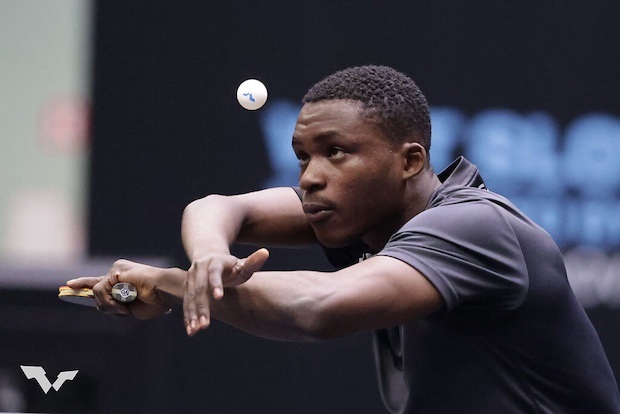
The qualification race in table tennis for the 2024 Olympics Games in Paris began on Monday, June 12 at the World Table Tennis (WTT) contender series, which served off in Lagos.

According to the International Table Tennis Federation (ITTF), the qualification process among table tennis players to the Olympics commenced in June 2023, and a total quota of 172 players (86 men and 86 women) would represent their countries at the global sporting competition.

Beginning with the qualification process is the ongoing maiden WTT Contender series in Lagos, Nigeria, where 64 table tennis players are slugging it to get the required points to earn a space at the event.

The WTT Contender Lagos is the first WTT Series in sub-Saharan Africa and one of the three WTT Contender events taking place in Africa this year following the successful staging of the WTT Contender Durban in South Africa.

The third WTT Contender will hold later this month in Tunisia.

The Event Manager, Kweku Tando, explained that the WTT Contender series has two phases: the preliminaries and the main draw.

At the Molade Okoya-Thomas indoor sports hall, Teslim Balogun Stadium, Lagos, 96 players began the knock-out contest at the preliminary stage to qualify for the main draw.

The preliminary stage is already producing impressive artistry from Nigerian players, who are locking horns with foreign players to determine their fate in the competition.

On day one in the qualifying round of the men’s singles, Jang Seongil of Korea defeated Nigeria’s Akinwale Fagbamila 3-1.

Also, Nigeria’s Riliwan Akanbi beat Adebowale Akinyemi 3-0.

Countries at WTT Contender series in Lagos

Participating countries in the series included Korea Republic, Germany, Slovenia, Chinese Taipei, India, China, Egypt, Slovakia, Poland, Portugal, Denmark, Ukraine, Algeria, Belgium, Italy, France, England, Côte d’Ivoire, Serbia, Ghana, Luxembourg, Switzerland, Wales, Sweden and Nigeria.

Host country Nigeria has the largest number of players in the preliminary round. The Nigerian contestants are hoping to join the likes of Taiwo Mati, Olajide Omotayo, Fatimo Bello and Edem Offiong in the main draw following the absence of their talisman, Quadri Aruna, due to a club engagement.

WTT Contender series will grow our grassroots athletes – LOC chairman

The Local Organising Committee (LOC) chairman, Wahid Oshodi, said the sporting tournament would help expose Nigerian players to learn from players from foreign countries.

“Now we are talking about Taiwo Mati. You remember him five years ago. He was just 15 years old, watching the big players, and now he is joining the top 32 in the world.

“The most important thing is that there are more than 20 to 30 Matis out there. Mati might be the best West African champion at the age group level.

“A lot is being done in Abuja, Ondo, Ekiti, and not just Lagos. Bayelsa looks like the stronghold of Nigerian table tennis. I would not have said that two years ago, but the chairman is doing a great job,” Oshodi said.

He was looking forward to a pool of surprises in the competition.

“There is a lot for us to be proud about, but we all know that in this tournament, we’ll have to wait for 19 years to be the best in the world,” he said.

He was optimistic that the competition would expose the players and give them the opportunity to rub shoulders with foreign players.

“Definitely, it is going to be competitve. This is the first time we have about 50 out of the top 150 players competing in Nigeria,” he said.

Nigerian players share expectations

The ICIR spoke with some of the Nigerian players. They said the tournament would help gain points on the ITTF ranking.

Etim Orok Effiong, who ranks 442 on the ITTF ranking, told The ICIR he was excited to feature at the competition, saying that it would help gain more points to move him higher in ranking.

Effiong said, “My ranking is 422 because it’s been long I played in an international tournament. The last time I played was in 2021 in West Africa, where I lost in the quarter-final.

“Participating in this World Table Tennis competition will boost my ranking and make me to be known.

“My expectation is to put in my best and make sure that every game counts.”

Augustine Emmanuel told The ICIR that his name was not initially included among the Nigerian table tennis players to feature in the competition.

However, due to the withdrawal of some top-ranked players from the event, his name was listed a few days to the commencement of the event.

“I have been training very hard. Now, I think I am good to play in the tournament,” Emmanuel said.

Azeez Solanke said he had been preparing since April for the competition.

“I have been preparing well since two months ago. My expectation is just to go out there and put in my best and make myself and my family proud.

“I have 52 points in ITTF ranking. I want to try to win some matches so that it can help me gain more points in the ranking.

“I hope to see myself play in the Olympics, world championships, and the All African Games,” Solanke said.

The chief coach, Nigeria Table Tennis Federation (NTTF), Bello Monsuru, enthused that the competition would help sharpen the ability of the grassroot players.

Monsuru said, “It will make a good impact on our local players because they will play with different players, learn more skills and acquire more knowledge from the offshore players that are coming.

“It will help them gain more points in their rankings. It is a kind of advantage for them because if you want to participate in the WTT Contender series in other countries, you know the challenge.”

The WTT Contender Series in Lagos ends on Sunday, June 18, and the cash prize is $75,000.

2023 Census: NPC to deploy over one million ad hoc staff

THE FEDERAL Commissioner representing Benue State at the National Population Commission (NPC), Patricia Kupchi, says the Commission has engaged and screened over one million workers ahead of the 2023 census exercise.

Kupchi also stated the Commission had acquired about 500,000 Personal Digital Assistants (PDAs), which had been configured and delivered across the 36 state offices and Abuja ahead of the census.

Speaking on Tuesday, June 13 at a one-day breakfast meeting and briefing with media executives organised by the Commission in Makurdi, Kupchi said that the one million personnel had been found capable and qualified to participate in the national counting.

While assurng that adequate arrangements had been made for storage and security of the equipment to prevent damages and theft, the Federal Commissioner said preparatory activities had been carried out to ensure a smooth running of the exercise.

She said, “The Enumeration Area Demarcation (EAD), the conduct of pre-tests and trial census, recruitment and training of census field staff, procurement and configuration of Personal Digital Assistants (PDAs), the establishment of ICT infrastructures across the country and logistics support and advocacy and publicity activities.

“For example, the EAD, which involved the division of the country into small land areas, was meticulously undertaken in such a way that only an update will be required for future censuses. Using satellite imageries, the enumeration areas were all geo-referenced with the coordinates of all the buildings established.

“The products of the EAD are currently being used by other government agencies. The recruitment of the ad hoc workers had been completed before the rescheduled census through a rigorous online process in which about one million workers have been screened and found worthy of the assignment. The database of all the recruited personnel, including their contact details, are available for the next census. The reserve personnel will be available to handle cases of attrition. The Commission had commenced training certain categories of personnel before the announcement of the rescheduled census.”

Acknowledging the values of human and material resources expended in the preparatory activities, Kupchi noted that the most important task ahead of the commission is sustaining and reinforcement of the resources towards the successful conduct of the 2023 Census.

According to Kupchi, “The processes and systems put in place for the census are being reviewed to determine what needs to be done to ensure that the preparations do not become obsolete for the census. The focus of the Commission is to ensure that all the resources expended so far are safeguarded, and that the nation does not need to start all over when the census is to be conducted.

“For us at the Commission, this is not a difficult task. In coming up with the plan for the 2023 Census, the Commission was not only looking at the immediate needs of delivering the next census, it was also concerned more with laying a solid foundation for future censuses. This mindset informed the scope and quality of arrangements put in place.”

She stressed that the Commission had carried out massive advocacy and publicity for the 2023 census at national and state levels.

Similarly, at a media breakfast on June 13 in Ilorin, the NPC Federal Commissioner for Kwara State, Abdulrazaq Gidado, assured Nigerians that the 2023 population and housing census project would hold this year.

Gidado stressed that technology deployed for the first digital census exercise in the country would make alteration of figures difficult.

He emphasised that the result of the census would form part of efforts towards actualizing an accurate, verifiable and acceptable data for planning and development of the country.

The ICIR had reported that the NPC chairman, Nasir Isa-Kwarra, disclosed it had spent over N200 billion on preparations for the 2023 national housing and population census.

Isa-Kwarra disclosed that the money was spent mostly on printing of census materials and training of ad hoc staff, among many other miscellaneous expenses.

He stated that although N800 billion was budgeted for the census, the Federal government allocated only N224 billion for the exercise.

“What we’ve been able to expend is about N200 billion. So the N800 billion is a budget and that budget covers the cost of conducting census in Nigeria. It is not that government has given us N800 billion but it is a budget and we believe that we may spend up to that or we may not spend up to that.

“To be straightforward, the Federal government has actually provided N224 billion, which we have utilised for the census so far,” he said.

Katherine Schneider Journalism Award seeks entries

JOURNALISTS from print, broadcast and online outlets can submit their stories to compete in the Katherine Schneider Journalism Award for Excellence in Reporting on Disability.

The award is a national journalism contest devoted exclusively to disability coverage, and is administered by the National Center on Disability and Journalism.

The contest features the Large Media Market Awards and the Small Media Market Awards categories. Winners will receive US$2,500 for first place, US$1,000 for second place and US$500 for third place.

Entries must have been published or aired between July 1, 2022 and June 30, 2023.

Works from outside the United States are accepted but must be in English. Special consideration will be given to entries that are accessible to those with disabilities.

The deadline is August 1.

Interested applicants can click here

Board Chairman accuses ‘CBN cabals’ of doctoring new NDIC Act, risking depositors funds

THE new chairperson of the governing board of the Nigerian Deposit Insurance Corporation (NDIC), Abdulhakeem Abdullateef, has raised concerns that elements he called “cabals” at the Central Bank of Nigeria (CBN) have doctored the new NDIC Act.

Abdullateef noted that the impact of the doctored report could expose depositors funds to uncertainties.

He faulted several sections of the new Act, stating that it gave the apex bank arbitrariness to perpetrate corruption.

In an online viral video obtained by The ICIR, the NDIC board chairman alleged that several aspects of the new Act were doctored and were different from the resolutions that the National Assembly passed.

“According to the resolutions in the National Assembly, the board representation must come from the six geopoliitical zones to enable it discharge its duties. It also gave the President a free hand to appoint Nigerians competent of becoming NDIC Managing Director.

“What they have done with the new Act is that they have tied the hands of the President and said only someone recommended by the CBN governor alone can be made the Executive Director,” he said.

He maintained that in the old Act, the President had the authority to appoint any competent Nigerian to superintendent over the affairs of the NDIC, while in the new Act, that is not the case.

Abdullateef said that the six geopolitical zones were not represented in the new Act as was the case in the old document, saying that the “cabals” removed that part from the new Act.

“There are other distortions in the new Act. They have now removed the representation from the six geopolitical zones and made the Permanent Secretary in the Ministry of Finance who doesn’t have time to be chairman of the board.

“Even when I visited the permanent secretary, he told me that he had told them not to make him the chairman of the board because he had thousands of things to attend to on his desk, alongside meetings with various commissioners of Finance,” he said.

The board chairman feared that the new Act has further destroyed the career progression of over 1,600 workers in NDIC.

“What they have done here is that no director in NDIC can ever progress to become an Executive Director. This is because they inserted in the law that only the Central Bank has the right to appoint an Executive Director.

“The NDIC is an independent body from the CBN; the CBN should be in charge of their own Executive Directors,” he said.

Abdullateef was appointed on May 17 by former President Muhammadu Buhari to serve as the chairman of the board of NDIC following the confirmation of the board members by the senate.

Buhari, on 26 May, signed the NDIC (repeal and reenactment) bill of 2023 into law, repealing the NDIC Act of 2006. The new Act, among other things, provides that only the permanent secretary in the Ministry of Finance can chair the governing board of the NDIC.

Abdullateef said the “cabals” deliberately waited till about two days to the end of Buhari’s tenure before presenting him the NDIC bill passed by the National Assembly to sign into law.

At that moment, he said, Buhari could not have had the concentration and time to study the document as he should.

NIMC registers 37.91 million Nigerians for National Identity Numbers in three years

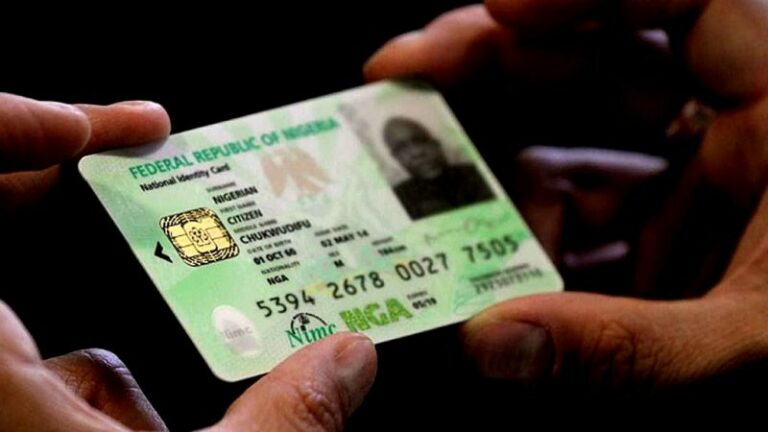
THE National Identity Management Commission (NIMC) registered and issued a total of 37,906,617 National Identification Numbers (NIN) to Nigerians between 2019 and 2021. 

A report by the National Bureau of Statistics (NBS) showed that 5.84 million NINs were issued in 2019, 5.02 million in 2020, and 27.05 million in 2021. 

Also, the report revealed that Lagos, Kano, and Kaduna states have the highest registration numbers within the period. 

In 2019, the NIMC registered 595,284 people in Kaduna state, 560,757 in Lagos state, and 485,912 in Kano state.

In 2020, Lagos state recorded the highest number of registrations and issued national identity numbers with 523,901, followed by Kaduna state with 471,858, and Kano state with 373,352.

In 2021, Kano state recorded the highest number with 3,415,421, followed by Lagos state with 3,002,693, and Kaduna state with 1,434,331.

The rush for registration was not unconnected with the directive of the former president, Muhammadu Buhari, in December 2020 to withdraw the licence of any service provider who failed to link NIN to subscribers’ SIM cards.

Analysis of the  data

In the report captured for the three-year period, the North-West recorded the highest number of registration and national identity numbers issued, with 1,786,469, 1,516,089, and 8,690,903 in 2019, 2020, and 2021 respectively.

The South-East had the lowest number of registration and issued national identity numbers with 414,089, 360,332 and 1,601,481 in 2019, 2020, and 2021 respectively.

While the North-Central had a total of 6,021,127 million registered people, the North-East had 5,225,194, South-South had 3,494,928, and the South-West had 8,795,996 registered people.

By gender, the data showed that more males registered for NIN than females. In 2019, 52.58 per cent of men registered, compared to 42.41 per cent of females.

In 2020, women made up 45.23 per cent, and men accounted for 54.27 per cent, while in 2021, women were 47.41 per cent, and men were 52.59 per cent. 

The ICIR reported how service providers, MTN and Airtel, barred 9.7 million subscribers from making outgoing calls over their inability to verify their NINs.

The Corporate Affairs Commission (CAC) had last year said that NIN would soon replace the current forms of identification required for applicants for business and company registration.

Nigeria’s security situation has got worse: what Tinubu’s administration needs to do about it

0

By Sallek Yaks Musa, University of Northampton

NIGERIA’S new president, Bola Ahmed Tinubu, has promised to make security a top priority of his administration.

In his inaugural speech he promised, among other things, to provide security personnel with better training, equipment, pay and firepower.

The new president has read the mood in the country well. A recent survey showed that 77 per cent of Nigerians felt unsafe in their country.

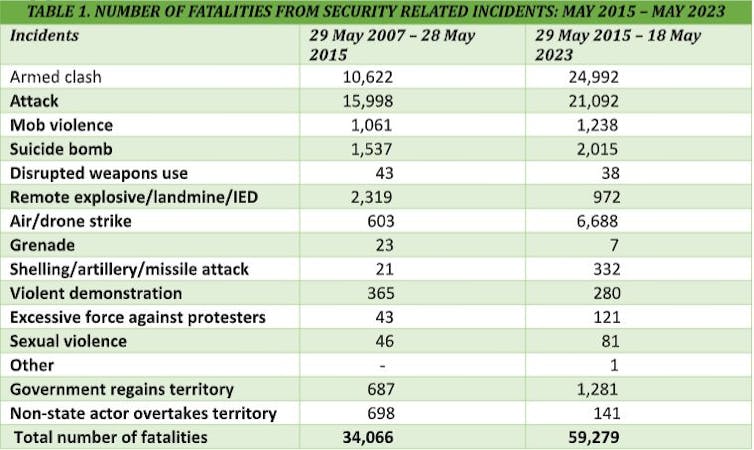
The security situation in Nigeria has deteriorated over the past eight years. Every region of the country is affected. Data compiled by this author, from the Armed Conflict Location & Event Data Project shows that there were 59,279 fatalities from security related incidents between 29 May 2015 when President Buhari assumed office and 18 May 2023. This is opposed to 34,066 of such fatalities recorded between 29 May 2007 and 28 May 2015. (See table 1)

Source: Armed Conflict Location and Event Data (ACLED)

Boko Haram, which has existed in various forms since the 1990s, was for many years the country’s biggest security challenge. The insurgency, which started in Borno State, was concentrated in the north-east region. But now, other non-state armed groups are spreading violence all over Nigeria.

At least 7,222 Nigerians were killed and 3,823 abducted as a result of 2,840 violent incidents between January and July 2022.

Buhari made a number of promises to address Nigeria’s chronic security problems. But he failed to effectively address them.

As a sociologist with specialisation in civil-military relations, armed groups, criminology and security studies, peace and conflict management and human rights, I have been researching various aspects of insecurity in Nigeria. Based on this work, I outline urgent steps the Tinubu administration must take to turn the tide of insecurity.

It needs to audit the security budget allocation of its predecessor and take a close look at its implementation. This will help identify areas of inefficiency and corruption.

There is also a need for enhanced oversight and coordination among security agencies.

On top of this, the Tinubu administration needs to address underlying socio-economic factors that contribute to insecurity. Investment in education, healthcare and infrastructure development are crucial. So are job creation, poverty alleviation and inclusive economic growth.

Deteriorating situation

Buhari’s administration got off to a strong start in 2015 because it was able to secure arms from the US. This made an impact on the capacity of terror and insurgent groups in the north-east.

But, over his two terms, things got worse in every part of the country.

North-east Nigeria: ISWAP (Islamic State West Africa Province), in particular, remained resilient by continuously altering its operational strategies – using unmanned aerial vehicles, for example.

The group has attacked military and civilian targets in north-west Nigeria and remains a threat in the north-east.

The middle belt: This comprises states in the north-central and parts of north-west and north-east Nigeria. In Plateau State, Benue State and southern Kaduna, rural communities face attacks from ethnic militias identified by survivors as Fulani.

Most of the attacks are executed to dislocate locals. They destroy crops and farmlands, kill people and animals, burn houses, and make survivors afraid to return.

In 2018, these attacks claimed six times more civilian fatalities than the terrorist insurgency in the north-east.

Over 100 settlements in Plateau State and southern Kaduna have been occupied by Fulani groups and renamed after communities were displaced.

The issue has been raised in the National Assembly. And in 2020, the Plateau State government enacted a law against kidnapping, land grabbing, cultism and other violence.

But attacks continued in Plateau State communities.

North-west region: A new wave of banditry emerged in the region during Buhari’s administration. Initially it appeared to be driven by ethnic feuds between Fulani and Hausa groups. But militia groups who had taken refuge in forests also appeared to be involved.

Bandits attacked military locations, kidnapped hundreds of school students and abducted travellers. They even bombed a train and abducted passengers.

Numerous bandit groups now exist across the north-west region and Niger State. These groups are economically driven. When they are not kidnapping for ransom, they exploit the lack of state presence to impose taxes and protection levies on rural communities.

Kidnapping for ransom is currently a blooming criminal enterprise across urban areas in Nigeria and on major road networks.

South-east: Here too the situation deteriorated under Buhari. His lopsided appointments – known as Buhari’s 97 per cent vs 5 per cent – fuelled a violent secessionist threat in the region.

The Indigenous People of Biafra (IPOB) championed the cause, and its leader, Nnamdi Kanu, was arrested.

But the group has remained resilient and, through threats and violence, it enforces days of sit-at-home in parts of the south-east.

Prison breaks: Eleven successful breaks between 2017 and 2022 have enabled 6,355 inmates, including high profile terrorists and bandits, to escape. My findings reveal that only 758 people have been rearrested.

Four successful breaks occurred during President Goodluck Jonathan’s regime, with 930 escaped and 274 rearrested or returned.

New administration’s to-do list

The security budget and its implementation must be audited to identify inefficiencies and corruption. Regular audits, citizen participation and whistle-blower protection would improve transparency and accountablity.

Security agencies need better oversight and coordination, along with performance monitoring and accountability. These measures can improve the impact of security budgets.

It’s also vital to address the socio-economic factors that contribute to insecurity. The country needs job creation, poverty alleviation and inclusive economic growth, particularly in areas affected by insurgency and insecurity.

Investment in education, healthcare and infrastructure will create opportunities that discourage criminal activities.

Inclusive governance is essential for peaceful coexistence and a sense of belonging. The government must also address the lingering crisis of displacement and occupation in the middle belt, and the secession agitation in the south-east.

Effective communication between communities and security agencies is essential.

The security sector must respond faster to early warning signs.

Finally, perpetrators of violence and their sponsors must be prosecuted.The Conversation

Sallek Yaks Musa, Lecturer, University of Northampton

This article is republished from The Conversation under a Creative Commons license. Read the original article.

Lagos rides on new electricity law, targets 20hrs daily power supply

THE Lagos State government has disclosed its plan to improve power supply up to 20 hours daily in many communities by exploring opportunities in the new Electricity Act 2023. 

The government said the plan would further stimulate investments and boost the standard of living, among others.

President Bola Tinubu had recently signed the Electricity bill into law, marking a significant update to Nigeria’s 2005 Electricity and Power Sector Reform Act.


READ ALSO:

How states can improve on access to power, investments with 2023 Electricity Act

Benue communal crisis over electricity: Many small arms, light weapons are in the hands of youth – Hemba

From blackout to chaos: Inside Benue communal crisis over electricity

New Electricity Act will enable states develop independent power market – Adegbemle, ED, PowerUp Nigeria


The National Assembly passed the bill in July 2022 during former president Muhammadu Buhari’s administration.

The new legislation aims to stimulate private sector investments in the country’s power sector and break the monopoly in electricity generation, transmission, and distribution at the national level.

The Permanent Secretary, Lagos state Ministry of Energy and Mineral Resources, Sholabomi Shasore, who disclosed the government’s electricity plan on June 10 at an organised stakeholders’ engagement in Alimosho Local Government Area, explained it was part of continued efforts to ensure adequate power supply to Lagos residents through various interventions.

Shasore said the meeting was organised in line with the inclusive policy of the administration of Governor Babajide Sanwo-Olu, whom he said believed that the contribution of every resident in the state would be essential to achieve the ‘Greater Lagos’ vision.

According to her, the Light Up Lagos Community Electrification Programme is an initiative of the present administration aimed at unlocking electricity distribution, transmission and metering infrastructure to deliver reliable power supply to high-impact, high-population, low-income communities in Lagos.

Shasore disclosed that the pilot implementation of the Power Infrastructure upgrade at target communities was nearing completion at Alimosho, Orelope, Okunola, Agege, Oko-Oba and Abattoir, as well as in Ajah, Eleko, Magbon and Ibeju Lekki.

“This initiative was borne out of the desire of the state government to improve the standard of living of Lagos residents, contribute to their economic activities, increase in productivity and job creation, and ultimately boost the businesses of small and medium scale enterprises, including artisans who rely primarily on electricity for the survival of their businesses, as well improve the overall well-being of all residents in the state,” she added.

Shasore stated that a total number of 8,613 service addresses connected to the feeders being installed would benefit from the improved supply covering almost 10,000 households.

According to her, “While the State Government had intervened in the functionality of electricity supply to various communities within Alimosho as a whole, the Sanwo-Olu administration is now taking it a step further by engaging with residents who are the critical stakeholders in this power intervention.

“Your participation is required to ensure that you reap the benefits of this Power Infrastructure upgrade.

“With this engagement, the state government seeks to ensure that you know your role in realising the goal of this intervention and look out and protect the infrastructure as your own. I implore the leadership of relevant CDAs, who are direct beneficiaries of this power project, to take ownership of this electrification infrastructure and protect it against vandals.”

Shashore stressed the importance of prompt payment of electricity bills, protection against energy theft, discouragement of meter bypassing, and other illegal acts that might jeopardise the overall intention of the state government to improve power supply to Alimosho and its environs.

She explained that the developments in the power sector with the recent amendment of the Power provision in the Nigerian Constitution of 1999 were an indication of greater things to come with regard to power, and with Lagos State at the forefront.

Shasore assured that the electricity infrastructure that had been put in place in the communities would guarantee reliable power supply as incidents of power failure, faulty transformers and cables, high and low electric current, and inadequate electricity poles, among others, had been fully addressed.

“It is worthy to note that Alimosho Local Government and its environs have always been identified as an integral part of the Greater Lagos Rising project under the administration of Governor Sanwo-Olu and, as such, it is set to enjoy more dividends of democracy and good governance, going forward,” she said.

The commissioner for Lagos Energy (Electricity), Lagos State, said the Lagos State Electricity policy is targeted at exploring advantages of the new Electricity Act 2023 to provide universal and reliable electricity access to citizens.

Records showed the state is powered by less than 1,000 megawatts of electricity supply from the national grid by the Eko and Ikeja DisCos.

The State Electricity Market Policy seeks to ensure that the market is owned and operated substantially by the private sector under a commercial framework, and guided by the state tarrif methodology.


READ ALSO:


The policy also notes that the Transmission Company of Nigeria (TCN) will be encouraged to incorporate its transmission network in the state under a separate corporate entity that would seek and obtain licence from the state regulator.

The Lagos Electricity Market will have six sets of players. They are the natural gas suppliers, generation companies transmission entity, an independent system operator, distribution entities and an electricity trading company.

Olalere said the policy would serve as a key enabler for Lagos State’s aspiration to become an advanced economy driving access and affordable electricity to residents and commercial consumers in the state.

New Senate President promises thorough oversight responsibility

NEWLY-ELECTED Senate President Godswill Akpabio has promised that the upper chamber would carry out thorough oversight of the activities of the executive, including those of ministries, departments and agencies (MDA).

Akpabio stated this in his inaugural address on Tuesday, June 13, in Abuja.

“We shall carry out very serious oversight functions to make sure we do not waste the resources of the country. We’ll put members of the executive on their toes, especially the ministers when they are ready to work when they are appointed,” he said.

The former Akwa-Ibom State governor, who represents Akwa Ibom North-West in the Senate, also promised to bring “uncommon changes” to the nation, in the economy, security, and job creation, and in supporting persons with disability.

He said, “We shall pay particular attention to issues relating to persons with disabilities and the vulnerable in our dear society. We’ll engage in any legislative action that will bring about empowerment and stop our youth from being recruited into banditry, Boko Haram and others. We’ll pay special attention to insecurity. We’ll work closely with the executive to ensure that we can sleep with our two eyes closed and we can travel by road and rail without fear, let or hindrances.”

Akpabio vowed to work with the President Bola Tinubu-led government to improve the country’s revenue.

According to him, for the first time, the Senate has members from eight political parties, which he said would enable them to deploy their skills and wisdom to make the nation enjoy better governance and reap more dividend .

Akpabio explained that the mission of the 10th Senate was to renew hope in Nigerians to ensure the revitalisation of the Nigerian economy. “Working closely with the executive, we will not betray the people of Nigeria,” he promised.

He added, “We’ll look into the existing laws and work closely with the House of Representatives to realign them to ensure that they are suited for purpose, and they see the current realities of the artificial intelligence that the world is facing today.

“We will try our best to also make laws that will move Nigeria forward and encourage foreign direct investment into the country. The current administration has brought about the acronym of ‘New Hope’. This Senate will join in ensuring a total renewal of hope for Nigerians where there seems to have no hope.”

He promised further to strengthen the “legislative pace” made by the 9th Senate. He said the Senate would look into what the states do to ensure progress in the country.

He lauded the 9th Senate for doing well in budget approval for the executive, and in ensuring the country maintain the January to December budget cycle.

The new Senate President charged the Federal government and Nigerians to grow the nation by consuming local products.

He decried the low number of women in the Senate and hoped that more women would come into the chamber through the next election.

Speaking with reporters, the immediate past president of the Senate, Ahmed Lawan, promised to provide guidance for the 10th Senate, especially the principal officers and the first-timers.

The 10th National Assembly was inaugurated today, June 13, and The ICIR reported how Tajudeen Abbas, representing the Zaria Federal constituency, emerged as the Speaker of the House of Representatives.

Ill-health: Akeredolu writes Ondo Assembly, takes 21-day medical leave

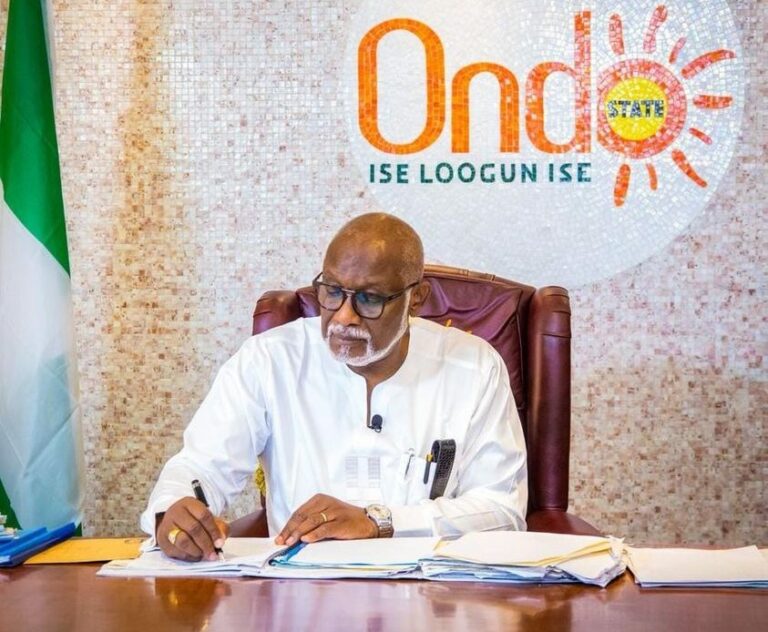
AILING Ondo state governor Rotimi Akeredolu has embarked on a 21-day medical leave.

He has consequently handed over power to his deputy, Lucky Aiyedatiwa.

On June 3, The ICIR reported how stakeholders in the state’s politics and other citizens expressed concerns over the governor’s health.

In a letter addressed to the Speaker, Ondo State House of Assembly, Olamide Oladiji, the governor said he would travel on June 7 and return on July 6.

He excluded public holidays from his leave.

Oladiji told other lawmakers on Tuesday, June 13, that the governor meant well for the state, and the people should pray for his full recovery. 

The ICIR reports that Akeredolu’s ill health became noticeable shortly after his mother died in September 2022.

The governor proceeded then on a two-week working vacation as part of his annual leave on April 3. He promised to resume work on April 26.

In a letter he addressed to the erstwhile state House of Assembly Speaker, Bamidele Oleyelogun, the governor said he would be handing over to Aiyedatiwa.

The Social Democratic Paty (SDP) in the state was among the stakeholders that expressed concerns over the governor’s health early this month when it became glaring that he could no longer discharge his official duties.

Speaking through its chairman, Stephen Adewale, in Akure, the state capital, the party said being a public officer, the governor’s health status should not be shrouded in secrecy.

Akeredolu’s health had led to a war between his wife, Betty, and one of his female aides, Bunmi Ademosu.

The governor’s wife accused Ademosu of plotting to become the deputy governor when the deputy – Aiyedatiwa – takes over should her husband die.

She poured expletives on Ademosu, whom she accused of feeding her husband with a concoction procured from a fake pastor.

Betty’s recorded audio outburst against Ademosu leaked from a Whatsapp page having the governor’s appointees.

The ICIR reports that Akeredolu was sworn in for a second term of four years on February 24, 2021.

He is the 18th person to lead Ondo State since its creation in 1976, and the sixth elected governor of the state.

He has been the most vocal governor in Nigeria’s southern region against atrocities committed by non-state actors, including herders, kidnappers, insurgents and bandits, who killed many people during former president Muhammadu Buhari’s tenure.

10th Assembly: Tajudeen Abbas emerges Speaker, Benjamin Kalu deputy

THE lawmaker representing Zaria Federal constituency, Tajudeen Abbas, has emerged Speaker of the House of Representatives.

Benjamin Kalu, representing Bende Federal constituency, Abia State, was also elected Deputy Speaker unopposed.

Abbas, the preferred candidate of the All Progressives Congress (APC), was declared Speaker of the 10th House of Representatives on Tuesday, June 13 after flooring his opponents.


READ ALSO:
UPDATED: Akpabio elected senate president

We’re 90% ready to roll out compressed natural gas before June end at N110/litre – IPMAN

Tinubu signs Student Loan bill, to establish Education bank


Abbas polled 353 votes to defeat fellow contenders, Ahmed Wase and Sani Jaji, who polled three votes each.

The election followed voting by the 359 members-elect of the 10th session of the House of Representatives on Tuesday, June 13.

The immediate past Majority Leader of the 9th Assembly, Alhassan Ado-Doguwa, made the first nomination.

The ICIR had reported that 11 lawmakers were showing interest for the seat of the Speaker.

The contestants were the immediate Deputy Speaker of the House of Representatives, Idris Wase; the immediate past Majority Leader, Ado Doguwa; Muktar Betara, Yusuf Gagdi, Sada Soli, Miriam Onuoha, Ben Kalu, Tajudeen Abbas, Abdulraheem Olawuyi, Abubakar Makki, and Aminu Jaji.

However, Betara, Kalu, Olawuyi, Makki, Gagdi and Doguwa stepped down, leaving only five candidates in the race.

Adoption of open ballot election for the 1st time

The election was a no-secret ballot system, for the first time.

The change allowed every member to take turn and vote for his/her preferred candidate in the open.

The new amendment to Order Two reads, “Every member voting shall name clearly and in the Open the candidate of his choice.”

The constitution, in section 54(3), gives lawmakers the power to develop a standing rule that guides their activities. The two chambers have their respective standing rules that guide their activities. The constitution amendment was assented to by former president, Muhammadu Buhari, in sections 54, 96 and 311 of the 1999 Constitution.

Section 54 was specifically amended to provide the quorum for the first sitting of the Assembly.

“(1A) For the purpose of the inaugural and first sitting of the Senate or the House of Representatives, the quorum shall be at least two-thirds of all the members-elect of either the Senate or the House of Representatives,” the section states.

This implies that the new law enables the President to know who voted for and against every member.

President Bola Tinubu had, however, promised to work together well with anyone that emerged despite his preference.

Another significant amendment to the standing rule is a section that empowers the Deputy Clerk of the National Assembly to preside over the election of the House of Representatives.

The previous law empowered only the Clerk of the National Assembly to preside over elections in the two chambers.

This amendment is to empower the Deputy Clerk in the absence of the Clerk.

The standing Rule of the House of Representatives provides that the election of presiding officers of the House, according to Order 2 rule 3(f(III)), shall be an open balloting system.

“(II) voting shall be conducted by the Clerk to the National Assembly or Deputy Clerk to the National Assembly using the list of the Members-elect of the House, with the proposers and Seconders as Tellers;

(III) every member voting shall name clearly and in the Open the candidate of his choice.

The constitution amendment as well laid emphasis on the need for the presence of two/thirds of the members-elect.

Amendment to Section 54(1) has changed the quorum of the first sitting of the two chambers. It means that two-thirds of the lawmakers must be seated.

With the amendment, the inauguration process will not start until 240 members are seated, unlike the one-third used in the past.

House of Representatives Speakers since 1999

9th Assembly

Femi Gbajabiamila, the APC preferred candidate, was elected Speaker of the House of Representatives.

Gbajabiamila, who defeated the endorsed candidate of the People’s Democratic Party (PDP), Umar Bago, polled 281 votes from a total of 358 votes, while Bago scored 76 votes, with one invalid vote.

Gbajabiamila, who President Tinubu recently elected as his Chief of Staff, was the APC congress Majority Leader and the House Leader of the 8th House of Representatives. He represented the Surulere Federal Constituency of Lagos State.

8th Assembly

Yakubu Dogara, from Bauchi State, emerged Speaker of the 8th House of Representatives.

Dogara (APC), who defeated Gbajabiamila, polled 182 votes against Gbajabiamila’s 174 votes.

7th Assembly

Aminu Waziri Tambuwal, the former Deputy Chief Whip of the House of Representatives, became the Speaker of the 8th Assembly.

Aminu polled a total of 252 votes to defeat the anointed candidate of the PDP, Mulikat Adeola-Akande, from Oyo State, who got 90 votes.

Other past speakers of the House of Representatives were Oladimeji Bankole, Patricia Olubunmi Etteh, Aminu Bello Masari, Ghali Umar Na’Abba, and Ibrahim Salisu Buhari.