Home Blog Page 892

UK supports Nigeria’s health workforce with £2m

0

The United Kingdom (UK) has committed two million pounds to strengthen Nigeria’s health workforce towards achieving universal health coverage (UHC).

The money is part of funds approved by the UK to support health workforce in Nigeria, Ghana and Kenya.

It targets strengthening the countries’ health workforce’s capacity to achieve universal health coverage.

The grant will cover two years to support to the Nigerian government in optimising the health workforce’s performance, quality, and impact through evidence-informed policies and strategies.

Announcing the fund in a statement on Tuesday, June 6, through the World Health Organization, the British High Commissioner to Nigeria, Richard Montgomery, a doctor, said, “A skilled, well-motivated and adequate health workforce is critical for Nigeria to end preventable deaths and build resilience against global threats.

“This UK International Development funding aligns with the Nigerian health workforce strategic plan and will help the country upskill its workers, and improve health outcomes in the long run.”

Similarly, the WHO said it welcomed the fund, provided by the United Kingdom’s Department of Health and Social Care.

“The strength of every health system reflects the capacity and adequacy of its health workforce, which are necessary to deliver quality services to address population health needs,” said WHO Representative in Nigeria, Walter Kazadi Mulombo, a doctor.

Mulombo explained that for a resilient and effective health system, Nigeria must have adequate numbers of health workers who are fit for purpose, motivated to perform, and equitably distributed across the subnational levels to enhance equity in access to their services by the population in need. 

“Through the UK government’s generous support through WHO, we will deploy the technical support from the three levels of the organisation to support the development of evidence-based policies and strategies, capacity building and management for improved planning and management of Nigeria’s health workforce,” Mulombo stressed.

The two-year human resource for health (HRH) project aims to support the government at national and sub-national levels and support regulatory bodies, professional associations, and other key stakeholders to develop transformative strategies for scaling up the quantity and quality of health workers, including competency-based curricula development and reviews. 

It will help to align investment in HRH with the current and future needs of the population and health systems; strengthen the capacity of institutions, including regulatory bodies, for effective public policy stewardship, leadership and governance.

It will also optimise health workers’ retention, support equitable distribution and performance, and strengthen the management of health workforce data for monitoring and accountability. 

“The project will draw on the technical capacity of WHO to strengthen health systems, including experience of implementing similar projects with appreciable results in the past. Implementation at sub-national levels with a focus on 6 states of Cross River, Enugu, Jigawa, Kaduna, Kano, and Lagos, will build on the presence and technical support being provided to State governments through the 37 WHO sub-national offices in Nigeria.”

The statement noted that the Nigerian health system, like many countries in the global south, has faced challenges in having a resilient health system that could provide quality health services, promote health and prevent diseases. 

It added that the challenges had been further exacerbated by the recent COVID-19 pandemic, which directly impacts the availability of health workers to provide quality services across the country. 

The ICIR reported how many health workers leave Nigeria for other countries that offer better welfare packages and where health infrastructures are more available.

Before COVID-19, the newspaper reported how the UK employed at least 12 Nigerian doctors weekly.

Multiple reports by The ICIR, including those on the Federal Medical Centres, Jalingo, Makurdi, and the Modibbo Adama University Teaching Hospital, Yola, Adamawa State, revealed the rapidly depleting number of doctors and other health workers in Nigerian hospitals.

In 2021, this organisation reported how Nigeria lost nearly 9,000 doctors to the UK and other countries.


READ ALSO:


In a report in November 2022, The ICIR reported how citizens decried the country’s health workers shortage.

In 2022, The ICIR’s investigations in several primary health care centres (PHCs) in two states in the country revealed an acute shortage of health workers and the poor state of the PHCs.
Two of the reports are here and here.

ICPC arraigns man over alleged employment scam

0

THE Independent Corrupt Practices and Other Related Offences Commission (ICPC) has arraigned one Umar Abubakar for offences bordering on alleged forgery and employment scam.

A statement released by ICPC spokesperson Azuka Ogugua on Wednesday, June 7, said the suspect was docked before an Adamawa State High Court presided by Hafsat Abdulrahman.

“The Commission in Charge No: HC/ADSY/127C/2022, accused the defendant of obtaining by false pretense the sum of Two Hundred Thousand Naira (N200,000) from an unsuspecting job seeker with the promise that he was going to help his victim secure employment with ICPC.

“In a 3-count charge, ICPC informed the Court of how the accused person fraudulently faked, signed and issued a letter of temporary appointment from the anti-graft Commission to his victim when he knew such a letter did not emanate from the Commission,” the statement explained.

The suspect demanded the sum of N1 million gratification to secure the purported employment for the victim.

According to the ICPC, the offence contravened Section 68 of the Corrupt Practices and Other Related Offences Act, 2000, and is punishable under Section 1 of the Advanced Fee Fraud and Other Related Offences Act, 2006, and equally contrary to Section 349, and punishable under Section 351, of the Penal Code Law of Adamawa State, 2018.

The accused pleaded not guilty when all the charges were read to him.

Abubakar’s counsel meanwhile applied for bail which was not opposed to by counsel to ICPC,  Anas Kolo.

The ICPC however appealed to the court to impose stringent measures that would compel the defendant to attend his trial.

The judge, Abdulrahman, in her ruling, granted Abubakar bail in the sum of N200,000 and a surety in like sum who must reside within the jurisdiction of the court.

The case was adjourned to June 15, 2023 for commencement of trial

In April 2023, The ICIR also reported that ICPC arraigned the General Manager, AGB Limited, Friday Adodo and a businessman and owner of FMateck Limited, Abdulrasheed Yusuf, for forgery.

The two defendants were arraigned on charges bordering on forging contract documents to bid for a contract at the Lower Benue River Basin Development Authority (LBRBDA) Makurdi, Benue State, contrary to section 97 of the Penal Code and Section 58(1) of the Procurement Act, 2007.

Reps say Nigeria Air launch a fraud, aviation unionist wants Sirika probed

THE House of Representatives has described the unveiling of the Nigeria Air aircraft a fraud allegedly perpetrated by the immediate past minister of aviation, Hadi Sirika, even as an aviation unionist wants him probed.

The lawmakers had summoned the permanent secretary of the Ministry of Aviation and Aerospace, Emmanuel Meribole, and other stakeholders to appear before the House committee on Aviation to brief it on the project.

At the meeting on Tuesday, June 6, the chairman of the committee, Nnolim Nnaji, said the launch of Nigeria Air was nothing but a fraud.

This is even as the Nigerian Airspace Management Agency (NAMA) reportedly told members of the committee that the aircraft bearing Nigerian colours that landed at the Nnamdi Azikiwe International Airport, Abuja was on a chartered flight.

Sirika had on Friday, May 26 unveiled an aircraft branded Nigeria Air, amid controversies over its specification, documentation, ownership, and technical agreement.

Commenting on the lawmakers’ declaration, an aviation observer, Simon Tumba, said, “It’s a fraud. That’s my opinion too. Where are the aircraft? Where are the technical staff of the airline, the office, and even the website to book flights?” Tumba asked.

He told The ICIR that Sirika needed to explain to Nigerians how he spent the billions of naira he received for the project.

“We are waiting for his explanation. The Nigerian Civil Aviation Authority’s (NCAA) disclosure has proved beyond reasonable doubt that nothing has been achieved with that project,” Tumba added.

The immediate past general secretary of the National Union of Air Transport Employees (NUATE), Olayinka Abioye, said the House of Representatives had affirmed that the so-called launch of Nigeria Air was nothing but a charade, fraudulently birthed.

Abioye said he was one of those Nigerians who suggested and advocated for the birth of a national carrier that he believed would come with huge gains.

“Nigeria stands to gain in terms of cultural heritage, national pride, job opportunities, and foreign direct investments, among others,” he said.

He noted that when Sirika came on board and included the establishment of a national carrier as one of his projects, it was applauded.

Abioye accused the former aviation minister of, however, hijacking the process after a committee of distinguished professionals had midwifed it.

“It is unfortunate that Sirika hoodwinked Nigerians and swindled us all,” Abioye said.

He added, “All said and done, he did not only humiliate Nigerians, he also degraded himself by his shoddy and unpatriotic dispositions. May we never see such individuals as a Nigerian Minister, and if there is the political will for his probe, it will be a welcome deal.”

The Federal government had in October 2016 approved the ‘Aviation Road Map Projects’, which included the establishment and operation of a national carrier.

Structured to be a joint venture between the Federal government and the private sector, the national carrier was to develop and operate flight operations on domestic, regional, and international routes.

In a report seen by The ICIR, headlined, Nigeria Air: The Journey So Far, and issued by the Corporate Office of Nigeria Air with office at the Nnamdi Azikiwe International Airport, Abuja, Nigeria Air claimed it had carried out some activities since the approval of the project.

These included the appointment of transaction advisers, development and approval of the outline business case, request for proposals (RFP), evaluation of the request for proposals, and due diligence and negotiations.

Others were the development of the full business case and draft agreement and the unveiling of the aircraft.

“The Ministry of Aviation and Nigeria Air sought legal advice, and the Ministry has been briefed that by unveiling Nigeria Air aircraft, the Ministry is not in contempt of court. Nigeria Air has existing approvals by the Federal Government to seek leases to commence operations pending when it acquires its own aircraft.”

“The Nigerian Civil Aviation Authority (NCAA) has followed its regulations and processes diligently in processing both the Nigeria Air Transport Licence and Air Operators Certificate (AOC). Nigeria Air has met and surpassed all the requirements. The AOC process is ongoing and there is no intention not to comply with any of the requirements for the granting of an AOC,” Nigeria Air said in the report.

It added that its next line of action would be to continue with the AOC process in line with extant laws, announce key job openings, saying it plans to fly its first commercial passenger flight by the third quarter of this year.

Stakeholders kick against frivolous lawsuits against journalists, activists

MEDIA stakeholders have kicked against continuous attempts to silence critical voices and media organisations by slamming frivolous lawsuits on them. 

They also proffered solutions to tackle the lawsuits and other attempts to frustrate and intimidate journalists and activists.

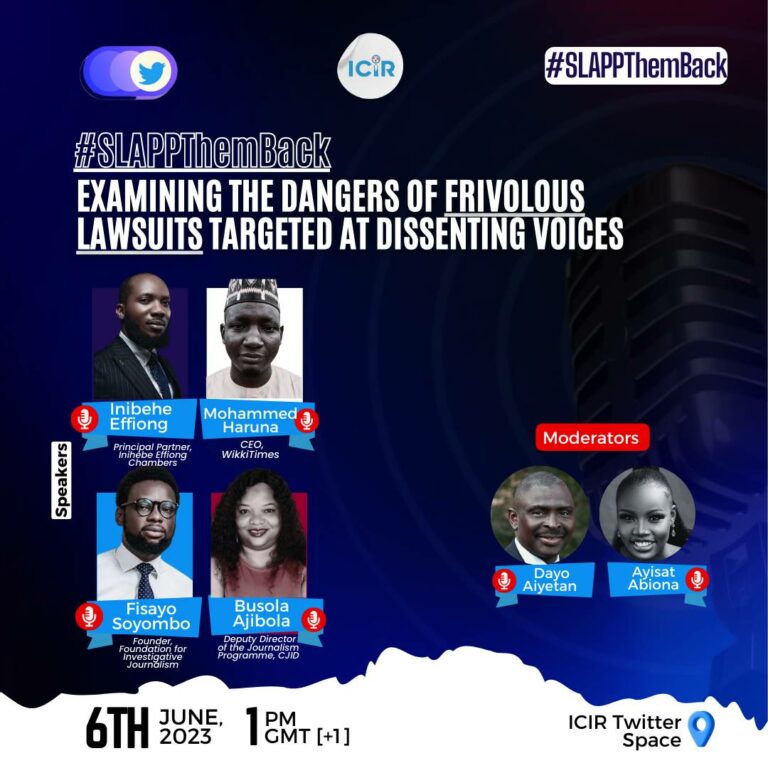
The media stakeholders spoke during a Twitter Space organised by The ICIR on Tuesday, June 6, on the theme, ‘SLAPPThemBack: Examining frivolous lawsuit targeted at dissenting voices’.

Speaking during the event, the Executive Director of the International Centre for Investigative Reporting (The ICIR), Dayo Aiyetan, explained that Strategic Lawsuits Against Public Participation (SLAPP) “are basically frivolous lawsuits that are filed by the people we (journalists and activists) hold to account”.

Noting that the problem is a global phenomenon, Aiyetan said there are attempts to emasculate the civic space in different countries, including Russia, China, Turkey, Iran, the United States and the United Kingdom.

“And then in African countries, in Nigeria, sometimes hypersensitive governments and regimes attempt to silence dissenting voices. In Nigeria, from the days of the military, even under democratic dispensation since 1999, journalists, advocates, activists and other critical voices have had to contend with arrests, illegal detention and all kind of repression.”

He pointed out the the President Muhammadu Buhari administration fought strenuously to silence critical voices through legislations such as the Cybercrime Act.

“You can fit anything you want into that legislation and use it in silencing your opposition or any kind of dissenting voices,” Aiyetan observed.

“These legal threats include cybercrimes law, fake news laws, espionage laws, defamation and insults laws. Journalists in some countries have been slammed with legal suits for saying something that the regime or the government finds insulting but they also include what we called frivolous lawsuits,” he added.

The ICIR, in a recent survey, found out that out of the 141 respondents (that is 28.4 per cent) made up of media organisations, journalists and civic advocates, about 40 have been sued in the last 12 months. 

Out of the 40 organisations that have been sued in the last one year, some have faced more than three lawsuits in the past year while some have been sued for more than 12 times. 

Of the 141 organisations, 37 or 26.2 per cent are civil society organisations; 31 or 22 per cent are online news media while 20 or 14.2 per cent are newspapers/magazines.

Forty-eight of these organisations (34 per cent) are small organisations of between one to 10 staff members.

Also, some of the organisations stated that the legal threats have had a tremendous effect on the way they carry out their advocacy and operations. 

The way out

Highlighting what media organisations can do to address the issue, the Deputy Director of Journalism Programme at the Centre for Journalism Innovation and Development (CJID), Busola Ajibola, said collaboration and cross checking of investigative reports will protect journalists from frivolous lawsuits.

“In the course of my work over the years, I have come to realise that we underestimate how collaboration can protect us. When perhaps we are doing a story that we know will expose us to abuse or libel cases, then we had better come together and do some forms of cross publications. 

“The second one on my list is that; I think we need to work together with CSOs to put forward a legislative proposal that is aimed at stamping out SLAPP and in doing that we need to have a clear timeline.”

Also, the Founder, Foundation for Investigative Journalism (FIJ), Fisayo Soyombo, said he has had conversations with his team on how investigative journalism comes with frivolous lawsuits. But he added that no lawsuit will discourage him and his team.

Speaking on how they get finances to tackle the lawsuits, Soyombo said media houses should cultivate the extra effort in building relationships with legal practitioners who believe in their work.

“But there are times when that option might not be enough because of the cost of prosecuting the case itself, not the legal fees. You can imagine that in one of the lawsuits we had the airline listed one of its witnesses as an aeronautical engineer and then there was someone with a background in forensics. To counter them, we probably need people like that too. Even if your lawyer wants to take on the case for free, those people may not be free and then you need money.”

He added that media houses and journalists need to sit with their funders in solving some legal cases.  

Cybercrime Act should be reviewed

A human right lawyer and principal Inebehe Effiong Chambers, Inibehe Effiong, while speaking on the frivolous nature of some cases slammed against journalists, disclosed that the Cybercrime Act, particularly Section 24, needs to be reviewed.

He added: “Quite sadly, efforts to have that section drop down are so far-fetched from the Federal High Court judgment of justice Muhammed Idris, which was affirmed by the Court of Appeal, but the matter is now at the Supreme Court. We are hoping that the Supreme Court will take a different position. 

“Other than that the only way will be to have Parliament to review it whether the political will will be there I don’t know. It is a lot that really needs to be reviewed because with Section 24 of the Cybercrime Act, everything publishable, everything reportable might be interpreted as cybercrime for which journalists and media houses can be targeted.”

“In terms of criminal defamation, I think other states can take example from Lagos. In Lagos the criminal code law no longer recognises criminal defamation as an offence. In most other states, defamation is still a crime in their various codes.”

Effiong further advised media houses to get legal practitioners to offer them advise on investigative pieces before publishing them.

“There is no harm in getting a lawyer to even give an advisory and read it so as to ask one or two questions.”

Senate approves Tinubu’s request to appoint 20 special advisers

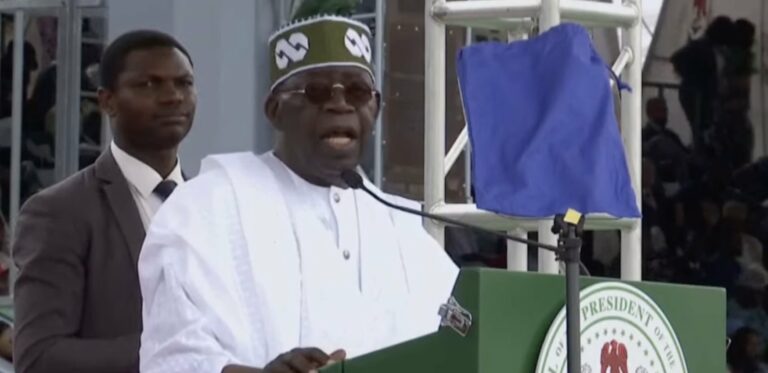
THE Senate has approved the request by President Bola Tinubu to appoint 20 special advisers.

The Senate approved the request after a voice vote during plenary on Tuesday, June 6.

Senate President Ahmad Lawan, who conveyed the President’s request to the lawmakers, said: “Because there is no name for special advisers, we will just approve it from here. We feel that that this is something of utmost urgency.”

A letter from the President concerning the request was read by Lawan during plenary.

The letter was, however, silent on the names of those to be appointed.

Senator representing Sokoto East Ibrahim Gobir moved a motion to consider the approval of the request, which was seconded by Minority leader Philip Aduda.

On Friday, June 2, Tinubu made his first major appointments, choosing the Chief of Staff, Deputy Chief of Staff and Secretary to the Government of the Federation (SGF).

The President appointed current House of Representatives Speaker Femi Gbajabiamila as Chief of Staff, despite still holding his position in the National Assembly.

The appointment had come after days of speculations that Gbajabiamila was favoured to occupy the position.

Tinubu appointed former governor of Benue State and immediate past Minister of Special Duties George Akume as SGF.

He also appointed former Jigawa State Deputy-Governor and senator currently representing Jigawa North-East Ibrahim Hassan Hadeija as Deputy Chief of Staff.

Tribunal adjourns Atiku’s petition over INEC’s refusal to provide materials

THE refusal of the Independent National Electoral Commission (INEC) to provide election documents from Kogi State has forced the Presidential Election Petitions Court (PEPC) to adjourn hearing of the petition filed by the Peoples Democratic Party (PDP) presidential candidate, Atiku Abubakar.

During the resumed hearing of the petition on Tuesday, June 6, the counsel for the PDP, Eyitayo Jegede, a Senior Advocate of Nigeria (SAN), had sought to present forms EC8A from 10 out of 21 LGAs in Kogi State as evidence for the petition against President Bola Tinubu of the All Progressives Congress (APC).

The exhibits comprising documents used during the presidential election held on February 25 included materials from Ankpa, Dekina, Idah, Ofu, Olamaboro, Yagba East, Yagba West, Kabba-Bunu, Igalamela Odolu, and Kogi LGAs of the state.

While the schedule of documents had been submitted alongside the exhibits, the tribunal observed that some of the LGAs were missing.

The tribunal, led by Haruna Tsammani, noted that introducing the sensitive exhibits in fragments would not facilitate their proper marking and numbering.

However, Jegede attributed the absence of the documents to INEC’s deliberate failure to provide them, despite the payment of N6 million by Atiku and the PDP for their certified true copies.

Jegede informed the court that Atiku’s legal team would subpoena top INEC officials to produce the required documents at the next sitting.

The court, as a result, adjourned the matter till Wednesday, June 7, after no objection was raised by counsels to all the respondents.

Earlier in the day, the panel admitted a document of discontinuance filed by six PDP states at the Supreme Court. The states – Adamawa, Akwa Ibom, Bayelsa, Delta, Edo, and Sokoto – had challenged the declaration of Tinubu as President, but chose to discontinue their suit.

Jegede informed the court that the discontinuance notice, contained in the schedule of documents to be tendered, was intended to support their counter affidavit against the APC’s claim that a similar suit was still pending at the Supreme Court.

The Attorneys General of the six states had jointly filed the suit before the Supreme Court on February 28.

They argued that INEC had declared Tinubu as the winner of the February 25 presidential election without adhering to the provisions of the Electoral Act 2022 and INEC guidelines. Their contention centered on the failure to upload results from the BVAS to the IREV before INEC’s pronouncement.

However, Tinubu and the APC raised a preliminary objection at the tribunal, asserting that Atiku and the PDP’s petition constituted an abuse of the court process, as they had already filed a similar suit before the apex court.

After ICIR investigation: We now have access to our brother – Ojokoh’s family

0

By ARINZE Chijioke

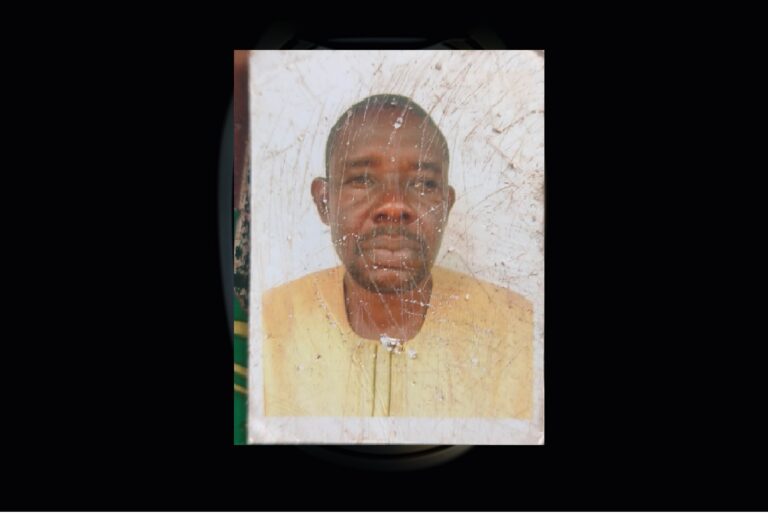
FAMILY members of Ikechukwu Ojokoh, a dressmaker arrested and detained by the Police in Imo State on allegations of being a member and the coordinator of the Indigenous People of Biafra (IPOB) in Mbaise say that they can now access him.

Recall that the ICIR had travelled to Umuokirika, Ojokoh’s community to investigate conflicting narratives around the suspect accused of killing five policemen.

The family members and neighbours insisted that he was innocent. They argued that Ojokoh was arrested at a market close to his shop and was already in police detention before the killing of the officers against the police claims that he and others were arrested at their hideout in Umuahia, Abia state.

Read the investigation HERE

For over a month after he was arrested and kept in detention at the Tiger Base, the Police detention facility in Owerri, his family members, including his wife, were not allowed access to him.

However, after The ICIR report, he was moved from detention to the Correctional facility in the state, where he has been for over two weeks as of press time.

His elder brother, Donatus, who spoke to The ICIR, said that his family members are now allowed access to him.

He also said that the family’s lawyer was already gathering the entire documents, which will enable them to appear in court and apply for bail.

Cross River state N600 million dubious contracts: Governor visits Lemna dumpsite after The ICIR funded investigation

0

By ARCHIBONG Jeremiah

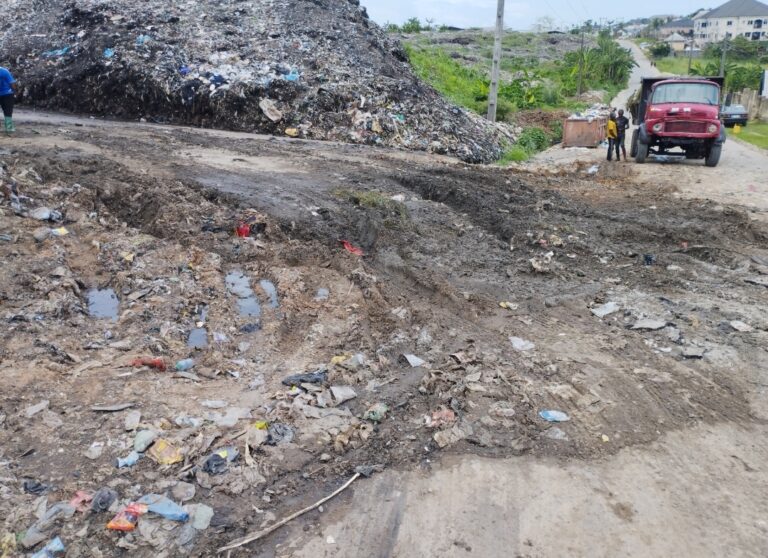
Cross River state Governor Bassey Edet Otu has revealed plans to relocate the Lemna dumpsite. 

He visited the site and other places two weeks and some days after The ICIR-funded investigation that revealed large-scale procurement violations in contracts awarded in 2020 was published.

The investigation by the CrossRiverWatch showed that the contract to manage the dump site and eleven other projects valued at over N600 million was awarded to nine companies that are not registered or recognised under the Cross River State Procurement Law, 2020 (Law No. 9).

The full report can be read here.

Speaking to journalists at the site, the governor said, “What I’m seeing here is quite pathetic; apart from the fact that we are putting proper arrangements to move this dump site from here, we are looking for where to take it, this one must be put in proper condition.


Read Also:

“Why I came here today is to assess the situation firsthand and make sure from tomorrow things are done to make this dumpsite workable and that trucks that are coming in are able to move in very easily to deliver their dump.”

Otu promised that “Calabar is going to be clean again, very, very soon.”

Earlier, stakeholders reacting to the investigation’s findings called on the government to probe the contract and contract process. You can read the report here.

How central bank can contain financial stress, fight inflation – IMF

THE International Monetary Fund (IMF) says recent events have shown central banks and policymakers can deal with sizeable financial stress without compromising their inflation-fighting stance.

In a report it released on Monday, June 5, the IMF expressed its observation that regulators and central banks were able to contain the impact of the collapse of Silicon Valley Bank and other United States regional banks, as well as Credit Suisse in Switzerland, without retreating on the inflation front.

It noted that in times of acute financial stress and high inflation, policy trade-offs were more challenging.

The ICIR can report that the Central Bank of Nigeria (CBN) aggressively raised its monetary policy rate from 11.5 per cent in April 2022 to 18.5 per cent in May this year to bring inflation back to target.

The rapid raising of the rates, IMF said, had stressed the balance sheets of exposed bank and non-bank financial institutions through declining values of their fixed-income assets and increased funding costs.

The IMF warned that the policy, if unmitigated, could threaten overall financial stability as increases in the rate transmit to the real economy in part by raising borrowing costs for households and firms.

To navigate the difficult trade-off, the IMF proposed that tools other than the policy rate could be used to contain financial stress.

It said, “Forceful and timely action by policymakers is required through aggressive financial policies. These include various forms of liquidity support, asset purchases, or possibly direct capital injections.

“Being sufficiently forceful, the interventions could leave monetary policy free to maintain its focus on inflation.”

It also suggested that critical actions needed to forestall a crisis might extend beyond what central banks can do alone.

It said, “While central banks can extend broad-based liquidity support to solvent banks, they are not equipped to deal with the problems of insolvent firms or borrowers, which must be addressed by governments.”

As such, the need for aggressive financial interventions becomes more acute as financial stresses intensify and insolvency risks grow, and the situation often requires committing sizeable fiscal resources.

The IMF explained that when inflation is still running high, it indicates that the central banks would be more flexible about the time frame for returning inflation to target.

In practice, this measure would likely put substantial downward pressure on inflation, thus realigning monetary and financial policy objectives.

“But emerging markets with weaker macro policy frameworks would likely have to confront the very difficult challenges posed by capital flight and currency depreciation-inflation spirals. Their central banks would have to remain vigilant about the need to maintain a nominal anchor, limiting any scope to ease.

“While these countries could take some steps on their own (for example, with capital flow management measures), a strong international safety net is vital to mitigate the risk of a prolonged and severe crisis,” the Fund stated.

It urged central banks to support non-banks like insurance firms, pension funds, and investment funds, which present important challenges, as the apex banks did during the global financial crisis and the COVID-19 pandemic.

The ICIR reported that the CBN, on Tuesday, May 23, revoked the licences of 179 microfinance banks (MfBs), four primary mortgage banks (PMBs), and three finance companies for being inactive, insolvent, and failing to render returns, among other reasons.

This happened in a country where the banking penetration is way below 40 per cent in the aggregate, the chief executive officer/principal partner with Afrique Capital and Equity Funds Limited, Kazeem Bello, said.

“The failed naira redesigning policy and the terrible flaws and poor mismanagement of the implementation have resulted in about seven Nigerian banks sliding into serious distress.

“I stuck to my gun on this and we shall soon set for the realities. Now they have started with the micro finance firms. Just wait and see,” Bello said.

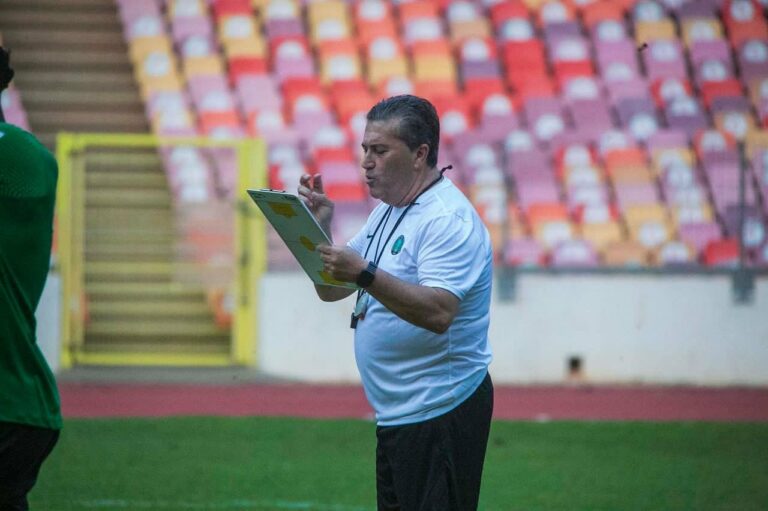
One-year-scorecard: Super Eagles coach Peseiro performs below par

2

FOLLOWING the resignation of Nigerian ex-international Austin Eguavoen as the handler of the Super Eagles in March 2022, the Nigeria Football Federation (NFF) announced the appointment of 67-year-old Portuguese Jose Paseiro as the new head coach.

Before Peseiro’s appointment as the coach, the Super Eagles under Eguavoen had failed to secure the Qatar 2022 World Cup ticket.

The failure to participate in the World Cup raised concerns over the competence of the handlers of the Super Eagles.

In a bid to fill the vacuum, the NFF shortlisted a handful of coaches for the position. Among the prospective gaffers, Paseiro was named as the coach on May 15, 2022.

Peseiro’s record as Super Eagles coach

The Portuguese tactician began his assignment with a 2-1 loss to Mexico in a friendly match, in Texas, on May 29, 2022.

Five days later, Nigeria lost to Ecuador 1-0 in another friendly match.

On June 9, 2022, Peseiro recorded his first win against Sierra Leone, 2-1, in a 2023 Africa Cup of Nations (AFCON) qualifying match.

Four days later, it was a goal fest for the Super Eagles as they pummelled Sao Tome and Principe, 10 goals to nil, in another 2023 AFCON qualifying match.

In his third friendly match played on September 27, 2022, the Super Eagles could not continue their winning streak as they lost 2-1 to Algeria.

On November 10, 2022, the Super Eagles suffered another defeat under Peseiro as they lost 2-0 in a friendly match against Costa Rica.

Again, on November 17, 2022, Portugal thrashed the Super Eagles 4-0 in another friendly match.

On March 24, 2023, the Peseiro-led Super Eagles suffered a shocking defeat – losing to Guinea-Bissau by a lone goal at the Abuja National Stadium.

Guinea-Bissau, ranked 118th on the FIFA rankings, is one of the minnows of African Football.

However, the Super Eagles redeemed themselves in the return leg in Bissau, winning 1-0, on March 27, 2023.

The ICIR’s analysis shows that Peseiro played nine matches; won three and lost six. The coach lost all five friendly matches played by the Super Eagles.

Super Eagles scorecard in Peseiro’s first year as coach

A breakdown of the matches played by the Super Eagles under Peseiro:

May 29, 2022 Mexico 2 vs Nigeria 1

June 3, 2022 Ecuador 1 vs Nigeria 0

June 9, 2022 Nigeria 2 vs Sierra Leone 1

June 13, 2022 Sao Tome and Principe 0 vs Nigeria 10

Sept 27, 2022 Algeria 2 vs Nigeria 1

Nov 10, 2022 Costa Rica 2 vs Nigeria 0

Nov 1u, 2022 Portugal 4 vs Nigeria 0

Mar 24, 2023 Nigeria 0 vs Guinea-Bissau 1

Mar 27, 2023 Guinea-Bissau 0 vs Nigeria 1

The ICIR conducted a comparative analysis of Peseiro’s one-year record with that of former coach, Genrot Rohr, who was appointed in May 2016.

Below are the results of Super Eagles matches during Rohr’s first year as coach

September 3, 2016 Nigeria vs Tanzania 1-0

October 9, 2016 Zambia vs Nigeria 1-2

November 12, 2016 Nigeria 3-1 Algeria

September 4, 2017 Cameroon 1 vs Nigeria 1

October 7, 2017 Nigeria 1 vs Zambia 0

November 10, 2017 Algeria 1 vs Nigeria 1

November 14, 2017 Argentina 2 vs Nigeria 4

This shows that Rohr won five matches and drew two out of the seven matches that were played under his leadership during his first year as Super Eagles coach.

2023 AFCON qualifiers

However, the Super Eagles are currently the leader in group D, with 9 points, in the ongoing 2023 AFCON qualifiers. The team has a match against Sierra Leone on Sunday, June 18.

Peseiro’s contract with NFF

Peseiro has a one-year contract, with an option of a two-year extension if the Super Eagles win the 2023 Africa Cup of Nations originally scheduled for June but later postponed to 2024.

This means his contract elapsed last month, May, and his employer, the NFF, is yet to release any statement on possible renewal, or termination, of the deal.

The contract is reportedly valued at $70,000 (N32 million) per month, out of which he pays the two staff that accompanied him.

Stakeholders react

Assessing Peseiro’s performance, veteran sports journalist, Kunle Solaja berated the Super Eagles handler. He noted that Nigeria has not enjoyed any dividend on the investment made in hiring him.

“He is collecting money in thousands of dollars but the returns has not been commensurate with the amount we are spending on him.

“I don’t think this is viable, except we come to adopt a situation whereby those coaches we employed from abroad will be working on a part-time basis.

“Peseiro cannot claim he is coaching the Super Eagles players because there is no player with him but if he could, just like his predecessors have done, create a homegrown team, train them and before you know it, three of them can graduate into the Super Eagles but that is given as part of their assignment.

“The few times he has been around, I think he just watched a few matches and in most cases, he will be abroad monitoring our players. The same players we see day in and out on television,” Solaja said.

Also, the publisher of Sport Pro Newspaper in Kwara State, Bayour Issah, gave Peseiro a low mark. He noted that the matches won by the Super Eagles under Peseiro were against countries that have a low pedigree in football.

“Most of the matches that he won were against countries that were not important when it comes to football pedigree.”

He suggested that Peseiro’s contract should not be renewed.

“I think that he should take his leave. As far as I am concerned, his performance is below par. I think that Peseiro’s time is over and it is an opportunity for all Nigerians to come around and scrutinise those that will be at the helm of affairs as national coaches.”

According to the publisher, the Super Eagles should be handled by world class coaches, like Manchester City manager Pep Guardiola.

“Super Eagles of Nigeria is a big brand across the globe, so whoever is going to handle them must be above board, must be somebody that everybody knows, like Pochettino, Mourinho or Guardiola,” he said.