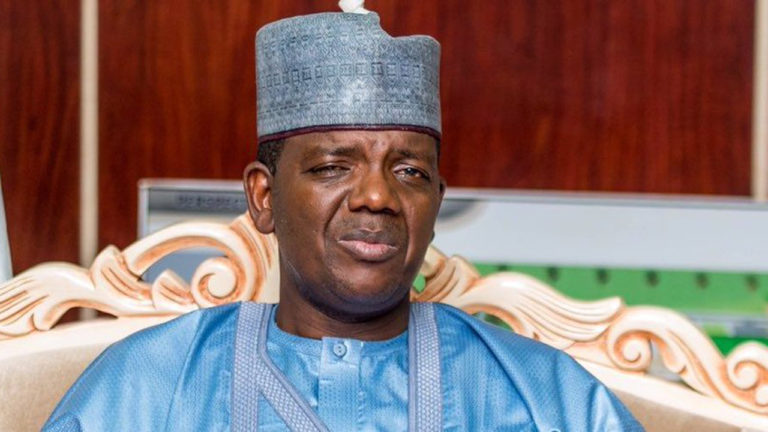
THE Governor of Zamfara State, Bello Mohammed Matawalle, has reinstated a monarch, Aliyu Garba Marafa, who was suspended for turbanning a notorious bandit leader, Ado Aleiru.
Marafa, the Emir of Birnin Yandoto, was suspended shortly after giving the bandit leader a chieftaincy title in 2022.
In a statement on Sunday, April 23, the Secretary to the Zamfara State Government, Kabiru Balarabe Sardauna, announced that Marafa has been reinstated as the Emir of Birnin Yandoto.
The statement reads: “This is to inform the public that His Excellency, the Executive Governor of Zamfara State, Hon. Bello Mohammed Matawalle, MON, (Shatiman Sokoto), has approved the reinstatement of Alh. Aliyu Garba Marafa as the Emir of Birnin Yandoto.
“His reinstatement is based on the recommendations of the committee constituted to investigate all issues pertaining to the conferment of a traditional title to a repentant bandit, Ado Aleiru. The committee found no evidence of any ill motive or collaboration between the Emir and the bandit.
“Based on the findings of the committee, the traditional title was conferred on the repentant bandit as part of peace-building efforts between the repentant bandit and banditry-affected communities in Tsafe and Gusau Local Government Areas, which include Yandoto town. The reinstatement takes immediate effect.”
In July 2022, the Zamfara State Government announced the suspension of Marafa as the Emir of Birnin’ Yandoto, in Tsafe Local Government Area, for turbanning the bandit leader.
.
Secretary to the State Government, Kabiru Sardauna, announced the suspension in a statement.
Marafa conferred Aleiru with the title of leader of the Fulani.
According to the Emir, Aleiru was conferred the title for his pivotal role during a peace process between the Emirate and the bandits terrorising Tsafe Local Government Area.
Following the development, the state governor, Matawalle, set up a committee to investigate the circumstances leading to the Emir’s action.
Zamfara State, in Northwestern Nigeria, is one of the strongholds of armed bandits who have been terrorising residents of many northern states.
The Zamfara incumbent governor, Bello Matawalle, lost his reelection bid to Lawal Dare of the Peoples Democratic Party (PDP) in the just concluded governorship election.
The returning officer for the election, Kasimu Shehu, said Dare scored 377,726 votes to defeat Matawalle, who polled 311, 976 votes.
SECTOR Commander of the Federal Road Safety Corps (FRSC) in Taraba Selina Williams has issued an alert over a fake LinkedIn account being used to defraud members of the public through an employment scam.
Although there is an ongoing recruitment process by the FRSC, Williams noted in a statement on Sunday, April 23 that the employment offer advertised by the LinkedIn account with the name Marshal Dauda Biu and WhatsApp number 07069777732, was fake.
FRSC “FRSC recruitment process is on and there is a fake linkedin account operating on Whatsapp number: 07069777732 under the name of Corps Marshal Dauda Biu with the intent to defraud innocent members of the public on the guise of offering them employment.
“I enjoin prospective applicants or members of the public in Taraba to be wary of such fake account and disregard it,” she said.
Members of the public interested in applying for employment were advised to visit the Corps’ portal at www.recruitment.frsc.gov.ng where the application process is free.
Many unsuspecting members of the public have been defrauded by fraudsters using phishing websites and social media platforms for employment scams across the country.
In 2021, The ICIRreported how fraudsters steal data from job seekers, including login credentials and credit card numbers, to illegally siphon users’ money from their bank accounts without their knowledge.
Oftentimes, there is an outright demand for application fees from unsuspecting applicants.
According to the report, the Federal Bureau of Investigations (FBI) said about 443 people in Nigeria were victims of employment scams in 2020, with losses estimated at $20 million.
Operatives of the National Drug Law Enforcement Agency (NDLEA) have arrested a widower, Ariyibi Ahmed Olaseinde and a divorcee, Akanbi Silifat Tunrayo, for drug trafficking at the Murtala Muhammed International Airport, (MMIA), Ikeja, Lagos.
According to the NDLEA, the suspects who were going for the Lesser Hajj in Saudi Arabia were arrested for attempting to export 14.4 kilograms of cocaine concealed in lace and Ankara fabrics.
This was disclosed in a statement on Sunday, April 23, signed by the spokesperson of the NDLEA, Femi Babafemi.
According to the statement, Ariyibi was intercepted on Thursday, 20th April, at the screening point of MMIA Terminal 2 during outward clearance of Qatar Airways passengers travelling from Lagos via Doha to Medina, Saudi Arabia.
Silifat Tunrayo Akanbi Photo credit: NDLEA
“When his carry-on bag was checked, four sets of white lace material with linings of substance that tested positive to cocaine weighing 11.50kg were discovered.
“The suspect, who claimed to be a widower and an advertising practitioner, said his original plan was to ingest the drugs but had to change his mind after failed attempts to swallow bitter cola, which he was using to practice the process.
“He is expected to be paid One Million, Eight Hundred Thousand Naira (N1,800,000) upon successful delivery of the consignment in Medina, Saudi Arabia,” the NDLEA stated.
The anti-narcotic Agency said that on Wednesday, April 19, NDLEA officers at the Terminal 2 airport also arrested Akanbi with 2.90kg of cocaine during outward clearance of Qatar Airways passengers from Lagos via Doha to Jeddah, Saudi Arabia.
A search of her hand luggage led to the discovery of six sheets of cocaine weighing 2.90kg concealed in Ankara fabrics.
“Preliminary investigation revealed that the suspect is a divorcee and a trader who used to hawk clothes around the Awoyaya area of Ajah, Lagos.
“Based on information in her statement, a follow up operation that lasted through the night into the early hours of Thursday 20th April was carried out, during which the person who recruited her, Adebayo Adeola Wasiu was arrested at No 28, Olateju Street, Mushin, Lagos. Adebayo is the managing director of B&T Travel Agency,” the NDLEA added.
Silifat Tunrayo Akanbi and Adebayo Adeola Wasiu Photo credit: NDLEA
In the same vein, NDLEA said officers attached to courier companies intercepted two drug consignments: ecstasy and skunk, going to the United Arab Emirates.
While the ecstasy pills were concealed in a gold wedding gown, the skunk was hidden in a microcontroller.
THE All Progressives Congress (APC) has dissolved its Presidential Campaign Council (PCC), which was established in September of last year.
The Council was chaired by the Plateau State governor, Simon Bako Lalong, with James Faleke serving as the Secretary.
The announcement of the dissolution was made via a statement jointly signed by Lalong and Faleke and released on Sunday, April 23.
According to the statement, the APC expressed its gratitude to all Council members, leaders, and supporters for their efforts towards securing “a resounding victory for the President-elect, Asiwaju Bola Tinubu”.
The statement also thanked President Muhammadu Buhari for his unwavering support and leadership throughout the campaign.
The APC acknowledged the campaign council’s unprecedented, relentless, and engaging mobilization of party members nationwide and in the Diaspora towards securing the majority popular votes for the Tinubu/Shettima Presidential ticket.
“The journey has been a worthy one with our hard-won victory. The credit goes to all our members particularly, the leaders and members of the various campaign directorates,” the statement said.
“However, we have concluded that it is in the best interest of the campaign and its stakeholders for us to dissolve our council with immediate effect. This has become necessary to retune us towards the May 29, 2023, inauguration of the President-elect Asiwaju Bola Ahmed Tinubu’s administration.
“The process of transitioning into a new era of a Renewed Hope is underway and all our energies and activities must reflect the principles underlying this process.”
The party expressed hopes that all members will continue to stay involved in Nigeria’s political process and advocate for issues they believe in.
The dissolution of the PCC comes as the APC prepares for the inauguration of Tinubu’s administration on May 29.
The Independent National Electoral Commission (INEC) had declared Tinubu as the winner of the February 25 presidential election.
According to INEC, Tinubu secured 8,794,726 votes, the Peoples Democratic Party (PDP) candidate, Atiku Abubakar had 6,984,520, while the Labour Party (PDP) presidential candidate, Peter Obi, polled 6,101,533.
The PDP and LP candidates have rejected the result. Both parties have approached the tribunal with separate petitions to challenge Tinubu’s victory.
THE Nigeria Centre for Disease Control and Prevention (NCDC) said Cerebrospinal Meningitis killed 118 persons in Nigeria in the last six months.
The NCDC disclosed this through its official Twitter handle on Sunday, April 23.
The Centre said that between October 2022 and April 2, about 235 confirmed cases had been reported, with 118 deaths from 22 states and 79 local government areas (LGAs).
The public health institute expressed worries that the disease killed 23 persons in one week between March 27 and April 2.
The deaths were reported from two states, Jigawa (6) and Yobe (17).
Additional information on NCDC’s website added that the national multi-sectoral Cerebrospinal Meningitis Technical Working Group (TWG) persist in monitoring response to the disease across states.
“As of April 2, a total of 1,479 suspected cases, including 118 deaths (Case Fatality Ratio, CFR 9.3 per cent), were reported from 22 states in 2022/2023 Cerebrospinal Meningitis seasons.
“Age group 5-14 years was the most affected age group; males were 57 per cent, females were 43 per cent.
About “93 per cent of all cumulative cases were from five states: Jigawa (1064 cases), Yobe (234 cases), Zamfara (36 cases), Bauchi (23 cases) and Adamawa (21 cases),” the NCDC said.
In 2022, the NCDC disclosed that Meningitis killed 56 persons in Nigeria between January and October 5.
In a statement, the Centre said the deaths occurred from 961 suspected cases.
The Centre said the suspected cases and deaths were logged from 159 local government areas in 32 states and the Federal Capital Territory (FCT).
Cerebrospinal Meningitis (CSM) is an epidemic-prone disease with cases reported annually in Nigeria.
The highest burden occurs in Africa’s ‘Meningitis Belt’, south of the Sahara Desert.
In Nigeria, the belt includes all 19 northern states, the FCT and some southern states.
The bacteria that causes Meningitis is transmitted from person to person through carriers’ droplets of respiratory or throat secretions.
The World Health Organization (WHO) defined Meningitis as a severe infection of the meninges, the membranes covering the brain and spinal cord.
Anyone of any age can be affected, but particularly infants, young children, and of preschool age.
The early symptoms can take several hours or several days. A sudden high fever, stiff neck, excruciating headache, nausea, and vomiting are a few examples.
In some situations, such as Meningococcal Meningitis, it may also cause disorientation or difficulty concentrating, seizures, tiredness or difficulty waking up, sensitivity to light, lack of appetite or thirst, and skin rash.
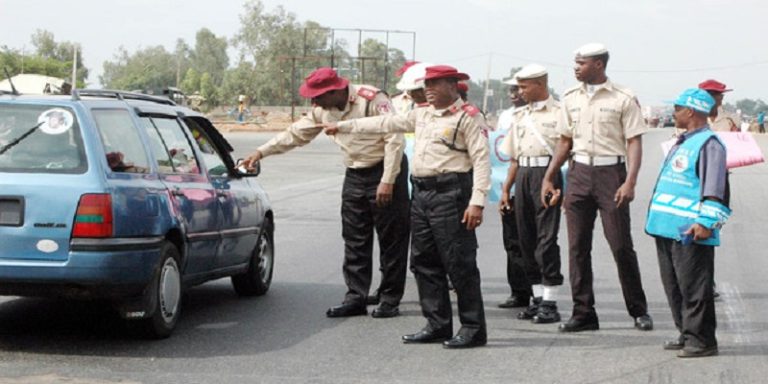
THE Federal Road Safety Corps (FRSC) has released data indicating that 32 of its officers lost their lives while on official duty between 2018 and 2022.
The data was released by FRSC spokesperson, Bisi Kazeem, on Friday, April 21.
According to the records, three officers were killed in 2018, eleven lost their lives in 2019, nine in 2020, five in 2021, and four in 2022.
The road safety personnel were killed “as a result of knockdown by reckless drivers or attacks” according to the data.
In November 2022, a truck driver crushed two officers along the Ikot-Ekpene – Aba route. The crash occurred as a result of excessive speed by the driver of a DAF articulated truck while trying to dodge a pothole along the route.
On April 3, 2022, unknown gunmen killed two FRSC officials in Ezinifite, Aguata Local Government Area of Anambra State.
In November 2020, the House of Representatives expressed concerns over the safety of FRSC members, who had been threatened, harassed, and even killed in the line of duty.
The House Committee on FRSC had suggested that arming FRSC members would help curb the excesses of road users in the country.
The Committee Chairman, Mayowa Akonfolarin, said the Road Safety Establishment Act of 2007 should be amended to provide a legal framework for the arming of personnel on essential duties.
He said that the committee would liaise with relevant bodies, including the FRSC, the Secretary to the Government of the Federation, and relevant supervisory agencies, to set up a body that would brainstorm on the issue and make recommendations.
To address the safety concerns, experts have suggested several measures that the FRSC could implement to reduce the number of officers killed while on duty.
These measures include deploying technology such as license plate recognition, speed limiting devices, and a traffic operation centre to enable the agency to discharge its duties effectively.
FRSC operatives have also been advised to to avoid jumping into the road to stop fast-moving vehicles. The road safety commission was also advised to deploy secret body cameras to monitor activities, and engage in arresting vehicles instead of chasing them down.
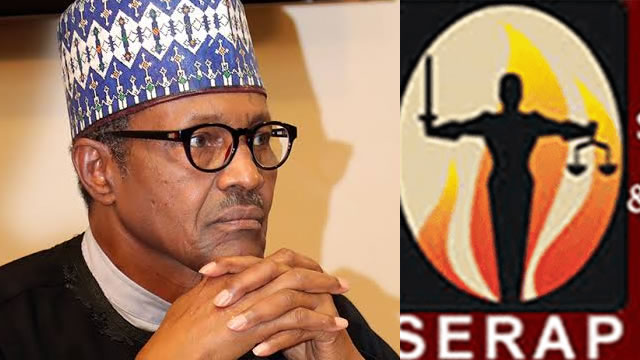
SOCIO-Economic Rights and Accountability Project (SERAP) has urged President Muhammadu Buhari to set up a presidential panel of enquiry to probe allegations that over 149 million barrels of crude oil are missing.
The allegation was documented in 2019 audited reports by the Auditor General of the Federation and Nigeria Extractive Industries Transparency Initiative (NEITI).
SERAP, in the letter dated April 22, and signed by its deputy director Kolawole Oluwadare, urged the President to “ensure the effective prosecution of anyone suspected to be responsible for the plundering of the country’s oil wealth and the full recovery of any proceeds of crime”.
It was reported that over 107 million barrels of crude oil were lifted as domestic crude without any document or tracing, according to the Auditor-General’s 2019 report.
NEITI, according to SERAP, also reported missing 42.25 million barrels of crude oil in 2019.
The letter stressed that there is a legitimate public interest in ensuring justice and accountability for the allegations.
The organisation further warned Buhari to take the recommended steps between now and the end of his term in office.
According to the the SERAP, poor and socio-economically vulnerable Nigerians have continued to pay the price for the stealing of the country’s oil wealth apparently by both state and non-state actors.
Parts of the letter read: “SERAP notes that you have repeatedly promised to combat corruption. As you go into the final weeks of your term of office, the missing crude oil allegations present yet another opportunity to demonstrate your commitment and to uphold your oath of office both as President and Minister of Petroleum Resources.
“As the President and substantive Minister of Petroleum Resources, you and your government should prioritise getting to the bottom of these allegations and use the remainder of your term of office to ensure justice and accountability for these serious crimes against the Nigerian people.
“Investigating the allegations and naming and shaming and prosecuting those suspected to be responsible for the missing crude oil would serve the public interest and end the impunity of perpetrators.
“We would be grateful if the recommended measures are taken within 7 days of the receipt and/or publication of this letter. If we have not heard from you by then, SERAP shall take all appropriate legal actions to compel your government to comply with our request in the public interest.
“The allegations by both the Auditor-General and NEITI are different from a whistleblower’s claims that 48 million barrels of Bonny Light crude oil allegedly sold in China in 2015 are missing or unaccounted for.”
“The reports by the Auditor-General and NEITI suggest a grave violation of the Nigerian Constitution 1999 [as amended], and the country’s anticorruption laws and international obligations, as well as the public trust.
“These damning revelations also suggest your government is failing to prevent and combat the plundering of Nigeria’s wealth and natural resources, name and bring suspected perpetrators to account and recover any proceeds of crime.
“Poor and socio-economically vulnerable Nigerians have continued to pay the price for the stealing of the country’s oil wealth apparently by both state and non-state actors.
“The country’s oil wealth ought to be used solely for the benefit of the Nigerian people, and for the sake of the present and future generations.
“These allegations can promptly be investigated and suspected perpetrators named and shamed. Taking these steps would advance the right of Nigerians to restitution, compensation and guarantee of non-repetition and improve public confidence in the fight against corruption, and related crimes, especially in the oil sector.
“According to the 2019 audited report by the Auditor General of the Federation (AGF), some 107,239,436.00 barrels of crude oil were lifted as domestic crude without any document or tracing.
“To date, there is no information on the sale of Un-Utilized Crude oil by Refineries for 2019 and no information on crude oil allocations from 30th May to 31st December 2019. The Auditor-General is concerned that the missing crude oil may have been diverted.
“The Nigeria Extractive Industries Transparency Initiative (NEITI) also reported missing 42.25 million barrels of crude oil in 2019.
“Section 13 of the Nigerian Constitution imposes clear responsibility on your government to conform to, observe and apply the provisions of Chapter 2 of the Constitution. Section 15(5) imposes the responsibility on your government to ‘abolish all corrupt practices and abuse of power.
“Under Section 16(1) of the Constitution, your government has a responsibility to ‘secure the maximum welfare, freedom and happiness of every citizen on the basis of social justice and equality of status and opportunity.’ Section 16(2) further provides that, ‘the material resources of the nation are harnessed and distributed as best as possible to serve the common good.
“The UN Convention against Corruption and the African Union Convention on Preventing and Combating Corruption to which Nigeria is a state party obligate your government to effectively prevent and investigate the plundering of the country’s wealth and natural resources and hold public officials and non-state actors to account for any violations.
“Specifically, article 26 of the UN convention requires your government to ensure ‘effective, proportionate and dissuasive sanctions’ including criminal and non-criminal sanctions, in cases of grand corruption.
“Article 26 complements the more general requirement of article 30, paragraph 1, that sanctions must take into account the gravity of the corruption allegations.
“The proposed panel should be headed by a retired justice of the Supreme Court or Court of Appeal, and its members should include people with proven professional record, and of the highest integrity that can act impartially, independently, and transparently.”
MAJOR opposition political parties in Nigeria are experiencing internal crises following the conclusion of the 2023 general elections.
The two major opposition parties, the Peoples Democratic Party (PDP) and the Labour Party (LP) are facing crises characterised by leadership tussles, suspensions, expulsions and court cases.
The crisis in the PDP has its root in the outcome of the party’s presidential primary election, where Rivers State governor, Nyesom Wike, lost to the former vice-president, Atiku Abubakar. After the primary, Atiku picked Delta State governor, Ifeanyi Okowa, as his running mate for the 2023 presidential election, against the recommendation of a committee chaired by Benue State governor, Samuel Ortom, which reportedly recommended Wike as the PDP vice presidential candidate. The Rivers governor would later lead four other PDP governors to demand the resignation of the party’s chairman, Iyorchia Ayu, as one of the conditions for backing Atiku’s presidential ambition.
All efforts to resolve the crisis, including the resignation of the party’s Board of Trustees (BoT) chairman, Walid Jibrin, were rebuffed by the G5 governors.
Just before the elections, the party moved to suspend some members believed to be loyal to former Ekiti State governor, Ayodele Fayose, who is also Wike’s ally, for anti-party activities in Ekiti. The party also suspended a former Enugu State governor, Chimaraoke Nnamani, who was openly working for APC presidential candidate Bola Tinubu.
Wike failed to support Atiku during the general elections and, instead, worked for Tinubu, who was declared by the Independent National Electoral Commission (INEC) as the winner of the presidential poll. But Wike did not stop asking for Ayu’s resignation even after the general elections.
Following the conclusion of the general elections, the PDP leadership moved to suspend Fayose. The Ayu-led PDP leadership also directed Ortom to face a disciplinary committee. The Benue governor swore that he will not appear before the panel.
The crisis took a new dimension when, in a move that appeared similar to circumstances surrounding the removal of former PDP national chairman Uche Secondus, Ayu was suspended by his ward for anti-party activities. Ayu was ordered by Justice W. I. Kpochi of the Benue State High Court to stop parading himself as the party’s chairman.
In the meantime, the Deputy National Chairman (North), Ambassador Umar Damagum, is the acting national chairman of the party, following Ayu’s removal by the National Working Committee (NWC) in compliance with the court ruling.
The Labour Party (LP) is also facing a similar crisis. The crisis started after the general election when the party’s national chairman, Julius Abure, was suspended by his ward in Edo State for anti-party activities. Although the party’s leadership dismissed the suspension, Abure and Farouk Ibrahim, were ordered by an Abuja Federal High Court to stop parading themselves as the party’s chairman and secretary, respectively.
The court also stopped the party’s National Organising Secretary, Clement Ojukwu, and the Treasurer, Oluchi Opara, from parading themselves as the party’s national officers.
The court, presided by Justice Hamza Muazu, ruled the the officials should remain suspended, pending the hearing and determination of a suit challenging their continued stay in office over allegations of corruption brought against them. The court also revised the suspension of some national officers that had been previously suspended due to alleged anti-party activities by the Abure-led party leadership.
Following the court order, the party’s South-West chairman, Lamidi Apapa, announced himself as the acting national chairman of the party. He also announced Saleh Lawan is the acting national secretary.
However, the crisis took another turn on Wednesday, April 12, when some state chairmen of the party clashed with the Lamidi Apapa-led faction. In the wake of the development, the LP state chairmen in the 36 states disowned Apapa and threw their weight behind Abure as the party’s leader.
Speaking to journalists, Kehinde Rotimi, state chairman of LP in Kwara State, narrated what transpired during the clash with the Apapa-led faction at the party secretariat. Rotimi said trouble started when the state chairmen arrived for a meeting but were locked out of the secretariat.
“We have been here for quite some days now for screening of some of our gubernatorial candidates for the forthcoming election in Bayelsa, Kogi and Imo states. We were at the screening, yesterday, when we learnt that some people brought themselves to this office to do screening for candidates, when we heard that, we said that that is an aberration because they do not have the locus standi to do that.
“I am a member of the screening committee where we screened so many candidates yesterday, so I do not know how they manipulated one or two candidates to come here yesterday and impersonated some of the candidates. So that’s why we came here. On getting to our secretariat, we wanted to hold a meeting and we discovered it was under lock and key.
“So we met some DSS men and some vigilantes groups, some thugs and miscreants and they said they asked them to lock the secretariat. So in the course of discussing, the legal committee led by Apapa came around and were trying to engage us, and their thugs were almost attacking us and we resisted every temptation to cause commotion and crisis because we know the case is in court.
“Anything in court you don’t discuss it and we don’t want to commit contempt of court and that’s why we now said okay, what do we do? Let’s stay here. So they could not enter, we too, could not enter.”
Although the APC has denied interference in the party’s crisis, the LP believes that its ongoing ordeal is part of several plots by the ruling party to frustrate its petition at the Presidential Election Tribunal (PET), where it’s presidential candidate Peter Obi is challenging the outcome of the February 25 election.
Crises could jeopardise election petitions — Political analysts
Political analysts believe that if the ongoing crises within the main opposition parties are not resolved, they could jeopardise their chances at the tribunals.
A professor of Political Science at the Federal University Oye Ekiti, (FUOYE), Shola Omotola, blamed the crises in the two main opposition parties on lack of internal democracy and discipline.
In an interview with The ICIR, Omotola said that the crisis could lead to a loss of support from their their supporters, who may see the parties as unstable and lacking in direction if the controversies are not quickly managed.
He noted that the ongoing crises could tarnish the image of the parties, as it could lead to negative media coverage and portray them as lacking in discipline and leadership.
He said that this could impact the parties’ ability to attract new members and supporters, and also focus on the various elections petitions.
“The leadership of the parties must be proactive in addressing the crisis. They must listen to the grievances of all parties involved and seek to find common ground,” he said.
“The party must promote internal democracy, where every member has an equal opportunity to contribute to the party’s growth and development. The parties need to promote democratic processes that promote fairness and transparency in the selection of candidates and party officials, avoiding the imposition of candidates or the use of violence.
“They need to enforce discipline within their ranks, promoting a culture of accountability and punishing members who act against the party’s interest.”
Omotola believe that the two parties need strong and decisive leaderships that can take charge of the situation and unify all interest groups.
Similarly, Rotimi Fashakin, a political analyst in Ado Ekiti, Ekiti State, believes that the solution to the crises lies in the promotion of democratic principles within the party.
According to him, “The party must promote democratic processes, including free and fair primaries, to select candidates for elections. This will promote inclusivity and ensure that every member has a stake in the party’s success.”
THE Federal Government has approved the payment of the new 40 per cent pay rise for federal civil servants under the Consolidated Public Service Salary Structure (CONPSS)
However, the pay rise will not be enjoyed other federal workers operating under different salary structures, such as university workers and medical doctors, who are under the Consolidated University Academic Salary Structure and Consolidated Medical Salary Scale, respectively.
The non-academic workers in tertiary institutions, nurses, police, members of the armed forces and some other category of public servant will not benefit from the pay rise.
The approval for the peculiar allowance was conveyed by the head of the National Salaries Income and Wages Commission, Ekpo Nta, in a memo addressed to the Minister of Finance, Budget and National Planning, Zainab Ahmed.
According to the Punch newspaper, the memo stated that only the 144,766 staff members of the federal civil service under the CONPSS salary structure will be paid the allowance, which will take effect from January 1, 2023.
In the memo, the commission stated that the estimated sum of N79.37 billion per annum required to implement the allowance for the 144,766 staff on CONPSS would be funded from the treasury.
“This approval takes effect from 1st of January, 2023 and the estimated sum of seventy nine billion, three hundred and seventy-three million, three hundred and forty thousand, nine hundred and fifty-nine Naira (N79,373,340,959.00) per annum required to implement it for the 144,766 staff on CONPSS will be funded from the treasury,” the memo said.
The Minister of Labour and Employment, Chris Ngige, had during his appearance of Channels Television, last month, announced a pay rise for civil servants across the country.
He disclosed that the rise had been included in the 2023 budget and that it would help government workers to cushion the effects of rising inflation, rising cost of living, and hikes in transportation fare, housing and electricity tariffs.
Meanwhile, some workers have started receiving bank alerts of the arrears for the first three months of the year, while others have protested the exclusion of their members from the payment of the peculiar allowance.
The Academic Staff Union of Universities (ASUU), has protested the exclusion of its members from the payment of the peculiar allowance.
ASUU National President, Emmanuel Osodeke, accused the government of trying to create problems in the system, adding that the Union would study the situation on the ground and make its stand known soon.
“We just saw the news this evening that arrears are being paid to workers. We are surprised. However, we will study the situation,” he said.
“The government is simply trying to create a problem in the system. We are watching and we are studying the situation of things on the ground,”
Similarly, the Nigerian Association of Resident Doctors (NARD) has also kicked against the exclusion of medical doctors from the pay rise.
NARD President, Emeka Orji, said that members were not happy with the development, because the Federal Government had yet to complete the process of increment in the Consolidated Medical Salary Structure both for doctors and other health workers since over one year.
“We are happy that they increased the salary of civil servants, but the only thing is that they have yet to do ours up till now. These are some of the things causing agitation,” he was quoted by the Punch newspaper as saying.
“I’m sure that when we have our national emergency council meeting on Friday, April 28, 2023, this will be part of the major discussions and decisions will be taken in that meeting.”
IN the heart of Nigeria’s capital city, a small, bustling hub for gadget sales and rehabilitation flourishes due to high demand for phone repairs and a growing smartphone market. IJEOMA OPARA reports how the GSM Village thrives amidst challenges facing SMEs in the country.
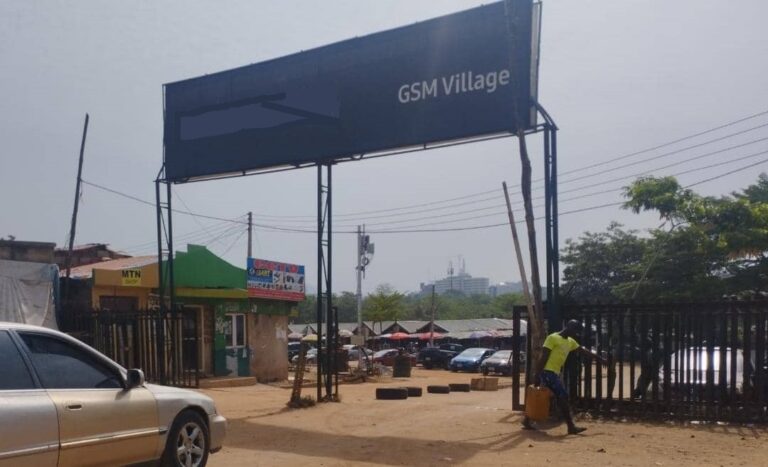
Daily, hundreds of customers troop in to the famous Abuja GSM Village in the Wuse area of Nigeria’s Federal Capital Territory (FCT), hoping to acquire new gadgets or seeking to repair a faulty device.
As early as 8.30 a.m. every day except Sundays, Chukwuemeka Okeke stands in front of his shop, rag in hand, cleaning and displaying phone accessories in a transparent show glass to attract potential buyers.
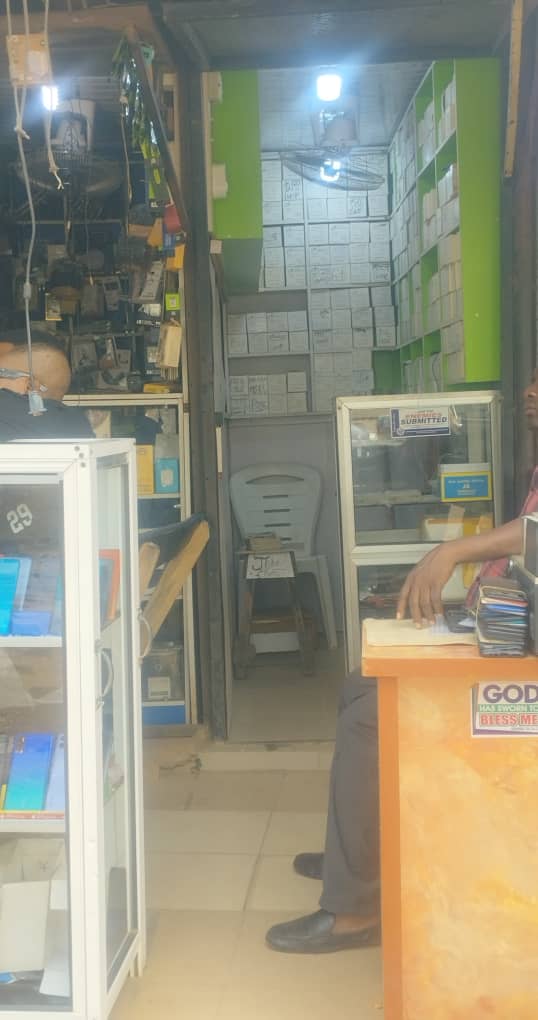
Like most others in the market, his shop is made of shipping containers used initially for importing or moving goods.
A standard shop in the market is tiny, with barely enough space for more than two people to sit in.
Although shop owners arbitrarily fix rent, which can fall around N100,000, N200,000 or more annually, traders are sometimes forced to pay for two adjoining shops and merge them to get more space.
A shop at the GSM Village market, Wuse. Photo: The ICIR/IJeoma Opara./April 2023
Like Okeke, other traders spend the mornings cleaning, shelving and calling out to passers-by whom they suspect might require their services.
He describes the market as a meeting point for both the rich and poor due to the range of customers it attracts each day.
“Whether rich or poor, everybody comes here for one thing or the other,” he said.
There is easy access to a wide variety of gadgets, used high-end phones which cost less than the new, and generally low prices of items compared to many locations in the FCT where such goods are sold, Okeke explained.
In Nigeria, 63 per cent of the population live in poverty, according to the Nigeria Bureau of Statistics (NBS), and high-end phones are a luxury to many.
Therefore, swapping and purchasing used high-end phones at affordable rates characterise the market and is a significant attraction for FCT residents.
A thriving hub for phone repair
But beyond lower prices, Okeke identifies the concentration of technicians, generally called engineers, who repair gadgets in the market as a significant reason the GSM Village thrives.
“What makes customers show up steadily is: there are many engineers here that fix devices. Other places be focused on sales, but here, we have a lot of repairers,” Okeke said.
A short distance from Okeke’s shop, one of such technicians examines a Nyne bass speaker as the owner explains the fault it has developed.
“I can fix it for you, but if it works, you will pay five thousand naira,” he tells the customer.
Although several gadgets get fixed at the GSM Village, mobile phones are the most commonly repaired items.
Phone repair includes multiple steps, as technicians specialise in various aspects of the craft and depend on each other to get their work done.
While loosening a faulty phone, a technician Sadiq Isiaka, says the process is not a one-person job.
“In this job, you cannot specialise in everything. It will seem as though you want to kill yourself,” Sadiq explains as he separates the phone’s screen from the rest of the device.
He spends several minutes picking at tiny screws with a screwdriver and replaces the calibrator, melting off unwanted leather with a rework station.
A food vendor stops in front of his shop with a plate of boiled yam and sauce. He hands her some money and continues with work.
In the shop next to his, a young man struggles to replace the faulty charging port of an Infinix phone.
Sadiq Isiaka working on a faulty phone. Photo: The ICIR/IJeoma Opara/April 2023
“There are various stages to the job. Your expertise and specialisation will determine how much you can make as an engineer,” Isiaka further explains.
Melting adhesive with a soldering iron, he glues the phone together. He sends it to another technician who, for N1,000, will ensure that the screen sticks firmly to the other part of the device, a process Isiaka describes as lamination.
A temporary arrangement
Until 2010, the GSM village was located under a bridge in the Central Business District (CBD) of Abuja.
In 2009, the then Abuja Metropolitan Management Agency (AMMA), under the Department of Development Control, announced that the GSM village would be moved from CBD to another location.
Subsequently, the market was moved to the Zone 1 area of Wuse, with about 350 shops, after a demolition exercise. However, some traders could not secure spots at the new site due to heavy losses recorded during the demolition.
While phone technicians and vendors occupy a significant part of the market, it also provides opportunities for other businesses beyond gadget sales and repairs to grow.
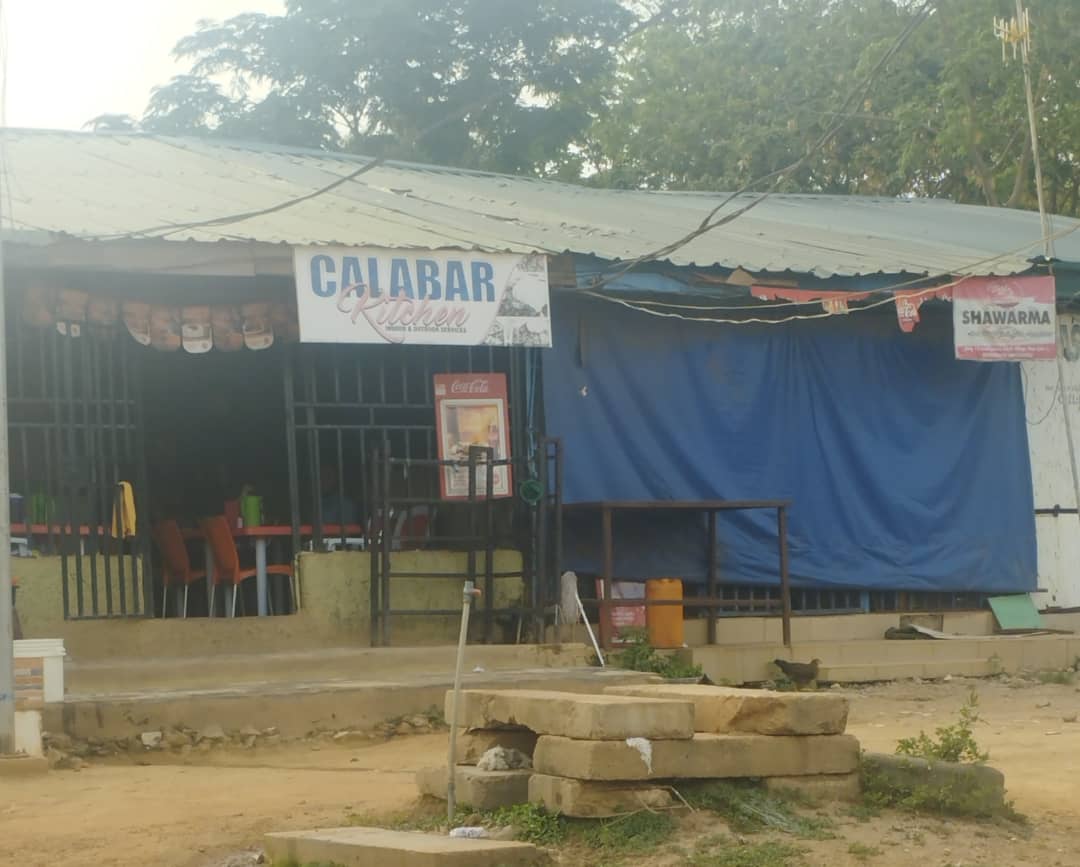
On the other side of the market lies a row of shops, where mainly food vendors are located.
Food shop at the Abuja GSM Village. Photo: The ICIR/Ijeoma Opara/April 2023
Others who transact business in the area include hawkers of various items ranging from fruits to beauty products.
The market is also littered with several point-of-sale (POS) vendors, which suggests steady financial transactions in the area.
With Nigeria’s youth unemployment rate at 42.5 per cent, more young people are turning to businesses to earn a living.
Due to rising poverty, many are unable to afford rent at the market. However, there are employment opportunities for such people, who act as middlemen between customers and business owners, taking a small percentage out of every deal successfully brokered.
Although the market has grown in the years since its relocation, traders say the new location is yet another temporary site.
Despite existing for about a decade, entrepreneurs like Gladys, who runs a POS business at the GSM village, are still sceptical about how long until the demolition vans show up again.
“You know Abuja is developing every day. Any day the government decides, they can still come and chase us out of here. If we could get a permanent place, it would be better,” she said.
However, the global dependence on mobile phones and other technological devices motivates entrepreneurs in the market.
According to data by Statista, the number of mobile cellular subscriptions in Nigeria was 204 million as of 2020, suggesting a high number of phone users in the country.
Although the percentage of smartphone users is much less, the market in Nigeria is also one of the fastest growing globally.
Based on available data, Statista predicts a strong indication of growth for the smartphone market in Nigeria, as the number of users is expected to exceed 140 million by 2025.
This implies that the phone sales and repair business is also fast growing and can contribute immensely to the country’s revenue.
Already, the Computer Village market in Lagos, a much bigger version of the Abuja GSM Village, generates at least N1 billion daily and a total of N366bn annually, with millions being paid as taxes to the state, according to Nigeria’s Ministry of Communication Technology.
Traders at the FCT GSM village say they pay regular monthly dues of N1000 per occupant to the Abuja Municipal Area Council(AMAC).
This means the GSM village, which has about 350 shops, already generates an estimated N4.2m annually for the council, a figure that might be higher, as there is often more than one occupant per shop in some cases.
The ICIR reached out to the Market Chairman, McDonald, for a definite figure, but he declined to comment.
“I am not willing to divulge any information at this time because many estate developers are trying to lobby the government, buy this place, develop and then sell it more expensive to us, even though we got here first.
“We will not allow that to happen, and based on that, I cannot give you such information,” he said.
A host of other challenges
Unlike Gladys, the Assistant Secretary of the market union, Chidozie Igwemezie, is more hopeful of a continued stay at the market.
“For now, there is no threat yet from the government. They are even considering making here a permanent place because we do not have anything like Computer Village; this is the only one we have in the FCT.
“You know times are changing now, and technology has come to stay. In a city like FCT, at least this kind of market is needed to drive the economy,” he said.
However, he noted that trading at a temporary site comes with attendant challenges, including the inability of traders to access certain infrastructure that would be beneficial to their businesses.
“We need boreholes here, because there is no water. We need adequate security, a police post, even banks. Banks will not come here since it is not a permanent place, and security is not guaranteed,” Igwemezie noted.
For vendors at the GSM Village, these issues compound the challenges associated with entrepreneurship in Nigeria, one of the most difficult places to do business globally.
Ranking 131st on the Ease of Doing Business (EDB) index out of 190 global economies rated by the World Bank in 2020, several unfavourable factors affect entrepreneurship in Nigeria.
Thus, despite the large number of customers that troop into the market daily, many vendors, including Vincent Okemefula, a technician at the GSM Village, barely manage to make enough profit to get by.
For Okemefula, the devaluation of the naira against the dollar has adverse effects on his business.
“The dollar rate affects us, because we pay for our software in dollars. If I want to unlock a phone, I have to pay in dollars for the software. One has to keep charging more money, based on the rates, so that you can get some change,” he said.
He also identified the inadequate power supply as another issue affecting business in the market.
In April 2021, the World Bank described Nigeria as the country with the least access to electricity globally, having dropped below the Democratic Republic of Congo.
Despite an estimated population of 200 million, Nigeria distributes only about 4000MWs of electricity instead of at least 200,000MWs based on global best practices.
Over 92 million Nigerians lack access to electricity, according to the Energy Progress Report, by the International Energy Agency (IEA) in 2022.
Some entrepreneurs like Okemefula rely on fuel-powered generator sets to back up electricity supply for their businesses, which spikes the cost of services.
Johnson Simon, who works as an attendant in one of the food shops at the market, also spoke on the inadequate power supply.
“Before, we were using one Mikano generator set. People were contributing money weekly. But now, the generator for our line is spoilt, so unless you buy your own generator, you have to depend on NEPA light,” he said, referring to the electricity distribution company.
He said a minimum of N3,000 is usually spent on fuel weekly, which amounts to N12,000 a month and N144,000 annually.
A 2021 report by the World Bank estimated the economic cost of power shortages in Nigeria to be $28 billion, about 2 per cent of the country’s Gross Domestic Product (GDP).
Oftentimes, getting petrol is an arduous task for entrepreneurs, as the country suffers from recurrent episodes of fuel scarcity, due to dysfunctional refineries and a heavy dependence on imported fuel, despite being one of the largest oil-producing states globally.
However, Isiaka thinks that business generally thrives in the market, and though operating a different line of the same business, Okeke shares similar sentiments with him.
After over five years spent selling phone accessories at the Zone 1 GSM Village, Okeke argues that business is good, as one could make at least N5,000 in profit from selling phone accessories on a bad market day.
But as he locks up every evening, the aluminium door of his mobile container shop is a constant reminder that the market is yet another temporary settlement.