THE Independent Corrupt Practices and Other Related Offences Commission (ICPC) has arraigned the General Manager, AGB Limited, Friday Adodo and a businessman and owner of FMateck Limited, Abdulrasheed Yusuf, for forgery.
According to a statement by the ICPC released on Friday, March 31, the two defendants were accused of forging contract documents. They were initially supposed to be arraigned on March 24 before Justice Abdul Dogo of the Federal High Court, Makurdi, Benue State.
They were arraigned on charges bordering on forging contract documents to bid for a contract at the Lower Benue River Basin Development Authority (LBRBDA) Makurdi, Benue State, contrary to section 97 of the Penal Code and Section 58(1) of the Procurement Act, 2007.
The earlier arraignment did not take place due to the absence of the second defendant, Adogo, leading the judge, Justice A. Dogo, to issue a bench warrant for his arrest for violating court proceedings.
The matter was, therefore, adjourned to March 28, 2023.
On the resumed hearing of the case on Tuesday, March 28, the defendants pleaded not guilty to the charge and were granted bail by the trial judge on stringent conditions.
However, Justice Dogo ordered that they should be remanded in the Nigeria Correctional Service (NCS) until they meet the bail conditions so they would not jump bail.
The case was adjourned to June 20, 2023 for a hearing.
In another development, a superintendent with the Nigeria Correctional Service, Eyimoga Moses, was also arraigned by the ICPC for job racketeering.
According to the ICPC counsel, Bako Alongs, Moses, who works with the Nasarawa State Command of the Service, was arraigned on a one-count charge of corruption for collecting N800,000 from a couple for two vacancy slots at the Federal University, Lafia, Nasarawa State.
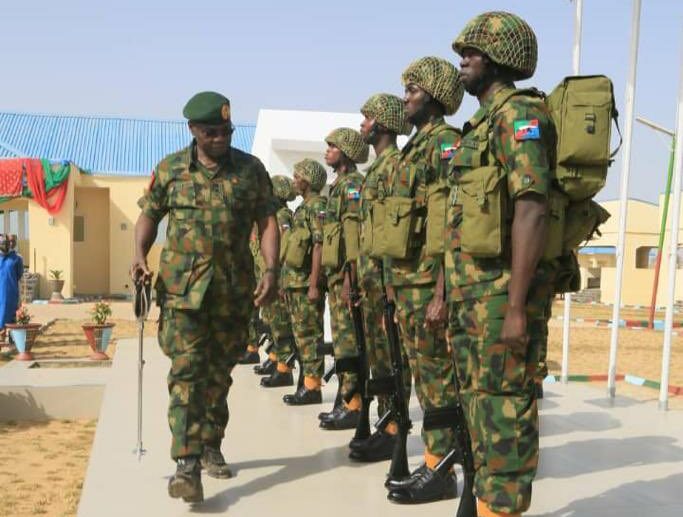
TROOPS of One Division, Nigerian Army, operating in Chikun Local Government Area, Kaduna State, have killed five bandits and recovered four AK-7 rifles in Kaduna.
The Acting Deputy Director, Army Public Relations of the Division, Musa Yahaya, disclosed this in a statement on Friday.
Yahaya said the troops operating in the local government conducted clearance operations on the Kanti-Tantatu road in the Kubusu forest and Kaso hills general area in the state.
He explained that the operation, which started on Thursday till the early hours of Friday, led to neutralizing of five bandits, as well as capturing four AK 47 rifles, six AK 47 magazines, and 24 rounds of 7.62mm.
Yahaya noted that the operation was in continuation of the onslaught against bandits and other criminal elements terrorizing the Northwestern part of the country.
“The operation was to deprive bandits and criminals freedom of action so as to create an enabling environment for economic activities and legitimate businesses to strive,” he said.
He added that the army also recovered three motorcycles, one matchet, two handsets and some charms.
THE National Broadcasting Commission (NBC) has slammed a fine of N5 million on Channels Television for breaching the broadcasting law in a programme with the Labour Party Vice Presidential candidate, Datti Baba-Ahmed.
This is contained in a letter, titled, ‘Broadcast of an Inciting Interview: A Sanction’, signed by the commission’s Director-General Balarabe Ilelah.
The letter, dated March 27, was addressed to the Chief Executive Officer of the television station, according to the News Agency of Nigeria (NAN)
Baba-Ahmed had on March 23, during an interview with Channels Television, said that the president-elect Bola Ahmed Tinubu should not be inaugurated as the president, claiming that there was no president elect.
Baba-Ahmed questioned the process through which Tinubu was elected, and alleged that his declaration violated the Nigeria constitution.
“Tinubu has not satisfied the requirement to be declared president-elect. Accordingly, there is no president-elect for Nigeria now because the declared one violated the constitution of the Federal Republic of Nigeria. I am not speaking illegally; to the contrary I am supporting the constitution.
“It’s better for the powers that be to go and create an additional six per cent out of thin air and rigged it back to Tinubu and go ahead and take the risk of swearing him in as the president that has not met the constitutional requirement,” he said.
The NBC boss, however, described the statement by Baba-Ahmed as volatile and capable of inciting public disorder, adding that it violated some sections of the broadcasting code.
It read in part, “The NBC monitored the broadcast of a live interview of the running mate of the Labour Party vice presidential candidate, Dr Datti Baba-Ahmed, by the anchor of Politics Today, Seun Okibaloye, on Wednesday, March 22.
“Dr Baba-Ahmed said it will be unconstitutional to swear in an elected president on May 29, 2023, because of election irregularities.”
“Consequently, on the following infractions, Channels Television is hereby sanctioned and shall pay a penalty of N5,000,000 (five million naira) only in the first instance,” he said.
Ilelah added that any further infraction by the television station would attract higher sanctions.
According to him, Channels TV has two weeks to pay the fine.
“You are advised to pay within two weeks from the day of receipt of this letter or the penalty will be graduated,” the letter stated.
The ICIR had also reported that the chief spokesperson of the All Progressives Congress (APC) Presidential Campaign Council (PCC) Festus Keyamo had petitioned the Department of State Services (DSS) to arrest and prosecute the Labour Party (LP) presidential and vice presidential candidates, Peter Obi and Datti Baba-Ahmed, respectively.
Keyamo accused Obi and Baba-Ahmed of making incendiary comments that were capable of causing rebellion and incitement to violence.
A Manhattan grand jury has voted to indict former President Donald Trump. The specific state charges, reports The New York Times, “remain a mystery” but will be related to the Manhattan district attorney’s investigation of Trump for making hush money payments to a porn star just before the 2016 presidential election.
It’s the first time a U.S. president or former president has been indicted.
In cases involving analogous qualifications for members of Congress, the Supreme Court has held that such qualifications form a “constitutional ceiling” – prohibiting any additional qualifications to be imposed by any means.
Thus, because the Constitution does not require that the president be free from indictment, conviction or prison, it follows that a person under indictment or in prison may run for the office and may even serve as president.
This is the prevailing legal standard that would apply to former President Trump. The fact of his indictment and potential trial is irrelevant to his qualifications for office under the Constitution.
Nevertheless, there seems no question that indictment, conviction or both – let alone a prison sentence – would significantly compromise a president’s ability to function in office. And the Constitution doesn’t provide an easy answer to the problem posed by such a compromised chief executive.
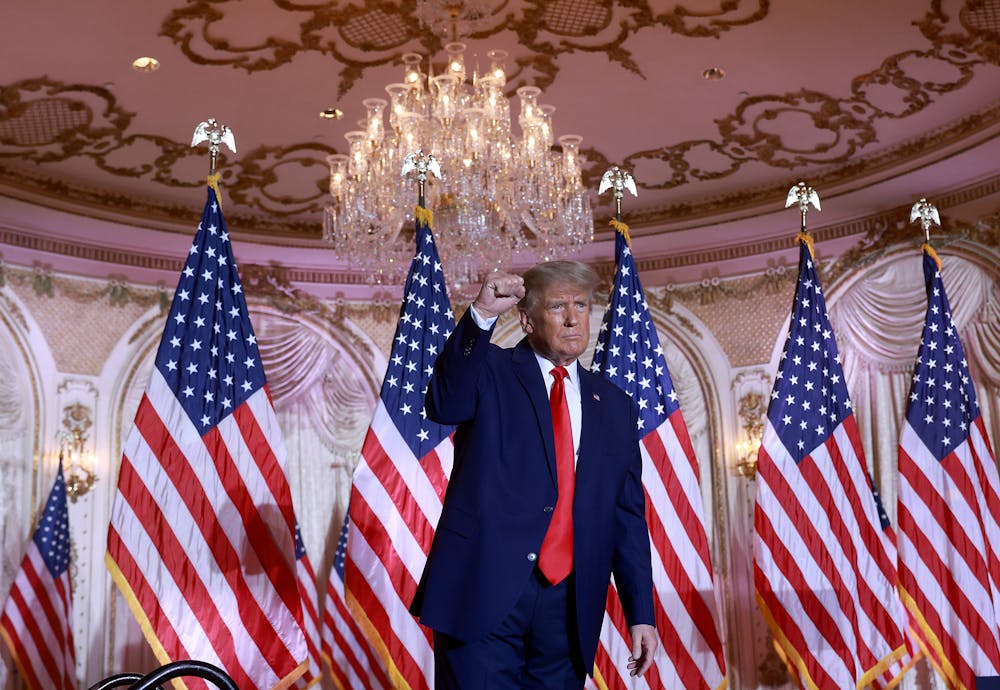
Former President Donald Trump, at a campaign event at his Mar-a-Lago home on Nov. 15, 2022, in Palm Beach, Fla., when he announced he was seeking another term in office and officially launched his 2024 presidential campaign. Joe Raedle/Getty Images
Governing from jail?
A presidential candidate could be indicted, prosecuted and convicted by either state or federal authorities. Indictment for a state crime may seem less significant than federal charges brought by the Department of Justice.
Ultimately, though, the spectacle of a criminal trial in state or federal court would have a dramatic effect on a presidential campaign and on the credibility of a president, if elected.
All defendants are presumed innocent until proved guilty. But in the case of conviction, incarceration in state or federal prison involves restrictions on liberty that would significantly compromise the president’s ability to lead.
These two memos addressed whether a sitting president could, under the Constitution, be indicted while in office. They concluded he could not.
But what about a president indicted, convicted, or both, before taking office, as could be the case for Trump?
In evaluating whether a sitting president could be indicted or imprisoned while in office, both the 1973 and 2000 memos outlined the consequences of a pending indictment for the president’s functioning in office. The earlier memo used strong words: “[t]he spectacle of an indicted President still trying to serve as Chief Executive boggles the imagination.”
Even more pointedly, the memos observe that a criminal prosecution against a sitting president could result in “physical interference with the President’s performance of his official duties that it would amount to an incapacitation.”
The memo here refers to the inconvenience of a criminal trial that would significantly detract from the president’s time commitment to his burdensome duties.
But it’s also lawyer’s language to describe a more direct impediment to the president’s ability to govern: He might be in jail.
Former New York Mayor Rudy Giuliani arriving at the Fulton County Courthouse in Atlanta, Ga., on Aug. 17, 2022, to appear before the special grand jury investigating efforts to overturn the 2020 election. AP Photo/John Bazemore
Core functions affected
According to the 1973 memo, “the President plays an unparalleled role in the execution of the laws, the conduct of foreign relations, and the defense of the Nation.”
Because these core functions require meetings, communications or consultations with the military, foreign leaders and government officials in the U.S. and abroad in ways that cannot be performed while imprisoned, constitutional law scholar Alexander Bickel remarked in 1973 that “obviously the presidency cannot be conducted from jail.”
Moreover, presidents need access to classified information and briefings. But imprisonment would also obviously compromise a president’s ability to access such information, which must often be stored and viewed in a secure room that has been protected against all manner of spying, including blocking radio waves – not something that’s likely available in a prison.
As a result of the president’s varied duties and obligations, the memos concluded that “[t]he physical confinement of the chief executive following a valid conviction would indisputably preclude the executive branch from performing its constitutionally assigned functions.”
Translation: The president couldn’t do his job.
Running from prison
Yet what to do if citizens actually elect an indicted or incarcerated president?
This is not out of the question. At least one incarcerated presidential candidate, Eugene Debs, garnered almost a million votes out of a total 26.2 million cast in the election of 1920.
One potential response is the 25th Amendment, which enables the president’s Cabinet to declare the president “unable to discharge the powers and duties of his office.”
The two Department of Justice memos note, however, that the framers of the 25th Amendment never considered or mentioned incarceration as a basis for the inability to discharge the powers and duties of the office. They write that replacing the president under the 25th Amendment would “give insufficient weight to the people’s considered choice as to whom they wish to serve as their chief executive.”
Holmes’ statement came in a letter reflecting on the Sherman Antitrust Act, which he thought was a foolish law. But Holmes was prepared to accept the popular will expressed through democracy and self-determination.
Perhaps the same reflection is apt here: If the people choose a president hobbled by criminal sanctions, that is a form of self-determination too. And one for which the Constitution has no ready solution.
THE Governor of Kano state Abdullahi Ganduje has reminded the governor-elect, Abba Kabir Yusuf, popularly known as Abba Gida-Gida, that he is still in charge.
This is coming as the governor-elect issued two public warnings within a week.
On Thursday, March 30, Yusuf issued an advisory asking people to stay off public buildings, and to avoid constructing anything on government lands, schools and other public places.
On Saturday, April 1, he also issued another warning titled, ‘Public Debt Suspension Advisory.’
In the new advisory directed at all subsisting and prospective lenders to the Kano State government, the governor-elect stated that from March 18 to May 29, no lender (domestic or international) shall approve and issue any loan facility to the Kano State government without the express consent of the incoming administration.
“Any such loan facility approved and issued to the Kano State Government between the date of election and the date of swearing-in without explicit knowledge and consent of the incoming administration will not be honoured by the new administration.
“All subsisting lenders to the Kano State Government shall take notice that all terms and conditions for all existing loan facilities shall be renegotiated by the new administration guided by the utilization audit/review of each loan facility,” the directive stated.
The two advisories were signed by the Chief Press Secretary to the governor-elect, Sanusi Bature Dawakin Tofa.
But in his reaction to the earlier warning on land and public buildings issued by Yusuf, the incumbent governor, Ganduje, asked Yusuf to desist from making official pronouncements in order to avoid confusion.
In a statement by the commissioner for Information and Internal Affairs, Malam Muhammad Garba, on behalf of Ganduje, the governor accused the governor-elect of jumping the gun.
“The action of the governor-elect amounts to jumping the gun by issuing a directive on a matter affecting government laid-down policy while the incumbent is yet to run his full term.
“Until he subscribes to the oath of office as governor on May 29, he remains what he is – a governor-elect – and does not have the powers of the governor.
“All he can do is to reverse some of the actions taken by his predecessor when he assumes office, if there is a valid reason to do so. No governor-elect has the constitutional or legal powers to determine the direction of a state until he is sworn in,” Ganduje said.
He pointed out that every government had done this, including the one the governor-elect worked under, and that the governor had immense power to distribute land parcels.
Additionally, he claimed that according to currently available records, the previous administration had allotted land in some of the public areas that the governor-elect named.
Ganduje said he still has the executive authority as governor until May 29 and reserves the right to do his duties in the public interest, even in the days leading up to his exit.
Meanwhile, some Twitter users have also reacted to the advisory issued by the governor-elect.
@DipoSpeak tweeted,
“This is very unfortunate, to say the least, you made the first announcement in the capacity of a governor-elect, not sworn in yet, and now you are making another declaration in the same capacity; I honestly hope Kano didn’t have another Obi in the making. I continue to wish you well.”
“You’re doing too much. Wait till they swear you in.”
In his reaction, a Twitter user @WOyetunde, replying to Yusuf’s tweet on the advisory, stated.
“This should be the law going forward. I also believe that if Corporate Governance was strong in Nigeria, no lending institution will lend any outgoing administration money during this handover phase in Nigeria.”
But responding to a question on the governor-elect’s power to issue an advisory, a lawyer, Abiola Kolawole, said he was not sure the advisory has any force of law.
“I have never heard such happen before, but at the same time I don’t think the issuance of advisory has any force of law,” he said.
ON February 25, Nigeria had its presidential election, a widely anticipated affair, with the lowest number of voters recorded since 2011.
It was a race between 18 candidates, but considered between four leading contenders; Bola Ahmed Tinubu, candidate of the All Progressive Congress, Atiku Abubakar, the People’s Democratic Party (PDP) candidate, Rabiu Kwankwaso, the New Nigeria People’s Party (NNPP) candidate and Peter Obi, the Labour Party candidate.
The days preceding the election were tense and filled with passion between candidates and their supporters. The election for its dynamics drew the attention of many — Nigerians within the country, Nigerians in the diaspora, and spectators.
But as popular as the election was among Nigerians, the turnout was low.
Increased registration, decreased votes
The turnout of voters for the presidential election is a new record in Nigeria’s long history of political apathy, with 93 million registered voters – the highest in any election – and 87 million collected PVCs.
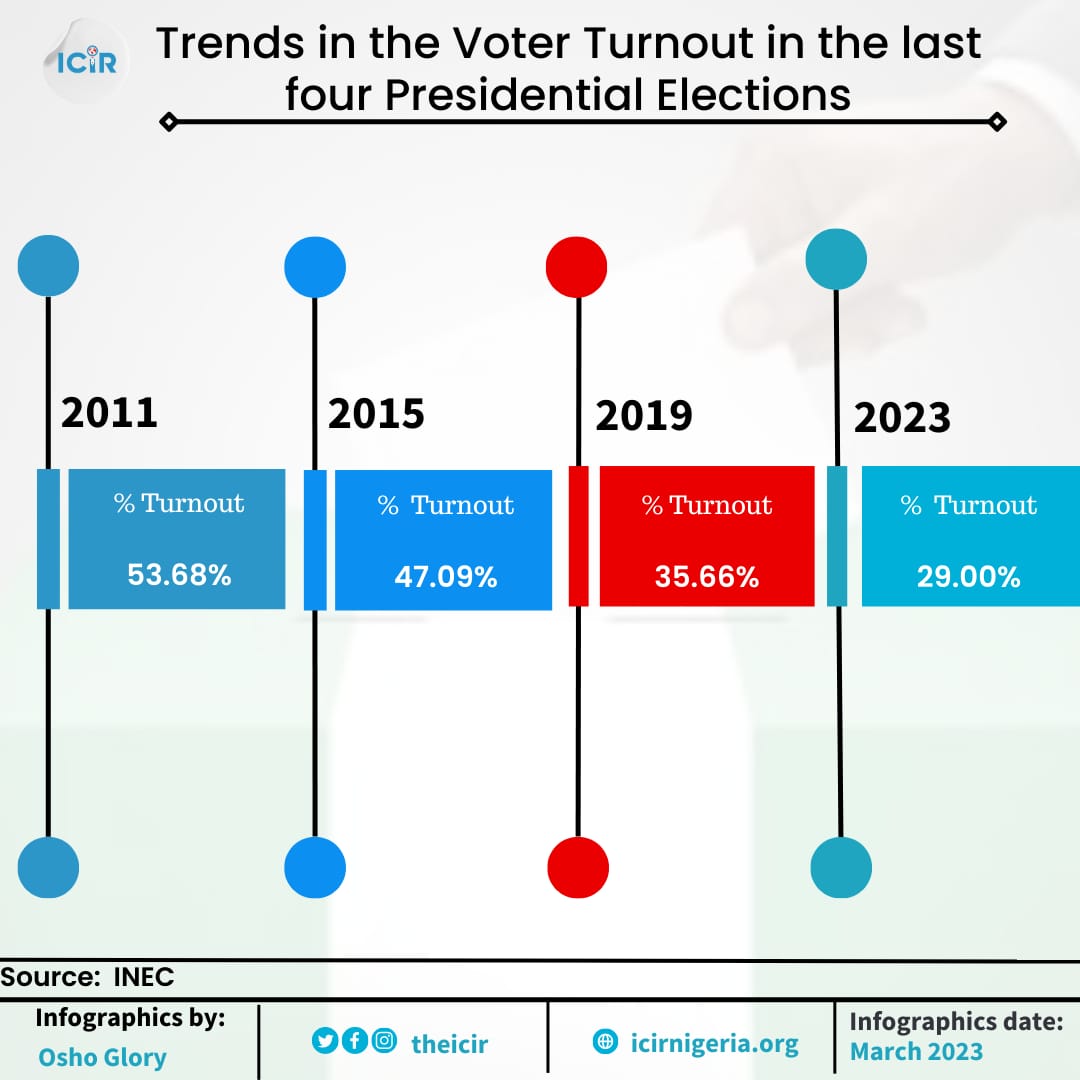
Trends in the voter turnout in the last four presidential elections
The 2023 presidential election is the 10th and has the lowest voter turnout rate in the last four election cycles.
More than 93 million Nigerians registered to vote, but only 25 million voted. This is to say, only 2.7 in every ten registered voters determined the out of the election. With a 29 per cent turnout rate, the 2023 election might also be the lowest turnout of voters in Africa.
The election in 2019 had 84 million (84,004,084) registered voters and 82 million (82344107) PVCs collected; in 2015, it was 68 million (68,833,476) and 67 million (67,422,005) PVCs collected. And in 2011, there were 73 million (73,528,040) registered voters.
Since 2011, the turnout for elections has been declining. That year, turnout for the presidential polls stood at 53.68 per cent, with 39 million votes cast. In 2015 it fell to 47.09 per cent, with 31 million votes. Then to 35.66 per cent, with 29 million voters in 2019, an ICIR analysis showed.
Turnout in geopolitical zones
Turnout for the 2023 presidential election varied across geopolitical zones.
Using the number of PVCs collected in each geopolitical zones, The ICIR analysis showed that turnout in the southeast was lowest and highest in the north-central.
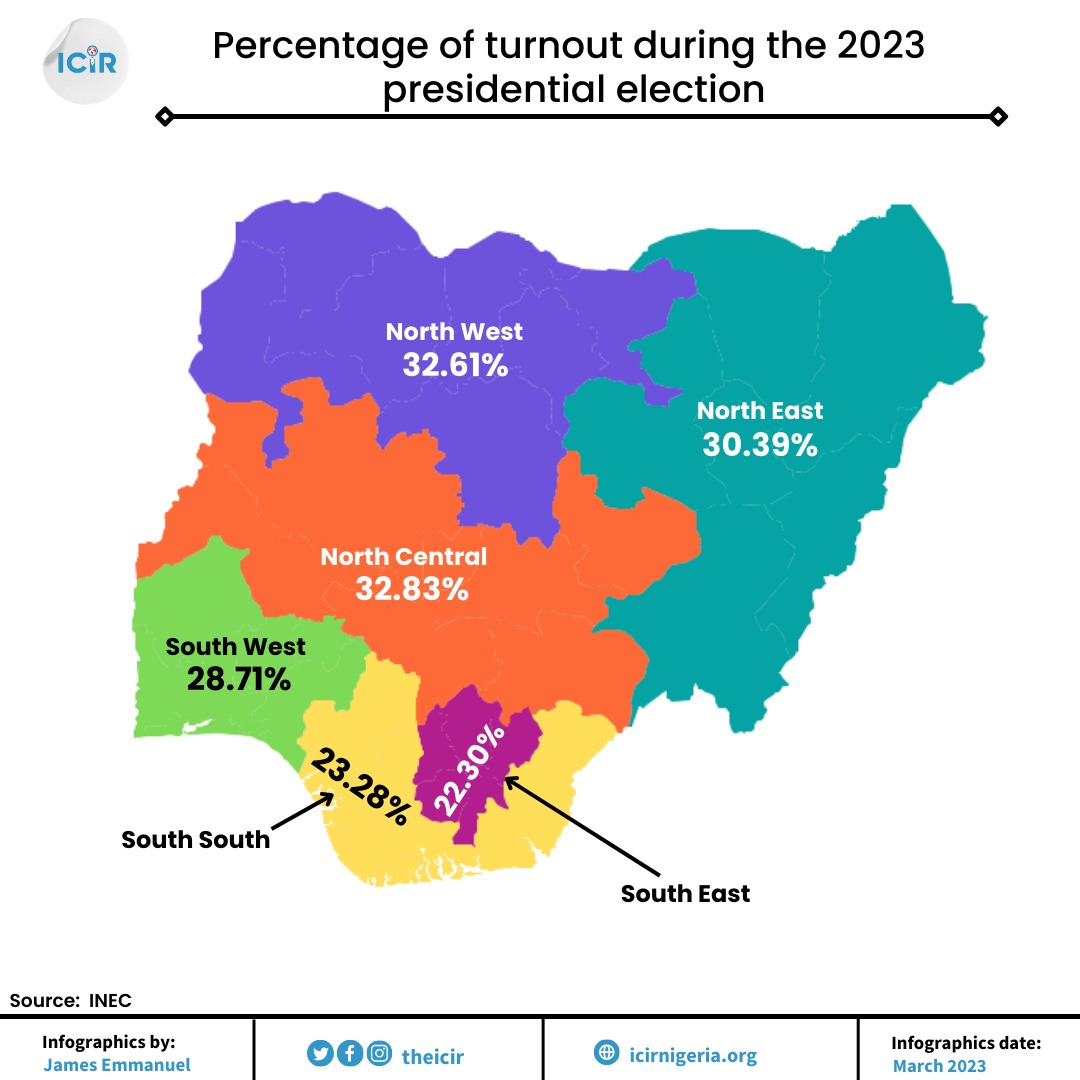
Percentage of turnout during the 2023 presidential election
Turnout in the southeast was 22.30 per cent out of 10.4m PVC collected. In the south-south, turnout was 23.28 per cent out of 13 million PVCs collected. Voters in the southwest comprised only 28.71 per cent of the 15 million PVCs collected.
The northeast had a 30.39 per cent turnout out of 11.9 million PVCs collected. The northwest turnout was 32.61 per cent out of 21.4 million PVCs collected. And in the north-central, turnout was 32.83 per cent of 14.6 million PVCs collected.
The registered voters in the southeast were 14.4 million; the south-south had 10.9m registered voters; the southwest had 17.9 million registered voters.
The northeast had 12.5 million registered voters, the northwest had 22.3 million, and the northcentral had 15.3 million.
Lowest majority
The ICIR report indicates that the total votes that secured Ahmed Tinubu’s victory as the president-elect is the lowest majority ever recorded.
The president elected in 2011, Goodluck Jonathan had 22 million majority votes; the APC candidate that emerged in 2015, ending the PDP winning streak, got 15 million votes and retained his office in 2019 with another r 15 million votes.
The majority vote in the 2023 election is 8 million.
Low turnout in governorship polls
Few weeks after the presidential election, the governorship election held on March 18, dotted with low turnouts across the 28 States.
There are several reports of empty polling units.
The ICIR reported that very few voters turned out for the governorship polls; others unenthusiastic busied themselves with their day-to-day activities.
In Borno, the election was delayed by INEC officials in ward 2, Jere local government, due to the absence of voters at the polling unit.
The case was also the same in Anambra state, where officials sat idly at polling units awaiting the arrival of voters.
Party agents at ward 10 in Onitsha North LGA begged passers-by to use the polling unit.
In some parts of Lagos, voters had not arrived at the polling units as of 8.40 a.m.
Voters in Rivers strolled scantily to polling units; the state’s total votes was only 496,852 despite having over 3.5 million registered voters.
Why low turnout of voters
Some identified reasons for the low voter turnout are violence, poor economic situation and citizens’ distrust in elections.
The Centre for Democracy and Development (CDD), a pro-democracy think-tank, said the diminishing confidence of the people in the electoral process to produce elected leaders influenced the actions of electorates.
The non-profit also said the harassment and intimidation of voters before the election created fear and disinterest.
Also, this report highlighted abnormalities and the poor behaviour of the electoral commission across states.
It identified that the voters were discouraged by the late arrival of sensitive materials and INEC officials.
“While large turnouts of voters were recorded in some parts of the country, late arrival of voting materials to polling units, malfunctioning of the BVAS devices and different degrees of rancour, among others, have disenfranchised many accredited citizens from exercising their civic rights so far.
“Also, terrorist attacks and lingering fears of insurgent attacks have affected voting processes across states in the country’s Northeastern regions coupled with the naira scarcity.”
AN Igbo leader in Lagos has threatened to invite the proscribed Indigenous People of Biafra (IPOB) to protect Igbo residents in the state.
The Eze Igbo in Ajao Estate, Fredrick Nwajagu, made the threat.
Nwajagu, in a 49-second video shared on Twitter on Friday by @DeeOneAyekooto, said the move became necessary in the wake of attacks on some Igbo people in the state.
“IPOB, we will invite them. They have no job. All of the IPOB will protect all of our shops. And we have to pay them. We have to mobilise for that. We have to do that. We must have our security so they will stop attacking us at midnight, in the morning, and in the afternoon.
“When they discover that we have our security before they come, they will know that we have our men there. I am not saying a single word to be hidden. I am not hiding my words. Let my words go viral. Igbo must get their right and get a stand in Lagos State,” he said in the video.
However, the Police Public Relations Officer in the state, SP Benjamin Hundeyin, responded to the post, noting that the Command would resist IPOB presence in the state.
“To start with, the ever-ready @LagosPoliceNG will never fold its arms and allow such within the state,” he wrote.
In the wake of the February 25 presidential election, there have been attacks on Igbo residents in some parts of Lagos State.
Also, some Igbo residents were attacked and prevented from voting during the March 18 governorhip and state assembly election in Lagos.
THE Nigerian Governors Forum (NGF) has slammed the Directorate of State Services (DSS) for causing ‘unwarranted tension’ in the country with its claim that some persons were planning to install an interim government to undermine democratic governance in the country.
In a communique issued by the NGF and signed by its chairman, Sokoto State Governor Aminu Tambuwal, after its fourth meeting on Friday, March 31, the governors charged the DSS to arrest the persons behind the alleged plot.
The governors condemned any unconstitutional means of regime change and pledged their commitment to continue to defend Nigeria’s democracy as elected leaders.
The governors said of the DSS alarm on the purported interim government: “The forum believes that issuing statements without arrests is akin to heating up the polity and causing unwarranted tension in the country.”
They called on the DSS to do its job by immediately arresting and prosecuting all those involved in the plot as a matter of urgency.
Meanwhile, the governors restated their commitment to engaging with all stakeholders and exploring all legal channels to ensure that the Federal Government releases states allocation of stamp duty monies currently in its custody to the nation’s 36 states.
The governors also congratulated their colleagues who were re-elected, as well as others who were newly elected during the governorship election conducted on May 18.
While acknowledging that the election was imperfect, they promised to deploy lessons learnt from the exercise to strengthen the nation’s democracy and electoral processes.
On implementing the National Development Plan (2021-2025), the governors nominated six governors to represent the country’s six geopolitical zones in the National Steering Committee. They are North Central – Governor of Kwara State, North East – Governor of Bauchi State, North West – Governor of Zamfara State, South-South – Governor of Edo State, South East – Governor of Anambra State, and South West – Governor of Ekiti State.
The governors also welcomed the cancellation of the proposed privatization of five National Integrated Power Projects (NIPPs) by the National Council on Privatisation (NCP) and the withdrawal of the legal suit between the 36 states and the Federal Government from the Federal High Court.
A LECTURER at Tai Solarin University of Education (TASUED), Balogun Olaniran, has been arraigned by the Independent Corrupt Practices and Other Related Offences Commission (ICPC) for allegedly soliciting sexual and monetary gratification from a female student in exchange for the alteration of her academic grades.
ICPC spokesperson, Azuka Ogugua, made this known in a statement on Friday, March 31.
She said Olaniran was brought before Justice Osinuga of the Ijebu-Ode High Court on Monday, March 27, by the ICPC on a one-count charge of violating Section 8(1) (a) of the Corrupt Practices and Other Related Offences Act, 2000.
According to a statement, Olaniran, who was the Head of the Department of Religious Studies at TASUED, demanded sexual benefits or a payment of N100,000 from a female student with a promise to alter her academic grades sometime between October and November 2021.
The charge stated that Olaniran “corruptly demanded for sexual benefit or payment of the sum of N100,000 for himself from a female student (name withheld), on account of a favour to be afterwards shown her in the discharge of his official duties as a lecturer and Head of Department of Religious Studies at the Tai Solarin University of Education”.
The defendant, Olaniran, pleaded not guilty when the charge was read to him.
The ICPC counsel informed the court of the allegations, and the matter was adjourned to May 11, 2023, for the commencement of trial.
Justice Osinuga granted the defendant bail in the sum of N500,000, with a surety in like sum. The surety must provide evidence of three years tax clearance and evidence of means.
THE Inter-Party Advisory Council (IPAC) on Friday, March 31, condemned the alleged plot to install an interim government in Nigeria.
IPAC is a body comprising the 18 registered political parties in the country.
IPAC Chairman Sabi Yabagi described the alleged plot to install an interim government as a civilian coup while addressing journalists during a press briefing after an emergency meeting in Abuja on Friday.
“Conscious of the need for reconciliation, healing, political stability, national unity, peace, cohesion and desire to preserve our hard earned democracy after the contentious 2023 general election, the Inter Party Advisory Council (IPAC) condemns in strong terms the call and plot to install an interim government in Nigeria.
“It is a civilian coup, treason, absolutely unconstitutional, undemocratic and unacceptable,” Yabagi said.
He further noted that the planned interim government was an attempt at destroying Nigeria’s democracy and causing chaos.
The Department of State Service (SSS) had, on Wednesday, March 29, alleged that it had uncovered a plot to install an interim government in the country.
Plotters of the interim government were not identified in the statement, but the agency attributed the plan to “misguided persons” with “entrenched interests”.
According to the DSS, those behind the alleged plot intend to actualise it by sponsoring endless violent mass protests in major cities to warrant a declaration of State of Emergency, and through frivolous court injunctions to forestall the inauguration of new executive administrations and legislative houses at the federal and state levels.
On Wednesday, Yabagi called on the DSS to name and apprehend those behind the plot. He reiterated this during the press briefing on Friday.
“Council demands that the country’s intelligence service should name the plotters, arrest and prosecute them in accordance with the law of the land to serve as a deterrent to others who would resort to self-help to achieve their selfish political ambitions,” he said.
He also urged the judiciary to dispense justice and uphold the rule of law.
All Progressives Congress (APC) candidate Bola Tinubu was declared winner of the February 25 presidential election but the major opposition parties, the Peoples Democratic Party (PDP) and the Labour Party (LP) have gone to court to challenge the result declared by the Independent National Electoral Commission (INEC).