
PETROL in Libya costs about ₦34.20 per litre, while the price in Nigeria stands at about ₦1,142.85 per litre, according to new data compiled by GlobalPetrolPrices.
An analysis by The ICIR shows that Libya currently has the lowest petrol price in Africa, while Malawi records the highest, selling for N4,074 per litre. The figures are based on petrol prices as of March 9, 2026.
The data shows Libya leading with ₦34.20 per litre, followed by Angola at ₦465.98, and Algeria at ₦508.73.
Others with relatively lower petrol prices include Egypt, ₦658.35; Sudan, ₦997.50; and Nigeria, ₦1,142.85 per litre.
The list also places Ethiopia at ₦1,202.70, Tunisia, ₦1,239.75; Niger, ₦1,262.55; and Liberia at ₦1,296.75 among countries with comparatively lower petrol prices on the continent.
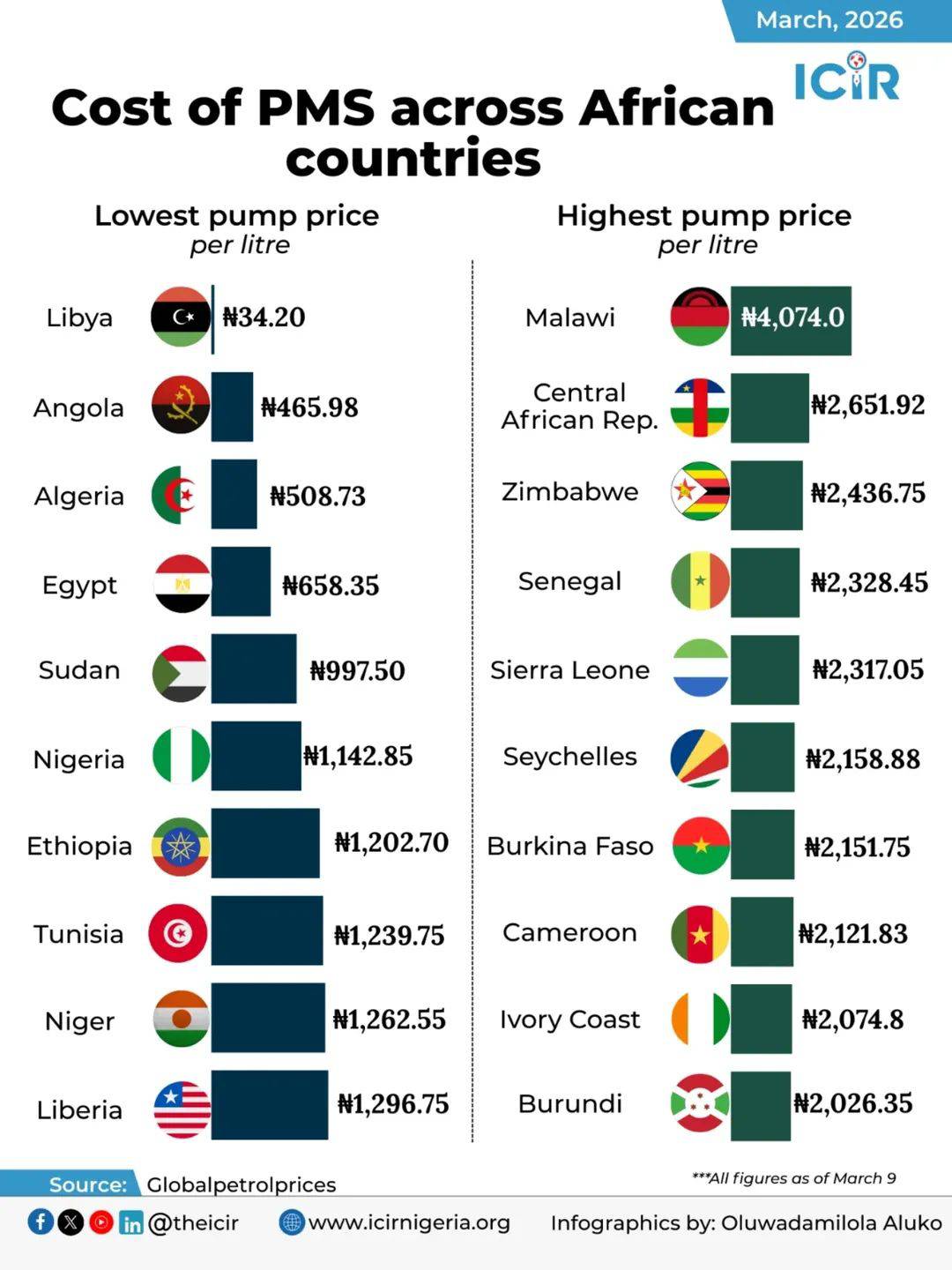
At the other end of the spectrum, Malawi has the highest petrol price in Africa, with the product costing ₦4,074 per litre.
The country is followed by the Central African Republic at ₦2,651.92, Zimbabwe, ₦2,436.75; Senegal, ₦2,328.45; and Sierra Leone, ₦2,317.05.
Others with high petrol prices include Seychelles, ₦2,158.88; Burkina Faso, ₦2,151.75; Cameroon, ₦2,121.83; Ivory Coast, ₦2,074.80; and Burundi₦, 2,026.35.
According to GlobalPetrolPrices, the average petrol price globally stood at about $1.35 per litre as of March 9, 2026, though prices vary widely across countries.
The report noted that wealthier countries generally recorded higher petrol prices due to higher taxes, while poorer nations or oil-producing countries often maintained lower prices through subsidies.
Although countries buy crude oil at similar prices on international markets, governments impose different tax regimes, subsidies, and price controls, which explains the huge differences in retail prices.
In countries with liberalised fuel markets, prices can change weekly. However, in countries where fuel prices are regulated by the government, adjustments are often made monthly or less frequently.
Iran war pushing global fuel prices higher
The comparison comes as global energy markets experience volatility following the ongoing war involving Iran, Israel and the United State, which has disrupted oil production and shipping routes across the Middle East.
The conflict has significantly affected global oil supply, particularly due to disruptions around the Strait of Hormuz, a critical maritime route through which roughly 20 per cent of the world’s oil supply normally passes.
Attacks on regional oil facilities and shipping routes have forced many tankers to halt movement through the strait, tightening global supplies and pushing crude oil prices sharply higher.
International benchmark Brent crude surged above $110 per barrel in the first week of the conflict, the highest level in more than three years, before fluctuating around $100 mark amid market volatility.
International Energy Agency warned that the disruption could become one of the most significant in the history of global oil markets if the conflict persists, potentially removing millions of barrels of oil from global supply.
“The war in the Middle East is creating the largest supply disruption in the history of the global oil market,” the IEA said in its monthly market report.
“Disruptions are not limited to upstream production and exports, with several refineries and gas processing facilities shut down due to attacks or for safety concerns.
“The closure of the Strait is also forcing export-oriented refineries to cut runs or shut completely as product storage tanks top up.”
Nigeria records sharp fuel price increase
GlobalPetrolPrices data also shows that Nigeria recorded one of the sharpest fuel price hikes since late February, with petrol rising by about 39.5 per cent and diesel by 62.5 per cent in the period following the escalation of the Iran conflict.
The latest figures highlight the continued pressure on energy markets globally and the significant variation in petrol prices across African countries despite many being oil-producing nations.
The ICIR reported that Nigerians would experience a hike in fuel prices following gantry price increase by Dangote Refinery.
The increase was occasioned by an increase in global oil prices following hostilities in the Middle East.
Both the Independent Petroleum Marketers Association of Nigeria and the Petroleum Products Retail Outlets Owners Association of Nigeria (PETROAN) had confirmed that fuel prices would go up from Tuesday, March 10.
PETROAN’s National President, Billy Gills-Harry, warned that continued volatility in crude prices would further strain consumers and businesses already grappling with economic challenges.

Mustapha Usman is an investigative journalist with the International Centre for Investigative Reporting. You can easily reach him via: musman@icirnigeria.com. He tweets @UsmanMustapha_M