
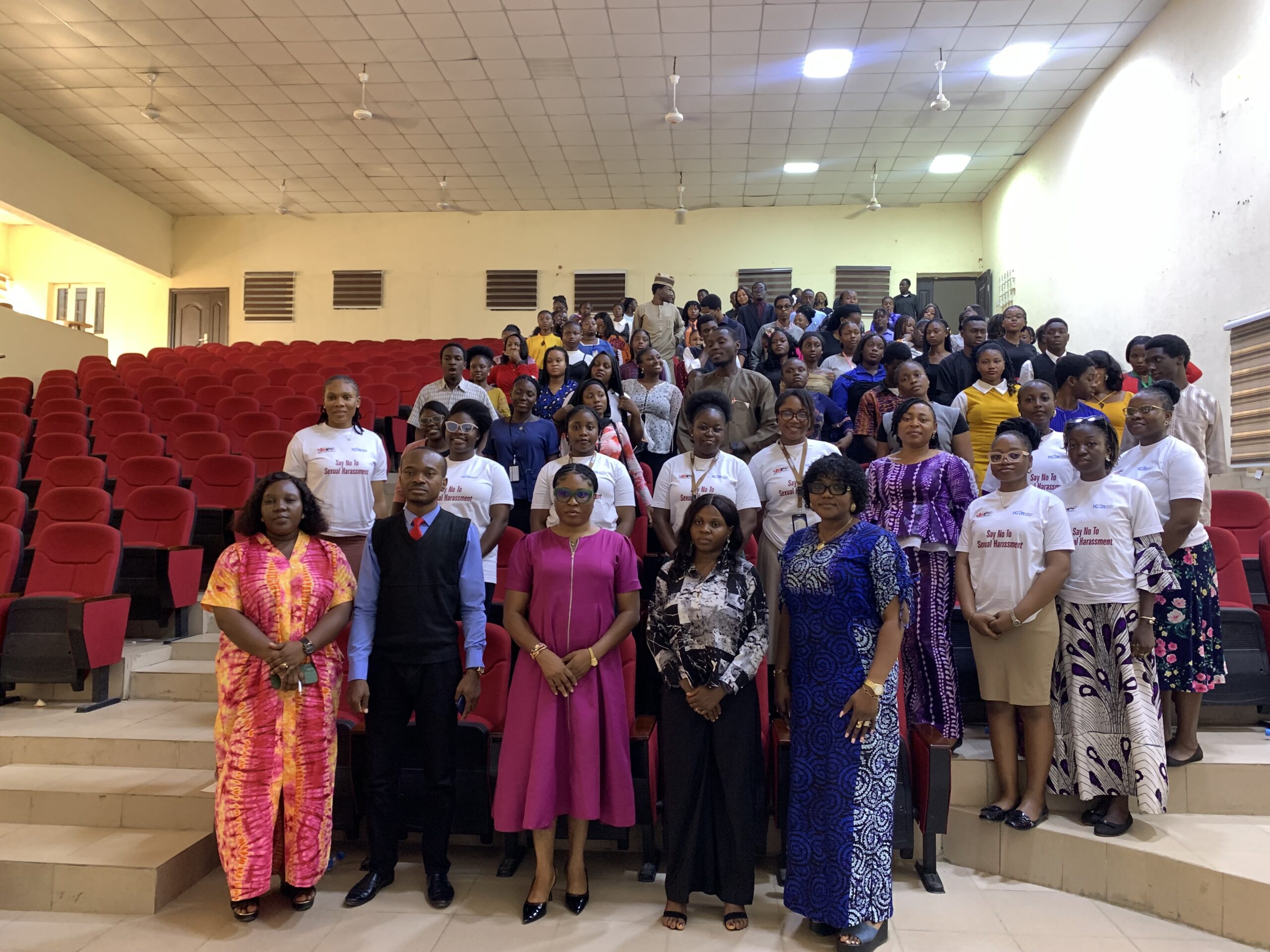
THE International Centre for Investigative Reporting (The ICIR), with support from the Development Research and Projects Centre (dRPC), on Wednesday, December 10, organised an awareness event focused on sexual harassment at Bingham University, Abuja.
The event themed, “Empowering Female Students to Challenge Sexual Harassment”, is part of ongoing efforts to curb sexual harassment on Nigerian campuses, educate students about its various forms, and the appropriate channels for reporting incidents.
It provided students with valuable insights into recognising and addressing sexual harassment. Participants learned that harassment could take many forms – verbal, physical, or even subtle actions that may seem harmless but are inappropriate.
In his welcome address, the Vice Chancellor of the university, Haruna Ayuba, a professor, represented by the Dean of the Faculty of Communication and Media Studies, Desmond Okocha, a doctorate holder, noted that universities must not mirror the negative behaviours in the society but instead serve as models of ideal conduct where harmful practices, including sexual harassment, are not tolerated.
“This training is not only meant to inform you, it is to equip you with the right tools to understand the concepts, the issues, the dynamics, the dimensions, and the strategies for pushback when confronted with sexual harassment,” Ayuba said.
He noted that the training aligned with the institution’s efforts to ensure students safety.
The Executive Director of The ICIR, Dayo Aiyetan, represented by the Senior Programmes Officer, Chukwudi Iwuoha, explained that the training was not to incite conflict between students and lecturers, but to empower students with knowledge about safety and sexual harassment.
He stressed that every student had potential and deserved a safe, supportive environment to thrive, both on campus and beyond, while encouraging them to speak up against harassment and to educate others. He emphasised that silence would embolden perpetrators.
Aiyetan further highlighted that the visit coincided with the global 16 Days of Activism Against Gender-Based Violence, noting that the campaign’s goal was to build a society where men and women coexist with mutual respect.
In her presentation, The ICIR Senior Programme Officer, Eunice Enoch, described sexual harassment as not only physical but also verbal and non-verbal, including inappropriate comments, unwanted touching, or suggestive behaviour. She listed common examples in Nigerian universities to include demands for sex in exchange for grades, offensive jokes, or displaying sexual content.
Enoch emphasised that anyone could be harassed regardless of whether they are female or male students, or even lecturers.
She also outlined the psychological, academic, social, and institutional impacts, noting that victims might struggle with fear, anxiety, poor concentration, and distrust in the university system.
“Sexual harassment doesn’t need to happen twice. Your gut is almost always right, so when something feels wrong, trust that instinct and remove yourself, because silence only puts the next person at risk,” Enoch stated.
Similarly, the Programmes Officer at Gender Mobile, Confidence Ezeala, in her presentation titled “The New Nigerian Legislative Bill on Sexual Harassment and Its Legal Implications”, explained that the 2024 Anti-Sexual Harassment Bill sets out clear definitions, penalties, and institutional responsibilities to address sexual misconduct in Nigerian higher institutions.
She highlighted that the bill reinforced existing school policies and introduced nationwide legal standards.
“The Anti-Sexual Harassment Bill is not here to replace university policies; it is here to strengthen them and hold institutions and offenders accountable. This bill gives a clear legal framework so that sexual harassment on campuses is no longer treated as a normal part of school life,” Ezeala stated.
She emphasised the fiduciary duty of educators, stating that lecturers hold authority, trust, and influence over students, making any romantic or sexual involvement a violation even when outwardly consensual. Ezeala used practical scenarios to illustrate how power imbalances could lead to coercion, manipulation, or fear of academic consequences.
“The penalties are clear. Offenders can face five to 14 years in prison, depending on the offence. There is no statute of limitation. Survivors can report at any time, and the law will still protect them,” she concluded.
A representative of the Bingham University Gender Office, Hope Cole, a doctorate holder, in her presentation on the university’s policies on sexual harassment and reporting mechanisms, said harassment could be subtle or overt and that silence often enables perpetrators, while urging students to speak up immediately when they sense inappropriate behaviour. Cole explained that “there are clear channels for reporting”, including the Gender Office, Legal Officer, and Student Disciplinary Committee, all of which handle cases confidentially and impose sanctions on both students and staff when necessary.
The official recounted several incidents to illustrate how harassment could escalate when students remain silent and how digital behaviour, such as sharing revealing photos or responding to inappropriate messages, could expose students to exploitation. She further emphasised that staff would be equally held accountable, noting that disciplinary actions, including suspension or termination, apply when staff violate the harassment policy.
Mercy Okafor and Praise Ikhayere, both campus ambassadors for the initiative, explained that many students were unaware of where to report harassment.
They said verbal, physical, or minor aggressive actions constitute sexual harassment, adding that the event helped sensitise students and increase awareness on the issue.
Oladiran Dorcas, a 400-level Nursing student, and Joshua Samuel, a 400-level Mass Communication student, remarked that they found the event very informative, explaining that they had previously thought of sexual harassment as a single concept, but the training helped them understand its various forms and how even seemingly minor actions could constitute harassment.

Fatimah Quadri is a Journalist and a Fact-checker at The ICIR. She has written news articles, fact-checks, explainers, and media literacy in an effort to combat information disorder.
She can be reached at sunmibola_q on X or fquadri@icirnigeria.org