
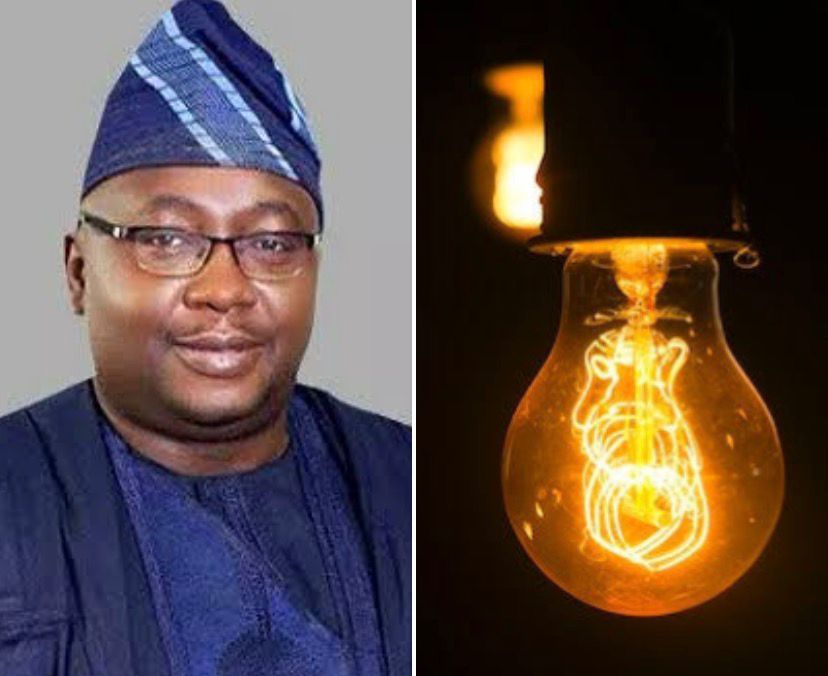
NIGERIA’S Minister of Power, Adebayo Adelabu, on Wednesday, April 22, announced his exit from President Bola Tinubu’s cabinet to pursue his governorship ambition in Oyo State.
In a resignation letter he addressed to Tinubu, the former minister informed that his resignation would take effect from April 30 to allow for a smooth transition and proper handover of responsibilities.
Adelabu’s resignation had been described in many quarters as long overdue, with Nigeria’s power sector struggling under his watch without functional policy direction.
This resulted in arguably the worst epileptic electricity supply nationwide since the country’s power supply was privatised in 2013.
With the struggles of power privatisation, the Tinubu administration signed the Electricity Act 2023, which assigned regulatory and investment responsibilities to state authorities, in partnership with the federal and private sector.
When Adelabu, an accountant, took over as Minister of Power in August 2023, he walked into a disorganised sector. Like most of his predecessors, he failed to provide policy direction that would stimulate the sector and enable it to bolster Nigeria’s industrialisation.
His era in office saw the Presidency move from grid power and migrate to solar-powered electricity, which many analysts and other Nigerians said was a testament that the grid electricity was irredeemable.
The Executive Secretary of the Association of Power Generating Companies (APGC), Joy Ogaji, who spoke on the development with The ICIR in an exclusive interview noted that the migration was viewed by the government as a cost-saving measure to curb excessive billing, adding, however, that “the implication for on-grid power is severe, as it represents a sovereign vote of no confidence in the national grid.”
Under Adelabu’s watch, many thermal generating plants were idle, gas was scarce because of massive debts to generation companies, and the grid collapse became a routine.
Despite high hopes and expectations from re-organising the sector, Adelabu’s era not only failed Nigerians but deepened the mistrust and confusion in the sector.
While unbundling the sector through the Electricity Act 2023 offered a pathway for Adelabu to enforce policy direction for states to take regulatory and investment responsibility, the former deputy governor of the Central Bank of Nigeria is leaving a sector that lacks proper direction, with many investors confused about the specific investment path to take.
Poor management of the perennial problem
Nigeria’s electricity crisis follows the same cycle year after year. From idle thermal plants that are not optimally functioning to gas shortages that affect on-grid power, and to liquidity in the sector.
Adelabu’s principal – Tinubu – had pitched his re-election on the condition that he addressed the power crisis during his first tenure.
Currently, Nigeria’s power generation plants can generate 13,625 megawatts (MW), but in early 2026, the grid dispatched only 4,901MW. That means 64 per cent of capacity sat idle.
Several times, Generating Companies (GENCOs) threatened to declare force majeure because of liquidity problems and debts owed to them, which ran into trillions.
The sector experienced liquidity problems, with the country relying so much on $750 million interventions from the World Bank and other developmental institutions to fund key projects like transmission expansion and even metering.
As Adelabu leaves the sector, investors are struggling to recover their funds from gas companies that are still being owned trillions of naira.
Despite band classification for power supply to homes and industrial clusters, homes went from 24-hour promises to having less than six hours of supply daily.
Grid collapse under Adelabu
Grid collapse was frequent under Adelabu. For instance, the national grid collapsed 10 times in 2024. It fell 16 times in 2025, with three collapses in a single week in October.
February 2026 delivered the year’s first total blackout when every DisCo went to 0MW. Even the plants the government owns run at just 20 per cent capacity.
Tasks for the new minister
Nigeria doesn’t just struggle to generate power. The recurrent grid collapse is a symptom of a bigger problem and a pointer to an uncoordinated system.
Gas suppliers cut off the plants because GenCos haven’t paid them. GenCos can’t pay because Distribution Companies (DisCos) don’t collect enough revenue. DisCos fail to collect because customers get nearly four hours of light a day and refuse to pay for darkness, and the cycle continues.
The grid keeps collapsing because it was built 50 years ago, and it is overloaded daily. Meanwhile, the debts pile higher as seen with the back and forth between the Presidency and the gas generation companies.
Every power minister since 1999 has promised 6,000MW, 10,000MW, or 15,000MW. None of them delivered. They couldn’t because the sector demands three fixes at once: cash, gas, and governance. If one is solved without the others, the system falls apart again.
Analysts said that with the Electricity Act 2023, the new minister should not recycle old promises. He has to set a clear policy direction that does one thing first: give investors confidence.
“Investors need to know they will recover their money if they fund a gas pipeline, a new plant, or a mini grid. Without that confidence, the turbines stay silent, and the grid stays dark,” a public affairs analyst, Kingsley Obiakor, said.

Harrison Edeh is a journalist with the International Centre for Investigative Reporting, always determined to drive advocacy for good governance through holding public officials and businesses accountable.