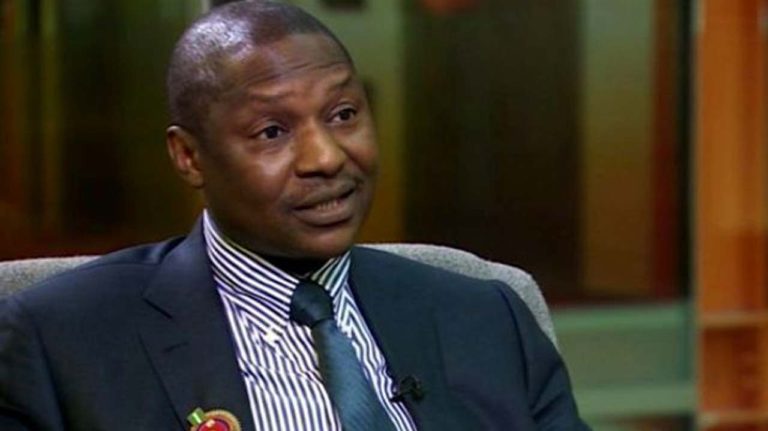
A FEDERAL High Court in Abuja has granted N500 million bail each to former Attorney-General of the Federation and Minister of Justice, Abubakar Malami (SAN) alongside his son, Abdulaziz, and one of his wives, Bashir Asabe, who are standing trial over alleged money laundering offences.
The presiding judge, Emeka Nwite, in his ruling on Wednesday, January 7, ordered that the defendants must produce two sureties with verifiable landed property located within Asokoro, Maitama, or Gwarimpa districts of Abuja.
The judge also directed that the title documents of the properties be submitted to the court and verified by the Deputy Chief Registrar, while the sureties are to depose to affidavits of means.
As part of the bail conditions, the court ordered Malami and the other defendants to deposit their international passports and other travel documents with the court. Each of the defendants was granted N500 million by the court.
They are also barred from travelling outside Nigeria without prior permission of the court.
Malami, his son, and Asabe had been remanded at the Kuje Correctional Centre following their arraignment by the Economic and Financial Crimes Commission (EFCC) on December 29, 2025, after pleading not guilty to a 16-count charge bordering on money laundering amounting to N8.7 billion.
The EFCC alleged that the defendants conspired to conceal and disguise proceeds of unlawful activities through the use of multiple corporate entities, bank accounts, and high-value real estate transactions across Abuja and other parts of the country.
According to court documents marked FHC/ABJ/CR/700/2025, the commission accused Malami and his son of using a company, Metropolitan Auto Tech Limited, to conceal over N1.01 billion between July 2022 and June 2025, while an additional N600 million allegedly passed through a Sterling Bank account linked to the same company between September 2020 and February 2021.
In another count, the EFCC alleged that Malami, his son, and Asabe, said to be an employee of Rahamaniyya Properties Limited, disguised the origin of N500 million used to purchase a luxury duplex on Amazon Street, Maitama, Abuja.
The prosecution further alleged that the defendants laundered N1.04 billion through the Union Bank account of Meethaq Hotels Limited between November 2022 and September 2024, while another N1.36 billion was allegedly controlled indirectly through the same account.
The EFCC also accused Malami of concealing N700 million allegedly used to acquire a property in Area 11, Garki, and N850 million for another property in the Jabi District of Abuja while he was serving as Attorney-General of the Federation.
Other properties listed in the charge include real estate on Amazon Street and Rhine Street in Maitama, houses in Asokoro and Gwarimpa, as well as properties in Abuja, Kano, and Birnin Kebbi.
The anti-graft agency told the court that it had traced 41 properties valued at about N212 billion to Malami and his associates, alleging that proxies and corporate fronts were used to obscure ownership.
The alleged offences, the EFCC said, contravene provisions of the Money Laundering (Prohibition) Act, 2011 (as amended) and the Money Laundering (Prevention and Prohibition) Act, 2022.
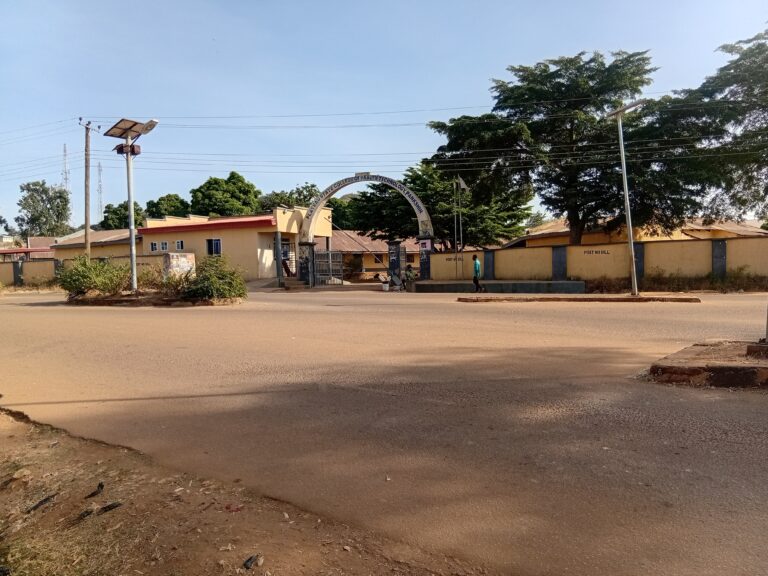
AMID several indictments by at least four separate panels against him, Yusuf Dalyop, the Head of Department of Public Health, Plateau State College of Health and Technology, Pankshin, is aspiring to be the provost of the institution. This is raising serious questions in many quarters.
Alpha Dubagari Isaac, a widower, said he promised to provide quality education for the five children his wife left behind. That was why he met with the Head of Public Health Department, Plateau State College of Health and Technology, Pankshin, Yusuf Dalyop, to discuss the possibility of his first child getting admission.
“I am an alumnus of the school, and he (Dalyop) was my lecturer. I asked him if he would assist to admit my son into Public Health department, to which he said yes. After we bought the form and did everything, my son’s name didn’t appear on the first, second, and supplementary lists. He called me in November that year and was asked why he didn’t see my son in school. I told him his name wasn’t on the list. He said I should forget the admission list, asking if didn’t know there was a supplementary list,” Isaac said.
Plateau College of Health and Technology Pankshin campus. PC: Nanji Nandang/ICIR
Isaac said he went to the school thinking Dalyop would show him his son’s name on the supplementary list but instead he asked him to pay the sum of N35,000 to his secretary. He paid in cash and was given a departmental receipt of N15,000 only. This done, he said he then went on to pay the tuition fee and other charges into the school’s account.
“He (Dalyop) told me that most of the school officials were not available at the time and that all necessary documents would be given to my son upon resumption. When my son resumed, the department still collected N15,000 from him to open his file. Throughout the first semester, my son’s class representative repeatedly informed him that his name was not on the class register, yet Dalyop continued to collect more money from him, claiming it was to settle lecturers,” he said.
Sharing the receipt of payments and all the relevant documents with The ICIR, Isaac said he spent a total of N354,400, and it was only when he applied for a deferment for his son after the first semester, and was asked to complete a deferment form and attach the candidate’s admission letter that he discovered his son was never issued an admission letter.
Plateau College of Health and Technology Pankshin campus. PC: Nanji Nandang/ICIR
“I wrote a petition to the provost; they invited me to give an oral testimony on how my son was admitted. During the process, Dalyop tried to persuade me to withdraw the case, even going as far as typing a letter and pressurising me to sign it, with the promise that once he became Provost, he would secure my son’s admission. I refused to submit the letter to the provost,” he added.
A copy of the letter of withdrawal Isaac said Dalyop drafted for him and forced him to sign. PC: Nanji Nandang/ ICIR
The college then set up a panel to investigate Isaac’s allegations against Dalyop.
The report of the investigation committee obtained by The ICIR indicates that the Chairman, Grace Hirkop and the Secretary, Istifanus Kopji Kumwar, signed and submitted its findings to the school management on October 18, 2025.
“Our findings revealed that Midah Chogkon was given a matriculation number and paid tuition fees for the 2024/2025 complete to the sum of N212,700 but had no admission letter to his name. The committee discovered that there were students who have actively been in class without admission letter and a search into the students’ files revealed that 29 students were not having the basic requirements to be admitted into the college,” the report read.
When contacted, Dalyop admitted giving Isaac the assurance that his son was offered admission. He, however, alleged that the Acting Provost of the institution instigated Isaac to write a petition against him because they were both contesting for the position of the provost.
“He was my student, a very nice student and wanted admission for his son. He bought form, and when they wanted giving him letter, the admission office said letter head paper got finished. The provost hid his file. All the files of those in 200-level students were with the provost for more than a year. Now this man came for deferment. He has paid all that needed for the deferment. When they went to the provost for the file, he told him that he should write… you know I am contesting for provost with him,” Dalyop claimed.
The College of Health and Technology is a key training institution responsible for producing frontline health workers for Plateau and neighbouring states, and it offers various accredited paramedical programmes at the certificate, National Diploma, Higher Diploma, and Professional levels.
Admission scandals and impersonation
Isaac’s experience is not in isolation. A report obtained by The ICIR revealed that six years ago at least three parents who had sought help from Dalyop to get admission for their children into the college, reported similar issues to the school management.
A committee comprised of Paul Walong Rabo, Shinplang F. Taldang, Pam Gambo, James Lohnan, and Peter Kwapzem, who submitted its findings to the school management on May 9, 2019, investigated an illegal admission scandal involving Dalyop.
The committee reported that Dalyop posed as the Head of Department of Community Health and demanded the sum of N213,000 from the parents of Ajala Elisha Karo and Dorcas Emmanuel, while making promises that were never fulfilled.
Talatu Elisha, Ajala’s mother, appeared before the committee and explained that her daughter was a student of the Department of Medical Laboratory Technician at the college but fell ill during the first semester and missed several continuous assessments, which affected her general performance and overall CGPA leading to her withdrawal.
“Al’amin confirmed to the panel that he and Ajala’s mother went to Pankshin in December 2018 to meet Dalyop who promised to assist. In January, Dalyop contacted Al’amin on phone to demand and collected N35,000.00 which, according to him, was to be given to the HOD, Medical Laboratory to facilitate Ajala’s admission processes. Not too long afterwards, another N40,000.00 was demanded and collected by Dalyop to be given to the Provost and Dean of the same school which amounted to N75,000.00 for processing Ajala’s promotion to the next class. When she finally settled down, he told her to pay for the semester fee which she did and a receipt issued to her to that effect,” the report read.
Talatu said that despite paying the amounts demanded, Ajala was not allowed to write the 200 level first semester exams except for the carry overs she had earlier written in the first two days of the commencement of the exam.
In the same report, Emmanuel Rabo, the father of another student, said his daughter, Dorcas, was a former student of Community Health, School of Health Technology, Alushi, Akwanga, Nasarawa State who had earlier withdrawn due to academic deficiency coupled with the fact that she resumed school late.
“Back then at home after withdrawal, while waiting for the next admission, his brother Al’amin Maidawa, who is an acquaintance of Dalyop approached him for assistance, seeing that he had earlier assisted Ajala with a similar withdrawal case. Dalyop having agreed to it and fortunately too, being the HOD Community Health, consequently demanded and collected the sum of N68,000.00 from Al’amin Maidawa to be given to the Provost and Dean, Community Health.
“He then invited Dorcas for an aptitude test with the sum of N12,500.00 being the cost of the exercise. She came for the aptitude test; wrote it in Dalyop’s office with him alone invigilating. Thereafter, she was told to resume lectures and along with N35,000.00 being the semester fee which she again complied with. When she had finally settled down and after a series of enquiries, she was informed that he was not HOD. It then dawned on her that she had no admission letter nor receipt for the payment made,” the report read.
The report explained that as the semester was almost rounding up and Dorcas realised that the transaction was just a hoax, she was prompted to request for the refund of her money and Dalyop told her that it was already used for the processing of her admission.
“Dalyop asked her not to be bothered about the semester exams but rather on getting indexed at the Board in Abuja. At this point Dorcas contacted Al’amin and informed him of this development. Al’amin in turn contacted Dalyop on this issue, only for him to inform Al’amin he was on his way to Abuja. At this point, they felt the need to get in touch with the College management which they eventually met with the provost to narrate their ordeals,” it added.
Impersonation
According to the report, Dalyop had demanded and collected the total sum of N115,500 for Dorcas’s admission alone, and he committed the offence of impersonation as self-imposed HOD, adding that it is a case of gross misconduct in line with the code of conduct for public servants and acting under all laws and regulations of the college code named “General Terms and Condition of Service for staff”.
“Directed that Dalyop Yusuf be suspended forthwith from the college pending the outcome of an investigative committee constituted for that purpose,” the report read.
The ICIR found out that a warning letter was issued to Dalyop on July 5, 2019 by the former Acting Registrar, Elisha Turgak Shehu, regarding the case, and that the Appointment and Promotion Committee relieved Dalyop of all responsibilities except for teaching and cautioned him never to engage in any case of indiscipline.
A copy of the warning letter issued to Dalyop by the Governing Council in 2019
“It was not admission really. The lady was schooling at ERCC Aluchi College of Health, Akwanga and then she wanted a transfer to Baptist School of Health, Kafanchan. We were neighbours with one of their relatives, that was how they were led to my house and it wasn’t even in relation to my college at all. I worked in that Kafanchan before as a Provost of that institution. So when they paid the money and the transfer failed, we now said let’s refund the money. So that was what happened. You see, all these things were just frameworks,” Dalyop said in response to the case.
He admitted that the “Governing Council of the college sat on the case and warned that such things should not happen again.
The ICIR gathered that Dalyop became the HOD of Public Health Department in 2022.
Admission sabotage
In another document obtained by The ICIR, a three-member committee submitted its findings to the school management on April 29, 2025, following an investigation into the omission of the School of Environmental Health from the admission letters issued by the Department of Public Health for the 2024/2025 academic session.
The report signed by the committee’s chairman, Josiah M. Emmanuel, alongside members; Sunday Ezekiel Ngwallang and Sogotshep Benedicta Sebastien, revealed that it asked the Deputy Registrar Admission, Grace Hirkop why the “School of Environmental Health” was omitted from the admission letters of Public Health Department 2024/2025 Academic Session.
“She responded that she was not the person that typed the admission letter. Her role was to collect the admission letters, stamp and issue out to successful candidates. She added that when she collected the admission letters, she discovered that “School of Environmental Health” was omitted from admission letters of Public Health and she went and reported to Monday Dingse Computer Operator and Secretary to the Registrar. But Dingse told her that it was a directive given to him by the HOD, Public Health Department, Dalyop, and she went to the HOD, and complained but he said that it was okay that way, adding that since the admission letters were signed by the Registrar, she then assumes that it means the HOD is right,” the report read.
School of environmental health PSCHT Pankshin. PC: Nanji Nandang/ICIR
The Committee said Dingse told them that while the admission letters were being prepared, Dalyop instructed him not to include “School of Environmental Health” on the letters, and that he complied with the directive.
After querying other staff involved in the case, the committee asked Dalyop “Were you the registrar/admission Officer? If not, why did you say that “School of Environmental Health” should be omitted from the admission letters?” and he told them that the Public Health Department ought to be on its own as far as he is concerned, noting that, no official document was handed over to him prescribing that the Public Health Department is under the School of Environmental Health.
The committee reported that Dalyop refused to give a written submission after oral interview like each one of the interviewees despite being contacted days after to make his submission.
“However, he was later served with a “LETTER OF REMINDER” to make his written submission within 24 hours of receipt, but he refused to collect the letter and that he had not seen anyone in the college who would ask him to respond to the letter. And that even the provost of the college is too small before him to respond to his query and talk less of the mere ordinary investigative team,” the report read.
The panel recommended that the management should administer any one of the disciplinary actions according to Chapter 3, Section 3, rule no. 030301 and 030305 of Public Service Rules 2008 edition on Dalyop for the act of insubordination and giving unauthorised instruction capable of breaching peace and harmony based on its findings.
“Also, Section XIV pages 9199 of the General Terms and Conditions Service for staff of Plateau State Colleges of Health Technology, Pankshin and Zawan states the punishment as: Suspension, Reduction in rank, Interdiction, Dismissal, which the Management may feel to administer to the said Officer (Dr. Yusuf Dalyop),” it added.
The Dean School of Environmental Health, Sunday Ezekiel Ngwallang, who was a member of the committee acknowledged the recommendations and suggested punishment in the report, highlighting that the school management have not taken action since they submitted the report.
“No decision has been taken based on our knowledge. Yes, the Provost received the report but no acknowledgement letter. We don’t know whether the Governing Council is in receipt of the reply,” he said.
When The ICIR contacted Dalyop on this, he denied being involved in sabotaging the admission.
“Before they appointed me as head of department. they handed over the students to me. And that was what I saw in their file, in their admission letter. Nothing like School of Environmental Health there. I wasn’t the person. Am I the registrar of the college? No. Am I the provost of the college?,” he said.
Physical assault on colleague
The ICIR obtained another report submitted to the school management in February 2025 by a five-man investigation committee chaired by Paul Wallong Rabo to investigate the allegation of physical assault on the Dean of Student Affairs, Simon Gyang by Dalyop in October 2024.
Gyang told the investigative committee that he uncovered irregular departmental charges during a routine oversight visit on October 7, 2024, and ordered the N16,000 departments charging above the approved N10,000 association fee to revert to the official rate, noting that the directive was complied with by affected heads of department, and he found out from Dalyop’s secretary, Julcit Banchir that Public Health departmental fee was N30,000.
Gyang told The ICIR that while he was attending to students in his office, Dalyop allegedly threatened that he was “a very dangerous man, and claimed to have killed, Mancha Dalyop, a former staff and he would be “next.”
“While explaining to him why I had to take those steps, he just swooped at me and punched my face using an unknown object thereby causing physical injuries on my face,” he added.
Gyang’s allegation was confirmed by this reporter in the investigation committee report, highlighting that in Dalyop’s testimony, he claimed that Gyang had always been an agent of mischief used to fight him in many fronts denting his good image, witch-hunting him, assassinating his character.
“That Simon Gyang connived with the late Mancha Dalyop and went to his former place of work to get negative information on him for their nefarious activities, but much to their chagrin, they couldn’t get the harmful weapon needed to use against him,” the document read.
The committee noted that it found out that it was in the course of enforcing the collection of N10,000.00 for the Departmental Association that the Dean Students Affairs discovered that Dalyops books were being sold at N5,000.00 each to new students in the Department of Public Health.
“After careful examination and evaluation of the facts, the defendant, Dalyop Yusuf is guilty of misconduct and has made himself liable to punishment under the relevant provisions of the law regulating the conduct of public servants,” the report added.
One of the committee members who spoke anonymously said that the Governing council have not taken any action on any of the reports submitted to them.
Dalyop in response claimed that Gyang was one of those agents recruited by the current acting Provost, Emmanuel Mahanan, to witch-hunt him as his perceived rivals in order to advance his ambition of becoming Provost of the College, and alleged that it was the reason an investigative committee was hastily constituted after management heard from one side of the matter without first giving him an opportunity to respond.
Dalyop denied physically assaulting Gyang, instead it was Gyang who shouted at him when he came to his office to address an issue the dean had with his secretary.
“Simon Gyang has even written a letter through his lawyer to the Commissioner for Education because the acting provost is still using him. I wouldn’t know that he is not qualified to be a provost. I am very much qualified,” Dalyop said.
Provost ambition
Dalyop insisted that all the allegations were made by the Acting Provost to him spoil his chances of becoming the provost of the institution.
“In fact, since I came to that college, you know, I’m the only PhD holder in that college. The people I met there, I came and even passed them at grade level qualifications and otherwise. Of course, you don’t expect them to be clapping hands for me. It’s all about jealousy, gossips, rumouring, up and down, here and there.
“One of the requirements stated, that you must be a chief lecturer for a minimum of three years. You must, they say must, be a chief lecturer for a minimum of three years. He is just one year, this December. But what of other qualifications? He has other qualifications, but in terms of publications, licensing and other things, he doesn’t have them. Then, he wants to use desperation. He wants to use witch-hunting by hook or crook,” Dalyop said.
However, the ICIR saw a letter of promotion issued to Emmanuel by the Senior Staff Appointment and Promotions Committee to the post to Principal Lecturer in October 2022.
A copy of the promotion letter issued to the current acting provost in 2022. PC: Nanji Nandang/ICIR
“I’m a community health officer. That is HND in Community Health from College of Health Zawang. Then a postgraduate diploma in Education Community Health from University College Hospital, Ibadan. Then because we don’t have a degree in community health. So there are areas by our registration board outlined for us to go and study to be relevant in the college and in the profession. Like guidance and counselling, educational psychology, public health, social works, health education and so on. I have first degree in Guidance and Counselling. Then I have master’s in educational psychology. Then PhD in Guidance and Counselling,” Dalyop said.
The ICIR reports that the institution released an advert in August last year, calling qualified candidates to apply for the position of Provost, Registrar, Bursar, and Librarian of the College.
It stipulated that qualified candidates are required to possess a master’s degree or Ph.D in a health-related discipline, must not be below the rank of a Chief Lecturer for a minimum of three years or equivalent
Publication of the call for application by PSCHT on Standard Newspaper. PC: Nanji Nandang
The ICIR gathered that Dalyop and the Acting Provost were the only contestants in the college invited by the governing council of the school in November for an interview.
This reporter obtained the credentials of Dalyop and Emmanuel. Dalyop has a first degree, Bachelor of Education, B.Ed. in Guidance and Counselling from the Federal College of Education Pankshin, an affiliated college of the university of Jos, in 2012; a master’s in educational psychology from the Nasarawa State University, in May 2019, and a Doctor of Philosophy, P.Hd., in Guidance and Counselling from Nasarawa State University in 2024.
Emmanuel has a diploma in Public health from the West Africa Health Examination Board in 1991, a first degree in Health Education from the University of Nigeria, Nsukka, in 2003, and a master’s degree in public health from the University of East London in 2014.
Management response
“All the investigative reports were submitted to the management. Management sat down when it was submitted, we deliberated on it. We have just forwarded to the council. Actually, the decision would have been taken long ago because there was no council on ground,” the Acting Provost told The ICIR when asked if the college management received the reports of the investigation submitted to the management.
The acting provost explained that the disciplinary recommendations against Dalyop were not implemented because the governing council was inactive for some time, noting that the reports have been submitted to the council some months ago.
“All these investigative reports were submitted to the management.So, when the reports were submitted to the management,actually the decision would have been taken long ago but because there was no council on ground.And looking at the magnitude of his offence, these four that you see,these are the just few ones that were selected out of the multiple petitions written against him,” he said.
Emmanuel, referencing a 2019 investigation that resulted in a warning from the governing council, clarified that he was not serving as provost at the time, as he dismissed Dalyop’s allegation that he was inciting others against him due to their contest for the provost position.
“My positionaspiring for the provost is not a do-or-die, I guess.If I get it, fine.If I don’t get it,there’s no problem.This is not the first timeI’ve contested.There was a yearI contested for this position.And I was the only personthat was qualifiedfrom the collegewith two othersfrom outside,” he added.
Meanwhile, the chairman of the Governing Council, Chris Piwuna, said “I will not confirm receiving that report” noting that “I cannot comment” on the issue involving physical assault against Gyang.
“The matter that you just raised now is either in court or about to go to the courts. So, I cannot comment on it.”
“The Governing Council is supposed to be a policy-making body. We don’t get involved in day-to-day administration of the institution. And this point you just raised, I think, is completely in the purview of the management of the institution. So, it’s not our place to meddle in such issues,” Piwuna said.
The chairman said that there are committees at the management level that handle disciplinary issues.
“If they cannot, they bring it to council. That’s how it is done. And there are cases, disciplinary issues that are supposed to terminate at the management level. The provost, the librarian, the registrar. Those are the management staff. And maybe the director of academic planning. They could invite the person to be in attendance. But the principal officers of the institution are the management staff of the institution,” he said.
Piwuna said that the government through the council will appoint a new provost based on the requirements highlighted in its advertisement, insisting he would not discuss the issue any further.
While the institution is yet to address its internal issues, parents like Isaac have not been compensated with either an admission or refund of the tuition paid, as students like his son are have been disengaged from the school for months now.
“The management promised to give my son admission since the fault was not from me but when the last admission list came out, my son’s name was not on the list. My son has been at home” Isaac said.
THE Federal Government froze the tariff payable by most Nigerian electricity consumers for the cost of power consumed in the third quarter(Q3) of 2025, with an electricity subsidy payment of N458.75 billion.
This was disclosed in the 2025 third-quarter report of the Nigerian Electricity Regulatory Commission (NERC)
The report, released on Tuesday, January 6, stated that the Federal Government cited electricity market stability as a key reason for the subsidy payment amid weak remittances from international electricity consumers under electricity bilateral agreements.
The report shows that the Nigerian Bulk Electricity Trading Plc (NBET) invoice payable by Distribution Companies (DisCos) stood at only N323.70 billion during the period, largely due to the Federal Government’s intervention.
According to the report, the subsidy arose from the continued freezing of end-use customer tariffs at the rates payable in July 2024, despite rising generation costs.
The ICIR reports that tariff payments are enforced by DisCos, which factor in exchange rate differentials to ensure cost recovery and attract investors in the electricity sector.
The Federal Government has also initiated an electricity Band classification for consumers, which seeks to encourage higher payment for those who have a higher number of hours per day of electricity, while those with fewer hours pay less. This model appears not to have worked efficiently, as it’s riddled with complaints of inefficiency and no delivery of the prescribed hours allotted to consumers.
The NERC report noted that without the government’s support, total generation costs for the quarter would have been about N782.45 billion.
It stated that DisCos showed marginal improvements in billing and collection efficiencies but recorded revenue shortfalls due to poor remittance from international bilateral customers.
According to the report, during the period under review, the naira value of total energy offtake by all DisCos was N854.53 billion.
It stated that the total energy billed amounted to N706.61 billion during the period, which translated to a billing efficiency of 82.69 per cent.
This represented an improvement of 1.08 percentage points over the 81.61 per cent recorded in the second quarter of 2025.
DisCos recorded cumulative billing losses of N147.92 billion within the period.
Total revenue collected by DisCos stood at N570.25 billion out of N706.61 billion billed during the period.
This feat resulted in a collection efficiency of 80.70 per cent, up by 4.63 percentage points from 76.07 per cent in the previous quarter.
Despite these gains, the weighted average Aggregate Technical, Commercial and Collection (ATC&C) loss across all DisCos remained high at 33.27 per cent.
This comprised technical and commercial losses of 17.31 per cent and collection losses of 19.30 per cent.
The figure exceeded the 2025 Multi-Year Tariff Order (MYTO) target of 20.54 per cent by 12.73 percentage points and translated to a cumulative revenue loss of N108.75 billion.
However, NERC observed a 4.65 percentage point improvement from the 37.92 per cent recorded in 2025 second quarter.
It added that only Eko and Ikeja DisCos met their ATC&C targets during the quarter, while Kaduna DisCo recorded the worst underperformance.
This posted an actual ATC&C loss of 71.10 per cent against a target of 21.32 per cent.
On market remittances, DisCos were billed a cumulative upstream invoice of N400.48 billion in the 2025 third quarter, comprising N323.70 billion for NBET and N76.77 billion for transmission and administrative services payable to the Market Operator (MO).
Out of this amount, DisCos remitted N381.29 billion, leaving an outstanding balance of N19.18 billion and a remittance performance of 95.21 per cent, slightly below the 95.65 per cent recorded in the previous quarter.
However, during the period, international bilateral customers paid only $7.125 million out of the $18.69 million invoiced by the MO for services rendered in the quarter, representing a remittance rate of 38.09 per cent.
In contrast, domestic bilateral customers paid N3.19 billion out of N3.64 billion invoiced, achieving a stronger remittance rate of 87.61 per cent.
Electricity analyst who heads the Electricity Consumer Protection Advocacy Centre, Princewill Okorie, expressed worry that the government still pays a huge amount of subsidy despite the privatisation of Nigeria’s power sector.
He noted that the subsidy payment had yet to reflect on the market efficiency.
“Subsidy payment is growing, and market efficiency is not top-notch despite privatisation. The regulator must continue to look into the activities of distribution companies to ensure transparency and accountability in their metering and billing processes,” Okorie said.
TWO women have been found dead in separate locations in the Federal Capital Territory (FCT) in incidents suspected to be linked to the activities of notorious “one chance” criminal gangs operating within Nigeria’s capital.
One of the victims, Chinemerem Pascalina Chuwumeziem, was a nurse with the Federal Medical Centre (FMC), Jabi, whose killing subsequently drew condemnation from the National Association of Nigerian Nurses and Midwives (NANNM), FCT Council.
The second victim, identified as Princess Ochigbo, was said to be found lying lifeless by the roadside, with indications suggesting she might also have fallen victim to “one chance” hoodlums.
Nurse murdered after boarding vehicle back home
In a statement by the chairman of NANNM, FCT Council Jama Medan, the association said Chuwumeziem closed from afternoon duty on January 3, and boarded a vehicle on her way home but never arrived alive.
The statement noted that her body was later discovered to have been dumped, in what the association described as a “most inhumane and heartbreaking manner.”
The NANNM described the killing as not only an attack on the nursing profession but “an assault on healthcare workers and humanity at large,” calling on security agencies in the FCT to immediately investigate the circumstances surrounding her death.
Second victim found by roadside
According to an X post, Princess Ochigbo was found dead by the roadside at a different location in Abuja on the same day, with documents recovered suggesting she might have been a staff member of the FCT High Court.
The handler, who provided the update with image of the deceased woman and her ID, noted that her bag was discovered, flung a short distance away from her body, a pattern consistent with previous one chance attacks, where victims are robbed, assaulted, and most times thrown out of moving vehicles.
Efforts to reach the FCT Police Command for updates on the two incidents proved abortive, as SMS and Whatsapp messages sent to its spokesperson, Josephine Adeh, were not responded to as of press time.
One chance killings persist despite past interventions
The incidents have renewed concerns about the persistence of one chance operations in Abuja, despite repeated assurances by authorities that the crime would be contained.
The ICIR has reported extensively on the menace, documenting cases where residents were robbed, stabbed, thrown out of moving vehicles, or left critically injured by criminals posing as commercial drivers.
In one documented case, a resident sustained over 30 stab wounds after boarding a vehicle at Area 8, Garki, while others have lost large sums of money and other valuables.
Although the FCT Police Command established an Anti-One Chance Squad in 2018, attacks have continued, raising questions about enforcement, surveillance, and accountability.
Transport system failures fuel insecurity
The ICIRreported that one-chance robberies remain a persistent menace in Abuja, with criminals posing as commercial drivers to lure, rob, and sometimes kill unsuspecting passengers.
They drive around with dangerous weapons, including guns, axe, cutlasses and knives, which they use to compel their victims to submission.
Security experts and transport analysts said the menace is worsened by the failure of organised public transportation in the FCT, which forces residents to rely on unregistered taxis and private vehicles.
In a 2022 investigation, The ICIRreported that an insufficient number of commercial vehicles, coupled with the near-collapse of the Abuja Urban Mass Transport Company Limited (AUMTCO), left commuters vulnerable to criminals.
Out of over 500 buses once commissioned under AUMTCO, only about 150 were functional, leaving thousands of residents stranded daily and exposed to risky transport options, especially during early mornings and late nights.
The report further showed how criminal gangs have exploited this vacuum, patrolling major routes in private vehicles and posing as transporters to lure unsuspecting passengers.
Nurses demand protection, organised transport
Reacting to Chuwumeziem’s killing, NANNM chairman said the incident highlighted the growing insecurity faced by healthcare workers while commuting.
“The continuous harassment and attacks on nurses have further exposed the alarming level of insecurity faced daily by healthcare workers, particularly while commuting to and from duty. Our lives are no longer safe. Nurses leave their homes daily to save lives, yet many are uncertain of returning alive to their families,” the association said.
The union called on the FCT Minister, Nyesom Wike, to urgently strengthen security around hospitals and major junctions, and to provide safe and organised transportation for nurses, particularly those on early-morning and late-night shifts.
The NANNM also demanded a thorough and transparent investigation by the Nigeria Police Force, Department of State Services (DSS), and Nigeria Security and Civil Defence Corps (NSCDC), insisting that anything short of decisive action would further endanger lives and erode public confidence in the security system.
A persistent fear in Nigerian politics is the emergence of a single-party system or a sole presidential candidate. Despite recurring anxieties, this outcome has never materialised. While recent party defections may suggest an invincible ruling party, Nigeria’s political history is defined by unexpected twists. Shattered dreams and surprise elements are inherent in our national life.
The surprise element is unavoidable. Unexpected events are an inescapable part of life and strategy. To illustrate this, I will cite three historical examples relating to three former leaders: Shehu Shagari (25 February 1925 – 28 December 2018), Ibrahim Badamasi Babangida (84), and Sani Abacha (20 September 1943 – 8 June 1998).
The 1979 elections and the myth of dominance
After the July 7, 1979 elections, in which Shehu Shagari was declared President, the composition of the Senate was as follows
National Party of Nigeria (NPN): 36 seats
Unity Party of Nigeria (UPN): 28 seats
Nigerian People’s Party (NPP): 16 seats
Great Nigerian People’s Party (GNPP): 8 seats
People’s Redemption Party (PRP): 7 seats
NPN Senators (1979)
Those elected on the platform of the NPN included A.D. Rufai, Ibrahim Dimis, Ibrahim Jalo Waziri, Abdulkadir Yelwaji Saleh, Uba Ahmed, D.D. Dafinone, Andrew Abogede, J.S. Tarka, Suemo Chia, B. Ameh Ebute, Ahmadu Ali, Girigiri Lawan, Victor Akan, Donald Etiebet, Joseph Wayas, Iliya Audu, Abba Ali, Jacob Madawaki, Yusuf Ali, Isa Abonyi Obaro, Aliyu Mohamadu Gani, Abubakar Olusola Saraki, Abubakar Magaji, Jibrin Salihu, Ibrahim Kolo, Abdullahi Mangu, Garba Dada Paiko, O. Eberewariye, C.N. Nunieh, Amatari Zuofa, Atto Bugundu, Haruna Muza, Garuba Gada, Hassan Zuru, and Garba Kware.
UPN Senators (1979)
Those elected under the UPN included John Umolu, Emmanuel O. Akpata, Franklin O. Atake, Gayus Gilama, Justus Olu Olabode, Sikiru Shitta-Bey, Femi Ayantuga, Mudasiru A.O. Abiru, Abayomi Durosinmi, Adeyiga Ajayi, Ladega Daniel Adetola, Oyero Kunle, S.O. Sogbein, Jonathan Akinremi Odebiyi, Abraham Aderibigbe Adesanya, Emmanuel Kayode Ogunleye, Michael Onukun, David O. Oke, Ayo Fasanmi, Banji Akintoye, Ayoola Adeleke, Christopher Ilori, Ademola Adegoke, Christopher Adeoye, Olalere Adesina.
On a personal note, Ayoola Adeleke from Ede was the father of the current Osun State Governor, Ademola Adeleke. He was the Vice Chairman of then Senate Committee on Labour. I will not forget his regular supply of bitter kola to me during his Senate years.
NPP, GNPP, and PRP senators
NPP Senators: Onyeabo Obi, Offia Nwali, B. C. Okwu, N. Nathaniel Anah, Isaiah N. Ani, Bardi Joe, Emeka P. Echeruo, Elijah E. Emezie, Jaja Nwachukwu, Tony Anyanwu, Simeon Ojukwu, Garba Matta, John Wash Pam, George Hookwap, Francis Ella, Obi Wali.
GNPP Senators: Idrisa Kadi, Bukar Sanda, Jafaru Manga, Umaru Lawan Bama, George Daniel, Joseph Ansa, Luka Zanyazing, Bitrus B. Kajal, Mahmud Waziri.
PRP Senators: Ibrahim Barau, Adamu Gaya, Ahmed Zakari, Hamisu Musa, Usman A. Dambata, Sabo B. Zuwo.
Governorship and House of Representatives results
In the 1979 gubernatorial elections, the following were elected on the platform of NPN. They were Tatari Ali (Bauchi), Shehu Kangiwa (Sokoto), Melford Okilo (Rivers), Anwal Ibrahim (Niger), Adamu Attah (Kwara), Clement Isong (Cross River), and Aper Aku (Benue).
As for the UPN, the following were elected as governors: Bisi Onabanjo (Ogun), Bola Ige (Oyo), Ambrose Alli (Bendel), Adekunle Ajasin (Ondo), and Lateef Jakande (Lagos).
For the NPP, there were three governors: Jim Nwobodo (Anambra), Solomon Lar (Plateau), and Sam Mbakwe (Imo).
For the GNPP, there were two governors: Abubakar Barde (Gongola) and Mohammed Goni (Borno).
For the PRP, there were two governors: Balarabe Musa (Kaduna) and Abubakar Rimi (Kano).
In the House of Representatives:
NPN: 168 seats
UPN: 111 seats
NPP: 79 seats
PRP: 47 seats
GNPP: 44 seats
Among those elected was Sule Lamido (PRP), who represented Barnin Kudu in the then Kano state. On July 30, 1993, as National Secretary of SDP, he was one of those who signed the tripartite Committee document that created the Interim National Government.
Almost forty-six years later, he among others, is still around. Also still around is Tajudeen Olusi (89) UPN, who represented Lagos South in the House of Representatives. He is at present Chairman, Governance Advisory Council in Lagos state. Also still around is my friend, Peter Olayemi Obaoye, who represented Irepodun Constituency in Kwara State.
The 1983 shift and the rise of one-party fears
However, the game changed after the Presidential and Senatorial elections of August 20, 1983. The NPN increased its Senatorial seats to 60, thereby gaining 24 more seats, while the UPN reduced its own to 16, thereby losing 12 seats and the NPP lost 4 seats thereby reducing its seats to 12. As for the PRP, it lost 2 seats thereby reducing its seats to only 5 and the GNPP lost 6 senatorial seats.
In the House of Representatives election, the NPN gained 138 more seats thereby increasing its strength to 306, the UPN lost 60 seats thereby losing to only 51 seats while the NPP lost 30 seats reducing its strength to 48. As for the PRP, it lost 8 seats and reduced its strength to 41 while the GNPP lost all its 43 seats and had no seat at all.
In the gubernatorial election, the following were elected. As for UPN, Lagos state, Lateef Kayode Jakande, Kwara State, Cornelius Olatunji Adebayo, Ogun state, Bisi Onabanjo and Ondo state, Michael Adekunle Ajasin.
Cornelius Adebayo, born February 24, 1941 died recently and was buried at Oke Onigbin in his hometown of Kwara State. He was a gentle man. I knew him in 1979 during his senate years and our friendship lasted till he died. I visited him last at his residence at Mabushi in Abuja. His death pained me. He became lonely after the death of his wife, Elizabeth Funmilayo Ibiwoye.
As for the NPN, the following were elected: Bamanga Tukur (Gongola), Tatari Alli (Bauchi), Aper Aku (Benue), Lawal Kaita (Kaduna), Christian Onoh (Anambra), Omololu Olunloyo (Oyo State), Melford Okilo (Rivers), Garuba Nadama (Sokoto), Muhammed Anwal Ibrahim (Niger), Donald Duke Etiebet (Cross River State), Samuel Ogbemudia (Bendel State), and Asheik Jarma (Borno State).
Under the PRP, Sabo Barkin Zuwo was elected in Kano State, while Samuel Mbakwe was elected in Imo State. Solomon Lar was elected on the NPP platform in Plateau State.
Thereafter, speculations became rife that Nigeria was heading for a one-party state. There were celebrations in the NPN camp. I remember visiting the house of Umaru Dikko, the then Minister of Transport, in Ikoyi, Lagos, along with my friend, Usman Muktar of the NTA. Dikko boasted at the time that very soon, “the NPN will swallow all other parties.”
Then came the morning of December 31, 1983, when the announcement by Sani Abacha (20 September 1943 – 8 June 1998) on that day terminated the attempt to establish a single-party system in the country. The military took over, and Muhammadu Buhari (17 December 1942 – 13 July 2025) never had a political programme until he was overthrown by Ibrahim Babangida (84) in August 1985.
The two-party experiment
Following the submission of the political bureau made up of S.J. Cookey, E. O. Awa, A. D. Yahaya, Haroun Adamu, Ibrahim Halilu, Pascal Bafyau, Oye Oyediran, Tunde Adeniran, Sam E. Oyovbaire, Bala Takaya, O.E. Uya, Sani Zaharadden, Hilda Adefarasin, R. Abdullahi, Ola Balogun, Edin Madunagu, and Abdullahi Augie, Ibrahim Badamosi Babangida, on October 7, 1989, decreed two political parties for the country.
They were the:
a. Social Democratic Party (SDP)
b. and the National Republican Convention (NRC).
In an address to the nation, Ibrahim Babangida announced that the AFRC had accepted the principles of a grassroots democratic two-party system. He declared:
“It is our belief that the system shall: (a) provide a grassroots basis for the emergence of political parties; (b) establish a grassroots or mass platform for the emergence of new leadership; (c) give equal rights and opportunities to all Nigerians to participate in the political process irrespective of their wealth, religion, geo-political backgrounds, and professional endeavours; (d) de-emphasise the role of money in politics; (e) reduce, to a minimum level, the element of violence in our electoral process; (f) preclude the emergence of political alliances along the same lines as in the First Republic and, therefore, give Nigerians a new political structure within which to operate; (g) ensure the emergence of a new, more dedicated and more genuine leadership cadre, which will not be a mere proxy for old political warlords; (h) chart a new pattern of political recruitment and participation which will enhance Nigeria’s stability; (i) establish strong institutional structures which not only sustain future governments, but also are strong enough to stand the test of time; and (j) establish a political system that will be operated according to the spirit and letter of the Constitution of the Federal Republic.”
In his speech to the nation, Ibrahim Babangida further declared that: “the two political parties shall be funded by the Federal Military Government. No financial contributions by any individuals or groups to party treasury shall be permitted at this stage.
NEC shall clearly specify the mechanism for fundraising by political parties at a later stage in the transition programme. Our decision to build political offices can now settle down to these buildings and conduct their respective business. They will be spared the ‘hostage politics’ of the past whereby people loaned out premises to a political party and used that fact to access influence and patronage.
All accounts of each party shall be audited before and after the first elections by external auditors appointed by NEC … at local, state, and national levels of the two political parties. The AFRC strongly believes that our financial contribution to the parties at this stage is a vital investment in the future political stability of our nation.
Party conventions shall be held after the registration exercise. Such conventions shall be held at the ward, local government, state, and finally, at the national levels in that order. The conventions shall
(a) elect officers of the party at relevant levels;
(b) discuss and suggest to NEC for onward transmission to the AFRC any amendments to the draft constitutions and manifestos;
(c) establish modalities for fundraising within the NEC guidelines on fiscal contributions to political parties; and
(d) establish strategies for campaigns within NEC guidelines.”
In his address at the Armed Forces dinner of 1990, Ibrahim Babangida said that “our political target is to ensure that we disengage in 1992, by which time we would have, at least, established the groundwork for a successful take-off of a new political order that will provide justice, equality, and social upliftment for the generality of Nigerians. The political system we are trying to create is one that has been worked in Nigeria by Nigerians for Nigerians.”
Termination of two-party system
The same Ibrahim Babangida terminated the presidential election of June 12, 1993. The annulment put an end to the experiment of having a two-party system in Nigeria. The setting up of the Interim National Government in 1993 finally nailed the coffin on the two-party structure.
If you invite ten Nigerians to a social event, the possibility is that all ten will wear different kinds of dresses. That sums up who we really are. Nigerians are people with different backgrounds, interests, and contradictions, and this extends to the political system.
1993 palace coup
Sani Abacha seized power in a palace coup in November 1993. Under Abacha, the main decision-making organ was exclusively the military Provisional Ruling Council, which ruled by decree. The 32-member Federal Executive Council was composed of military officers and civilians. Pending the promulgation of the constitution written by the Constitution Conference in 1995 and subsequently approved by the Head of State, the government observed some provisions of the 1979 and 1989 Constitutions. The decree suspending the 1979 Constitution was not repealed, and the 1989 Constitution was not implemented. In 1995, Abacha announced a transition timetable designed to return the country to a democratically elected civilian government by October 1, 1998.
The government continued to enforce its arbitrary authority through the Federal Security System—the military, the state security service, and the national police—and through decrees blocking action by the opposition in the courts. All branches of the security forces committed serious human rights abuses.
Throughout his tenure, Abacha’s government relied regularly on arbitrary detention and harassment to silence critics. The winner of the annulled 1993 presidential election, Moshood Kashimawo Abiola, remained in detention on charges of treason, and unidentified persons murdered Abiola’s wife, Kudirat, under mysterious circumstances.
In September 1996, 39 people were reported dead in the northern cities of Kaduna and Zaria after police attempted to break up demonstrations protesting the detention of Ibrahim Al-Zakzaky.
Joseph Kporok, a 30-year-old Movement for the Survival of the Ogoni People (MOSOP) activist, was arrested after a dispute with his mother-in-law over land. Once in custody at the Rivers State internal security task force headquarters, he was interrogated about his MOSOP affiliation and beaten. He was then transferred to state police headquarters in Port Harcourt, where he died. Kenneth Nwokoye, aged 26, was beaten to death by uniformed officers who arrested him after raiding his house.
Suliat Adedeji, an outspoken politician and businesswoman, was beaten and shot by armed men who invaded her home in Ibadan. Despite demands for ransom, nothing was taken. Alex Ibru, publisher of The Guardian, was shot and permanently injured by gunmen.
The 1979 Constitution and the 1989 Constitution prohibit torture and mistreatment of prisoners and provide criminal sanctions for such excesses. The Evidence Act of 1960 prohibits the introduction of evidence obtained through torture. Nevertheless, detainees frequently died in custody, and there were credible reports that police routinely tortured suspects to extract confessions. Authorities tortured Chris Anyanwu while in detention and beat Bunmi Aborishade when he was arrested.
Ibrahim Badamasi Babangida
During this period, Emmanuel Bolanle Gbonigi of the Akure Anglican Diocese consistently spoke out against abuses of power. Bagaudu Kaltho of Tell Magazine was abducted by unknown persons and has never been seen again.
Early in the Abacha regime, Olagunsoye Oyinlola formed the Lagos State Environmental Task Force. Under his supervision, the task force used brutal force against street traders and residents. The government largely failed to acknowledge or punish these abuses. Later, Buba Marwa acknowledged that abuses had occurred and pledged to curb them.
Several detainees were released ahead of a Commonwealth Ministerial Action Group meeting. Tunji Abayomi was held from July 1995 until June; Fred Eno from August 1994 to June; and Abdul Oroh from July 1995 to June. Ayo Opadokun was released on June 25, 1996, rearrested the next day, and held until November 2. Expectations of reform were not fulfilled, as arbitrary arrests continued, including those of Fred Fasehun and Olabiyi Durojaiye.
Several leading labour and prodemocracy activists who were arrested in 1993 remained in detention, ncluding M.K.O. Abiola and Frank Kokori, General Secretary of the National Union of Petroleum and Natural Gas Workers (NUPENG). Security forces arrested Milton Dabibi, who was General Secretary of the Petroleum and Natural Gas Senior Staff Association (PENGASSAN) before the government dissolved the executive structure of the union and installed a sole administrator.
By1997 and 1998, M.K.O. Abiola remained in prison despite a November 1994 ruling by the Kaduna Federal Hight Ciourt of Appeal granting him bail on the condition that he would “not disturb the peace”.
File Photo: M.K.O Abiola
In May 1995, eight Supreme Court justices, including a Chief Justice, Mohammed Bello, withdrew from hearing the case because of a libel suit they had pending against Abiola’s Concord Press, effectively suspending hearings on Abiola’s appeal until new justices were named to the court. Abiola’s trial on treason charges remained suspended indefinitely on orders from the regime.
By 1997 and 1998, Abiola remained imprisoned despite a court ruling granting him bail. His treason trial remained indefinitely suspended.
here were no known instances of forced exile as a means of political control, although several NADECO members, including former Senator Bola Tinubu, retired Air Commodore Dan Suleiman, Nobel Laureate Professor Wole Soyinka, and elder statesman, and senior NADECO figure, Chief Anthony Enahoro live in self-imposed exile. Other activists such as Owens Wiwa, brother of executed minority rights activists Ken Saro-Wiwa, and his wife Diana joined them.
In practice tribunal proceeding often deny defendants due process as in the trial before the Ogoni Civil Disturbances Special Tribunal of Ken Saro Wiwa and others for their alleged roles in the killings of four prominent Ogoni politicians in May 1994. On October 31, 1995, the Tribunal announced guilty verdicts and death sentences for Saro-Wiwa and eight other activists.
The PRC “confirmed” this decision on November 8, 1995, and quickly executed all nine on November 10, 1995. In that case, the Government refused to comply with a tribunal order to produce a videotape recorded on May 22, 1994, with Rivers state governor, Lt. Colonel Dauda Komo, who proclaimed that Saro-Wiwa was “guilty of murder”. This led the 18-member defense team, led by Abdul-Ganiyu Fawehinmi SAN 22 April 1938 – 5 September 2009), to withdraw in protest. Included in the team were Femi Falana SAN (67) and Oronto Douglas (1966-2015).
In May 1997, the National Broadcasting Commission (NBC) banned Ray Power, a private Lagos radio station, from transmitting British Broadcasting Corporation (BBC) programmes.
Throughout 1997 and 1998, government security agents frequently harassed, arrested, and detained journalists. Four journalists convicted of involvement in an alleged 1995 coup plot remained in prison. The government detained without charge Nosa Igiebor, editor in chief of Tell Magazine. In March, the government briefly detained Emeka Omeihe, editor of the newspaper Daily Champion, and three top editorial staff of The Guardian over reports in their newspapers that the Directorate of Military Intelligence (DMI) had ruled out sabotage in the presidential plane crash in January that killed Ibrahim Abacha, the Head of State’s son.
Others detained for shorter or longer periods, usually without charge, included Bunmi Aborishade, editor of the defunct weekly June 12; in May, George Onah, defence correspondent of the Vanguard newspaper; Tunji Adegboyega, editor of The Punch, for a front-page story relating to the arson attack on the home of one of the prominent NADECO members in self-exile; Kate Odigie-Oyegun, the general manager of the newspaper company that publishes The Observer, over a story that speculated about changes in the military following large-scale promotions to the rank of general; in August, Alphonsus Agborh, The Punch Port Harcourt correspondent, for a story concerning imported arms; and in September, Ola Awoniyi, Abuja bureau chief for The Nigerian Tribune, after reporting allegations of espionage and corruption in the Air Force.
Virtually all senior editors of the weeklies Tell, Dateline, The News (Bayo Onanuga and Femi Ojudu), Tempo, and the Daily A.M. News were subjected to surveillance and harassment by security agents. Security forces routinely seized entire runs of Tell magazine when cover stories offended the government. Agents harassed and intimidated vendors and printers to the point that in some parts of the country, Tell was no longer available. The seizures and intimidation caused great financial distress for Tell and were partially responsible for the weekly’s decision to discontinue publication of its sister magazine, Dateline.
Throughout 1997, the government routinely seized the passports of its critics, including those of Movement for the Survival of Ogoni People (MOSOP) Vice President Ledum Mitee, CLO President Ayo Obe, National Association of University Women President and African-American Institute program representative Clara Osinulu, lawyer Priscilla Kuye, United Nations hunger award recipient Bisi Ogunleye, and human rights activist, lawyer, and CLO co-founder Olisa Agbakoba.
In an attempt to install Abacha as the sole presidential candidate, Max Siollun is our guide.
The National Committee of Youth Associations (NACYAN) published pro-Abacha advertisements in several newspapers in 1998. They called for a “Two Million Man March” on March 3–4, 1998, a 48-hour carnival during which there would be “no school, no work, no sleep”. Daniel Kanu was the chairman of Youths Earnestly As for Abacha (YEAA). Kanu and YEAA threatened to go on a hunger strike and to make Nigeria “ungovernable” if Abacha did not agree to continue in power. Kanu said: “We will do whatever it takes to ensure Abacha continues”.
Despite claiming to be autonomous, NACYAN and YEAA seemed suspiciously well funded. They had a budget of N500 million for the Two Million Man March, managed to mobilise significant logistics, and procured government cooperation at every turn. When a coalition of civil society groups called the United Action for Democracy (UAD), led by the lawyer Olisa Agbakoba, organised an anti-government demonstration in Lagos, the Lagos State Commissioner of Police sternly reminded them that they did not have a permit for the demonstration. When the UAD proceeded with the demonstration anyway, the police fired tear gas at them, hit them with gun butts, broke up the demonstration, and arrested Olisa Agbakoba.
When demonstrators objected to the heavy-handed treatment, the police responded by firing more tear gas at them. Yet when NACYAN planned a pro-government rally in Abuja, the police promptly issued them with a permit. The Federal Road Safety Corps also promised to facilitate their rally by keeping the road clear. Civil servants were given time off work to enable them to attend the event. Despite a massive fuel shortage, the Managing Director of the Pipeline and Product Marketing Company, Aminu Suleima, said that petrol stations would open until midnight to ensure free movement of persons during the rally. The government also made police bomb disposal and helicopter surveillance units available for the events.
The rally itself was part political procession, part carnival, and featured pro-Abacha balloons and posters. Its organisers claimed that 3 million people attended, though opposition estimates were only 100,000. Prominent actors, actresses, and musicians attended and performed, while the political elite was also present, including the national chairmen of the five political parties and leading political figures such as Arisekola Alao, Sam Mbakwe, Uche Chukwumerije, Miatama Sule, and Evan Enwerem.
At the rally, Kanu read from a prepared script and described Abacha as “the best head of state” the country had ever had, saying, “We want you to continue…the children are calling. Please, against all odds, you must answer us”.
Kanu also subsequently appeared in a CNN television interview, where he demonstrated in-depth knowledge of government politics and reeled off statistics about government finances and economic achievements. He also criticised Abacha’s opponents, such as Wole Soyinka.
Five political parties were to contest the presidential election on August 1:
the Congress for National Consensus (CNC),
Democratic Party of Nigeria (DPN),
Grassroots Democratic Movement (GDM),
National Centre Party of Nigeria (NCPN),
and the United Nigeria Congress Party (UNCP).
Between April 6 and 9, 1998, the parties held conventions to choose their presidential candidates. Only the GDM allowed nominees other than Abacha, namely Muhammadu Dikko, M. D. Yusuf, and Tunji Braithwaite. The government took an unusual interest in the GDM’s convention. The GDM chairman, Gambo Lawan, was a close friend of Hamza Al-Mustapha. Lawan and Al-Mustapha flew together with members of the GDM’s national executive committee in the presidential jet to the party’s convention in Maiduguri.
Abacha presidential candidate for five political parties
All five parties chose Sani Abacha as their presidential candidate, even though he was not a member of any of them. Some of the parties amended their constitutions to make Abacha eligible. Braithwaite walked out of the GDM’s convention in protest at the manipulation of the nomination process. A member of the UNCP claimed that the party was “being run from the [presidential] Villa” and that a Lt Gen., Jeremiah Useni was the anchor man.
NADECO member Bola Ige described the parties as “five fingers of the leprous hand” and announced that he had started the “Siddon Look Movement”. Rather than voting in a presidential election, it appeared Nigerians would instead vote yes or no in a referendum on an Abacha presidency. Abacha did not confirm or deny whether he would accept any party’s nomination.
In April 1998, a group of 18 northern politicians calling themselves the G18 (Group of 18) wrote an open letter to Abacha opposing his self-succession bid. The G18 included figures such as Adamu Ciroma, Solomon Lar, Sule Lamido, Balarabe Musa, Abubakar Rimi, and Ahmed Joda.
File Photo: Sani Abacha
Shortly after the G18’s letter, 14 politicians from the south-east under the leadership of Alex Ekwueme issued a statement opposing Abacha’s candidacy as a civilian president. The two groups coalesced to form the G34, also known as the Institute of Civil Society. Opposition to Abacha from northern and south-eastern wings of the G34 slightly eased the ethno-regional colouring of the crisis and demonstrated that NADECO was not the sole proprietor of the democracy struggle.
On June 8, 1998, Sani Abacha died at THE VILLA.
Nigeria’s political culture inherently resists monolithic control. Our diversity is profound—from Adamawa State with over 70 ethnic groups to relatively homogenous Ekiti. We are a nation of different backgrounds, interests, and contradictions.
The constitutional provision for a multi-party system reflects this reality. History shows that whenever a single party or candidate seems inevitable, a “surprise element”—whether military intervention, internal resistance, or unforeseen events—preserves pluralism.
Despite current defections, the survival of only one party by 2027 remains doubtful. Our strength, and our challenge, lie in our differences; no single political party can truly accommodate Nigeria’s contradictory interests.
DESPITE the commencement of their implementation since January 1, the Nigerian government is walking a tight rope trying to convince Nigerians on the tax laws because of trust deficits and lack of fiscal transparency in the administration of President Bola Tinubu.
This was the view of the Executive Director of Civil Society Centre Legislative Advocacy Centre (CISLAC), Auwal Musa Rafsanjani, while speaking with The ICIR on Tuesday, January 6.
He said the Tinubu government was facing a lot of backlashes because it failed the transparency test with subsidy removal savings.
Rafsanjani argued that efforts to reform the tax law gained cautious support from many Nigerians, noting, however, that “the legitimacy issues and controversies surrounding its alterations and reclassification have lowered the confidence of most Nigerians.
“There’s still a question of clarity and legitimacy in these laws, arising from the controversies spotted by the National Assembly, claiming that what was passed was not what was gazetted. These issues must be addressed properly for public trust despite the re-gazetting assurances from the legislature.
He added, “Many Nigerians are suspicious of the desperation that the government has shown in pushing for the tax laws. This is because many a times, government failed Nigerians with unfulfilled promises.”
Citing an example with poor transparency with petrol subsidy savings, he stressed that the government’s promise to better the lives of the people with subsidy savings remained largely elusive and unfulfilled.
“Two years after the subsidy removal, the large chunk of savings accrued from such savings has not translated to better healthcare, education, energy, water, sanitation and infrastructural development,” he said.
He explained that the absence of transparency and accountability in the fuel subsidy removal created room for doubt about the government’s tax reform laws and efficient utilisation of proceeds from the taxes.
He stressed the consequences of growing economic hardships, adding that “The government could face resistance as a result of backlash from the enforcement of the tax laws.”
According to Rafsanjani, the government needs revenue through taxes but should be able to build confidence through the effective use of taxes.
He suggested that the government could change the narrative of lack of public trust through “public disclosure of expenditures so that Nigerians can see the amount collected and what they are used for.”
The ICIR reports that the Nigerian tax reform laws have generated controversies, which revolve around allegations of discrepancies between the tax laws passed by the National Assembly and the versions gazetted by the Presidency.
Several pressure groups, such as the Nigerian Bar Association (NBA), the Chartered Institute of Taxation of Nigeria (CITN) warned that such discrepancies could create legal uncertainty and heighten compliance risks for taxpayers, professionals, and investors.
A member of the House of Representatives, Abdulsamad Dasuki, had during a plenary session alleged discrepancies and alterations between tax laws passed by the National Assembly and the versions subsequently gazetted and made available to the public.
He said his legislative rights was breached because the content of the gazetted tax laws did not reflect what lawmakers debated and approved on the floor of the House.
As a result, many Nigerians have been furious that despite the concerns raised in several quarters about the law, the government insisted on its implementation, not minding possible compliance resistance.
AS Nigeria steps into 2026, the need to devote more attention to education remains glaringly urgent for stakeholders, including all tiers of government and development partners.
President Bola Tinubu’s 2026 budget proposal earmarked N3.52 trillion for education, representing just 6.1 per cent of the total N58.18 trillion expenditure. While he insisted during his budget presentation that the move supported his Renewed Hope Agenda, experts argued that such allocation was insufficient to address the sector’s structural weaknesses and pressing needs.
This was also as the president made several promises during his campaign and post-election addresses to reform the education sector by augmenting its funding.
The ICIR reports that the United Nations Educational, Scientific and Cultural Organisation (UNESCO) benchmark recommends that at least 15 to 20 per cent of a national budget be directed toward education.
Going by the recommendations, a more adequate education budget for 2026 would have been between N8.7 trillion and N11.6 trillion, significantly higher than the allocated N3.52 trillion.
In an interview with The ICIR, Education policy analyst, Ishiaq Ishowo, noted that the chronic underfunding of tertiary institutions was compounded by inefficiencies in accessing allocated capital.
This concern is reflected in the Federal Government’s directive mandating all vice-chancellors, rectors, and provosts to publish detailed financial and operational data on their schools’ websites.
The Ministry of Education in April 2025 directive required schools to provide full breakdowns of personnel costs, overheads, capital expenditures, TETFund allocations, research grants, endowment funds, and student enrollment figures.
The ministry also emphasised that this information must be accessible, user-friendly, and publicly visible, with compliance to be verified through periodic reviews.
However, many of the institutions have yet to implement the directive as accessing such information on their websites still prove futile.
Recognising this problem, the Federal Government again, in November 2025, directed all vice-chancellors, rectors, and provosts to publish detailed financial and operational data on institutional websites through the Tertiary Institution Governance and Transparency Platform (FTIGTP).
The initiative, unveiled by the Education Minister, Tunji Alausa, similarly requires institutions to provide full breakdowns of personnel costs, overheads, capital expenditures, TETFund allocations, research grants, endowment funds, and student enrollment figures.
Ishowo, however, stressed that while funds are budgeted for infrastructure, laboratories, and institutional development, they often remain underutilised due to delays in disbursement and gaps in transparency.
“Year after year, funds are budgeted and provisions are made in the capital accounts, but the real question is: how accessible are these funds? What is the level of actual funding and cash backing for these budgets in our tertiary institutions?
“At the same time, accountability and transparency in these institutions are also in question. It is often difficult to access detailed information on their expenditures. Their websites are not transparent, and even the government struggles to gain insight into how these institutions spend their funds,” he said.
‘Funding is only part of the problem’
Beyond funding, welfare and infrastructure deficits remain critical as academic staff wages, allowances, and other stimulus packages often dominate policy discussions, according to Ishowo.
The ICIR reports that safety of students and teachers became one of the major issues of the Tinubu’s administration as attacks on schools and mass abductions of students became frequent towards the end of 2025.
Despite billions poured into the Safe Schools Initiative over the past decade, the attacks on school show how little protection many vulnerable schools actually have, according to analysts.
During The ICIR visit to Government Girls Comprehensive Secondary School Maga in Kebbi State, where 24 students were kidnapped in 2025, this organisation gathered that the response capacity of security officers was grossly ineffective as terrorists still moved in and out of the school for nearly two hours without meaningful resistance.
Sequel to the Kebbi abduction, terrorists in the early hours of Friday, November 21, stormed St. Mary’s Papiri Private Catholic Secondary School in the Papiri community of Agwara Local Government Area, Niger State, and abducted over 200 students and teachers.
These incidents, and the broader insecurity in and around schools, has left long-lasting psychological scars, according to Ishowo, who said the Nigeria government must prioritise safety of schools and students in 2026.
Ishowo mentioned that many of the affected students might never return to their original schools.
He argued that schools should be treated as essential infrastructure, deserving protection at both national and subnational levels.
“A persistent problem in Nigeria remains infrastructural and welfare deficits in schools. Welfare issues, such as salary packages, allowances, and stimulus packages for academic staff—often dominate concerns. Beyond that, student safety is a major challenge. When students are abducted, the psychological trauma is severe. Some may never return to the classroom, while others may have to transfer schools entirely, “ he said, adding that “parents are also unlikely to send children back to institutions where such incidents occur, regardless of whether ransom was paid by the government or the victim’s family.
“Most schools in Nigeria lack basic security infrastructure, such as perimeter fencing. Many maintain outdated structures with no modern security planning. There is limited presence of civil defense or other security personnel crucial for safeguarding infrastructure and protecting students. Policymakers need to rethink school security at subnational and national levels, ensuring that schools are recognised as critical infrastructure that requires protection,” he added.
A national funding gap persists
The ICIR reports that the federal allocation of 6.1 per cent in the 2026 proposal for education continues a long-standing pattern of underinvestment despite recommendations of good budget by UNESCO and World Bank.
Nigeria remains well below the recommended thresholds, which has repeatedly been said to have limited the capacity of public schools to improve infrastructure, expand access, and provide quality education.
In 2025, the Federal Government allocated the same N3.52 trillion to the education sector. Although the allocation was the highest for the sector in the nation’s history, experts lamented that the sum was insufficient to tackle the industry’s challenges. They also argued that the fund was only big in number, not in value, given the depreciating value of the nation’s currency to the United States dollar.
Also in 2024, Tinubu allocated only N1.59 trillion of the N28.77 trillion national budget to the education sector.
Out of the allocation to the Education Ministry, N480 billion (N480,781,350,182) was budgeted for capital projects, constituting 30.3 per cent, and the overhead budget stood at 4.5 per cent, totalling N72.1 billion (N72,124,230,514). Meanwhile, personnel allocation was slightly over a trillion naira (N1,036,484,193,887), translating to 65.2 per cent of the ministry’s budget.
The ICIR reports that Tinubu’s appropriation for the sector in 2024 was more than what the late former President Muhammadu Buhari approved for the sector when he was in office. Between 2016 and 2019, under Buhari, education allocations fluctuated from N369.6 billion (7.9 per cent) in 2016 to N550.5 billion (7.4 per cent) in 2017. He subsequently allocated N605.8 billion (7.04 per cent) in 2018, and N620.5 billion (7.05 per cent) in 2019.
In 2020, the share dropped to N671.07 billion (6.7 per cent) and further declined to ₦742.5 billion (5.68 per cent) in 2021. The allocation rebounded in 2022 to ₦1.18 trillion (7.2 per cent), before reaching its highest percentage of 8.8 per cent in 2023.
Also, state-level budgets revealed a similar disparity. The ICIR analysis shows that in 2025, 17 states met or exceeded the UNESCO benchmark, including Enugu, Kano, Kaduna, Jigawa, and Oyo. Yet 19 states allocated less than 15 per cent, with Lagos, Akwa Ibom, and Edo spending below seven per cent despite their fiscal capacity.
ASUU strikes reflect deeper structural issues
Prolonged disputes between the government and the Academic Staff Union of Universities (ASUU) are among the factors that have crippled progress in the sector. Recall that on Monday, October 13, 2025, ASUU embarked on a two-week strike over alleged failure of government to implement the renegotiated agreement submitted since February.
Although the strike was abruptly suspended on October 22 by the union’s leadership after “useful engagements” with the Nigerian government, concerns remain over a possible fresh strike due to what the union described as the slow pace of government negotiations.
Meanwhile, education expert, Ishowo, stressed that without addressing these foundational issues, industrial actions would continue to disrupt academic calendars and frustrate students.
Ishowo argued that meaningful reforms, akin to past bold decisions in tax, subsidy, and student loan policies, were necessary to create sustainable change.
He added that engaging union bodies, ensuring transparent fund utilisation, and redefining institutional autonomy would strengthen universities while protecting students’ learning and wellbeing.
“In terms of solutions, the government can mitigate some of these challenges through deliberate engagement and political will. Bold reforms, similar to those implemented in tax, subsidy, student loans, and forex unification, can yield long-term benefits despite potential initial resistance. Engaging union bodies and taking decisive actions can strengthen the feasibility and performance of tertiary institutions.”
THE Gombe State Government has announced an immediate statewide ban on scrap metal trading, popularly known as Bola Jari, citing its growing link to the vandalisation of public infrastructure and rising security concerns.
The decision was taken on Monday after an expanded meeting of the State Security Council, presided over by Governor Muhammadu Inuwa Yahaya, to review emerging security threats and recent incidents across the state.
“It observed that operators in the scrap business lack a coordinated structure, recognised leadership and an effective regulatory framework, making their activities difficult to monitor and control.
“In view of these developments, the council has, with immediate effect, banned all Bola Jari activities across the state,” the state Attorney-General and Commissioner for Justice, Zubair Umar told journalists shortly after the meeting.
Umar said intelligence and security reports presented to the council showed that public facilities, especially school infrastructure were being systematically vandalised and sold to scrap dealers.
“This ban will remain in force until the dealers properly organise themselves under a recognised leadership, after which the government will designate a controlled operating centre under strict security supervision,” Umar said.
The move positions Gombe as one of the states in Nigeria to impose an outright ban on scrap metal trade on security grounds.
The ICIRreports that across the country, scrap metal trading has increasingly been linked to theft of critical public assets, including manhole covers, electricity installations, school equipment, railway materials and telecommunications components.
In Abuja and several other cities, residents have repeatedly raised concerns over missing manhole covers, which have caused fatal accidents and exposed communities to further risks.
Recall that in December, the Nigeria Security and Civil Defence Corps in Edo State announced plans to begin regulating scrap dealers from 2026, citing their role in the vandalism of critical national assets.
Beyond the scrap ban, the Gombe State Government announced tougher internal security measures, including mandatory profiling of new residents.
The government disclosed that all persons relocating to or renting accommodation in the state would be required to have their personal information properly documented to strengthen intelligence gathering and enable easier tracking by security agencies.
“Anyone coming into Gombe State to reside or rent accommodation must have their personal information properly documented. This will allow security agencies to access such information whenever the need arises,” said the attorney-general, adding that the measure was intended to curb criminal activities and enhance community security.
He explained that the council also addressed the long-standing farmer-herder conflict in the state, noting that an enforcement committee had been constituted to implement the White Paper on Grazing Reserves and Cattle Routes, which followed the recommendations of a committee earlier chaired by retired Assistant Inspector-General of Police, Zubairu Muazu.
NIGERIA cruised into the quarterfinals of the 2025 Africa Cup of Nations with a commanding 4–0 victory over Mozambique Monday night at the Stade de Fès in Morocco.
The Super Eagles produced a dominant first-half display before sealing the contest early in the second half at the 75th minute.
Ademola Lookman opened the scoring in the 20th minute after a well-worked team move. Alex Iwobi threaded a precise through pass into space for Adams, who drove into the box and pulled back a fine cut-back that Lookman calmly finished beyond the Mozambican goalkeeper.
Nigeria doubled their advantage five minutes later, with Victor Osimhen getting on the scoresheet in the 25th minute. Adams again played a key role, providing the assist as Osimhen reacted quickest inside the box to slot home and put the Super Eagles firmly in control.
Osimhen struck again shortly after the restart, scoring his second of the night in the 47th minute to effectively put the tie beyond the reach of his opponents.
Nigeria completed the rout in the 75th minute after a perfectly weighted pass into space by Lookman, allowed Adams to apply a neat finish and cap a dominant individual performance.
Mozambique struggled to recover throughout the match. Despite brief spells of resistance, the Mambas were unable to create clear-cut chances against a disciplined Nigerian backline.
Eric Chelle’s side controlled the remainder of the contest, managing possession and limiting Mozambique to speculative efforts, as the Super Eagles comfortably saw out the game.
The win extended Nigeria’s unbeaten run in the tournament and maintained their perfect record against Mozambique at the Africa Cup of Nations, having also beaten them 4–0 in their only previous AFCON meeting in 2010.
Nigeria will now face either Algeria or DR Congo in the quarterfinals as they continue their quest for a fourth continental title.
VENEZUELA’S deposed leader, Nicolás Maduro, and his wife, Cilia Flores, who were taken into custody in the United States (US) pleaded not guilty on Monday to four criminal counts including narco-terrorism, cocaine importation conspiracy and possession of machine guns and destructive devices.
They were escorted by armed guards shortly after 7 a.m. (1200 GMT) from a Brooklyn detention facility to a helicopter that flew them to a federal court in Manhattan, where they were scheduled to appear for a midday hearing on drug-related charges.
US prosecutors allege that Maduro presided over a cocaine-trafficking network that collaborated with violent criminal groups, including Mexico’s Sinaloa and Zetas cartels, Colombia’s FARC rebels, and Venezuela’s Tren de Aragua gang.
Reuters quoted him as saying “I am innocent. I am not guilty. I am a decent man. I am still president of my country,” through an interpreter.
The United Nations was to debate the legality of United States President Donald Trump’s extraordinary operation that captured the accused and his wife as the court’s proceeding progressed.
However, the court adjourned after 30-minute hearing and scheduled the next session for March 17.
The ICIRreported on January 3 that Trump said American forces carried out what he described as a “large-scale strike” in Venezuela, while led to Maduro and his wife’s arrest. The couple was immediately flown to the US.
The 63-year-old leader has consistently denied the allegations levelled against him, describing them as a pretext for imperialist ambitions targeting Venezuela’s oil resources.
The operation marks the largest US intervention in Latin America since the 1989 invasion of Panama, with Special Forces flying into Caracas by helicopter over the weekend, breaching Maduro’s security cordon and seizing him at the entrance of a safe room.
While denouncing Maduro as a dictator and drug kingpin responsible for flooding the United States with cocaine, Trump has been open about his desire to gain access to Venezuela’s oil wealth.
According to Reuters, the country holds the world’s largest proven oil reserves, around 303 billion barrels, mostly heavy crude in the Orinoco Belt, but years of mismanagement, chronic underinvestment and US sanctions have crippled the sector, with output averaging about 1.1 million barrels per day last year, roughly a third of production levels seen in the 1970s.
Trump has warned of further strikes if Venezuela fails to cooperate in opening up its oil industry and curbing drug trafficking. He also issued threats toward Colombia and Mexico, and claimed that Cuba’s communist government “appears close to collapse.”
Trump has also defended Maduro’s capture as a response to the surge of Venezuelan migrants, about one in five of whom fled during the country’s economic collapse and to Venezuela’s nationalisation of US oil interests decades earlier.
Maduro, a former bus driver, union leader and foreign minister handpicked by the late Hugo Chávez as his successor in 2013, is expected to be held in a cell for up to 23 hours a day at New York’s Metropolitan Detention Center.
The facility has previously housed figures such as hip-hop mogul Sean ‘Diddy’ Combs and Ghislaine Maxwell, an associate of convicted sex offender Jeffrey Epstein, both of whom have criticised its conditions as inhumane.
Meanwhile, Switzerland Federal Council announced an immediate freeze on any assets held in the country by Maduro and his associates on Monday.
The council said that the freeze, which will remain in place for four years, is intended to prevent the possible flight of illicit funds and supplements the sanctions Switzerland has imposed on Venezuela since 2018.
Swiss authorities clarified that the measure did not apply to members of Venezuela’s current government. They added that any assets determined to have been illegally obtained would be returned for the benefit of the Venezuelan people.
Describing the situation in Venezuela as volatile, the Federal Council said several scenarios could unfold in the coming days and weeks, noting that Switzerland was closely monitoring developments.
It urged all parties to exercise restraint and de-escalate tensions.