Home Blog Page 1049

2023 Election Result: Obi floors Atiku, Tinubu in Delta

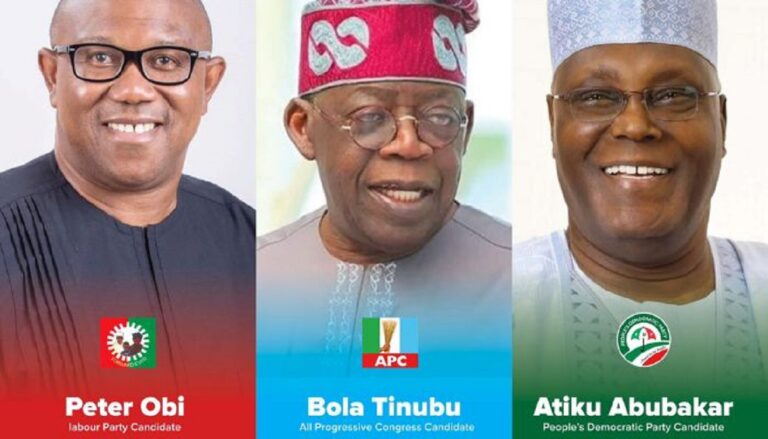
PRESIDENTIAL candidate of the Labour Party, Peter Obi, has defeated his rivals of the Peoples Democratic Party (PDP) Atiku Abubakar, and the All Progressives Congress (APC), Bola Tinubu in the February 25 presidential election in Delta State.

Abubakar’s running mate in the election is the incumbent governor of Delta State, Ifeanyi Okowa.

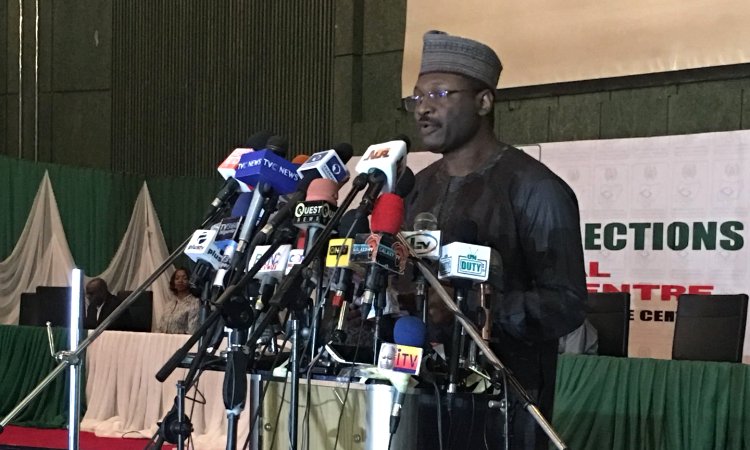
Announcing the results in Asaba, the returning officer of the Independent National Electoral Commission (INEC), Owunari Georgewill, said that Obi polled a total of 341,866 votes, while Atiku secured 161,600 votes.

The APC came a distant third by polling a total of 90,183 votes, while the All Progressives Grand Alliance, Zenith Labour Party and the New Nigeria People’s Party polled 3,746, 3,324 and 3,122 respectively.

The ADC polled 160, ADP 788, APM 1,028, APP 493, BP 1,016, MRM 988, PRP 334, SDP 3,071, and  YPP 605 votes.

The returning officer stressed that the total number of votes cast was 615,342, while 39,309 votes were rejected.

INEC logistically ill-prepared for elections – Group

THE Incident Centre for Election Atrocities (ICEA) has frowned at the Independent National Electoral Commission’s (INEC) preparation for last Saturday’s presidential and National Assembly elections.

ICEA said INEC allowed many lapses, including the lateness of its officials to polling units, bringing wrong materials or insufficient ballot sheets to polling units, and disenfranchising the elderly and persons with disabilities because they could not endure very long queues.

In a statement signed by the Head of its Secretariat and Executive Director of Global Rights, Abiodun Baiyewu, the Centre condemned the violence that characterised the polls.

At least, 10 persons died from the violence from the polls in Edo, Taraba, Rivers, Gombe, Abia and Kogi states, while, at least, seven persons, including three INEC ad-hoc staff, were abducted on election day in Taraba and Kaduna states, ICEA said.

The group decried the threat by hoodlums on voters who they assumed would vote for opposition parties or candidates from certain ethnic groups.

It also berated lawlessness by urchins and thugs who disrupted the polls by chasing voters away, snatching ballot boxes and fleeing with voting materials.

“Despite attempts at voter suppression through violence and ballot snatching by unscrupulous elements, Nigerians defied the odds and came out in significant numbers to exercise their franchise, even in areas that were widely acknowledged as flash points,” ICEA stated.

Besides, it expressed disappointment with the reported failure of the Bimodal Voter Accreditation System (BVAS) at some polling units, and with INEC’s failure to upload the election results on its server as required by the Electoral Act.

The failure cast a strong shadow on the transparency of the elections and gave room to its results manipulation, said the team.

Speaking on the extent of violence during the polls, the group noted that its findings showed that Lagos, Kogi and Edo states recorded the highest levels of voting disruptions caused by violence.

The organisation also deplored attacks on journalists and election observers during the polls.

“Dayo Aiyetan, the Executive Director of the International Centre for Investigative Reporting (ICIR) was attacked at the Agwan Fulani Town Hall, Gwagwalada town, FCT, while he was covering the Presidential and National Assembly elections.

“Six other journalists – Akam James, Daily Post’s state correspondent Princewill Sede, the publisher of Upfront news magazine Jeany Metta, the managing editor of Upfront news magazine Joe Kunde, and a reporter of TVC and cameraman, Mr Miebi Bina – were assaulted and chased away when thugs attacked the Ebelebiri community Ward 05 unit 19 in Bayelsa State on February 25, 2023.

“Adebola Ajayi, a Lagos metro beat reporter at the Peoples Gazette, was manhandled and his phone temporarily confiscated for attempting to take footage when thugs attacked a polling unit in the Oshodi area of Lagos state,” the Centre narrated.

The team also noted the roles of the Economic and Financial Crimes Commission (EFCC) and the security agencies during the exercise. It commended the EFCC and the police for apprehending politicians who attempted to buy votes.

However, it explained that many security officers could not help to control the crowd during the elections.

It said the 2023 elections represented a critical moment for the country’s future, and for West Africa.

“As the collation and announcement of results are underway, ICEA calls on the Independent National Electoral Commission (INEC) to maintain political neutrality in the election process.

“We also call on the Inspector General of Police to ensure the arrest and prosecution of all persons indicted in the political violence and manipulation recorded, including its personnel who were compromised and deliberately looked the other way while voters were being attacked and intimidated at the polls,” it stated.

Ortom, Ugwuanyi, Ishaku, Lalong, Ayade: Outgoing governors who lost senate bids

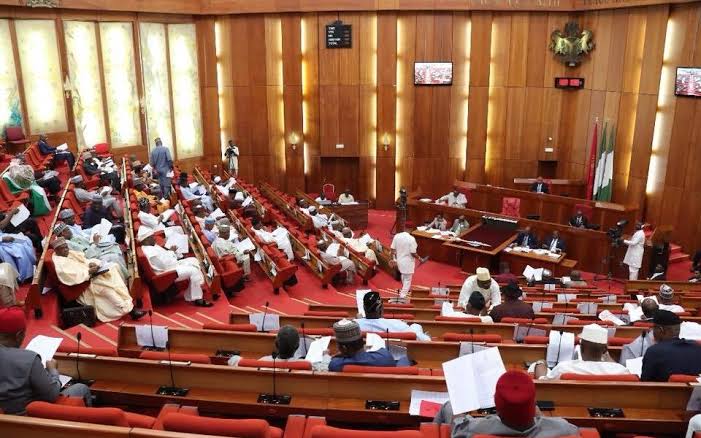
THE recently concluded National Assembly elections in Nigeria saw, at least, five outgoing governors lose their attempts to cross over to the Senate after their two-term tenure of eight years each. This has prompted discussions about the National Assembly, which has been described as a retirement home for former governors who ride on the power of incumbency to win elections into the red and green legislative chambers.

Since Nigeria’s return to democracy in 1999, the National Assembly has been a sought-after destination for former governors seeking to continue their political careers. In the Ninth National Assembly in 2019, about 20 former governors were elected, including Rochas Okorocha (Imo), Ibikunle Amosun (Ogun), Abdulaziz Yari (Zamfara), Kabiru Gaya (Kano), Abdullahi Adamu (Nasarawa), Chimaroke Nnamani (Enugu), Orji Kalu (Abia), Gabriel Suswam (Benue), and Ibrahim Shekarau (Kano).

However, in the most recent elections, outgoing governors like Samuel Ortom of Benue State, Ifeanyi Ugwuanyi of Enugu State, Darius Ishaku of Taraba State, Simon Lalong of Plateau State, and Ben Ayade of Cross River State all failed in their bids to move to the National Assembly after their tenure on May 29, 2023.

Ortom, a vocal figure of the five aggrieved governors of the Peoples Democratic Party (PDP) known as the G5, lost his election bid for Benue North West Senatorial District in the National Assembly to his All Progressives Congress (APC) counterpart in the district, Titus Zam. Zam received 143,151 votes, while PDP scored 106,882, and the Labour Party 51,950.

Ugwuanyi, another member of the G5, lost his bid to represent Enugu North Senatorial District in the National Assembly to Okechukwu Ezea of the Labour Party. Ezea received 104,948 votes, while Ugwuanyi came second with 46,948 votes.

Ishaku, an outgoing two-term PDP governor, also lost his senatorial ambition to his APC counterpart in the district, David Jimkuta, who received 85,415 votes to defeat Ishaku, who received 45,708 votes.

Lalong, an APC governor and former chairman of the Northern Governors’ Forum (NGF), lost the bid to clinch the Plateau South Senatorial District slot to Bali Ninkap Napoleon of the PDP. Napoleon received 148,844 votes, while Lalong received 91,674 votes.

Ayade, who had hoped to return to the Senate after completing his eight-year tenure as governor, was defeated by the incumbent, Jarigbe Agom-Jarigbe. PDP’s Agom-Jarigbe received 76,145 votes, while Ayade polled 56,595.

Although results are still trickling in for the presidential and National Assembly elections, newcomers are poised to unseat some old members who have consistently been in the red and green chambers for the past 24 years.

The outcome of the elections has raised questions about the continued relevance of the National Assembly as a destination for former governors seeking to continue their political careers.

Some have argued that the failure of outgoing governors to secure Senate seats indicates that the electorate is becoming more discerning and less inclined to vote based on party affiliations alone.

Others have also pointed to the Obidient movement of the Labour Party presidential candidate, Peter Obi, which unseated some members of the National Assembly, especially in the South-East part of the country.

India court acquits four Nigerians charged with criminal offences 

FOUR Nigerians charged with criminal intimidation, rioting, assault, and use of criminal force to deter public servants from discharging their duties during the infamous rioting incident of October 2013 in India have been acquitted.

The Nigerian men – Sunday Onye Lucky, Mwachukwu Elgwedimme, Arinze Ukemoezie and Ifeanyi Pascal – had gathered to view the body of another Nigerian, 35-year-old Simeon Obodo, who was murdered on the street in Gao village on October 30.

Obodo’s death sparked a diplomatic row between both countries, as about 200 Nigerians in India staged a protest, blocking a national highway and clashing with locals and police in the area.

Fifty-three of the protesting Nigerians were arrested, and while 49 of them were later released after meeting their bail conditions, the four were charged to court.

However, a Mapusa court acquitted the four men after the prosecutor failed to provide evidence of their involvement in the crime.

“No evidence has come on record that they used any force against police officials, nor has any specific act been attributed to any of the accused herein,” the court said.

It added, “All this gives a presumption that the accused persons/Nigerians had gathered  to see the body of Obodo Uzona Simeon, the Nigerian national, and it cannot be said that their assembly was unlawful.”

In addition, although photographers were present at the spot, no photographs were produced on the presence of the accused, the scene of the offence, or the body.

The court also noted that police personnel from police stations other than Mapusa were called to Lobo Waddo, Parra, to control law and order situation, but that none of them was examined in support of the prosecution.


FG accuses Obasanjo of attempt to truncate electoral process

0

THE Federal Government has warned former President Olusegun Obasanjo against truncating the 2023 general elections after he called for the cancellation of results in areas where the Bimodal Voter Accreditation System (BVAS) failed.

Obasanjo made the demand in a letter on Monday, February 27, where he alleged that results of the 2023 Presidential Election had been manipulated.

In a statement signed by the Minister of Information and Culture Lai Mohammed on Tuesday, February 28, the Federal Government said Obasanjo’s letter was a calculated attempt to undermine the electoral process and a willful incitement to violence.

The minister expressed shock and disbelief that a former President could “throw around unverified claims and amplify wild allegations picked up from the street against the electoral process”.

Mohammed recalled that the former President, in his time, organised perhaps the worst elections since Nigeria’s return to democratic rule in 1999.

He said Obasanjo is the “least qualified to advise a President whose determined effort to leave a legacy of free, fair, credible and transparent election is well- acknowledged within and outside Nigeria”.

“As the whole nation waits with bated breath for the result of last Saturday’s national elections amid unnecessary tension created by professional complainants and political jesters, what is expected from a self-respecting elder statesman are words and actions that douse tension and serve as a soothing balm.

“Instead, former President Obasanjo used his unsolicited letter to insinuate, or perhaps wish for, an inconclusive elections and a descent into anarchy.

“He used his time to cast aspersion on electoral officials who are unable to defend themselves, while surreptitiously seeking to dress his personal choice in the garb of the people’s choice. This is duplicitous,’’ he said.

The minister reminded the former President that organising elections in Nigeria were “not a mean feat, considering that the voter population of 93,469,008 in the country is 16,742,916 more than the total number of registered voters, at 76,726,092, in 14 West African nations put together”.

He added : “With the deployment of over 1,265,227 electoral officials, the infusion of technology to enhance the electoral process and the logistical nightmare of sending election materials across our vast country, INEC seems to be availing itself creditably, going by the preliminary reports of the ECOWAS Electoral Observation Mission and the Commonwealth Observer Group, among other groups that observed the election”.

He further stressed that aggrieved persons should exercise restraint and allow the electoral body to conclude its duty.

”Therefore, those arrogating to themselves the power to cancel an election and unilaterally fix a date for a new one, ostensibly to ameliorate perceived electoral infractions, should please exercise restraint and allow the official electoral body to conclude its duty by announcing the results of the 2023 national elections.

“After that, anyone who is aggrieved must follow the stipulated legal process put in place to adjudicate electoral disputes, instead of threatening fire and conjuring apocalypse.”

Rivers collation officer alleges threat to life, postpones proceedings

0

THE Rivers State Collation Officer for the Presidential Election, Charles Adias, has adjourned the collation of results.

Adias, the Vice Chancellor of the Federal University, Otueke, announced the adjournment on Tuesday morning while addressing journalists at the State Collation Centre in Port Harcourt.

He said the adjournment was due to an alleged threat to his life by unnamed party supporters.

The collation officer was asked by the Commissioner of Police in charge of the Presidential Election in the state, Aderemi Adeoye, to reveal the identity of those threatening his life.

Adias refused and insisted that he will proceed once the state’s Resident Electoral Commissioner addressed some of the concerns of those threatening him, including fixing the faulty Bimodal Voter Accreditation System (BVAS).

Results of 21 local government areas have been collated with two remaining (Degema and Obio-Akpor) before the incident.

In a similar incident, the collation officer for the Nnewi South Local Government Area, Chinwe Isikpo, claimed that she had received death threats from unidentified individuals.

The allegation caused tension and drama at the INEC Anambra State collation centre for the 2023 Presidential Election.


READ ALSO:


Isikpo shouted in the collation hall on Monday after finishing her presentation of the Nnewi South LGA Presidential Election results to the presiding officer, Nnenna Oti.

She claimed that some unidentified males had been following her since Sunday.

After presenting her results, the collation officer abruptly raised the alarm, confusing everyone in the room and briefly halting operations.

She was later led out of the room.

EU observer mission faults INEC, speaks about visa ban on election offenders

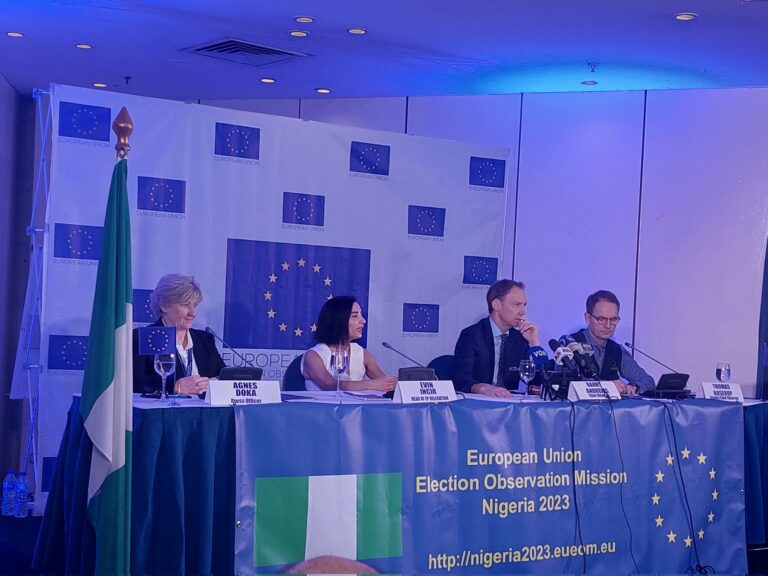
THE European Union Election Observation Mission (EU OM) said despite the fact that presidential and parliamentary elections were held as scheduled, there were considerable operational failures which have dampened trust in the process, and denied many citizens the right to vote.

EU chief observer Barry Andrews, stated this while presenting the preliminary findings of the Mission in Abuja on Monday.

He said although stakeholders had expressed confidence in the Independent National Electoral Commission (INEC) in the preparatory phase leading to the election, the Commission’s lack of efficient planning in critical stages and effective public communication reduced trust in the process, including on election day.


Read Also:

Andrews commended the patience and resilience displayed by Nigerians on election day in the face of delays in the deployment of election materials and late commencement of accreditation and voting in many polling units observed.

“The introduction of the Bimodal Voter Accreditation System (BVAS) and the INEC Results Viewing Portal (IReV) were perceived as an important step to ensure the integrity and credibility of the elections.

“However, uploading of the results using the BVAS did not work as expected and the presidential election results forms started to appear on the portal very late on election day, raising concerns,” he said.

Responding to a question on whether perpetrators of election violence would be placed on a ban, Andrews pointed that it was not within the mandate of the Mission to determine if a ban would be imposed or not.

“We acknowledge that INEC had to conduct this election under urgent circumstances and we are very conscious that the electoral act provides the framework that instilled a lot of trust in INEC in the run up to the election.

“We are here simply to observe…that’s a matter for the European Union in the European Council. We are aware that other jurisdictions have made those calls but it doesn’t fall within the mandate of this mission,” he clarified.

Similarly, the head of delegation of the European Parliament Evin Incir, noted that less than 10 per cent of candidates were women and urged the next government and parliament to heed the call for affirmative action for women electoral participation.

On their part, the International Republican Institute (IRI) and National Democratic Institute (NDI) Joint Election Observation Mission (IEOM), noted that the 2023 presidential and National Assembly elections in the country fell short of citizens’ expectations.

Former president of Malawi Joyce Banda, who presented the preliminary report on election on behalf of the IEOM, called on the international community to punish anyone that undermines Nigeria’s election.

There are 110 election observers from the EU member- states as well as Canada, Norway and Switzerland, present in Nigeria to monitor the election process.

Peter Obi wins FCT with wide margin

0

LABOUR Party (LP) candidate, Peter Obi, has won the presidential election in the Federal Capital Territory (FCT) Abuja.

Obi won the election with a landslide, polling 281,717 votes.

The former Anambra State governor defeated his opponents including the candidate of the ruling All Progressives Congress (APC) Bola Tinubu, who polled 90,902 votes, and Atiku Abubakar of the Peoples Democratic Party (PDP), who got 74,199.

Obi won four of the six FCT area councils, while APC won the other two.

A total of 478,923 people were accredited to vote. The total votes cast was 478,652.

Obi condemns attacks on supporters in Lagos

THE candidate of the Labour Party (LP), Peter Obi, has condemned attacks on residents believed to have voted for the LP during Saturday’s presidential election in Lagos State.

Deputy Director General and Campaign Manager of the Obi-Datti presidential campaign committee (PCC), Oseloka Obaze, made this known in a statement on Tuesday, February 27.

He expressed regrets that political thugs would single out citizens who exercised their constitutional rights to vote for candidates or parties of their choice.

Obaze noted that the attacks were not limited to indigenes but also targeted at non-indigenes.

He further reiterated the LP’s commitment to political decorum and thanked the party’s supporters and all Nigerians who exercised their fundamental rights to vote according to the dictates of their conscience.

Obaze acknowledged that there were some irregularities in the elections in several states and that the LP would follow due process and use constitutional means to address its grievances while maintaining peace.

He also emphasized the party’s commitment to change Nigeria for the better and to defend every vote.

In the same vein, he called on governments at all levels to recommit to their constitutional responsibility to protect citizens within their territories regardless of their political leanings.

According to Obaze, the LP remained resolute in its mission to change Nigeria.

APC wins Kogi senatorial seat as Natasha Akpoti-Uduaghan loses out

0

THE Independent National Electoral Commission (INEC) has declared the All Progressives Congress (APC) candidate Abubakar Sadiku-Ohere winner of the Kogi Central Senatorial election.

The INEC Returning Officer for the senatorial district Rotimi Ajayi announced this at the collation centre in Okene on Tuesday, February 28.

“Engineer Abubakar Sadiku-Ohere of the APC having scored the highest votes in the election for the Kogi Central Senatorial seat is hereby declared winner, and is therefore returned elected,” he said.

Sadiku-Ohere defeated the Peoples Democratic Party (PDP) candidate Natasha Akpoti-Uduaghan to emerge winner in the National Assembly elections held on Saturday, February 25.

The APC candidate acquired 52,132 votes, closely followed by Akpoti-Uduaghan who amassed a total of 51,763.

A few hours to the elections, the state government had reportedly engaged workers to destroy roads leading to the Kogi Central Senatorial District.

The PDP alleged that the act was part of deliberate efforts of Governor Yahaya Bello, who assumed leadership of the state under the APC, to influence election outcomes in the district.

The state government, however, said that the destruction of roads was aimed at preventing terrorists from accessing the area.

Akpoti-Uduaghan had also accused the APC of hiring thugs in military camouflage to disrupt the elections in some polling units in Kogi Central.