PRESIDENT Bola Tinubu has approved the appointment of Mulisiu Olalekan Oseni as the Chairman and Chief Executive Officer of the Nigerian Electricity Regulatory Commission (NERC) following the Senate’s confirmation of its members on December 16, in Abuja.
A statement by Special Adviser to the President on Information & Strategy, Bayo Onanuga, on Thursday, December 18, said the appointment took effect immediately, as the president equally reconstituted the commission’s board.
Oseni, who was appointed commissioner in January 2017, has subsequently been appointed vice chairman and now the commission’s chairman.
The statement said his appointment took effect from December 1, 2025, and shall subsist until the completion of his 10-year tenure at the commission, in accordance with the provisions of the Electricity Act, 2023.
Other members of the reconstituted board are Yusuf Ali, an academic doctor (Vice Chairman), Nathan Rogers Shatti (Commissioner), Dafe Akpeneye (Commissioner), Aisha Mahmud Kanti Bello (Commissioner) Chidi Ike (Commissioner) and Fouad Animashaun (Commissioner)
Ali was first appointed commissioner in February 2022. His designation as vice chairman took effect on 1 December 2025 and shall remain in effect until the completion of his first term. Also, Shatti is serving a second term as commissioner. He was first appointed in January 2017. Akpeneye is serving a second term, having been first appointed as a commissioner in January 2017.
Similarly, Aisha Bello is serving her second term, having been first appointed as a commissioner in December 2020. Ike is serving his first term, having been first appointed as a Commissioner in February 2022, and Animashaun is serving his first term, effective December 2025.
Tinubu charged the board members to deepen and consolidate the ongoing transformation of Nigeria’s power sector, in strict alignment with the letter and spirit of the Electricity Act, 2023.
Brief background about the NERC chairman
Musiliu Olalekan Oseni is a prominent figure in Nigeria’s energy sector.
Before his appointment, he served as NERC vice chairman. He was a research associate in economics and finance of the Built Environment at University College London, and previously worked at the Energy Policy Research Group, University of Cambridge, United Kingdom.
As NERC’s vice chairman, he’s played a key role in shaping Nigeria’s electricity market, championing reforms that promote transparency, accountability, and sustainable growth.
He has also played a vital role in tariff reform policies, metering initiatives, and safeguarding the rights of electricity consumers.
THE Senate has confirmed the appointment of 64 ambassadorial nominees, despite sustained criticism from opposition parties and many Nigerians over their nomination.
Of the confirmed nominees, 34 are career ambassadors, while 30 are non-career. Others are prominent political figures and allies of the ruling All Progressives Congress (APC)
The confirmation followed the consideration and adoption of a report by the Senate Committee on Foreign Affairs, chaired a member of the 10th Senate, Sani Bello.
Among the career ambassadors confirmed by the Senate are Arewa Esther (Oyo), Adeola-Ibrahim Mopelola (Ogun), Ramat Omonbolale (Lagos), Monica Okechukwu Enebechi (Anambra), Adams Bassey (Cross River), Clark Efe (Delta), Mohammed Lele (Bauchi), Muhammad Dahiru (Kaduna) and Ahmed Monguno (Borno), among others.
More controversial, however, was the confirmation of several non-career ambassadors, including Reno Omokri (Delta), former Minister of Aviation Femi Fani-Kayode (Osun), former Rivers State sole administrator, ex-Chief of Naval Staff Ibok-Ete Ekwe Ibas (Cross River) and former INEC chairman Mahmud Yakubu.
Others confirmed as non-career ambassadors include Ita Enang (Akwa Ibom), Chioma Ohakim (Imo), Jimoh Ibrahim (Ondo), Femi Pedro (Lagos), Isaac Adewole (Osun), Ajimobi Florence (Oyo), Sulola Akande (Oyo), Ugwanyi Ifeanyi (Enugu), Jerry Manwe (Taraba), Abas Braimah (Edo) and Onueze Okocha (Rivers).
The confirmations came amid strong objections raised by many Nigerians and opposition parties.
President Bola Tinubu had forwarded the ambassadorial list to the Senate earlier in December, urging lawmakers to expedite the screening to enable timely diplomatic postings.
Part of the nominations were read on the Senate floor on December 4 and referred to the Committee on Foreign Affairs.
Their nomination followed the recall of all Nigerian ambassadors by Tinubu in September 2023, shortly after he assumed office.
Opposition parties, particularly the Peoples’ Democratic Party (PDP), had criticised Tinubu’s ambassadorial lists, describing them as ‘scandalous’ and alleging that the administration prioritised political loyalty over merit.
Many Nigerians also expressed outrage on social media, especially over the inclusion of high-profile political loyalists such as Omokri, Fani-Kayode, and Mahmud Yakubu, arguing that the appointments reinforced perceptions of patronage rather than professionalism in Nigeria’s diplomatic service.
The Senate had earlier confirmed three additional non-career ambassadors, bringing the total number of confirmed ambassadors to 67.
They are expected to represent Nigeria in key countries including China, India, Canada, South Africa, the United Arab Emirates and Kenya, as well as multilateral institutions such as the United Nations, African Union and UNESCO.
THE Federal Capital Territory (FCT) High Court sitting in Abuja, on Thursday, December 18, granted bail to former Minister of Labour and Employment, Chris Ngige.
Ngige is standing trial over alleged ₦2.2 billion contract fraud filed by the Economic and Financial Crimes Commission (EFCC).
The presiding judge, Maryam Hassan granted the bail after hearing arguments from both parties, six days after the former minister was remanded at the Kuje Correctional Centre pending the determination of his bail application.
Ngige, a former governor of Anambra State, was arraigned on December 12 and pleaded not guilty to an eight-count charge bordering on abuse of office and receipt of gratification while supervising the Nigeria Social Insurance Trust Fund (NSITF) between September 2015 and May 2023.
In her ruling, Hassan overruled the prosecution’s objection to bail, holding that bail conditions must be reasonable and not punitive.
She noted that imposing overly stringent conditions would amount to a denial of bail.
The court granted bail on the condition that Ngige produces one surety, who must be a director-level officer in a federal government establishment.
The surety is also required to own a landed property within Abuja Municipal Area Council (AMAC) and submit the property’s certificate of occupancy to the court.
Hassan further ordered that the former governor surrender his international passport after obtaining a replacement, following his claim that the original passport was stolen.
Pending the perfection of the bail terms, the judge directed that Ngige should continue on the administrative bail earlier granted to him by the EFCC.
Ngige had earlier been granted administrative bail by the EFCC in October 2025 on self-recognisance and one surety, which allowed him to travel abroad for medical treatment on the condition that he returned his passport upon arrival.
During his arraignment last week, EFCC counsel, Sylvanus Tahir, a senior advocate, urged the court to remand the former minister pending trial.
However, defence counsel, Patrick Ikwueto, also a senior advocate, opposed the request, citing Ngige’s health condition and the fact that he had already spent several days in EFCC custody before being brought to court.
Ikwueto argued that the offences were not capital in nature and did not warrant denial of bail, insisting that correctional facilities lacked adequate medical capacity to manage his client’s health challenges.
Following the ruling, EFCC counsel, Eunice Daylo, requested a trial date, and the court fixed January 28 and 29, 2026, for the commencement of hearing.
The ICIR reports that the EFCC alleged that Ngige abused his office by approving multiple consultancy, training, supply, and construction contracts in favour of companies linked to his associates.
According to the charge sheet, Cezimo Nigeria Limited allegedly received contracts worth ₦366.4 million, while Zitacom Nigeria Limited was said to have secured contracts valued at ₦583.6 million.
Other firms listed include Jeff & Xris Limited, Olde English Consolidated Limited, and Shale Atlantic Intercontinental Services Limited, with combined contract values running into hundreds of millions of naira.
The commission further alleged that Ngige received cash gifts totalling over ₦93 million through organisations linked to him from companies doing business with the NSITF.
Ngige pleaded not guilty to all charges and will now stand trial beginning later in January.
A FEDERAL Capital Territory, FCT, High Court, Abuja, has thwarted efforts by the former Attorney-General and Minister of Justice, Abubakar Salami, to secure bail from the custody of the Economic and Financial Crimes Commission (EFCC)
The judge, Babangida Hassan, gave the ruling on Thursday, December 18.
A statement by the commission said Malami, through his counsel, Suliaman Hassan, a senior advocate and a doctorate holder, had approached the court seeking bail from the custody of the EFCC. He argued that his detention by the commission in its ongoing investigation was illegal.
The EFCC’s counsel, J.S. Okutepa, also a senior advocate, submitted that the commission was holding the former minister through a valid remand order obtained at an FCT High Court granted by a judge, S. C Oriji.
“He equally affirmed that the EFCC was a law-abiding commission that would not detain a suspect beyond the lawful period without an order of the court.
“In his ruling, Justice Hassan held, quoting Section 35 of the Constitution, that since there was a provision in the Administration of Criminal Justice Act, ACJA, for detention, Malami was lawfully detained by the remand order of the court. ‘Asking this court to grant this application is tantamount to inviting the court to sit as an appellate court over an application made by a court of coordinate jurisdiction which the court has no power to do'”, the EFCC quoted the judge to have said.
The ICIR reports that Malami has been held by the EFCC over the recovered loot of the former late Head of State, Sani Abacha, a general.
Malami was a minister under the late former President Muhammadu Buhari, under whose government the recovery process was carried out.
There have been altercations between the commission and Malami over the past days since he was held.
While Malami argued that the claims against him were untrue and said the EFCC Chairman, Ola Olukoyede, should recuse himself from investigating him, citing vendetta, the commission has insisted he must be probed.
The embattled former minister had alleged that the investigation and his continued detention were not driven by genuine law enforcement concerns but by “deep-seated historical animosity” involving the EFCC chairman.
He recalled that while he served as attorney-general, the Federal Government set up the Justice Ayo Salami Judicial Commission of Inquiry to probe allegations of corruption and abuse of office within the EFCC, during which the current EFCC chairman served as secretary.
According to him, the Salami report contained findings implicating the EFCC chairman, including recommendations that could have led to his prosecution.
The commission has dismissed Malami’s arguments and continued with its probe. Reports indicate that his houses in Abuja and Kebbi were raided by the EFCC as the investigation progresses.
THE European Union (EU) has promised to strengthen its longstanding partnership with Nigeria through deeper defence cooperation, aimed at tackling the country’s emerging and complex security challenges.
The EU Ambassador to Nigeria and ECOWAS, Gautier Mignot announced this on Wednesday, December 17, during a courtesy visit to the Chief of Defence Staff, Olufemi Oluyede, at the Defence Headquarters in Abuja.
“Nigeria’s strategic importance to the European Union, 19 out of the EU’s 27 member states currently maintain diplomatic missions in the country,” he said.
Mignot congratulated Oluyede on his recent appointment and reiterated the EU’s commitment to assisting Nigeria in addressing its security challenges.
EU promises stronger security ties with Nigeria,” he added.
The ambassador drew attention to a range of EU-funded non-kinetic initiatives being implemented across Nigeria to promote peacebuilding, stability, and conflict prevention.
Oluyede, in his response, appreciated the EU for its sustained support to Nigeria, noting his familiarity with the union’s various interventions and programmes in the country.
He commended the EU’s resolve to engage Nigeria directly on security issues, beyond its predominant focus on the Multinational Joint Task Force.
The CDS urged that the proposed engagements be expedited, emphasising that Nigeria is confronting complex and overlapping security threats across multiple regions.
According to him, timely EU’s assistance would be vital in enabling the armed forces and other security agencies to respond effectively to these challenges.
The ICIRreported that Germany also promised to strengthen its cooperation with Nigeria in key areas including the fight against terrorism, malnutrition, energy reform, and migration management, as both countries mark 65 years of diplomatic relations.
The country’s Ambassador to Nigeria, Annett Günther described the relationship between the two counties as one that had evolved from post-independence friendship to “an increasingly intense partnership of equals,” focused on shared prosperity and stability.
FAROUK Ahmed has resigned as the Chief Executive Officer of the Nigerian Midstream and Downstream Petroleum Regulatory Authority (NMDPRA) following days of controversy triggered by corruption allegations levelled against him by billionaire Aliko Dangote.
President Bola Tinubu, in a statement on Wednesday, December 17, confirmed Ahmed’s resignation and announced that he had forwarded the name of Saidu Aliyu Mohammed to the Senate for confirmation as the new head of the NMDPRA.
Ahmed was appointed in September 2021 by former President Muhammadu Buhari to lead the NMDPRA, one of the two regulators created under the Petroleum Industry Act (PIA).
His exit came shortly after Dangote petitioned the Independent Corrupt Practices and Other Related Offences Commission (ICPC), accusing him of gross abuse of office, violation of the Code of Conduct for Public Officers, corruption, and financial impropriety.
Dangote, through his lawyers, alleged that Ahmed spent over $7 million in public funds on the education of his four children in Switzerland, an expenditure he claimed was inconsistent with the earnings of a career public servant.
The petition also accused the former regulator of using his position to divert public funds for personal gain.
The ICPC had confirmed receipt of the petition and said it would investigate the allegations.
In a brief reaction earlier, Ahmed dismissed issuing any public response to the claims and described the allegations against him and his family as “wild and spurious.”
He said he chose not to engage in public exchanges while the matter was before an investigative body.
While the Presidency did not link Ahmed’s resignation directly to the corruption allegations, the timing of his departure has intensified public reactions on the matter.
To replace him, Tinubu nominated Mohammed, a former Group Executive Director and Chief Operating Officer, Gas and Power Directorate of the Nigerian National Petroleum Company Limited (NNPCL).
Mohammed, according to the Presidency, has held several senior positions in the oil and gas sector, including Managing Director of the Kaduna Refining and Petrochemical Company and the Nigerian Gas Company.
The President also announced the resignation of Gbenga Komolafe as Chief Executive Officer of the Nigerian Upstream Petroleum Regulatory Commission (NUPRC) and nominated Oritsemeyiwa Amanorisewo Eyesan as his replacement.
A member of the House of Representatives, Abdulsammad Dasuki (PDP, Sokoto), on Wednesday, December 17, raised concerns over alleged inconsistencies between the tax laws passed by the National Assembly and the versions later gazetted and released to the public.
This revelation came after the Federal Government had prepared the grounds for implementing the new tax law from January 1, 2026, with the approval of the establishment of the National Tax Policy Implementation Committee (NTPIC).
The committee has been tasked with overseeing the coordinated rollout of the Federal Government’s new tax reforms.
Citing Order Six, Rule Two of the House Rules, Dasuki informed lawmakers that his legislative privilege had been breached, contending that the gazetted versions of the laws did not faithfully represent what was debated, approved, and passed on the floor of the House.
He said after the passage of the tax bills, he spent the last three days reviewing the gazetted copies alongside the House Votes and Proceedings, as well as the harmonised version agreed upon by both chambers of the National Assembly and discovered notable discrepancies.
“I was here, I gave my vote, and it was counted, and I am seeing something completely different,” Dasuki said, adding that he obtained copies of the gazetted laws from the Ministry of Information and found them to be inconsistent with what was approved by both the House and the Senate.
The lawmaker clarified that his address was not meant to serve as a motion, but rather to draw the House’s attention to what he termed a “serious violation” of legislative procedure and the Constitution.
He urged the Speaker to ensure that all important documents, such as the harmonised versions, the Votes and Proceedings from both chambers, and the currently circulating gazetted copies, are submitted to the Committee of the Whole for comprehensive review by the members.
Dasuki warned that allowing laws that deviate from those duly passed by the National Assembly to be released to the public would undermine the legislature’s credibility and constitute a breach of constitutional provisions.
“Mr. Speaker, I will be pleading that all the documents should be brought before the Committee of the Whole. Thank you. The whole members should see what is in the gazetted copy and see what they passed on the floor so that we can make the relevant amendment. Mr. Speaker, this is a breach of the Constitution.
“This is a breach of our laws, and this should not be taken by this honourable House,” he said.
Editor’s Note: Reader discretion is advised as some of the images used in this report are disturbing.
ON Tuesday, December 9, Headquarters 23 Brigade of the Nigerian Army issued a statement absolving its officers of killing unarmed protesting women in Lamurde Local Government Area of Adamawa State. The women were protesting alleged bias of the military in the crisis between Bachama and Chobo tribes in the LGA. In this report, The ICIR’s Marcus Fatunmole visited the area and unearthed what transpired.
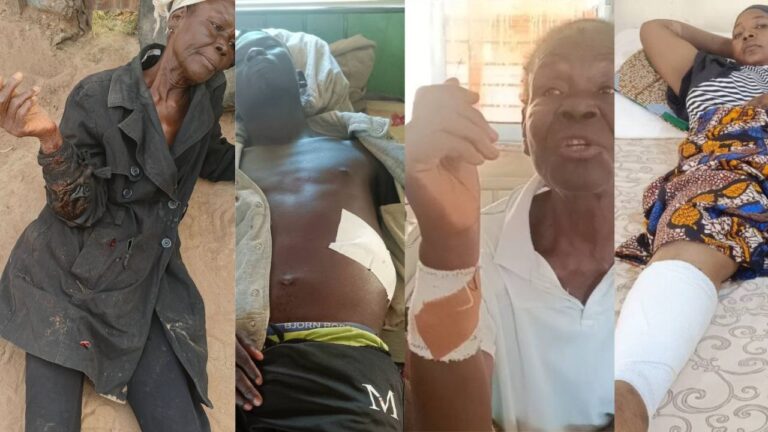
Seventy-three-year-old grandma, Anogrom Abiathar, is currently writhing in pains at the Numan General Hospital, Numan town, Adamawa State.
The widow and mother of five is among the women allegedly shot by soldiers in Lamurde town, Lamurde LGA on Monday, December 8.
While she is lucky to be alive with bullet wounds on her right arm, 11 others, including a girl, died in the shooting.
Madam Abiathar joined dozens of other women in Lamurde to protest alleged bias in the soldiers handling of long-standing conflict between the Bachama and Chobo tribes in the LGA.
The mother of five wondered how unarmed women and children would be gunned down by soldiers who should protect them.
73-year-old Anogron Abiathar. PC: Lamurde community
She also expressed shock that the military could deny the shooting and claimed that it was carried out by local militias. She said the soldiers shot sporadically and with fury before zooming off from the scene with their convoy.
Asked what form of justice she demanded, she said no government or anyone could bring back her fellow women and children who were killed during the protest.
Other survivors at the Numan General Hospital shared their story of the shooting with The ICIR. Among them is 12-year-old Takuso Victoria who lost two of her toes to gunshot. She had finished primary education at the Central Primary School, Lamurde, in September this year but could not secure admission into the Government Day Secondary School in the town. She had since been staying at home. Victoria joined her mother at the protest where she became a victim of the attack.
While the girl is hoping to be fine and return home, another 11-year-old died at the hospital from the gunshot.
Takuso Victoria. PC: Marcus Fatunmole/The ICIR
Deceased families are mourning in Lamurde and across the state. Destiny Charles lost her mother, Florence Frank, to the gunfire. The 25-year-old has one sibling – an 11-year-old boy – whom she would take responsibility to fend for.
Destiny said her father no longer fended for her mum and children since he married another wife over a decade ago. Her mum’s sudden death adds to the agony she has borne for years. She didn’t finish secondary school secondary school because of lack of funds, despite being among the best in her class. Destiny, who speak the English Language fluently, has been living with her grandmother in Numan without a job.
“I was at the protest and returned home without knowing that my mum was still there. As I was lying down, I heard gunshots. Someone came and asked for my mum. I told her she was outside. The person asked if my mum had a phone. I said no. The person told me that women had been shot outside. We rushed to the hospital and saw people lying down. People were crying. I began to look for my mum, only for me to enter one room, and I saw her corpse.
“At first, I didn’t know that she was dead. I thought she was suffering from pains. I was shouting, crying…When I got there, they had already covered my mum. I asked the people if she had died; they said yes. I kept crying. I was very shocked. I couldn’t believe that she had died.”
The ICIR met Destiny’s grandmother in her home in Numan. The grieving mother demanded justice for her daughter.
Destiny Charles who lost her mum. PC: Marcus Fatunmole/The ICIR
Another bereaved, Remedy Yakubu, a resident of Lamurde, said his brother, Lucky Yakubu, was just passing by and was not protesting when he received bullets. “He was on his way home and they shot him with two bullets. He died instantly before I rushed him down to hospital in Lamurde. It’s Army that shot him,” he stated.
The ICIR reports that three men – Thomas Moses, 25, Shalom Orland, 28, and Phineas Dennis, 42 – are battling to survive gunshot wounds at the Numan General Hospital. They claimed to be passers-by shot by soldiers.
As of Saturday, December 12, eleven people, including one male, had died from the attack. 17 were at the Numan hospital, 16 were at the State Specialist Hospital in Yola, and two others at the German Hospital in the state capital, according to Caleb Zadab, a journalist and community representative looking after the victims.
Mass burial
The deceased were buried in mass grave adorned in the Nigerian flag at the Lamurde LGA Secretariat. Youth in the Lamurde community insisted the casualties must be buried at the secretariat since it’s the most important government institution in the town. “The mass grave will serve as memorial for the victims and be a reminder of the dastardly act of the Nigerian military,” one of the youths told the reporter.
Mass grave where the protesting women were buried
How Bachama, Chobo crisis evolved
Bachama and Chobo ethnic nationalities in Lamurde LGA have co-existed for centuries. They have intermarried and share some socio-cultural identities, including religion. However, these were not enough to keep them as one. The Chobos feel they should be independent of the Bachama traditional council, which has been ruling over both tribes.
Both tribes fall under the Bachama Chiefdom, comprising Numan and Lamurde LGAs. The LGAs have 10 wards each. By population, the Chobo people dominate only two out of the 20 wards. The wards are in the Lamurde LGA.
The Chobo are seeking their own chiefdom from the Adamawa State Government. Led by its youth, the people say the only condition for peace in the LGA was for them to get the chiefdom. They also say that granting the chiefdom comes with land demarcation, which will enable to overcome the challenges arising from land ownership.
Poles hit by bullets during the attack on the women protesters. PC: Marcus Fatunmole/The ICIR
Land ownership is the architect of the current feud. The Bachama nationality claims it has inhabited the area for over four centuries and brought down the Chobos from ‘mountains’ where they lived to enable them to farm. Conversely, the Chobos argue that their forebears accommodated the Bachamas when they migrated from Sokoto. Litigation over land ownership between the parties is currently in court.
The crisis escalated in July this year when both tribes burnt down each other’s communities in Waduku, populated by Bachama, and Lakan and Bashaka, owned by Chobos. The state government promptly declared 24-hour curfew, which residents said disrupted socio-economic activities. The government has severally mediated in the crisis, which has defied solutions.
There are also allegations that the military officers deployed to the area were favouring the Chobos and often failed to respond promptly whenever the Bachamas called on them. On Monday, December 7, Lamurde women trooped to the street, carrying tree branches and leaves to protest the alleged bias by the soldiers. They said the military failed to respond to distress calls the previous night when Waduku,Tingno and Tito communities were attacked by the Chobo people.
In the process, they blocked some soldiers deployed to the area to contain the crisis from passing, alleging that the officers had come too late. The drama unfolded for hours. More platoons of soldiers passing through the route were also blocked by the irate women as the stalemate lingered.
What followed was the shooting and killing of the protesters and passers-by. The Headquarters 23 Brigade of the Nigerian Army denied its troop fired the shots. It blamed the killing on “armed men suspected to be fighting for Bachama.”
One of the women killed during the attack. PC: Marcus Fatunmole/The ICIR
While the survivors say no other persons shot them but the soldiers, the military says otherwise.
Several eyewitnesses in Lamurde confirmed to The ICIR that troop fired the shots. They also said an Army colonel led a military team to the community on Friday, December 12, to obtain information on the attack. Representatives of the Army’s leadership also visited the hospital where survivors are receiving treatment.
Meanwhile, the Governor Ahmadu Fintiri-led administration imposed another 24-hour curfew on the LGA. As of the time of gathering information for this report, the curfew was only effective in some parts of the LGA. People were moving freely along the Gyawana-Lamurde route. However, the curfew did not stop residents from moving within their communities. Only movement across communities was restricted.
Our position – Bachama, Chobo leaders
The head of the Bachama Traditional Council, Hama Bachama, Daniel Ismaila Shagah, a doctorate holder, blamed the Chobos for the conflict.
Speaking through his aide, Agoso Bamaiyi, a doctorate holder and District Head of Gyawana town, the Hama Bachama said the Chobo people had been aggressive in the manner they were demanding a chiefdom.
Hama Bachama, who controls 21 districts under his council, said, “For a long time, they’ve been mountainous people. The Bachamas brought them down from the mountains to the kingdom lands. Right now, they’re claiming lands that are not theirs; they’ve been fighting over family lands.”
Agoso Bamaiya, a doctorate holder and and District Head of Gyawana town. PC: Marcus Fatunmole/The ICIR
He alleged that the Cbobo people had been arming themselves for a long time. “We learnt that some of their members who work in the security agencies were supplying them arms and connecting them with the people who sell arms to them. We never thought that the Bachama people and Chobo would ever fight. The Bachama people were not ready for any fight,” he added.
He went further, “The accusation that the Bachama people are throwing at the security officers is that they favoured the Chobo above the Bachama people. If you look at the circumstance, you will agree with them because the security operatives, including the military, were providing armed escorts for the Chobo people to go to their farms. They were providing armed escorts for them to travel in-between communities, but they were not doing that to the Bachama people.
“There was already disaffection in the Bachama communities against the security agencies. On Sunday, December 7, the Chobo youth came out again and attacked Waduku and burnt it down for the second time. They attacked Tingno and burnt down part of it. They also attacked Tito and burnt it down completely. They now approached Rigangun and Lamurde, which is the local government headquarters, but at Rigangun and Lamurde, they met resistance. This led to the fight that stretched through the night till the following morning.
Names of protesting women who were allegedly shot dead by Nigerian soldiers in Lamurde
“Throughout the night, calls were made to the security agencies, they didn’t come in. They didn’t do anything. In the morning, when the soldiers wanted to pass through Lamurde, the women came out and blocked the path. They held tree branches and leaves. They were singing and shouting. This was a spontaneous process; it was not organised. Nobody planned it. They just decided that they’d had enough of the security agencies for delaying. The fight went on throughout the night. The security agencies didn’t intervene… They were completely unarmed; they were just venting their anger and frustration over the security officers. That stalemate went on for a very long time. Toward evening, another convoy of soldiers came to Lamurde, attempting to pass but the women were already there.
“They blocked the path. You would hear that the Brigade Commander was in that convoy. You would also hear that the Theatre Commander was in that convoy. It’s just that the people could not tell who is Brigade or Theatre Commander. They were those responsible for the soldiers sent to Lamurde. But most likely, it was the Theatre Commander, not the Brigade Commander who was in that convoy. He didn’t come down. The women also refused to allow them to pass. Another detachment of soldiers came from the opposite direction. After a while, they fired shots into the air. Remember, these are women and children, and those children were girls, not boys.”
He emphasised that the soldiers shot the women, children and others hit by bullets. He also called for a thorough investigation into the attack and that those responsible should be held to account.
“Were they acting on command or they acted on their own? We need to find that out because the shells they left on the ground, our people picked them up. One ran and left his helmet; that was also picked up. There are video evidence and all that. It was the Army that did the shooting,” he stated.
Names of survivors of the attack on women protesters in Lamurde
The monarch condemned the ‘hasty’ denial of soldiers involvement in the shooting by the military. He wondered why the military would take such a position without investigation.
Deceased victims of Lamurde shooting in Adamawa State
“We feel that this falls in line with the normal behavior of the military. When things go wrong, they tend to deny it. We are not taking it. We are not accepting it. As a result of that shooting, we have 10 dead now. We have buried them in a mass burial. Several others, 37 of them, are in hospitals here in Numan. Some are in Yola, the state capital.
“From all the information we have, it was the military that did the firing. But the military is blaming the Bachama militia. The question is: why will the Bachama militia fire on its own people? I assure you that there is no Bachama militia. That is the first thing we have to clear. There is no group of people that have set themselves aside and identify as Bachama militia. Whatever happened that people needed to put up resistance, it was just the young people who stepped out through raw courage and faced whatever situation. Secondly, that particular point where the firing was done, there were all kinds of security agencies, including SSS and other partner security agencies.
Nany Peter who was shot in the buttock. PC: Marcus Fatunmole/The ICIR
“No militia man in his right senses would go to such a place. They won’t even get close to that place let alone firing. Thirdly, the injuries we saw are consistent with the weapons that the military use. These are not simple, light injuries, plain wounds from normal guns that you carry. These are deep wounds, cutting through flesh, breaking legs and arms, and shattering heads. We repeat, it’s the military that did the shooting. We’ve been asking for investigation. Instead of denying it, they should set up a panel, or the Federal Government should set up an independent investigative panel or investigative journalists should come and do the investigation, look at the evidence and present the case to the world; because you see, these are women,” the monarch stated.
According to him, It’s against international convention for soldiers or fighters of any sort to fire on women, children and the aged. He added that the military is constitutionally bound to defend citizens, not to kill them.
He also noted that the gap between civilians and the military had widened in the past decade, worsening violence from soldiers against civilians. He opined that the situation had been worse than when the military ruled Nigeria.
“The thinking of the Traditional Council is that they should strengthen the police and bring back the mobile police fully. They are trained to interact with civilians. For instance, if it was police convoy that was blocked by these women, if the need be, the worst they would have done is to teargas; everybody would run back to their houses. Nobody would be killed.”
Anagron Abiatha at the hospital. PC: Marcus Fatunmole/The ICIR
Reacting to the new chiefdoms created by the state government, he said the process was done transparently. He said the Chobo people presented their case to have a new chiefdom, “but unfortunately, they did not have proper lobbying etiquette.” He added that “the letter they wrote was aggressive and combative, and they ended up angering the governor.” He also said the Chobo’s population did not meet the requirement for having a chiefdom.
Speaking on why the women were immediately buried after they were shot, he said, the Bachama custom required that whenever people die during war, they must be buried immediately.
Addressing The ICIR on behalf of the Cbobo people, the Acting District Head of Bulkutu community, Elkanah Ishmael, said the crisis started after his people demanded a chiefdom from the state government.
“Since we wrote a memo requesting for chiefdom, we’ve been having problem with Bachama people. They are saying that where did Chobo man has land that he can look for chiefdom? They have forgotten that our grandfathers lived there, and they too came from Sokoto to meet our grandfathers here. Because things are not doing well, they have been ruling us; that’s okay. Now that the executive governor has asked whoever wants a chiefdom to write, we have written. Since then, we’ve had no peace with these people. A lot of things happen. They are not happy that we want our own chiefdom.”
Pwafurino Ishaku. PC: Marcus Fatunmole/The ICIR
He said the hatred that arose from his people’s demand for a chiefdom led the Bachama people to burn down Chobo villages, including Warmi and Bashaka. He said it was from that point his people began to defend themselves.
“What happened in Bashaka, the same thing happened here. The Bachama of Waduku came to attack people of Lakan, where Chobo are. They burnt our place in Lakan. Our people pursued them and our people burnt down Waduku. This happened on Monday, July 7, this year. The Bachama people came with another attack on Bashaka on Friday of the same week.
“Another recent attack on us was last Sunday, December 7. Tingno community comprises Chobo and Bachama people. Around 12 midnight, Bachama people started burning the homes of Chobo people. When our people in other communities heard of it, they mobilised to rescue their kinsmen in Tingno. It was from there the crisis escalated, which extended till the following Monday morning, when they started burning the houses of each other. A lot of lives have been lost. They killed Chobo people, the Chobo people also killed them. About 20 Chobo people died, but I don’t know the number of casualties in Bachama.”
The scene where the protesting women were shot in Lamurde. PC: Marcus Fatunmole/The ICIR
When asked if his people carried weapons, including guns to fight their neighbours, he said he could not confirm. He also confirmed that none of the people allegedly killed by the military in Lamurde was from Chobo tribe. He said they were from Lamurde, a mainly Bachama town.
Asked if there could be temporary peace in the area pending when his people’s demand would be addressed, he said, “The only solution there is, you know when somebody is aspiring for something, if that is done, it will solve many problems.” He added that getting the chiefdom was the only condition for peace.
He also responded to claims that its tribe’s small size would not make the government approve a chiefdom for it. “Chobo people have two wards in Lamurde Local Government but it has about 44 villages. You know the population of Bachama and Chobo people, they are almost the same, but due to a kind of game, we only have two wards. Our population can even be more than Bachama in Lamurde because our villages are more than theirs.”
A man in a pool of blood during the attack. PC: Marcus Fatunmole/The ICIR
More victims share their agonies at Numan General Hospital
Pwavi Ayuba, 45, and businesswoman was shot in the hand. She lost two of her friends who participated in the protest. The mother of five said she and other victims had been feeding themselves at the hospital, with the support of well-meaning Nigerians. She, however, said the government was footing all medical bills.
Thomas Moses, 25, and farmer, was riding on his motorbike when bullets hit him. Shalom Orland, 28, a father of two, said he was watching the drama between the protesting women and soldiers when he was shot.
Another man, Phineas Dennis, 42, said soldiers saw him on the road, ran after him and shot him. A mother, Nancy Peter, 67, is battling for her life as bullets ripped through her buttock during the rampage. The widow, with 10 children, has since abandoned her business and farms after landing at the hospital. Homori Micah said she was hit by a butt of a soldier’s gun. The 40-year-old, with five children, demanded justice from the government.
Sharlom Orland. PC: Marcus Fatunmole/ICIR
Mumkai Emmanuel, 35, claimed she was running away when soldiers ran after him and marched on him, causing him internal injury. The father of three is a farmer.
Another victim at the Numan General Hospital, Pwavi , lost two of her sisters. Her sisters namely Suzzy Tanko, Mercy Kennedy died in the attack, while three others, namely Pwanonau Dennis, Happy Danbaki, and Gopwa Smallie, are battling for their lives at the Federal Medical Centre, Yola.
Mary Musa,18, Favour Mamuda, 20, Pivanide Fukoshi, 29, Tanin Bagudu, 57, are all at the Numan hospittal with different degrees of bullet wounds.
Danladi Walma, 45, is also in serious pain at the facility. The mother of five decried the spate of the attack, stressing that she didn’t expect it. A lady, Only Bekal, 20, was hit with butt of gun in the womb. Pwafurino Ishaku, 34, was also not spared of the gunshots.
Godiya Pwaadakai, 29, and an orphan was writhing in pains when the reporter met her on the hospital bed, while Keziah Nemuel, 37, and hairdresser could not also hold back tears as she narrated her ordeal. Many of the survivors had different parts of their bodies hit by bullets bandaged at the hospital.
Homori Micah. PC: Marcus Fatunmole/ICIR
Victims list
Names of the deceased, as exclusively obtained by The ICIR, include Florence Frank, Suzy Tanko, Mary Talmon, Mercy Kennedy, Lucy Yakubu, Pwamwasari Tami, Mary Shikanno, Destiny Gibson, and Hunbokwama Nickson.
Others are Happy Dan Baki, Arnoron Abiyata, Precious, Evenlyn, Keziya Nemuel, Serah Alpha, Elizabeth Pwavi, Saipwa Moses, Pwakandi David, Pwavi Ayuba, Favour Mamuda, Pwanidi Fukushi, Mary Musa, Only Pekers, Peace Zuifanus, Godiya Pwavadakai, and Joy Iliya.
We are investigating the killings-Adamawa government
Speaking with The ICIR on the conflict, the Senior Special Adviser to the state Governor on Community Peace and Security, Ahmed Lawan, said the state government was investigating the killing. He vowed that anyone responsible for the shooting would face the wrath of the law.
While urging Bachama and Chobo communities to embrace peace, he said the two tribes were the only people threatening the peace of the state since it came into power.
Recall that Adamawa is among the three states in the North-East that had seen a decade-long insurgency, with attendant crippling of their economies, deaths and displacement of residents in thousands and millions respectively. While Borno still witnesses sporadic attacks, Yobe and Adamawa have since been free from the clutches of terror.
The mother of Madam Florence killed during the protest (Destiny Charles grandma) PC: Marcus Fatunmole/The ICIR
“From the beginning of this crisis, the government has been involved. We have been calling both parties to sit with the government and make sure that we have amicable resolution. A week before that happened, the governor sat down with both parties at the Government House.
“It was unfortunate that on Sunday, December 7, there was another attack again. That’s why the government decided to impose 24-hour curfew to make sure that the peace return. But very unfortunately, we had a situation where women were being killed, and the government set up an investigation committee. We’re investigating to make sure that we find out the truth of what transpired…
“We are on top of the situation to make sure that peace returns in that area, and also we are investigating to find out what really transpired on the killing of the women. So, any party involved, the government is going to make sure that there is justice in both communities by God’s grace,” Lawan stated.
He also conveyed the government position on Chobo people’s condition for ending the conflict, which is achieving the chiefdom they seek. He said, “I think getting chiefdom is not by taking law into your hand. If you look around, this crisis has been happening, and I think the only thing you can do is request. You write to the government that this is what you want, and the government is going to see and to make sure that they do it. But the way they are always bringing a crisis in that area, I think that will not resolve the problem.”
Remedy Yakubu who lost his brother to the shooting. PC: Marcus Fatunmole/The ICIR
He assured that the government would not take sides on the feud. He also said the government and police were doing everything possible to mop up arm in the area.
Lawan posited that a committee set up by the government would take decision on what could be done to support the families of people killed, and those who survived the attack.
Adamawa Police
When contacted, the spokesperson of the Adamawa State Command of the Nigeria Police Force, Suleiman Nguroje, a superintendent of police, said the Force was in sustained collaboration with sister security agencies and were doing everything humanly and legally possible to restore peace in the Lamurde LGA.
Reacting to alleged proliferation of arms in the LGA, he said the command would apprehend and prosecute anyone caught with weapons. He also assured of adequate policing in the area.
“The command is now in the touch with critical stakeholders that include government representatives, community, religious, youth, women leaders amongst others to adopt alternatives dispute resolution as means to solving the lingering crisis,” he stated.
THE Central Bank of Nigeria (CBN) has revoked the operating licences of Aso Savings and Loans Plc and Union Homes Savings and Loans Plc, citing violations of banking regulations and insufficient capitalisation.
The decision, disclosed in a statement on Tuesday, December 16, by the spokesperson of CBN, Hakama Sidi-Ali, was part of the apex bank’s ongoing efforts to strengthen the mortgage sub-sector and enforce compliance with relevant laws.
According to the CBN, the affected institutions failed to meet the minimum paid-up capital requirements for their banking licence categories, had assets insufficient to cover liabilities, and were critically undercapitalised with capital adequacy ratios below the prudential minimum.
They also failed to comply with several directives issued by the regulator.
“The affected institutions had violated various Sections of BOFIA 2020 and the Revised Guidelines for Mortgage Banks in Nigeria, including: failure to meet the minimum paid-up share capital requirement for the category of the bank licence granted to them by the CBN.
“Having insufficient assets to meet their liabilities; being critically undercapitalised with a capital adequacy ratio below the prudential minimum ratio as prescribed by the CBN; and failure to comply with several directives and obligations imposed upon them by the CBN,” the statement read.
The move comes amid a broader push by the CBN to ensure stability and resilience in Nigeria’s mortgage and housing finance sector.
In recent years, the apex bank has mandated recapitalisation exercises for mortgage banks to improve liquidity and lending capacity, as well as to protect depositors.
The revocations show the need for other institutions in the sector to maintain proper governance, adequate capital, and compliance with regulatory requirements.
The CBN reiterated its commitment to promoting a sound financial system and safeguarding the interests of depositors, stressing that compliance with capital and operational standards was non-negotiable for all financial institutions.
In 2019, the CBN raised the capital requirements of the Primary Mortgage Banks (PMBs) by 73.3 per cent to a total of N13 billion as a whole, from N7.5 billion in 2013.
A breakdown of the financial requirements of the sub-sector shows that operators of the national category of the PMBs are required to shore up their capital base to N8 billion, which is an increase of 60 per cent compared to N5 billion it was in 2013.
Most working-class Nigerians still struggle to own a house, despite several housing policies initiated by the state and the Federal Government.
The ICIR has, in previous reports, highlighted how policy failures have led to the unaffordability of homes by many Nigerians in need of decent accommodation, despite housing policies of the current administration and the existence of Primary Mortgage Banks.
THE Independent Corrupt Practices and Other Related Offences Commission (ICPC) has said it would investigate a petition filed by billionaire Aliko Dangote against the Chief Executive Officer of the Nigerian Midstream and Downstream Petroleum Regulatory Authority (NMDPRA), Farouk Ahmed.
The anti-graft agency confirmed on Tuesday, December 16, that it had received the petition through Dangote’s lawyer.
“The Independent Corrupt Practices and Other Related Offences Commission (ICPC) writes to confirm that it received a formal petition today Tuesday 16th December, 2025, from Alhaji Aliko Dangote through his lawyer.
“The petition is against the CEO of the NMDPRA, Alhaji Farouk Ahmed. The ICPC wishes to state that the petition will be duly investigated,” the commission said.
The confirmation followed Dangote’s petition accusing the NMDPRA boss of abuse of office, corruption, and financial impropriety.
In the petition, Dangote alleged that Ahmed spent millions of dollars on the education of his children abroad, an expenditure he argued was inconsistent with earnings from public service.
The petition also urged the ICPC to probe alleged diversion of public funds and violations of the Code of Conduct for public officers, citing provisions of the ICPC Act and relevant court judgments.
The allegations came against the backdrop of rising tensions in Nigeria’s downstream petroleum sector, where Dangote has repeatedly accused regulatory authorities and entrenched interests of undermining domestic refining and protecting fuel import cartels.
Earlier, Dangote had publicly called on the Federal Government and anti-corruption agencies to investigate the NMDPRA boss, arguing that transparency and accountability were critical to restoring confidence in the sector.





![[BREAKING] Farouk Ahmed resigns as NMDPRA boss amid Dangote corruption allegations](https://www.icirnigeria.org/wp-content/uploads/2025/12/IMG_6625.jpeg "[BREAKING] Farouk Ahmed resigns as NMDPRA boss amid Dangote corruption allegations")