Home Blog Page 111

Tinubu meets labour leaders over proposed nationwide protest

0

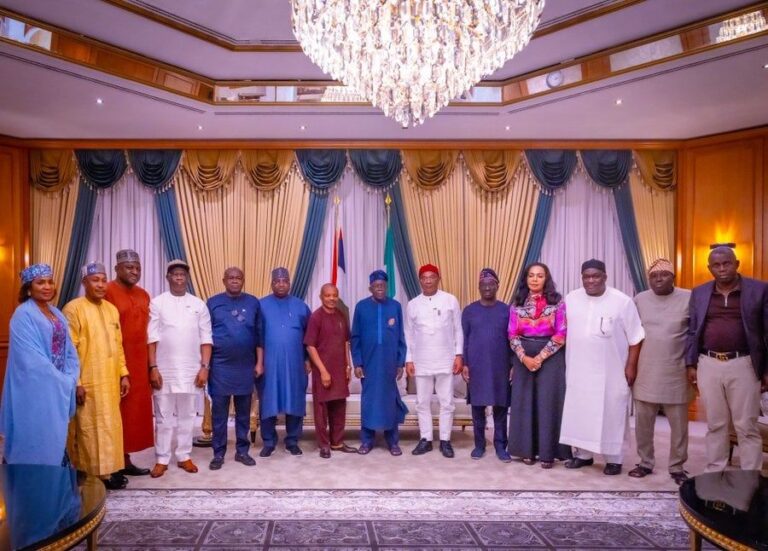
PRESIDENT Bola Tinubu met with the leadership of the Nigeria Labour Congress (NLC) late Tuesday over plans by the organised labour to stage a nationwide protest against unresolved demands.     

The Special Adviser on Information and Strategy to the President, Bayo Onanuga, revealed this in a statement, noting that the meeting which took place at the State House, Abuja, followed growing tensions between the Federal Government and labour unions over issues bordering on workers’ welfare, rising cost of living and the implementation of previously agreed concessions.

“President Bola Ahmed Tinubu met with the leadership of the NLC, along with the chairman of Progressive Governors Forum, Hope Uzodimma, Governor of Edo State, Monday Okpebholo and Governor of Kebbi State, Dr Nasir Idris, and the Minister of State Labour, Honourable Nkeiruka Onyejeocha,” the statement partly read.

Onanuga said that the Nigeria Labour Congress was led to the meeting by its national leadership, without highlighting the outcome of the meeting.

“The chairman of the NLC, Comrade Joe Ajaero, led the labour leaders to the meeting,” it added.

The meeting followed the NLC’s recent threat to embark on mass protests nationwide over what it described as the Federal Government’s failure to fully address workers’ demands, including relief measures to cushion the impact of economic reforms, wage-related concerns and broader socio-economic hardships faced by Nigerian workers.

The workers had accused the government of delaying the implementation of agreements reached in previous engagements, warning that failure to act decisively could trigger industrial unrest and street protests across major cities.

NMDPRA boss dismisses issuing viral statement, welcomes ICPC probe into Dangote’s allegations

0

THE Chief Executive Officer of the Nigerian Midstream and Downstream Petroleum Regulatory Authority (NMDPRA), Farouk Ahmed, has dismissed making any public statement in response to corruption allegations levelled against him.

He described a circulating response attributed to him as false.

In a statement reacting to the controversy on Wednesday, December 17, Ahmed said his attention was drawn to a “purported response” credited to him on the allegations, stressing that the statement did not originate from him.

“My attention has been drawn to a purported response I was said to have made on the recent allegations against my person. I hereby state categorically that the so-called statement did not emanate from me,” he said.

Ahmed acknowledged awareness of what he described as “wild and spurious allegations” against him and his family but said he deliberately refrained from engaging in public exchanges due to the sensitive nature of the sector he regulates.

“While I am aware of the wild and spurious allegations made against me and my family and the frenzy it has generated, as a regulator of a sensitive industry, I have opted not to engage in public brickbat,” he noted.

The NMDPRA boss said he welcomed the decision to submit the matter to a formal investigative body, expressing confidence that the process would afford him the opportunity to clear his name.

“Thankfully, the person behind the allegations has taken it to a formal investigative institution. I believe that would provide an opportunity to dispassionately distill the issues and to clear my name,” Ahmed added.

The ICIR reports that the reaction followed a petition submitted to the Independent Corrupt Practices and Other Related Offences Commission (ICPC) by Africa’s richest man, Aliko Dangote, through his lawyers.

Dangote had accused Ahmed of corruption, abuse of office, and financial impropriety, including allegations that millions of dollars were spent on the education of Ahmed’s children abroad.

The ICPC has since confirmed receipt of the petition and said it would investigate the allegations.

Dangote’s petition came days after he publicly accused the NMDPRA chief of living above his means during a press briefing, where he called on the Federal Government and anti-graft agencies to probe the regulator.

He also linked his accusations to broader concerns about alleged sabotage and entrenched cartels in Nigeria’s downstream petroleum sector, which he claimed were frustrating local refining efforts, including operations at his Lekki refinery.

Kekere-Ekun, S’Court, others mourn ex-CJN Tanko Muhammad

0

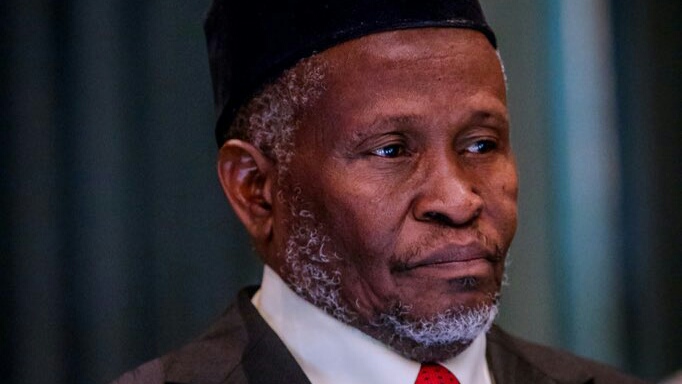
THE Chief Justice of Nigeria and Chairman of the National Judicial Council, Justice Kudirat Kekere-Ekun, joined other prominent Nigerians mourning the passing of former Chief Justice of Nigeria, Justice Ibrahim Tanko Muhammad.

Kekere-Ekun described his death as a profound loss to the nation’s judiciary in a statement signed and released by the NJC Secretary, Ahmed Gambo, on Tuesday, December 16.

 “His keen intellect and compassionate demeanour earned him the respect of judges, lawyers and citizens alike, as his contributions have indelibly shaped Nigeria’s legal landscape,” the CJN said.

Recall,Justice Muhammad, who died in the early hours of Tuesday at a hospital in Saudi Arabia, was about two weeks before his 72nd birthday on December 31.

While acknowledging the pain of his passing, the CJN said the judiciary takes solace in the enduring legacy of hard work, honesty, and dedication left behind by the former head of the Nigerian judiciary.

Also reacting to his death, the Supreme Court of Nigeria, in a statement issued by its Director of Information and Public Relations, Festus Akande, extended its condolences to the family of Muhammad.

“Justice Muhammad was a jurist whose tenure was marked by a strong commitment to the rule of law, judicial independence and the fair administration of justice,” Akande.

The court added that he played a key role in strengthening the appellate system, improving procedural efficiency, promoting the professional development of judges and judicial staff, and fostering a culture of transparency and accountability within the judiciary.

“Justice Muhammad is survived by members of his family and a grateful legal community, as the court and the CJN pray for the peaceful repose of his soul,” the statement added.

Also reacting, the Bauchi State Governor, Bala Mohammed, commiserated with the jurist’s family in a statement by his spokesman, Mukhtar Gidado.

Mohammed described Muhammad as a venerable jurist whose life and career exemplified dedication to duty, integrity in service, and steadfast commitment to the rule of law.

“It is with profound sadness and a deep sense of loss that His Excellency, Sen. Bala Abdulkadir Mohammed CON, FNIPR ( Kauran Daular Usmaniyya ), the Executive Governor of Bauchi State, on behalf of his family, the Government and the good people of Bauchi State, joins all Nigerians in mourning the sudden passing of Honourable Justice Ibrahim Tanko Muhammad, GCON, a distinguished son of our great State, who died today in a Saudi Arabian hospital after a prolonged illness,” the statement read.

The governor explained that the judge rose through the legal profession with diligence and distinction, bringing to the highest office in the nation’s judiciary his wealth of experience and commitment to justice.

The ICIR reports that Justice Muhammad, a devout Muslim, was praised for exemplifying the highest ideals of the Bench, as well as for his courage and integrity in the discharge of his duties.

He served as a Justice of the Supreme Court of Nigeria from 2006 to 2022 and as Chief Justice of Nigeria from 2019 until his resignation in June 2022 on grounds of ill health.

Born in Bauchi State, the late former CJN was called to the Bar in 1981 and began his judicial career in 1982. He was appointed Chief Magistrate of the High Court of the Federal Capital Territory in 1989, a position he held until 1991, before becoming a judge of the Bauchi State Sharia Court of Appeal. In 1993, he was elevated to the Court of Appeal and later rose to the Supreme Court.

Dangote petitions ICPC over alleged corruption by NMDPRA boss

0

AFRICA’S richest businessman, Aliko Dangote, has petitioned the Independent Corrupt Practices and Other Related Offences Commission (ICPC) over allegations of corruption, abuse of office, and financial impropriety against the Chief Executive Officer of the Nigerian Midstream and Downstream Petroleum Regulatory Authority (NMDPRA), Farouk Ahmed.

The petition, dated December 16, 2025, was signed by Dangote’s lawyer, Ogwu J. Onoja, a  Senior Advocate of Nigeria (SAN) who leads his legal team and was addressed to the Chairman of the ICPC in Abuja.

In the letter, the legal firm alleged that Ahmed, who was appointed NMDPRA chief executive in September 2021 by late former President Muhammadu Buhari, had “grossly abused his office contrary to the extant provisions of the Code of Conduct for public officers.”

It also noted that the petroleum regulatory boss had become “enmeshed in monumental corruption and unlawful spending of public funds running into Millions of Dollars.”

According to the petition, Ahmed allegedly spent “a humongous amount of money of over $7 Million of public funds for the education of his four children in different schools in Switzerland for a period of six years upfront,” without evidence of lawful income to support such expenditure.

The children listed in the petition are Faisal Farouk, Farouk Jr., Ashraf Farouk, and Farhana Farouk, with the schools named as Montreux School, Aiglon College, Institut Le Rosey, and La Garenne International School.

The lawyers further alleged that Ahmed had used “the instrumentality of his office as the Chief Executive Officer of the NMDPRA to embezzle and divert public funds for self-gains and pursuit of private interest to the detriment of the Nigerian people,” adding that the alleged actions had triggered protests by different groups and attracted media attention.

The petition argued that Ahmed’s career-long service in the public sector could not justify the alleged spending, stating that “the totality of his earnings over the years is nothing close to the sum of 7 Million USD diverted from the public coffers to pay for the education of his teenage children abroad.”

Dangote’s lawyers said the allegations amounted to abuse of office, corrupt enrichment, and embezzlement, offences for which the ICPC is empowered to investigate and prosecute under Section 19 of the Independent Corrupt Practices and Other Related Offences Act.

Quoting the law, the petition stated:
“Any public officer who uses his office or position to gratify or confer any corrupt or unfair advantage upon himself or any relation or associate of the public officer or any other public officer shall be guilty of an offence and shall on conviction be liable to imprisonment for five (s) years without option of fine.”

The petitioners added that their client was ready to provide evidence to substantiate the allegations and urged the ICPC to act decisively, noting that the matter was already in the public domain.

Public allegations

The ICIR reports that Dangote’s petition to the ICPC followed public allegations he made days earlier against the leadership of the NMDPRA.

On Sunday, December 14, Dangote accused the NMDPRA’s boss, Ahmed, of corruption and living beyond his legitimate income.

During a press briefing, the billionaire industrialist alleged that the regulator’s boss paid over $5 million in tuition fees to Swiss secondary schools for four of his children over six years.

He argued that such expenditure raised serious concerns about conflicts of interest and the integrity of regulatory oversight in Nigeria’s downstream petroleum sector, particularly at a time when the sector is undergoing major reforms and increased private-sector participation.

Backstory

Dangote’s allegations emerged amid his broader criticism of what he described as entrenched cartels within the downstream oil and gas industry, which he said were deliberately frustrating his multi-billion-dollar refinery project in Lekki, Lagos State.

According to him, these groups pose “a bigger threat than drug mafias” and have historically benefited from import dependence and regulatory loopholes.

He cited repeated acts of sabotage at his refinery and at publicly owned refineries, including the removal of spare parts from a 400-ton boiler at the Lekki facility, which he described as the largest ever built.

Dangote also pointed to widespread destruction of pipeline infrastructure nationwide, insisting that the damage was not due to natural wear but deliberate acts meant to undermine domestic refining.

The ICIR reports that Dangote’s dominance in the petroleum market has often exposed longstanding inefficiencies in Nigeria’s refining sector, triggering resistance from major oil marketers and labour unions.

His frequent fuel price reductions and calls for an end to fuel importation have repeatedly drawn pushback from industry players, especially as his refinery continues to reshape pricing and supply dynamics.

REA, NBS sign agreement on energy survey to support power sector plans

0

THE Rural Electrification Agency (REA) and the National Bureau of Statistics (NBS) have signed a memorandum of understanding (MoU) to jointly conduct a comprehensive national energy survey in Nigeria.

The initiative is designed to generate high-quality analytical data to support evidence-based planning and policy formulation in Nigeria’s power and energy sector.

The survey is to be carried out using the multi-tier tracking (MTF) framework being implemented under the energy sector management assistance programme (ESMAP) of the World Bank.

In a statement on Tuesday, December 16, REA said the MoU formalised a strategic partnership between the two federal government agencies to provide technical support and collaboration for the exercise.

The agreement was signed by the Managing Director/Chief Executive Officer of REA, Abba Aliyu, and the Statistician-General of the Federation/Chief Executive Officer of NBS, Adeyemi Adeniran, in Abuja.

On his part, Aliyu said the collaboration reflected REA’s commitment to data-driven rural electrification planning.

“This collaboration will provide granular, credible data on electricity access, affordability, and off-grid energy solutions across Nigeria,” he said.

“The findings will directly inform national electrification initiatives such as the National Electrification Strategy and Implementation Plan (NESIP), while also strengthening investor confidence in the sector.”

Also speaking, the Statistician-General of the Federation said the NBS would ensure that the survey meets global statistical standards.

“NBS is pleased to provide technical oversight, sampling expertise, and quality assurance to ensure that the survey adheres to global best practices. Reliable data is fundamental to effective policy and sustainable development,” Adeniran said.

Under the MoU, the statement said, both agencies will collaborate to assess energy access at the household, community, enterprise, and public institution levels.

The survey will also examine household energy affordability, spending patterns, and willingness to pay for grid and off-grid solutions, as well as analyse access to and usage of off-grid technologies such as solar home systems, mini-grids, and clean cooking solutions.

“REA will serve as a key implementation and policy partner, providing sectoral expertise, stakeholder engagement, public awareness, and alignment with Nigeria’s rural electrification priorities.

“NBS will provide regulatory approval, sampling frames, methodological validation, technical supervision, and capacity building for enumerators, ensuring data quality and credibility.

“The World Bank, through ESMAP, will fund and technically oversee the survey and engage a qualified survey firm responsible for field data collection, analysis, and reporting,” the statement added.

The REA said the MoU would be in effect for 18 months from the date of signing, while data from the survey is expected to support national energy planning, improve programme targeting, guide private sector investment, and strengthen Nigeria’s push towards universal access to electricity and clean cooking solutions.

According to the statement, the partnership reaffirms the federal government’s commitment to inter-agency collaboration, improved energy data availability, and sustainable electrification for rural and underserved communities.

Buhari once believed I plotted to kill him in Aso Rock – Aisha, late President’s wife

0

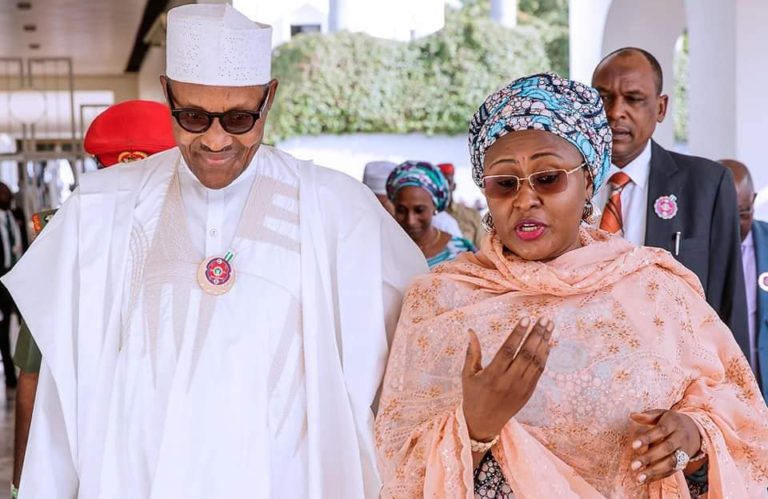
FORMER First Lady Aisha Buhari has disclosed that her late husband, former President Muhammadu Buhari, once believed rumours within the Aso Rock that she was plotting to kill him.

She said the development disrupted his feeding routine and worsened his health.

Aisha Buhari’s account is contained in a newly released biography titled ‘From Soldier to Statesman: The Legacy of Muhammadu Buhari, authored by Charles Omole, a doctorate holder, and launched at the State House on Monday, December 15.

The 600-page book chronicles Buhari’s life from his childhood in Daura, Katsina State, to his final days in a London hospital in July 2025, according to a Punch report.

The book quotes the former First Lady as saying Buhari began locking his room and changing his habits after being fed with what she described as malicious gossip within the Presidential Villa.

“Then came the gossip and the fearmongering. They said I wanted to kill him,” the book says.

“My husband believed them for a week or so,” it adds.

Aisha Buhari also linked the health crisis that kept Buhari away from office for several months in 2017 to what she described as a breakdown in his nutrition routine rather than poisoning or a mysterious illness.

The ICIR reports that in February 2016, Buhari embarked on a six-day vacation to the United Kingdom. A few months later, in June, he returned to England for a 10-day medical trip to treat an ear infection. He later extended his stay by three days to recuperate.

In January 2017, Buhari returned to London for another medical vacation. The following month, he wrote to the National Assembly requesting an extension of his medical leave.

He returned to Abuja on March 10, 2017, after spending 50 days outside Nigeria. In May 2017, the late leader again left for London on what became one of his longest medical vacations, spending 104 days before returning to Nigeria.

What followed was a wave of speculation and misinformation about his health, with some even claiming he had died and was replaced by a body double named “Jubril of Sudan” – a tale many still believe even after his death.

The late leader did not visit London later that year for another medical check-up until May 2018, when he spent four days for a “medical review.”

Explaining further on the former president’s health, Aisha said before moving into Aso Rock, she had personally overseen Buhari’s meals and supplements, a system she said helped manage his long-standing malnutrition symptoms.

“Elderly bodies require gentle, consistent support,” she recalled, adding, “He doesn’t have a chronic illness. Keep him on schedule.”

The book says after Buhari moved into the Villa, the routine collapsed, with meals delayed, supplements stopped, and nutrition mismanaged.

“My husband believed them for a week or so,” she said, revealing that Buhari began locking his room, while “meals were delayed or missed; the supplements were stopped.”

“For a year, he did not have lunch. They mismanaged his meals,” she added.

Aisha explained that she convened a meeting with senior aides, including the presidential physician, the Chief Security Officer, the housekeeper, and the Director-General of the Department of State Services, to explain the nutrition plan her husband required.

She described the regimen as “daily, at specific hours, cups and bowls with tailored vitamin powders and oils, a touch of protein here, a change to cereals there.”

In London, doctors reportedly prescribed a more intensive nutrition plan. Initially, Buhari was said to be reluctant to comply, prompting his wife to take charge of his care.

“She took charge of his welfare, slipping hospital-issued supplements into his juice and oats,” Omole wrote.

Aisha Buhari described the recovery as rapid. “After just three days, he threw away the stick he was walking with. After a week, he was receiving relatives.”

She said, “that was the genesis, and also the reversal of his sickness.”

She also dismissed long-standing claims that Buhari was poisoned, insisting that the health crisis stemmed from “loss of a routine, ‘my nutrition.’”

The biography further revealed what it described as a climate of mistrust within the Presidency.

Aisha further dismissed rumours that Buhari was replaced by a body double known as “Jibril of Sudan,” describing the claim as absurd and blaming poor government communication for allowing conspiracy theories to thrive.

FG, States, LGs share ₦1.928 trillion FAAC allocation in November

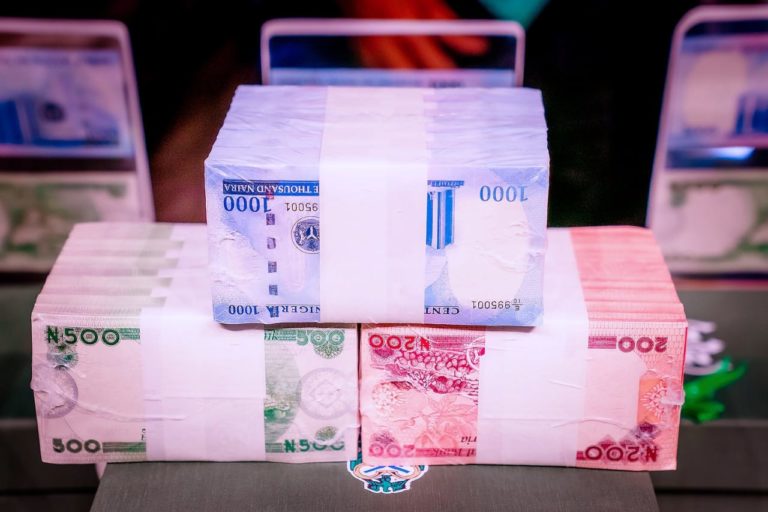
THE Federation Account Allocation Committee (FAAC) shared ₦1.928 trillion as November 2025 federation account revenue for federal, states, and local governments.

The FAAC said the revenue was shared at the December 2025 Federation Account Allocation Committee (FAAC) meeting in Abuja.

The ₦1.928 trillion total distributable revenue comprised distributable statutory revenue of ₦1.403 trillion, distributable Value Added Tax (VAT) revenue of ₦485.838 billion, and Electronic Money Transfer Levy (EMTL) revenue of ₦39.646 billion.

A communiqué issued on Monday, December 15, by FAAC indicated that the total gross revenue of ₦2.343 trillion was available in November 2025. The total deduction for the cost of collection was ₦84.251 billion, while the total transfers, interventions, refunds, and savings were ₦330.625 billion.

According to the communiqué, gross statutory revenue of ₦1.736 trillion was received for November 2025. This was lower than the sum of ₦2.164 trillion received in the month of October 2025 by ₦427.969 billion.

The communique noted that the gross revenue of N563. 042 billion was available from the VAT in November 2025. Conversely, this was lower than the N719.827 billion available in the month of October 2025 by N156.785 billion.

The FAAC said that from the N1.928 trillion total distributable revenue, the Federal Government received a total sum of N747.159 billion, and the State Governments received N601.731 billion.

Local Government Areas got N445.266 billion, while N134.355 billion (13 per cent of mineral revenue) was shared with the benefiting states as derivation revenue.

On the N1.403 trillion distributable statutory revenue, the communiqué stated that the Federal Government received N668.336 billion and the State Governments were allocated N338.989 billion.

Also, the local government councils received N261.346 billion, and N134.355 billion (13 per cent of mineral revenue) was shared among the benefiting states as derivation revenue.

From the N485.838 billion distributable VAT revenue, the Federal Government got N72.876 billion, the State Governments received N242.919 billion, and the Local Government Areas were given N170.043 billion.

A total sum of N5.947 billion was received by the Federal Government from the N39.646 billion Electronic Money Transfer Levy (EMTL), the State Governments took N19.823 billion, and the Local Government Councils got N13.876 billion.

The communique added that in November 2025, Excise Duty increased moderately while Petroleum Profit Tax (PPT), Hydrocarbon Tax (HT), CIT on Upstream Activities, Companies Income Tax (CIT), CGT and SDT, Oil & Gas Royalties, Import Duty, CET Levies, Value Added Tax (VAT), Electronic Money Transfer Levy (EMTL) and Fees recorded substantial decreases.

2025 budget carryover: FG admits deep revenue gaps as Senate demands answers

THERE are doubts over 2026 budget projections after the Federal Government admitted that it realised just ₦10 trillion out of the ₦40 trillion revenue targeted for the 2025 fiscal year.

This development led to the Senate asking questions about persistent borrowing, overlapping budgets and weak capital project execution.

These concerns dominated an interactive session between the Senate Committee on Finance and the Federal Government’s economic management team on Monday, December 15, in Abuja, as lawmakers began scrutiny of the 2026–2028 Medium-Term Expenditure Framework and Fiscal Strategy Paper (MTEF/FSP).

The Minister of Finance and Coordinating Minister of the Economy, Wale Edun, at the event acknowledged that revenue performance in both 2024 and 2025 fell significantly short of projections, creating structural pressure on budget implementation and spilling capital spending into subsequent years.

“We projected about ₦40 trillion in revenue for 2025, but actual federal government cash revenue is roughly ₦10 trillion,” Edun told the lawmakers.

“That gives us funding capacity for only about 30 per cent of the budget, meaning nearly 70 per cent of capital projects will roll over into 2026.”

The admission also confirmed that Nigeria is operating multiple budgets within a single fiscal year, an outcome the lawmakers described as unsustainable and unacceptable.

Some economic watchers also questioned the gains of the subsidy removal if the government could not fund the budget despite its numerous borrowed funds through supplementary budgets.

Former Gombe State governor, Danjuma Goje, called the situation ‘ugly’, warning that it undermined fiscal discipline and public confidence.

“Are projects in the 2024 budget fully paid for? The 2025 budget has not really been implemented. How do we return to normal budgeting instead of running three budgets at the same time?” Goje queried.

Other lawmakers, including Ireti Kingibe, Victor Umeh and Aminu Iya Abbas, pressed the finance team to explain how over ₦17 trillion borrowed within the first 10 months of 2025 was deployed, given the massive revenue shortfall and stalled capital projects.

Available data presented at the session showed that Nigeria borrowed about ₦17.36 trillion during the period, ₦15.8 trillion domestically and ₦1.56 trillion externally, raising fresh concerns about debt sustainability amid weak revenue inflows.

Edun also clarified that President Bola Tinubu’s earlier claim that revenue targets had been met by August 2025 referred strictly to non-oil revenue, not total government income.

“In 2024, we estimated revenue at ₦25.9 trillion, but actual receipts were about ₦8.27 trillion. In 2025, the pattern repeated,” Edun claimed.

“This historical trend shows clearly that we must adopt a far more realistic revenue framework going into 2026.”

Senator Adams Oshiomhole added a labour-market dimension to the debate, warning that poor capital budget performance was choking job creation.

“How do we create jobs when capital projects are not implemented? Once the capital budget fails, the system fails to generate employment,” he reasoned.

While defending the government’s approach, the Chairman of the Federal Inland Revenue Service, Zacch Adedeji, argued that budget revenues remain projections until cash is realised, adding that loans embedded in budgets would not automatically translate into available funds.

However, senators pushed back strongly, with the Senate Committee on Finance formally tasking the FIRS to raise its 2026 revenue target from ₦31 trillion to ₦35 trillion, signalling lawmakers’ insistence on more aggressive domestic revenue mobilisation.

The committee chairman, Sani Musa, said the Senate would not consider the 2026–2028 MTEF/FSP until a comprehensive public hearing is conducted to probe revenue performance for the 2024 and 2025 budgets.

“We must understand why revenues consistently underperform before projecting new figures for 2026,” he posited, stressing that a three-man ad hoc committee would engage the Finance Ministry and the Accountant-General to ensure contractors are paid for verified 2024 projects before the budget expires on December 31.

Under the proposed budget framework, the Federal Government plans a ₦54.5 trillion budget for 2026, with projected revenue of ₦34.33 trillion, implying a deficit of about ₦20 trillion and debt service obligations estimated at ₦15.9 trillion.

The MTEF assumes crude oil production of 1.84 million barrels per day at a benchmark price of $64.85 per barrel, an exchange rate of ₦1,512/$, and GDP growth of 4.68 per cent, assumptions defended by Edun, Budget Minister Atiku Bagudu and Petroleum Minister Heineken Lokpobiri.

But lawmakers remain unconvinced, especially given that the MTEF arrived late at the National Assembly, contrary to the Fiscal Responsibility Act timeline.


Recuse yourself from my trial, Malami tackles EFCC chairman, alleges vendetta

0

FORMER Attorney-General of the Federation and Minister of Justice, Abubakar Malami, a senior advocate, has protested his detention by the Economic and Financial Crimes Commission (EFCC), describing it as illegal, politically motivated, and driven by personal vendetta, while demanding that the EFCC chairman, Ola Olukoyede, recuse himself from investigating him.

In a statement on Monday, December 15, by his media aide, Mohammed Bello Doka, Malami described the EFCC’s actions against him as a “politically motivated witch-hunt,” which he said was triggered by his recent defection to the African Democratic Congress (ADC).

Malami alleged that the investigation and his continued detention were not driven by genuine law enforcement concerns but by “deep-seated historical animosity” involving the EFCC chairman.

He recalled that while he served as attorney-general, the Federal Government set up the Justice Ayo Salami Judicial Commission of Inquiry to probe allegations of corruption and abuse of office within the EFCC, during which the current EFCC chairman served as secretary.

According to Malami, the Salami report contained findings implicating the EFCC chairman, including recommendations that could have led to his prosecution.

He argued that the ongoing investigation against him “bears all the hallmarks of retaliatory persecution” motivated by personal revenge.

Malami said he had been pre-judged and could not receive a fair and impartial investigation under the current leadership of the anti-graft agency.

He therefore demanded that the EFCC chairman immediately withdraw from the case and that the matter be transferred to another appropriate law enforcement body to safeguard credibility and public confidence.

“Malami reiterates his insistence on immediate prosecution or release, demanding that a charge be filed and that he be arraigned before a court of competent jurisdiction within 24 hours, in strict compliance with Sections 35(3), (4), and (5) of the Constitution of the Federal Republic of Nigeria (1999, as amended).

“He has consistently maintained that only a court of competent jurisdiction, and not politically compromised agencies, can lawfully and credibly adjudicate this matter,” the statement added.

Malami also accused the EFCC of attempting to rely on individuals allegedly convicted by foreign courts and serving criminal sentences abroad as witnesses against him.

He described the move as an abuse of process and warned that it undermined the integrity of Nigeria’s criminal justice system.

The ICIR reports that Malami’s latest demands came amid his continued detention by the EFCC following his alleged failure to meet bail conditions imposed by the anti-graft agency.

The commission had earlier said the former attorney-general was granted administrative bail after a brief interrogation on November 28, 2025, pending the conclusion of investigations and possible arraignment in court.

According to the EFCC, the bail was provisional and subject to five conditions, none of which Malami allegedly fulfilled.

EFCC reacts

Earlier, the EFCC had dismissed claims that it is being weaponised against opposition politicians, insisting that its mandate is strictly to investigate and prosecute economic and financial crimes, regardless of political affiliation.

In a statement on Monday, the commission said allegations of persecution, politicisation, or erosion of its independence by political actors were deliberate misrepresentations of its constitutional responsibilities.

The commission argued that its operations were guided solely by its Establishment Act, which mandates it to investigate and prosecute all economic and financial crimes, except where suspects enjoy constitutional immunity.

The anti-graft agency said its record over the past two years showed that suspects from both the ruling party and opposition parties, including former governors and ministers, have been investigated and prosecuted, stressing that corruption “has no gender, religion, tribe, or political party.

“What the so-called opposition politicians are seeking to achieve in this assault against the EFCC is far from altruistic, but a veiled attempt to confer immunity from prosecution for alleged corruption on politicians who suddenly find themselves in the opposition. This gambit is alien to the Nigerian constitution and the enabling law of the Commission both of which compel mandatory action against any evidence of graft irrespective of the position and political inclinations of the accused.
“The Commission won’t succumb to blackmail or be railroaded into inconclusive investigations just to be seen to be non- selective in its operations,” it added.

Again, Nigeria’s inflation eases to 14.45% in November as food prices drop

NIGERIA’S headline inflation rate has again declined further to 14.45 per cent in November 2025, according to the latest Consumer Price Index (CPI) report released by the National Bureau of Statistics (NBS).

The figure represents a drop from the 16.05 per cent recorded in October, continuing the downward trend under the recently rebased CPI, which now uses 2024 as its base year instead of 2009.

NBS data, released on Monday, December 15, showed that the CPI increased to 130.5 points in November from 128.9 points in October, reflecting a 1.6-point rise month on month. 

In its report, the statistics agency said headline inflation in November was 20.15 percentage points lower than the 34.60 per cent recorded in the same month of 2024, largely due to the impact of the rebasing exercise.

The average CPI for the 12 months ending November 2025 rose by 20.41 per cent, a significant slowdown from the 32.77 per cent recorded in November 2024.

“The Consumer Price Index rose to 130.5 in November 2025, reflecting a 1.6-point increase from the preceding month (128.9).

“In November 2025, the Headline inflation rate eased to 14.45 per cent relative to the October 2025 headline inflation rate of 16.05 per cent.

“Looking at the movement, the November 2025 Headline inflation rate showed a decrease of 1.6 per cent compared to the October 2025 Headline inflation rate,” the NBS report read.

The drop was hugely impacted by the drop in food inflation in November 2025 to 11.08 per cent year on year in November 2025, down from 39.93 per cent recorded in November 2024, following the easing of prices for maize, garri and beans.

The ICIR reported that in its October 2025 inflation report, the NBS said the inflation rate showed a decrease of 1.96 per cent compared to the September 2025 headline inflation rate, and on a year-on-year basis, the headline inflation rate was 17.82 per cent lower than the rate recorded in October 2024 (33.88%).

The significant decline in the annual food inflation figure is technically due to the change in the base year methodology. Accordingly, on a month-on-month basis, the food inflation rate in October 2025 was -0.37 per cent, up by 1.21 per cent compared to September 2025 (-1.57 per cent).

It added that the average annual rate of food inflation for the twelve months ending October 2025 over the previous Twelve-month average was 21.96 per cent, which was 16.16 percentage points lower compared with the average annual rate of change recorded in October 2024 (38.12 per cent).