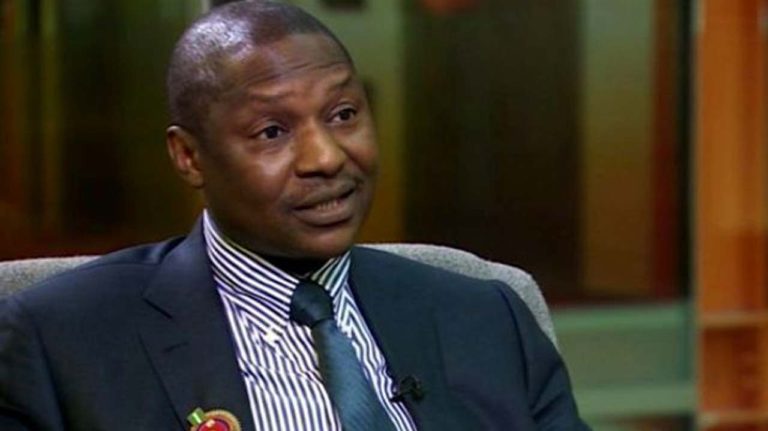
FORMER Attorney-General of the Federation and Minister of Justice, Abubakar Malami, a senior advocate, has protested his detention by the Economic and Financial Crimes Commission (EFCC), describing it as illegal, politically motivated, and driven by personal vendetta, while demanding that the EFCC chairman, Ola Olukoyede, recuse himself from investigating him.
In a statement on Monday, December 15, by his media aide, Mohammed Bello Doka, Malami described the EFCC’s actions against him as a “politically motivated witch-hunt,” which he said was triggered by his recent defection to the African Democratic Congress (ADC).
Malami alleged that the investigation and his continued detention were not driven by genuine law enforcement concerns but by “deep-seated historical animosity” involving the EFCC chairman.
He recalled that while he served as attorney-general, the Federal Government set up the Justice Ayo Salami Judicial Commission of Inquiry to probe allegations of corruption and abuse of office within the EFCC, during which the current EFCC chairman served as secretary.
According to Malami, the Salami report contained findings implicating the EFCC chairman, including recommendations that could have led to his prosecution.
He argued that the ongoing investigation against him “bears all the hallmarks of retaliatory persecution” motivated by personal revenge.
Malami said he had been pre-judged and could not receive a fair and impartial investigation under the current leadership of the anti-graft agency.
He therefore demanded that the EFCC chairman immediately withdraw from the case and that the matter be transferred to another appropriate law enforcement body to safeguard credibility and public confidence.
“Malami reiterates his insistence on immediate prosecution or release, demanding that a charge be filed and that he be arraigned before a court of competent jurisdiction within 24 hours, in strict compliance with Sections 35(3), (4), and (5) of the Constitution of the Federal Republic of Nigeria (1999, as amended).
“He has consistently maintained that only a court of competent jurisdiction, and not politically compromised agencies, can lawfully and credibly adjudicate this matter,” the statement added.
Malami also accused the EFCC of attempting to rely on individuals allegedly convicted by foreign courts and serving criminal sentences abroad as witnesses against him.
He described the move as an abuse of process and warned that it undermined the integrity of Nigeria’s criminal justice system.
The ICIR reports that Malami’s latest demands came amid his continued detention by the EFCC following his alleged failure to meet bail conditions imposed by the anti-graft agency.
The commission had earlier said the former attorney-general was granted administrative bail after a brief interrogation on November 28, 2025, pending the conclusion of investigations and possible arraignment in court.
According to the EFCC, the bail was provisional and subject to five conditions, none of which Malami allegedly fulfilled.
EFCC reacts
Earlier, the EFCC had dismissed claims that it is being weaponised against opposition politicians, insisting that its mandate is strictly to investigate and prosecute economic and financial crimes, regardless of political affiliation.
In a statement on Monday, the commission said allegations of persecution, politicisation, or erosion of its independence by political actors were deliberate misrepresentations of its constitutional responsibilities.
The commission argued that its operations were guided solely by its Establishment Act, which mandates it to investigate and prosecute all economic and financial crimes, except where suspects enjoy constitutional immunity.
The anti-graft agency said its record over the past two years showed that suspects from both the ruling party and opposition parties, including former governors and ministers, have been investigated and prosecuted, stressing that corruption “has no gender, religion, tribe, or political party.
“What the so-called opposition politicians are seeking to achieve in this assault against the EFCC is far from altruistic, but a veiled attempt to confer immunity from prosecution for alleged corruption on politicians who suddenly find themselves in the opposition. This gambit is alien to the Nigerian constitution and the enabling law of the Commission both of which compel mandatory action against any evidence of graft irrespective of the position and political inclinations of the accused.
“The Commission won’t succumb to blackmail or be railroaded into inconclusive investigations just to be seen to be non- selective in its operations,” it added.
NIGERIA’S headline inflation rate has again declined further to 14.45 per cent in November 2025, according to the latest Consumer Price Index (CPI) report released by the National Bureau of Statistics (NBS).
The figure represents a drop from the 16.05 per cent recorded in October, continuing the downward trend under the recently rebased CPI, which now uses 2024 as its base year instead of 2009.
NBS data, released on Monday, December 15, showed that the CPI increased to 130.5 points in November from 128.9 points in October, reflecting a 1.6-point rise month on month.
In its report, the statistics agency said headline inflation in November was 20.15 percentage points lower than the 34.60 per cent recorded in the same month of 2024, largely due to the impact of the rebasing exercise.
The average CPI for the 12 months ending November 2025 rose by 20.41 per cent, a significant slowdown from the 32.77 per cent recorded in November 2024.
“The Consumer Price Index rose to 130.5 in November 2025, reflecting a 1.6-point increase from the preceding month (128.9).
“In November 2025, the Headline inflation rate eased to 14.45 per cent relative to the October 2025 headline inflation rate of 16.05 per cent.
“Looking at the movement, the November 2025 Headline inflation rate showed a decrease of 1.6 per cent compared to the October 2025 Headline inflation rate,” the NBS report read.
The drop was hugely impacted by the drop in food inflation in November 2025 to 11.08 per cent year on year in November 2025, down from 39.93 per cent recorded in November 2024, following the easing of prices for maize, garri and beans.
The ICIRreported that in its October 2025 inflation report, the NBS said the inflation rate showed a decrease of 1.96 per cent compared to the September 2025 headline inflation rate, and on a year-on-year basis, the headline inflation rate was 17.82 per cent lower than the rate recorded in October 2024 (33.88%).
The significant decline in the annual food inflation figure is technically due to the change in the base year methodology. Accordingly, on a month-on-month basis, the food inflation rate in October 2025 was -0.37 per cent, up by 1.21 per cent compared to September 2025 (-1.57 per cent).
It added that the average annual rate of food inflation for the twelve months ending October 2025 over the previous Twelve-month average was 21.96 per cent, which was 16.16 percentage points lower compared with the average annual rate of change recorded in October 2024 (38.12 per cent).
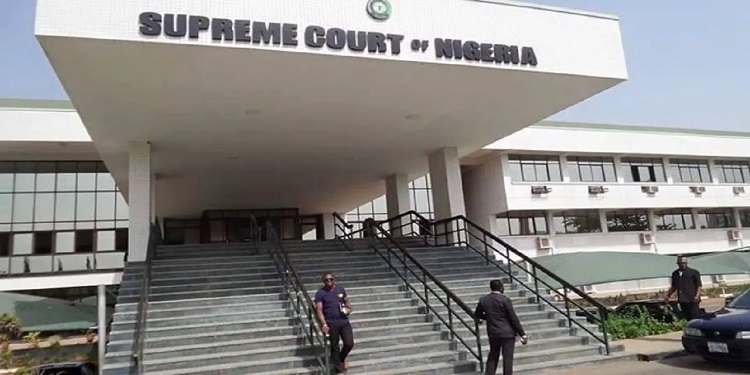
THE Supreme Court on Monday, December 15, affirmed the constitutional power of the president to declare a state of emergency in any part of Nigeria to prevent a breakdown of law and order.
In a majority judgment of six justices against one, the apex court further upheld that the president might temporarily suspend elected state officials during an emergency period.
The ruling followed a litigation filed by Adamawa State and 10 other states governed by the Peoples’ Democratic Party (PDP) over the emergency rule imposed on Rivers State in March 2025 by President Bola Tinubu.
Following the declaration, the president suspended the state Governor Siminalayi Fubara, his deputy, Ngozi Odu, a professor, and members of the State House of Assembly for six months.
The emergency rule was subsequently lifted in September 2025.
The plaintiff – Adamawa, Enugu, Osun, Oyo, Bauchi, Akwa Ibom, Plateau, Delta, Taraba, Zamfara, and Bayelsa states – represented by their attorneys-general, argued that the president acted outside his constitutional bounds by suspending democratically elected officials and dissolving legislative structures.
They also questioned the legality of the process leading to the emergency declaration, insisting it undermined federalism and democratic governance.
The plaintiffs urged the court to determine “whether, upon a proper construction and interpretation of Sections 1(2), 5(2), 176, 180, 188, and 305 of the Constitution of the Federal Republic of Nigeria 1999, the president of the Federal Republic of Nigeria can lawfully suspend, or in any manner whatsoever interfere with, the offices of a governor and the deputy governor of any of the 36 component states of the federation and replace them with his unelected nominee as a sole administrator, under the guise of, or pursuant to, a proclamation of a state of emergency in any of the plaintiffs’ states.
They also asked “Whether, upon a proper construction and interpretation of Sections 1(2), 4(6), 11(4) & (5), 90, 105, and 305 of the Constitution, the president can lawfully suspend the House of Assembly of any of the 36 States under the guise of, or pursuant to, a proclamation of a state of emergency in such states.”
Delivering the lead judgment, one of the judges, Mohammed Idris, stated that Section 305 of the 1999 Constitution (as amended) granted the president discretionary powers to determine the measures required during a state of emergency.
He explained that the Constitution did not expressly define the scope of “extraordinary measures” that might be adopted in such circumstances, thereby leaving room for presidential discretion where normal governance structures were deemed incapable of maintaining order.
The court further upheld objections raised by the Attorney-General of the Federation and the National Assembly, holding that the plaintiffs failed to establish a dispute that would activate the court’s original jurisdiction.
Consequently, the court struck out the suit for want of jurisdiction and proceeded to dismiss it on the merits.
Obande Ogbuinya, the dissenting justice, agreed that the president had the power to declare a state of emergency but maintained that such authority did not extend to suspending elected state officials or legislative assemblies.
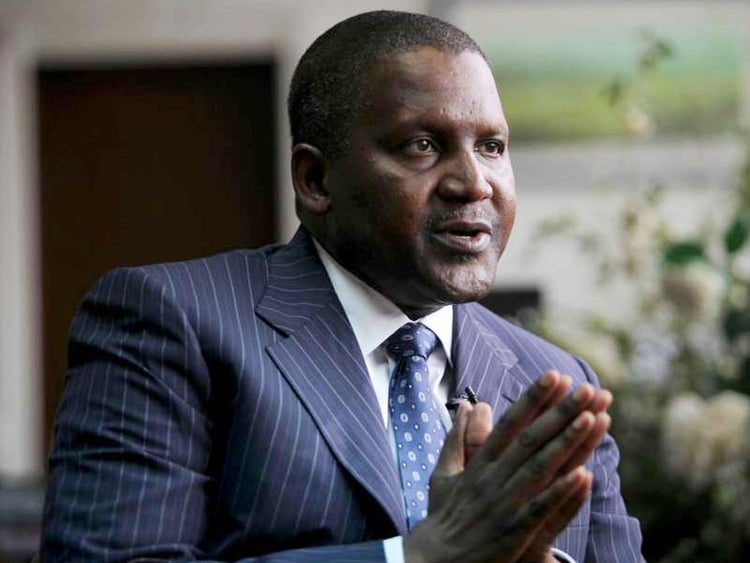
THE chairman of Dangote Industries Limited (DIL), Aliko Dangote, has accused the Managing Director of the Midstream Downstream Petroleum Regulatory Authority (NMDPRA), Farouk Ahmed, of corruption.
The billionaire businessman has also called for the NMDPRA boss’ probe by anti-graft agencies.
Dangote, during a press briefing on Sunday, December 14, alleged that Ahmed paid $5 million to Swiss secondary schools for his children.
Dangote said Ahmed paid the said amount for four of his children, covering a period of six years.
Although the Africa richest man did not mention the name of the Swiss schools, he said the NMDPRA’s CEO was living above his means. He challenged the Federal Government to investigate his claim.
He argued that such expenditure raised serious questions about potential conflicts of interest and the integrity of regulatory oversight in the downstream petroleum sector.
Cartels in downstream sector frustrating my refinery business
Similarly, Dangote raised concerns over alleged sabotage in Nigeria’s downstream oil sector.
He recounted multiple ‘sabotage’ incidents at both his facility and public refineries.
He also lamented that organised cartels pose a “bigger threat than drug mafias.”
He cited examples at his refinery in Lekki, including the removal of spare parts from a 400-ton boiler, which he described as the largest ever built.
“If I tell you the sabotages that we went through, including some of the machine manufacturers that were on the verge of going to court, you will know what I’m saying.
“Drug mafias are actually smaller than the people who are in oil and gas. They have robbed so many people in this sector,” he added.
The Kano-born sexagenarian also highlighted the destruction of pipeline infrastructure across the country.
He alleged that depots from Kano to other states had been deliberately sabotaged, not damaged by natural causes.
“You are talking about sabotage, and I’m happy that you are also here in Nigeria. I don’t know if Mele Kyari [former NNPCL GCEO] is still in town, but I think you should go to his house in Maitama and ask him how many sabotages the Port Harcourt refinery repairs went through.
“He told me many times that they have had more than 100 sabotages at the refinery. You can ask him, and he will tell you. Why is it that, for example, all the pipelines built from the military base to date are no longer functioning?
“The one that we have, which is from where I am from, Kano, that depot, we were not using trucks. The depots were only loading the trucks. Everything was piped up to that. 22 depots were built. They are all piped, all 22 depots.
“Actually, even the sediments don’t have it anymore. They have destroyed the pipes, all of them. So, if it is not sabotage, is that an earthquake? It’s not an earthquake, it’s sabotage. Sabotage is sabotage. So, that is what it is,” Dangote stated.
The ICIR reports that Dangote’s dominance as a market leader had exposed poor management and redundancy of Nigerian refineries.
The pioneer chairman of ECOWAS Business Council had on several occasions faced attacks by the petroleum major oil marketers over price war, which has also raised eyebrows whenever he slashes prices or raises questions over his staff’s membership allegiance to the Petroleum and Natural Gas Senior Staff Association of Nigeria (PENGASSAN)
Dangote on Sunday also announced that petrol would be sold for N739 per litre in many filling stations across the nation.
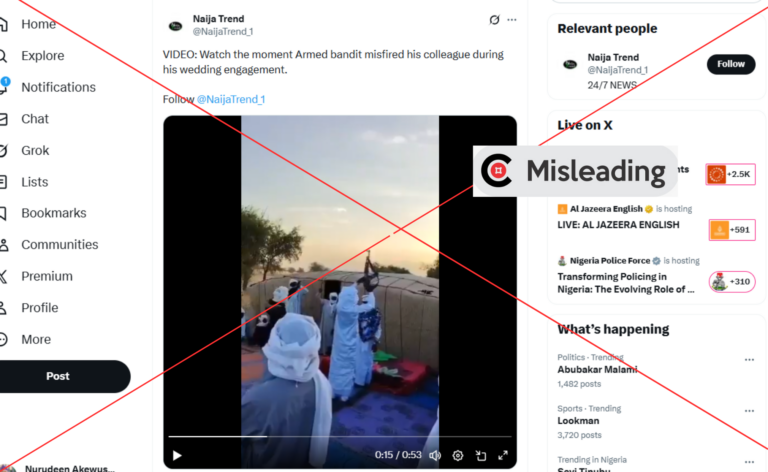
A video circulating on social media claims to show a bandit leader in Nigeria being accidentally shot by his colleague during his wedding celebration.
The 53-second clip shows a group of men gathered in a circle, wearing different outfits and turbans covering most of their faces. One man holding a gun walks toward another and fires into the air. One of the bullets appears to hit a man identified by the Facebook user as the leader, after which the crowd rushes toward him as he appears to be bleeding.
An X account, @Naija Trend_1, posted the video with the caption:
“VIDEO: Watch the moment Armed bandit misfired his colleague during his wedding engagement.”
As of December 10, 2025, the post had generated 800 reposts and over 2,000 likes with many suggesting they are terrorists in Nigeria.
A Facebook user, Abumeze Chukwumaeze Ibe, posted frames in the video with a caption:
“Bandits Leader Mistakenly Kills Another Leader During Celebration (Photos)
A viral video shows a group of bandits gathered for what appears to be a special occasion. One of the leaders arrived on a bike with some members, while another leader was already seated and surrounded by his men. The seated leader raised his hand in greeting as soon as he saw the other leader coming down from the bike.
However, the leader who arrived on the bike, along with two others, began shooting into the air like a gun salutation to the one seated. Somehow, he fired some bullets straight into the head of the one sitting down, and immediately others realised what had happened, they gathered around him…..”
CLAIM
Video shows a bandits leader in Nigeria accidentally shot during a gathering.
screenshot of the viral post
THE FINDINGS
Findings by The FactCheckHub show that the claim is MISLEADING.
The claim is circulating amid a rise in terrorist attacks, kidnappings, and violent incidents across Nigeria, which has heightened public sensitivity to videos showing shootings or injuries. For instance, in November 2025, over 300 schoolchildren and 12 teachers were abducted from St. Mary’s Catholic School in Papiri, Niger State, in one of the largest mass kidnappings in recent times.
Around the same period, gunmen stormed a girls’ boarding school in Kebbi State, abducting 25 students. Such attacks, along with repeated raids on communities and clashes between armed groups, have prompted widespread outrage, fear, and rapid sharing of related content on social media.
The FactCheckHub subjected the keyframes in the video to Google Reverse Image search, and it was traced back to November 28, 2025, in Amdirib, Batha Province, Chad.
Reports by platforms like The Zambia Observer and Daily Star indicate the video shows a man who was accidentally shot on his wedding day after his brother fired celebratory gunshots into the air. The groom later died at the provincial hospital, and local authorities launched an investigation.
The shooting was part of a cultural practice in Chad, where communities, including the Hadjerai people, fire guns into the air during weddings and other celebrations to express joy.
Analysis of the video indicates that the language spoken by the people is Hadjerai, largely spoken in the Batha province of Chad, further establishing that the incident occurred in Chad and not Nigeria.
Extensive searches using keywords from the social media post found no verifiable reports of a similar incident in Nigeria.
THE VERDICT
The claim that the video shows a Fulani herdsmen leader being shot in Nigeria is FALSE. The incident actually took place in Chad during a wedding celebration, where ceremonial gunfire accidentally struck the groom.
THE Federal Inland Revenue Service (FIRS) has said the memorandum of understanding (MoU) it signed with France’s Direction Générale des Finances Publiques (DGFiP) would not grant the European nation access to Nigerian taxpayers’ data or systems.
The DGFiP (Directorate General of Public Finances) is an agency of the French government that plays a key role in public finance management, including taxes.
On December 10, the service signed an MoU with the DGFiP on the promotion of efficient tax administration.
The MoU has raised a lot of questions from economic and security stakeholders over a possible data privacy breach.
However, in a statement on Sunday, December 14, the FIRS clarified misconceptions about the development.
“MoU is a standard, globally recognised cooperation framework focused solely on technical assistance and capacity building,” the FIRS said.
It explained that it did not grant France access to Nigerian taxpayers’ data, digital systems, or any element of the country’s operational infrastructure.
“All existing Nigerian laws on data protection, cybersecurity, and sovereignty remain fully applicable and strictly enforced.
“The Nigeria Revenue Service (NRS), like its predecessor (FIRS), places the highest premium on national security and maintains rigorous standards for the protection of all taxpayers’ information,” it stated.
The FIRS said the MoU was to leverage France’s expertise in digital transformation, taxpayer services, governance, and public finance.
“It is advisory, non-intrusive, and entirely under Nigeria’s control. Contrary to misconceptions, the MoU does not displace local technology providers,” the Service said.
“FIRS and the emerging Nigerian Revenue Service (NRS) continue to work closely with Nigerian innovators such as NIBSS, Interswitch, PayStack, and Flutterwave,” it stressed.
According to the FIRS, the MoU strengthens Nigeria’s sovereignty to build a modern, capable, globally competitive tax administration, one firmly in command of its systems, data, and strategic direction.
While expressing concerns over data privacy breach, the Executive Director of Centre for African Policy Reserach and Advisory (CAfPRA), Segun Adebayo, said the full execution of Nigeria’s tax reforms must remain 100 per cent in Nigeria’s hands, noting that it’s a sovereign security risk if a foreign entity has access to Nigerian tax data, financial transactions or national digital records.
He expressed fears over espionage, surveillance and massive exploitation, stating that, “Foreign-controlled systems open the door of espionage, digital colonisation and economic sabotage.
He further stressed that the MoU could give real-time visibility into which sectors thrive, which could give France leverage in every future trade, investment and loan negotiations.
“No serious country hands its tax backbone to a foreign power,” he added.
In a similar vein, the spokesperson of the African Democratic Congress (ADC), Bolaji Abdullahi, said on Sunday, December 14, on his official X account that the MoU endangered Nigeria’s data security and exposed a strategic national economic information for foreign exploitation.
“Tax matters are about business, not charity. In entering into this business agreement, the FIRS has told us what Nigeria stands to benefit. However, it has failed to tell us what France stands to benefit from this deal. Why did the Federal Government of Nigeria enter into a serious agreement such as this, which potentially infringes on national security and sovereignty, without public disclosure of its full terms, without open engagement with the National Assembly, and without any meaningful effort to carry Nigerians along?”, Adbullahi queried.
He further queried the broader implications of such a political-economic alliance with France, adding that “Across West Africa, France’s role and influence are being openly questioned. Former French colonies are loosening or severing their neo-colonial ties with the country. Yet, under the Bola Tinubu administration, Nigeria appears to have become more Francophone than the French.”
In Enugu State, in Nigeria’s Southeast region, securing affordable housing has become a growing challenge for many residents. Spiralling agency and legal fees, coupled with arbitrary charges imposed by landlords, are pushing accommodation beyond the reach of ordinary citizens. Although a bill aimed at regulating these exploitative practices was introduced at the Enugu State House of Assembly, it has yet to be passed, leaving tenants vulnerable and the housing crisis unchecked.
When Ifunanya Eze returned from her wedding in February 2025, she and her husband were eager to begin a new chapter together. One of their first tasks was to find a modest two-bedroom apartment they could call home.
Before then, her husband had managed in a cramped self-contained flat, but marriage brought the need for more space. The little room, already overflowing with his belongings, could hardly accommodate two people, let alone the life they hoped to build.
But what should have been a simple search for a home quickly turned into a frustrating ordeal. The couple soon found themselves priced out of many options in Enugu, where arbitrary charges collected by agents, lawyers, and landlords are worsening the housing crisis.
Infographics illustration
“With a budget of N500,000, we started searching for houses in the Agbani area,” she recalled. “But each one we saw within that budget came with an extra cumulative fee of N450,000 to N500,000 for agents, lawyers, management and caution.
Eze and her husband could not afford the additional costs, so their search dragged on. As time passed, prices climbed even higher. What was once N500,000 for a two-bedroom apartment had now risen to N600,000 and more across areas like Emene, where they also scouted for accommodation. The experience was draining as Eze often had to close her business just to go house hunting, as their rent deadline drew nearer.
Despite the high costs, the apartments were quickly taken. Each time she went searching, she paid N2,000 inspection fee to an agent, and by the end of it all, she had spent more than N200,000 on transport and inspection fees alone.
After nearly five months of searching, the couple finally settled for a one-bedroom apartment, the only option within reach. The rent was N350,000, but the total cost rose to N650,000 including an agent fee of N100,000, a legal fee of N100,000, and a caution fee of N100,000.
Complete Housing Cost Breakdown in Enugu. Data sourced through AI prompting
One of Nigeria’s most expensive cities, according to NBS
Eze’s story mirrors the struggles of thousands of tenants across Enugu, where the dream of affordable housing is slipping out of reach. Studies and reports show that Enugu is battling a growing housing deficit driven by rapid urbanisation, population growth, and the absence of effective pro-poor housing policies.
Extra charges such as agent, legal, and management fees now make up as much as 45 per cent of total housing costs in Enugu. For many tenants, rent is only half the story in a housing market that has become “the new oil.”
Breakdown of rental costs in Enugu State showing agent fees, legal fees, and rent across different apartment types (2025). Data sourced through Enugu based Housing Agents
In its Consumer Price Index (CPI) report released in April 2025, the National Bureau of Statistics (NBS) listed Enugu as one of Nigeria’s most expensive states to live in, with the highest year-on-year inflation rate at 35.98 per cent. This steep cost of living is largely fuelled by surging housing expenses.
“In April 2025, the All-Items inflation rate on a year-on-year basis was highest in Enugu (35.98 percent), Kebbi (35.13 per cent), and Niger (34.85 per cent), while Ondo (13.42 per cent), Cross River (17.11 percent), and Kwara (17.28 per cent) recorded the lowest rise,” the NBS report stated.
In Enugu, high-end areas such as Independence Layout, GRA, New Haven, and estates like WTC and Centenary top the price list. But even formerly affordable neighbourhoods; Trans Ekulu, Abakpa, Asata, Thinkers Corner, Nike, Emene, Garki, Uwani, and Ugwuaji, have now seen rent prices skyrocket.
With the rush for housing, some landlords have also introduced discriminatory conditions, such as state of origin and marital status, before leasing their properties. In some cases, prospective tenants must submit their names and contact information and wait to be called for interviews.
Where is the new tenant bill?
Somewhere, inside the office of the Attorney General of the State, a Bill for a Law to Amend the Landlord and Tenant Law, CAP. 101, Laws of Enugu State, 2024, is waiting to be attended to or is slowly being attended to. Kingsley Udeh, who was recently nominated as the Minister of Science and Technology, was theAttorney General at the time the bill was introduced in February 2025.
Enugu State Landlord and Tenant Amendment Bill
Sponsored by the member representing Nkanu East State Constituency, Okey Mbah, the bill was intended to regulate agency, legal and other fees in tenancy agreements. It capped agent and legal fees (payable to a qualified legal practitioner) at 10 per cent of rent payable by the prospective tenant.
Key Provisions of the Tenant Protection Bill
“With effect from the commencement of this law and notwithstanding any provision in other enactments, agent fee chargeable for procuring any accommodation in the State shall not exceed 10 per cent of rent paid by the prospective tenant,” part of the bill read.
“No tenant shall be caused to pay any further premium in acquiring any accommodation except legal fee payable to a qualified legal practitioner for the purpose of preparing the landlord and tenant agreement, and such fee shall not exceed 10 prt cent of the rent.”
The bill abolished caution, management and other hidden/unjustified charges.
On March 26, 2025, the House of Assembly held a public hearing after the bill scaled the first, second reading and committee stages. After the hearing, it was submitted to the executive for input. However, as of November, eight months after the public hearing, nothing has been heard of the bill. And there are doubts in certain quarters that the government might be under pressure to drop it.
Anthony Okey Mbah, Bill Sponsor
When contacted, Mbah, sponsor of the bill, said that because it was a private member bill, it had to be sent to the executive for input. He confirmed that the bill is now in the office of the attorney general, who is supposed to look at it and make changes where necessary.
“If everything is okay, the bill will be sent back to us to tidy it up, pass it and send it to the governor for assent,”. “We may go back to the committee stage if the executive raises any concerns. But there is no idea of when it will be attended to.”
Mbah said that his decision to sponsor the bill was informed by complaints of residents in the state.
“The bill has enforcement provisions. It proposed a N500,000 fine or a prison term, or both, for offenders, “he said. “Any person or persons who contravene any of the provisions of this law is liable, on summary conviction, to a fine of N500,000 or imprisonment for a term of six months or to both. If it goes as planned, residents will now have where to go and report, and whoever is found wanting, with evidence, will go in for it,”.
Housing agents making it big
In Enugu, housing agents have become the biggest beneficiaries of the city’s housing crisis. What used to be a side hustle for a few middlemen has turned into a booming industry where almost everyone now claims to be involved. From businessmen and women to commercial bus drivers and even students, many have joined the hunt for desperate tenants seeking accommodation.
In a city where demand far outweighs supply, the housing business has become the new oil, a fast-moving market of exploitation, inflated prices, and unchecked profiteering that leaves tenants at the mercy of agents who dictate the rules.
Typically, agents describe listings as either direct or indirect briefs. A direct brief means the advertising agent retains the entire commission, while an indirect one involves sharing the agent fee between the original advertiser and whoever brings in a tenant.
To inspect a house, an individual is charged a non-refundable inspection fee of N2,000 and sometimes more, whether or not they eventually rent the property. This is separate from the standard agent’s commission, which typically ranges between 15 and 20 per cent of the annual rent.
Chidera Joseph is an agent. He told this reporter that he charges a standard fee of N50,000 for a single room, N100,000 for a self-contained apartment, N150,000 for a room and parlour, N200,000 for two bedroom and parlour and N250,000 for three bedroom. He, however, said that many agents go ahead to hike their own prices and get unsuspecting individuals to pay.
In July 2024, a civil rights activist and member of the Civil Liberties Organisation (CLO) in Enugu, Kindness Jonah, led a protest against the hike in house rent in the state, calling on the Enugu State House of Assembly and the administration of Peter Mbah to regulate the activities of lawyers and other agents whom they blamed for the development.
The demonstrators carried placards with inscriptions such as, “High rent in Enugu, no lawyer fee; high rent in Enugu, no agency fee”; “high rent in Enugu, stop legal fee, management and caution fee”; “no agency fee, no lawyer’s fee among others.”
“A landlord does not need agency, a landlord does not need a lawyer”, Jonah said during the protest. “A landlord should write his agreement in common English. Go and buy a seal in the High Court and put it there.”
What the new law says about agents
Introducing the bill did not come without backlashes, especially regarding the aspect that had to do with the certification of who becomes an agent. According to the bill, the Enugu State Housing Development Corporation, through its managing director, shall see to it that any person who intends to operate as an agent in the State shall apply to the corporation to obtain a permit, and this shall be subject to renewal annually.
This reporter had found from interviews with agents that many of them do not belong to any body that regulates their activities, a major contributor to why they impose whatever amounts they want as agent fees. “The one we have is not active and so, belonging to it is a matter of choice for many of us,” Joseph said.
During the hearing, Mbah said that the Enugu State Branch of the Nigerian Institution of Estate Surveyors and Valuers (NIESV) insisted that they will be in charge of the certification and not any government agency, as contained in the proposed bill.
“But we told them that we can bring them in to train those who become agents and ensure that they are registered but the government will be responsible for certifying who is an agent.”
Onah said that the body claimed that they do not charge more than 10 per cent. The Nigerian Bar Association also claimed that they charge between 3-5 per cent of rent as legal fees; all of these run contrary to the findings of this investigation.
Lawyers and landlords are not left out of the profit chain.
At Independence Layout Phase One, for instance, a self-contained room with a rent of N300,000 came with additional demands of N100,000 legal fee, N50,000 caution fee, 50,000 management fees, a carton of malt, N50,000 for the caretaker, and N100,000 for the agent. That is an additional N350,000.
An advertised apartment
A one-bedroom apartment in New Haven was advertised with a rent of N700,000 but with additional demands amounting to N650,000 including N150,000 legal fee, N150,000 caution fee, N150,000 management fee, and N200,000 agency fee. A two-bedroom apartment around New Market was listed for N2.3 million, broken down as N1.5 million rent, N200,000 legal fee, N200,000 management fee, N100,000 service charge, and N300,000 agent fee. Even for smaller apartments, the charges are steep.
Similarly, a three-bedroom flat at Trans Ekulu by New GRA was advertised at N2.7 million — N1.8 million rent, plus N300,000 legal fee, N200,000 caution deposit, N100,000 management fee, and N300,000 agent fee. That is an extra N900,000 aside from the rent itself. For some locations, facilities such as kitchen cabinets, wardrobes, water heaters, and POP ceilings also determine the cost of rent.
Advertised property for rent
The so-called legal, management, and caution fees often included in rent payments usually go directly to the landlord and not to any lawyer, as is often claimed. Worse still, the caution fees, which should be refunded to tenants when no damage is found, are rarely, if ever, returned. In many cases, landlords even act as their own agents.
These additional charges often push total housing costs far beyond the reach of average earners.
Forced to move back home
With the cost of housing not getting any better, low- and middle-income earners continue to be pushed into distant locations, unplanned settlements and sometimes, back to their communities. An example is Chizzy Ani, a media personality who comes to Enugu to work from Agbani, a community located about 30 minutes away from the city.
In 2023, Ani’s search for a two-bedroom apartment took him to the Amechi area in the state, where a landlord asked him to buy 6 cartons of beer, including two cartons each of Hero, Life and Stout. The rent was N600,000, but the agent, caution and management cost N700,000, taking the total to N1.3million
“I asked him if he wanted to open a beer parlour and he said it was to welcome me. There was no water in the compound, you had to buy and I was begging him to cut the cost, but he insisted. I would have spent some more to fix the apartment.”
Because he could not afford the amount, he got a self-contained apartment for his family while he comes from Agbani, his community, to Enugu daily for work.
“If I have that amount, I will get a land and develop it gradually. I cannot be working yearly only to pay all the money to a landlord.”
Currently, anybody searching for an accommodation in Enugu looks for where they can stay for several years to avoid paying recurring agent and legal fees each time they move.
Government’s imposition of taxes
Some landlords who spoke to this reporter blamed the situation on the imposition of numerous fees as a result of what they describe as ‘burdensome taxes and levies’ imposed by the government. This include the Land Use Charge (LUC), a mandatory charge for all property owners based on property value and location (residential, commercial, industrial) paid to the Enugu State Internal Revenue Service (ESIRS).
Land Use Charge Variations Across Enugu Neighbourhoods. Data created from existing records in Enugu State
Just after renewing his house rent of N400,000, Izuchukwu Nnamdi, a resident of Amechi, was informed by his landlord that he would have to pay N600,000 subsequently. Sam had moved into the apartment two years earlier after his wedding.
“Now I have to work harder to be able to save up and build my own house, no matter how small, because I do not see myself working and making money only to pay landlords,” he said.
Nnamdi added that what makes the situation more troubling is that Enugu is predominantly a civil servant state, with most workers relying on meagre salaries to survive and care for their families.
“I wonder how people are supposed to pay such huge amounts as rent. It means you will be working and saving up for the landlord to eat,” he lamented.
In July 2024, Chairman of the Enugu State Internal Revenue Service, ENIRS, Emmanuel Nnamani, said that the state targets to generate revenue of N20 billion from Land Use Charge Payment by the end of the year, with the Geographic Information System, which had captured over 800,000 properties across all the 17 local government areas of the state.
This land use charge differs from ground rents, which is an annual tax or fees paid to the state government by the holder of a Certificate of Occupancy (C of O) for the use of a piece of land, whether developed or undeveloped, payable to land owners, such Ministry of Lands or Housing Development Corporations.
LUC rates vary widely across neighbourhoods: in upscale areas like GRA, Okpara Avenue and Fidelity Estate, findings show that landlords pay between N260,000 and N500,000 per plot yearly, depending on whether the property is residential, industrial, or commercial. In Trans Ekulu, the charge stands at about N76,000, while Abakpa residents pay N36,000. At the lower end, landlords in Emene and 9th Mile pay around N26,000, those in Gariki pay N57,000, and rural areas like Oji River are charged between N3,000 and N15,000.
Apart from the Land Use Charge, land owners across Enugu say they are also grappling with steep hikes in Certificate of Occupancy payable to the Ministry of Land or Housing Development, depending on who leased the land. A C of O typically costs as much as N2million, which includes a registration fee, non-refundable fee, survey check, certificate publishing, ground rent and a processing fee. It is calculated in Square meters.
Findings show that a sqm goes for as much as N3000 in some locations. When multiplied by 500sqm, which is the size of a plot of land, that gives you N1.5million. Other payments take it up to N2million. In locations like Olympic Layout, it was gathered that a square meter costs N4000m, which is N2million by 500 sqm. There is also the rental income tax, which is pegged at 10% of the total rent paid. A social media user shared a tax of N896,000 for an annual rental income of N6million.
Nnamani disagrees and insists that one cannot link rent increases to taxation. “The trend is a nationwide challenge driven by demand and supply, not state tax policies. “The shift from rental developments to private residences with gates has reduced housing stock, increasing rental pressure. “If we had more high-rise residential buildings, rent would drop,”.
He added that no taxes or levies in Enugu State are imposed outside what the law permits. “Tax administration in the state is guided primarily by the Personal Income Tax Act (as amended), we are not running our own differently,”.
“In other countries, people build skyscrapers, but here people build duplexes and bungalows and occupy them alone; hence the housing deficit will continue to expand,” he said, adding that estate developers were not helping the situation by mostly clearing lands and selling them off instead of building on them. “Even when they do, it is mostly bungalows because that is the quick cash sale,”.
On Saturday, October 18, the Managing Director and Chief Executive Officer of the Enugu State Geographic Information System (ENGIS), Chiwetalu Nwatu, announced that the state governor, Peter Mbah, had approved a 50 per cent reduction in fees for the processing of Certificates of Occupancy (C of O) and other land-related documents. The decision, according to Nwatu, is aimed at promoting property ownership, encouraging investment, and improving documentation compliance across the state.
“This initiative reflects Mbah’s commitment to inclusivity and economic empowerment, particularly for low-income earners and unregistered landowners who have long struggled with the cost of documentation,” Nwatu said.
Nwatu, however, noted that the discount will run for 45 days, starting from October 15, 2025, till November 29, to allow landowners and investors to obtain land titles and other related documents at half the regular cost.
Recently, the state governor, Mbah inaugurated a committee to carry out a comprehensive review of tax policies, rates, levies, and fees under the control of the state.
The committee, which has two weeks to undertake its assignment, is expected to benchmark Enugu State’s revenue practices against Lagos, Abuja, and other South East states as they relate to Land Use Charge, Certificate of Occupancy (C-of-O) fees, market levies and stall rents, business premises registration, signage and advertisement fees, among others, and recommend reforms to improve compliance, fairness, transparency, and revenue efficiency.
Any way out?
Nnamani believes that no amount of regulation will stop the activities of lawyers, agents and landlords that charge arbitrary amounts. According to him, what legislation, like the bill that was introduced, can do is to regulate the percentage collection.
“What will stop it is the forces of demand and supply, he said. “The state government is working on increasing the housing supply by building blocks of 10-story buildings at Aguowa and other locations like the New Enugu. When that is done and tenants move into the buildings, landlords will begin to look for tenants themselves and not rely on agents and lawyers.”
Mbah, who doubles as the chairman of the House Committee on Housing and Foreign Investment, also confirmed that the government has since commenced the construction of 9,000 units of low-cost houses out of a proposed 30,000 across different locations for civil servants and low-income earners.
Real Estate experts like Fortune Ugonna also say that the government must create incentives for developers to come in and build more affordable homes.
THE Federal Government has prohibited the admission and transfer of students into Senior Secondary School Three (SS3) across all public and private secondary schools in Nigeria, as part of efforts to tackle examination malpractice.
The directive by the Federal Ministry of Education, was announced in a statement on Sunday, December 14, and signed by the Director of Press and Public Relations, Folasade Boriowo.
According to the ministry, the ban is in response to rising cases of examination malpractice, including the use of so-called special centres during external examinations, which it said undermine the credibility of the country’s education system.
The ministry stated that the policy will take effect from the 2026/27 academic session, restricting admissions and transfers strictly to Senior Secondary School One (SS1) and Senior Secondary School Two (SS2).
“Admission or transfer into SS3 will no longer be permitted under any circumstance,” the statement said.
The ministry explained that the move is aimed at discouraging last-minute movement of students for examination-related advantages, ensuring effective academic monitoring, and promoting continuity in teaching and learning.
It directed school proprietors, principals, and administrators nationwide to comply fully with the new policy, warning that any violation would attract sanctions in line with existing education regulations and guidelines.
The ministry reaffirmed the Federal Government’s commitment to upholding academic standards, promoting fairness, and restoring the credibility of public examinations across the country.
The directive applies to both public and private secondary schools nationwide.
The ICIR reports that the development followed years of complaints by stakeholders and examination bodies over the last-minute movement of students into SS3, often just before external examinations such as the West African Senior School Certificate Examination (WASSCE) and the National Examination Council (NECO) exams
This often leads to concerns over organised cheating, impersonation, and collusion between candidates and school operators.
These concerns have also led to the blacklisting of several schools and so-called ‘special centres,’ particularly during senior secondary certificate examinations.
Recall that WAEC earlier in August confirmed that the results of 191,053 candidates (9.7 per cent) out of the total candidates who sat for the 2025 WASSCE were withheld over alleged examination malpractice.
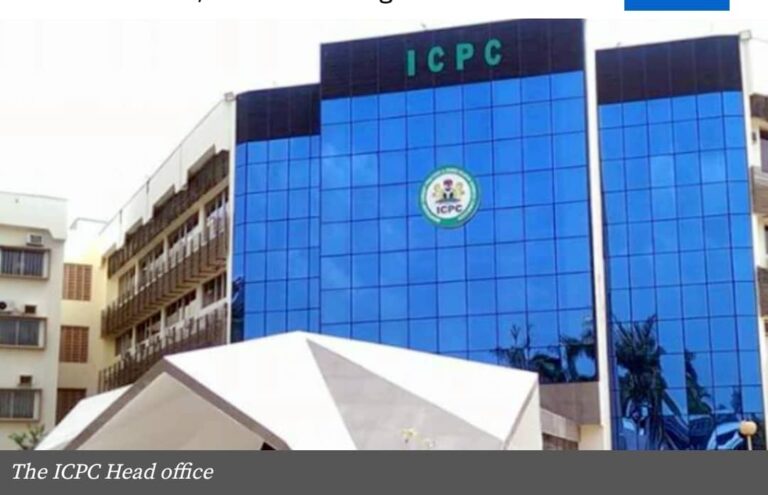
THE Independent Corrupt Practices and Other Related Offences Commission (ICPC) recovered ₦37.44 billion and $2.353 million in 2025, while recording a 55.74 per cent conviction rate in its prosecutions, the agency has announced.
The Commission’s Chairman, Musa Aliyu (SAN), disclosed the figures during the ICPC’s End-of-Year Engagement, send-off for retiring staff, and Annual Merit Awards ceremony, according to a statement by the commission on Sunday, December 14.
Aliyu mentioned that the recoveries rank among the Commission’s largest ever.
“2025 is a pivotal year marked by substantial progress across enforcement, prevention and public enlightenment.
“This year, the ICPC investigated 263 cases, exceeding its target of 250, and filed 61 cases in court, achieving a 55.74 per cent conviction rate. ₦37.44 billion and $2.353 million were recovered in 2025 through asset seizures and forfeitures,” the statement read.
Aliyu highlighted some of the year’s high-profile convictions, including that of Cyril Ndifon, a professor of the University of Calabar, who was sentenced to five years’ imprisonment for sexual harassment and cyberbullying.
On preventive measures, he added that the ICPC assessed 344 Ministries, Departments and Agencies (MDAs) using its Ethics and Integrity Compliance Scorecard.
According to him, the agency also conducted 66 corruption-monitoring exercises and tracked 1,490 projects nationwide, while completing Systems Study and Corruption Risk Assessments in 12 MDAs to reduce structural loopholes for graft.
Aliyu said the Commission initiated 15 collaborative projects with partners, while civil society organisations carried out 57 complementary engagements.
The ICPC chairman called on staff to maintain integrity and professionalism as the agency prepares for 2026.
Insecurity in Nigeria remains one of the country’s most persistent and troubling challenges, one that successive governments have failed to decisively address. It is easy to conclude that the crisis is an outcome of entrenched bad governance and corruption, or a political tool wielded by desperate political actors. It could also be both. Whatever interpretation one adopts, one fact is undeniable – insecurity affects every Nigerian, regardless of age, sex, origin, political affiliation, religion, ethnicity, or social status.
The gravity of the situation was once again highlighted in the wake of President Trump’s re-designation of Nigeria as a Country of Particular Concern. In response, President Bola Tinubu, on 6 November 2025, reassured citizens that his administration would defeat terrorism and secure every part of the country. Yet, barely a week after this assurance, Nigerians awoke to the tragic news of another mass abduction of about 25 schoolgirls from Maga Comprehensive Girls’ Secondary School in Danko Wasagu Local Government Area, LGA, of Kebbi State. While citizens were still calling on the government to ensure the safe return of the school girls, there was another abduction of over 300 pupils, students, and teachers at St. Mary’s Catholic School, Papiri, Niger state on 21 November, 2025. This incident adds to the growing list of assaults that continue to undermine public confidence in government promises.
Yet, in a democracy, power should originate from and belong to the people. Through elections, citizens confer legitimacy on the government. That mandate comes with clear responsibilities for the protection of lives and property. The 1999 Constitution captures this succinctly when it describes the safety and security of the people as the “primary” responsibility of government. Whenever anyone in Nigeria is killed, abducted, disappeared or endangered – especially vulnerable groups like schoolchildren – it raises fundamental questions about governance, accountability, and the state’s commitment to its obligations.
Nightfall in many Nigeria’s communities living with or on the frontiers of this insecurity is redolent of Oswald M. Mtshali’s “Nightfall in Soweto”, where he depicts night as “a dreaded disease seeping through the pores of a healthy body, and ravaging it beyond repair.” Students in both secondary and tertiary institutions have suffered severe trauma as a result of encounters with terrorists euphemistically branded bandits by government. Tragically, some lost their lives. It is important to recall some of these horrific yet avoidable incidents as a reminder that insecurity remains pervasive, robbing us of the peace we desire.
In 2003, Nigeria adopted the Child Rights Act (CRA), which enacted into domestic law the United Nations Convention on the Rights of the Child (UNCRC) previously ratified by the country in 1991. Article 28 of the UNCRC guarantees the Right to Education – free and compulsory primary education, and accessible secondary and higher education. The Universal Basic Education Commission (UBEC) Act, enacted the following year in 2004 established the UBEC to ensure that every Nigerian child enjoys free, universal, compulsory, and basic education. Basic education under the UBEC Act is a minimum of nine years schooling, that is; six years of primary school and at least three years in junior secondary school.
Yet, in today’s Nigeria, students who simply yearn for knowledge are increasingly becoming victims of abduction. How do we explain this tragic reality to young minds?
From the attack on Government Secondary School, Mamudo, Yobe State, on July 6, 2013 where 42 people, including students and staff, were killed to the abduction of over 270 schoolgirls on April 14, 2014 at Government Girls Secondary School, Chibok, Borno St ate, the pattern remains deeply disturbing. The Chibok abduction inspired the #BringBackOurGirls campaign, a movement for school safety led by prominent activists and amplified globally by politicians and diplomats demanding the safe return of the schoolgirls.
On February 19, 2018, bandits stormed Government Girls Science and Technical College, Dapchi, in Bursari Local Government Area of Yobe State, abducting 110 schoolgirls. In February 2021, another 279 students were abducted from Government Girls Secondary School, Jangebe, Zamfara State.
The data and trend clearly show that there is an overwhelming feminization of the phenomenon of mass school abduction in northern Nigeria but boys are sometimes not spared too. Two years after the Dapchi schoolgirls abduction, over 300 schoolboys were kidnapped on December 11, 2020, from Government Science Secondary School, Kankara, Katsina State.
In response to this rising incidents of school insecurity, the Federal Government has shut down 47 Federal Government (Girls) Colleges. The governors of Katsina, Plateau, Kebbi, and Niger have similarly ordered the immediate shutdown of primary, secondary, and tertiary institutions in vulnerable communities. In Taraba State, the Governor adopted a different approach, directing the immediate de-boarding of all students in both private and public secondary schools and enhanced security measures across all school premises reinforced by community monitoring assets.
According to the United Nations Children’s Fund (UNICEF), an estimated 18.3 million Nigerian children between the ages of five and fourteen were out of school in 2024. With the alarming rise in school attacks, how can we keep students safe and ensure they remain in school long enough to transition to higher levels of learning? Has the pursuit of formal education become a crime? If not, why are students repeatedly targeted?
In response to the destruction of school facilities and the killings and abductions of teachers and students, the Nigerian government, in partnership with the United Nations Envoy for Global Education, launched the Safe Schools Initiative (SSI) in 2014 to improve the protection and safety of students, teachers, and family members. In 2019, former President Muhammadu Buhari signed the Safe Schools Declaration (SSD) ratification document, signalling Nigeria’s commitment to uphold its principles. The record of implementation has been non-existent or abysmal. In a recent report, The Punch newspaper reports that 30 states have yet to implement the SSI. Writing more recently, former British Prime Minister, Gordon Brown, advised that the best practices of the SSI must be reintroduced, reinvigorated, and supercharged at the federal, state, and local levels in Nigeria.
Nigeria’s insecurity crisis is not just a threat to national stability; it is a test of leadership, political will, and the government’s ability to uphold its constitutional obligations. Every Nigerian – except those perpetrating or benefitting from – should be concerned about the crisis of insecurity that has emptied schools and threatening enlightenment in the country. Nigeria’s political elites should not play politics with the lives of Nigerians and the vulnerable groups. The response of government appears to have focused on recovering the abducted without the perpetrators being accounted for. This has fuelled credible speculation that the government has rewarded them with ransom payments, guaranteeing that there will be more abductions not less.
I am a product of a boarding school in North-West Nigeria and this issue is deeply personal to me. How is it possible for over 300 students to be abducted and no one is held accountable? An effective response must begin with a policy of zero-tolerance for school abductions around three issues.
First, security institutions must be required to perform better. The abduction and transportation of hundreds of school children from one place to another without minimal resistance or interference by Nigeria’s security agencies is an awful blot on the security management system in the country. Officers or sector commanders in areas where these abductions occur have to be held accountable.
Second, government must stop encouraging the impression that it can buy its way out of this crisis of school abductions. The money spent on ransom payments can be used instead on smart digital surveillance and reporting which can help with proactive and preventive action to identify and rout the perpetrators before they are able to strike.
Finally, state governors and local government must take their roles a lot more seriously in complementing the capabilities of the Federal Government by mobilizing local assets in their respective areas to identity and disable the perpetrators of the abductions. When these occur, Nigeria’s international partners will have the confidence to believe that they have a credible partner to work with in returning safety to learning in Nigeria and making the right to education a meaningful entitlement for every Nigerian child.
Dr. Adaobi Obiabunmuo is Programs Manager at PRIMORG