
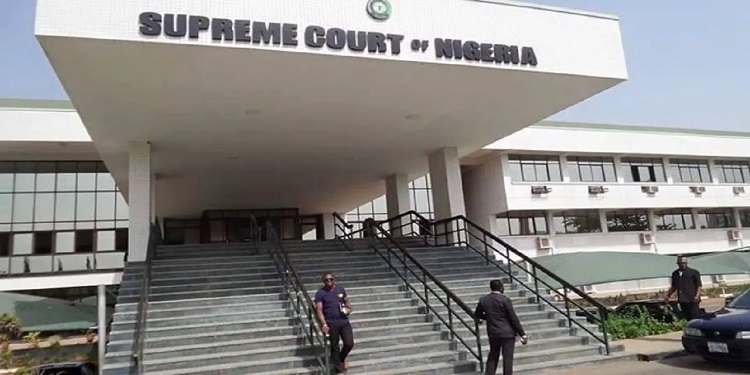

THE Supreme Court on Monday, December 15, affirmed the constitutional power of the president to declare a state of emergency in any part of Nigeria to prevent a breakdown of law and order.
In a majority judgment of six justices against one, the apex court further upheld that the president might temporarily suspend elected state officials during an emergency period.
The ruling followed a litigation filed by Adamawa State and 10 other states governed by the Peoples’ Democratic Party (PDP) over the emergency rule imposed on Rivers State in March 2025 by President Bola Tinubu.
Following the declaration, the president suspended the state Governor Siminalayi Fubara, his deputy, Ngozi Odu, a professor, and members of the State House of Assembly for six months.
The emergency rule was subsequently lifted in September 2025.
The plaintiff – Adamawa, Enugu, Osun, Oyo, Bauchi, Akwa Ibom, Plateau, Delta, Taraba, Zamfara, and Bayelsa states – represented by their attorneys-general, argued that the president acted outside his constitutional bounds by suspending democratically elected officials and dissolving legislative structures.
They also questioned the legality of the process leading to the emergency declaration, insisting it undermined federalism and democratic governance.
The plaintiffs urged the court to determine “whether, upon a proper construction and interpretation of Sections 1(2), 5(2), 176, 180, 188, and 305 of the Constitution of the Federal Republic of Nigeria 1999, the president of the Federal Republic of Nigeria can lawfully suspend, or in any manner whatsoever interfere with, the offices of a governor and the deputy governor of any of the 36 component states of the federation and replace them with his unelected nominee as a sole administrator, under the guise of, or pursuant to, a proclamation of a state of emergency in any of the plaintiffs’ states.
They also asked “Whether, upon a proper construction and interpretation of Sections 1(2), 4(6), 11(4) & (5), 90, 105, and 305 of the Constitution, the president can lawfully suspend the House of Assembly of any of the 36 States under the guise of, or pursuant to, a proclamation of a state of emergency in such states.”
Delivering the lead judgment, one of the judges, Mohammed Idris, stated that Section 305 of the 1999 Constitution (as amended) granted the president discretionary powers to determine the measures required during a state of emergency.
He explained that the Constitution did not expressly define the scope of “extraordinary measures” that might be adopted in such circumstances, thereby leaving room for presidential discretion where normal governance structures were deemed incapable of maintaining order.
The court further upheld objections raised by the Attorney-General of the Federation and the National Assembly, holding that the plaintiffs failed to establish a dispute that would activate the court’s original jurisdiction.
Consequently, the court struck out the suit for want of jurisdiction and proceeded to dismiss it on the merits.
Obande Ogbuinya, the dissenting justice, agreed that the president had the power to declare a state of emergency but maintained that such authority did not extend to suspending elected state officials or legislative assemblies.

Mustapha Usman is an investigative journalist with the International Centre for Investigative Reporting. You can easily reach him via: musman@icirnigeria.com. He tweets @UsmanMustapha_M