THE Nigerian Army said troops of Operation Hadarin Daji rescued one more teacher and three other students abducted from the Federal Government College Birnin Yawuri in Kebbi State.
The soldiers had earlier, on Friday, June 18, rescued two students and two teachers from the terrorists.
Spokesperson for the Nigerian Army Onyeama Nwachukwu disclosed in a statement on Sunday that a fresh set of abductees, comprising the teacher and three students, were rescued on Saturday at Makuku as part of ongoing search and rescue operations for the abducted students.
The statement disclosed that officers of the Nigerian Air Force supported the rescue operation.
The ICIR had reported that more than 50 students of the school were abducted on Thursday by gunmen who stormed the school in motorcycles and overpowered mobile police officers on duty.
During the attack, one student and a policeman were killed by the gunmen who escaped in a government vehicle allegedly snatched from a high court judge.
A member of the House of Representatives representing Yauri/Ngaski/Shanga in Kebbi State Tanko Sununu said the bandits had earlier issued a threat to notify residents of the attack.
According to Sununu, days before abducting the students, the bandits had attacked a nearby community, where they raided houses and made away with residents’ belonging.
“10 days later, they came back to the same area and entered into my constituency bordering some villages, and they had more than a seven-hour field operation going from house to house, room to room, collecting money, phones, cows, and any machine they deemed useful for their operations, and they left a message behind that they would soon be back,” Sununu said.
He noted that on the day of the abduction of students, there was an intelligence report that the bandits were on their way to the school.
However, they were still able to carry out the operation successfully.
Spokesperson of the Kebbi State Police Command had told The ICIR that the bandits overpowered policemen guarding the school during the attack.
PLANS to stave off hunger in Niger State by increasing crop yields are in jeopardy as the hectares of land used in planting across the state are gradually losing nutrients due to the inability of farmers to replenish the soil. Justina Asishana speaks with smallholder women farmers in the state regarding their challenges in assessing inputs, including fertiliser, to improve their yield.
Amina Garba has been farming groundnut and yam in Tayi B in Bosso Local Government Area of Niger State for over 20 years. But in all these years, she has not got any form of fertilizer, either for free or at a subsidized rate from the Niger State government.
Her yearly yield is thus very poor as she makes barely half of the expectation she aims to meet, a reason she attributes to lack of fertilizer and other inputs used in farming.
“Our lands are old and tired. Every year, we farm on these lands and we do not have fertilizers or other chemicals to put into the land to make it fertile and healthy. We have not got any fertilizer from the government. Even the one said to be at a reduced rate, we do not get it. And we do not have money to buy fertilizer because of how high it costs,” Garba says.
Fertilizers are substances that add nutrients to the soil to promote soil fertility and increase plant growth. The three most important fertilizers include nitrogen, phosphorus and potassium. The latter two have been available for centuries, but getting nitrogen in a form that plants could absorb is scarce, and the lack of nitrogen has led to low crop yields for centuries.
Fertilizers replace the nutrients that crops remove from the soil. Without the addition of fertilizers, crop yields and agricultural productivity would be significantly reduced. To grow healthy crops full of nutrients, farmers need to ensure they have healthy soil.
Without fertilizers, nature struggles to replenish the nutrients in the soil. When crops are harvested, important nutrients are removed from the soil, because they follow the crop and end up at the dinner table. If the soil is not replenished with nutrients through fertilizing, crop yields will deteriorate over time.
The Smallholder Women Farmers in Tayi Community in Bosso
The International Fertilizer Association (IFA) estimates that 85 per cent of the soils globally are deficient in nitrogen, 73 per cent are deficient in phosphorus, while 55 per cent lack potassium.
In sub-Saharan Africa, where hunger and starvation have long been a threat, lack of fertilizer is a primary reason agricultural yields lag the rest of the world, especially as the combination of high prices and shortages forces some farmers to revert to older methods of fertilization.
Amina is not alone in the difficulty women farmers face to get fertilizers across the state despite the huge sum of money budgeted and expended for fertilizer procurement and distribution in Niger State.
In Bosso Local Government Area, Rose Joseph explains that whilst groundnut does not need much fertilizer, yam does. She also bewails to the reporter how her yams, when harvested, come out below the average size. This does not allow her to sell at a price she can make a profit.
“Last year, I did 500 heaps of yams but could only get back 300 heaps of good yams, making me lose 200 heaps. The yam got spoilt because there was no fertilizer. We do not get fertilizer here because the government does not give it to us and we do not have money to buy it. What we do when we plant is that we just put our seeds on the ground and hope it comes out good.”
Amina Garba of Tayi Community in Bosso LGA
She says that because of poor yield, she cannot send her child to a good school inside the city because her husband is also a farmer and they face the same difficulty in the farming business.
Rabiatu Abdulmalik, who is also in Bosso Local Government Area, says she has been farming for about 25 years, noting that their hectares of land have gone old as there is no fertilizer or money to buy fertilizer.
“We do but use fertilizer, we plant our crops like that. If we plant it, God will bring it out well for us.”
According to Rabiatu, she plants 10 mudus (measuring bowls) of groundnut seedlings she purchases in the market and harvests about 50 big bags, but she can get more if she has access to fertilizer.
Same moans of fertilizer woes everywhere
The story of Rabiatu, Amina and Rose is akin to the same of every other rural smallholder women farmer across Niger State.
In Rijau Local Government Area, a maize, rice and soya beans farmer of about 29 years Fatima Mu’azu says all through her years of farming, she has not benefitted from government-subsidised fertilizer.
According to her, farmers were promised an allocation of 500 bags of fertilizer last year by the state government but to date, they are yet to get any fertilizer from the state government.
“Last year, they gave us allocation paper of fertilizer where we saw that 500 bags of fertilizer was approved to us but till date, nothing has been done.”
She says that when she buys from the market, there is usually no gain at the end of the planting season as a bag of fertilizer in the market costs between N11,500 to N13,500. She further explains that when there are no resources to buy fertilizer, she gets cow dung from the cattle herders which she uses on the farm.
In the Ija Gwari community in Tafa Local Government Area, Hannatu Yisua, who is part of an all-women cooperative society that farms rice, beans and maize, says that she and other women farmers have not got any fertilizer or farm inputs from either the state or local government.
She shares the same sad tale as the other women farmers in the rural areas across the state concerning the lack of access to fertilizers.
“We have applied for fertilizers and other agricultural inputs several times in our local government area but they do not give us. For now, we use cow dung which we get from the cow herders. We do not have money to buy fertilizers because it is expensive and scarce to get in our local government.
“Our farm does not get the expected yield. Sometimes, we plant 50 mudus of rice and at the end of harvesting, we get like 10 sacks of rice. Each sack contains 50 mudus. If we have access to fertilizers and other inputs, we can expect like 100 bags of rice and also an increase in the other products we farm. Also, getting other inputs will help us prevent insects that infest on our products.”
Women farmers and Niger government differ on extension workers
In a research article titled, ‘Challenges and Prospects of Rural Women in Agricultural Production in Nigeria’ by JB Effiong, published in Lwati: A Journal of Contemporary Research, inadequate technology, poor extension services, inadequate land, lack of access to credit facilities, cultural/religious restrictions, poor health, lack of adequate infrastructure, access to education and training were identified as factors affecting women in agricultural production.
An important aspect of agricultural production is access to education and training, which is usually carried out by extension officers or agents. Extension service is an informal educational process directed toward the rural population, which offers advice and information to help them solve their problems.
According to the United Nations’ Food and Agriculture Organization (FAO), extension is a process of working with rural people to improve their livelihoods. This involves helping farmers to improve the productivity of their agriculture and also developing their abilities to direct their future development. The objective of farm extension is to change farmers’ outlook on issues affecting them.
Extension agents, therefore, are expected to discuss matters with the rural people, help them to gain a clearer insight into their problems and also to decide how to overcome these problems.
But this is not the case in Niger State, where despite over N579 million expended on the enhancement of extension service delivery from 2017 to 2019, the majority of the rural women farmers, with whom these extension workers are supposed to work with, have not seen or heard about extension services.
Rebecca Yahaya in Tafa LGA She said these are the tools she uses in farming
A farmer of rice, soybeans and yam in Ija Gwari community in Tafa Local Government Area Rebecca Yahaya says she has been farming for over 50 years and no one has come to train her or any other woman farmer she knows.
In Borgu, a rice processor and farmer Rabbi Suleiman says that apart from the IFAD Value Chain Development Programme that trained her and other women on rice processing, no other government or organisation has come to brush them up on any agricultural practice.
Women in Rijau, Bosso and Tafa have been using the knowledge gained from their parents to farm as they also have not received any training or consultant service from the local or state government.
“We have not received any training from the government or any organisation. The farming we do and the knowledge we are using is from the knowledge of what we learnt from our parents and grandparents. And we need training very seriously because we are facing a lot of challenges in farming and do not know how to go about solving these challenges,” SWOFON Coordinator in Rijau Talatu Galadima told the reporter.
For SWOFON Coordinator in Munya Local Government Area Asabe Mathew, the only training women get is when they call someone from the state capital to train members of their cooperative society on some challenges they face.
She also says that her cooperative society has benefitted from training by the Alliance for Green Revolution in Africa (AGRA) after which the person sent for the training returns to transmit the knowledge to the people.
“But receiving training from the state government or local government, we have not seen anyone. I know about extension workers and what they do but in our local government area, no one has come to us willingly to give us advice or train us on anything.”
SWOFON Women in Rijau local government area
But the claims of the women were refuted by the Head of Women in Agriculture, which is under the Niger State Agricultural and Mechanization Development Authority (NAMDA) Rose Saba, who insists that there are extension agents in the 25 local government areas of the state assisting and offering training to the farmers.
She notes that the women are probably not ready to work with the extension agents, which is why they claim they have not seen or got any training from them.
“We have extension agents across the 25 local government areas and they are there to assist and offer training to the rural women so that it will boost their farm produce. I don’t know why they say there is none. Maybe the women are not ready to be captured during the training, but we have extension agents that are around them and they are carrying them along.
“These agents visit them in their homes. Although they are not enough, they are trying their best. When you say the women say there are no extension agents, it is not true. The extension agents are reaching out to the rural women,” she insists.
Niger State government agricultural expenditure
The Niger State Commissioner of Agriculture and Rural Development Haliru Zakari Jikantoro, during a Radio Contact Programme on May 1, 2021, in Minna, highlighted the achievements and programmes’ implementation of the ministry from 2015 to 2021.
According to him, the ministry had procured and distributed 68,710 metric tonnes or 1,374,200 bags of fertilizer from 2015 to 2020.
Giving a breakdown, he said, ” the ministry procured and distributed 15,000 metric tonnes (300,000 bags) of NPK fertilizers in 2015, 4,710 metric tonnes (94,200 bags) of NPK fertilizer in 2016, 4,000 mt (80,000 bags) in 2017.
“Distribution of 15,000 metric tonnes (300,000 bags) of fertilizer in collaboration with TAK fertilizer company under the federal government fertilizer intervention programme in 2018, in 2019, 15,000 metric tonnes (300,000 bags) of fertilizer supplied to stores all over the state for the 2010 farming season under an arrangement between the state, Morris fertilizer plant, TAK and other private dealers.”
The commissioner added that a total of 15,000 metric tons of fertilizer, 437 metric tonnes of assorted seeds and 107,050 litres of assorted agrochemicals were made available through private input dealers at various stores across the state.
For 2021, the commissioner said that arrangements had been concluded with seven fertilizer producers, companies and distributors for the supply of fertilizer to all the stores across the state, noting that farmers would access it for the farming season. He stated that the input would be sold to farmers on cash and carry basis as the state government would not be subsidizing the cost of transportation to the stores.
In the Niger State budget from 2017 to 2019, it was discovered that the Ministry of Agriculture, through the Niger State Agricultural and Mechanization Development Authority (NAMDA), expended N579.078 million for the enhancement of extension service delivery. To this end, N37,000 was expended in 2017, N538.51 million was expended in 2018 while N40.5 million was expended in 2019 for extension service delivery.
When the Managing Director of NAMDA Suleiman Rijau was contacted, he said he was outside the state for a conference and would send the contact of one of his directors, but as of the time of filing this report, he was yet to send the contact and he stopped picking calls.
But Head of Women in Agriculture Rose Saba insists that the extension workers are doing their job and they are being monitored and supervised, stressing that there has not been any complaint about them or their services.
Giving more explanation about the difficulty in getting inputs for their farm, Saba explains that even the government finds it difficult to distribute inputs to the farmers as the resources are not available for now.
“But whenever there is little, we ensure that some of them get it. Some of the inputs can be bought from the market. That is why the extension workers are there so that they will be able to link the farmers with agro-dealers in the market where they can purchase it at a subsidised rate. Because for now, from the government, the inputs are not forthcoming.”
Smallholder women farmers Charter of Demands
Smallholder women farmers undertake agricultural activities that are tedious and hectic with crude farm implements like hoes and cutlasses. This has led to low productivity, health challenges and limited income for smallholder women farmers.
The farm equipment available to these women farmers is not gender-friendly and the alternatives that governments refer to in their speeches are heavy-duty and expensive tractors and similar equipment which are also not easy to access.
As a result, the Small Holder Women Farmers Organization of Nigeria (SWOFON), in its Charter of Demands identifies women-friendly farm equipment that can reduce drudgery and increase productivity.
The Charter of Demands also points out that in Niger State, 102,661 bags of fertilizer, which will cost about N564.635 million, will be needed annually for women farmers across the state.
Women farmers
There was no costing for other issues in the SWOFON Charter of Demands such as good road network, capacity building, extension services and access to soft loans because they are already ongoing government programmes. However, there is a need to streamline them and make them more gender-sensitive with possible quotas for access to soft loans and proper targeting of extension services.
We had deficit in fertilizer distribution – Niger Ministry of Agriculture
Efforts made to see the Commissioner of Agriculture proved abortive, but the reporter approached the Permanent Secretary in the ministry who directed her to the Director of Agricultural Services and Linkages – who is also the Desk Officer for Women Farmers in the state – Adamu Maikasua Garba.
Garba explains that the women farmers in 2020 were allocated fertilizers and other farm inputs but the state had a deficit in fertilizer, which is why a lot of women farmers could not get the input despite that they were allocated some.
“In 2020, allocation to assess fertilizers and other agricultural inputs were given to SWOFON but we had a deficit in fertilizer distribution because of the shortfall we had in the supply.
“While the women farmers were given allocation, some were able to assess theirs and some were not able to assess theirs because of the shortfall,” he explains.
Garba says that the ministry, in its 2021 budget, has proposed to provide small work-friendly women equipment so that the women would have the opportunity to have easy farming for the season.
“This year, we have it in the budget to provide small working women equipment so that the women will have the opportunity to work on their farms using machinery.
“The equipment we have proposed include tillers, rice reapers and small irrigation pumps. The proposal has been made and we are working with local fabricators of the machines to make it available for this cropping season.”
Will the Economic Sustainability Plan help address the challenges of the women farmers?
For most of last year, COVID-19 pandemic worsened farming nationwide, leaving the majority of women farmers struggling to get back on their feet despite this year’s approaching planting season.
The Federal Government, through its Economic Sustainability Plan (ESP), pledged increased palliatives for women farmers across the country to prop them back on their feet as well as help them cushion the unpleasant fiscal impact of the imposed lockdown.
In order to provide the promised financial assistance to farmers and businesses, the Federal Government adopted a combined stimulus package of about N3.5 trillion. The stimulus includes a three-month repayment moratorium for all TraderMoni, MarketMoni, and FarmerMoni loans, a Targeted Credit Facility (TCF) of N50 billion to businesses affected by the pandemic, an N500 billion COVID-19 Crisis Intervention Fund, amongst others.
One of the projects under the Economic Sustainability Plan focused on agriculture is the ‘Mass Agricultural Programme,’ which was conceived to boost the entire agricultural value chain with N634.98 billion, estimated to be ploughed into the project.
The programme is expected to bring between 20,000 and 100,000 hectares of new farmland under cultivation in every state of the federation through a multi-layered approach, and the smallholder farmers are expected to receive support directly or through out-grower schemes.
The support would involve services and inputs, including land clearing, ploughing, provision of seeds, saplings, fertilizers, pesticides, as well as extension services, storage to mitigate post-harvest losses and equipment. Farmers are also expected to be linked to low-interest input financing.
Unfortunately, the plan does not specifically indicate how smallholder farmers, particularly the women, will benefit from the programme, neither did it factor in projects that will involve the introduction of technology to aid production and output.
Another palliative measure that would have favoured the women farmers was the re-introduction of the Conditional Cash Transfer, but the majority of the women smallholder farmers did not benefit from this.
Several of the women say they have not heard of anything about the mass agricultural programme by the Federal Government, neither have they benefitted from any of the programmes.
The farming season is here and the women farmers would require farm inputs such as fertilisers, agrochemicals, and improved seeds to make farming easier for them and enable them to have improved yield. They are still in the dark on how these salient needs would be available.
Yet, the women farmers remain united in asserting that with the land being tired, fertilisers will go a long way to help them get a good yield in the 2021 farming season.
Hence, they are requesting the timely release of fertilizers and other agricultural inputs that are most needed.
*This report was done with the support of the International Budget Partnership (IBP) and the International Centre for Investigative reporting, (ICIR).
THE Lagos State Police Command has arrested a 62-year-old school proprietor identified as Emmanuel Madueke over alleged sexual assault on a 14-year-old student.
The Lagos State Domestic and Sexual Violence Response Team (DSVRT) disclosed in a statement on Sunday that the incident occurred during the Children’s Day celebration at Megland Comprehensive School, Lekki.
The Coordinator of DSVRT Titilola Vivour-Adeniyi disclosed that a team comprising officials of the Lagos State Office of Education Quality Assurance, Lagos State Ministry of Youth and Social Development and the DSVRT visited the school on June 17 to investigate the alleged assault.
Findings made by the team during the visit revealed that Madueke had developed cordial relations with the student before the assault took place.
“He kissed her on her lips but she was able to push him away and ran out of his office. She (student) added that since the incident, she had made every effort to distance herself from the proprietor,” the DSVRT said.
Reacting to the allegation, Madueke denied kissing the student’s lips and described his actions as an innocent peck on her cheek.
Investigations further revealed that other students might have fallen victim to sexual harassment at the hands of the proprietor.
“It was further alleged that Madueke tactically grooms female students who become acquainted with him promising educational advancement as a reward to them,” the DSVRT added in the statement.
Based on findings by the DSVRT, the case was reported to the Ilasan Police Division where investigations are currently ongoing.
According to the statement, Madueke’s actions contravened the Child’s Rights Law 2015 and Sections 135, (Indecent treatment of a child) and 263 (Sexual Assault) of the Criminal Law of Lagos State 2011.
The DSVRT noted that the Lagos State government was determined to protect children from all forms of sexual and gender based violence.
PRESIDENT Muhammadu Buhari, on Thursday, June 17, visited Borno State on a one-day working visit.
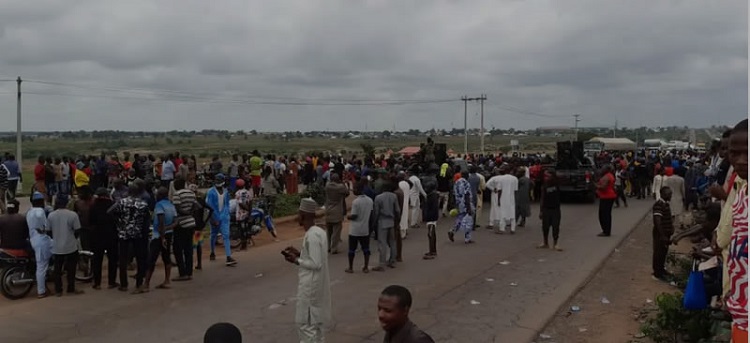
After the visit, however, an old and unrelated picture surfaced online, claiming that the photo was taken during president’s visit to the state. But it was Buhari’s 2019 campaign picture.
Special Adviser to Lagos State Governor Babajide Sanwo-Olu on Drainage & Water Resources Joe Igbokwe, on Thursday, took to his Facebook page to share five pictures, saying they all emanated from the president’s visit to Borno.
“No He is not campaigning, he is just on an official visit. No Nigerian leader alive can attract people in a way he does. Only PMB can do this,” his post read.
The old image circulated online as recent
The Claim
Igbokwe’s claim was that the picture of crowd in an open space was that of Buhari’s visit to Borno State in June 2021.
The Findings
The old image circulated online by Igbokwe as recent
Checks by The FactCheckHub showed that the picture in question emanated from the President Muhammadu Buhari’s campaign visit to Jos, Plateau State, in 2019.
Google Reverse Image search revealed that the picture was from Buhari’s campaign visit to Borno State on January 19, 2019, as reported here.
This is not the first time Igbokwe would be posting an old photo as new. Earlier in June, he had shared photos from 2019 as an event that happened in 2021 in relation to the Greenfield students’ abduction in Kaduna State. This was debunked by The ICIR.
The Verdict
The picture of the crowd in an open space is not of Buhari’s recent visit to Borno State but of his 2019 campaign visit to Jos. Hence Joe Igbokwe’s claim is MISLEADING.
CHAIRMAN of the National Drug Law Enforcement Agency (NDLEA) Buba Marwa,on Sunday, warned operatives working with sister security agencies against hiding under the guise of uniforms to engage in drug trafficking.
He said any security operative caught in the act would not be spared.
Marwa spoke just as the NDLEA announced the arrest of a serving officer of a law enforcement agency for selling illicit drugs to students of a federal university and cultists in Ogun State.
“Those who think they can sabotage ongoing efforts to rid Nigeria of the menace of illicit drug trafficking and abuse hiding behind the façade of their uniforms should better think twice because they will have NDLEA to contend with.
“We will not only arrest and expose them but we will equally prosecute them and seize all assets acquired through the proceeds of their criminal act,” Marwa warned.
The alleged drug dealer, according to NDLEA’s Director of Media and Advocacy Femi Babafemi, served in the Lagos State Command of the security agency.
In a statement issued in Abuja, the NDLEA disclosed that the suspect was arrested on Wednesday, June 15.
The NDLEA revealed that the unnamed suspect used his wife’s shop, located in the camp area of Abeokuta, Ogun State capital, as a sales point.
The agency said the man was apprehended after days of surveillance.
According to him, one of his salesmen, a motorcycle rider, was trailed to the location at about 8:00 pm and arrested with six pinches of Colorado weighing 1.17grams.
He noted that the incident occurred before the principal suspect, who had been on the agency’s watch list, was nabbed with different illicit drugs.
The NDLEA’s spokesperson gave the breakdown of the substances recovered from the suspect as codeine -17 bottles; cannabis -22.26 grams; tramadol 230 tablets -98grams; 61 tablets of flunitrazepam -23.72grams; 113 tablets of molly -48.16grams and sex drops -43.92grams.
“After the arrest of the two suspects, some student union officials of the institution blocked the NDLEA team with their official vehicle.
“The narcotic agents, however, restrained themselves and after hours of standoff, succeeded in moving the suspects to custody,” NDLEA spokesman Babafemi stated.
The agency has made several seizures since 2021. For instance, in February, the NDLEA seized cocaine worth over N32 billion at the Lagos port. In March, N60 billion worth of narcotic drugs was seized within six weeks.
By April, the agency also announced the seizure of N80 billion worth of drugs. The following month, a Nigerian drug lord was arrested with cocaine worth N8 billion.
Babafemi also revealed how another drug dealer was arrested by operatives of the Oyo State Command in Ilorin, Kwara State. The accused was intercepted with a parcel of cocaine and heroin that weighed 10.5grams and 4.8grams, respectively, on June 13.
“The following day, two ladies, aged 40 and 39, respectively, were arrested at total Garden, Ibadan when NDLEA operatives acting on a tip-off, intercepted their commercial Micra car.
“The two women were arrested with seven bags of cannabis weighing 77.23kg brought in from Ogbese, Ondo State, to supply a man they simply identified as Alhaji.
“According to them, they had earlier supplied the same Alhaji two bags before coming with the seven bags they were caught with,” he stated.
In Oyo, the agency stated that operatives of the state command also raided the residence of another Alhaji at Elebu area, Akala expressway, Oluyole LGA, Ibadan, on Friday, June 18.
According to him, 43 ampoules of methylphenidate were recovered.
In Kaduna, Babafemi said another drug trafficker was arrested at Panteka area of Kaduna State on June 17, with 211.5kg of skunk, heading to Kano State.
Similarly, he said a Nigerian returning from Pakistan was arrested by NDLEA operatives at the Murtala Muhammed International Airport, (MMIA) Ikeja Lagos.
He said five pellets of heroin weighing 250grams were discovered in the suspect’s anus.
Babafemi added that the suspect had arrived at the ‘D’ arrival hall of the Lagos airport on June 14, on a Turkish airline flight from Pakistan with the illicit drug.
The officers from Ogun, Oyo, Kaduna, and the MMIA commands of the agency were also applauded by Marwa for the their efforts in the campaign against illicit drug trafficking.
THE police in Benue State, on Sunday, said operatives killed 14 bandits who attacked a police station.
Spokesperson of the Benue State Police Command Kate Anene disclosed the development in an interview with The ICIR.
Anene said the bandits were killed in a foiled attack on the Katsina-Ala Police Station on Sunday morning. An unspecified number of bandits were said to have sustained injuries during the incident.
Shedding light on the attack, Anene said the command had earlier, on Saturday, arrested and detained some suspected bandits at the Katsina-Ala Divisional Police Station for further investigations.
However, on Sunday morning, around 1:00 am gunmen ‘numbering about 50′ launched an attack on the station in an attempt to free the suspects from police custody.
Anene explained that operatives at the division’s office were already on the alert and engaged the bandits in a gun duel.
According to her, 14 of the bandits were gunned down during the exchange of gunfire while others escaped with bullets wound.
“On June 19, 2021, five bandits were arrested and detained at Kastina-Ala Police Division for investigation and prosecution. On June 20, 2021 at about 0130hrs, more than 50 other gang members of the detainees mobilised and invaded the police station to rescue their counterparts.
“Officers at the division who were already at alert engaged them in a gun duel and were able to subdue the bandits,” Anene said.
She noted that operatives of the command were on the trail of the escaped bandits in order to bring them to book.
Anene further disclosed that the arrest of the suspected bandits was part of series of operations embarked on by the command to check banditry in Kastina-Ala Local Government Area of the state.
THE Academic Staff Union of Universities (ASUU) has threatened to embark on an industrial action if the 13 months’ salaries owed over 1,000 members across the country are not paid.
Chairman of the University of Jos chapter Lazarus Maigoro said this in a statement on Saturday, in Jos, disclosing that the Federal Government had also withheld the check-off dues of the affected members.
He accused the Accountant General of Federation (AGF) Ahmed Idris of systematically denying lecturers of their remunerations, even after the government and the union had reached an agreement on non-victimisation of ASUU members following their last strike, the News Agency of Nigeria (NAN) reported.
Maigoro alleged that the affected members were being threatened to either enroll into the Integrated Payroll and Personnel Information System (IPPIS) platform or have their salaries withheld.
He explained that despite the directives of President Muhammadu Buhari that members of the union be paid their full remunerations, the AGF had denied the affected union members their pay, in complete violation of the terms of the agreement signed between the union and government.
Maigoro said that the office of the AGF had continued to feed the public and some sections of government with false reasons over the matter, such as saying that there were issues around incorrect BVN numbers, incorrectly spelled names and sequential arrangement, among others.
He, however, added that such excuses were not tenable, because the bursary departments of their various institutions had submitted the names severally to the authorities, but the problem had continued to persist.
“SUU wants to bring to the attention of the Nigerian public the deliberate, systematic, and unpatriotic actions of the Accountant General of the Federation, Ahmed Idris, on the future of education in Nigeria.
“Idris, from all intent and purposes, is bent on withholding the salaries of over 1,000 members of ASUU spread across the country, with more than 100 of such lecturers being members of our branch at the University of Jos.
“This is simply because they participated in the last strike and refused to enroll in the much discredited IPPIS, despite the non-victimisation clause signed in the Memorandum of Action (MoA) that led to the suspension of the strike in December 2020.
“Despite the directive given by Mr President to pay the salaries of all lecturers, the AGF has refused to pay their salaries, for periods ranging from four to thirteen months, respectively.
”More worrisome is the fact that while the AGF is refusing to pay the salaries, his staff are busy calling the affected lecturers and insisting they have to register with IPPIS before they are paid; some are even asked to forfeit a part of their salaries in order to be paid. So, it is very clear that this is a deliberate act on the part of the AGF and his staff.
“Many of our members at the University of Jos have not been paid salaries from February 2020 to date. How they are expected to go to the classroom and teach beats my imagination.
“It is not news, that our union have vowed to fight back at any cost in order to salvage our colleagues from his tyranny and unpatriotic act against not just ASUU members, but the future of education in Nigeria and so, if nothing is urgently done, we will be forced to take action,” Maigoro said.
“The union has gotten to a stage where it may be forced to take drastic measures to save the lives and families of its members because their despair is also our collective despair.”
Maigoro also said that the inability of government to pay other allowances such as sabbatical, visiting, part-time and contract staff was also destroying the university system in the country.
“Apart from the refusal to pay the salaries of our members, the lack of payment of allowances of sabbatical, visiting, part-time, contract staff is further killing the federal universities in Nigeria, and this is all because of IPPIS.
“We hope that whatever decision the union takes, will not be misconstrued by the Nigerian public, especially seeing the seeming silence of the public and the government over the complete violation of our 2020 MoA,” he said.
Maigoro called on President Buhari to wade into the matter in order to save the affected members, as well as the future of education in Nigeria.
A Federal High Court sitting in Abuja has ruled that assets of President Muhammadu Buhari’s cabinet members are not of public interest.
Justice Inyang Ekwo made this ruling on Friday while delivering a judgement on a suit filed by a non-profit news organisation, The International Centre for Investigative Reporting (The ICIR), against the Code of Conduct Bureau (CCB) since 2019.
Other respondents in the suit were the CCB Chairman Danladi Umar and the Attorney General of the Federation (AGF) Abubakar Malami.
The ICIR had filed a suit against the respondents following the CCB’s refusal to avail the Centre of details of the assets declared by all cabinet members of Buhari.
In a letter dated January 16, 2019, The ICIR had requested details of all asset declarations by all cabinet members in the present administration, including the secretary to the government of the federation, chief of staff, head of civil service, national security adviser and 31 other ministers.
Following CCB’s refusal to comply, The ICIR prayed the court to compel the bureau to make copies of the requested documents available and order the attorney-general of the federation to “initiate criminal proceedings against the 1st and 2nd Respondents for the offence of wrongful denial of access to information.”
Delivering his judgment on Friday, Ekwo said the form in the first schedule referred to Section 15 of the CCB Act, designated as form CCB1 filled by public officials, contained personal information.
He noted that the asset declaration of the public officials in the custody of the CCB became personal information of the public officer in the control of the bureau.
“It is pertinent to know that FOI Act defines personal information in section 31 to mean “any official information held about an identifiable person but does not include the information that bears on the public duty of public employee or official,” Ekwo said.
The judge further said after studying The ICIR’s application, he did not find “any material which demonstrates that the disclosure of the information which is requested from the first respondent is in the public interest.”
Ekwo stated that The ICIR did not place any material for the first respondent to act as requested by law.
“This means that the first respondent had nothing upon which to consider a weight of public interest in the applicant’s application, I find in the end that this application lack in merit and is dismissed. That is the order of the court,” Ekwo ruled.
THE Supreme Committee of Crisis and Disaster Management in Dubai, on Saturday, announced new travel protocol for inbound passengers from Nigeria, South African and India, effective from Wednesday June 23.
Flights between Nigeria and the United Arab Emirates have been suspended since March 17 over disagreement relating to COVID-19 testing.
Announcing the new measures on Saturday, Head of the Committee HH Sheikh Mansoor bin Mohammed bin Rashid Al Maktoum said the updated travel protocol was part of a regular process of revising and optimising precautionary measures based on the latest local, regional and international developments.
Under the new guidelines, travelers from Nigeria must present a negative test result for a PCR test taken 48 hours prior to departure at labs approved by the Nigerian government and the test certificate should carry a QR Code.
“Passengers must also undergo a PCR test on arrival in Dubai. Transit passengers should comply with entry protocols of final destinations,” the committee said.
The new protocol will also allow travellers from South Africa and India, who have received two doses of a UAE-approved vaccine, a negative result from a PCR test taken within 48 hours before departure and are ready to undergo a PCR test on arrival in Dubai.
However, the protocol for India passengers is more stringent. They must have valid residence visa and are required to undergo a rapid PCR test four hours prior to departure to Dubai.
“In addition, following arrival, passengers from India should undergo institutional quarantine until they receive their PCR test result, which is expected within 24 hours,” the statement added.
The UAE citizens and diplomats are exempted from all the above requirements.
Since the suspension of flights in March, many travellers have been left stranded and without adequate communication from authorities.
Some Nigerians living and working in the UAE who visited Nigeria before the impasse, have been unable to return to their jobs. Others have complained about their visas getting expired and called for a quick resolution to the situation.
Although the Nigerian government is yet to provide an update on the situation, it had announced in April that extensive deliberations had taken place and both parties had reached a compromise.
THE alleged killing of a 13-year-old girl by bandits around Anguwar Magaji in Chikun Local Government Area of Kaduna State has elicited public outrage, raising questions over the high level of insecurity in the state.
Angry residents took to the Abuja-Kaduna expressway on Saturday to express their anger over the incident which also involved the village head and his family.
It is not certain if the deceased teenager was a relative of the village head, but a report by Daily Trust disclosed that other members of the community were abducted with the family of the traditional ruler.
The aggrieved villagers, however, blocked the highway preventing commuters from accessing the road.
“We cannot go to our farms and yet, they will follow us to our homes to abduct us for ransom. They killed a 13-year-old girl, a security man in the village as well as abducted other residents including the family of the village head,” a resident stated.
Abducting and kidnapping civilians along the Abuja-Kaduna expressway is not a new occurrence. It has become a reccurring situation, just like killings and abduction of students in various parts of the country.
A British woman and a Nigerian man were killed on April 21, 2019 by kidnappers in the state. Three others were abducted during the attack.
In April five abducted students of the Greenfield University, located within the state, were also killed by their abductors. Some were freed after their parents allegedly paid N180 million as ransom.
In the preceding month of March, gunmen also attacked the Federal Government College of Forestry and kidnapped 39 students.
Also, on May 24, protesters blocked the Abuja-Kaduna Expressway over rising cases of kidnapping and banditry.
“My uncle was shot in the back and slaughtered like goat,” one of the survivors in a series of attacks in Southern Kaduna also told the Cable News Network (CNN).
The ICIR reached out to the Police Public Relations Officer (PRO) in the state Jalige Mohammed to confirm the incident, but he did not reply to the message sent to his phone. His phone was busy when he was called repeatedly.
Calls to the Special Adviser to the Kaduna State Governor on Media and Communication Muyiwa Adekeye failed. Text messages sent to his phone and WhatsApp were not replied.