Home Blog Page 1865

Flutterwave in $1bn valuation, proposes New York listing

AFTER securing 170 million dollars from investors to expand its customer base, Africa-focused Flutterwave has been valued at 1 billion dollars, putting it in the class of unicorn start-ups. 

“We are thrilled to share news of our 170 million dollar #SeriesC funding which will be crucial in improving our technology, product, customer support, and expansion drive,” Flutterwave said on its Twitter handle on Wednesday.

“The company’s valuation is now more than 1 billion dollars. The fundraise brings the total investment in Flutterwave to $225 million,” the company said in a separate statement seen by The ICIR on Wednesday.

It explained that the 170 million dollars would be used to execute an ambitious growth strategy to become a leading global payments company, empowering small and medium enterprises (SMEs) and multinational brands by connecting the highly fragmented African digital payments landscape.

“Flutterwave will invest the new capital in accelerating customer acquisition in existing and international markets, as well as develop complementary and innovative products such as the newly launched Flutterwave Mobile, an app to help accelerate e-commerce growth as a result of the success of the Flutterwave Stores,” it said.

The payment company said the fundraise was coming when Covid-19 had accelerated the shift to digital payments in Africa, contributing to Flutterwave’s exceptional revenue growth of 226 percent compound annual growth rate (CAGR) from 2018-2020.

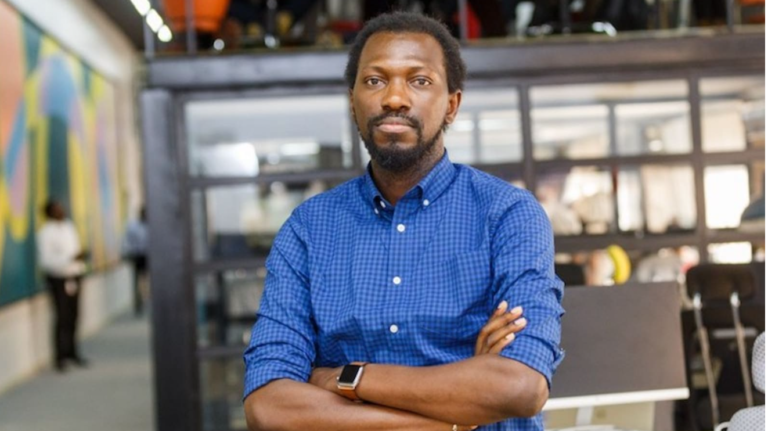
Olugbenga Agboola, founder and CEO of Flutterwave, said success would not be possible without his team, investors, customers, and regulators.

The San Francisco-based fintech is also mulling listing in New York Stock Exchange, Agboola had told Reuters in a telephone interview on Tuesday.  The payment processing firm is also eyeing the North African market, particularly Egypt, Morocco and Tunisia, by the second quarter of this year, Agboola said.

Read AlsoAmid COVID-19, Nigerian start-ups secure big-ticket private equity investments

New York Stock Exchange (NYSE) listing is important for businesses because the market has leading innovators, and its model leads to lower stock price volatility (fluctuations). The Exchange says that listing on its platform helps reach a worldwide audience, enabling firms to get insights into the markets and their shares.

According to Flutterwave, the Series C funding was raised from investors such as Avenir Growth Capital, Tiger Global and PayPal. Other venture capitalists who participated in the deal included Early Capital Berrywood, Green Visor Capital and Greycroft Capital and Paypal.

Jamie Reynolds, a partner at Avenir Growth Capital, said Flutterwave was at the forefront of innovation in payments technology.

Reynolds said Avenir was excited to support the Flutterwave team as they built the last available payments infrastructure frontier in the world – connecting merchants and consumers intra-Africa and globally.

Scott Shleifer, a partner at Tiger Global Management LLC, said, “We are excited to partner with Flutterwave as they continue building a world-class payments platform. We were impressed by Flutterwave’s focus on customer success and believe the company is well-positioned for sustainable long-term growth.”

Flutterwave has processed over 140 million transactions valued at over 9 billion dollars to date, serving more than 290,000 businesses, including  Uber, Flywire, Booking.com, Facebook, among others, the company said.

The firm said its key advantage was international payment processing in 150 currencies and multiple payment modes, including local and international cards, mobile wallets, bank transfers, Barter by Flutterwave, among others.

Why unicorns matter

A unicorn is a private firm whose valuation has hit 1 billion dollars and above. According to CBN Insights, there are 500 unicorns around the world as of March 2021. Economists say unicorns enjoy economies of scale, meaning they enjoy advantages larger businesses have over smaller ones.  Such include low cost of operations and unit prices, efficiency and low costs of production factors such as land, labour and capital.

“Larger companies are able to produce more by spreading the cost of production over a larger amount of goods,” said Will Kenton, a behavioural economist and Any Drury, former CEO of OnPoint Learning, both of Investopedia.  This is one advantage of facing Flutterwave.

Economists and management experts say unicorns are popular with investors and guarantee them good returns.

#EndSARS: Why I ordered suspension of Flutterwave’s payment platform- Tunde Lemo

Jonathan Low, partner and co-founder of Predictiv and PredictivAsia, explained that unicorns would always draw in eager investors and consumers.

The Road to $1bn valuation

In 2017, the payment processing company raised 10 million dollars in Series A funding. As of that time, it had   10 banking partners across Africa, processing over 14 million transactions worth 1.5 billion dollars, just 12 months after commencing operations. In 2018, the fintech galvanised another 10 million dollars in extended Series A funding.

The fund came mostly from Green Visor Capital, Greycroft Partners, Mastercard, CRE Ventures, Fintech Collective, 4DX Ventures, and Raba Capital. It further raised 35 million dollars in Series B venture capital raise in 2018. In addition to 170 million dollars raised in the Series C round, the firm has galvanised 225 million dollars in funding (in total).

A company’s valuation often involves aggregating its revenue, assets, and cash flow, subtracting them from liabilities such as debts, wages, and taxes.  The 1 billion dollar valuation means that Flutterwave’s assets and cash flow/ revenue are at least equal to the valuation.

Ezra Olubi (left)and Shola Akinlade (right), co-founders of Paystack, Credit: www.finextra.com

Fintech boom.  

Fintech business in Nigeria is becoming larger by the day.  In October 2020, Stripe, a US fintech firm, acquired Nigerian fintech business Paystack for 200 million dollars. In 2019, Visa acquired a 20 percent stake in  Interswitch, a Nigerian payments company. A 2020 Mckinsey report  disclosed that between 2014 and 2019, “Nigeria’s bustling fintech scene raised more than 600 million dollars in funding, attracting 25 percent (122 million dollars) of the 491.6 million dollars raised by African tech startups in 2019 alone—second only to Kenya, which attracted 149 million dollars.”

“At the same time, a youthful population, increasing smartphone penetration, and a focused regulatory drive to increase financial inclusion and cashless payments, are combining to create the perfect recipe for a thriving fintech sector,” the report said.

“Nigeria is now home to over 200 fintech standalone companies, plus several fintech solutions offered by banks and mobile network operators as part of their product portfolio.”


Why I sponsored bill to change national minimum wage – Reps member, Datti-Babawo

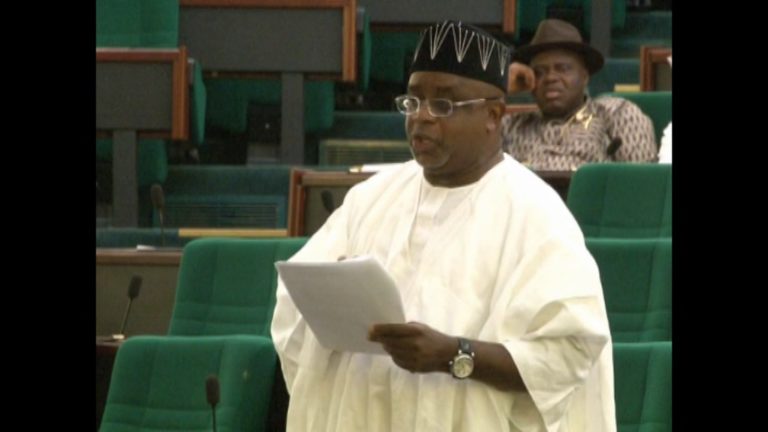
FOLLOWING the protest by the National Labour Congress (NLC), Garba Datti-Babawo, a member of the House of Representatives representing Sabon Gari federal constituency, who sponsored a bill to move the national minimum wage from the exclusive legislative list to  concurrent list, has given reasons for presenting the bill before the National Assembly.

Datti-Babawo disclosed the motives behind the bill during a telephone interview with The ICIR on Wednesday, as members of NLC stormed the streets of Lagos, Abuja and Kaduna to protest against the bill.

According to Datti-Babawo, many state governments could not afford to pay the new 30,000 naira minimum wage to their workers, resulting in threats of retrenching workers if they were to pay.


Read Also:


“Since it has been changed to 30,000 naira, you will find out that most of the states could not pay until the federal government intervened by giving them bailouts to pay. Now that there is no bailout, they cannot pay and most of the states are threatening to retrench most of their workers if they have to pay the 30,000 naira,” Datti-Babawo said.

He noted that the aim of the bill was to allow state governments to negotiate with the NLC on how much they could afford to pay their workers in consideration of the their revenue.

“What we are saying is that we should allow them to negotiate what they can pay based on their own resources because the money that goes to the federal  government is not the same that goes to the state governments. Even among states, their resources are not the same.

“There are many socio-economic variables based on local peculiarities like the cost of living, housing, cost of school fees transportation, feeding and others. In essence, you will find out that more than 80 percent of local governments, after paying salaries, would not have anything to implement any single capital project, even for drugs for their clinics,” the lawmaker said.

He further argued that the decision on what to pay should be made by state assemblies because it was the assemblies that passed the budget, knew what the states earned and made projections for it.

Datti-Babawo further stated that the federal government should not just sit in Abuja and determine what a local government would pay to its workers, stating that prominent Nigerians and others had supported his position in the bill.

He said instead of employing devices of ‘intimidation,’ the NLC should rather attend the public hearing of the bill and make its contribution.

“NLC president has also written a letter to me which I replied in a five-page letter. In that letter, he said I should not have brought that bill, that I should have sat with them and negotiate, but I said that is not how we operate.

“When we brought this bill, there was a debate of which more than 80 percent of  those who contributed were in support. Those are the people that represent the people. We advise them to come for the public hearing if the members are convinced with their argument. Nothing stops them from throwing the bill away.”

When asked if the bill would create an environment for enslaving workers as said by the NLC, Datti-Babawo said even without the bill, state governments were not paying. “Of what good is a law that is not implementable and has no punishment when broken?” he asked.

The lawmaker advised the NLC to change its method of abuses and intimidation, and come out for constructive engagement.

“I am looking at their protests now. The chairman is talking about me, which is a very wrong approach, and he should not talk about me because it is an issue of National Assembly. If it is not a popular bill, it would not be voted for.

“We have also seen how they turned it into a personal issue and this is the method employed by labour all the time when there is something of this nature. They do not engage in constructive dialogue, they resort to insult, they resort to all forms of intimidation which I think would not solve their own problem.

“If we allow it, most of the states would retrench almost 60 percent of their workers. Even  NLC Kaduna is attacking me, but I am unperturbed, I do not care because the truth would always prevail,” Datti-Babawo stated.

The ICIR had earlier reported the ongoing protest by the NLC in Abuja and Lagos earlier on Wednesday morning over the minimum wage.

Ondo govt suspends NURTW indefinitely

THE Ondo State government has announced an indefinite suspension of all activities of the National Union of Road Transport Workers(NURTW) across the 18 local government areas of the state.

One person was killed on Tuesday during a clash involving some factional members of Ondo State chapter of the NURWT at Oja Oba area of Akure, the state capital.

Following the clash, the state government has suspended the union indefinitely.

A witness said the clash caused pandemonium at Oja Oba and some streets in Akure, as residents ran for their lives following sporadic gunshots by the warring members.

The incident came barely 48 hours after the unionists fought in the Owode area of the state, injuring many people.

Business and social activities were paralysed when the armed unionists faced one other, while vehicular movements were also halted in the affected areas for several hours.

Some vehicles were also said to have been vandalised by the fighters, but the cause of the dispute was still unknown as of the time of filing this report.

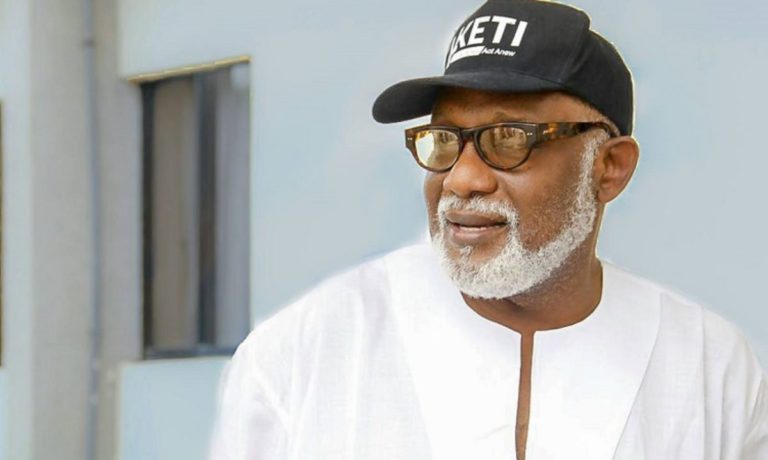
While reacting to the matter, senior special sssistant to Governor Rotimi Akeredolu on special duties and strategy, Doyin Odebowale, ordered the NURTW members to immediately vacate all motor parks across the state.

He described the clash as unruly and uncultured behavior, which resulted in violent attacks on members and the innocent residents.

“The indefinite suspension did not affect the Road Transport Employers Association of Nigeria, who comported themselves in a peaceful manner,” the governor’s aide added.

The state government had earlier ordered the suspension of the NURTW and RTEAN for two weeks over a purported plan of their members to engage in violence.

The state police public relations officer, Tee-Leo Ikoro, said the investigation had commenced into the incident and some men of the command had been drafted to the area to restore normalcy.

Return £4.2m Ibori loot to Delta State, Nigerians urge FG

MANY Nigerians have taken to the social media to express displeasure over the federal government’s proposed spending  of 4.2 million pounds recovered Ibori loot on some federal projects. 

Many Nigerians on Twitter say the federal government should return the stolen funds to Delta State, which it originally belongs to, rather than spend it on federal projects.

On Tuesday, Abubakar Malami, attorney general of the federation and minister of justice, had announced the imminent return of £4.2 million recovered from James Ibori, a former governor of Delta State, by the government of the United Kingdom.

During his announcement, Malami had said that about 2.2million pounds expected to arrive in Nigeria in two weeks would be spent on the Second Niger Bridge, Abuja-Kano Road, and Lagos-Ibadan Expressway, stressing that the funds would not ne returned to Delta State government.

This announcement sparked several reactions from Nigerians who felt that rather than spend it on the mentione federal projects, it should be returned to the coffers of Delta State government.

While reacting to the announcement, Aisha Yesufu, a social commentator and activist, said the money must go to Delta State and not the federal government.

“The money belongs to the people of Delta State! They must ensure the federal government does not lay its hands on it,” Yesufu said on her Twitter handle @AishaYesufu.

Another Twitter user, who identifies as Sammy @Talk_2_Sammy, said instead of spending the fund on federal projects, it should rather be used on infrastructural development in Delta State where the money originated from.

“This is so wrong. They should have used the money to repair and construct more roads and infrastructure in Delta. The money was stolen from Delta treasury and should be used to develop Delta. It is state money and not federal money,” Sammy wrote on Twitter.

Omoyele Sowore, publisher of Sahara Reporters and activist, also took a similar stance, saying that part of the fund should be used to subsidise exorbitant school fees paid by students of Delta State University.

“Students of higher institutions in Delta must demand that the 4.2m pounds Ibori loot being repatriated from the UK must be spent on schools in the state instead of accepting to pay exorbitant school fees like the N150k being charged at Delta State Uni. It is your money,” said Sowore.

However, some Nigerians said that Delta State government had declared that no money was missing from the state account, hence the recovered loot should not go to the state.

A user, who identifies as Moses Babatunde O @tunmmyzhe, said since a Nigerian court had held that Ibori did not launder the state fund, there was no justification for the money to be returned to Delta State government.

“But in the high court of Delta State, the same Ibori was cleared of money laundering and no government officials were ready to testify against him.

“Delta state, therefore, has no claim to the money since it has always maintained that no money was missing from its coffers,” Babatunde said.

Delta is one of the nine oil-rich states in Nigeria, situated in between Anambra and Edo.

Why recovered loot would not go to Delta state – Malami

On Tuesday evening, Malami featured on Channels Television’s Politics Today to explain why the recovered Ibori loot would not be handed over to Delta State. According to him,  the looting was a national crime, and not a sub-national one.

Malami said only the federal government was involved in the recovery of the fund, and the UK and Nigeria had already ‘negotiated’ on how the money would be spent after it had been handed over.

“All the processes associated with the recovery were consummated by the federal government and the federal government is, indeed, the victim of the crime and not sub-national,” he said.

Delta State to challenge FG over recovered loot

The Delta State government has also vowed to challenge the federal government’s position that the recovered loot would not be handed over to its original source.

Ehiedu Aniagwu, Delta State commissioner for information, said this while reacting to reports that the federal government was set to expend the fund on federal projects.

“We would try to take advantage of the legal system to make the federal government correct the injustice they are about to visit on us as a state.

“If they are quite sure that the funds they are about to repatriate left Delta State on account of those who have governed the state in the past, on what basis would they now take the money to another place? Under which law? ” Aniagwu said.

NLC begins protest in Abuja, Lagos over minimum wage

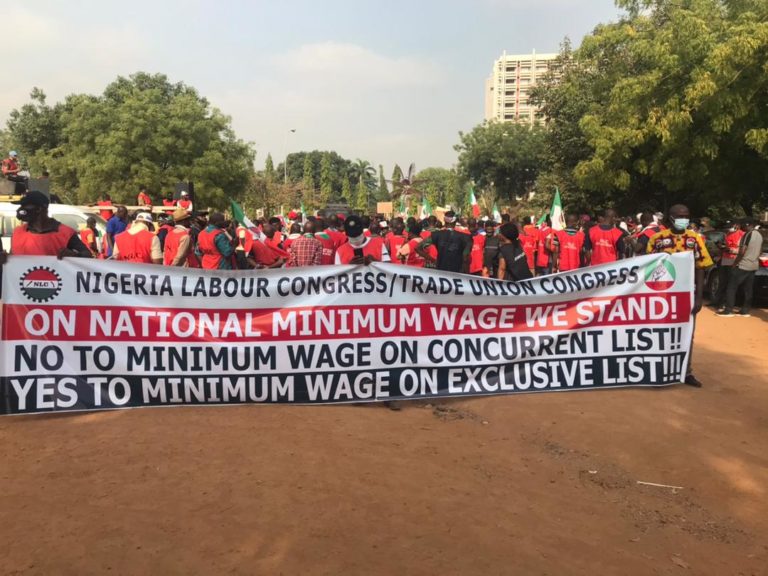
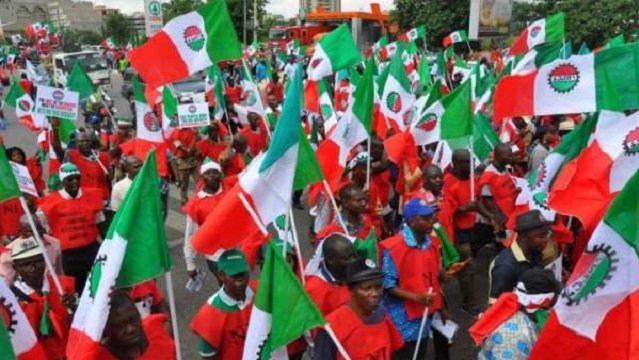
THE Nigeria Labour Congress (NLC) has commenced protests in the Federal Capital Territory (FCT) and Lagos State over issues concerning the implementation of the new minimum wage.

On early Wednesday morning, the union members gathered in numbers at the Unity Fountain in Abuja where they marched to the National Assembly gate.

Also in Ikeja, the capital of Lagos State, members of the labour union took to the streets, marching towards the Lagos State House of Assembly.

Ayuba Wabba, NLC president, had said last week that the union would stage a nationwide protest over a bill seeking to take the national minimum wage away from the exclusive list, allowing state governments to fix it for workers.

The ICIR had reported that Ayuba Wabba, NLC president, had noted there would be a protest by the union over a bill seeking to move the minimum wage from the exclusive legislative list to the concurrent legislative list.

Wabba explained that if the National Assembly succeeded with the change, it would create an avenue for state governments to ‘enslave’ their workers.

“The NEC decided that should the need arise, it has empowered the National Administration Council of the NLC to declare and enforce a national strike action, especially if the legislators continue on the ruinous path of moving the National Minimum Wage from the Exclusive Legislative List to the Concurrent Legislative List,” Wabba said.

The NLC, in a tweet on its official Twitter handle @NLCHeadquarters recently, lambasted Garba Datti-Babawo, member of the House of Representatives representing Sabon Gari federal constituency of sponsoring the bill.

For over one year, the NLC, federal and state governments have battled over the approval and implementation of thenNational minimum wage from 18,500 naira to 30,000 naira.

While some states have adopted the new minimum wage, some others have refused to implement the change in wages.

Minimum wage: No going back on nationwide protest on Wednesday – NLC

THE Nigeria Labour Congress (NLC)has said that the proposed nationwide protest over issues concerning the implementation of the new minimum wage will take place on Wednesday.

Benson Upah, NLC head of information, told The ICIR on Tuesday that the proposed strike would take place as earlier announced.

“Yes, the strike is still holding here in Abuja from the Unity Fountain to the National Assembly, while others would hold across state assemblies of the 36 states of the federation,” said Upah.


Read Also:


Ayuba Wabba, NLC president, had said last week that the union would stage a nationwide protest over a bill seeking to take the national minimum wage from the exclusive list and allow state governments to fix them for workers.

According to Wabba, the bill, if allowed to be passed into law, would enable authorities in the states to enslave their workers.

Wabba explained that the directive was part of the resolutions reached at an emergency meeting of the national executive council of the NLC.

“The NEC decided that should the need arise, it has empowered the National Administration Council of the NLC to declare and enforce a national strike action, especially if the legislators continue on the ruinous path of moving the National Minimum Wage from the Exclusive Legislative List to the Concurrent Legislative List.”

“The NEC warned that should the current artificial scarcity persist, that the various leadership structures of the NLC should picket petrol stations found to be inflicting pains on Nigerians,” the NLC president added.

Recall that the NLC and the federal government had spent several months ‘negotiating’ the minimum wage before it was eventually agreed that 30,000 naira would be the least pay for workers in Nigeria.

COVID-19 forces Nigerian manufacturers to cut investments by 76 percent

COVID-19 outbreak in 2020 forced Nigerian manufacturers to reduce their investments by 76.11 percent within the year, according to the second half 2020 economic review released to The ICIR by the Manufacturers Association of Nigeria (MAN) on Tuesday. 

Manufacturing investment hit a rock-bottom 118.52 billion naira in 2020 as against 496.11 billion naira achieved in 2019. The 118.52 billion is the least amount of investment made by Nigeria’s manufacturers at least since 2014.

“Manufacturing investment declined in the period following the depressing fallouts from COVID-19 that gave no impetus
for new investments in the sector,” MAN, headed by Mansur Ahmed, said in the review.

In 2020, COVID-19 dislocated supply chains worldwide, incapacitating firms, especially manufacturers importing their raw and packaging materials from different parts of the world. The virus forced many manufacturing firms to close down to avoid outbreaks in factories. Brewery firms were not allowed to open for months while many firms which managed to open faced low patronage due to general lockdowns and inter-state movement restrictions.

In Guinness Nigeria’s nine-month to 2020, year-on-year revenue fell by 78.6 percent, majorly due to COVID-19 and lockdowns which lasted for months across states. Nigerian Breweries (NB), the biggest brewer controlling 56 percent market share, reported a revenue decline of 11 percent to 151 billion naira in the first half (H1) of 2020.

The GDP report released by the National Bureau of Statistics (NBS) in the first quarter (Q1) of 2020 (before the pandemic) said that activities in the manufacturing sector recorded a performance of 0.43 percent growth. However, in the second quarter (Q2) of the year, in the heat of the COVID-19 pandemic which disrupted economic activities, the sector contracted by 8.78 percent, indicating struggles faced by manufacturers during the period.

“Lingering foreign exchange crisis was perhaps the most significant challenge for the sector in 2020 as most industry players found it increasingly difficult to access foreign exchange meant for importation of critical factor inputs,” the Lagos Chamber of Commerce and Industry (LCCI) said.

Matthew Ibeabuchi, a manufacturer  of chemicals in Enugu, South-East Nigeria, noted that most big investors in manufacturing sector  struggled to stay afloat, with others  showing caution due to uncertainties in 2020.

“You cannot make big investments when your patronage is low and when you are not sure of raw materials supply,” he said, expressing hope that things would bounce back.

Past investments

Nigerian manufacturers made investments valued at 5.73 trillion naira between 2013 and 2020,  MAN said. In 2014 and 2015, manufacturing investments worth 691.77 billion naira and 489.55 billion naira respectively were made by the real sector players. More so, manufacturers made investments valued at 614.55 billion naira and 508.98 billion naira in 2016 and 2017 respectively. Also, total investments of 552.64 billion naira and 496.11 billion naira were made by manufacturers in 2018 and 2019 respectively.

Lagos and Ogun top the chart

A break-down of the 2014-2019 data shows that out of 691.77 billion naira worth of investments made by manufacturers in 2014,  Ogun got 514.87 billion while Lagos got 100 billion naira. This means that both states had a share of 88 percent of total investments within the year. On the other hand, 34 other states shared 12 percent of the investment largesse. In 2015, out of 489.45 billion naira total new investments made by manufacturers and agro processors, Lagos got 29.79 billion naira as against Ogun’s 430.56 billion naira.  Hence the two states had a share of 94 percent while other 34 states took only six percent share of the investments.

Also, Lagos got 94.83 billion naira value of investments in 2016 while Ogun received 351.13 billion naira out of N614.55 billion total investments.

In other words, Lagos and Ogun contributed 73 percent to the total investments while the rest had a share of 27 percent.

Also, out of a total of 508.98 billion naira investment made in 2017, Lagos received 235.61 billion naira as against Ogun’s 94.32 billion naira, representing 65 percent of the total. Other 34 states contributed 35 percent of total investments. MAN’s data further show that out of 552.64 billion naira investment in 2018, Lagos welcomed 287.16 billion naira whereas Ogun got 186.47 billion naira, indicating that both states contributed 86 percent of the total investments. Other 34 states shared 14 percent.

More so, a total of 496.11 billion naira investments were made in 2019, out of which Lagos got 180.63 billion naira and Ogun, 105.05 billion naira, indicating 58 percent share of the total.

Why Lagos and Ogun?

Analysts say Lagos is attractive to investors due to its proximity to a booming market of over 20 million people and presence of infrastructure such as seaports.

Olusegun Osidipe, director of research and statistics at MAN, said it was easier to check who owned a piece of land on the system in Lagos.

“You know how much to pay on Land Use Charge in Lagos. There is certainty around these things in Lagos ,” he said.

On the other hand, Ogun is leveraging its proximity to the Lagos by making cost of doing business easier.

“There are a few landmarks in Ogun State. Manufacturers and other investors have more room for expansion,” Ambrose Oruche,  director of corporate affairs in MAN, said recently.

“Lagos and Ogun states provide access to markets driven by population. In addition, Lagos promises high security which many investors appreciate. Ogun State is also ranked high in the ease of doing business with its business friendly policies and environment,” he said.

“Another important factor is the availability of the ports in Lagos which makes it easier to receive goods, especially when the market is proximate. Long distance between ports and market or consumers will affect competitiveness, quality and quantity of the goods,” Oruche further said.

Manufacturers complain that many other states have poor security network and infrastructure that can aid business success.

We will invest

Despite the flip-flops in 2020, there is likelihood of higher investments in 2021 due to subdued COVID-19 situation and roll-out of vaccines.

In a recent interview, Santosh Pillai, managing director of PZ Wilmar, a palm oil firm, said the firm, which had invested over 150 million dollars in Nigeria, would continue to pump money into the economy.

FG launches temporary passport for diaspora Nigerians

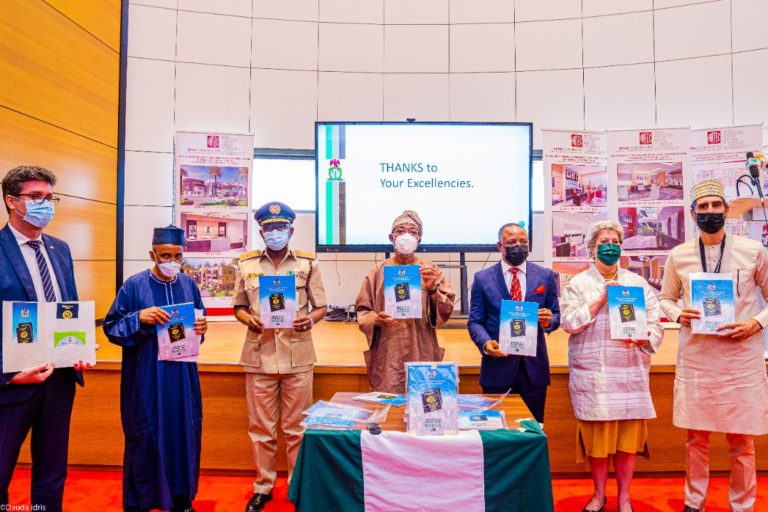
THE Nigerian government, on Tuesday, launched a temporary passport that replaces the paper-type Emergency Travel Certificate for Nigerians in the diaspora.

Rauf Aregbesola, minister of interior, who chaired the launch at the headquarters of the Nigerian Immigration Service (NIS) in Abuja, said the e-document would be issued at Nigerian embassies and high commissions to Nigerians with an urgent need to return home but whose national passports were either lost or expired.

Aregbesola added that the document, which had validity for 30 days, would also address the needs of Nigerians abroad being returned home by their host countries without valid passports.


Read Also:


In his remarks, Muhammed Babandede, comptroller general of Immigration, noted that the introduction of the document was another way of engaging with the diaspora population with a view to addressing their emergency travel needs, stressing that the document could be issued to applicants irrespective of age.

The-four-page electronic passport, which has all the features of the standard passport, is designed for a one-way travel to Nigeria and is expected to be surrendered to the immigration authorities at the port of entry on arrival into the country.

Sunday James, spokesperson for the NIS,  confirmed to our correspondent that the new e-passport could only be issued upon proof of citizenship, genuineness of the stated emergency and would invalidate any pre-existing passport.

The event was attended by members of the diplomatic community, including the envoys from the United States, Mary Berth Leonard; her counterpart from the United Kingdom, Naeem Khan; the Canadian High Commissioner, Nicolas Simard; the doyen of the Diplomatic Corp and Cameroon high commissioner to Nigeria, Salaheddine Abbas, and permanent secretary of the Ministry of Foreign Affairs, Gabriel Aduda, among others.

Explainer: Why Nigeria recorded N7.37trn trade deficit in 2020

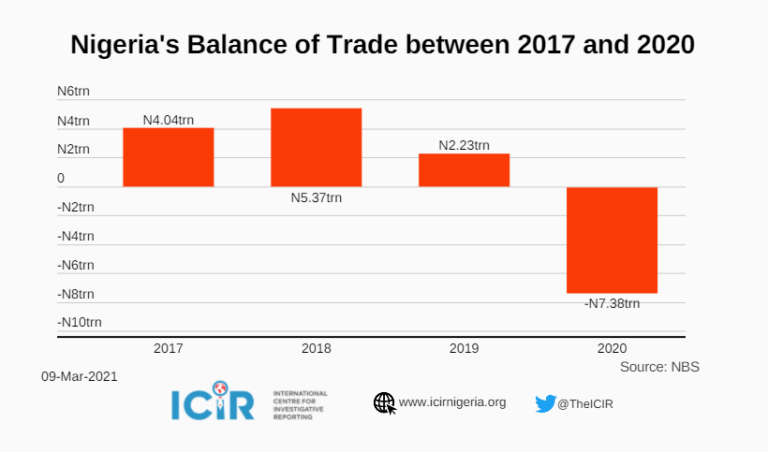
NIGERIA recorded a trade deficit of N7.37 trillion in 2020, according to the fourth quarter (Q4) 2020 Foreign Trade Statistics released by the National Bureau of Statistics (NBS) on Tuesday.

This is the first time Africa’s largest economy has reported a negative trade outcome since 2016.

Nigeria’s export stood at 12.52 trillion naira while imports amounted to 19.9 trillion naira. In other words, Nigeria imported more goods and services than it exported to other countries within the period under review.

According to the NBS report, total trade stood at 32.42 trillion naira in 2020, representing a 10.32 percent, compared with 36.15 trillion naira reported in the previous  year.

The report further revealed that between 2016 and 2020, Nigeria’s total trade stood at 23.16 trillion naira, 31.69 trillion naira, 36.15 trillion naira, and 32.42 trillion naira, respectively.

Infographics by Damilola Ojetunde

On quarter-on-quarter basis, the 2.73 trillion naira trade deficit recorded in Q4 2020 represents the fifth consecutive quarterly deficit since the 1.38 trillion naira trade surplus recorded in the third quarter (Q3) of 2019.

The value of total imports increased by 17.3 percent to 19.89 trillion naira in 2020, compared with the 16.96 naira trillion recorded in 2019 and more than twice its value in 2017 (9.56 trillion naira).

In 2020, machinery and transport equipment accounted for 36.6 percent of total imports, while chemicals/related products  and mineral fuels constituted 18.2 percent and 15.3 percent respectively.

The report further shows that imports from China accounted for 28.3 percent of the total imports, followed by India (8.5 percent); the United States (7.57 percent); the Netherlands (7.2 percent); and Denmark (5.4 percent).

Total exports dropped by 34.8 percent to 12.52 trillion naira in 2020 from 19.19 trillion naira in 2019.

In Q4 2020, Nigeria majorly exported mineral products, accounting for N2.96 trillion. The second-largest component was vehicles, aircraft and parts, which were valued at 111.3 billion naira. Vegetable products worth 39.9 billion naira  were exported within the period.

The top five export destinations in Q4 2020 were India, Spain, South Africa, the Netherlands and the United States, with goods valued at 547.0 billion naira, 313.4 billion naira, 256.7 billion naira, 194.5 billion naira and 170.4 billion naira, respectively, shipped to the countries.

These countries collectively accounted for 46.39 percent of the value of total exports in Q4 2020.

In Q4 2020, the bulk of export transactions were conducted through Apapa port in Lagos, accounting for 93.9 percent of total exports, followed by Port-Harcourt, which recorded 4.6 percent of the total.

In terms of imports, Apapa port also recorded the highest transactions at 42.8 percent, followed by Tin Can Island (also in Lagos) which accounted for 17.4 percent, while Port-Harcourt received 10.35 percent of total imports.

Why trade deficit occurred

Analysts attribute the deficit majorly to COVID-19 pandemic, which prompted lockdowns and restrictions at the local and the international levels, dislocating supply chains and economic activities.

“Activities in the global and domestic economy in year 2020 were shaped by the COVID-19 pandemic and responses of various national governments, monetary
authorities, private sector as well as international agencies in dealing with the health and economic effects of the pandemic,” the Lagos Chamber of Commerce and Industry (LCCI) said in a 2020 economic review signed by Muda Yusuf, director-general.

However, COVID-19 cannot take the whole blame for the deficit. The closure of Nigeria-Benin border was seen by trade experts as a significant factor.

“Major players in the beverages, polypropylene, bags, tobacco, cement, toiletries and cosmetics industries are losing markets they had worked very hard to secure in the West and Central African region. This is a position that Nigeria has hoped to leverage on to secure a strong position in the African Continental Free Trade Area(AfCFTA) which kicks off in January 2021,” Mansur Ahmed, president of the Manufacturers Association of Nigeria (MAN), had said in late November 2020.

In August 2019, the federal government shut down major borders with neighbouring countries, foreclosing the possibility of exporting products through the land borders. The border closure lasted till December 2020.

Lagos-based Cadbury, a confectioner, said in November 2020 that it could not bring Hot Chocolates into Nigeria from its Ghana plant, and was unable to export Tom Tom, Buttermint and cocoa intermediaries to West and Central Africa by land.  The confectioner reported a 14.42 percent decline in revenues from year-on-year export sales to 3.3 billion naira in nine months to 2020 due to Covid-19 and closure of the land border.

Also, Guinness Nigeria could not move its drinks to West and Central Africa, leading partly to a nine-month  to 2020 revenue crash of 78.6 percent. 

Okhai Ehimigbai, export manager at Aarti Steel, said that its export segment was shut down in 2020 owing to the border closure.

Most exporters said they could not export by sea because it was expensive and time-consuming. This reporter learnt that Nestle Nigeria spent over eight weeks on sea at one point while exporting its products to Niger Republic, a move that could have taken three days or fewer.

The situation impacted trade negatively. Nigeria earned 823.06 million dollars (296.3 billion naira) from export to ECOWAS countries and 2.72 billion dollars (978.21 billion naira) from shipping out products to Africa in the first quarter of 2020. In the second quarter of 2020, export to the whole of Africa was estimated at 401.4 billion naira, while goods worth 149.3billion naira were moved from Nigeria to ECOWAS member states, representing 82 percent decline from export in the first quarter. Though this was attributed to Covid-19, manufacturers said the border closure was a critical factor.

Extremely misleading?

Seyi Kolawole, an associate at PwC, said the foreign trade statistics released by the NBS might be ‘extremely misleading.’ He said, even to a layman, Nigeria often imported more than what it exported. “I can understand there was the impact of COVID-19 on trade last year. However, the variation is too extreme,” Kolawole said.

“One of the major items that may have affected the figure is fuel. Unless they say that massive difference is all accounted for by fuel, because that is one of the major commodities we export. Therefore, the oil price crash and the reduction in the volume of oil that was exported might be responsible for that,” Seyi said.

However, he went further to say that more explanation was still needed from the NBS because it did not reflect the real picture of the country’s trade reality.

On the other hand, Muyiwa Adesina, another associate at PwC, said the foreign trade was measured on value and not on quantity or volumes. “So if you look at the value of crude export relative to other exported commodities, that might explain that. Therefore, it means Nigeria suffered a plunge in its oil export for us to have a trade deficit.”

Dozens dead in army barracks’ blast in Equatorial Guinea

By Lisa VIVES

A series of four explosions heard in Equatorial Guinea’s commercial hub, Bata, left a huge plume of smoke hanging over the city. 

News reports say 20 have died and there is significant damage. Health workers have been asked to report to the city’s hospitals, says the Spanish news agency EFE.

The TVGE channel broadcast footage of wrecked and burning buildings, with people — including children — being pulled from the rubble and the wounded lying on a hospital floor. A video posted on the social media shows a chaotic scene of distressed people fleeing from the site of the explosions.


Read Also:


The blasts were caused by ‘negligence’ relating to the storage of dynamite at the barracks, President Teodoro Obiang Nguema was reported to have said. The impact of the explosion “caused damage in almost all the houses and buildings in Bata,” he added, and called for international help with aid.

The camp houses elements of the army’s special forces and the paramilitary gendarmerie, a journalist said.

Bata is the largest city in the oil- and gas-rich nation, with around 800,000 of the nation’s 1.4 million population living there — most of them in poverty.

Report blames rising piracy in Gulf of Guinea on weak response by Nigerian government

The president’s son, Teodoro Nguema Obiang Mangue, a vice president with responsibility for defense and security, has appeared in television footage at the scene of the blasts inspecting the damage, accompanied by his Israeli bodyguards, the French news service AFP reports.