A Boeing 737-500 belonging to Sriwijaya Air, an Indonesia airline, has been declared missing, the nation’s transport ministry said in a statement on Saturday.
According to the flight tracker website FlightRadar24, the aircraft which descended more than 10,000 feet in less than a minute, lost contact with flight controllers shortly after it took off from Jakarta Airport.
“It lost more than 10,000 feet [3,000 meters] of altitude in less than one minute, about 4 minutes after departure from Jakarta,” Flightradar24 said on its Twitter handle.
Local newspapers reported that there were 59 passengers on board the plane to Pontianak.
Surachman, a local government official, told Kompas TV that fishermen found what appeared to be the wreckage of an aircraft in waters north of Jakarta and a search was underway. Other news channels showed images of suspected wreckage.
“We found some cables, a piece of jeans, and pieces of metal on the water,” Zulkifli, a security official, told CNNIndonesia.com.
“The missing plane is currently under investigation and under coordination with the National Search and Rescue Agency and the National Transportation Safety Committee,” Indonesian Transportation Ministry spokeswoman, Adita Irawati, said.
Indonesia, world’s largest archipelago nation with more than 260 million people, has been plagued by transportation accidents on land, sea, and air because of overcrowding on ferries, aging infrastructure, and poorly enforced safety standards.
A Boeing 737 MAX operated by the Indonesian airline Lion Air crashed off Jakarta in late 2018, killing all 189 passengers and crew. The plane that lost contact on Saturday is a much older model.
Sriwijaya Air said that it was collecting more information regarding the flight before it could make any statement.
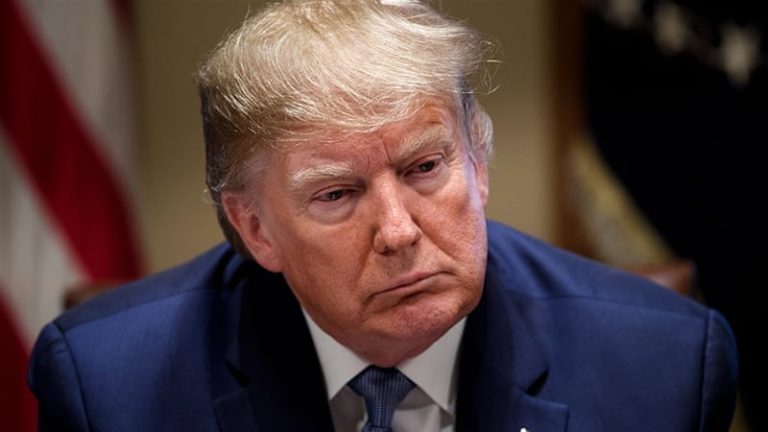
PRESIDENT Donald Trump said on Friday that he would not attend Joe Biden’s inauguration on January 20.
He posted this on his Twitter handle, attracting criticisms from detractors and Twitter users.
“To all those who have asked, I will not be going to the Inauguration on January 20th,” he tweeted.
The statement attracted 50,800 re-tweets, 267,700 likes and 59,800 quotes one hour and thirty minutes after it was tweeted, according to The ICIR checks.
For two days now, Trump has attracted severe criticisms from across the world for inciting violence in parts of the United States, especially Washington DC, on Wednesday.
Until Friday, Trump had refused to concede defeat, making unfounded statements about the November 2020 presidential elections which he lost to Biden, claiming without evidence that the election was rigged in Biden’s favour.
He had incited followers and supporters to breach Capitol Hill on Wednesday—the day the Congress were to certify Biden after his Electoral College victory.
After his incitement of supporters, he abandoned them mid-way following global condemnations, warning that those who perpetrated the insurrection would be brought to book. Some of his global allies such as UK and Israeli prime ministers Boris Johnson and Benjamin Netanyahu condemned Trump’s behaviour and the attack on Capitol Hill. House and Senate members of Republican and Democratic parties are calling for his impeachment before his exit on January 20.
On Twitter, Chris Jacobus, executive producer of ‘America Reads The Mueller Report,’ asked jokingly, “Does this mean you’ve planned another attack on our Capitol on that day?” One Helen with a Twitter handle, @doerfler_helen, said, “He won’t be going because his mob on Parlor are planning a march in DC on Jan 19th & Jan 20 th.”
One Bettemidler tweeted, “Who cares? After what you have put us through, we all hope to never clap eyes on you again, you traitorous, seditious, appalling…loser.” One Twitter user, Gwendolyn Hammond, wrote, “Hopefully, you’ll be removed from office before then. Wicked, immoral man. No one will miss you at the inauguration.”
However, his supporters backed him, expressing sadness at his imminent exit.
“Jay, Donald Trump was the best president since Ronald Reagan. America will pay a heavy price for electoral fraud,” one Krzysztof Bień, with a handle @reaktor57, replied.
One of his supporters Goose Wayne Batman, with a Twitter handle @GoooseWayne TV. tweeted, “Proud of you, Mr President. Best 4four years of my life.”
Trump said earlier that his focus had shifted to ensuring a peaceful transfer of power.
One of the issues that come up when discussing gender bias in Nigeria is that “a woman cannot post bail in Nigeria.”
This statement is understood to mean that a woman cannot stand as surety or provide any security for a defendant or a suspect.
This was further crystalised in a Nigerian web TV series entitled ‘Skinny Girl In Transit (SGIT)’ by Ndani TV. SGIT is seen as a show that highlights societal issues dealing with themes of domestic violence, adoption, inter-faith and culture relationship, among others.
In the pre-credit opening scene of Season 6 Episode 7 (S6E7), a police officer stated authoritatively that a woman could not post bail.
By January 6, 2021, the episode posted on March 27, 2020, had garnered over 640,000 views.
THE CLAIM
A woman cannot post bail in Nigeria.
THE FINDINGS
Findings by the FactCheckHub show that the claim is false.
‘A woman cannot post bail’ is often listed among the litany of things women cannot do in Nigeria when having gender bias discussions
The web TV series, SGIT, in a hard-to-miss position – the first 40 seconds –also reiterated this narrative that a woman could not post bail in Nigeria.
Here is the dialogue that ensued in the first 40 seconds of the episode.
Woman: I don’t get it. Are you telling me that he is going to sleep here tonight?
Policeman: Madam, I never knew you are such a nice person. But you see, in the constitution of the Federal Republic of Nigeria (FRN), a woman does not post bail. So, you have to come back with a man tomorrow morning and that is how it is done.
Woman: Really?
Policeman: Yes.
The statement meant that a woman could not enter any recognisance or stand as surety or provide any security for a defendant because the woman in question attempted to get her son released on bail from detention.
Abimbola Craig, lead actress and a producer of SGIT, says the show tries to mirror society as well as shed light on societal ills.
Responding to a question around the show opening room for discussion on a lot of societal matters in Nigeria, she said “…Every time we come up with storylines, we try to make sure we come up with stories that are addressing everyone’s life”.
For instance, she pointed out that the show sought to highlight the ignorance around dating married men. “[What] I really wanted people to take out was the married men situation. It has happened before, it will constantly keep happening. We need to stop being ignorant and letting girls think it is okay.”
The FactCheckHub reached out to the managing partner of Spectrum Legal Services, Saidu Muhammad Lawal, who noted that the claim was false.
Lawal said, “a woman can stand as a surety in Nigeria.”
He, however, clarified that ’to post bail’ means to pay a sum of money for bail.
Lawal also stated that a woman could stand as surety for any accused person or defendant standing trial in Nigeria.
He said this was backed by Section 42 of the 1999 Constitution of the Federal Republic of Nigeria.
Lawal stated that claim that a woman could not stand surety would be contrary to Section 42 of the Nigerian Constitution and that law would be void to the extent of its inconsistency with the Constitution.
Another lawyer, who is principally into litigation, John Okebe, concurred with Lawal, adding that the practice of not allowing women to stand as surety did exist.
Okebe told the FactCheckHub that “It is not the law that says a woman cannot post bail in Nigeria. I must, however, admit that it is a fact in some parts of Nigeria that women are disallowed from guaranteeing bail.”
Okebe said culture and the stereotype that women were incapable of owning personal properties, which was often a condition for guaranteeing bail, were likely reasons why this might happen.
He, however, maintained that “The law itself, in this instance, the Constitution prohibits discrimination on the basis of sex as such wherever and whenever a woman is not allowed. Such a woman can maintain action in fundamental rights from discrimination on the basis of sex.”
Nnenna Joy Eze, a partner at Ijenna LP, noted that the Constitution was silent on who was eligible to post bail, implying that the claim was false.
She said, “From the combined reading of Section 35(4) and Section 42 of the 1999 Constitution of the FRN as well as Section 30 of Administration of the Criminal Justice Act (ACJA), nothing stops a woman from posting bail.”
The sections read:
“Section 35 (4) Any person who is arrested or detained in accordance with subsection (1) (c) of this section shall be brought before a court of law within a reasonable time, and if he is not tried within a period of –
(a) two months from the date of his arrest or detention in the case of a person who is in custody or is not entitled to bail; or
(b) three months from the date of his arrest or detention in the case of a person who has been released on bail, he shall (without prejudice to any further proceedings that may be brought against him) be released either unconditionally or upon such conditions as are reasonably necessary to ensure that he appears for trial at a later date.
Section 30 ACJA reads; 1) Where a suspect has been taken into police custody without a warrant for an offence other than an offence punishable with death, an officer in charge of a police station shall inquire into the case and release the suspect arrested on bail subject to subsection (2) of this section, and where it will not be practicable to bring the suspect before a court having jurisdiction with respect to the offence alleged, within 24 hours after the arrest.
(2) The officer in charge of a police station shall release the suspect on bail on his entering into a recognisance with or without sureties for a reasonable amount of money to appear before the court or at the police station at the time and place named in the recognisance.
(3) Where a suspect is taken into custody and it appears to the police officer in charge of the station that the offence is of a capital nature, the arrested suspect shall be detained in custody, and the police officer may refer the matter to the Attorney- General of the Federation for legal advice and cause the suspect to be taken before a court having jurisdiction with respect to the offence within a reasonable time.
Now these two sections provide for bail and as you can see, nothing here suggests such, she noted.
Eze told the FactCheckHub that some argued that Section 122 of the Criminal Procedure Act created such a provision:
“An accused admitted to bail may be required to produce such surety or sureties as, in the opinion of the court admitting him to bail, will be sufficient to ensure his appearance as and when required and shall with him or them enter into a recognisance accordingly.”
However, this, Eze stated, was struck off by Section 14 of the Interpretation Act which clearly stated that “words importing the masculine gender include females.”
Furthermore, Eze stated that Section 42 of Nigeria’s 1999 Constitution precluded any law in force in Nigeria from subjecting anyone to any form of disability or restriction on grounds, inter alia, of sex.
Eze also noted that the Administration of Criminal Justice (Repeal and Re-enactment) Law of Lagos State, 2011, which was the criminal procedural law in place within Lagos, had dispelled every doubt as to the eligibility of a woman to post bail by its provision in Section 118 (3) of the law stating that “No person shall be denied or prevented or restricted from entering into any recognisance or standing as surety or providing any security on the ground that the person is a woman.”
She added that Section 167 (3) of the Administration of Criminal Justice Act 2015 regulating criminal procedure in the FCT had a similar provision.
Furthermore, all states that had domesticated this law equally had similar provisions too, she explained.
THE VERDICT
The claim that a woman cannot post bail in Nigeria is FALSE.
This is because the Constitution of the Federal Republic of Nigeria is silent on the gender of eligibility and it also does not allow for discrimination on the basis of sex.
IN Sokoto State, many office messengers travel several kilometres between the state secretariat complex and the auxiliary secretariat in Giginya on a daily basis in an attempt to meet the demands of their jobs. Their frustration provides an insight into how the abandoned multibillion-naira secretariat project contributes to the workers’ plight.
At 7:45 am, on a Monday morning, this reporter arrived at one of the apartments in Giginya Secretariat on the outskirts Sokoto city. The buildings comprise blocks of residential houses originally built for civil servants in the 90s by the Second Republic governor of the state, late Shehu Kangiwa. At the main gate was a middle-aged man who had been waiting for a scheduled meeting with this reporter. Just before the meeting began, the man shook with fear.
“You know we are civil servants and we are not permitted to speak with the media,” he said, referring to other workers, “All of us have one or more stories to tell,” he added. To hide his identity, he agreed to be identified simply as Malam Kabiru.
Taking messages from one office to another is a journey
For Kabiru, life as a messenger, otherwise called dispatch-man within the civil service, has been stressful and laborious. Since he joined the state’s workforce many years ago, his daily routine has been shuttling between various offices within Sokoto capital city to deliver official documents.
Kabiru lives in Mebera and treks about 12 kilometres to work in Giginya and thereafter begins a daily routine of dispatching official letters, files and documents to the main secretariat complex in Sokoto city, covering no fewer than 10 kilometres. In the last two decades he has been dispatching government’s files, letters and memos, and must have covered thousands of kilometres. But he has little or nothing to show for his hard labour.
“My responsibility is to deliver files and important documents of the ministry from here, (Giginya Office complex) to the Cabinet Office at Usman Faruk Secretariat,” he told our reporter.
The Cabinet Office complex is an old administrative building housing key government departments including the offices of the Deputy Governor, secretary to the state government and that of the Head of Service. Other key ministries domiciled in the complex are finance, justice, budget and economic planning, works and transport, local government and community development, among others. It has an empty vast land earmarked for the construction of permanent buildings to accommodate all the ministries temporarily operating at the old complex.
But the non-completion of the buildings eight years after the contract was awarded is causing untold hardship to many civil servants, especially junior staff like Kabiru, who have to carry files and other documents from the temporary secretariat to the permanent site.
Corroborating Kabiru’s narrative, Abdul Magaji, an administrative officer, said he uses his private car to convey some of the messengers in their routine trips to the main secretariat complex. “Sometimes, I spend personal money to convey them (messengers) to the main complex where they usually deliver their messages either at the Head of Service or SSG’s offices on a daily basis.
“Before the advent of this administration, each ministry got its monthly overhead cost from the government from where money was given to these messengers and some of us to fuel motorcycles and cars. But, now, it has stopped. There is no money to pay for daily overheads.
“That is why there are complaints of shuttling long distances by these dispatch riders. They now use their personal money to run around the two secretariats to either deliver one document or convey very important messages without any remuneration,” 51-year old Abdul lamented.
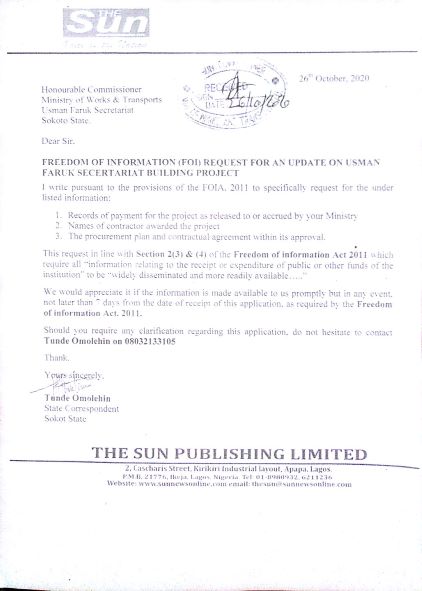
ledged letter of FOI sent to Sokoto State Government
Another government worker, Musa Lawal, recalled the excitement of workers when the then Aliyu Wamakko administration announced plans to relocate ministries to a permanent complex in Giginya in 2013. He said that the governor awarded a contract for the secretariat project to ease the suffering of civil servants traversing between the main complex in Sokoto City and Giginya.
But “it has been eight-year now; we are still listening to the same old story on the secretariat project. We want this present administration to fast-track its completion to ease our movement from one location to another.”
He believes that the completion of the project will bring to an end to decades of suffering for workers who travel several kilometres between the main and temporary secretariat.
The beginning
On June 3, 2013, the Sokoto state government signed a contract to construct the Head of Civil Service Office complex and additional office structures at the Usman Faruk Secretariat. The buildings were to accommodate ministries, departments and agencies (MDAs) that are, at present, located at the Shehu Kangiwa Secretariat.
According to the official documents sighted by this reporter, it was with a view to centralise the administration of the government by turning the Usman Faruk Secretariat into the main secretariat complex in Sokoto. After a procurement process, an indigenous construction firm, Messrs. Edile Construction Nigeria Limited won the bid for the job at the cost of N5.7 billion. The contractor moved to the site as soon as the government paid 30 percent mobilisation.
But a few months after the commencement of the job, a former Commissioner for Information, Danladi Bako, said the government revoked the contract, citing low pace of work by the contractor. While the contractor promptly refuted the claims, the government went ahead to award the contract to another indigenous firm, Messrs. Habmostar Construction & Engineering Company at the cost of N5, 284,206,081 with a mandate to complete it before the expiration of the administration’s tenure.
Main entrance of Usmanu Faruk Secretariat
The new contractor never showed up at the project site till the expiration of the Wamakko’s administration after allegedly pocketing the sum of N1.5 billion being the required 30 percent down payment in the contractual agreement. A visit to the project site showed a picture of a public structure left to rot away by two successive administrations in the state. Relevant officials at the state Ministry of Works and the office of the Head of Service declined to speak on why the project was abandoned when our correspondent visited them for interview.
A Freedom of Information Act (FOIA) request sent to the office of the Commissioner of Works, Salihu Maidaji, was declined on grounds that the matter was already before the court. The Acting Permanent Secretary, Ministry of Works, Smaila Wali, said the ministry knew nothing about the project, adding, “We are only given a supervisory role. I will want you to visit the office of the Head of Service. They are the clients for the project. There, you can be briefed on the details of the project. But bear in mind that the state Ministry of Justice is prosecuting a case against an aggrieved contractor. Maybe you can contact the commissioner in charge for the legal details also,” he said.
When contacted, the state Attorney General and Commissioner for Justice, Suleiman Usman, SAN, acknowledged a text message sent to his cell phone, but he refused to provide further details surrounding the project as requested by this reporter.
A building at Gingiya secretariat converted to ministerial offices
Legal intrigues
For four weeks, our reporter made several attempts to have an audience with the aggrieved contractor to no avail. But the company’s lawyer, Lagalo Dan Lagalo, in a telephone conversation said his client had dragged the Sokoto State Government to court to enforce his fundamental rights. He hinted that the case has been moved to the Supreme Court after the company secured landmark victories at both the High Court and the Court of Appeal. The lawyer, however, declined further comments on the matter. But court papers obtained by our reporter showed that a lawsuit was first filed before Justice Abubakar Muazu Lamido of Sokoto State High Court in 2014.
In the suit with Number: SS/ OS/1/2014 Between Edile Const. Nig.Ltd V Sokoto State Government & Anor, the applicant had challenged the decision of the state government to abort a valid contractual agreement without any wrongdoing on the part of the contractor.
Among reliefs sought by the aggrieved contractor is an order re- straining Sokoto State government, its agents, servants or representatives from enforcing, implementing and, or giving effect to the purported revocation, as well as unjustly interfering with the progress of work done. The plaintiff had insisted that the action taken by the government was malicious and done in bad faith, and not in accordance with Clause 42 of the contractual agreement.
Parts of the prayers before the court is to determine whether the agreement dated 3rd June 2013, freely entered into by the plaintiff and the Sokoto State Government was valid, subsisting and, or binding on the parties. The contractor also sought an order of court declaring as null and void, the revocation paper dated April 15, 2014, by which the 1st Defendant (Sokoto State Government) purported to revoke, determine and, or terminate the contract awarded to the plaintiff and a declaration that the said revocation was malicious and in bad faith.
Investigation by our correspondent revealed that both the lower and appellate courts, all sitting in Sokoto have since delivered their verdicts in favour of the contractor but the state government rejected the courts’ decisions.
Unkept promises
Checks by this reporter show that the former governor of the state, Aliyu Wamakko, had initiated several multibillion naira projects towards the end of his administration. These include the state Independent Power Project (IPP), the College of Agriculture situated in Wurno, and an International Conference Centre. Others are the 37.1 kilometres Rundi-Katami Road in Silame Local Government Area, the 45 kilometres Balle-Kurdulla-Niger Republic Road in Gudu Local Government Area, the Deputy Governor’s official residence, renovation of state High Court Complex and series of water projects.
Some of the equipment left behind by the contractor
Wamakko, now senator representing Sokoto Central Senatorial District, has come under serious criticism for his inability to complete many of the projects he initiated while he served as governor for eight years. While in office, he always boasted that every project embarked upon by his administration would be completed and handed over before May 29 handing over date. To achieve the goal, he had directed his works commissioner, Umar Nagwari, to provide strict supervision of all projects under the ministry and vowed to deal with contractors who were not serious about their jobs.
Despite the promises made by the former governor, our reporter found out that only a few projects initiated during the twilight of the administration were completed. For instance, the contracts for the construction of the state’s Independent Power Plant and the Usman Faruk Secretariat never saw the light of the day. Wamakko’s Special Adviser on Media and Publicity, Bashir Rabe Mani, would not offer any explanation on why the for- mer governor could not deliver on the projects he initiated. Mani, who had initially promised to contact Wamakko for a response, did not get back to our reporter and would not take further calls or respond to text messages sent to his phone.
Looking the other way
Despite promises at his inauguration to continue with all projects and policies of his predecessors, Governor Aminu Tambuwal has failed to complete the multi-billion naira projects left behind by both Wamakko and Attahiru Bafarawa. He reasoned that since large sums of money were spent on the projects abandoned by his predecessors, it could make sense for his administration to complete them.
However, six years after he took over from Wamakko, nothing has been done to complete abandoned projects that litter the state. The governor had shown an early commitment by completing the International Conference Centre situated at Kasarawa area of the state, one of the many left behind by his predecessor. But that interest has waned. Rather than complete abandoned and exist- ing projects, Tambuwal has recently signed fresh contracts worth over N20 billion and made a down payment of N6.2billion representing 30 percent of the contract sum to the new contractors.
Workers at the new N6.8bn state university teaching hospital currently ongoing in the state
The projects include the construction of two flyovers at Runjin Sambo and Rijiyar Dorowa areas within Sokoto metropolis, dualisation of Tashar Illela Road, and construction of the State University Teaching Hospital. Others include the dualisation of Maituta Road, Waziri Abbas Road as well as the construction of a Premier Hospital at Sabon Birni Local Government Area. He has also unveiled a plan to borrow N65.7 billion to embark on new infrastructure projects a The state Commissioner for Finance, Abdusamad Dasuki, told this reporter that the money will be spent on critical sectors of the economy, including agriculture, health, housing, urban renewal, infrastructure and education. He said that the move was to fast-track the economic transformation and “to position Sokoto as a leading economy in Nigeria and Africa.”
Why inherited projects were halted
The state government says it is aware of the plight of civil servants who have to trek several kilometres between the main secretariat complex in Sokoto City and the Giginya temporary secretariat. The Special Adviser on Media and Publicity to the Governor, Muhammad Bello, told our reporter in an interview that as part of measures to ameliorate their suffering, the government gave loans and provided mobility to the junior civil servants working between the two secretariats.
Giginya Temporary Secretariat entrance gate
“We are aware of this development as a result of moving a bit distance between Shehu Kangiwa and Usman Faruk Secretariats on a daily basis. This has been on for decades now,” he said. “But the present administration in its friendly approach to this situation has provided soft loans through owned microfinance banks to this category of civil servants to help leverage their plights. The Governor has also provided motorcycle loans to some of the messengers to enable them to solve the problem of mobility in the course of discharging their daily duties, pending the completion of the project in question,” Muhammad told our correspondent.
The governor’s aide, however, insisted that Tambuwal has not abandoned the secretariat project as being speculated in some quarters. “I want you to know that the government is an institution that must not be halted at the expiration of a particular administration,” he said. “We are reviewing the terms and conditions of all the projects inherited from the immediate past government. This is necessary to enable the present ad- ministration to have a clear picture of what is expected to be done or any improvement needed to have the project completed.
“For instance, the contract for the deputy governor’s official quarters has just been reviewed and awarded to a new contractor to ensure a standard job is carried out. I am sure other projects like the secretariat complex will follow suit. The government has not in any way abandoned any project initiated by his predecessor,” Muhammad said.
Abandoning projects is normal – civil society The National Coordinator, Coalition for Transparency, Accountability and Good Governance (COTAGG), Mike Opia, has insisted that Nigeria’s political elite have seriously abused the country’s procurement laws and processes. “The public procurement law in Nigeria has un- fortunately been used by government operators to perpetuate corruption rather than check corruption,” he observed.
“In the first place, the bureaucratic nature of the law has been used by the authorities to delay contractual obligations leading to abandonment and pocketing of the funds. So, the ills the law was meant to solve have been turned around to be the tool for their corrupt tendencies.”
Addressing the situation in Sokoto, Opia maintained that various governments in Nigeria are fond of abandoning old projects, so they could award new ones. “The reasons are obvious – if they award new contracts, they will collect kickbacks which they can’t collect from the old ones. Again, some of them are pursuing vain- glory,” he said. “They always seek to show that they started and finished the said projects irrespective of the costs to society.”
He, however, called not only for transparency in the award and execution of contracts but also in the leadership recruitment processes, adding that development will continue to elude the country until leaders are responsible to the electorate. He urged policymakers to review the current procurement law and make it less cumbersome so that the operators will no longer hide under the unnecessary bureaucracy to perpetrate corruption.
Opia appealed to the legislature and civil society actors to step up oversight functions on projects and whistle-blowing, respectively. He maintained that until all stakeholders become watchdogs over public projects, those in charge of contract awards and those in charge of execution would continue to frustrate implementation.
THE African Continental Free Trade Area (AfCFTA) started on January 1 this year with a view to expanding intra-African trade and removing barriers to economic cooperation.
The essence of the AfCFTA is to create a borderless Africa where trade and commodities can freely flow without customs restrictions.
Since the AfCFTA will redefine the way Nigerians live, The ICIR has compiled a list of 10 facts you must know as the continental free trade gears up.
The first fact is that the AfCFTA was signed by 55 African countries except for Eritrea.
The second fact is that there will be fewer restrictions on export products from Nigeria to African countries and imports from African countries into Nigeria, going forward.
The third fact is that intra-African trade was 15 percent in 2019, while intra-European trade stood at 68 percent. On the other hand, intra-Asian trade was 59 percent within the same period. This means that Africa is not trading so much with each other.
Fourth is that the size of African economy is $2.6 trillion, but the AfCFTA is estimated to increase this to $6.7 trillion by 2030 if the free trade treaty becomes successful.
Fifth is that Nigeria ratified the AfCFTA on November 12, 2020, making Africa’s most populous nation a signatory to the trade treaty.
The sixth fact is that there is Anti-Dumping Agreement in line with the World Trade Organisation (WTO)’s rules on Article V1 of General Agreement on Tariffs and Trade (GATT) of 1994. This means that it is a breach of the agreement for countries to turn Nigeria into a dumping ground for their products.
Seventh, the Nigerian Customs Service has a right to apply anti-dumping measures if it feels that countries are dumping products into the country.
Eighth, there are rules of origin, meaning that goods from any African country will be given preferential treatment while products from outside Africa will not, according to Article 13 of the Agreement prepared by the African Union.
Ninth, in line with Article 28 of the Agreement, Nigeria can adopt restrictions if its balance of payment position is in dire deficit or if its economy is in dire straits.
Tenth, countries can apply for amendments from time to time.
In what looks like an endless circle of deception, Hadejia Jama’are River Basin Development Authority continue to receive millions of naira in yearly allocation on poorly executed and fraudulent irrigation projects in Bauchi, Jigawa and Kano States; WikkiTimes’ investigation has revealed.
Mallam Bello Aliyu is always anxious whenever the rains are over, and dry season sets in.
“We remain at home and wait for another raining season to be able to farm again or we look for an alternative source of water supply,” says Aliyu, a small-scale farmer in Kanye Babba, Babura Local Government Area (LGA) of Jigawa state.
Shuwaki, Kanye Babba and Jama’are communities in Tudun-Wada, Babura and Jama’are Local Government Areas (LGAs) of Kano, Jigawa and Bauchi states continue to decry government’s neglect despite being predominantly agrarian. Without access to irrigation farming, farmers like Aliyu are rendered jobless whenever the dry season sets in.
Irrigation practices which give room for year-round farming has been neglected in Nigeria despite huge amount of resources thrown at it by the government. Irrigation potential estimates in Nigeria vary from 1.5 to 3.2 million acres, says the World Bank in its 2014 report. The latest estimate gives a total of about 2.3 million acres, of which over 1 million acres are in the North.
Putting it into context, the level of abundant water resources and investment in the sector does not correlate with the state of neglect of farming communities in the country.
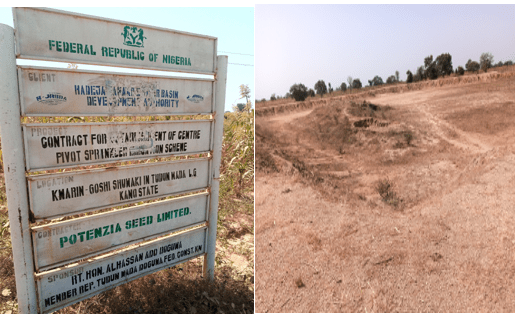
One of such investments is the failed ₦176 million Hadejia Jama’are River Basin Pivot Scheme meant to enable irrigation farming practice in three communities across three states namely Shuwaki, in Tudun Wada LGA (Kano), Kanye Babba in Babura LGA (Jigawa) and Jama’are LGA (Bauchi).
The project’s intention is to aid subsistence farming, as well as improve food security, a major focus of the current administration. However, this is not the case due to project’s failure as most farmers in these communities continue to lament government neglect in providing irrigation support for them.
In the 2018 and 2019 national budgets, the Hadejia Jama’are River Basin Development Authority (HJRBDA), an agency under the Federal Ministry of Water Resources, proposed the construction of a center-pivot irrigation sprinkler.
A center-pivot irrigation system is a modern and mechanized irrigation method consisting of several pipes to convey water, as well as sprinklers supported by trusses and mouthed on wheels. This method of irrigation increases crops yields while also conserving water unlike flood and drip-well irrigation.
The project started only to be abandoned later, though funding continues, investigation by WikkiTimes has shown. The project, which received over N87 million as funding from the Federal Government was awarded to Isa Halilu Nigeria Limited, Triple K. Construction Company and Potentzia Seed Limited, records from open treasury portal show.
Painful lies we were told – residents
A visit to Kanye Babba community in Babura LGA, Jigawa State, one of the project locations, revealed that food insecurity is evident across the communities.
The project was moved from the Hadeija LGA, the location initially stated in the budget.
According to the community’s secretary, Ibrahim Yunusa, HJRBDA officials visited them and proposed the irrigation project.
Thereafter they requested for land, and vouched to acquire a large expanse for the project but that was the last time the residents heard from them since 2018, Yanusa said.
Bello Aliyu, a retired civil servant and the Kanye Babba (district adviser on religious matters), said farmers often travel to neighboring states including Kano, Taraba, and even Benue to get necessary irrigation support such as drip-well, manual and localized irrigation.
The same experience was observed in Shuwaki community in Tudun-Wada LGA, Kano State. Armayau Kwaringoshi is one of the residents of the community who had high hopes when the project commenced.
He expressed his disappointment in the project, adding that community members were hopeful when they were informed about the irrigation scheme and when the contractor moved to site.
Kwaringoshi, however, lamented that the project has been left in its present state shortly before the 2019 general election.
Tundun Wada LGA project Site
They only came back in March 2020 to move all their equipment. We have not seen them since then,” he said.
Another resident, Ya’u Namadi Shuwaki, corroborates Armayau’s statement.
He said he was informed by the contractor and an official of the River Basin Development that there is a change of project from the initially proposed center pivot sprinkler to the provision of boreholes in different farmlands within each project community.
In Jama’are LGA, the story remains the same.
A visit by this newspaper to the project site shows that many were abandoned.
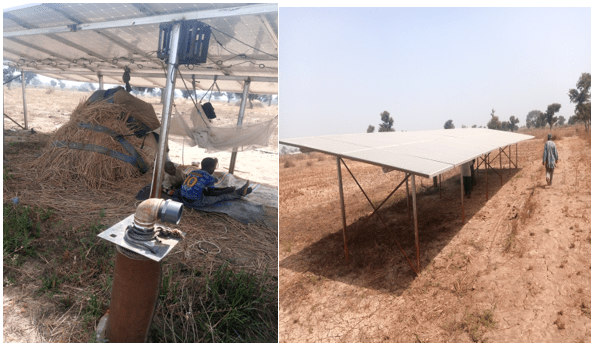
There were two installed solar panels on both sides of the farmland where the project is situated. There were also borehole pipes sunk into the ground, apparently meant for water supply to the farmland.
Mustapha Umar, engineering officer of HJRBDA, explained that the project was changed due to the unsuitability of the project site.
“It is a flood-prone area, and that was why the contractor could not do anything there, especially the installation of the center pivot irrigation sprinkler.
It was later changed, considering the high level of flooding which always affects the area during raining season. So they swapped the project for drip-well irrigation,” he said.
Installed solar and borehole at Jama’are project site wasting away
Furthermore, Umar said that the agency has since then dug over 50 boreholes at every 40 meters of every acre, providing water for each acre of farmland for farmers, using generators and pumping machines. He disclosed that farmers fuel the generating set since the cost of fueling the machines wasn’t provided for in the agency’s budget.
According to him, each of the drip-well boreholes has been functioning well as each farmer was given a water-pumping generator as an aid to use in pumping water daily.
This invariably runs contrary to the intention of the pivot irrigation scheme and brings into the question whether appropriate feasibility studies and environmental assessment was done, said Bello Gambari, an irrigation expert.
“Drip well irrigation is one of the cheapest irrigation system available in Nigeria but leaving the farmers to cater for the fueling wasn’t well thought out considering the already dire situation most rural farmers find themselves in financially,” Gambari said.
He explained that drip well cost around N50, 000 to N70, 000 depending on the size of the sumo used since most drip-wells are handmade.
Even then, Umar’s claim is difficult to believe. Findings showed that he owns acres of farmland which the wells serve, at the exclusion of other farmers. Aside Umar who claimed to be a beneficiary, attempts by this newspaper to locate other beneficiaries were futile.
Ibrahim Danjuma is a popular farmer in the area. When asked about the project, he said: “I don’t know anything about the project. I have not benefitted from any irrigation project. The land is not accessible so we don’t go there to even farm.”
False hope and lies by contractors
A breakdown of the amount expended on the contract showed that Isa Halilu Nigeria Limited was paid N18,550,054.43; Tripple K. Construction Company Limited and Potenzia Seed Limited received N36,190,476.20, and N33,178,756.28 respectively.
This reporter met with Haythman Yahaya, the Manager of Tripple K. Construction Company located at 7, Dorowa Street, off Audu Bako way, Nassarrawa LGA Kano State to enquire about the project abandonment in Kanye Babba. He chronicled how the project started, adding that the company had to stop the project due to no fault of theirs.
Yahaya explained that the company was only paid 15 percent mobilization fee and that that all the equipment needed for the project was imported from China without additional funding.
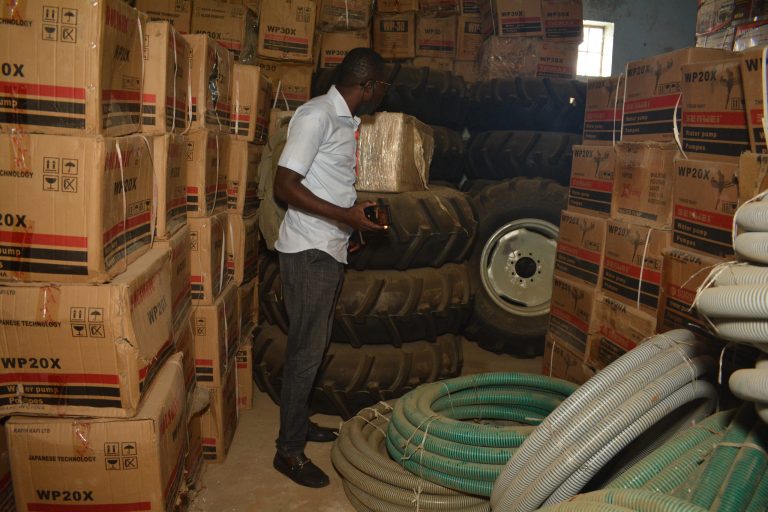
“After we were paid the mobilization fee we proceeded to clear and prepare the project site for the commencement of work. However, funding stalled and the equipment worth over N15 million imported from China for the project is left to waste,” he disclosed.
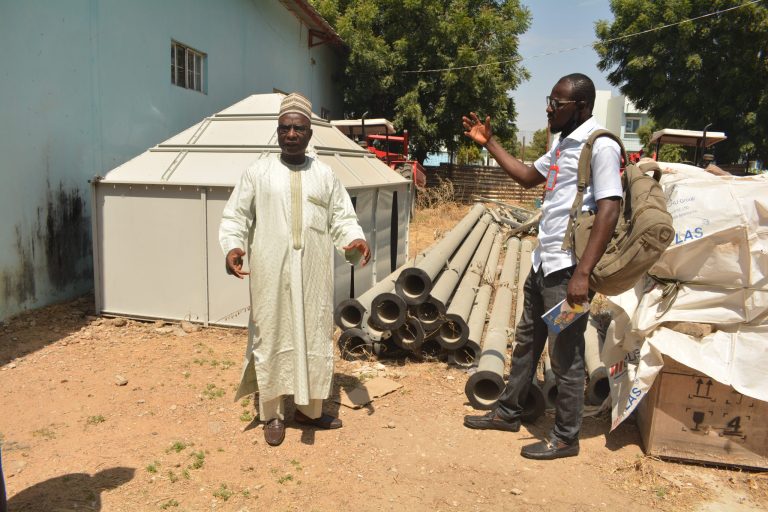
Engr Umar Showing the supplied equipment in the store house
Yahaya said the cost of acquiring the equipment is yet to be covered by the contracting agency, HJRBDA, and as such the company decided to abandon work.
Some of the Sprinkler equipment in a pity state in the store house at HJRBDA
“Until the agency pays back the money invested into the project and the contract fee, the company won’t return to site to continue the project,” he said
The River Basin Authority, however, did not dispute the fact that equipment was purchased. It added that the challenges of theft, vandalism and maintenance were the main reason why the project in Kanye Babba was stalled.
Sani Mohammed, Director of Account of the agency could not explain the outstanding amount owed the contractor when questions concerning it were posed to him.
The Managing Director, Isa Halilu Nigeria Limited, Mohammed Sani, who was contracted to provide irrigation facilities in Jama’are, Jama’are LGA, Bauchi State, could not be bothered that the project he was paid N18,550,054.43 to execute has been abandoned.
Sani could not be reached after several weeks of visit by this reporter at his office located in Hauwau house, Gyadi Gyadi, Tarauni, Kano State. However, when contacted on phone Sani asked the reporter to direct questions to the HJRBDA for answers. He insisted he was not in the position to provide any information about the project to the reporter.
A Freedom of Information Act, FOIA, request sent to the company was received by one Isa Garo on October 19, 2020 with no response weeks after the request was made.
The FOI Act (FOIA) 2011 stipulates that response to requests should be made available promptly, but in any event, not later than 7 days from the date of receipt of the request. Furthermore, section 2(7) of the FOIA provides that the act is “applicable to private companies utilizing public funds or providing public services or public function.”
The third contractor, Potenzia Seed Nigeria Limited’s address could not be located. On request, another address provided by HJRBDA at Plot 2, Sanni Marshal Road, Nassarawa LGA, Kano State belonged to another company. Also, a search on Nigeria’s company directory, Corporate Affairs Commission, CAC, was futile.
However, its project site which was said to have been cleared and ready for construction was left desolate depriving farmers of their farmlands.
Also a search in the Corporate Affairs Commission (CAC) to confirm the registration of Isa Halilu and Tripple K. construction limited proved abortive as both companies could not be found on the commission’s website, this contravenes the Public Procurement Act (BPP) (2007) which states that the minimum qualification for the awarding of any contract must be with a Proof of Registration with the Corporate Affairs Commission (CAC), a Tax Clearance from the Federal Inland Revenue Service (FIRS) for at least three years and Pension Clearance Certificate from the Pension Commission (PenCom) among others.
Federal Agency Defrauding Farmers
In reaction to a FOIA request sent to the HJRBDA enquiring about the status of the project, the agency agreed to an interview granted by the Managing Director at its headquarters on Maiduguri Road, Hotoro, Kano State. His response was at variance with that of the contractors.
According to Abdullahi, the center pivot sprinkler project was appropriated in 2018 and commenced same year. He said the project was only proposed to be sited in Tudun-Wada, Jama’are, adding that Kanye Babba was originally not among the beneficiaries.
It was later included, Abdullahi said, because there were several irrigation projects in Hadejia where the project was initially situated.
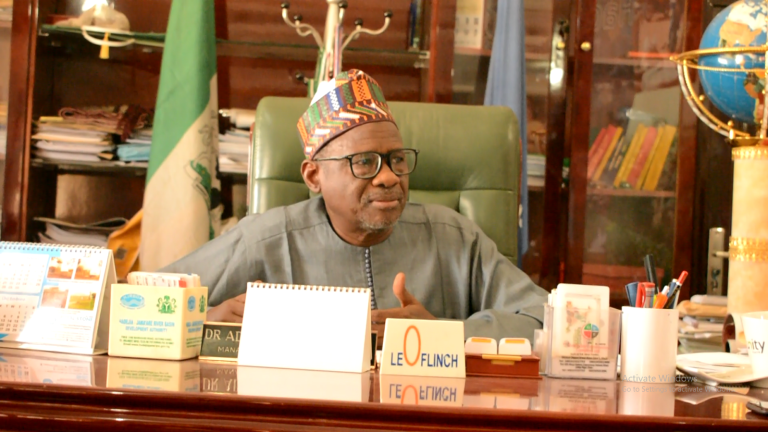
Dr. Ado Khalid Abdullahi, Managing director HJRBDA
When asked why the projects are stalled two years after the contracts were awarded, he explained that they are on-going project and are in phases, adding that he is pleased and impressed with the level of work carried out there, which he claims is at 80 percent completion.
Abdullahi also said the initially planned center pivot irrigation scheme was changed to drip-well irrigation and that over 40 drip wells have been dug. Some, he noted, were already serving farmers before the flooding which destroyed the farmlands and kept farmers away from farming for a very long time.
This naturally suggests that funding for the project should be reviewed downwards since the pivot irrigation is not as costly as the drip-well irrigation system, says Gambari.
But this was not the case. Abdullahi could not explain why the fund for a pivot irrigation project stated in the budget would be spent on drilling boreholes and buying pumping machines without any review of the procurement process.
When informed that the contractors were paid N87 million in 2019, he could not offer any concrete explanation. But he insisted the projects were near completion, despite contrary evidence.
Regardless, there is a lot more than meets the eyes in the matter. Engineer Ibrahim Abdullsalami Yakasai, Head of Procurement at HJRBDA, said the project was advertised in the national dailies specifically Daily Trust and had several bidders.
He further said the project advertised in the tender was actually the center pivot irrigation sprinkler and all contractors awarded the contract were selected on merit.
He however was not forth-coming on the procurement process when the project changed mid-way from the center pivot sprinkler to the drip well irrigation system. In his response, Yakasai stated that the need for change was necessary so as to avoid wastage of resources. But he also declined to provide additional information on the overall amount expended on the project.
A call to the members representing these local government at the National Assembly Allhassan Ado Doguwa representing Doguwa/Tudun-Wada and Isa Hassan Jama’are representing Jama’are/Itas-Gadau federal constituency by this Newspaper to get their opinion and awareness on the project was futile as their phone rang severally but it was not answered. Also, text messages sent to them in this regard, were not replied as at press time.
For Mike Falodun, an irrigation expert with International Institute of Tropical Agriculture (IITA), the project conception was poorly done.
He said although center pivot irrigation sprinkler is expensive to construct and seems more mechanized for irrigation farming, it is often prone to vandalism and poor maintenance in Nigeria.
Experts also argued that Nigeria will continue to face a lot of setbacks in its drive to ensure food security if such project abandonment, corruption and mismanagement of funds are not properly tackled.
Hamzat Lawal is the chief executive officer, Connected Development (CODE), an anti-corruption advocacy organization.
In an interview with WikkiTimes, Lawal explained that corruption is one major factor hindering government’s effort towards curbing food insecurity.
“Nigeria’s agricultural sector would have been the largest sector in the whole of Africa, considering the nature of our soil and population as an advantage. We are faced with the evil corruption and until it is brought to its knees, we will continue to face a lot of setback in the agricultural sector as a country,” he said.
Development expert and project consultant, Nura Gazali, takes it further.
He explained that: “Corruption is one of the key issues affecting public projects and policies. It is one of the major impediments for implementation of projects across public sectors including the agricultural sector.”
“Food insecurity in Nigeria is continuously being aggravated by myriad factors, and poor conceptualization of project and corruption are among the two major causes for setbacks in the quest to ensure food security,” Gazali said.
* This investigation is supported by the John D. And Catherine T. MacArthur Foundation and the International Center for Investigative Reporting.
THE Manufacturers Association of Nigeria (MAN) has told the federal government that any attempt to hike electricity tariff will worsen the state of the sector.
In a press release on Thursday signed by its director-general, Segun Ajayi-Kadir, the association said the news of federal government’s directive to the National Electricity Regulatory Commission (NERC) to suspend the implementation of the duly performed minor review from N2 per kWh to N4 per kWh till the conclusion of the Joint Ad Hoc Committee’s work at the end of January 2021 was only a temporary relief.
MAN said even though the increase could be reconsidered during this period, there was no doubt that the NERC was anticipating an increase in electricity tariff before the slight adjustment. “Apparently, the three weeks respite is to accommodate the spirit of the agreement between Labour and the federal government on tariff increase started last year,” MAN said.
“This is why the calls for circumspection and pragmatism in the matter of increase remain relevant. No matter what becomes the outcome of the Ad-Hoc Committee’s work, an increase at this time is ill-timed and not manufacturing friendly,” the statement noted. MAN said the federal government’s reasons for suspending the tariff should have included consultations with other economic actors, including manufacturers who were major electricity consumers and whose businesses would be most impacted by the increase.
“As indicated in the previous press release, the sector is already groaning under inclement operating environment, including the debilitating impact of COVID-19 disruptions and deteriorating infrastructures. It is important for us to avoid this additional burden,” the statement further said. In a previous statement, MAN had said that substantial increase in electricity would increase production cost, forcing manufacturers to seek expensive alternative energy sources to meet electricity requirements.
“It will lead to decrease in foreign exchange earnings from the sector as high cost of production feeds into export commodity prices,” MAN also said. The association said it would further reduce capacity utilisation in the sector, leading to GDP decline and large-scale unemployment across the 76 manufacturing sub-sectors.
State of Nigeria’s manufacturing sector
Nigeria’s manufacturing sector is hard hit by high energy cost due to irregular power supply from electricity distribution companies. Many of them have resorted to self-generated energy such as gas, low-pour fuel oil and coal, with self-generating capacity of Nigerian manufacturers now estimated at 13,000 megawatts, according to MAN. Members of MAN spent N34.70 billion on alternative power sources in the last six months of 2019, according to a survey done by the association in 2019.
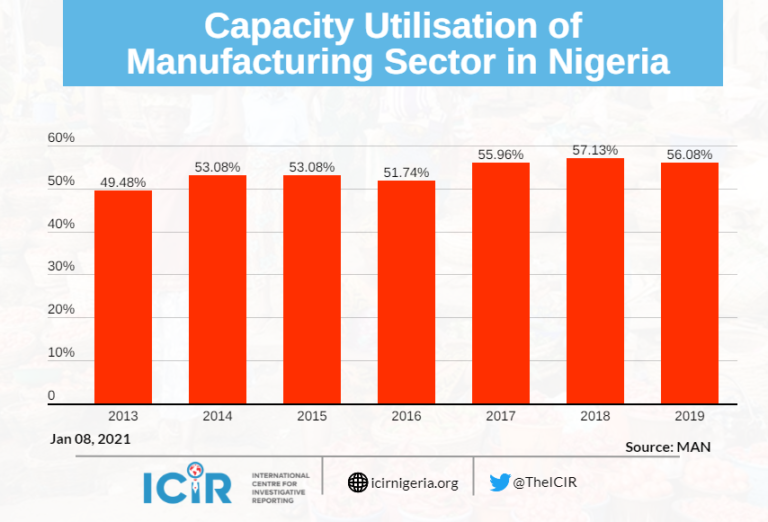
Capacity utilisation in the sector averaged 56.8 percent in 2019, which was a 0.95 percentage increase from 57.75 percent reported in 2018, MAN said. Capacity utilisation is the rate at which firms use their installed capacity. From 2013 to 2019, capacity utilisation moved from 49.48 percent to 56.8 percent, according to MAN’s data. The sector lost 1,308 jobs in the last six months of 2019, according to MAN.
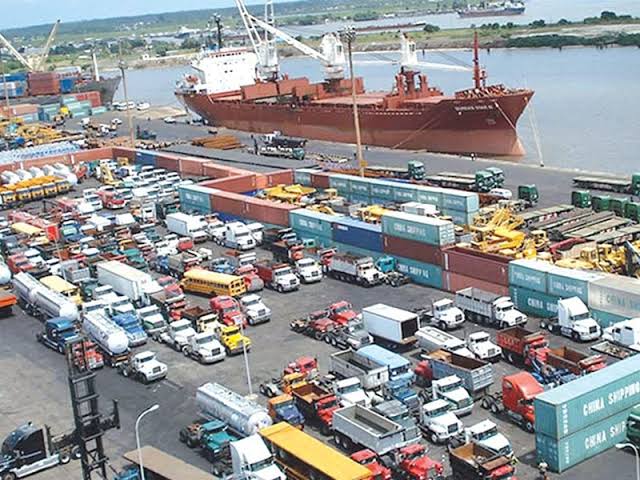
Apart from energy, the state of Nigeria’s seaports has dealt a blow on Nigerian manufacturers. Access road to two major ports in Lagos cannot be easily accessed due to congestion, as the police, the Army, the Navy and the Lagos State government remain incapable of resolving the challenge. The ports also do not have functional scanners for examination of cargoes.
Vicky Haastrup, chairman, Seaport Terminal Operators Association of Nigeria (STOAN), recently condemned manual examination of cargoes at the Lagos port, saying that it was a sad situation. Haastrup, who spoke in Lagos during a virtual conference held in 2020, said, “We have a situation where people must visit the port physically to do Customs documentation and cargo examination before they can take delivery of their consignments. This is inefficient.”
“It is a shame that Nigerian ports do not have quality and functional scanners. That is why Customs relies on physical examination of containers, which drives human traffic into the port. We need to provide these scanners and other automation platforms in order to make cargo clearance quicker. Nigerian ports must operate the one-stop-shop platform if we must compete with other ports in the West and Central Africa,” she further said.
Light at the end of the tunnel
Several manufacturers did not perform well in the 2019 financial year due to COVID-19 restrictions, supply chains disruptions as well as bars and event centres’ closures. Brewers such as Nigerian Breweries, Guinness, International Breweries and Champion Breweries were heavily affected.
However, drug and food makers performed relatively well due to the essential nature of their products. In 2020 half year, Fidson Healthcare, a drug maker, reported a 12 percent rise in sales, from N7.3 billion to N8.2 billion in the corresponding period of 2019. Also, Glaxosmithkline (GSK)’s revenue in the first six months of 2020 rose 5 percent to N10.4 billion, from N9.9 billion the previous year. GSK is a key player in the pharmaceutical industry. For the food category, the revenue of Honeywell Flour Mills rose 39 percent to N26 billion in the second quarter of 2020, from N18 billion in the same period of 2019. Also, within the same period, Flour Mills of Nigeria’s revenue jumped 15 percent to N154 billion in 2020, from N134 billion reported in 2019.
FACEBOOK, Instagram and Twitter have suspended Donald Trump’s accounts for inciting violence in Washington D.C. on Wednesday—the day the Congress was to certify Joe Biden as president.
The outgoing U.S. president was, on Thursday, banned from using both Facebook and Instagram indefinitely, according to Mark Zuckerberg, Facebook’s chief executive, in an issued statement.
Trump’s Twitter account had earlier been banned by Twitter on Wednesday for 12 hours starting at 7pm ET, but the account was still suspended 19 hours after when The ICIR checked.
According to Zuckerberg, the decision was to prevent Trump from using his accounts from undermining the ongoing peaceful transition of power to Joe Biden, US president-elect.
Since he lost the November presidential election to Biden, Trump has consistently used all of his social media platforms to instigate violence and to discredit the outcome of the election.
On Wednesday, hundreds of Trump’s supporters besieged the Capitol Hill to prevent the Congress from certifying the electoral victory of Biden held in November 2020.
The ensuing violence following the invasion, which has been widely condemned across the globe, led to the death of four persons with several others injured.
“The shocking events of the last 24 hours clearly demonstrate that President Donald Trump intends to use his remaining time in office to undermine the peaceful and lawful transition of power to his elected successor, Joe Biden,” Zuckerberg said.
“Over the last several years, we have allowed President Trump to use our platform consistent with our own rules, at times removing content or labelling his posts when they violate our policies. We did this because we believe that the public has a right to the broadest possible access to political speech, even controversial speech. But the current context is now fundamentally different, involving the use of our platform to incite violent insurrection against a democratically elected government.
“We believe the risks of allowing the president to continue to use our service during this period are simply too great. Therefore, we are extending the block we have placed on his Facebook and Instagram accounts indefinitely and for at least the next two weeks until the peaceful transition of power is complete.”
Zuckerberg noted with concern that Trump’s decision to use his platform to condone rather than condemn the actions of his supporters at the Capitol building had rightly disturbed people in the US and around the world.
While calling on the entire nation to ensure that the transitional process goes smoothly, he said that Facebook removed Trump’s “statements yesterday because we judged that their effect — and likely their intent — would be to provoke further violence.”
“Following the certification of the election results by Congress, the priority for the whole country must now be to ensure that the remaining 13 days and the days after inauguration pass peacefully and in accordance with established democratic norms.”
Similarly, Twitter punished Trump on Wednesday over a series of tweets that sought to cast doubt over the 2020 presidential race. One included a video in which Trump spread disinformation about the election’s outcome, even as he told rioters to leave the House and Senate at a time when lawmakers had started the certification of the election.
Twitter required Trump to delete the tweets to obtain access to his account, but it made clear it of plans to escalate its enforcement efforts and suspend the president permanently if he continues to break its rules.
Similarly, YouTube removed videos where Trump was making the inciteful comments on Wednesday’s evening.
THE federal government has reversed the recent adjustment of electricity tariff for selected sections of electricity consumers in the country.
The ICIR had, on Tuesday, reported how the Nigerian Electricity Regulatory Commission (NERC) announced an adjustment rate for service bands A, B, C, D and E “by NGN2.00 to NGN4.00 per kWhr to reflect the partial impact of inflation & movement in forex.”
But on Thursday, Saleh Mamman, Nigeria’s minister of power, through a statement by his senior special adviser, media and communications, Aaron Artimas, informed all Electricity Distribution Companies(DISCOs) to revert to tariffs that were applicable in Dec. 2020.
The decision, according to the News Agency of Nigeria (NAN), was to constructively conclude the ongoing dialogue between Labour leaders and representatives of the government.
“I have directed NERC to inform all DISCOs that they should revert to the tariffs that were applicable in December 2020 until the end of January 2021 when the FGN and Labour committee work will be concluded.
“This will allow for the outcome of all resolutions from the Committee to be implemented together,” he said.
Mamman, who decried report of a 50 percent increase by sections of the media, noted that the government had continued to subsidise electricity consumers in bands D and E.
“I would like to affirm that these reports are inaccurate and false. It is unfortunate that these reports have led to confusion with the public.
“On the contrary, government continues to fully subsidise 55 per cent of on-grid consumers in bands D and E and maintain the lifeline tariff for the poor and underprivileged.
“Those citizens have experienced no changes to tariff rates from what they have paid historically, aside from the recent minor inflation and forex adjustment. Partial subsidies were also applied for bands A, B and C in October 2020,” he said.
While stating that these measures were all directed towards cushioning the economic impact of COVID-19 on citizens, the minister noted that the Buhari-led federal government and the labour union had been engaged in positive discussions about the electricity sector through a Joint Ad-hoc Committee.
He said that the committee was led by Festus Keyamo, minister of state for labour and productivity and co-chaired by the minister of state for power, Goddy Jedy-Agba.
According to him, progress had been made in these deliberations set to be concluded at the end of January.
“Some of the achievements of this deliberation with Labour are the accelerated rollout of the National Mass Metering Plan and clampdowns on estimated billing.
“It also included improved monitoring of the Service-Based Tariff and the reduction in tariff rates for bands A to C in October 2020 (that were funded by a creative use of taxes),” he said.
The power minister stated that the regulator must be allowed to perform its function without undue interference.
He said that the role of the government was not to set tariffs but to provide policy guidance and an enabling environment for the regulator to protect consumers and for investors to engage directly with consumers.
According to him, bi-annual minor reviews to adjust factors such as inflation are part of the process for a sustainable and investable Nigeria Electricity Supply Industry (NESI)
He also stated that the regulator must be commended for implementing the subsisting regulations while putting in place extensive actions to minimise the adverse impact on end-user tariffs.
“The administration is committed to creating a sustainable, growing and rules-based electricity market for the benefit of all Nigerians.
“The administration and the Ministry of Power will also continue to devise means to provide support for vulnerable Nigerians while ensuring we have a sustainable NESI,” he said.
At a time the Nigeria government is debating whether to increase electricity tariff or not, the Ghanaian government announced in a statement on Wednesday that it is providing 3-months free electricity units to its lifeline customers.
Lifeline customers are those who consume less electricity compared to other consumers.
Kwame Agyeman-Budu, managing director of the Electricity Company of Ghana Limited, who made it known in an issued statement on Tuesday, said the gesture was part of the government’s extended COVID-19 electricity relief.
ON February 28, 2020, Nigeria recorded its first case of the deadly COVID-19.
From that date to December 16 of last year, the country’s daily positive cases remained below 1,000. However, Africa’s most populous nation began to see daily cases above 1,000 from December 17 when it recorded 1,145 infections. The ICIR takes a look at how COVID-19 cases have surged to highest daily record in the last 14 days.
After recording its first over 1,000 cases on December 17, the following five days showed a decrease in the number to as low as 356 daily cases on December 21, 2020. However, the number of infections rose to 1,133 daily cases on December 23.
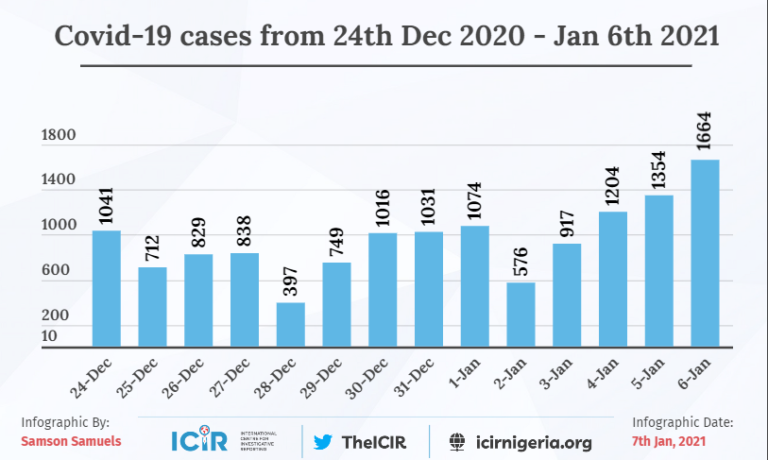
On December 25, the Christmas day, Nigeria recorded a total of 712 cases, a 32 percent fall from 1,041 reported the previous day.
On December 26, total number of cases increased to 829. The number of new cases rose to 832 on December 27, another increase from the previous day.
On December 28, however, there was a sharp decrease from 832 to 397 cases, more than half of what was recorded the previous day. But cases spiked again the following day, with the Nigeria Centre for Disease Control (NCDC) announcing that 749 cases were confirmed, almost double of cases from the previous day.
8836 cases in eight days
During the end of December 2020, the number of confirmed cases increased in the nation as NCDC confirmed 1,016 cases on December 30 and 1,031 on the last day of 2020.
On the 2021 New Year day, the NCDC announced another increase in the figures as 1,074 cases were confirmed positive of the deadly virus.
However, on January 2, 2021, there was a massive decrease in the number as only 576 cases were confirmed, but the decrease was short-lived following an update from the NCDC that 917 cases were confirmed on January 3.
The increase continued on January 4 when NCDC announced that 1,204 persons tested positive for the virus.
On 5th January 1,354 persons were again confirmed positive of COVID-19 while 1,664 persons tested positive on January 6, which currently represents the highest record number of daily cases in Nigeria.
In just eight days, Nigeria recorded 8,836 positive cases. Meanwhile, it took the nation more than three months to record 8,000 cases in the early days of the pandemic.
As of the time of filing this report, Lagos State leads in the number of confirmed cases in Nigeria with 32,687 infections, followed by the Federal Capital Territory (FCT) with 12, 428 of positive cases.