Home Blog Page 1909

COVID-19: Tales of Recoveries, Deaths (1)

By Tobore OVUORIE


Nigeria is one of the countries that have been hit by a second wave of the COVID-19. Currently, the country struggles to curb the spread of the virus as figures of infection rates soar each day.

TOBORE OVUORIE who visited  Delta, Lagos, Ogun, Anambra,  Sokoto states and the Federal Capital Territory, Abuja reports about  COVID-19 survivors’  tales of recoveries and deaths. She discovered that while many Nigerians still believe COVID-19 is a myth,  others think the infection no longer exists in the country. She also observed that stigmatisation and discrimination against persons who have contracted the virus are rife.

Nine survivors, all from diverse backgrounds, spoke with her. 

Here are their stories.

Of falsehood and misinformation

December 14th, 2020

Ughelli North, Delta State.

5.47AM

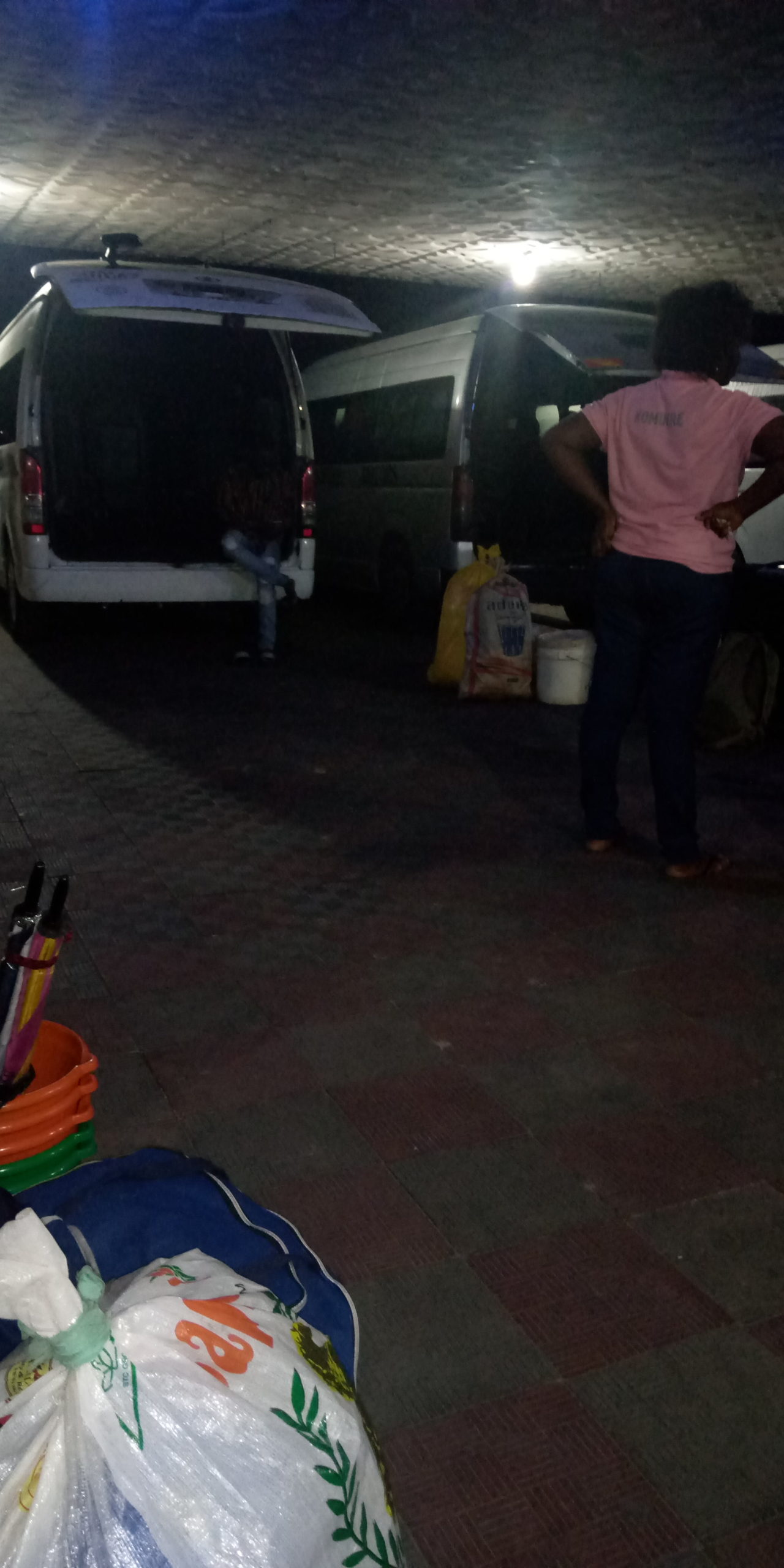
“Oga, there is no more coronavirus in Nigeria,” I heard a rather very high-pitched voice from someone nearby. I was shocked by the outright falsehood and misinformation being served with  confidence where I was sitting just two meters away from the front desk; scene of a fresh unfolding drama. It had been quite a scene since 5 am when I arrived at Agofure Motors park  at Ughelli North, in Delta state. Other dramas did not consist in  life-threatening gross misinformation. I stood up, turned around and behold, it was Omoh, a ticketer at the Agofure park.

Some passengers at the Agofure Motors Park, Ughelli North, Delta State, December 14th, 2020. Photo: Tobore Ovuorie

I do not know her surname but everyone at Agofure park in Ughelli, call her Omoh. She also confirmed that to be her name. The strongly-built, not so dark in complexion, young lady, with athletic legs revealed by her knee-length dress, is within the age range of 20 to 30 years and five feet and four inches in height. The recipient of the false news was a  dark  man of average height, in his sixties. Omoh was not done with misinforming the elderly man about the presence of the COVID-19 in Nigeria.

“Oga, we dey carry full load here for Agofure. Passengers for we bus dey complete because coronavirus no dey Delta state and Nigeria.”

The elderly man argued that there is coronavirus in Nigeria and Agofure is a standard  motor park, so shouldn’t be breaching NCDC Covid protocol of carrying  full-load in a 14-passenger seater. The old man who all the while had his facemask fastened on, stood some distance away from Omoh.

Later, a middle-aged man – possibly a driver with Agofure park, as he wore a green uniform like others –  came to listen to his complaint.

Some passengers at the Agofure Motors Park, Ughelli North, Delta State, December 14th, 2020. Photo: Tobore Ovuorie

The middle-aged man joined Omoh in spreading the gospel of no coronavirus in Delta state and Nigeria. The elderly man then said he wouldn’t board a bus with complete passengers.

“Oga, then make you go Effurun go enter motor. But na charter you go charter o because no park for this Delta wey no dey carry full loading!” she retorted.

The elderly man stared at Omoh and her colleague in sheer disbelief, turned away with hurried steps. I caught up with him to engage him in an interview but he was either in a hurry, angry or too shocked over what had just happened. He ignored me, boarded a motorcycle and left.
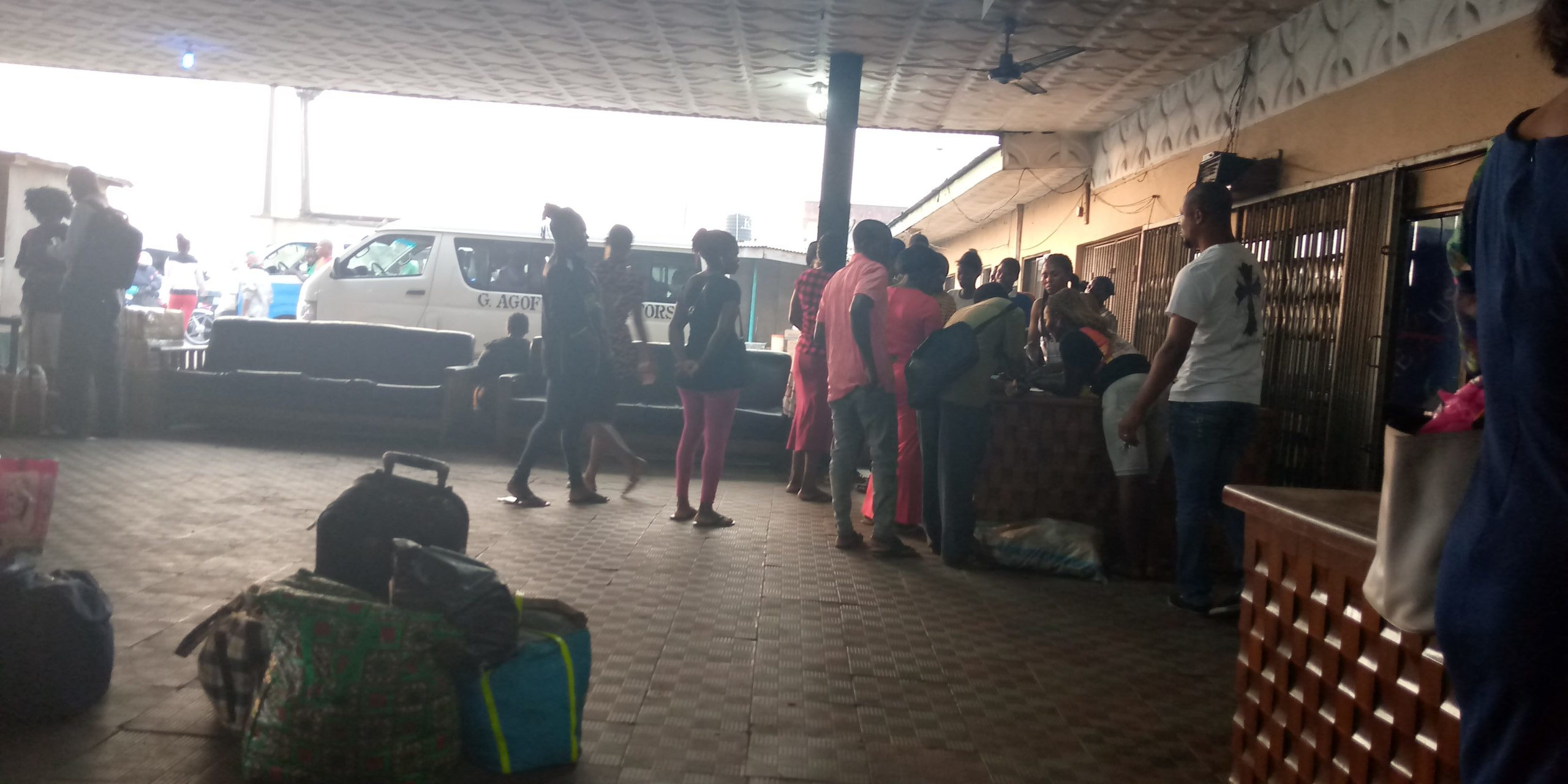
Some passengers at the Agofure Motors Park, Ughelli North, Delta State, December 14th, 2020. Photo: Tobore Ovuorie

I was tempted to go tell Omoh and her colleague that the coronavirus is not only present in Nigeria but on the increase. I felt like telling her I actually came to Delta state to speak with some survivors of COVID-19 in the state. I doubted she would believe me except I played my audio recordings of Itiveh Ekpokpobe, Andrew Usen and Onoriode Onosode. All survivors of the COVID-19 in Delta state, South-South, Nigeria.

ONORIODE ONOSODE

“Customers Laugh At Me For Contracting COVID-19”  

Onoriode Onosode, 32,  work-from-home entrepreneur went down with fever and body weakness first week of July this year, then within four days, her very sensitive nostrils which perceives anything easily, suddenly failed her when she cooked. No more could she taste salt in the food she prepared. The mother of three ran a domestic test by chewing unwashed bitter-leaf, yet tasted nothing. Onos, as she is fondly called by everyone around her, then suspected she had contracted the coronavirus.

Already tensed, she shared her fears with Daniel; her husband, who is a medical doctor with one of the renowned private hospitals at Ughelli North, in Delta state. He requested she got tested for the virus. Four days after being tested, her fears were confirmed. Positive.

Onos was very scared for her kids and herself. She was still breastfeeding at the time, so her fears and worries knew no bounds.

“I was not taken to the isolation centre. I was asked to go home and isolate because one of the doctors said it wasn’t that serious though I was coughing and breathless,” Onos narrated.

Although placed on medications, she took ginger, garlic and other hot spices concoctions alongside. Her medications included vitamin C 1000mg, several ‘strong’ antibiotics among others I cannot mention in this story due to health reporting ethics.

Her treatment regimen was quite long until the symptoms were over. She was down for about three weeks and some days, while recovering was slow and uneasy. Onos still wonders why no contract tracing was done in her case. She wasn’t asked for names of persons she had been with before testing positive to the virus. Only her husband’s elder brother visited her and showered her with care. Other persons disappeared.


“Now that I have survived it, my family and friends are back and free with me. The only person that makes fun of it is my first son.” Giggling while talking, dark-but-shinny-skinned Onos continued “whenever I sneeze or cough, he will say “mummy shift, coronavirus.” My little baby does that. Every other person is okay. Very okay with me.” The little baby is a five year old boy, while Onos says nothing has changed in her body since her recovery.

Though she defeated the coronavirus, Onoriode is still very worried. She says because it is believed out there that the COVID-19 is a government and global propaganda. She also never believed it existed in Nigeria until she contracted it. Ever since her recovery, she now “preaches about the coronavirus” every time she goes to the market.

“I talk about it to my customers but they laugh at me. I preach about it but they tell me to leave it that there is no COVID-19. I told a customer I contracted the virus but she laughed at me that na you dey fear am.”

Her customers in the market make jest of her that she contracted the virus because she is afraid of it. Onos’ customers and many of her friends still believe that COVID-19 is not real but shift away from her when she tells them she contracted it.

“Even as at yesterday (December 8th, 2020) I was sitting in a bus and they (the passengers) were talking about it. I kept quiet and after a while, I said I had contracted it before. The persons sitting by my right and left-shifted away from me.”

Onoriode is now more deliberate about keeping the virus away from her home and space.

ANDREW USEN

I could barely hear him well during the interview. I wondered if he was this very soft-spoken or it was the sore throat, he said he was battling with again, or maybe because I sat quite far away from him in his large living-room. Listening to the audio recording of the interview with him later on proved my first take was correct, possibly the first two because I positioned my recorder quite close to him.

He and his wife were about to have a baby second week of May this year when Andrew Usen, 37, a nurse at a major private hospital in Warri, Delta state, took ill. He had malaria symptoms and was used to ignoring such. But many of his colleagues tested positive for  COVID , so he decided to get tested as well. Two days later, his result returned positive and he quickly dashed off to request for his wife’s result which surprisingly was negative.

He was concerned for his wife because of the nature of his job, and moved her out of their home when he had to self-isolate during treatment because there was no available bed space at the isolation centre in Delta state.
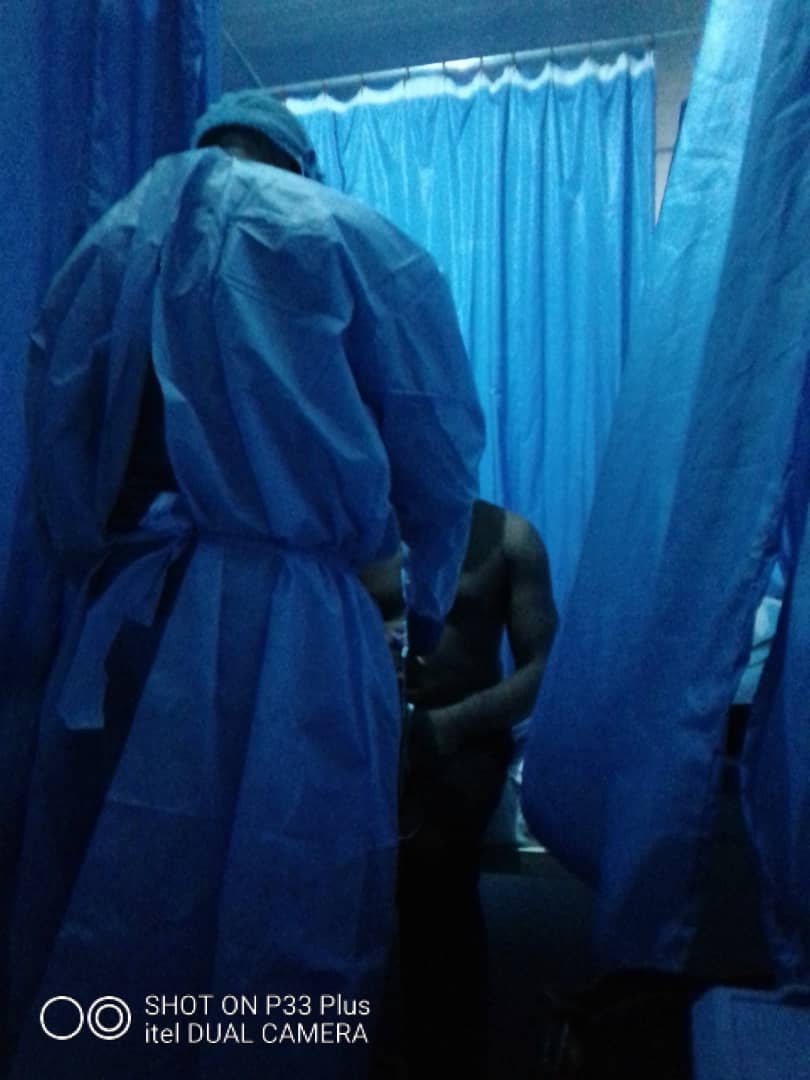
A Covid patient receiving treatment

Andrew’s family and friends were initially very scared. “A friend of mine asked ‘Hope you are not going to die?’” . But after the initial fear, they all started to encourage him that he would pull through.

He was treated with several medications but refuses to tell me their names. “It’s unethical for me to tell you,” he explained.

On the eighth day, he was taken for a repeat test which came back negative the next day. And he has moved on with his life though now very cautious of observing all COVID precautionary measures, with patients at the hospital in particular, to ensure he doesn’t contract it a second time.

Itiveh Ekpokpobe

Itiveh Ekpokpobe, six feet and three inches tall, a journalist and management consultant who lives in Delta state was in Lagos February this year when the news hit the country that Nigeria had recorded the first case of COVID-19. Coincidentally, it happened in Lagos where he was meeting with six persons who had just returned to the country; two from the United States, while four from the United Kingdom.

Within four days of his return to Delta state, Itiveh became very ill. He had severe cold and was terribly feverish. He took an overdose of malaria medications – two packets – yet, remained sickly. He consumed over a pack of immune boosters but there was no improvement whatsoever. Then, he resorted to more self-medications: a combination of spicy teas and was relieved eight days later.

A week after he felt better, he learned that two of the persons who were at the meeting experienced exactly what he battled with. Itiveh then went online to study the symptoms of COVID-19 and discovered he exhibited all of them. These include cough, fever, shivering chills, body pain, headache, shortness of breath, diarrhea, abdominal pain, runny nose, catarrh, fatigue or tiredness.

Itiveh has lost no fewer than three friends who were politicians in Delta to the virus. But after recovering, he never bothered to go for a proper test at a government approved centre. He says he didn’t get tested for the virus because at the time he contracted it, there was no test centre in Delta state, while the first two known COVID cases in the state were poorly handled. Itiveh says an investigative story about the Delta state government he worked on for some time was published that period. It had heated up the polity, so feared for his life if he still tested positive and being quarantined at the then makeshift isolation space was recommended.


He says the first two known cases in Delta state were abandoned in the hospital and treated with disdain as if they were lepers. Hence, he didn’t want to expose himself to such ill treatment. A part of his self-treatment included consumption of very hot liquids, ++ fresh foods and fruits to boost his immune system and was always in very warm environment. He never contacted the NCDC for contact tracing because he did not want to expose himself for security reasons. But his girlfriend whose house he went to from Lagos joined him in taking the medicines and home treatments because she exhibited mild symptoms.

Though Itiveh’s father is a medical doctor, he never informed him of his contracting the virus because the dad is 85 years old, while his mother is managing high blood pressure. But when he recovered, he informed only his father but requested his mother must never be told.

Itiveh alleges the Delta state government poorly handled COVID-19 cases in the state during the lockdown, while the isolation centre in the state was completed just when the COVID complete lockdown was lifted July this year.

If my story had been published when Omoh was peddling wrong and quite untrue information about COVID-19 in Nigeria, I would have also shared the survivor stories of Lucy Okechukwu, and Sele Hussein with her.

Lucy Okechukwu

It all started sometime in the middle of May this year. Her husband still had complaints of extreme tiredness and fever after taking all antimalaria medicines he was given at the hospital. This was two weeks before Lucy Okechukwu, 35, and a journalist who lives in Anambra state, South East, Nigeria, took ill and had to go to the same hospital where her husband had been treated for malaria. Hers was consistent pounding headache, slight sore throat, fever, loss of appetite, and extreme body weakness. The hospital conducted a Widal and malaria test which returned positive. Then she was given a dose of injection and antimalaria medications.

But three days into taking the medications, every food Lucy ate were tasteless while her environment too was odorless. She was not getting any better. Just about same period, every food eaten by the husband had no taste while the usual perfumes he had always used were suddenly scentless.

He phoned the medical doctor who attended to his wife at the hospital to complain and was told they should return to the hospital for re-examination. But the doctor phoned her husband back that morning to recommend they undertake test for COVID-19, instead. Lucy sought a second opinion over the phone from Prof. Sunday Omilabu, a virologist at the Lagos University Teaching Hospital, LUTH. After explaining all that had happened, he also advised they test for the COVID-19.

Getting tested was tedious as Lucy’s husband had to call the state’s emergency health lines countless times before his call was answered. And, after a series of questions about their state of health, they were asked to come to their office for the test.

“Inserting that cotton stick into my nose and throat was very irritating. After the test, they asked us to quarantine ourselves while we await the results,” Lucy narrated.
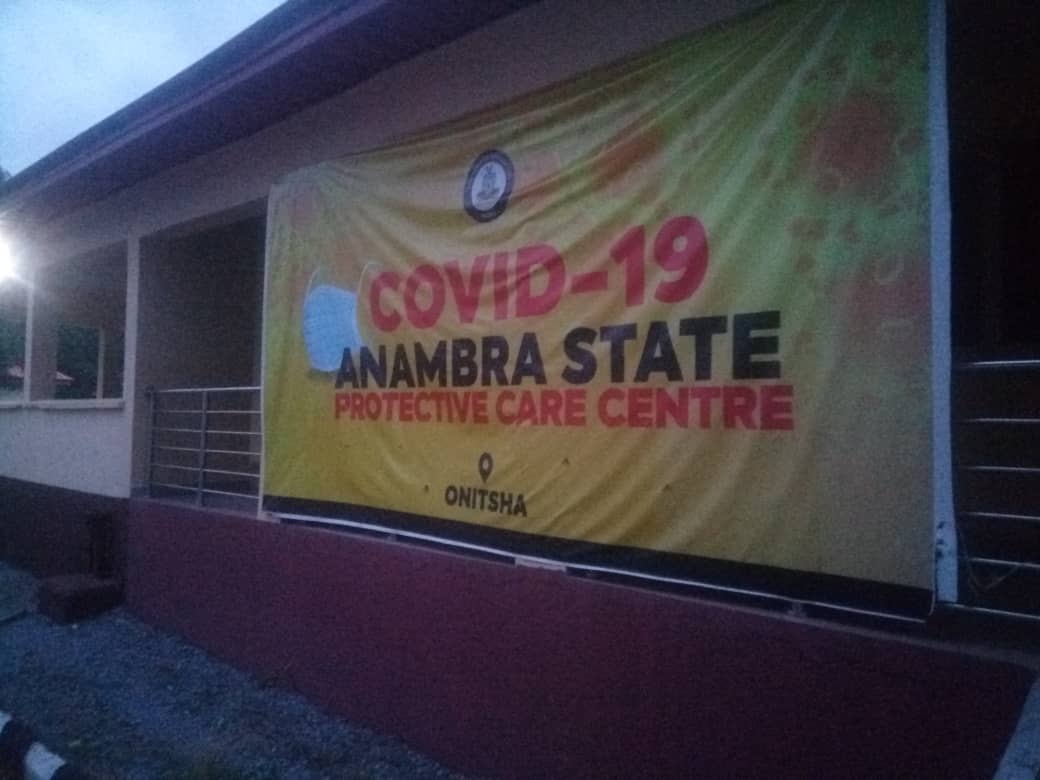
By Saturday night, the couple concluded they were COVID-free after not hearing anything from the hospital since Thursday the test was carried out on them. This changed the following morning.

A certain Dr. Chijioke phoned Lucy’s husband to announce their test results came back positive. Then instructed them to pack their bags because the center will be coming to pick them from their home to the isolation center. They were scheduled to be on treatment for the next 10 to 14 days.

If a needle had dropped on the ground in the Okechukwu’s home, it would have made a deafening noise. The couple didn’t talk to each other. A potpourri of emotions enveloped them. They became angry, quiet, afraid, sad and depressed. Lucy was struck with fear of death. The fever and headache she was battling with became worse. “Really, I became afraid to die,” the health journalist disclosed.

“I did not travel to anywhere and honestly; I still cannot specifically say this is how I got infected. I was working from home most of the time.”

Lucy guesses she possibly contracted the virus from the market as she sometimes didn’t wear the facemask because it made her nauseous. She also thinks possibly her husband may have contracted it because as a civil servant, he went to work regularly and interacted with many people.

The couple phoned the doctor back that Sunday morning to tell him they would meet up with the ambulance at the junction of their street. This was to prevent calling the attention of their neighbours due to rife stigmatization of persons who have contracted the virus.

Quiet but not a lonely ride   

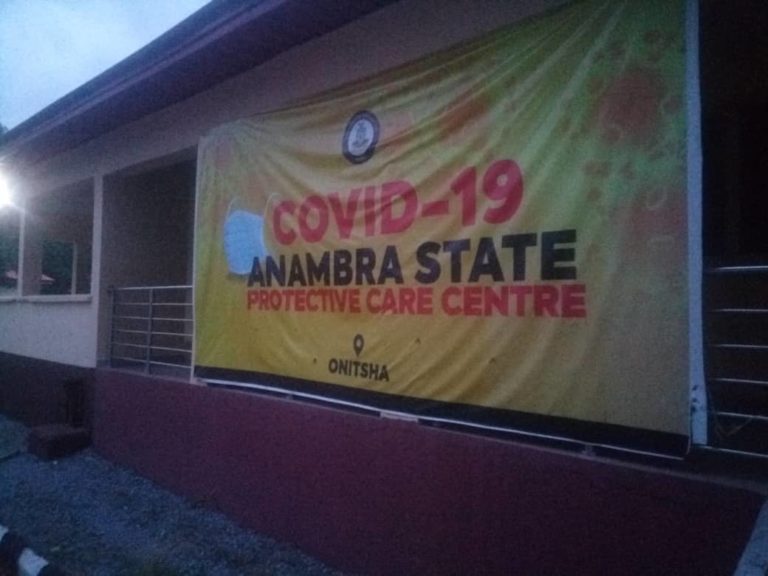
When the couple boarded the ambulance, they met two other patients. It was a quiet drive to Onitsha where the Protective Care Centre – as it is called in Anambra state – is located. Four other patients who had arrived earlier were in the 12-bed ward. Two doctors wearing Personal Protective Equipment (PPE) addressed and encouraged them. They kept repeating “COVID-19 is not a death sentence.” It was only then reality hit Lucy that she and her husband indeed had COVID-19. She had been in denial all the while.


‘Compulsory’ while lies   

Their siblings, when informed, did not believe them until they made video calls and saw where the couple were. No one else aside their immediate family members were told. They deliberately did not tell their friends and neighbours. Lucy says they kept lying to them that they had traveled to spend some time with her grandma whenever they phoned. Other patients too kept lying on phone  about their whereabouts. Lucy’s husband called in sick at his workplace. He said he needed to go take care of himself. Lucy was with her gadgets and did more of telephone calls, zoom and webinars.

Treatment regimen

Every morning and night, medications were passed to the patients through a window by a medical doctor. The treatment pack contained zinc, vitamins D and C respectively and other medications I cannot mention in this story due to health reportorial ethics. The meds were to boost their immune system to fight the virus.

Patients with underlying health issues such as diabetes and hypertension were given more medications to manage their health condition.

After their medications, a doctor came in every morning to check the patients’ vitals and health status, then would leave them all alone for the rest of the day. Everyone in the ward bonded by sharing life experiences and watched television as there was constant power supply. This possibly explains why patients in isolation centres shown on TV looked very healthy, while the public expected to see frail-looking sickly people.

“People need to understand that there are different categories of patients – the asymptomatic, fully symptomatic or  patients with severe condition,” Lucy who specializes in health reporting, explained.

“The very severe cases were isolated in the Intensive Care Unit (ICU). We heard some were on drip or either intubated. We could see some of their family members far off the building waiting to see a doctor whom they could ask about the health status of the sick loved ones,” she added.

Lucy’s case was not severe because most of them in her ward were asymptomatic patients. She was actually ill but after three days of treatment and checks, the headache, fever, sore throat and body weakness were all gone. But her loss of senses of smell and taste lingered. Other patients  were also responding to treatment.

A cousin to a patient in Lucy’s ward contracted the virus, too. The young man refused to come in for treatment when he tested positive and insulted the health worker who informed him of his test result, as well as the Anambra state commissioner for health who also phoned him and pleaded that he agrees to be picked up for treatment. The young man was later wheeled into the centre when his case had become severe. While being treated for COVID, it was discovered he was diabetic but he never knew all the while. He died three days later.

“Believe it or not, COVID-19 is real! This disease is spreading daily because some people who tested positive refused to present themselves for treatment and some refused to go for test. It is unfortunate that such people are helping to spread the disease and some people they might infect might not have strong immunity to survive the disease,” she lamented.

Five days after being at the protective care centre, Lucy and her husband were re-tested. Their results were negative. They were admitted on June 7th, 2020. A second confirmatory test though was not conducted before they  were discharged on the 15th of June

Sele Hussein

Sometime in June 2020, Mr. Sele Hussein, a lawyer-turned -businessman started having headache. He was later in and out of Omotayo hospital, situated in the capital of Lagos state, regularly, treating malaria but never got better.

One day, during what would become his last visit to the hospital, his doctor asked if he had been tested for the COVID-19. Omotayo hospital didn’t have the facility to run a COVID test so gave him a phone number to call. It turned out to be the NCDC centre at Agege, a suburb in Lagos. No one at the centre answered his call.

Sele as he is popularly known amongst his friends, neighbours and colleagues, later saw NCDC Abuja’s phone number on TV that night. He called. It was answered, while the person at the other end of the phone promised to escalate his complaints to the Agege centre. But when Sele woke up the following morning, his sense of smell had vanished.

“I sprayed my perfume but couldn’t perceive its scent. I sprayed insecticide in my room and couldn’t perceive the smell, too.” Six hours later that day, his sense of taste has also disappeared. He put some salt in his mouth but it was tasteless, same  with sugar. At that point, he knew he had contracted the virus, and went on self-isolation; never to leave his house anymore until he received proper treatment.

Sele was called Tuesday the following week to be tested at the NCDC Agege  centre. Four days later, the test result confirmed his fears.

“I was afraid at that point. It was not funny because I didn’t know how I contracted it. I was using my facemask and living alone, then,” he said.

Sele whose wife and kids live in Abuja had big bottles of hand sanitizers in his office, car and home respectively and used them regularly. Thus, he is still wondering even till this moment about how he contracted the virus.

“It happened at the peak when people were dying, not now that they are not serious about it. I was really afraid that I was going to die,” he added.

But with the counselling from doctors at the centre, he became somewhat hopeful; reason he was able to drive by himself and alone to the isolation centre in Yaba, a commercial part of Lagos state.
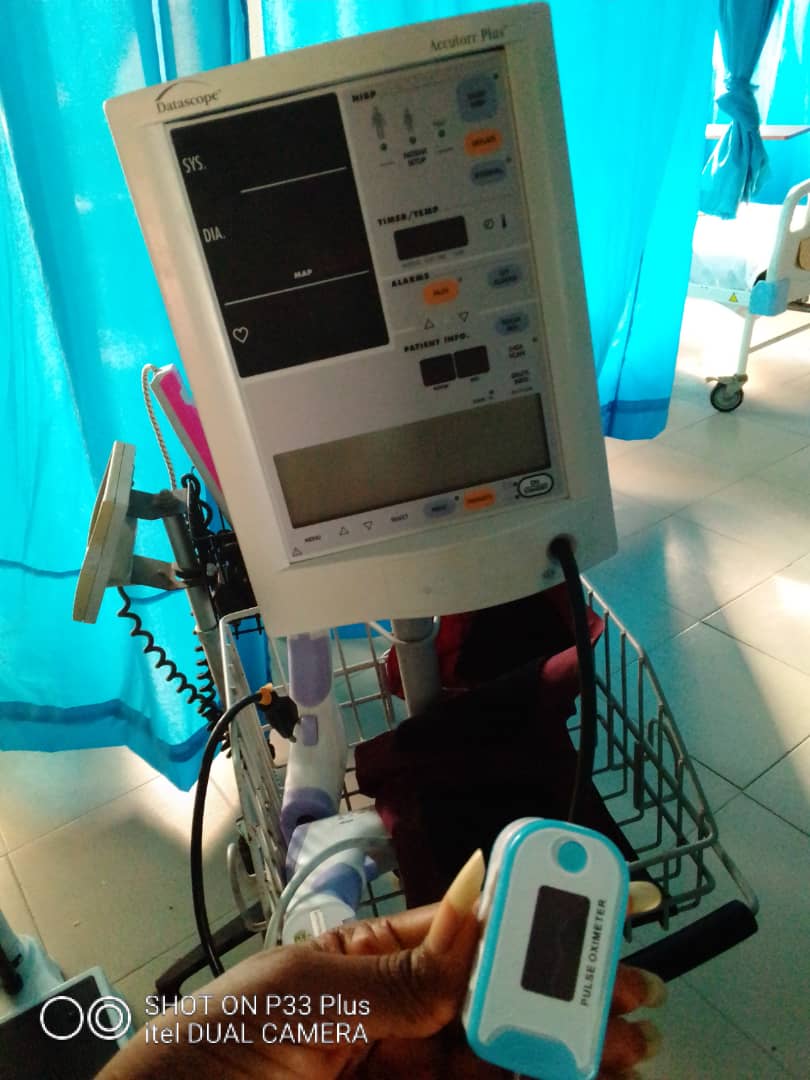
During contact tracing the NCDC tested his colleagues at the office but their results were negative. Sele’s home and office were then fumigated.

Sele was given so many medications which he doesn’t know their names because it never dawned on him that a patient can demand to be told what is being administered on him or her from a doctor. He only recognized vitamin C 1000mg.

The father of three girls had his mind fixated on leaving the isolation centre alive. He was scared and traumatized by the fact that he contracted the much talked about coronavirus. But he encouraged himself with the positive news of patients being discharged at the centre. “If these people survived and left here alive, I will,” he kept repeating to himself.  The death-rate was lower compared to the survival rate at the Yaba centre.

“I wasn’t particular about the environment. I just wanted to get well and move on,” he replied when I asked about the environment and patients’ comfort at the Yaba isolation centre.

Betrayal and strained relationship

Sele’s immediate family members were supportive and praying for him all through the ordeal. He says his father phoned him 10 times a day while his siblings kept his phone very busy with prayers via phone calls, text and WhatsApp messages. These gave him more hope that he would defeat the virus and leave the centre alive.

However, one of his very close friends bluntly told Sele he would not visit him at the centre, even just to sit at the reception like visitors did, nor at his home after he was discharged. The friend now treats Sele like a leper and told him he can’t be around Sele anymore because he contracted the coronavirus. Tender-hearted and soft-spoken Sele is still deeply hurt by the unkind words and treatments from his close friend whom he believed so much in. Their relationship since then has hit the rocks.

“I cannot do that to him if I were to be in his position. There is no way I would have abandoned him,” he kept repeating with so much emotions.


After 14 days of being managed for COVID-19 at the isolation centre, he was tested again but the result returned positive. A week later, another test was carried out and it was negative.

Since after recovering, Sele noticed he has yellow spots all over his brownish skin but isn’t bothered about them because the doctors told him it is a harmless aftereffect of contracting the virus.

Sele’s family members are still very free with him. Their love, care and treating him kindly keeps him going, while four of his friends who used to say COVID-19 is a government propaganda are now very deliberate about their hand hygiene and using facemasks after he shared his COVID experiences with them.

Covid reality

Nigeria, West Africa’s most populous nation, like countries across the globe, is battling to curb the spread of COVID-19. Daily statistics of confirmed cases by the Nigeria Centre for Disease Control (NCDC) indicate the country is yet to cross to the safe path as many Nigerians are contracting and spreading the coronavirus. Unfortunately, testing remains extremely limited.

Dr. Osagie Ehanire, Nigeria’s Health Minister, had announced to journalists earlier this year that: “We (Nigeria) have passed that era when people used to think that COVID-19 was something for big men and big women who came from abroad.”

The country, he explained, is now in the community transmission phase of the deadly virus.

First detected in Wuhan China, the viral infection has rapidly spread globally, hence declared a pandemic by the World Health Organization (WHO). The medical online publication called Statista, indicates in a research titled ‘Cumulative cases of COVID-19 worldwide from January 22 to December 2020, by day’ and authored by Mr. John Elflein, that over 73 million persons have contracted the virus globally. The disease, the publication reveals has impacted almost every country and territories globally, with the United States confirming no fewer than one-fifth of the global cases.

The Nigeria Centre for Disease Control (NCDC) reveals that Nigeria, as at 10.17am, December 20th, 2020 had tested 874,617 Nigerians, while 77,933 persons tested positive. The agency further indicates on its website that as at this stated date, there were 8,931 active cases in the country while 67,784 of the confirmed cases have been discharged and 1,218 deaths recorded.


The novel coronavirus also called COVID-19, mostly affects the respiratory systems with catastrophic consequences in various body organs. It is however more severe in the elderly and people with underlining health conditions. Many aspects of the novel virus remain unclear; while vaccines critical to preventing infections in humans are not yet readily available.

The Nigerian government, like other global governments and agencies recommend physical distancing of humans being observed because it is an effective measure in reducing transmission of viral diseases, such as the COVID-19.

But investigations so far reveal the physical distancing guidelines are not being observed in many parts of Nigeria.

Life after Covid

Since leaving the COVID treatment centre, Lucy and her husband have been extra cautious. “I’m so married to my face mask and sanitizer,” she revealed.

Lucy has become an advocate by speaking with Nigerians who are living in denial and doubting the presence of COVID-19 in the country. She wants more lives to be saved.

“The truth is, this disease is really killing people every day but our people have a way of covering up the cause of death. My advice is, people should stay safe by adhering to the safety precautions, go for test when you feel the symptoms and present early for treatment,” she concluded.

Itiveh is now more deliberate about not exposing himself to the coronavirus. He advises Nigerians should not joke with their health. “You don’t hear that there is a bomb somewhere and you say because it hasn’t exploded you want to go close to it. What will it cost you to follow the regulations?” he asked.

Andrew Usen ensured a social distance between us when I went to speak with him at his home for this story. “The COVID-19 protocol is meant for our safety; so, it is ideal we practice them to reduce the chances of contracting the coronavirus,” he kept telling me. “Please, pass the message to Nigerians when you write your story,” he requested when I was leaving his home.

Sele Hussein has moved on with life but worries that many Nigerians are asymptomatic but do not know because they are yet to submit themselves to be tested for the virus. He advises that Nigerians should walk into centres to get tested.

“It is better for Nigerians to get tested and get treated if their results turn out positive. The virus is real. It is not a government propaganda. I went through it, survived it and I am out. Anybody that wants to propagate that COVID-19 is not real lives in another planet”.

He advises COVID survivors not to let their guards down by believing they are now immune to the virus. “It is good we adhere to the COVID precautionary measures,” he said.

“My advice to people out there is that COVID-19 is real. I didn’t believe it till I had it. There is no need to panic; you just need to act fast. When it hits you, you may not be financially buoyant to take care of yourself.” These are Onos’ message to Nigerians.

Onos says she spent over N60,000 on medications, alone. These meds and their costs are different from those bought for her kids to prevent them from contracting the virus.

“Imagine someone who doesn’t have the means like those in the villages? That is death.”

Dr. Daniel Onosode – Onos’ husband – a public health practitioner says people with underlining health conditions such as high blood pressure, respiratory issues like asthma, amongst others, are not only more prone to contracting the virus but are at greater risk when they do and don’t recover on time.

He used his wife as an example. According to him, she coughs right from childhood especially during dry season; such as from October of every year, reason her recovery was uneasy.

Dr. Onosode says elderly people contract it easily due to low immunity as a result of old age. “Everybody should keep safe by using their facemasks, wash their hands and use sanitizers regularly. These are cheaper, safer and with no risk, compared to contracting the virus,” he said.

Covid-hiked fares, yet no Covid protocol observed

Agofure Motors, a major transportation company with its headquarters in Delta state had hiked transportation fares by 100 percent when the COVID-19 pandemic began in Nigeria. Employees of the organisation had explained that it is because only eight passengers would travel in each bus in accordance with the World Health Organisation’s social distancing COVID-19 precautionary measures. But when I traveled to and from Delta state through Ughelli December 8th and 14th, 2020 respectively, we were squeezed like loaves of bread in Agofure Motor’s 15-seater bus.

On my return trip to Lagos, sitting with half of my buttock and resting my head and side on sacks of garri which pinned me to so little space in the bus, I spent the over eight-hour road trip adjusting each buttocks on the chair and scrambling for a comfortable space to put my legs in the bus. I was the only passenger in the bus who used a facemask while traveling to Delta state, while only two of us had our facemasks on during the return trip to Lagos.
This report was facilitated by the Wole Soyinka Centre for Investigative Journalism (WSCIJ) under its COVID-19 Reality Check Project.
 

Ondo workers protest non-payment of 3-months salaries

0

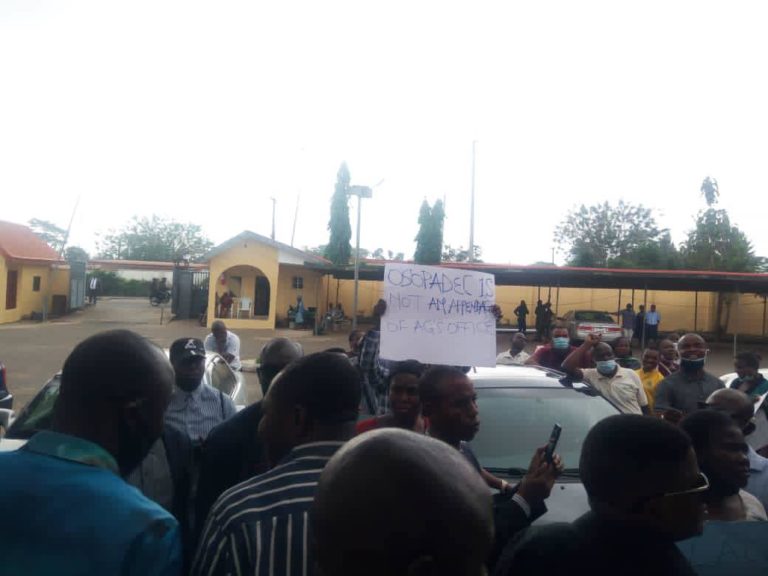
WORKERS at Ondo State Oil Producing Development Commission (OSOPADEC), on Tuesday, marched to the office of Laolu Akindolire, the state’s accountant general to protest the non-payment of their three months salaries.

The workers were seen carrying placards with different inscriptions such as “Obey Arakunrin directive,” “Arakunrin, Save OSOPADEC From AG,” “OSOPADEC Is Not An appendage Of AG’s Office,” “AG Release Our Money Now,” “Laolu Misrepresenting Aketi’s Administration,” “Laolu Akindolire Enemy of Development Laolu Proceed On Leave Now.”

Protesting Workers

The workers noted with concern that despite approval by the state government, the accountant general has refused to pay them their October, November and December salaries.

Despite being told that the accountant general was not available, they adamantly demanded that he must come out from wherever he had gone to and address them and state the reasons why they were yet to be pay their salaries.

Laolu, who admitted to the claims upon his arrival, told the protesters that though the salaries had been approved, there was no cash backing the approval and his office could not facilitate the payment of their salaries.

“Approval for salaries, vouchers are all inside here, but there’s no cash backing. You can only pay if there is cash backing. The commissioner of finance is there; he can confirm this,” he said.

He was reportedly shouted down while he was explaining to the angry workers all the intricacies that go with the payment of salaries.

There was indeed an attempt by workers to attack him when  they forced their way into his office but was prevailed upon by their leaders.

Oyesanmi Ilesanmi, the state chairman of Amalgamated Union of Public Corporations and Civil Service, Technical and Recreational Services Employees (AUPCTRE), who led the protesters, said Laolu was responsible for the delay in payment of his members’ salaries.

He said the protest became an option after  letters written to the accountant general’s office to seek clarifications were ignored.

The workers wondered who was lying between Governor Rotimi Akeredolu, the state governor and the accountant general. He vowed that his members will continue to occupy the protest premises until their salaries are paid.

“We have got approval for the payment of the October salaries from the governor close to two months now and no payment has been made. We have written letters to the accountant general, and nothing has been done, and there was no reason or explanation as to why the salaries have not been paid,” he said.
“We issued him 7-day ultimatum, then 3-day ultimatum, which lapsed on Friday, last week, but they didn’t respond. Salaries of OSOPADEC workers are paid from the 30 per cent derivation accruing to the commission.
“The Accountant General said there’s no cash backing, so we don’t know who’s not telling the truth. We are occupying the premises every day until our salaries are paid.”

Nigeria needs N400 billion to buy COVID-19 vaccine -FG

0

 THE President Muhammadu Buhari-led federal government has disclosed that the country would be needing a whooping sum of N400 billion naira for the purchase of COVID-19 vaccines for Nigerians.

Osagie Ehanire, minister of health, stated this before the leadership of the national assembly on Tuesday.

While stating the government is prepared to save lives with the vaccine, the minister said that the proposed amount vaccinate 70 percent of Nigeria’s over 200 million population, at $8 per person.

The minister added that N156 billion will be needed in 2021 while N200 billion will be used for vaccination in 2022.

On the issue of storage, the minister explained that the COVID-19 vaccines will be stored in the same storage facilities (cold chains) used to store the polio vaccines.

Ahmad Lawan, the president of the senate promised the full support of the national assembly to fund the vaccine.

He, however, expressed concern about the storage of the vaccine when it is acquired, adding that more needs to be done by the ministry of health.

“I have not been convinced with your presentation that we are ready to bring in the vaccines,” he said.

“You have to do much more to convince me that we are ready.”

Nigeria is currently experiencing a worrisome surge in numbers of recorded cases across the country following a decline in October and November.

According to data by the Nigeria Center for Disease Control (NCDC), the country recorded 5,176 new cases in last week which is the highest since COVID-19 outbreak in the country.

As at Wednesday morning, the number of recorded cases from Sunday morning has risen to 1856 making the country’s overall cases to  79789 with 1231 deaths and 68879 recoveries since its outbreak in the country.

The new variant of COVID-19 announced in the United Kingdom in September has been reportedly discovered in Nigeria by scientists at the Africa Centre of Excellence for Genomics of Infectious Diseases (ACEGID), at the Redeemers University in Ede, Osun state, on Monday.

The federal government through the presidential taskforce on COVID-19, had issued new guidelines for religious and business centres, on Monday.

Also, President Buhari on Tuesday advised Nigerians to avoid non-essential trips and large social gatherings as they celebrate the festive season.

He said if necessary, large gatherings should be completely avoided.

ASUU suspends 9 month strike

0

By, Temi OHAKWE, Abuja


THE Academic Staff Union of Universities ASUU has called off its nine-month-old strike with effect from Thursday 24th December 2020.

The Union says it resolved that the current industrial action be suspended conditionally adding that should government fail to fulfill its own part of the Agreement, ASUU will resume its suspended strike action as deemed necessary.

Briefing journalists in Abuja on Wednesday morning, the President of ASUU, Prof. Biodun Ogunyemi said in its resolutions of National Executive Council of ASUU held on the 22nd of December, the Union resolved to accept the agreements reached between ASUU and the federal government as the same date.

According to Prof. Ogunyemi, ASUU resolved to consciously and diligently monitor the implementation of the FGN/ASUU agreements of 22nd Dec.

“To pursue the areas in the FGN-ASUU agreement of 2009 and the MOA 2013 that require legislation such as the mainstreaming of Earned Allowance into the annual budget and the amendment of the Executive Bill in respect of the NUC Act,2004”

He stated that IPPIS is no longer an issue to ASUU Ogunyemi said the FG has agreed that it members will be migrated on UTAS and by January, salaries of ASUU members will be paid via the platform.

“Govt has agreed on principle with us and should the government renege our members will not hesitate to withdraw their services”.

ASUU stated that it expects immediate release of the Earned Academic Allowances EAA as agreed.

It also expects the government to engage the universities and other research centers in the fight against COVID 19 pandemic.

” Our Union and it members are more than ready to meet the challenge”.

ASUU also expects the government to expedite action on the test processes and ensure the deployment of UTAS for the parent of salaries in the University system.

The Union President hinted that the government had commenced payment of it members owed salaries.

” We also expect that the FGN/ASUU re-negotiation exercise would be concluded as specified in the timelines agreed by both parties”.

Prof Ogunyemi added that the implementation time of agreements is elastic, stressing that some aspects of the agreement will begin immediately while some will commence in January and others would talk e place in March 2021.

ASUU, however, said it is bent over backward again to accommodate the federal government and if it does, Nigerians are challenged to query the government and not ASUU.

The issues in dispute between ASUU and the FGN are; Funding for revitalisation of Public Universities, payment of Earned Academic Allowances, reconstitution of the 2009 FGN/ASUU re-negotiation Committee, University Transparency and Accountability Solution UTAS as an alternative to IPPIS, and payment of withheld salaries and remittance of check-off dues.

Buba Galadima: Between statesmanship and pretence

0

By Owei LAKEMFA 


AN old friend and fellow journalist, Ya’u Shehu Darazo, called me in 2006 asking if I could arrange a meeting between former Head of State, retired General Muhammadu Buhari and the leadership of the Nigeria Labour Congress, NLC.

Buhari who was running in the 2007 Presidential elections, was accompanied to the meeting by Darazo and a man introduced as Engr. Buba Galadima.

Where Buhari was slow and deliberate in speech, Galadima spoke like a man running a commentary. He appeared confident, knowledgeable and full of ideas. At the end of the meeting, I joked with Darazo that he was selling two presidential candidates as their party could easily switch Buhari for Galadima.

Since then, Galadima has risen to become one of the biggest politicians in the country; one who has been a major player in the last four presidential elections. In his November 15, 2020 interview in The Punch Newspapers, he declared: “ I have a track record; I have always lived my life fighting for social justice and fair play.” As a claimed fighter for social justice, Galadima was asked a simple question on one of the most dominant issues in Nigerian politics; restructuring the country.

In the last three decades, Nigerians can be categorised into two broad groups; those for, and against restructuring. In fact, the ruling All Progressives Congress, APC which Galadima helped midwife, and bring to power in 2015, had restructuring as one of its main programmes. To this straight forward question, Galadima responded: “I don’t understand what restructuring is. If you define restructuring to me, I can give you an answer… There must be a universal definition of restructuring so that we can now agree either to work towards it or against it.”

When reminded that restructuring was promised by the APC which he championed, he retorted: “Was there a referendum? …Did the party sit down to agree on what is restructuring? What are they restructuring?” But Galadima is merely being smart by half.

As an engineer, he is literate enough to check the dictionary which generally defines ‘restructure’ as: “to organise something, such as a system or a company, in a new and different way.” Even if he claims not to understand this simple definition, he could have asked any of his seven children who he says are medical doctors and holders of Master’s degrees.

In truth, Galadima understands what restructuring is, but he wants to hide behind a finger as his claims to being a fighter for social justice, will be unsustainable were he to oppose restructuring. The simple truth is that while the country at independence was structured as a federation, the 1966 military intervention turned it into a unitary state.

This has subsisted since then and even when the grundnorm of the country is proclaimed as the “Constitution of the Federal Republic of Nigeria” we all know it is a lie. So the honest thing to do, is restructure the country as a federation.
However, those who benefit from such untruth do not want a change. But for me, those who oppose restructuring are far better and preferable than political elite like Galadima who claim not to understand it.

A large percentage of our citizenry, are Igbos who have cried that they have been marginalised since the Civil War ended fifty years ago in January, 1970. What they are demanding is a restructuring of the country to eliminate this perceived injustice. How can a Galadima claim he does not understand what this cry is about?

There were claims before 1999 that a part of the country had monopolised power so there was the need for power shift to another part, especially the West where Chief Moshood Kashimawo Abiola, winner of the annulled June 12, 1993 elections, had come from.

This was why the presidential contest that ushered in civil rule, was narrowed to two Yoruba politicians: Chiefs Olu Falae and Olusegun Obasanjo. When the latter won the elections, his type of cap which was popularly worn in the West, was called ‘Power Shift.’ Would Galadima claim ignorance of these truths?

The revenue derivation formula from colonialism was initially 100 per-cent, then 50 per-cent before the military cancelled derivation. There was a peaceful, then violent agitation for its reintroduction. The restructuring of the Revenue Allocation formula is reflected in Section 162(2) of the 1999 Constitution which states that derivation shall be “ not less than thirteen per cent of the revenue accruing to the Federation Account directly from any natural resources.”

Despite this, the people of the Niger Delta where the country derives its oil resources, continued to agitate leading to the restructuring of the Ministries with the creation of a special Ministry of Niger Delta Affairs. Are these matters lost to Galadima?

Just like Obasanjo and the ‘power shift’ cap, when Dr. Goodluck Jonathan became President, his hat and dressing which is common in the Niger Delta, became known as ‘Resource Control’ in recognition of the demand for restructuring along the lines of derivation.

There is a coalition of the Yoruba Afenifere in the West, the Igbo Ohanaeze in the East and some Middle Belt Nationality groups who are agitating for fundamental restructuring of the country.

If Galadima claims not to understand this, even if an elephant stands on his nose, he would claim not to see it. He also makes a not too honest argument that the Presidency should not rotate between the South and the North as the ruling class had agreed to in principle. This is self-serving.

The fact is that Alhaji Atiku Abubakar whom he worked for in the 2019 elections is still eyeing the Presidency, so if this gentleman agreement on power rotation is respected, Galadima’s principal will lose out.

I have not set out to argue for or against restructuring which by the way is inevitable; I have merely expressed my preference for arch-conservative and ethnocentric people who take a stand, than shifty politicians who stand on no principle.

I like the rhetoric and reverberation of Galadima’s reformist voice, but like William Shakespeare would have noted, it is “full of sound and fury, signifying nothing.”

INVESTIGATION: Abandoned, uncompleted primary healthcare projects litter Anambra

0

By Kelechukwu IRUOMA


EIGHT years ago, there was a communal clash between Ogwu-Ikpele community in Ogbaru local government area of Anambra State and neighbouring communities in Rivers State, leading to bloodshed.

During the clash, several weapons such as cutlasses and daggers were used. Some youths of Ogwu Ikpele were injured while others died due to the injury sustained.

“Some of those who died could have survived if we had a functional primary health center with qualified doctors and nurses,” said Onyedika Ochije, a youth in the village.

“The health center was empty that period and no doctor was around when we rushed them to the center.”

Ogwu Ikpele is an oil-producing community in the Southeast that shares a boundary with Omoku, Okpai, and Uchi communities in Rivers State in the South-South region. The road to Ogwu Ikpele from Ossomala is bushy and not motorable as it has been severely affected by flood and erosion.

NPHCDA
The uncompleted Primary health centre at Ogwu Ikpele in Igbaru local government

Preventable death caused by a lack of quality healthcare

Ochije said some of the injured youths died on the way to the general hospital in Ossomala, which is about 20 kilometers from Ogwu Ikpele. Besides the clash that claimed lives, people also usually died prematurely in the community from common, tratable ailments due to a lack of a functional healthcare system.

“People were dying, including pregnant women,” added Ochije.

“Before you take them to the other town in Ossomala, they would have died.” The existing healthcare in Ogwu Ikpele is dilapidated and underfunded.

The World Health Organization (WHO) says only about 20% of the 30,000 Primary Health Center (PHC) facilities across Nigeria are working, which makes it difficult for Nigeria to achieve Universal Health Coverage (UHC).

Effective delivery of healthcare services requires the availability of adequate infrastructure, diagnostic medical equipment, drugs, and well-trained medical personnel. But where health centers exist, they cannot operate because of a lack of basic amenities due to inadequate funding and financial mismanagement by the leaders.

According to the National Primary Health Care Development Agency (NPHCDA) a PHC should have one or more doctors, a pharmacist, a staff nurse, and other paramedical support staff to provide outreach services.

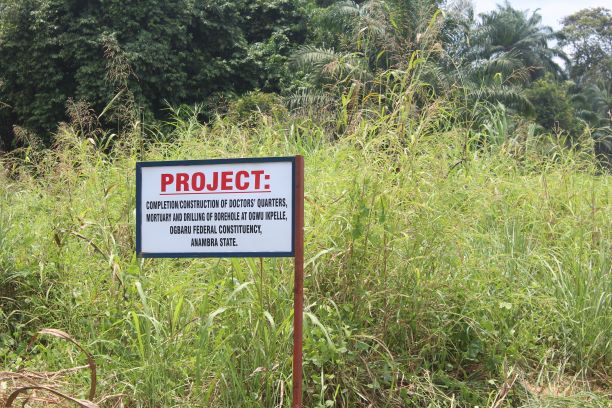
A sign showing the completion of the PHC at Ogwu Ikpele

It should also have a well-equipped open ward, labour room, children and female wards, doctor’s office and staff quarters, an ambulance for referrals, and drugs and equipment for immunization, preventive and basic curative care. But many PHCs in Nigeria lack most of these.

The lack of adequate facilities is the leading cause of maternal mortality in Nigeria. According to the Nigeria Demographic Health Survey (NDHS, 2018), the under-five mortality rate in Nigeria is 132 per 1,000 live births meaning that 1 in 8 Nigerian children never reach the age of 5. One Nigerian woman dies in childbirth every 10 minutes, and 1 Nigerian child under-5 years of age dies every minute.

To address the healthcare challenges in Ogwu Ikpele, NPHCDA awarded a contract worth N21.9 million in 2014 to Gridline Nigeria Limited for the construction of a new PHC.

The project was not completed. It was abandoned at the foundation level.

When contacted, the Managing Director of Gridline, Peter Ogbomo, said the project was abandoned due to non release of funds by the NPHCDA.

“We were not paid. They did not give us anything for that project. One single kobo was not given to us. Even after submitting the bill security, they did not give us anything. That was when we abandoned the project. It was around 2016 we left that place,” he said.

“I went to the agency several times and I did not know what happened. We applied for advance payment and we submitted documents. I could not keep on putting my money into the project. They did not pay us even after we had started the job and spent money.”

Ogbomo is sad that he is still being owed.

The PHC project was, however, re-awarded in 2016 to Maldini Construction Company Limited for N57 million as a Type 3 project, which included a PHC, staff quarters, and mortuary.

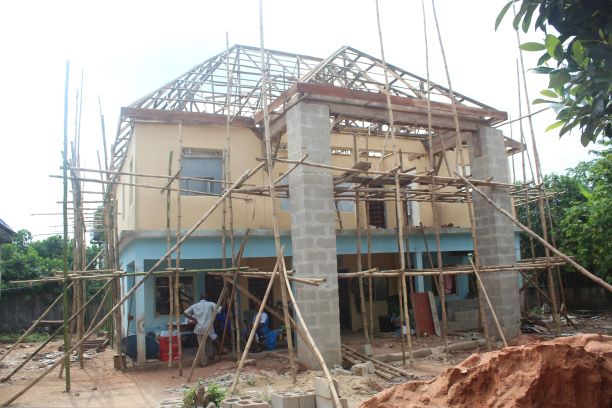
The project was initially abandoned until work started on the site in February this year. When the reporter visited the project site in late August, the PHC and the doctors’ quarters had been erected and roofed.

NPHCDA
The uncompleted staff quarters being constructed at Ogwu Ikpele in Ogbaru local government

The project site was filled with bushes. Ochije, who is the project supervisor said work stopped in May this year but some young men were seen clearing the bushes.

“Due to the flood and some issues concerning the work, there is a slow pace in the project. By the end of this month [August], we hope the plastering of the building will be completed and by January next year, if there is any other thing, we will continue from where we stopped,” he said.

Work has also stopped at the doctors’ quarters. Due to the long distance of the community to Ossomala, there was also a contract for the provision of an ambulance at 20 million in 2016 to Akunna-Martata Limited for the primary health centre in Ogwu Ikpele but the ambulance has not been delivered.

Ochije said he was not aware of the ambulance and confirmed that no ambulance had been brought to the community.

When the reporter checked the contacts of Akunna-Martata on the website of the Corporate Affairs Commission (CAC), no details of the company were found.

Failed primary healthcare revitalization initiative?

The federal government in 2017 began the National Primary Healthcare Revitalisation Initiative to resuscitate over 10,000 health centres across the country. Then Minister of Health, Isaac Adewole, said the objective of the scheme, which would be executed by the NPHCDA, was to have at least a functional health care centre in each ward in the country.

Three years after the initiative was launched, the impact had not been felt by many communities around the country.

As of 2018, there were over 900 NPHCDA PHC projects abandoned across the 36 states of the federation, according to the agency. It said the health projects were abandoned due to delays in the approval of funds by the National Assembly as well as the lack of political will on the part of the lawmakers.

NPHCDA
Udezu community in Awka North local government does not boast of a primary health center

The agency, however, said it would no longer be involved in the construction of new projects until all the pending ones were completed.

But in August 2019, the Ministry of Health said N5.8bn had been released to the NPHCDA from the N51bn from the Basic Health Care Provision Fund (BHCPH) and this has been disbursed to 15 states, including Anambra state, which received N338 million.

So, why are there still abandoned and uncompleted primary health care projects in the state?

At Udezu village, Achalla in Awka North local government, the PHC project awarded for N21 million in 2014 to Nec Engineering Services Limited had been abandoned. When the project site was visited, it was covered by bushes. Having access to the building was difficult. Lack of a functional PHC is one challenge the villagers face.

This, according to the President General of the community, Boniface Chigbo, troubles him. He is furious that his people are not benefiting from the government.

“I inherited that abandoned healthcare project the way it has been,” Chigbo, who was recently made the community’s administrator. “That project awarded in 2014 has been abandoned for five years now and the ones in the neighbouring communities are working.”

NPHCDA
The uncompleted Udezu primary health center at has been abandoned for five years

Chigbo has made efforts to find out why the project was abandoned six years after it was awarded but there was no positive response from the government representatives he contacted.

“I traced the reason the project was abandoned, I went to Awka and met the health commissioner. I traced the contractor and he said he had not been paid for the completion of the project,” he said.

He said there was nothing he could do to bring back the contractor since he said he had not been paid and the commissioner was not also helping to see to the completion of the projects.

Emmanuel Nnadi-Akwoku, the chairman, Udezu Welfare Association, described the abandoned PHC projects in the community as “unfair” to the people of the community.

“It saddens me a lot. There is nothing we can do because when we hold some people, they say it is not their concern. I am afraid the people given the money have embezzled it.”

“It pains me that when someone is sick here, we carry the person to another place in Awkuzu and Awka. We do not want to be going elsewhere. We want the assistance of the government because we are suffering here,” he lamented.

More worries

When the reporter visited Oraukwu PHC in Idemili North local government in August, where the NPHCDA awarded a project in 2018 to Redeemers Touch Nigeria Limited for the renovation of the facility, the renovation awarded for N15 million was not done on the PHC building but the staff quarters.

The matron of the PHC, Chika Ann, said she was disappointed with the work carried out by the contractors mid last year. Before the work was done, Ann said they had several issues in the PHC and staff quarters.

“It is the quarters that they did alone,” she said. “The ceiling usually leaked so they renovated some of the ceilings. They put the doors, roof, and windows.”

NPHCDA
The completed staff quarters of Oraukwu by Redeemer’s Touch Nigeria, which the health workers and community were not satisfied with

The staff quarters did not look like a renovated building. Only the doors and windows were new and the building was painted.

Ann said the iron gates at the entrance of the building were supposed to be changed but they were not. Rather, the workers used iron wire to hold the gate around the pillar to avoid it from collapsing.

“They should change the gate outside and at the back of the building,” said Ann.

The NPHCDA said it would give the PHC a solar as part of the renovation but the matron said she had not seen any such thing.

“We have a generator but it costs a lot to fuel daily,” she lamented.

When contacted, the Director of Redeemer’s Touch, Titus Okonkwo, denied that the project did not meet expectations.

NPHCDA
The staff quarters was demolished by the community after not satisfied with the renovation by Redeemer’s Touch. It is now being renovated by one “big man” in the community

“The job was duly completed based on what was in the bill of quantity,” he told the reporter on the phone.

“We removed all the roof and re-roofed, repainted, and changed all the doors. That was what was awarded to us. We changed the ceiling and plastered it. The health workers said they wanted the staff quarters renovated as they were equally used as clinics. That was their priority. The bill of quantity was not the health center. It was for the staff quarter. We were paid after we completed the project,” said Okonkwo.

He revealed the project was awarded to his company as N13 million and that he was paid N8 million after the job was completed. “We were at loss,” he lamented.

Not satisfied with the job the contractor did, the community started to mobilize well-meaning people from Oraukwu to renovate the clinic for them.

When the reporter visited the PHC in November, the PHC and the staff quarters had been dismantled and in the process of being renovated.

Ann reiterated the community was not happy with the work the contractor did.

But Okonkwo disagrees with Ann, reiterating the NPHCDA visited the PHC, satisfied it, and paid them. “That one [renovation by the community] does not concern the construction company. Any big man that is working there is on their own but what we were awarded was duly completed,” he said.

More challenges in primary health centers

In the same vein, the PHC at Ime Nsugbe in Anambra East local government was not done to the taste of the people and health workers.

The project awarded in 2018 to Vinded Construction Limited for N6 million was to address the physical and internal challenges the PHC was the facility. The matron of the Centre, Philomena Okafor, was not satisfied with the items provided by the NPHCDA as some were deemed not fit to address the issues the PHC was facing.

According to her, “The PHC buildings were painted, cupboards constructed, fan, television, and generator were also provided and a generator house was constructed,”

Okafor was furious that the Elemax 2.2 KVA generator supplied to them could not supply power to the entire buildings in the PHC. As a result, the generator was put in a store.

“I told the agency that supplied the materials that the plant [generator] that was sent to us could not supply light to the entire building and they said there was nothing they could do as that was what was budgeted. We dumped it here and it is not working. We need a big plant to operate fully,” she said.

NPHCDA
The 2.0 KVA generator provided to Ime Nsugbe primary health centre that could not power the PHC

Okafor also expressed her disappointment at the agency’s failure to provide the PHC with a solar medical refrigerator, which is one major item the facility requires to function effectively.

Ogechukwu Nwosu, a nurse at the PHC also lamented the lack of drugs in the center. “We also want the government to give us drugs. We do not have drugs,” she said.

Vincent Ofumelu, a member representing Oyi/Anyamelum federal constituency sponsored the project. When contacted, he said the project done by the contractor was inspected, verified, and satisfied, and the contractor was paid. He said that was what was in the bill of quantity.

“They [NPHCDA] sent their people to the site before payment was made. Last week they went for inspection for retention. They do not pay you unless they see the projects have been completed. They sent people from Abuja to find out if it was completed. The project was 100 percent completed and I sponsored the project,” he said.

At Nando, in Anambra East local government, the agency awarded a contract in 2014 to Ramax Resources for the construction of a PHC in the community. When the reporter visited the PHC, the project was not seen as the community people could not locate the project site.

When contacted, the Director of Ramax Resources Limited, Chidi Amaechi said the project was abandoned because the agency did not pay to complete it.

“We did the projects up to the lintel [roofing] level and when we put for valuation, we got paid for the one we did. You know how things are done, every year we were told the money for the project will be withdrawn from the parastatals. When we went further, we were told that the national assembly member will put it back in the budget so that we can continue the project,”

Six years later, the project is still abandoned. He said the lawmaker who sponsored the project was no more on the seat after the 2015 election.

“I cannot use my money to do it. There is no continuity. If another lawmaker comes, he will tell you this is not my project. It has to be put back in the budget so that we can complete it. The thing is that the budgeting process in Nigeria runs for 12 months but a contract will not be awarded until October, which is two months to go. Then you rush to the site and you cannot complete such projects in two months.”

“If it is a continuous thing, the project will be completed. About N21 million was budgeted but the whole money was not paid. We were only paid N6 million to get to the roofing level,” he said.

He urged the lawmakers representing the people of Nando to work with NPHCDA to complete the project.

The visit to Ossomala to check the state of the rehabilitation, provision of drugs and equipment at Ossomala General Hospital in Ogbaru local government awarded in 2018 by the Federal Medical Center, Asaba to Pumeco Industries Limited, for N100 million, was positive as the project was still ongoing.

The hospital, which had 4 buildings, had been rehabilitated, plastered, and wired. There were painters seen painting the building walls.

The contractor was supposed to equip the hospital with chairs, tables, beds, and other necessary hospital equipment, including drugs. The equipment and drugs had not been supplied yet due to the ongoing project.

When the reporter called the contractor, he did not pick and did not return texts sent.

At Eziagu village in Orumba South local government, the reporter visited the PHC to enquire about the provision of equipment awarded to African Plus in 2018. The project had been completed.

The matron, Cecilia Uruigwe, was full of thanks to the agency for supplying the facility with such equipment she described as being “more than enough”. The items were delivered in April 2019. She listed 10 beds, two delivery couches, one fridge, a generator, a standing fan, and gas cylinders as the items delivered to them by the agency.

“But they have not set up the equipment due to a lack of space,” she said. The equipment was stored in a PHC building constructed by the community, which is not functional yet. She is, however, sad the PHC lacks staff.

“I only have one government staff, one volunteer, and one N-power,” she stated. “It is difficult for us to work without staff. We need more staff.”

The Director of African Plus Limited Ogonna Okoli Ogonna confirmed the equipment had been delivered to the PHC and the company has been [paid after the NPHCDA satisfied the project.

“We finished the projects in 2018, handed them over to the community, and we have been paid. We have done our bit of the job and we have been paid. Whatever that is in the bill has been done and it has been verified and we have been paid. That ends our obligation,” he reiterated.

The contract awarded in 2019 for N10 million for the construction of PHC at Isieke village, Alor in Idemili South local government has not been done. When the existing PHC was visited, a signpost showing the contract for the renovation of the PHC as part of the rehabilitation of health facilities across the nation was mounted and contracted to Alewa Nigeria Limited.

The existing PHC was functioning effectively when the reporter visited but the nurses there said no renovation OR construction of a new one had been carried out in Isieke recently. To clear her doubt, the nurse, who refused to disclose her identity, called her matron, who also confirmed no renovation had been carried out in the PHC.

When the contractor was checked on the website of the CAC, no details were found and the NPHCDA could not provide the details of the contractors when a Freedom of Information (FOI) request was sent to it.

When the reporter visited Enugwu Ukwu in Njikoka local government and Umudum in Anyamelum local government to track the revitalization of healthcare centres and construction of a new one respectively, the projects were not found.

Contacted, one of the NPHCDA advisors who refused to disclose his name as he was not authorized to speak said a letter should be written and addressed to the Executive Director/ CEO of the agency.

When he was informed letters had already been sent to the agency, which were yet to be replied, he then decided to speak anonymously.

“We came on board in 2017 and we do not have any projects or awards pending,” he claimed. When he was informed there were projects awarded in 2018 that had not been done, he then revealed the responsibilities of PHCs are domiciled with states and LGAs and members representing such places in the National Assembly.

“If projects sometimes are abandoned, in most instances are due to lack of or poor appropriation of funds for such projects. Lawmakers identified projects in their community, appropriate for it in the budget, and entrust the agency to handle it on their behalf. A concerned lawmaker who knows his onion will follow up and sort it out because it’s their projects,” he said.

A top official of NPHCDA in Anambra, who pleaded anonymity for fear of being suspended is sad that the Nigerian people will allow lawmakers to sponsor and implement health projects, which will either not be completed or abandoned.

“Most of these projects are constituency projects they gave to highly placed individuals through NPHCDA,” he revealed. “What they do is to get the money and at the end of the day not do anything or not do a good job.”

“I do not like contracts being done through a senator or house of representatives member because he will not do what he is asked to do. Some of them are God-fearing and will do the projects very well,” he said.

NPHCDA
The rehabilitation of Ossomala general hospital is still ongoing as workers were seen working at the hospital

He encouraged the reporter to contact the agency’s headquarters to find out the sponsors of the projects and the contractors involved to hold them accountable.

“This is the only way we can make these people complete the projects that they have been given money for. I am not aware of all these [projects]. Sometimes I will go to a local government and they will tell me that these [PHC] projects are sponsored by NPHCDA and I did not know. When such projects are being done, the state primary health agency should be aware so that when they ask them, they will know,” he said.

The Director of the Nigeria Health Watch, Ifeanyi Nsofor, described PHCs as a “continuous must care” that must be protected and preserved by the government and communities they were built for.

According to him, “It is important to know what the World Health Organization said about the PHC system that 80 to 90 percent of healthcare needs of an individual’s lifetime can be provided at the PHC level. This tells you how PHC is important and strategic. In Nigeria, we have to remember that health is on the concurrent list and what it means is that the different levels of government have their responsibility.”

He said it was the responsibility of the government to maintain the PHC and every community needs a functional health facility to meet their health needs, emphasizing the importance of functional PHC on maternal health.

“We do not need to be talking about health facilities not having enough doctors in the 21st century,” he said. “Communities should be able to hold the government accountable and responsible for providing functional primary healthcare.”

Ochije is hopeful that when the PHC and staff quarters in his community is completed, it will address the numerous health challenges facing the people of Ogwu Ikpele.

“We all know that hospitals are built for the good health of human beings,” he said. This PHC when completed will solve our health issues.”

* This report was written with support from the John D. and Catherine T. MacArthur Foundation and the International Centre for Investigative Reporting.

Insecurity: About 616 people were killed across Nigeria in November -Report

0

NOT less than 616 persons were killed across states in Nigeria in November, a report by Nigeria Security Tracker (NST), has shown.

NST, which relied on data from newspapers reports during the month shows that the killings were carried out by state actors such as military operations against terrorists and bandits in the northern part of the country and operatives of the Nigerian police force (NPF).

Others are targeted and random abductions, extrajudicial killings; and, the continued spate of banditry and terrorism by suspected members of Boko Haram, its faction and the Islamic State in West Africa Province (ISWAP).

Borno state which has been the epicentre of Boko-Haram insurgency in the country was responsible for the highest number of deaths with 271 persons followed by Katsina which had 104 deaths. They were trailed by Kaduna and Zamfara with 69 and 42 deaths respectively.

Others are Adamawa – 2; Akwa Ibom – 3; Anambra – 2; Bayelsa – 1; Benue – 4; Cross River – 2; Delta – 22; Ebonyi – 7; Edo – 18; Ekiti – 6; FCT – 1; Imo – 3; Kano – 4; Kebbi – 1; Kwara – 1; Lagos – 7; Nassarawa – 2; Niger – 10; Ogun – 2; Ondo – 6; Oyo – 6; Plateau – 3; Rivers – 5; Sokoto – 1; Taraba – 6; Yobe – 5.

Similarly, a report by NigeriaMourns, a non-governmental organization tracking insecurity across the country shows declining figures after it had excluded killings by state actors.

The report shows that not less than 349 persons were killed in violent attacks across 23 states in Nigeria during the month of November, 2020.

It also revealed that about 290 persons were also abducted.

While 309 out of the killings were civilians, 40 were security operatives.

According to the report, 149 Boko-Haram and its faction, the Islamic State in West Africa Province (ISWAP); 86 were killed by bandits while cult clashes claimed 62 lives.

Also, 40 people died in isolated attacks, 7 died through extrajudicial killings, 2 were killed by herdsmen while 2 died in communal conflicts.

According to NigeriaMournsm, Borno and Edo as states have the highest numbers of deaths with 162 and 57 respectively.

File: NigeriaMourn

These reports are coming following continuous claims by the presidency that security has improved under the present administration of President Muhammadu Buhari.

Femi Adesina, special adviser to the president on media and publicity wants Nigeria to be grateful to the president because Boko-Haram’s bombing has reduced as compared to what it was before 2015.

COVID-19: Stay away from unnecessary trips and social gatherings, Buhari urges Nigerians

PRESIDENT Muhammadu Buhari on Tuesday advised Nigerians to avoid non-essential trips and large social gatherings as they celebrate the festive season.

He said if necessary, large gatherings should be completely avoided.

He later announced the extension of the mandates of the Presidential Task Force (PTF) till next year March.

This is coming following surge in the figure of Coronavirus Disease (COVID-19) cases in the country and emergence of new strain of the virus.

“As the festive season approaches, I urge you all Nigerians to remain vigilant and stay safe. Non-essential trips and large social gatherings should be avoided or shelved completely,” he disclosed via his verified social media handle.

“I am extending the mandate of the PTF on COVID-19 till the end of March 2021, bearing in mind the new surge in the number of cases, and the bid for vaccines.”

The President had earlier rolled out new restrictions advising state governments and appropriate authorities to comply with the spelt out safety guides.

He banned opening of public gatherings such as clubs, cool spot and restricted capacity of religious meetings to 50 per cent.

But, in his new message to Nigerians, he emphasised need to take urgent measures to halt the disease spread and its fatalities.

“Nigerians cannot afford to lose the gains of the last nine months,” he stated.

Speaking on the vaccines, he disclosed urgent need to access the injections and administer to Nigerians in a safe, effective and timely manner.

Administering the cure, he said is an important government obligation that must be fulfilled as the nation approaches 2021.

“Now is the time for collective efforts to be intensified. I, therefore, urge all sub-national entities, traditional rulers, religious and leaders of thought to collaborate with the PTF by taking up the responsibility for risk communication and community engagement at all levels.”

On December 21, Nigeria announced about 356 new cases.

But since inception of the pandemic, the country has recorded 78,790 confirmed cases, 68,483 discharged and 1,227 deaths.


Buhari surrenders supervision of Nigeria’s border to God

0

PRESIDENT Muhammadu Buhari says the effective supervision of Nigeria’s land borders with the Republic of Niger can only be carried out by God.

According to a statement by Femi Adesina, special adviser to the president on media and publicity, Buhari stated this in the State House on Tuesday while receiving in audience Namadi Sambo, Nigeria’s former vice president, who is heading a delegation of the Economic Community of West African States (ECOWAS) election mission to observe the forthcoming election Republic of Niger.

“We share more than 1,400 kilometers of border with that country, which can only be effectively supervised by God,” he said.

The president promised Nigeria’s robust support to the Niger as it goes to the polls to elect its a new president and members of its national assembly by the end of this month.

Buhari also hailed President Mahamadou Issoufou, for not attempting to tamper with the Constitution of his country, and elongate his stay in power, after serving for the maximum two terms.

“I come from Daura, a few kilometers to the Republic of Niger, so I should know a bit about that country.

“The President is quite decent, and we are regularly in touch. He is sticking to the maximum term prescribed by the Constitution of his country.

“I will speak with the President, and offer his country our support. We need to do all we can to help stabilise the Sahel region, which is also in our own interest.”

According to the statement, Sambo was quoted as congratulating Buhari on the successful return of abducted schoolboys from Government Science Secondary School, Kankara, in Katsina State, and also his 78th birthday, last week.

The Buhari-led federal government had in 2019 cited insecurity and proliferation of arms into the country as one of its reasons, for closing all of Nigeria’s land borders with her neighbouring countries.

Four out of the nation’s borders were opened recently following persistent calls by Nigerians across all divides.

There are plots to bomb selected places during yuletide, SSS raises security alarm

0

THE Nigeria security service popularly known as the department of state services (DSS) has raised a security alarm, stating that there are plots by some criminal elements to bomb some selected places during the yuletide.

Peter Afunanya, the agency spokesperson, who revealed this in a statement on Tuesday, asked Nigerians to be vigilant.

While calling on the perpetrators to shelve their ill plans, he noted that the agency is taking steps to prevent such attacks across the country.

“The Department of State Services (DSS) wishes to inform the public about plans by some criminal elements to carry out violent attacks on public places including key and vulnerable points during the yuletide seasons,” the statement read.

“The planned dastardly acts are to be executed through the use of explosives, suicide bombing and other dangerous weapons.

“The objective is to create a general sense of fear among the people and subsequently undermine the Government.

“Against this backdrop, citizens are called upon to be extra vigilant and report strange movements and indeed, all suspicions around them to security and law enforcement agencies

“On its part, the Service is collaborating with other sister agencies to ensure that adequate measures are put in place for protection of lives and property.”

Afunanya provided emergency response numbers which he asked Nigerians to take advantage of.

“To further achieve this purpose, the Service has provided these emergency response numbers 08132222105 and 09030002189 for urgent contacts. It is also using this opportunity to unveil its interactive website www.dss.gov.ng for public communication support,” he said.

“Everyone is encouraged to take advantage of these platforms and similar ones provided by related agencies to timely reach and avail them (security agencies) of the required information.”