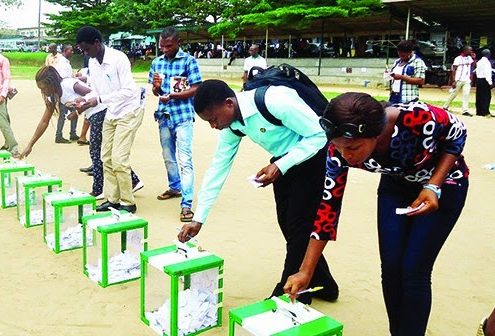
COALITION of Domestic Election Observers (CODEO) on Sunday says 4, 200 observers will be deployed for the Ghana Presidential and Parliamentary election, scheduled to start on Monday, December 7.
Arimaywo Shaibu, CODEO Acting Chairman disclosed this during media and stakeholders briefing held at the Kofi Annan International Peacekeeping Training Center (KAIPTC), Accra, Ghana.
The briefing normally holds on evening to the general election at every election year.
Shaibu who spoke on behalf of the different groups at the briefing said observers had undergone immense training on voters’ education, peace campaign, adherence to Coronavirus Disease (COVID-19) protocol and other electoral processes for proper monitoring of the 33,367 poll stations.
The observers, he said, would be deployed to each of the 275 constituencies from which each lawmaker from their respective constituents would get elected from the entire 16 regions of the country.
Aside from monitoring both polls, the observers are also expected to report voting activities and compile election results which would be used to benchmark final results declared by the Ghana Electoral Commission.
1,502 from the total observers are deployed as Parallel Vote Tabulation (PVT) observers.
“We are aware that elections provide the opportunities for citizens to democratically select their representatives to govern and manage the affairs of the society on their behalf,” Shaibu said.
“It is therefore imperative that this democratic right of exercising one’s franchise is conducted in a manner that the processes and outcomes are generally deemed credible and acceptable.”
The Ghana election is the eight in series of presidential polls held in the country since fourth republic commenced in 1992.
Major candidates contesting in the poll among the 27 political parties include John Mahama, the former president. He is contesting under the National Democratic Party (NDC) while the incumbent President, Nana Akufo-Addo is seeking re-election under the New Patriotic Party (NPP).
CODEO’s mandate is to support the Ghana electoral commission to ensure the country realise a free, fair and credible poll.
However, Shaibu, urged all contesting political leaders and their supporters to ensure peace reigns during the poll.
He urged the ad hoc staffs and electoral officials to remain objective. The security agencies were charged to conduct themselves professionally while the media was charged on proper reportage of the poll.
SENATOR representing Borno South, Ali Ndume, faces possible prosecution for alleged perjury and forgery, arising from the documentation he filed at the Federal High Court, Abuja as surety for Abdulrasheed Maina, former chairman of the Pension Task Team, who is facing trial for corruption.
Ndume first ran into trouble two weeks ago when Justice Okon Abang of the Federal High Court, Abuja ordered his remand in Kuje Correctional Centre for failing to produce Maina for trial. But the senator got a reprieve after spending five days in detention when the judge granted him bail on account of his “good behaviour and conduct,” even though the lawmaker challenged the court’s order to have him remanded in prison at the Court of Appeal in Abuja.
With the turn of events which saw the arrest and extradition of Maina to Nigeria from Niger Republic earlier last week, it would appear that the senator is off the hook.
However, he has bigger problems to deal with as there are allegations that he deceived the court to grant Maina bail by lying and presenting to the court property that did not belong to him as bail guarantee and presenting forged documents to prove ownership of same.
Prosecutors in the Maina case are said to be considering action against the senator for perjury and forgery and misleading the court to grant bail to the embattled former pension task team boss, who has now been remanded in prison until his trial is concluded.
In early June, the senator stood surety for Maina, agreeing to a bail bond of N500 million. As guarantee, he presented a property, a house in Asokoro District in Abuja worth N500 million.
Earlier, on May 5, Ndume had sworn to an affidavit of means in which he stated that “the property used in the fulfilment of the bail term belongs to me personally.”
In the affidavit, the senator also stated “if the defendant (Maina) jumps bail, the surety (Ndume) shall forfeit the bond to the tune of N500,000,000 (Five hundred million naira) to the federal government of Nigeria.”
However, sources close to the court case and the Economic and Financial Crimes commission, EFCC, which is prosecuting Maina, said that Ndume not only lied when he claimed ownership of the property, the house he presented to the court had been forfeited to the federal government and now serves as corporate offices of the Revenue and Fiscal Commission.
Documents obtained by The ICIR show that to sustain the claim of ownership of the property, a series of other lies were told and forged documents presented to the court.
First, the photograph of the property documented as Plot 158 Asokoro District, which is actually No 93, Yakubu Gowon Crescent, Asokoro is that of another property known as Manor Terrace situated at 22 Idris Kutigi Street Asokoro. It is believed that the photograph of Manor Terrace, an impressive property even by the standards of the highbrow Asokoro district, presented to the court was to convince it that the property is worth the N500 million bond.
Also, a photograph of the real house would have shown that it houses a federal agency, which could have raised questions.
Meanwhile, a geolocation of the addresses revealed that the distance between No 93, Yakubu Gowon Crescent, Asokoro and 22 Idris Kutigi Street Asokoro is 6.6km, a 9 minutes’ drive.
Documents presented to the court also claim that the property at No 93, Yakubu Gowon Crescent, Asokoro was originally owned by one Lawal Ahmed who “donated” it to Ndume in 2018. But it was learnt that the property is owned by the federal government, having been forfeited to it by its previous owner. It could not be ascertained why the federal government took over the property but our reporter confirmed that the property has been handed over to the Fiscal Responsibility Commission for its use as office.
First in the list of documents presented to the court believed to have been forged is an irrevocable power of attorney purportedly issued by Lawal to Ndume dated February 14, 2018.
Investigators believe that the power of attorney was hurriedly prepared to serve the specific purpose of presenting it to the court for Maina’s bail. It is curious that the court did not verify the authenticity of the document before accepting it as there are obvious questionable discrepancies in it.
For example, though the power of attorney was purportedly made on February 14, 2018, it did not take on the authority of a legal document until March 20, 2020 when it was signed a Notary Public/Commissioner for Oaths.
Another forged document presented to the court is an application purportedly made by Lawal to the Abuja Geographic information System, AGIS, to register the power of attorney to Ndume, which would formalise the latter’s ownership of the property and document him accordingly on agency’s database. The document, dated March 20, 2020, the same day that the power of attorney was signed by a Notary Public/Commissioner for Oath, was presented to the court as proof that Ndume is listed by the Federal capital Territory Administration, FCTA, as the bonafide owner of the property offered to the court as collateral for the N500 million bail bond. No such document exists at AGIS and Ndume is not listed as owner of the said property, The ICIR confirmed from FCTA authorities.
Purported FCTA’s confirmation of Registration of Power of Attorney.
Allegedly forged also are two letters of confirmation dated March 30, 2020 and May 20, 2020 purportedly signed by G.G. Bawa for the Director of Lands, Federal Capital Territory Administration, confirming to the Federal High Court, Abuja, the authenticity of a certificate of occupancy for the property presented to the court and the registration of the power of attorney with AGIS.
The first letter purports to confirm the authenticity of a certificate of occupancy for Plot 158, Asokoro District (93 Yakubu Gowon Street, Sokoro) issued to Lawal on August 29, 2015. That letter, addressed to the Deputy Registrar, Federal High Court, Abuja and dated March 30, 2020, also purports to confirm that the power of attorney from Lawal to Ndume over the property is registered with AGIS.
The second letter dated May 20, 2020 and also addressed to the Deputy Registrar, Federal High Court, Abuja, claims the said power of attorney is registered with the FCT authorities.
“We wish to confirm the execution of the Power of Attorney between Lawal Ahmed (Donor) and Mohammed Ali Ndume (Donee) in relation to Plot no 158, Cadastral Zone, Asokoro District, Abuja, covered by Certificate of Occupancy no (withheld) dated 29th August 2015. The Power of Attorney is duly registered in favour of Mohammed Ali Ndume,” the letter reads.
However, when The ICIR met Bawa in his office at the AGIS complex in Abuja on Friday afternoon, he denied any knowledge of the documents, confirming that they were forgeries.
Laughing when shown the letters, Bawa in turn showed our reporter a photocopy of the said letters in his possession and pointed out that the dates – March and May – fell within the period of lockdown when civil servants in the FCT, as in other parts of the country, did not go to work. He said no such documents were signed or issued by his office at this time.
The names of three lawyers appear on the power of attorney presented to the court purportedly handing ownership of 93 Yakubu Gowon Crescent, Asokoro, to Senator Ndume. They are Stanley Dienu, Thankgod Enahoro and Tamunoibim Ibitoru. When our reporter called Enahoro, he told the lawyer he would like to reach him on WhatsApp because he wanted to share some documents with him. On November 30, the lawyer read the first two messages sent by the reporter. In the first message sent at 5.39 pm, the reporter introduced himself. The second one send at 5.40pm that reads “I would like to confirm if the Power of Attorney attached is authentic. It is indicated that your chambers handled it.” He read both and subsequently switched off his WhatsApp because he has not even read the third message which contained the said power of attorney sent a few minutes later as at December 4 when this report was filed.
Since Monday, Enahoro has also refused to take the reporter’s calls, cutting him off every time he tried to reach him.
A source close to the court case and the investigations leading to it said that when Ndume was confronted with the forgeries and their implications for him, particularly with his position as a senator, he confessed that did not own the house presented to the court as guarantee for the bail bond.
The senator, it was gathered, said that when he told “Maina’s people” that he did not have a house worth the N500 million requested by the court, they told him not to worry as they would get the house to be used as surety.
The senator reportedly said they brought papers for him and he just signed them, trusting that they were genuine.
When our reporter spoke to Senator Ndume on Sunday night, he explained that he did not own a property worth N500 million and that the one he submitted to the court was donated to him.
“I do not own a property worth N500 million. I do not have that kind of money. I did not tell the court that I own the property but that it was donated to me. And before the court accepted the papers for the house, they should have verified it,” he asserted
The lawmaker insisted that he verified the papers of the property to determine its genuineness, asserting that they were confirmed to be authentic by AGIS.
“I sent a lawyer to verify if it was genuine when they donated the house to me and it was confirmed by AGIS. I accepted when they said they would donate the house. My only condition is that it would not be Maina’s own because that would have been wrong as he was accused of money laundering. So what is all this about?”
“I believe that some people want to smear my name because the bottom line is that the issue of the property has been overtaken by events. Bottomline is that Maina jumped bail but he has been arrested again and is now back in Kuje. So, what is the issue?, the senator queried.
When Ndume was told that AGIS distanced itself from the papers purportedly sent by it to the court verifying his ownership of the property, he said that he could not be blamed for that because the court should have verified if the documents were genuine.
He insisted that he did not know Maina until recently and had no reason to protect him through dubious means.
“I never knew Maina before and it took them eight months for them to convince me to stand as his surety. I have met him only twice in my life. First, when I went to prison to confirm that he was really sick and the doctor told me he was, indeed, terribly ill. The second time was last Thursday after they rearrested him. The thing is that judge insisted on a serving senator and he is from my constituency.”.
A source at the lands department of the FCTA who cannot be named said that presentation of forged land documents to courts for bail purposes is a racket that is common and that provided daily bread for many Nigerians. According to the source, the way it works is that when a court grants an accused person bail that requires a property as guarantee, there are always “touts, lawyers and even court officials who are there whose business it is to ensure that land\property documents are perfected and presented to the court.
The source said that the “racket involves FCTA, AGIS, court officials and even some security men.
“I have lost all I have worked for this year. Yam and cassava farms were submerged by the flood. I don’t know how to recover from this. The whole of Anambra West Local Government is under water. We really need the Federal and State governments to help us so we can get back on our feet”.
One of the farmers and stakeholders in Mmiata Anam, Chief Mathias Ameke, lamenting the impacts of this year’s flood on him and the entire community.
While many residents are still not able to come to grips with the cause of annual flooding that devastates their livelihood, experts say it is not unconnected with Climate Change, which is increasingly becoming more threatening globally every year. Anambra is one of the states in Nigeria that is considerably impacted by flood disaster, a harsh spinoff of climate change, largely caused by man’s actions.
Flooding took a dangerous dimension in the state in 2012 and has since become a major environmental concern in Anambra State, leaving thousands of residents including farmers with unquantifiable losses, from which some of them are yet to fully recover. Recovery seems impossible because the disaster has become a recurring decimal which leaves farmers with varying degrees of loss anytime it occurs.
Flooding is caused by excessive rainfall and expanding seas due to global warming, which warms up and causes the ice to melt.
The Director, Centre for Water and Climate Change at Nnamdi Azikiwe University Awka, Dr Emma Ezenwaji, further explains how climate change causes excessive rainfall, which in turn leads to flooding.
“The expansion in the sea is because the rainfall actually depends on water it takes from the ground. So, with much water in the sea and massive sun, there is evaporation, which eventually leads to excessive rainfall. Without excessive rainfall, we will not have the flood disaster, which we now face annually in Anambra State”.
Dr Emmanuel Ezenwaji of the Department of Geography and Meteorology, Nnamdi Azikiwe University Awka and Victor Otti of the Department of Civil Engineering, Federal Polytechnic Polytechnic, Oko, in a publication in 2013, argued that excessive rainfall, which is one of the evidences of climate change, has a major contribution to flooding in the Anambra North Senatorial District, where most of the worst hit Local Government Areas and communities are located.
The research work also revealed that the area is getting wetter by 6.86mm per year.
“We are aware that rainfall generates runoff which empties into basins and rivers where they exist, but in an area which is poorly drained, flooding will result. Even when the basins and rivers exist to carry the flood, heavy rainfall often causes their carrying capacities to be exceeded, result in flooding”.
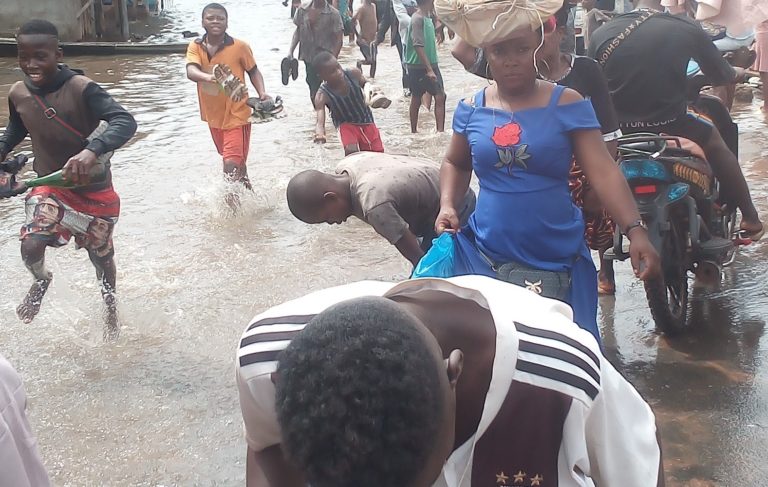
Anambra West LGA totally flooded
“The heavy flooding into the water channels often generate pressure on dams where they are located which sometimes force the authorities to open the water control structure to release some water downstream or risk the pulling down of the dam by water pressure in the reservoir section of the dam. The current flooding of almost everywhere in the country including areas in northern Anambra State is as a result of this problem”.
Also, in the journal of Geography and Regional Planning authored by Chukwudi Nzoiwu, Emma Ezenwaji, Ifeanyi Enete and Nwabueze Igu in July 2017, the academics observed that the annual rainfall varies slightly over 1370 mm to more than 2700 mm for the 40 years period under study.
They submitted that: “The annual rainfall in Awka varies from slightly over 1370 mm to more than 2700 mm for the 40 years period under study. The trend shows that at the start of the studied period (1976 to 2015), rainfall decline was recorded within the first decade (1976 to 1985) until 1987 after which increasing rainfall was noticeable for Awka”.
From Ayamelum to Anambra East and West as well as Ogbaru, Awka North, Onitsha North and South Local Government Areas, farmers tasted the bitter pill but those from Ayamelum, Anambra East, Anambra West and Ogbaru have more heart-rendering stories to tell as a result of this year’s episode of the deluge.
Visits to those local government areas revealed the level of devastation and colossal losses suffered by the local farmers, who most often take loans for their agricultural production. With roads and bridges submerged and farms and livestocks washed away, thousands of farmers can only hope for some form of succour and indemnity first from relevant government institutions as well as corporate bodies, international agencies and public spirited individuals.
The whole of Anambra West Local Government Area was under water, with varying stories of devastation to houses, farmlands and forest reserves. Sunday Iloegbunam, Mmiata-Anam, said several farmers had been plunged into debt by the incident.
“There is no place that is not covered by water in Mmiata-Anam. We are not talking of property again. We just want to save our lives. Our farm products are under water – yam, cassava, potatoes. I do borrow money to farm. But I could not get half of the size I farmed out before the flood came. I lost so much”.
Various communities in Anambra East Local Government Area including Aguleri, Enugwu-Otu, Mkpunando, Ezi-Agulu Otu and Anam were not spared as the bridge linking them with other parts of the local government had been submerged. A displaced Octogenarian, Mr Augustine Emeka, recounted the experience with bitter feelings.
Completely flooded Community Secondary School, Atani
“Our yam, cassava, rice are under water. The water this year pass last year. And he still dey come more and more. Water don cover my house. That is why we are running out. The money we take work rice, yam, cassava, all gone like that. I no hear that government say they provide place for us to run to. We are only helping ourselves”.
In Awka North, communities like Ugbenu, Ugbene and Awba Ofemili were also hit by the disaster. Cosmas Nnamah, a young rice farmer from Ugbenu, joined the farming occupation at the age of twelve and had enjoyed every bit of it but for the perennial flooding, which he first experienced in 2012.
”The flood came again this year with big force. Here at Ugbene, farms are submerged and destroyed. Some farmers have nothing to show for all their labour this year”.
As at 12th of October, 2020, Ayamelum, a Local Government Area, particularly reputed for rice farming, had been largely covered by flood, with several residents sacked from their homes, valuables lost, while the only access road linking the Local Government to the rest of the state was impassable. Those desperate to cross the flooded road had to pay extra as they were ferried by speed boats, tractors, trucks and lorries at a cost.
Mr Hyacinth Okafor, an Aggregator for NIRSAL-CBN Geo-Cooperatives in Anambra State, said the 2020 episode of the flooding has left them with different stories of losses.
“Out of ten hectres of farm we have here, six have been submerged by flood and it is still rising. So, the remaining four are not even safe. The farmer had put a lot into the farm, which was close to harvest. Many of our members are devastated and confused. Hope of livelihood had been destroyed”.
For some of the farmers in Ayamelum, who had earlier lost their rice field to drought, another evidence of climate change, it was a year of double tragedy with the arrival of flood.
Between June and August, we experienced drought and many farmers lost their rice fields. Then, this flood again. As we speak over twenty hectres are inside water most especially in Anaku and some parts of Omor. For farmers, the hope of making profit is dashed, For us the processors, the mills are inactive because we have no paddy to mill. The transporters are also idle because the road is submerged. Mr Abraham Ogwu, a rice processor and marketer lamented.
Perhaps, one of the most devastated local government areas is Ogbaru where the Police Zonal Headquarters, the Naval Outpost, General Hospital, the Chief Magistrate and Customary Courts as well as schools were submerged.
Houses have fallen, many lives lost and none of the sixteen communities in the local government is completely spared.
“As you can see, nowhere is safe from Okpoko to Oguikpele, the end of Ogbaru. This is a terrible situation. It’s almost getting to the level of 2012. But, I thank God, we started the sensitization on time with SEMA and NEMA. We told them to expect high rise of water”.
Some farmers in Ossomala forced to bring their cassava on the road for sale
That was Hon. Nnamdi Esimai, the Co-ordinator, Local Emergency Management Committee for Ogbaru Local Government Area.
Impacts on women and children
“Some of the things that our husbands and men can do in this situation, we cannot do. They can run and escape, but we cannot do that. You see women here in the camp, we have no privacy. You have to go to bathroom or go anywhere at the back of the building to change and have some privacy”.
The above statement by one of the female victims, Mrs Ijeoma Sunday, strengthens the fact that women and children bear greater brunt during emergencies arguably due to their vulnerability and natural weaknesses. Investigations revealed that the 2020 flood disaster had left far reaching adverse impacts on women and children across the affected communities.
The children were once again sacked from school for the second time in the year after resumption from the long break occasioned by COVID-19. This development worried some parents. Besides the disruption of their academic pursuit, most of those reportedly killed by the flood are infants.
One of the women said: “We have lost so much of our property and farmlands. We have lost some persons most of them children. Our prayer is that this does not continue”.
Soil erosion: evidence of climate change
Apart from flooding, another visible impact of climate-induced flooding is soil erosion, a major ecological problem confronting Anambra State, with severely negative effects on food production. Data from the Nigeria Erosion and Watershed Management Agency, NEWMAP indicates that Anambra State as at the last count, had nine hundred and sixty active erosion sites, which have claimed arable land in the area. Some of the communities in the state have become synonymous with erosion such as Nanka, Agulu, Oko among others.
New gullies are said to be forming with every drop of rain and this worries the Co-ordinator of NEWMAP in the state, Mr Mike Ivenso.
“Unfortunately, the resources to tackle the nine hundred and sixty erosion sites are very limited. NEWMAP is working on fourteen sites across the three Senatorial Zones. But, that is only a drop in the bucket. I am thinking that by now, the number sites should be around one thousand gullies and still counting. This is because the geomorphologic nature of the soil in the area, which is friable and loses its weight easily when in contact with water or moisture”.
Food crisis looms
Indisputably, climate change is one of the biggest threats to food security and the situation in Anambra calls for attention. Food security, which was earlier in the year threatened by the novel Corona Virus Disease (COVID-19) lock down, has been worsened by the flood, which has robbed most farmers of the harvest of their toiling round the year and has rendered several hectares of cultivable land useless.
Production capacity of the farmers, which had been badly affected by the twin disasters, promises far reaching multiplier effects for the State, as most of the farmers have lost input to cultivate in the next planting season and may not be able to farm at the rate they have done in the past due to the huge losses they suffered this year. This, for commentators, is an invitation to starvation and hunger.
Some of the children displaced by flood at the holding camp within Ogbaru LG Secretariat, Atani
A Natural Resources Surveying Lecturer in the Department of Forestry and Wildlife, Nnamdi Azikiwe University, Awka, Mr John Ogbodo, lucidly explained the link between climate change and food insecurity.
“Soil erosion washes away the nutrients on the surface of the soil and that leads to very low yield for farmers. Deforestation also leads to soil erosion which has rendered thousands of hectares of arable land unusable around the state.
“There is equally increase in weeds, blights and pests as well as droughts and moisture stress. You would have noticed competition for land becoming more intense across the state with farmers and herders clashes. The culminating impact of all these is food insecurity”. Mr Ogbodo feared.
Government interventions
The Federal Government is in partnership with Anambra State Government and the World Bank, implementing the Nigeria Erosion and Watershed Management Programme, NEWMAP, which is currently intervening in fourteen erosion sites across the three senatorial districts of the state. The state had spent about sixteen billion naira in the partnership with tripartite funding arrangement.
President Muhammadu Buhari recently directed that assistance be given to the state affected by flood this year and an Assessment Team, led by the Zonal Co-ordinator, National Emergency Management Agency, NEMA, in the South East, Mr Fred Anusim, had visited Anambra to give effect to that presidential order.
“We are in Anambra State to assess the impacts of the flooding to see how the Federal Government will assist as it is doing in other states like Kebbi, Niger, and Kwara to Kogi and Jigawa States. Then, Anambra, Delta, Rivers and Bayelsa. After we are done with the assessment, report will be sent back to Abuja so that they can plan for the relief intervention”. Mr Anusim explained.
A Medical Rescue Mission, headed by the Commissioner for Health, Dr Vincent Okpala was deployed to the affected Local Government Areas to save lives of residents and give them all necessary medical assistance.
Four truck load of food items were sent to the four worst hit Anambra East, Anambra West, Ayamelum and Ogbaru Local Government Areas, though under a circumstance many citizens described as questionable and face saving. One of them, who pleaded anonymity, alleged that government could no longer hoard the food items, after attempts by some irate youths, who besieged the warehouse to cart the materials away during the ENDSARS protest.
“My dear, they simply hoarded those items for campaign next year. Now, they want us to believe they are for flood victims. Yet, just last week, we heard them pleading to the Federal Government to assist flood victims with food items. They went to the camps and never carried any food items to the victims”.
Sensitization and information sharing campaign had been mounted for traditional rulers, Presidents-general and other critical interest groups on issues of flooding, erosion, indiscriminate dumping of refuse and blockage of drains, linking them with climate change.
Dr Emmanuel Okafor, the Permanent Secretary in the Ministry of Environment, further revealed that work on about one hundred and fifty erosion sites across the state are at various stages of completion while some had been delivered. The government, he added is encouraging tree planting in various communities to mitigate flooding and had distributed gas cylinders to households to reduce deforestation.
“We are already partnering with the Federal Ministry of Environment to see that old fridges and radio are carted away because they emit some gases that affect the ozone layers. The Government is executing land reclamation in two sites through the state ministries of works and environment.
“Recently, we met with people in Agulu, Nanka and Oko which are very prone to erosion on how to prevent new ones. Efforts are on to stop sand excavation in those communities. We are also encouraging our people to construct catchment pits in their compounds and to stop interlocking which aids run-off”.
Dr Okafor also hinted that the Ministry will soon champion the incorporation of Climate Change subjects into the curricular of all levels of education, to catch the children young with the message that will help to preserve the coming generation. The State Government earlier this year established the Erosion, Watershed and Climate Change Agency, for which three hundred million had been budgeted in the 2021 appropriation bill.
Other preventive measures by the state government include: setting up a task force for proper scoping and execution of development projects, campaign against indiscriminate building and erecting of structures on water ways and launch of one million tree planting initiative to provide natural cover for the soil.
“Trees take in carbon dioxide and give out oxygen which human beings need. So, removing carbon dioxide from the atmosphere causes greenhouse gases, which lead to climate change. The Task Force is to ensure that every development project is properly scoped and executed. For instance, for road projects, drainage system attached must be properly terminated into the nearest body of water”. NEWMAP Co-ordinator said.
Preventing the anticipated food crisis
Several measures had been suggested as ways to mitigate the negative impacts of climate change and save Anambra State from the looming hunger and starvation. These include: the dredging of big water bodies to enable them contain more water, wide publication of the onset and cessation of rainfall to enable farmers adjust to rainfall regime, early planting by farmers to ensure harvest before the arrival of flood, introduction of flood resilient rice species among others.
For an Agric-Value Chain Expert, Mr Abraham Ogwu, the government must be decisive in finding lasting solutions to the perennial flood disaster.
“Government should fund research institutes to be able to look at Climate Smart Agriculture. They can develop crop varieties that can resist either drought or flooding. Where that had been done, let the Government support the institutes to produce such special specie of rice in a good number to go round farmers who have fields in flood prone areas”.
The need for farmers especially those who cultivate acres and hectares of land to be insured by NIRSAL, against disastrous incidents such as flood and erosion has become more imperative than ever. It is the hope of many that National and State Emergency Management Agencies will come up with good programmes on how best to assist victims in the most impactful manner.
Woman Farmer narrating the ordeals of women and children
Experts submitted that the current situation in Anambra State is a time bomb that must not be allowed to explode to prevent devastation of unimaginable magnitude.
“If not checked in the next ten years, the whole state will be one big site of erosion. So, this is one area that is agitating the minds of experts and scholars because I don’t know how far government has gone in that area. I have said it severally that the Ministry of Environment in the state should not concentrate all attention on refuse evacuation. We have a very big problem in our hands” Director, NAU Centre for Water and Climate Change, Dr Emma Ezenwaji warned.
It was gathered that the State Government has been taking steps to ensure that food crisis does not result as anticipated. One of such measures, according to the Head of Department, Extension Services in the State Ministry of Agriculture, Mrs Ifeyinwa Uzoka, is sharing useful and timely information with farmers to build their capacities for optimal productivity.
“Most of the flood prone places do dry season farming. If they start early November, they will be able to harvest and make some profit before the flood sets in. Also, farmers in those areas should plant short-duration crops such as: rice, sweet potatoes, vegetables, amaratus green, pepper, okro, corn, and others which they can harvest two to three times before the flood comes. Planting only long-duration crops like yam and cassava can lead them to poverty food insecurity.
“Government is partnering NIRSAL and other agricultural facilities lending institutions to train our farmers and link them to agricultural credits at single digit interest rate. As we speak, the farmers are positioning themselves to access the facilities that are available at the moment”. Mrs Uzoka explained.
Awareness is yet low
One incontrovertible inference from most of the respondents is the hitherto low level of awareness among residents about climate change and its impacts on the state. Obalum Okagbue, a resident of Aguleri Otu, could not hide his ignorance as he responded to the poser on how much he knew about the cause of flooding.
“I no know wetin dey cause this flood. Na you people go fit tell us now. But, I hear people dey talk say na from kainji dam the flood come”. Okagbue responded
Cosmas Nnamah from Ugbenu is aware of the climate change but is pained that majority of the people, who bear its consequences, still don’t know why their farms are flooded every year.
Surviving against the odds
For Chief Ameke, the Government which is expected to take the lead in educating the populace about Climate Change, is found wanting.
“People have not been educated on why this is taking place. They said Kainji Dam has over-flown its bank and excess water must be released. It’s all about climate change. It is however pathetic that burning of bushes and felling of trees had continued unabated, while the fire is burning every day. No one is educating the people”.
The Permanent Secretary, Ministry of Environment, Dr Okafor, also agreed to the need to raise the bar on whatever is currently being done.
“I agree with you, we need to up our rate of public enlightenment. However, we’ve been talking to the people and putting up regular announcements through the state owned radio station. We could not scale to other stations due to financial constraints”.
Also reacting to the need for more intensive awareness campaign, the NEWMAP Co-ordinator, Mr Ivenso, posited that enlightenment about such an important issue must not be one-off.
“There can never be enough education. People must be constantly reminded of some of these things so that they will remain in their consciousness. We have a radio programme that is funded by the World Bank, on the state own radio station but must continue to highlight the issues. Other MDAs should please join us. Environmental issue is not just for the Ministry of Environment.
Mrs Ifeyinwa Uzoka, assured that the Ministry, through the Extension Services Department, is poised to bridge the gap in information dissemination.
“My Programme Manager, Mr Jude Nwankwo has plan to make sure that we reach the nooks and crannies of Anambra State to educate our people to discontinue with those practices that impact negatively on Climate Change and for farmers to imbibe the practice that can mitigate its effects. We must retrieve our footsteps and do only those things that will mitigate the impacts of climate change.
Facing the future
The Paris Climate Agreement reached in 2015 is the first single agreement uniting nations of the world to forge a common front in mitigating negative impacts of Climate Change. Its key elements include: keeping the global temperatures well below 2.0C (3.6F) above pre-industrial times and endeavour to limit them even more, to 1.5C and limiting the amount of greenhouse gases emitted by human activities to the same levels that trees, soil and oceans can absorb naturally, beginning at some point between 2050 and 2100.
Other elements are: reviewing each country’s contribution to cutting emissions every five years so they scale up to the challenge and encouraging the rich countries to help poorer nations with the provision of “climate finance” to adapt to climate change and switch to renewable energy.
Medical Outreach to flood affected communities
Bearing the above in mind, it is quite in order to conclude with the submission of the Co-ordinator of NEWMAP in the State, Mr Mike Ivenso.
He said: “The environment doesn’t need us but we need the environment. If the environment is bad to us, we will not survive. So, our practices have to be right to be able to survive and thrive on earth. The entire issue of climate change is a matter of whether we’ll exist or we’ll not. It is the biggest issue of our time. If we take it that seriously, then we have to make that commitment and efforts to continue to educate people and spare no effort to mitigate it”.
Nigeria must take the Climate Agreement seriously and implement those four key elements with patriotic commitment to ensure that negative impacts of climate change are kept at bay in the country. Anambra State Government must be more decisive and be seen as doing its utmost in tackling the challenges posed by climate change across the state.
Support for this report was provided by the Premium Times Centre for Investigative Journalism (PTCIJ) and is made possible through funding support from Ford Foundation.
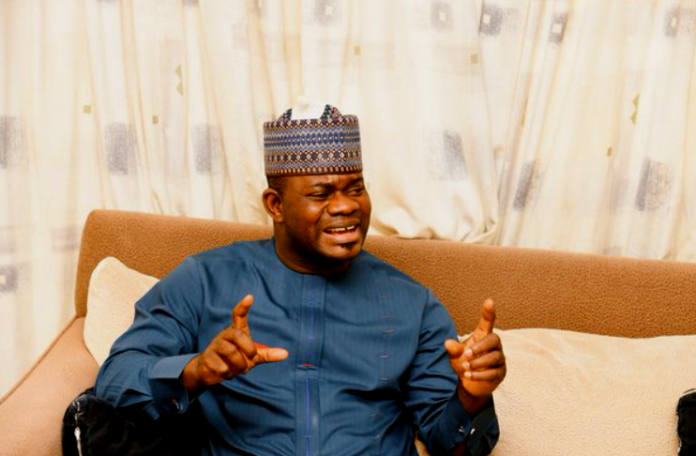
YAHAYA Bello, Governor of Kogi State, on November 19th, 2020, claimed that the All Progressive Congress (APC) -led government is securing Nigeria, stating that the achievement among others of the ruling party would stir them to victory in the 2023 general election.
He made this known when he appeared as a guest on Thursday’s edition of Channels Television’s Politics Today.
FULL TEXT
“APC has come to stay. We are developing the country, the people are happy with our programmes, we are touching lives and we are securing the nation.”
CLAIM
That the APC-led government is securing the country
VERIFICATION
The ICIR conducteda review of the recent weekly update of data of Nigeria security situation by Nigeria Security Tracker (NST) of 4 consecutive weeks, October 20 to November 20, 2020.
Analysing the 4 reports ( week 1, 2, 3, and 4), 620 people were killed in 34 states of the federation, including the Federal Capital Territory (FCT), as a result of various forms of violence across the country.
The reports gathered that a total of 293 were civilians, 64 security operatives, two were political actors and 20-year-old Pelumi Onifade, a journalist, was killed in custody by men of the Nigerian police. Other casualties included 128 Boko Haram members, 124 armed persons, eight robbers, two sectarian actors (2), and a kidnapper.
The highest death tolls were recorded in Borno (163), Katsina (72), Lagos (68), and Kaduna (64). They were followed by Zamfara (34), Edo (26), Cross River (18), Delta (15), Plateau (14), Yobe (12).
NST also noted that the bulk of deaths recorded in Lagos were as a result of the extrajudicial killings of peaceful protesters by men of the Nigerian Army and sponsored thugs during the height of the protest against police brutality in the state.
In October, Nigerian youths across the country staged a renewed national protest against police brutality, especially the notoriety of the special anti-robbery squad, one of the tactical units of the Nigerian police force. The protest signalled the zero confidence Nigerians have in the country’s police force which is known for extortion, extra-judicial killings, and gross violation of human rights.
The peaceful protest, however, turned bloody when Nigerian security forces, including soldiers, opened fire on hundreds of protesters in Lagos.
On kidnapping, the data revealed that in the same months under review, a total of 224 people were kidnapped across 18 states.
The acts took place in Katsina (38), Nasarawa (30), Kaduna (27), Zamfara (23), and Edo (23). Following closely were Ondo with 29 cases, Niger (14), Borno (9), Benue (5), Cross River (5), and Delta (5).
In addition, the northwestern part of the country is currently a hotbed for banditry and kidnapping activities.
Data from Assessment Capacities Project (ACAPS) also revealed that about 21 million people living in these states have been exposed to insecurity from activities of bandits. Banditry violence began as a farmer/herder conflict in 2011 and intensified between 2017 to 2018 to include cattle rustling, kidnapping for ransom, sexual violence and killings.
The violence has affected about 35 out of 92 local government areas in the 4 states. The discovery of gold mines and the activities of illegal miners competing for the control of gold reserves have served to further intensify the existence and activities of armed groups in the northwest. By March 2020, more than 210,000 people have been internally displaced. More than 35,000 refugees have crossed communal borders to Maradi in the Niger Republic by the beginning of March 2020.
Similarly, Nigeria retained its seat as the third country with the worst impact of terrorism for six consecutive times globally, the 2020 Global Terrorism Index (GTI) report stated. Even though terror-related deaths declined to 1,245 in 2019, Boko Haram recorded an increase in their activities targeted at civilians.
Terror-related deaths and incidents attributed to Boko Haram in Nigeria increased by 25 and 30 percent respectively from the prior year. Over the past year, Boko Haram increased attacks on military targets, with deaths rising from 26 in 2018 to 148 in 2019.
An attack on Rann, Borno, on January 28, 2019, by Boko Haram terrorists which left at least 60 people flowing in the pool of their blood while dozens were reported missing in the attack made one of the worst attacks in 2019.
The group was also responsible for Nigeria’s deadliest terrorist attack in 2019 when assailants attacked a funeral in Badu, Borno State. At least 70 people were killed and 10 others were wounded in the attack and ensuing clash.
According to the report, Fulani extremists were responsible for 26 percent of terror-related deaths in Nigeria at 325 fatalities. The majority of terrorist activity related to Fulani extremists occurred in the states of Kaduna, Plateau and Benue. Of the 111 attacks attributed to Fulani extremists, over 59 were armed assaults.
In its latest tragic strike, Boko Haram at least beheaded 110 farmers who were working on their rice fields in Zabarmari, Maiduguri. It was gathered that the farmers were tied up and had their throats slit by the Assailants, making murder the most “insane” attacks on civilians this year.
This came a month after Boko Haram militants slaughtered 22 farmers working on their irrigation fields near Maiduguri, in two separate attacks.
Verdict
Yahaya Bello lied. The above findings show that Yahaya Bello’s claim that the APC-led government is securing the country is false.
The report was produced during the 2020 Dubawa Fellowship attended by the reporter.
TOKUNBO Abiru, candidate of the All Progressives Congress has been declared the winner of the December 5 bye-election of Lagos East Senatorial District by the Independent Electoral Commission (INEC).
Ademola Oremosu, the INEC Returning Officer for the bye-election, declared the result at Somolu collation centre on Sunday.
Oremosu said Abiru polled a total of 89, 204 votes to defeat his closest rival from the People’s Democratic Party (PDP), Babatunde Gbadamosi, who gathered a total of 11,257 votes.
The Bye-election was contested by 12 political parties, 12 candidates out of which three are females while nine are males.
According to Oremosu, Muyiwa Adebanjo of Action Alliance (AA) got a total of 96 votes, Mercy Adeoye of African Action Congress (AAC) scored 248 votes, while John Kome of African Democratic Congress (ADC) polled 376 votes.
He further announced that Adebowale Ogunlaru of Action Democratic Party (ADP) polled 535 votes, Olusola Babatope of Allied Peoples Movement (APM) scored 202 votes, Florence Trautman of Labour Party (LP) got 58 votes, while Adijat Lawal of New Nigeria Peoples Party (NNPP) polled 52 votes.
Oremosu added that Akin Olukunle of National Rescue Movement (NRM) got 65 votes, Saheed Aluko of Social Democratic Party (SDP) scored 35 votes, while Taiwo Temitope of Young Progressive Party (YPP) scored 208 votes.
He noted that out of the total registered voters of 1,261,673 in the district, the total accredited voters were 104, 894, the total vote cast was 104, 405, the total valid votes were 102, 336, while the rejected votes were 2,069.
The election was necessitated by the death of the former senator representing Lagos East, Adebayo Osinowo. Osinowo otherwise known as ‘Pepperito’ died on Monday, June 15, at 65 years-old.
THE Nigerian Centre for Disease Control (NCDC) said it had launched a network of COVID-19 survivors to further help in sensitizing Nigerians on the reality of the pandemic.
Head of Risk Communication of the Centre, Dr Yahaya Disu, disclosed this in Abuja on Saturday, while addressing journalists.
The Minister of Health, Dr Osagie Ehanire was absent at the meeting.
Meanwhile, number of daily confirmed cases of infection continue to increase, as Nigeria recorded 310 new cases, according to data released by the NCDC, bringing total cases of the disease in the country to 68,937 and 1180 fatalities, since the country recorded its first case on February 27, 2020.
Of the confirmed cases, 64,650 patients have been discharged, leaving 4,287 active cases of the virus across the country.
FCT led Saturday’s cases with 128, followed by Lagos, 86; Kaduna, 26; and Katsina, 20.
Others are Rivers, 19; Oyo 7; Benue, 5; Edo, 5; Jigawa, 5; Ogun 5; Bayelsa, 2 and Kano 2.
The country recorded one death from the disease on Saturday.
Addressing participants at the 4th Annual Health Conference of Association of Nigeria Health Journalists (ANHEJ), with the theme: COVID-19 Reportage Assessment,” Disu said a major factor confronting the containment of the disease in the country was doubt among the people.
The attitude, he said, was a major reason people flout the guidelines set by the government such as use of face mask, regular hand-washing and social distancing, so the disease could be contained.
“We have just set up the network of survivors now in the country. We have registered them. Maybe, when they start talking, their voice will be louder,” Disu said.
He cautioned that there is no need for people to doubt the existence of the virus because high fatalities are being recorded in many countries around the world.
Disu said of the level of doubt over the disease in Nigeria: “In another clime, you just give information, people would take it. In another clime, people want to see evidence. They want to see people dying. I saw one man on TV saying until he sees 30 people dying around him, he would not believe COVID-19 is real. Who does he know the 30 people would be? Would they be his daughter or wife,? he queried.
He attributed the doubt largely to less severity of the disease and fatality recorded from it over the past eight months that the nation recorded its first case of the killer virus.
He said even when people see evidence around them, they would still say it’s not COVID-19 but malaria.
“Until somebody experiences it; do we get to that level? How many cases do we have in Nigeria? It’s still less than 70,000. What is our population? 200 million. If you look at that – ratio 70,000 to 200 million, that will give you like ratio one to, maybe, 5000.
“That means for you to see the next person that will be infected, you have to count 5000 persons. So, you’re not likely to see people who are infected. Most of the people who are infected are asymptomatic. For you to believe this person has it, you must see the symptoms. So, the figures you’re even seeing include asymptomatic people. The reality is that they may not see; it is those who are affected that know the truth and will tell you this is real,” he stated.
He added that the youthful population that the country parades had been key in low confirmed cases and fatalities from the virus.
He however urged people in the country to consider the aged and those with underlying diseases such as hypertension and diabetes that could be easily killed by the virus, if they contract it.
At midnight Saturday, Nigeria had 68,937 confirmed COVID-19 cases, 64,650 discharged patients and 1,180 deaths.
Lagos state topped the list with 22,648 confirmed cases, 21,119 discharged patients and 220 deaths.
The Federal Capital Territory (FCT) came second with 6,513 cases, 5,934 treated and discharged persons with 82 deaths.
Imo state had the least cases and mortality from the disease, as it recorded 648, 613 and 12 confirmed cases, discharged patients and deaths respectively.
Globally, there was 66.7 million cases, 46.1 million recoveries and 1.52 million deaths at the time of filing this report.
The US leads the chart with 14.4 million cases and 279,000 deaths.
Some prominent Nigerians who died of the pandemic include former Chief of Staff to President Muhammadu Buhari, Abba Kyari; former governor of Oyo State, Abiola Ajimobi; and Dr Wahab Adegbenro, a serving commissioner of health in Ondo state who died of the ailment.
A new report by Citizen Lab has shown that the Nigerian government purchased surveillance equipment to spy on the mobile calls and short message service (SMS) of Nigerians.
The Citizen Lab is an interdisciplinary laboratory based at the Munk School of Global Affairs & Public Policy, University of Toronto, focusing on research, development, and high-level strategic policy and legal engagement at the intersection of information and communication technologies, human rights, and global security.
It investigates digital espionage against civil society, documents internet filtering and other technologies and practices that impact freedom of expression online, analyzes privacy, security, and information controls of popular applications, and examines transparency and accountability mechanisms relevant to the relationship between corporations and state agencies regarding personal data and other surveillance activities.
In the report, titled “Running in Circles: Uncovering the Clients of Cyberespionage Firm Circles,” the Nigeria Defence Intelligence Agency (DIA) and other unspecified entity in Nigeria had acquired the equipment from Circles, a cybersecurity company founded by an Israeli with affiliation with the NSO groups to exploit flaws in telecommunications systems and to access calls, SMS and location services.
“Our scanning identified two Circles systems in Nigeria. One system may be operated by the same entity as one of the Nigerian customers of the FinFisher spyware that we detected in December 2014.
“The firewall IPs are in the same /27 as the IP address of the FinFisher C&C server we detected in our 2014 scans (41.242.50.50). The other client appears to be the Nigerian Defence Intelligence Agency (DIA), as its firewall IPs are in AS37258, a block of IP addresses registered to “HQ Defence Intelligence Agency Asokoro, Nigeria, Abuja.”
In 2016, Premium Times had reported that two former Nigerian governors of Bayelsa and Delta states, purchased systems from Circles to spy on their political opponents. In Delta State, Premium Times reports that the system was installed at the “governor’s lodge,” and operated by employees of the governor, rather than police.
In Bayelsa State, the governor reportedly used the Circles system to spy on his opponent in an election, as well as his opponent’s wife and aides. The investigation also found that the two Circles systems were imported without the proper authorizations from Nigeria’s Office of the National Security Adviser.
The report added that members of civil society in Nigeria face a wide range of digital threats.
A recent report by Front Line Defenders concluded that Nigeria’s government “has conducted mass surveillance of citizens’ telecommunications.” The Committee to Protect Journalists (CPJ) has also reported multiple cases of the Nigerian government abusing phone surveillance.
The Nigerian government in recent times has renewed its effort to control and gang the social media on the pretense that it wants to fight the spread of fake news.
Irked by the #ENDSARS protest, the Nigerian government has launched a deadly state security crackdown on the campaigners of the protest by freezing their accounts and arresting them on trumped up charges.
DESPITE various accounts of victims, Tukur Buratai, the Chief of Army Staff has insisted that there was ‘no single corpse’ at the Lekki toll gate shooting on Tuesday, October 20, during the ENDSARS protests in Nigeria.
Buratai said this on Friday during the decoration of 39 newly promoted major generals in Abuja.
According to the Chief of Staff, there was no single corpse due to a spiritual warfare seminar organized by the Nigerian Army.
“I must say that the Spiritual Warfare Seminar we had last time helped us during the last #EndSARS protests to the extent that there was no single corpse, but some persons were seeing double at Lekki toll gate in Lagos State,” said Buratai.
He added that the Nigeria Army would continue to protect Nigerians in accordance with the ‘rules of engagement’.
“We will continue to protect every law-abiding Nigerian anywhere in the country and we will do that in accordance with the rules of engagement and confines of the constitution,” he added.
Contrary to Buratai’s claim, men of the Nigerian Army fired shots at peaceful protesters at Lekki toll gate in Lagos state during the ENDSARS protests.
Initially, the Army denied its presence at the scene before it was confirmed by Babajide Sanwo-Olu, the governor of Lagos state.
A few days after, the Nigerian Army said its operatives were at the scene but only fired blank bullets at the peaceful protesters.
However, the claimed ‘blank bullet’ has taken the lives of some, got some amputated and others gravely injured with bullet wounds, according to eyewitnesses at the scene and other video recordings.
An investigation by the Cable News Network, bullets casings found at the scene were confirmed by current and former Nigerian military sources that the bullet casings match those used by the army.
The CNN also said two ballistics experts confirmed that the shape of the bullet casings indicate they used live rounds, which contradicts the army’s claim that blank bullets were fired.
Lekki shooting victims appear before Judicial panel
On Friday, a counsel to victims of police brutality, Adesina Ogunlana, presented some victims of the October 20 shooting to the Lagos State Judicial Panel.
Edwin Augustine, one of the presented victims told the panel that a bullet pierced his thigh on the night of the shooting at the Lekki tollgate.
“I was shot on October 20 at the Lekki tollgate. I didn’t see who shot me. I was at the snooker board. I heard gunshots. The first one was in the air. The second was direct to people. I wanted to follow someone to the charging spot to collect my phone, but he was shot right beside his heart.
“Immediately he fell, I tried to turn and check what was wrong and I received mine (shot) on my thigh. I fell and I was there unconscious. When I woke up the next day, I saw myself at the hospital,” Augustine narrated.
Nathaniel Solomon, another victim at the panel, presented a picture of his late brother, Abouta, who was allegedly shot and killed during the shooting at the toll gate.
He said the remains of his brother was recovered from the Lekki Tollgate the same night the shooting occurred.
“I didn’t know when my brother left home for the tollgate. He never told me he was going there. He was living with me here in Lekki, at Marwa.
“Some boys called me. By then, my phone battery was flat, the phone had gone off. They called one of our brothers and told him that Abouta had been killed. So, we went there, found him on the grass, picked up his corpse and we went to St Paul’s Mortuary at Oyingbo.
“His corpse was at the Lekki tollgate. There were protesters around at the time. He was laid on the grass that was growing on the road divider in the middle of the road, that night when we took my brother’s corpse, we saw other people who had been shot, about four of them, on the ground. They were all dead,” said Solomon.
BYE-elections are being held in 11 Nigerian states including Lagos and Bayelsa to fill vacant seats in the State Assemblies, House of Representatives and Senate arm of the National Assembly.
According to information gathered from the Twitter handle of the Independent Electoral Commission (INEC), other states where bye-elections are being held include, Imo, Cross Rivers, Plateau, Kogi, Enugu, Bauchi, Borno, Katsina and Zamfara states.
In Lagos state, elections are being held in Kosofe II State House of Assembly and the Lagos East Senatorial District By-Election.
The Bye elections are also being held in Bayelsa West Senatorial District Bye-election, Bayelsa Central Senatorial District Bye-election, Plateau South Senatorial District Bye-election, Imo North Senatorial District Bye-election, Cross River North Senatorial District Bye-election, Dass State Constituency (Bauchi State), Isi-Uzo State House of Assembly Bye-election (Enugu State).
Others include Ibaji State House of Assembly Bye-election (Kogi State), Nganzai State House of Assembly Bye-election (Bornu State), Obudu State House of Assembly Bye-election (Cross River State), Bayo State House of Assembly Bye-election (Bornu State) and Bakori State House of Assembly Bye-election (Katsina State).
However, The ICIR observed that COVID-19 protocols are not being adhered to in some polling units across the states.
In Kolokuma/Opokuma Local Government Area, Central Senatorial District, some voters were seen voting without the use of face masks.
The same practice was seen in Shomolu Local Government Area in Lagos State.
Apart from voters and INEC officials, security officers of the Nigeria Police Force and the Nigeria Security and Civil Defence Corps (NSCDC) also failed to use facemasks in Yenagoa Local Government Area, Bayelsa State.
In this report, Jennifer UGWA went undercover as an intending bride in need of a statutory marriage license to expose sharp and corrupt practices of marriage registrars and officials appointed by the Federal Ministry of Interior within the FCT.
The inconspicuous sign stringed to the low- fenced wall on the dusty road only read: Marriage Registry, Kuje Area Council, Town Hall.
A flat white iron board– was the only indication of the presence of a registry as an arrow was pointing in the opposite direction away from the Women Development Centre.
On this hot Wednesday afternoon, Abah Benjamin, office assistant to the registrar sat bent over notes scattered on an old wooden desk in the reception.
Benjamin Abah, Assistant registrar, Kuje. Credit Jennifer Ugwa1
As the sound of approaching footsteps got closer, Benjamin stopped writing and attended to the visitor.
Tits for Tats
Among the scattered sheets of paper on Benjamin’s clustered table is a pamphlet advertising a ‘Now and Forever’ union in Kuje registry.
“Good afternoon. How may I help you?” Benjamin greeted.
Upon this reporter’s revelation that she was there to legalise her marriage, the assistant proceeded to give her a download of how much her quest will cost.
Benjamin explained that for N20,500( Twenty thousand five hundred naira) ($53.2645) which can be paid in installments, the marriage can be certified within 21 workdays.
However, despite the favourable fees which were below the official sum of N21,000, as of March, the officials had found a loophole to squeeze out more cash from couples.
Since Saturdays are often a free day from work and business engagements for most people, ceremonial activities are also slated for the weekends.
Nevertheless, if a solemnisation is to take place in this registry on such days, “You have to pay an additional fee of N10,000,” Benjamin disclosed.
“We are civil servants, officially we don’t work on weekends. So you have to pay. But feel free to choose any other day,” he said.
The foreknowledge that intending couples prefer a weekend wedding is the axe registrars wield to their advantage.
And this additional payment is not going to be receipted. It is for private pockets.
Meanwhile, on the list of requirements was also a request for a carton of malt drink which the assistant said was as mandatory as the provision of an affidavit.
“You can monetise the cartoon of malt if you don’t want to carry anything,” Benjamin said.
“Don’t you know how much a carton of Malt is? You can find out,” added the assistant upon his clients’ inquiry on how much it would cost her.
Based on his explanations, it was certain the marriage won’t hold if the soft drink was not provided.
Benjamin would later suggest an urgent marriage certification for N30,000 ($77.9470) instant payment which could be awarded within 24hours or less.
This could be done in contravention of the provision of the Marriage Act that allows for 21-28 days public notification of such unions.
Yet, this new arrangement will not exclude the carton of malt and two pens.
When Benjamin was asked for the registry’s banking details to facilitate deposits he claimed there was none just as he would also claim there was no official website for the agency.
Marriage requirements @Federal Marriage Registry
Marriage requirements@Kuje Marriage Registry.
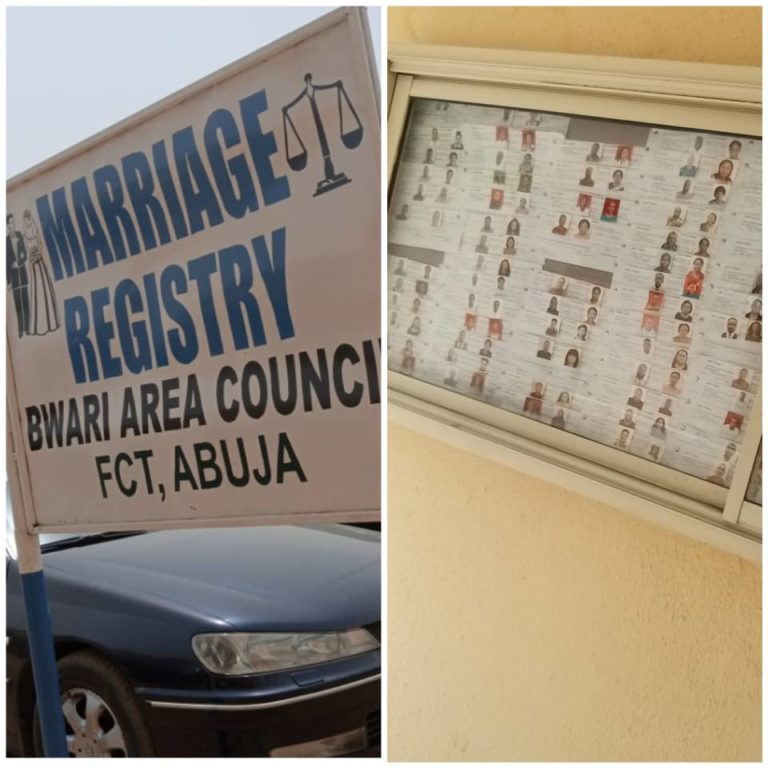
Printed requirements at Buwari marriage registry
Finally, he provided his First Bank private banking details; Abbah Benjamin, Account number: 3050028920 through which the payment can be facilitated with a promise to help the ‘bride’ create a folder.
The Federal Capital Territory is made up of six Area Councils, each has a statutory licencing registry bound by the Nigerian marriage laws.
For an ordinary marriage statutory licensing which is between indigenous Nigerians, the official cost is N15,000 ($38.9735) while the official cost to obtain a special marriage certificate is N25,000 ($64.9563). A special marriage is one between a Nigerian and a foreigner.
But registries within the state capital flouts provisions of these laws.
Abuja registry where you can marry a ghost
The concept of ghost marriages associated with the unification of a living person to a dead party although practised by a few cultures in the world is not legally recognised by the Nigerian constitution.
However, for the right price, as impossible as the thought of getting hitched to a ghost may seem, it can be done in this small marriage registry in Bwari Area Council Abuja.
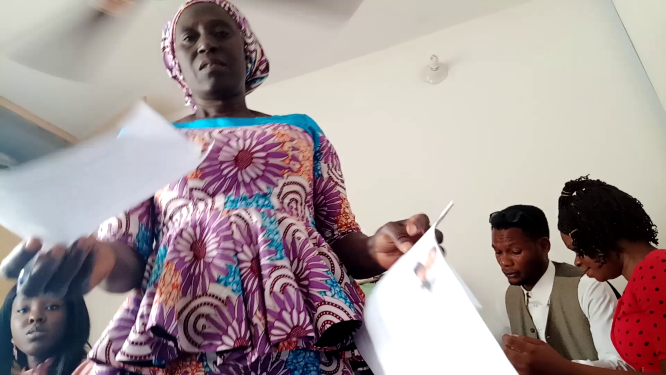
After the exchange of pleasantries, the registrar who introduced himself as Mohammed—later identified by an identity call App as Madaki Dahiru Mohammed— handed out a laminated sheet of marriage requirements to his new client.
Madaki Dahiru Mohammed, Registrar Bwari Area council. Credit – Jennifer Ugwa
“Just go through it. I am coming to attend to you and explain anything you don’t understand,” he said.
This was a few seconds before he dashed off to the adjoining office.
Mohammed was at the present more interested in purchasing new sets of footwears from the shoe vendor in the next room.
According to this new set of requirements, and N16,000 fee, excluding one carton of Maltina drink (with an option to monetising at N3,000), N1,000 for four copies of photographs by the in-house photographer and other personal documents, any marriage can be legalised within 21 working days.
“The 21 days starts from the day you registered, but anything less than this will attract an extra charge of N10,000,” Mohammed explained.
This price is, however, not inclusive of an additional N 10,000 if a couple opts for a weekend solemnisation.
Meanwhile, neglecting his former directives about the appearance of both the groom and bride on a fixed date, Mohammed would quickly suggest a ghost marriage between her ‘supposed based’ Switzerland husband.
“If he can’t come back by then, we can do a ghost marriage. It means we didn’t see the husband.
“But you will pay more. That one will cost you N50,000($ 129.916).”
“We do that. “We call it ghost marriage. It is just that it is more costly that’s all,” the registrar said.
Nonetheless, under section 44 of the Nigerian Marriage Act, the impersonation of any person in a marriage or under a false name or description, with intent to deceive other parties to the marriage, is an offence liable to five years imprisonment.
It was however unclear if the registrar was going to arrange for a fake husband to represent the absentee groom.
In order not to break any law contained in this act, the investigation was halted at this point.
Just as will be expected, payment was to be transacted on a one on one basis with no intermediary apart from the registrar.
“All you need to do is to sign where necessary and you can scan it (certificate) to him over there and he signs. He can use it to do whatever he wants over there,” Mohammed said.
Splashed across the wooden mauve-cushioned notice board in the small office was pictures of married couples.
He took great pride in showing off several interracial marriages the registry had officiated in the past months.
“This woman’s husband is not a Nigerian I think he is a contractor here in Nigeria and they just had the marriage done here not long ago.”
Despite Mohammed’s success in conducting foreign marriages, it is worthy to note that presiding over a statutory licencing of a ghost marriage is in contravention of section 42 of the Marriage Act.
“Whoever performs or witnesses as a marriage officer the ceremony of marriage, knowing that he is not duly qualified so to do.
“Or that any of the matters required by law for the ceremony, the validity of such marriage has not happened or been performed, so that
the marriage is void or unlawful on any ground, shall be liable to imprisonment for five years.”
Barrister Bridget Edokwe, Editor in Chief BarristerNg, a law-focused online publication during an interview with this journalist said there is ‘no place’ for ghost marriage in the Nigerian constitution.
Edokwe said the practice of this act in whatever form is a sharp practice that contravenes the Nigerian Matrimonial Cause Act.
“Normally a marriage is done when the two parties involved are present. So, whatever they (registries) are doing separate from that is a side run and they cannot publicly declare this.
“It is illegal,” she said vehemently.
Edokwe also affirmed that it has been observed that in some instances, registrars in connivance with the couples present a family member who takes the place of an absentee husband.
The abroad fever enabling sham marriage
Although Benjamin’s opportunity to extort extra fees in Kuje was ruined by the late revelation on the residency of his client’s beau abroad, he was benevolent enough to advise against divulging such information to a senior official.
“Don’t let my madam hear that or you will pay more. Maybe if you had told me earlier I would have collected more money from you,” he warned.
The clamour for foreign-based clients or couples with spouse resident abroad has created a high inclination to be of service to these groups and/or individuals at registries.
And this stratagem assistance does not come without heavy monetary requirements from officials.
Fuelling the need for sham marriages is also the craze for obtaining residential visas abroad by deceptive individuals who conspire with illegal marriage arrangement agencies in Nigeria as a primary avenue of gaining entrance into foreign countries.
Based on data obtained from Abuja Municipal marriage registry, almost 13,000 marriages from 2015- 2019 have been awarded statutory licences in the FCT alone.
Unfortunately, of this number, it would be impossible to ascertain the exact number of marriages that have been solemnised under false identities with ghost representatives.
Except for instances where foreign emissaries visit marriage registries to confirm the legalisation of unions, thorough checks are not (or rarely) done by the Nigerian counterparts to verify individual claims of marriage.
This dismal oversight Barr. Edokwe said has become an injurious action on individual and societal morals.
“It is a personal decision that people make but someone else can have a different opinion about it but it doesn’t make it right,” she said.
Federal Marriage Registry—Maximum cashouts
Marriage registries are domiciled under the Ministry of Interior and overseen by the same agency with the Federal Marriage registry situated in the city capital, Abuja.
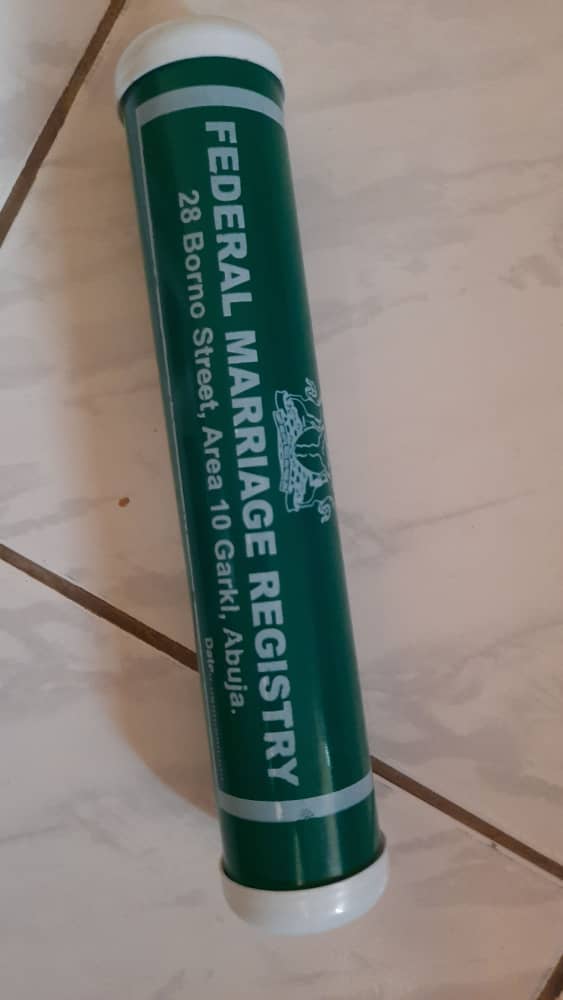
Federal Marriage Registry, Abuja. Photo credit – Jennifer Ugwa
Contrary to the official fees for statutory licencing as published on its website, the cost of marriage solemnisation within the FCT varies across the four visited registries.
And the Federal Marriage Registry is no different.
Ladi, a tall dark-skinned lady probably in her late 5o’s is the frontline official in this registry.
Any questions, inquiries and verifications will first be presented at her desk.
Although she answers to a higher authority, all the action goes down in the small office she occupies in the one-story building that houses the registry in Area 10 Garki.
Ladi, Assistant@ Federal Marriage Registry. Credit – Jennifer Ugwa
As is the protocol now, Ladi is ready with copies of printed marriage requirements cut into smaller sheets that are given to couples upon arrival to the registry.
For an ordinary marriage, and public notice of 21 days, N34,000 is the fee. Meanwhile, for less than that at seven days notification, it will cost N48,000.
With patronage of richer clientele, this particular registrar is busier than the others visited by the reporter.
Marriages are legalised three times within the week— on Tuesdays, Thursdays and Saturdays.
And payments are received by the official. The existence of a registration portal is never mentioned to couples, neither is there any information indicative of a self-help process.
Hence, Joseph Osuigwe, 35, a child rights activist was taken aback when he was informed by an official at the Abuja Municipal marriage registry that it would cost him N27,000 to legalise his marriage.
Instead of N21,000 as indicated on the official website of the Ministry of Interior, he is about to pay more despite what he knew.
“When I insisted on printing out the Remita myself and paying directly at the bank, it still didn’t change much,” the activist said.
“Because I was still asked to pay an additional fee for processing and for the scroll that the marriage certificate would be issued in!” Osuigwe narrated, obviously still upset from the dilation of his voice.
Certificate scroll sold at Abuja Municipal Marriage Registry. Photo credit_Joseph Osuigwe
Osuigwe said his knowledge of the existence of such a portal came as a surprise to the officials who he claimed tried to stop him from divulging this information to other applicants.
“If people know the actual amount, that would mean bad business for them. But I still told anyone who would listen,” he said.
The citizen… portal, enables couples intending to legalise their union facilitate registration and payment online.
But disappointedly, all registrars encountered by this journalist displayed crass ignorance about the existence of such a platform.
Although public notification of marriages in different states of the federation is updated on the website, most certifications do not satisfy the 21- 28 days notice.
Diamond in the dirt
Gwagwalada area council marriage registry is just an hour and a few minutes drive from the city centre.
Gwagwalada Marriage Registry requirements.
Gwagwalada Marriage Registry, Abuja. Photo credit – Jennifer Ugwa
Form A marriage registration booklet.
On this Wednesday morning, it seemed the prerogative was to devour hot plates of ‘Amala’ (a local cuisine made from yam flour) before business.
But this victual self-assigned objective proved to be no hindrance to service delivery.
Save for the mandatory provision of a cartoon of malt beverage and two black biros, marriage legalisation under a 21-day public notice is N15,500.
Although Mr Ibro, a registry official, was informed by the reporter that her spouse was not in the country, neither Ibro nor any of the other officials made any other extra demand.
Besides, the official warned that the legalisation process will not take place if all the parties involved were not present.
“Open your file, come with your ring or Bible on the date that’s all,” Ibro said.
New marching order, wrong soldiers
Although the ecitibiz portal on the Min. Of Interior’s website exists, only a handful of person’s like Oseigwe is aware of the portal.
The existence of such a website is not publicized rather, individual registrar advertise the statutory licencing offices that they oversee.
It is no wonder that despite a new directive by the Ministry of Interior on July 1, which reduced the statutory marriage fee to N15,000 and N25,000 for ordinary and special licencing, from the initial fees of N21,000 and N30,000 respectively, registries are still extorting couples months after.
Like in the case of Kuje registry, instead of N20,500 fee for ordinary licencing he had earlier billed this reporter, Benjamin said hiked the fee by a thousand nairas.
He refused to confirm if there has been any monetary change since the last visit.
His cryptic response was “until you come to the office”.
Kuje is not the only registry that is defaulting as of September, ghost marriages could still be facilitated in Bwari.
“For an Express certificate, it is still N30,000 but your case is under the ghost category and that is N50,000,” Mohammed reasserted over the phone.
He told The ICIR that an arrangement can be made to have the ‘supposed husband’ signature emailed and attached to the license.
Gloria Okwu, programme officer at Civil Society Legislative Advocacy Center,(CISLAC) in an interview with this reporter said that the ineffectiveness of reforms often pulsates from the absence of proper governance structures.
“Our problem is not the absence or shortage of laws and directives, it is the domestication of such laws.
“There is no implementation plan. Unfortunately, this is now common. There are zero monitoring agencies,” she said.
Okwu noted that the impunity culture in the Nigerian system of government does not make room for accurate checks and balances.
“Because people don’t know their rights, corrupt government officials can exploit them and get away with it”.
Also, she bemoaned the absence of public orientation on crucial matters affecting the citizens.
A development which Okwu said is borne out of the dismal attitude of agencies charged with such duties.
“Instead, you find that it is now the media and Non- Governmental Organisation that are doing their job for them. The excuse is always the same; lack of funding.
“The National Orientation Agency is more or less a moribund agency and is doing next to nothing,” she said.
Although a 2008 report by the Service Compact with all Nigerian, (SERVICOM) revealed incompetencies and irregularities at the Nigerian marriage registries.
Twelve years later, corruption and unprofessionalism still is the ethos that impedes the legal framework of the marriage registry system.
This story was supported by The International Center for Investigative Reporting (ICIR).



 Documents presented to the court also claim that the property at No 93, Yakubu Gowon Crescent, Asokoro was originally owned by one Lawal Ahmed who “donated” it to Ndume in 2018. But it was learnt that the property is owned by the federal government, having been forfeited to it by its previous owner. It could not be ascertained why the federal government took over the property but our reporter confirmed that the property has been handed over to the Fiscal Responsibility Commission for its use as office.