THE Nigerian Centre for Disease Control (NCDC) said it had launched a network of COVID-19 survivors to further help in sensitizing Nigerians on the reality of the pandemic.
Head of Risk Communication of the Centre, Dr Yahaya Disu, disclosed this in Abuja on Saturday, while addressing journalists.
The Minister of Health, Dr Osagie Ehanire was absent at the meeting.
Meanwhile, number of daily confirmed cases of infection continue to increase, as Nigeria recorded 310 new cases, according to data released by the NCDC, bringing total cases of the disease in the country to 68,937 and 1180 fatalities, since the country recorded its first case on February 27, 2020.
Of the confirmed cases, 64,650 patients have been discharged, leaving 4,287 active cases of the virus across the country.
FCT led Saturday’s cases with 128, followed by Lagos, 86; Kaduna, 26; and Katsina, 20.
Others are Rivers, 19; Oyo 7; Benue, 5; Edo, 5; Jigawa, 5; Ogun 5; Bayelsa, 2 and Kano 2.
The country recorded one death from the disease on Saturday.
Addressing participants at the 4th Annual Health Conference of Association of Nigeria Health Journalists (ANHEJ), with the theme: COVID-19 Reportage Assessment,” Disu said a major factor confronting the containment of the disease in the country was doubt among the people.
The attitude, he said, was a major reason people flout the guidelines set by the government such as use of face mask, regular hand-washing and social distancing, so the disease could be contained.
“We have just set up the network of survivors now in the country. We have registered them. Maybe, when they start talking, their voice will be louder,” Disu said.
He cautioned that there is no need for people to doubt the existence of the virus because high fatalities are being recorded in many countries around the world.
Disu said of the level of doubt over the disease in Nigeria: “In another clime, you just give information, people would take it. In another clime, people want to see evidence. They want to see people dying. I saw one man on TV saying until he sees 30 people dying around him, he would not believe COVID-19 is real. Who does he know the 30 people would be? Would they be his daughter or wife,? he queried.
He attributed the doubt largely to less severity of the disease and fatality recorded from it over the past eight months that the nation recorded its first case of the killer virus.
He said even when people see evidence around them, they would still say it’s not COVID-19 but malaria.
“Until somebody experiences it; do we get to that level? How many cases do we have in Nigeria? It’s still less than 70,000. What is our population? 200 million. If you look at that – ratio 70,000 to 200 million, that will give you like ratio one to, maybe, 5000.
“That means for you to see the next person that will be infected, you have to count 5000 persons. So, you’re not likely to see people who are infected. Most of the people who are infected are asymptomatic. For you to believe this person has it, you must see the symptoms. So, the figures you’re even seeing include asymptomatic people. The reality is that they may not see; it is those who are affected that know the truth and will tell you this is real,” he stated.
He added that the youthful population that the country parades had been key in low confirmed cases and fatalities from the virus.
He however urged people in the country to consider the aged and those with underlying diseases such as hypertension and diabetes that could be easily killed by the virus, if they contract it.
At midnight Saturday, Nigeria had 68,937 confirmed COVID-19 cases, 64,650 discharged patients and 1,180 deaths.
Lagos state topped the list with 22,648 confirmed cases, 21,119 discharged patients and 220 deaths.
The Federal Capital Territory (FCT) came second with 6,513 cases, 5,934 treated and discharged persons with 82 deaths.
Imo state had the least cases and mortality from the disease, as it recorded 648, 613 and 12 confirmed cases, discharged patients and deaths respectively.
Globally, there was 66.7 million cases, 46.1 million recoveries and 1.52 million deaths at the time of filing this report.
The US leads the chart with 14.4 million cases and 279,000 deaths.
Some prominent Nigerians who died of the pandemic include former Chief of Staff to President Muhammadu Buhari, Abba Kyari; former governor of Oyo State, Abiola Ajimobi; and Dr Wahab Adegbenro, a serving commissioner of health in Ondo state who died of the ailment.
A new report by Citizen Lab has shown that the Nigerian government purchased surveillance equipment to spy on the mobile calls and short message service (SMS) of Nigerians.
The Citizen Lab is an interdisciplinary laboratory based at the Munk School of Global Affairs & Public Policy, University of Toronto, focusing on research, development, and high-level strategic policy and legal engagement at the intersection of information and communication technologies, human rights, and global security.
It investigates digital espionage against civil society, documents internet filtering and other technologies and practices that impact freedom of expression online, analyzes privacy, security, and information controls of popular applications, and examines transparency and accountability mechanisms relevant to the relationship between corporations and state agencies regarding personal data and other surveillance activities.
In the report, titled “Running in Circles: Uncovering the Clients of Cyberespionage Firm Circles,” the Nigeria Defence Intelligence Agency (DIA) and other unspecified entity in Nigeria had acquired the equipment from Circles, a cybersecurity company founded by an Israeli with affiliation with the NSO groups to exploit flaws in telecommunications systems and to access calls, SMS and location services.
“Our scanning identified two Circles systems in Nigeria. One system may be operated by the same entity as one of the Nigerian customers of the FinFisher spyware that we detected in December 2014.
“The firewall IPs are in the same /27 as the IP address of the FinFisher C&C server we detected in our 2014 scans (41.242.50.50). The other client appears to be the Nigerian Defence Intelligence Agency (DIA), as its firewall IPs are in AS37258, a block of IP addresses registered to “HQ Defence Intelligence Agency Asokoro, Nigeria, Abuja.”
In 2016, Premium Times had reported that two former Nigerian governors of Bayelsa and Delta states, purchased systems from Circles to spy on their political opponents. In Delta State, Premium Times reports that the system was installed at the “governor’s lodge,” and operated by employees of the governor, rather than police.
In Bayelsa State, the governor reportedly used the Circles system to spy on his opponent in an election, as well as his opponent’s wife and aides. The investigation also found that the two Circles systems were imported without the proper authorizations from Nigeria’s Office of the National Security Adviser.
The report added that members of civil society in Nigeria face a wide range of digital threats.
A recent report by Front Line Defenders concluded that Nigeria’s government “has conducted mass surveillance of citizens’ telecommunications.” The Committee to Protect Journalists (CPJ) has also reported multiple cases of the Nigerian government abusing phone surveillance.
The Nigerian government in recent times has renewed its effort to control and gang the social media on the pretense that it wants to fight the spread of fake news.
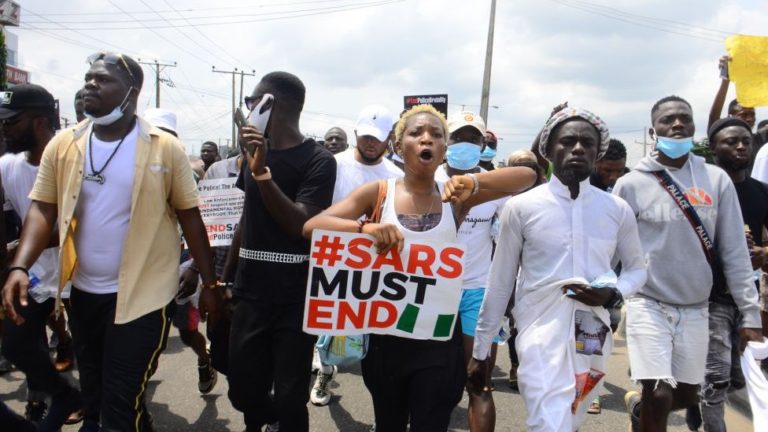
Irked by the #ENDSARS protest, the Nigerian government has launched a deadly state security crackdown on the campaigners of the protest by freezing their accounts and arresting them on trumped up charges.
DESPITE various accounts of victims, Tukur Buratai, the Chief of Army Staff has insisted that there was ‘no single corpse’ at the Lekki toll gate shooting on Tuesday, October 20, during the ENDSARS protests in Nigeria.
Buratai said this on Friday during the decoration of 39 newly promoted major generals in Abuja.
According to the Chief of Staff, there was no single corpse due to a spiritual warfare seminar organized by the Nigerian Army.
“I must say that the Spiritual Warfare Seminar we had last time helped us during the last #EndSARS protests to the extent that there was no single corpse, but some persons were seeing double at Lekki toll gate in Lagos State,” said Buratai.
He added that the Nigeria Army would continue to protect Nigerians in accordance with the ‘rules of engagement’.
“We will continue to protect every law-abiding Nigerian anywhere in the country and we will do that in accordance with the rules of engagement and confines of the constitution,” he added.
Contrary to Buratai’s claim, men of the Nigerian Army fired shots at peaceful protesters at Lekki toll gate in Lagos state during the ENDSARS protests.
Initially, the Army denied its presence at the scene before it was confirmed by Babajide Sanwo-Olu, the governor of Lagos state.
A few days after, the Nigerian Army said its operatives were at the scene but only fired blank bullets at the peaceful protesters.
However, the claimed ‘blank bullet’ has taken the lives of some, got some amputated and others gravely injured with bullet wounds, according to eyewitnesses at the scene and other video recordings.
An investigation by the Cable News Network, bullets casings found at the scene were confirmed by current and former Nigerian military sources that the bullet casings match those used by the army.
The CNN also said two ballistics experts confirmed that the shape of the bullet casings indicate they used live rounds, which contradicts the army’s claim that blank bullets were fired.
Lekki shooting victims appear before Judicial panel
On Friday, a counsel to victims of police brutality, Adesina Ogunlana, presented some victims of the October 20 shooting to the Lagos State Judicial Panel.
Edwin Augustine, one of the presented victims told the panel that a bullet pierced his thigh on the night of the shooting at the Lekki tollgate.
“I was shot on October 20 at the Lekki tollgate. I didn’t see who shot me. I was at the snooker board. I heard gunshots. The first one was in the air. The second was direct to people. I wanted to follow someone to the charging spot to collect my phone, but he was shot right beside his heart.
“Immediately he fell, I tried to turn and check what was wrong and I received mine (shot) on my thigh. I fell and I was there unconscious. When I woke up the next day, I saw myself at the hospital,” Augustine narrated.
Nathaniel Solomon, another victim at the panel, presented a picture of his late brother, Abouta, who was allegedly shot and killed during the shooting at the toll gate.
He said the remains of his brother was recovered from the Lekki Tollgate the same night the shooting occurred.
“I didn’t know when my brother left home for the tollgate. He never told me he was going there. He was living with me here in Lekki, at Marwa.
“Some boys called me. By then, my phone battery was flat, the phone had gone off. They called one of our brothers and told him that Abouta had been killed. So, we went there, found him on the grass, picked up his corpse and we went to St Paul’s Mortuary at Oyingbo.
“His corpse was at the Lekki tollgate. There were protesters around at the time. He was laid on the grass that was growing on the road divider in the middle of the road, that night when we took my brother’s corpse, we saw other people who had been shot, about four of them, on the ground. They were all dead,” said Solomon.
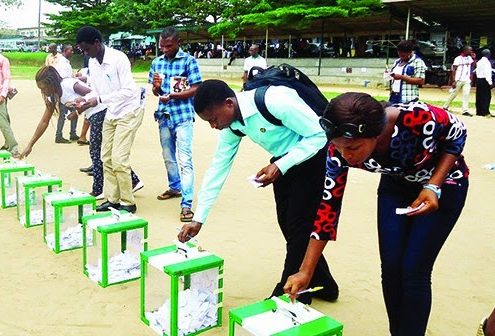
BYE-elections are being held in 11 Nigerian states including Lagos and Bayelsa to fill vacant seats in the State Assemblies, House of Representatives and Senate arm of the National Assembly.
According to information gathered from the Twitter handle of the Independent Electoral Commission (INEC), other states where bye-elections are being held include, Imo, Cross Rivers, Plateau, Kogi, Enugu, Bauchi, Borno, Katsina and Zamfara states.
In Lagos state, elections are being held in Kosofe II State House of Assembly and the Lagos East Senatorial District By-Election.
The Bye elections are also being held in Bayelsa West Senatorial District Bye-election, Bayelsa Central Senatorial District Bye-election, Plateau South Senatorial District Bye-election, Imo North Senatorial District Bye-election, Cross River North Senatorial District Bye-election, Dass State Constituency (Bauchi State), Isi-Uzo State House of Assembly Bye-election (Enugu State).
Others include Ibaji State House of Assembly Bye-election (Kogi State), Nganzai State House of Assembly Bye-election (Bornu State), Obudu State House of Assembly Bye-election (Cross River State), Bayo State House of Assembly Bye-election (Bornu State) and Bakori State House of Assembly Bye-election (Katsina State).
However, The ICIR observed that COVID-19 protocols are not being adhered to in some polling units across the states.
In Kolokuma/Opokuma Local Government Area, Central Senatorial District, some voters were seen voting without the use of face masks.
The same practice was seen in Shomolu Local Government Area in Lagos State.
Apart from voters and INEC officials, security officers of the Nigeria Police Force and the Nigeria Security and Civil Defence Corps (NSCDC) also failed to use facemasks in Yenagoa Local Government Area, Bayelsa State.
In this report, Jennifer UGWA went undercover as an intending bride in need of a statutory marriage license to expose sharp and corrupt practices of marriage registrars and officials appointed by the Federal Ministry of Interior within the FCT.
The inconspicuous sign stringed to the low- fenced wall on the dusty road only read: Marriage Registry, Kuje Area Council, Town Hall.
A flat white iron board– was the only indication of the presence of a registry as an arrow was pointing in the opposite direction away from the Women Development Centre.
On this hot Wednesday afternoon, Abah Benjamin, office assistant to the registrar sat bent over notes scattered on an old wooden desk in the reception.
Benjamin Abah, Assistant registrar, Kuje. Credit Jennifer Ugwa1
As the sound of approaching footsteps got closer, Benjamin stopped writing and attended to the visitor.
Tits for Tats
Among the scattered sheets of paper on Benjamin’s clustered table is a pamphlet advertising a ‘Now and Forever’ union in Kuje registry.
“Good afternoon. How may I help you?” Benjamin greeted.
Upon this reporter’s revelation that she was there to legalise her marriage, the assistant proceeded to give her a download of how much her quest will cost.
Benjamin explained that for N20,500( Twenty thousand five hundred naira) ($53.2645) which can be paid in installments, the marriage can be certified within 21 workdays.
However, despite the favourable fees which were below the official sum of N21,000, as of March, the officials had found a loophole to squeeze out more cash from couples.
Since Saturdays are often a free day from work and business engagements for most people, ceremonial activities are also slated for the weekends.
Nevertheless, if a solemnisation is to take place in this registry on such days, “You have to pay an additional fee of N10,000,” Benjamin disclosed.
“We are civil servants, officially we don’t work on weekends. So you have to pay. But feel free to choose any other day,” he said.
The foreknowledge that intending couples prefer a weekend wedding is the axe registrars wield to their advantage.
And this additional payment is not going to be receipted. It is for private pockets.
Meanwhile, on the list of requirements was also a request for a carton of malt drink which the assistant said was as mandatory as the provision of an affidavit.
“You can monetise the cartoon of malt if you don’t want to carry anything,” Benjamin said.
“Don’t you know how much a carton of Malt is? You can find out,” added the assistant upon his clients’ inquiry on how much it would cost her.
Based on his explanations, it was certain the marriage won’t hold if the soft drink was not provided.
Benjamin would later suggest an urgent marriage certification for N30,000 ($77.9470) instant payment which could be awarded within 24hours or less.
This could be done in contravention of the provision of the Marriage Act that allows for 21-28 days public notification of such unions.
Yet, this new arrangement will not exclude the carton of malt and two pens.
When Benjamin was asked for the registry’s banking details to facilitate deposits he claimed there was none just as he would also claim there was no official website for the agency.
Marriage requirements @Federal Marriage Registry
Marriage requirements@Kuje Marriage Registry.
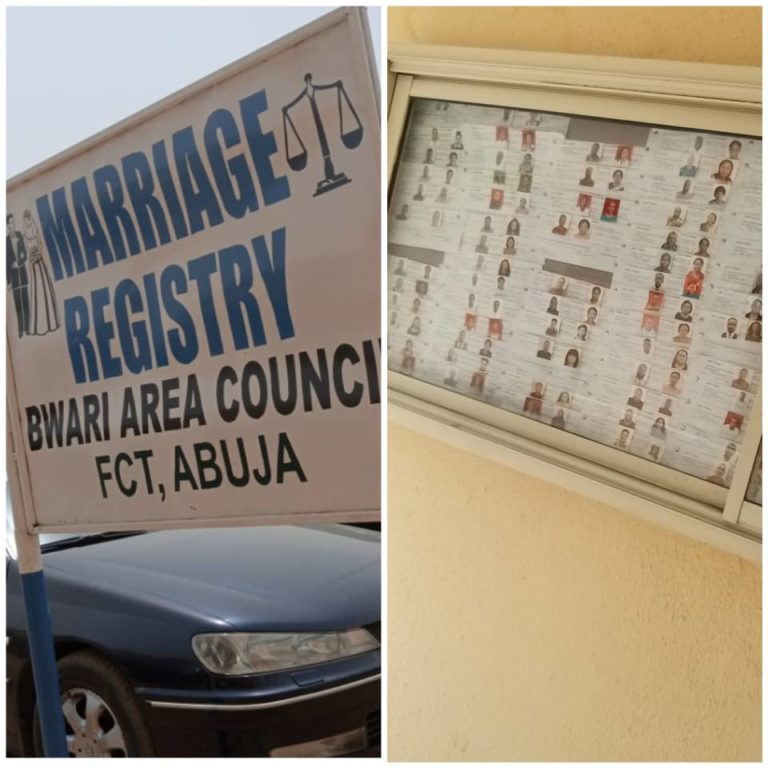
Printed requirements at Buwari marriage registry
Finally, he provided his First Bank private banking details; Abbah Benjamin, Account number: 3050028920 through which the payment can be facilitated with a promise to help the ‘bride’ create a folder.
The Federal Capital Territory is made up of six Area Councils, each has a statutory licencing registry bound by the Nigerian marriage laws.
For an ordinary marriage statutory licensing which is between indigenous Nigerians, the official cost is N15,000 ($38.9735) while the official cost to obtain a special marriage certificate is N25,000 ($64.9563). A special marriage is one between a Nigerian and a foreigner.
But registries within the state capital flouts provisions of these laws.
Abuja registry where you can marry a ghost
The concept of ghost marriages associated with the unification of a living person to a dead party although practised by a few cultures in the world is not legally recognised by the Nigerian constitution.
However, for the right price, as impossible as the thought of getting hitched to a ghost may seem, it can be done in this small marriage registry in Bwari Area Council Abuja.
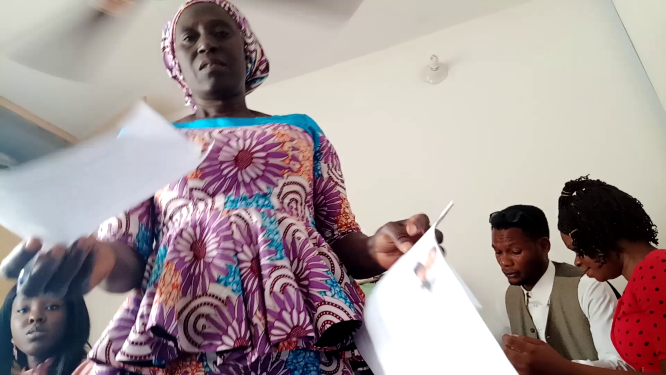
After the exchange of pleasantries, the registrar who introduced himself as Mohammed—later identified by an identity call App as Madaki Dahiru Mohammed— handed out a laminated sheet of marriage requirements to his new client.
Madaki Dahiru Mohammed, Registrar Bwari Area council. Credit – Jennifer Ugwa
“Just go through it. I am coming to attend to you and explain anything you don’t understand,” he said.
This was a few seconds before he dashed off to the adjoining office.
Mohammed was at the present more interested in purchasing new sets of footwears from the shoe vendor in the next room.
According to this new set of requirements, and N16,000 fee, excluding one carton of Maltina drink (with an option to monetising at N3,000), N1,000 for four copies of photographs by the in-house photographer and other personal documents, any marriage can be legalised within 21 working days.
“The 21 days starts from the day you registered, but anything less than this will attract an extra charge of N10,000,” Mohammed explained.
This price is, however, not inclusive of an additional N 10,000 if a couple opts for a weekend solemnisation.
Meanwhile, neglecting his former directives about the appearance of both the groom and bride on a fixed date, Mohammed would quickly suggest a ghost marriage between her ‘supposed based’ Switzerland husband.
“If he can’t come back by then, we can do a ghost marriage. It means we didn’t see the husband.
“But you will pay more. That one will cost you N50,000($ 129.916).”
“We do that. “We call it ghost marriage. It is just that it is more costly that’s all,” the registrar said.
Nonetheless, under section 44 of the Nigerian Marriage Act, the impersonation of any person in a marriage or under a false name or description, with intent to deceive other parties to the marriage, is an offence liable to five years imprisonment.
It was however unclear if the registrar was going to arrange for a fake husband to represent the absentee groom.
In order not to break any law contained in this act, the investigation was halted at this point.
Just as will be expected, payment was to be transacted on a one on one basis with no intermediary apart from the registrar.
“All you need to do is to sign where necessary and you can scan it (certificate) to him over there and he signs. He can use it to do whatever he wants over there,” Mohammed said.
Splashed across the wooden mauve-cushioned notice board in the small office was pictures of married couples.
He took great pride in showing off several interracial marriages the registry had officiated in the past months.
“This woman’s husband is not a Nigerian I think he is a contractor here in Nigeria and they just had the marriage done here not long ago.”
Despite Mohammed’s success in conducting foreign marriages, it is worthy to note that presiding over a statutory licencing of a ghost marriage is in contravention of section 42 of the Marriage Act.
“Whoever performs or witnesses as a marriage officer the ceremony of marriage, knowing that he is not duly qualified so to do.
“Or that any of the matters required by law for the ceremony, the validity of such marriage has not happened or been performed, so that
the marriage is void or unlawful on any ground, shall be liable to imprisonment for five years.”
Barrister Bridget Edokwe, Editor in Chief BarristerNg, a law-focused online publication during an interview with this journalist said there is ‘no place’ for ghost marriage in the Nigerian constitution.
Edokwe said the practice of this act in whatever form is a sharp practice that contravenes the Nigerian Matrimonial Cause Act.
“Normally a marriage is done when the two parties involved are present. So, whatever they (registries) are doing separate from that is a side run and they cannot publicly declare this.
“It is illegal,” she said vehemently.
Edokwe also affirmed that it has been observed that in some instances, registrars in connivance with the couples present a family member who takes the place of an absentee husband.
The abroad fever enabling sham marriage
Although Benjamin’s opportunity to extort extra fees in Kuje was ruined by the late revelation on the residency of his client’s beau abroad, he was benevolent enough to advise against divulging such information to a senior official.
“Don’t let my madam hear that or you will pay more. Maybe if you had told me earlier I would have collected more money from you,” he warned.
The clamour for foreign-based clients or couples with spouse resident abroad has created a high inclination to be of service to these groups and/or individuals at registries.
And this stratagem assistance does not come without heavy monetary requirements from officials.
Fuelling the need for sham marriages is also the craze for obtaining residential visas abroad by deceptive individuals who conspire with illegal marriage arrangement agencies in Nigeria as a primary avenue of gaining entrance into foreign countries.
Based on data obtained from Abuja Municipal marriage registry, almost 13,000 marriages from 2015- 2019 have been awarded statutory licences in the FCT alone.
Unfortunately, of this number, it would be impossible to ascertain the exact number of marriages that have been solemnised under false identities with ghost representatives.
Except for instances where foreign emissaries visit marriage registries to confirm the legalisation of unions, thorough checks are not (or rarely) done by the Nigerian counterparts to verify individual claims of marriage.
This dismal oversight Barr. Edokwe said has become an injurious action on individual and societal morals.
“It is a personal decision that people make but someone else can have a different opinion about it but it doesn’t make it right,” she said.
Federal Marriage Registry—Maximum cashouts
Marriage registries are domiciled under the Ministry of Interior and overseen by the same agency with the Federal Marriage registry situated in the city capital, Abuja.
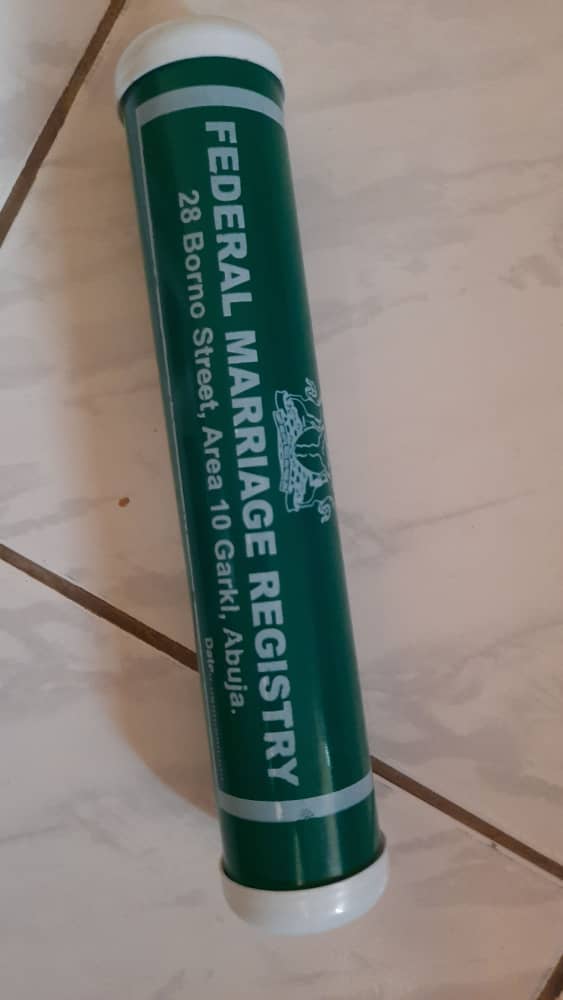
Federal Marriage Registry, Abuja. Photo credit – Jennifer Ugwa
Contrary to the official fees for statutory licencing as published on its website, the cost of marriage solemnisation within the FCT varies across the four visited registries.
And the Federal Marriage Registry is no different.
Ladi, a tall dark-skinned lady probably in her late 5o’s is the frontline official in this registry.
Any questions, inquiries and verifications will first be presented at her desk.
Although she answers to a higher authority, all the action goes down in the small office she occupies in the one-story building that houses the registry in Area 10 Garki.
Ladi, Assistant@ Federal Marriage Registry. Credit – Jennifer Ugwa
As is the protocol now, Ladi is ready with copies of printed marriage requirements cut into smaller sheets that are given to couples upon arrival to the registry.
For an ordinary marriage, and public notice of 21 days, N34,000 is the fee. Meanwhile, for less than that at seven days notification, it will cost N48,000.
With patronage of richer clientele, this particular registrar is busier than the others visited by the reporter.
Marriages are legalised three times within the week— on Tuesdays, Thursdays and Saturdays.
And payments are received by the official. The existence of a registration portal is never mentioned to couples, neither is there any information indicative of a self-help process.
Hence, Joseph Osuigwe, 35, a child rights activist was taken aback when he was informed by an official at the Abuja Municipal marriage registry that it would cost him N27,000 to legalise his marriage.
Instead of N21,000 as indicated on the official website of the Ministry of Interior, he is about to pay more despite what he knew.
“When I insisted on printing out the Remita myself and paying directly at the bank, it still didn’t change much,” the activist said.
“Because I was still asked to pay an additional fee for processing and for the scroll that the marriage certificate would be issued in!” Osuigwe narrated, obviously still upset from the dilation of his voice.
Certificate scroll sold at Abuja Municipal Marriage Registry. Photo credit_Joseph Osuigwe
Osuigwe said his knowledge of the existence of such a portal came as a surprise to the officials who he claimed tried to stop him from divulging this information to other applicants.
“If people know the actual amount, that would mean bad business for them. But I still told anyone who would listen,” he said.
The citizen… portal, enables couples intending to legalise their union facilitate registration and payment online.
But disappointedly, all registrars encountered by this journalist displayed crass ignorance about the existence of such a platform.
Although public notification of marriages in different states of the federation is updated on the website, most certifications do not satisfy the 21- 28 days notice.
Diamond in the dirt
Gwagwalada area council marriage registry is just an hour and a few minutes drive from the city centre.
Gwagwalada Marriage Registry requirements.
Gwagwalada Marriage Registry, Abuja. Photo credit – Jennifer Ugwa
Form A marriage registration booklet.
On this Wednesday morning, it seemed the prerogative was to devour hot plates of ‘Amala’ (a local cuisine made from yam flour) before business.
But this victual self-assigned objective proved to be no hindrance to service delivery.
Save for the mandatory provision of a cartoon of malt beverage and two black biros, marriage legalisation under a 21-day public notice is N15,500.
Although Mr Ibro, a registry official, was informed by the reporter that her spouse was not in the country, neither Ibro nor any of the other officials made any other extra demand.
Besides, the official warned that the legalisation process will not take place if all the parties involved were not present.
“Open your file, come with your ring or Bible on the date that’s all,” Ibro said.
New marching order, wrong soldiers
Although the ecitibiz portal on the Min. Of Interior’s website exists, only a handful of person’s like Oseigwe is aware of the portal.
The existence of such a website is not publicized rather, individual registrar advertise the statutory licencing offices that they oversee.
It is no wonder that despite a new directive by the Ministry of Interior on July 1, which reduced the statutory marriage fee to N15,000 and N25,000 for ordinary and special licencing, from the initial fees of N21,000 and N30,000 respectively, registries are still extorting couples months after.
Like in the case of Kuje registry, instead of N20,500 fee for ordinary licencing he had earlier billed this reporter, Benjamin said hiked the fee by a thousand nairas.
He refused to confirm if there has been any monetary change since the last visit.
His cryptic response was “until you come to the office”.
Kuje is not the only registry that is defaulting as of September, ghost marriages could still be facilitated in Bwari.
“For an Express certificate, it is still N30,000 but your case is under the ghost category and that is N50,000,” Mohammed reasserted over the phone.
He told The ICIR that an arrangement can be made to have the ‘supposed husband’ signature emailed and attached to the license.
Gloria Okwu, programme officer at Civil Society Legislative Advocacy Center,(CISLAC) in an interview with this reporter said that the ineffectiveness of reforms often pulsates from the absence of proper governance structures.
“Our problem is not the absence or shortage of laws and directives, it is the domestication of such laws.
“There is no implementation plan. Unfortunately, this is now common. There are zero monitoring agencies,” she said.
Okwu noted that the impunity culture in the Nigerian system of government does not make room for accurate checks and balances.
“Because people don’t know their rights, corrupt government officials can exploit them and get away with it”.
Also, she bemoaned the absence of public orientation on crucial matters affecting the citizens.
A development which Okwu said is borne out of the dismal attitude of agencies charged with such duties.
“Instead, you find that it is now the media and Non- Governmental Organisation that are doing their job for them. The excuse is always the same; lack of funding.
“The National Orientation Agency is more or less a moribund agency and is doing next to nothing,” she said.
Although a 2008 report by the Service Compact with all Nigerian, (SERVICOM) revealed incompetencies and irregularities at the Nigerian marriage registries.
Twelve years later, corruption and unprofessionalism still is the ethos that impedes the legal framework of the marriage registry system.
This story was supported by The International Center for Investigative Reporting (ICIR).
NIGERIA and other developing nations may face scarcity of tools needed to fight COVID-19 if the countries fail to raise US$ 4.3 billion urgently needed to fast-track critical work on kits needed to combat the pandemic.
The World Health Organization (WHO) said in a statement on its website, Thursday, that the Access to COVID-19 Tools Accelerator (ACT Accelerator), faced funding gap of US$ 28.2 billion.
“If that shortfall isn’t met, low- and low-middle income countries will have delayed access to these vital tools in 2021, which will result in a protracted pandemic, with severe economic consequences, not just for these countries by also for the wider global economy,” WHO said.
ACT Accelerator is a global collaboration to accelerate the development, production, and equitable access to COVID-19 tests, treatments, and vaccines. The initiative has the support of 189 countries.
The ACT Accelerator was set up in response to a call from G20 leaders in March 2020 and launched by the WHO, European Commission, France and the Bill & Melinda Gates Foundation in April 2020.
A report by the Eurasia Group – the world’s leading global political risk research and consulting firm – quoted by the WHO, indicated that global equitable access to COVID-19 vaccines would generate economic benefits of at least US$ 153 billion between 2020 and 21, as well as US$ 466 billion by 2025 in 10 major economies.
The countries are Canada, France, Germany, Japan, Qatar, South Korea, Sweden, United Arab Emirates, United Kingdom and the United States.
$2.4 billion had been contributed by the 10 countries, with the United Kingdom committing over US$ 1 billion, and Germany, Canada, Japan and France providing US$ 618 million, US$ 290 million, US$ 229 million and US$ 147 million respectively, according to the health agency.
As vaccine candidates are undergoing trials, and the Pfizer/BioNTech vaccine got endorsement of, and immediate order for procurement of 40 million doses by the United Kingdom last Wednesday, WHO quoted the report as urging world leaders, which hold high-level Special Session in response to COVID-19 pandemic between December 3 and 4 that leaving low and lower-middle-income countries without access to vaccines amid the COVID-19 pandemic would cause significant economic damage that puts decades of economic progress at risk – for both low and lower-middle-income countries and advanced economies alike.
“The report, which was commissioned by the Bill & Melinda Gates Foundation, finds that the economic benefits of a global equitable vaccine solution alone for the 10 countries included in the analysis would be at least US$ 153 billion in 2020-21, rising to US$ 466 billion by 2025.
“This is more than 12 times the US$ 38 billion estimated total cost of the ACT Accelerator. This figure was compiled using the expected negative effects of sustained coronavirus outbreaks in LLMICs, based on the downside and baseline scenarios of the IMF’s October 2020 World Economic Outlook forecasts.
It quoted WHO Director-General, Dr Tedros Adhanom Ghebreyesus, as calling on countries to commit to the work of the ACT Accelerator, adding that “the ACT Accelerator is the global solution to ending the acute phase of the pandemic as quickly as possible by ensuring equitable access to COVID-19 tools. Contributing to the ACT Accelerator it is not just the right thing to do – it’s the smart thing for all countries – socially, economically and politically.”
Managing Director for Global Strategy at Eurasia Group and one of the authors of the report, Alexander Kazan said: “There is a clear humanitarian and ethical case for supporting the ACT Accelerator and the Covax facility, along with the obvious economic gains it would bring to developing countries; doing nothing risks reversing years if not decades of economic progress. But our analysis shows that the program is likely to yield economic and other returns for major donor countries as well. The ACT Accelerator is a unique opportunity to save lives and repair, global economy and build diplomatic capital that will last a generation.”
Deputy Director at the Bill & Melinda Gates Foundation, Hassan Damluji, was also quoted to have said of the findings of the report: “The moral case for an equitable global solution to the COVID-19 crisis has always been clear, but with high-income countries reeling from a huge shock, their governments are increasingly focusing on investments that can help their own economies to rebound. This report adds to the body of evidence that shows that the ACT Accelerator is precisely one of those investments. It is both the right thing to do and an investment that will pay dividends by bringing the global economy back from the brink, benefiting all nations.”
THE Nigeria Police Force (NPF) has applied for the withdrawal of a suit it earlier filed to the Federal High Court, Abuja seeking to stop various state panels probing allegations of misconducts and extra-judicial killings by operatives of the force.
The application for withdrawal of the suit on Friday followed public outcries on social media by Nigerian youths who said the government has reneged on its promise on fulfilling the demands of the ENDSARS protesters.
Muhammad Adamu, the Inspector General of Police had on Thursday denied knowledge of the suit adding that investigation would be opened in the suit.
Adamu in a statement “expressed the disapproval of the Force Management Team on the matter and ordered investigations into the alleged role of the Force Legal Section including its Head”.
In the original suit filed by Nigeria police through its counsel, O. M. Atoyebi, the force challenged the constitutionality and legality of state governments to set up judicial panels to investigate the activities of a federal establishment.
Atoyebi prayed the court in the suit to restrain the Attorneys-General of the 36 states in the country and their various panels of enquiry from continuing with the probe into alleged police misconduct.
The NPF charged the court to also declare the actions of the governors of the states over the panel as unconstitutional, illegal, null and void and of no effect whatsoever.
Furthermore, Atoyebi sought an order of perpetual injunction restraining the state Attorneys-General of the 36 states from making or conducting any investigations, sittings, and inquiries in connection with the Nigeria Police force or its officials.
The decision to constitute the state judicial panels was made after the Federal government during the National Economic Council (NEC) meeting held on Thursday, October 16 made the resolution.
Nigerians across many states are protesting extra-judicial killings and various illegality perpetrated by operatives of the defunct Special Anti-Robbery Squad (SARS) and the police force in general.
So far, over 1200 petitions have been submitted to state panels stating different horrific encounters with men of the Nigerian Police force.
THE Court of Appeal sitting in Owerri, Imo State, on Friday, dismissed Senator Ifeanyi Araraume as the candidate of the All Progressives Congress, APC, for the Imo North senatorial bye-election to be held on Saturday.
The decision of the court which was delivered by the presiding judge, Justice Uchechukwu Onyemenam is coming on the heels of the bye-election barely 24 hours away across 64 wards in the six local government areas of the state.
The Independent National Electoral Commission INEC is set to conduct the senatorial bye-election in the state on Saturday, to fill up the seat that became vacant after the death of Benjamin Uwajiomogu, who initially won the primary election.
Frank Ibezim was declared the authentic candidate of the APC ahead of the elections after a legal tussle with Ifeanyi Ararume, another aspirant who disputed his emergence.
On November 6, the Federal High Court sitting in Abuja in a judgement had sacked Ibezim and announced Araraume, who represented the senatorial district between 1999 and 2007 as the rightful winner of APC primary election.
Justice Onyemenam had ordered INEC to immediately enlist Ibezim’s name as the candidate of the party for the bye-election.
Also on Friday, in another simultaneous judgement delivered by the Federal High Court in Abuja, Ibezim as the candidate of the APC in the bye-election for making a false declaration in the documents he submitted to INEC.
In his ruling, Justice Inyang Ekwo, the presiding judge, said the affidavit and documents submitted by Ibezim were falsified and uncertified photocopies of the West African Examination Council, WAEC, certificate.
The judge held that the documents of the candidate bear two different and irreconcilable names – Ibezim Chukwuma Frank and Ibezim Francis Chukwuma.
Ekwo directed INEC to remove Ibezim’s name from the list of candidates for the bye-election.
However, bye-elections is expected to be conducted simultaneously by INEC in 10 other states across the country.
FOLLOWING the extradition of Abdul Rasheed Maina, a former chairman of the Pension Reform Task Team (PRTT) from Republic of Niger, a Federal High Court in Abuja has on Friday ordered his remand in Kuje Correctional Centre until the end of the trial.
Okon Abang, the sitting judge on the case made the order following an application by Mohammed Abubakar, counsel to the Economic and Financial Crimes Commission (EFCC).
Earlier in July, the Court had granted bail to Maina but he has failed to appear for the ongoing trial on alleged pension fraud.
Operatives of the Nigeria Police Force and INTERPOL expatriated Maina back to the country on Thursday to continue the trial.
Ruling on the EFCC’s application, Abang said a bench warrant had already been issued against him for jumping bail.
“The defendant is already on bench warrant having jumped bail. So he shall be remanded in correctional centre pending the conclusion of the trial.” Abang said.
The ICIR had reported that Joe Gazama, counsel to Maina in the pension fraud and Adeola Adedipe, counsel representing Maina’s company, Common Input Investment Limited have withdrawn from the case.
While Gazama withdrew on the basis of not being able to locate Maina, Adedipe withdrew on the basis that he is yet to be paid for his services and he is also unable to locate him.
Adaji Abel, a lawyer, who has now taken over as Maina’s counsel in the case prayed the court to adjourn the case.
Abel said the adjournment is to enable him to prepare properly for the trail
Consequently, Abang ruled in favour of the defence counsel’s prayers and adjourned the trial to December 8, 2020.
Maina is facing prosecution by the Economic and Financial Crimes Commission, (EFCC) over N2 billion money laundering charges and use of fictitious bank accounts while serving as Chairman of the PRTT.
NIGERIA’s population quadrupled from 45.2 million in 1960 to 221.39 million in 2020, the Chairman, Association for the Advancement of Family Planning (AAFP), Dr. Ejike Oji, has said.
Addressing journalists at a media round table preceding the 6th Nigeria Family Planning Conference 2020 in Abuja recently, Oji said while the UK maintained 15 million leap in its population within the period, moving from 52.2 to 67.3, Nigeria’s grew by 176 million.
It thus implies that the UK has had an average of 250,000 annual population growth, while Nigeria’s jumped by nearly three million yearly.
Currently, the world’s 7th most populous country, Nigeria is projected by the United Nations to have over 400 million people by 2050; overtaking the US.
The current sharp rise in Africa’s most populous country has been attributed to many factors, including a high fertility rate and poor family planning.
Parading some of the worst health indices, highest maternal, child morbidity rate in the world, the country’s population appears to have been a burden, rather than a blessing in the past years, Oji said.
In his presentation titled: “Population Growth and the Challenges of Human Capital Development: Challenges and Opportunities, Oji decried poor governance, rising crimes, unemployment, corruption, poor health, education and other social amenities that have denied the nation of enjoying demographic dividends.
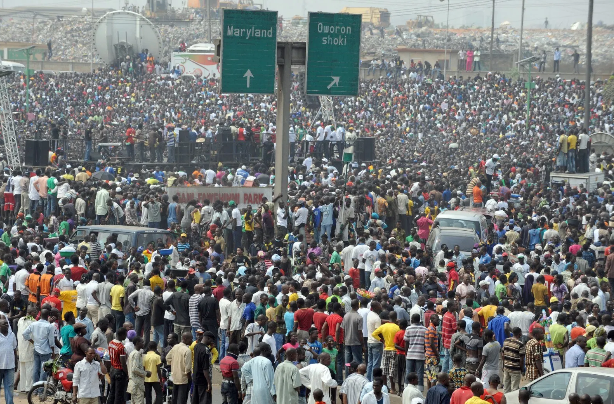
He cited the End-SARS protest that left in its trail deaths and destruction, including a high rate of crime, unemployment, overstretched infrastructures and other vices in the country as some of the ills arising from the nation’s largely unproductive population.
Quoting the Nigeria Bureau of Statistics (NBS), World Bank, Trading Economics and the UK Office for National Statistic (ONS), World Bank, Trading Economics, he said UK’s per capita income in 1960, was 1396.5948, and Nigeria had $1746.99.
Nigeria currently has a per capita income of $1,746.99 and the UK had 42,300.2671 USD in 2019. The unemployment rate in Nigeria in 1960, according to him, was 2%. It skyrocketed to 27% in 2020.
The FP2020 Focal Person for Civil Society Organization said in 1960, the UK had an unemployment rate of 1.7 percent, rising significantly to 4.1% in 2020, but at a much lower level than Nigeria’s.
The medical expert also revealed, against the much-touted 17 percent modern contraceptive rate (CPR) in Nigeria, that the nation’s official figure is 12%. Nigeria had vowed at the 2012 London summit to achieve 27 percent modern contraceptive rate by the end of 2020.
He urged government and development partners to invest more in family planning to enable the nation to enjoy demographic dividends. He also appealed to all people of reproductive age to embrace family planning.
In her presentation titled “The Future of Family Planning in Nigeria: Leading With Advocacy and Demand,” Portfolio Director, John Hopkins Centre for Communications Programme (JHUCCP) Nigeria, Dr. Mojisola Odeku called for Interventions that engage key decision-makers and influential leaders as change agents for shaping norms and creating a supportive environment for increasing contraceptive uptake in Nigeria.
She also advised that a huge investment be made in evidence-based advocacy and demand generation to improve the modern contraceptive prevalence rate and overall quality of life in the country.
The 6th Nigeria Family Planning Conference 2020, which holds next week, will draw experts from Nigeria and the diaspora.