ABOUT a month after the Federal Government told university lecturers to resign their jobs and go into farming, the Academic Staff Union of Universities (ASUU) has advised its members to seek alternative means of livelihood.
The advice followed the inability of the Federal Government and ASUU to resolve outstanding issues over which the lecturers embarked on the industrial action which had grounded Nigeria’s public universities for several months.
Coordinator of ASUU, Abuja Zone, Professor Theophilus Lagi, at a press conference at the University of Abuja on November 17, revealed that the union has advised lecturers to find alternative means of livelihood.
Lagi suggested that the Federal Government, represented by Minister of Labour and Employment, Dr Chris Ngige, had not been sincere in negotiations with ASUU.
“Our members have been advised to seek other legitimate means of survival as the government has not released salaries withheld since February 2020. One need not be a psychologist to understand the behaviour and recent utterances of the Minister of Labour and Employment, Dr Chris Ngige.
“The minister has clearly shown his disdain for Nigerian academics and has failed to play the role of an unbiased umpire in moderating the imbroglio. In the past few weeks, for instance, Ngige has said one thing when he met with the union and a different thing on the same subject in interviews with the media,” Lagi said.
But he also gave indications that the union was not going to back down from its position in the protracted, unending negotiations with the Federal Government.
“Our members are relentlessly determined to continue with the ongoing strike until our demands are met,” the ASUU official said.
The Federal Government had on October 5 told members of the union to consider resigning their lecturing jobs and take up farming and other professions.
Minister of State for Education, Emeka Nwajiuba, who made the suggestion when he appeared as a guest on ARISE NEWS Channel, a television station, had insisted that ASUU members cannot dictate how they should be paid by the Federal Government, their employer.
The minister observed that Nigeria was in need of more farmers.
The minister had said, “ASUU is within its rights as a union of lecturers. We didn’t start a strike with ASUU on the basis of COVID-19. ASUU was already on strike way before COVID-19. Just before COVID-19 we shut down schools, they gave notice of an indefinite strike. We are not in any contention with them.
“Government is actually not holding anyone to ransom. It says this is how I want to pay and it has to be through IPPIS. You can leave the employment. You can opt out of it and say ‘I no longer want to teach’. You can find other professions. What we need now are probably more farmers. You cannot keep forcing your employer and tell him, ‘I will like you to pay me my money through my pillow. Or, I will like you to pay it through this mailbox’.
“ASUU has a lot of complaints and dissipation around it. That is legitimate but doesn’t mean you should force yourself on the man who has the money.”
ASUU did not take kindly to the minister’s suggestion.
In its response, the union also advised Nwajiuba to resign his appointment as minister and go into farming.
Reacting to Nwajiuba’s comments, chairman of the University of Ibadan Chapter of ASUU, Professor Ayo Akinwole, in a statement, said the minister’s comments showed that he was naïve on education matters.
“If the Minister of State for Education is interested in farming, he should resign his appointment and stop displaying his cluelessness of the problems in the education sector. We are on a just fight to ensure that those in public offices become responsive and responsible to the masses they swore to serve.
“They must fund public education. We have been on the same salary since 2009. That is no longer sustainable. The universities are being run with personal sweat of lecturers while politicians siphon money for personal aggrandizement. We cannot accept the IPPIS that is against the laws of the land and which fails to recognise the uniqueness of academic profession and culture.
“We have brought an alternative using our members’ money. People like this minister of state mirror the disdain of the ruling class for the workers and people of the country,” the UI ASUU chairman said in the statement.
ASUU commenced its ongoing indefinite strike on March 23, largely to protest a Federal Government directive that academic staff in all Nigerian public universities must enrol on the Integrated Payroll and Personnel Information System (IPPIS).
President Muhammadu Buhari had directed that all ministries, departments and agencies of the Federal Government drawing their salary from the Consolidated Revenue Funds should enrol on the IPPIS platform by the end of October 2019.
Despite the complaints by the university workers concerning the IPPIS, the Federal Government says the scheme has helped to reduce corruption in the public sector.
In May 2020, the Office of the Accountant General of the Federation said the IPPIS had saved over N361 billion for the Federal Government “despite opposition and sabotage” from some quarters.
The Federal Government had also described ASUU’s opposition to enrolment of its members on the IPPIS as an “open endorsement of corruption”.
Created in 2007, the IPPIS secretariat is a department under the Office of the Accountant General of the Federation responsible for payment of salaries and wages directly to government employees’ bank accounts with appropriate deductions and remittances of third-party payments such as taxes and health insurance.
In place of the IPPIS, ASUU has developed the University Transparency and Accountability Solution (UTAS) as an alternative payment platform for university lecturers. UTAS is currently being scrutinised by the National Information Technology Development Agency (NITDA), preparatory to its possible acceptance by the Federal Government.
Interestingly, the Senior Staff Association of Nigeria Universities (SSANU) and the Non-Academic Staff Union (NASU) have also proposed an alternative payment platform – the University General Peculiar Payroll Payment System (UGPPPS) – in place of the IPPIS.
The university non-academic staff unions have been complaining of irregularities in payment of salary, including delays and deductions since they migrated to the IPPIS platform.
ASUU is insisting on the adoption of UTAS as the payment platform for its members.
The Federal Government has said it has agreed to pay N30 billion Earned Academic Allowance to the lecturers, as well as arrears of salaries. According to the Federal Government, the only outstanding issue was the disagreement over the payment platform.
However, ASUU is insisting on continuing the industrial action, which has lasted about eight months, until the Federal Government meets all its demands.
THE Zamfara State government says contrary to what is being reported in the media the state does not own any goldfield.
Nuruddeen Isa, the state commissioner for solid minerals, who stated this while addressing journalists in his office on Wednesday, said the state government was never involved in the mining gold as purportedly reported.
He added that the state government only buys from miners to prevent the commodity from being sold outside the country in which the money can be used to finance the activities of bandits.
“The state government doesn’t own any portion of the goldfields throughout the state and is not involved in mining activities.
“What the state government does is to buy the gold so that it doesn’t fall into wrong hands who in return sell it outside the country and purchase weapons for the bandits.”
While stressing that the state government has recently banned illegal mining activities in the state, the commissioner admonished “anybody who wants to venture into mining activities should obtain a permit from the federal government”.
He said mineral resources belonged to the federal government, as such, anybody who wants to partake in mining activities must obtain a license from the Federal government.
There were several controversies last month when it was reported that the Central Bank of Nigeria (CBN) had purchased gold worth N5 billion from the state government.
The federal government has since come under attack over the development with a renewed call for restructuring and resource control by governors of the oil rich South South of the country.
Ifeanyi Okowa, Delta State governor said the country “cannot apply laws in such a manner that it becomes discriminatory because you cannot mine solid minerals somewhere in Zamfara and you can’t allow Niger Delta to manage their oil.’’
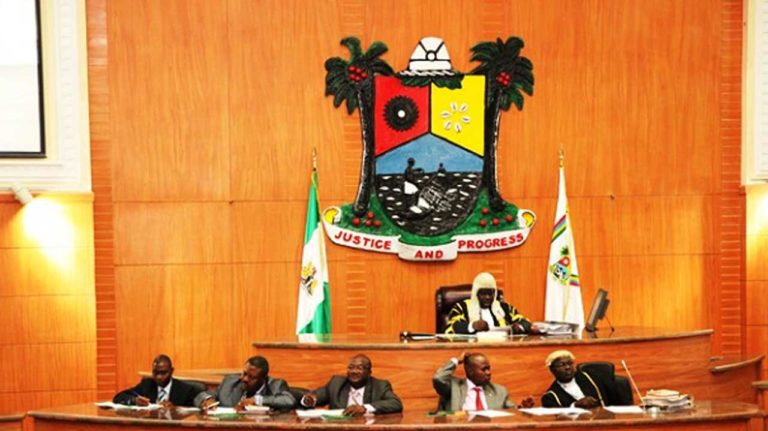
THE Lagos State House of Assembly has begun a three-day public hearing to compensate the victims attacked during EndSARS protests.
On Wednesday, residents of the Lagos Central Senatorial District were given audience to by the Assembly Committee headed by the Deputy Speaker, Wasiu Eshinlokun-Sanni.
Mudashiru Obasa, the Speaker of the House had on October 26 set up a nine-man Ad-Hoc Committee to investigate the level of destruction of properties and loss of lives with a view to determining compensation for the victims.
Residents of the other two Senatorial districts, East and West are expected to come between Thursday and Friday.
Eshinlokun-Sanni said the terms of reference of the Committee include interfacing with the victims, relevant stakeholders and community leaders and to ascertain the level of destruction.
Eshinlokun-Sanni noted that the Committee has sent across forms to victims of the destructions across all the constituencies and is accepting submission of the forms, which will be the foundation of the Committee’s consideration.
“We shall be leveraging on the knowledge and experiences of the experts we have invited (such as architects, insurance etcetera) in assessing the details and making decisions on how to assuage the pains of our people,” he said.
He added that the committee would also determine the level and value of compensation and restitution and where necessary, make recommendations towards preventing future occurrence of such incidents in the state.
On the similarities and differences between the House’s Committee and the Judicial panel set up by Babajide Sanwo-Olu, the Governor of Lagos State, Eshinlokun-Sanni said the panel is focused on unravelling the brutality meted out to Lagosians by the security agents before and during Lekki toll gate attack.
“The work of our committee is to see how the events after the Lekki shootings affected our people and how we can put them back to work so that they will not suffer more losses. Already, we had COVID-19 Pandemic in the nation and in the state during the year.”
He added that when such an incident occurred there could be a reduction in foreign direct investment into the country and in the state due to the alleged unsafe environment.
Hoodlums had hijacked the ENDSARS protest against police brutality that cut across many states in the country which resulted in attacks on private and public properties.
The hijack follows the killing of peaceful protesters by men of the Nigerian Army, which the authorities have denied.
THE World Bank has so far contributed a total of $376 million for the rehabilitation of Boko Haram-ravaged communities in the Northeastern region of Nigeria through its Multi-Sectoral Crisis Recovery Project (MCRP).
This was disclosed in a report on the World Bank website, titled ‘Strengthening Recovery and Peace Building in North-East Nigeria’.
The MCRP was established in 2017, in response to the escalation of the Boko Haram crisis in the North-East, with the aim of rehabilitating and improving critical service delivery infrastructure, and enhancing livelihood opportunities, in conflict-affected and displaced communities in the region.
A Recovery and Peacebuilding Assessment (RPBA) conducted by the World Bank and the Federal Government in the region in 2016 had estimated multi-sectoral recovery and resilience building needs at nearly $6.7 billion.
Findings from the RPBA led to the creation of the North-East Development Commission by the Federal Government, and the establishment of the Multi-Sectoral Crisis Recovery Project (MCRP) by the World Bank.
The report, dated November 10, noted that the World Bank, through the International Development Association (IDA) “initially contributed $200 million in 2017 for the MCRP to support efforts in North-East Nigeria. In May 2020, additional financing of $176 million was approved, bringing the total project amount to $376 million”.
The report added that the MCRP supports the Federal Government’s response to the acute humanitarian and forced-displacement crisis in Borno, Adamawa and Yobe states.
“Its approach includes: implementing a surge of high-impact, early recovery interventions (i.e. distribution of non-food items, agricultural and non-agricultural inputs) to address urgent needs and rebuild livelihoods while humanitarian operations continue; and transitioning into medium-term recovery and resilience building through investments in social cohesion, livelihoods, infrastructure and public services,” the report added.
The additional $176 million, injected in the MCRP in May 2020, is meant to bring Nigeria into the regional program supported in parallel by the New Lake Chad Region Recovery and Development Project.
It will also focus on job creation and labor-intensive works programs, and provide service delivery beyond infrastructure rehabilitation and improvement, with special emphasis on health and education service provision activities.
The additional financing would also pay greater attention to climate change adaptation and mitigation efforts.
Results achieved in the implementation of the MCRP between 2017 and 2020, according to the report, include distribution of non-food items, agricultural and non-agricultural kits and small ruminants to over 42,000 households, of which 51.4 percent are led by women, in line with deliberate efforts to prioritize and target female beneficiaries by the states.
Also, 17 peace groups have been formed, of which 201 households have participated in a series of capacity building training in different aspects of crisis management and recovery skills.
Psychosocial support services interventions have reached 13,500 households, while 687 infrastructure rehabilitation projects have been initiated, of which 136 are in various stages of implementation and 551 projects have been completed. The projects include 295 hand-pump boreholes, 121 solar-powered boreholes, 76 Ventilated Improved Pit latrines, 31 public buildings, 12 schools and 15 hospitals.
The construction of 178 kilometers (km) of roads and the reconstruction of three bridges are in various stages of implementation in Borno, Adamawa and Yobe states.
In the same vein, over 105,000 beneficiaries, of which 49 percent are women, have gained access to rehabilitated roads, hospitals, schools, Water, Sanitation and Hygiene (WASH) facilities and public buildings.
The World Bank report added that through the MCRP, “the North-East Development Commission has also developed a sophisticated security information system and protocols for the benefit of the constituent North-East states to further identify hotspot areas where activities are being implemented, and to protect those who are working on project sites”.
The report noted that about 20,000 people have been killed, while 2.2 million were displaced, as a result of the Boko Haram crisis.
“Violent activities of Boko Haram and the armed conflict since 2009 have deeply affected North-East Nigeria and the lives of 15 million people across the region. Over 20,000 people were killed and 2.2 million were forcibly displaced.
“The North-East states of Borno, Adamawa and Yobe host 70 percent of those displaced, with regional spillovers around the Lake Chad. Affected communities have experienced severe damage to their social fabric, extensive destruction of infrastructure, and significant socio-economic basic needs that remain largely unmet,” the report said.
FOLLOWING release of evidence that men of the Nigerian Army in fact fired live bullets and killed peaceful protesters on October 20, in Lekki toll gate plaza area of Lagos, many Nigerians have taken to social media to condemn the military authorities.
The Cable News Network (CNN) investigation which was released on Wednesday – exactly four weeks after the incident that left at least a dozen Nigerian youths dead – has sparked outrage over how the government met peaceful #EndSARS protesters with brutal force, in an attempt to quell the demand for an end to police brutality and bad governance in Nigeria.
“My heart curses all (including my uncles) who said #LekkiMassaccre didn’t happen. The CNN video is really sad to watch. Another sad thing is how helpless we are as Nigerians,” a Twitter user identified as Blue Natural shared in a post.
Another Twitter user identified as Ehizoba Archibald said: “The government is shocked by the CNN news today. They should be holding emergency meeting to think of how to quell down the uprising agitation. They will start forming serious with ASUU again. But the truth must prevail.. Intimidation would only worsen things.”
Directing his anger at the Nigerian government, one Twitter use simply identified as Eddy said: “You know what’s great about the CNN#LekkiMassacre footage? There is more where that came from. Every now then, an exclusive will be released for the world to see how shameless the Nigerian Government is.”
One Jerry on Twitter expressed sadness that it appears there is a constant attempt to conceal the truth.
“The #LekkiMassacre hits differently after watching the CNN video…The Nigeria govt tried to bully everyone but the truth came out eventually,” he shared in an impassioned post.
More concerned about safety, another Twitter user said: The @CNN #LekkiMassaccre investigation clip keeps popping up on the TL and eventually, I caved in. Tears! Fears! Oh God! I have kids. Is living too much to ask for? Haba!”
While many express fear, sadness and disgust over the truth of the incident of that day, some have characterised the attitude of the Nigerian government as a shameful display.
Dr. Olaleye, another Twitter user expressed this n a tweet in which he said: “After watching the CNN report on #LekkiMassaccre I must say, I have never been more embarrassed about Nigeria. Extremely shameful that @jidesanwoolu is still the gov of Lagos. To think people tried to cover the story is infuriating.”
Working with the Balkan Investigative Reporting Network, CNN established that several of the bullets from the Lekkitollgate originated from Serbia, and were used by Nigerian soldiers who carried out the operation shortly after leaving Bonny Camp barracks, Victoria Island on that day.
The Nigerian and Lagos State government have in several reports and interviews tried to distort the facts of the incident. The Army in its initial first response denied ever being present at the location of the incident – a lie that has been punctured with several evidences including an admission by the Army that its men were present but only used rubber bullets to disperse protesters.
Babajide Sanwo-Olu, the governor of Lagos also claimed in an interview with CNN that there are no fatalities from the shooting – another lie that has been debunked with evidence and time-stamped videos.
In an earlier released report, Premium Times, a Nigerian media organization had revealed that soldiers and policemen shot at the peaceful protesters and killed many youths.
Through pictorial and video evidence including eyewitness accounts, the newspaper established the fact that many lives were lost through gunshots, while many others sustained gun wounds.
The Nigerian government, despite several evidence continues to deny the incident till this day.
EMMA Adimachukwu, father of deceased Obinna Sandy said operatives of the defunct Special Anti-Robbery (SARS) in Anambra state killed his son in their custody and collected N400,000 from him to feed him.
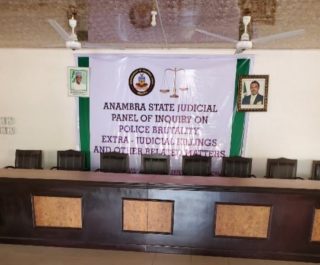
Adimachukwu, who is a school proprietor in Delta State told his story to the Anambra State Judicial Panel of Inquiry on police brutality, extral judicial killings, and other related matters on Tuesday.
Adimachukwu, an indigene of Oraifite in the Ekwusigo Local Government Area, but a resident in Asaba, Delta State, said his son Obinna Sandy, a businessman, was killed in 2014.
According to him, Obinna was a graduate of the Nnamdi Azikwe University where he studied Business Administration. After his education, he opened a clothing shop for Obinna Mount Olive shopping plaza Onitsha, Anambra state.
“He travelled to India to buy clothes. On March 14, 2014, he went to Nnewi and collected $10,000 owed him by a friend and proceeded to Onitsha to take delivery of his goods that just arrived.
Adimachukwu added that while his son was waiting for his goods, SARS operatives arrived at the scene and started shooting before they searched Obinna and found $10,000 on him.
“It was while waiting for the goods that some SARS men arrived and started shooting. They arrested him and his friend. They searched him and saw $10,000 on him and concluded he was an armed robber.
“My son refused to let them take the money, he fought them. So, when they got to Awkuzu SARS, they killed him.”
Adimachukwu further narrated that when he went to see Obinna and his friend, N400,000 was collected from him for the purpose of feeding his son who he did not know has been killed.
“When I went to see him after his friend who was smuggled out told me of it, James Nwafor (SARS boss) told his men to lock me up that I was a father to an armed robber. Some prominent people intervened and they released me.
They later told me to drop money so they can be feeding my son, and they collected N400,000 from me, knowing full well that they had killed my son,” Adimachukwu said.
Nwafor was invited to the panel but he has refused to show up to defend himself from the allegations levied against him.
Anambra State Judicial Panel of Inquiry
However, the panel sitting headed by Veronica Umeh, a retired judge of the State High Court and Chairman of the panel was suspended due to logistic reasons.
“We will have to discontinue sitting because of logistics reasons, we will not sit until the needful is done,” Umeh said at the sitting.
Abdul Mahmud, counsel to one of the petitioners had raised a motion that the portraits of Willie Obiano, Governor of Anambra, and President Muhammadu Buhari hung at the venue of the sitting portrays it as an executive panel.
AN American Cable News Network (CNN) investigation has revealed that operatives of the Nigerian Army shot #ENDSARS protesters at Lekki tollgate with live ammunition.
In the investigation published on Wednesday, CNN said it examined bullet casings found at the scene and confirmed with current and former Nigerian military sources that the bullet casings match those used by the army. Two ballistics experts have also confirmed with CNN that the shape of the bullet casings indicate they used live rounds, which contradicts the army’s claim they fired blanks.
Also, working with the Balkan Investigative Reporting Network, CNN established that several of the bullets from the Lekki tollgate originated from Serbia. Export documents CNN has seen show that Nigeria purchased weaponry from Serbia almost every year between 2005 and 2016.
The investigation revealed that soldiers who carried out the operation were from Bonny Camp barracks, Victoria Island.
Two eyewitnesses told CNN they saw soldiers arriving in a Toyota Hilux pickup truck with “OP Awatse” written on it — the name of a joint military task force that operates in Lagos State.
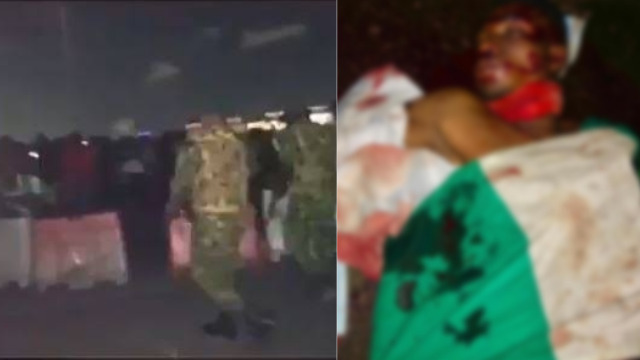
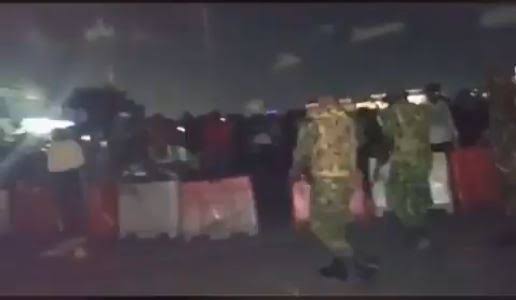
Videos examined by CNN show the army trucks approaching the protesters from both sides of the toll gate and barricaded them in. The shooting started almost immediately, with no warning given. Panic ensued as protesters attempted to flee.
From multiple videos, CNN has pieced together a timeline that shows that shooting by the army lasted from 6:43 p.m. until at least 8:24 p.m., according to video evidence.
The videos capturing some of those 101 minutes tell a story of terror and chaos. They show graphic injuries and people bleeding on the ground.
One eyewitness, whom CNN identified Sarah, said that the soldiers shot in the air but also directly at protesters.
“They pointed their guns at us and they started shooting,” she said. “They were shooting in the air, they were shooting at us, they were shooting everywhere.”
Some chanted: “We are peaceful protesters” and “ENDEARS, we no go gree [pidgin for we will not agree, or give in].”
In several of the videos, reviewed and verified by CNN, some of the protesters can be seen carrying bodies, the flashlights on their phones the only thing illuminating the darkness as the sound of ambulance sirens wail in the background. It is not known whether these were dead or injured protesters.
CNN has verified that bullets fired at Lekki toll gate are from live ammunition. This one was manufactured in Serbia in 2005 and is currently in use by the Nigerian army. CREDIT: CNN
In another, there are several injured people, some on the ground bleeding while defiant protesters continued to wave Nigerian flags.
Injured people whom CNN has confirmed were present at the toll gate started arriving in local hospitals carried by civilians from 7:19 p.m. while the shooting was still ongoing, according to videos analyzed by CNN.
Army lied
The revelation of investigation is contrary to claims by the army that its men fired only blank bullets into the air to disperse the protesters.
Ahmed Taiwo, Commander of the 81 Military Intelligence Brigade, stated this before the Lagos State Judicial Panel of Inquiry on Saturday.
He added that such blank bullets cannot cause any serious damage to life, citing that a live bullet had the power to kill three people with one shot.
Taiwo also told the panel that no casualty was recorded by the soldiers during their report.
THE Anambra State Judicial Panel of Inquiry into police brutality has suspended further sitting over lack of proper logistics.
Veronica Umeh, a retired judge of the State High Court and Chairman of the panel who announced this on Tuesday said the panel will not sit until the needful is done.
“We will have to discontinue sitting because of logistics reasons, we will not sit until the needful is done,” she said.
The panel’s decision was followed by a plea by Abdul Mahmud, a lawyer to one of the petitioners, that the portraits of Governor Willie Obiano and President Muhammadu Buhari be removed from the venue of the sitting.
Abdul, who revealed this in a Twitter post said he had told the panel that the portraits were inappropriate in a judicial panel, arguing that such pictures made it look like an executive panel and stripped the panel of its independence.
“My protest drew the attention of the panel to the improper venue of its sittings and it was on this basis the Panel suspended further sittings until Anambra State Government does the proper thing,” Abdul said.
“Those who were in Awka would testify to the shabby nature of the venue. Counsels and Panel members had their exchanges constantly drowned by the generator nearby and the oscillating ceiling fans.”
Reacting to the request, the chairman said the venue which was borrowed from the Anambra State Association Town Unions, stated that the panel lacked the power to remove items it met in the place.
Protest, demands, government’s response
In October, there were a series of protests across major cities of Nigeria, when the youths demanded an end to police brutality and police reforms.
The protesters issued a five-point demand which included the release of all persons arrested and justice for victims of police brutality.
Other demands are “setting up an independent body to oversee the investigation and prosecution of all reports of police misconduct (within 10 days), psychological evaluation of all disbanded SARS officers before they can be redeployed, and increase in police salary so that they can be adequately compensated for protecting lives and property of citizens.”
In response, President Muhammadu Buhari directed Mohammed Adamu, the Inspector General of Police (IGP) to disband the dreaded unit of the police.
Also, Some state governors except Borno, Kebbi, Kano, Sokoto, Yobe, Jigawa and Zamfara have set up Judicial panels of inquiry to investigate the acts of police misconduct perpetrated by the operatives of the disbanded Special Anti-Robbery Squad (SARS) and to give reprieve to the victims of police brutality and their families.
ONE sunny afternoon in April 1996, Maryam Ibrahim, also known as Ladi, took Maryam Ibrahim Sulaiman, her six-year-old daughter, to the Infectious Diseases Hospital (IDH) in Kano for vaccination after the child had suffered severe headache and fever overnight.
Before dawn, the child’s situation became so severe that she could barely walk. Ladi strapped her daughter to her back and headed for the hospital.
The child was later confirmed by a female European doctor at the IDH to be suffering from Meningitis.
Maryam Ibrahim Sulaiman and her mother after the vaccination in April 1996 at IDH Kano.
After giving her four rounds of injections, the doctor handed her a wristband and a whistle. She also took her photograph, and gave her mother a copy as gift. And the pink colour registration card was taken from her by the officials of the hospital.
Ladi was excited, especially as the treatment was done free of charge. But her excitement would later be short-lived because, what transpired at the hospital cast doubts on the treatment administered on the poor child.
“…On reaching there (IDH) I entered with Maryam and she was accepted immediately and they took her to a particular room,” she recalls during an interview with The ICIR.
“I peeped through the window where they laid her on a bench but when they discovered that I peeped, they let the curtain down, and as of then they’ve cut her open from the waist to fetch some fluid. I saw something like a TV connected with a cable on her, yes, I saw that. But after that I was not allowed to see anything again. Later they asked me to get a seat for myself, which I did.
“Later, I saw a staff held her by the neck and told me to follow so as to get a bed for her, and I did.
“All that I cared about then was my child’s health and well-being.”
Later, the hospital officials instructed her to come back with the child after a week for check up.
But during the week, the child began to feel chronic pain in the leg and waist region.
On the day she was asked to come back with her daughter, Ladi was amazed when she was told that the white doctor and her colleagues had gone back to their country.
A physician who witnessed the event said the doctors left Kano unceremoniously immediately after the treatment.
Ladi did not know that her daughter had been used as one of the 200 guinea pigs to test the efficacy of a vaccine manufactured by the United States-based pharmaceutical company, Pfizer.
Since then, Maryam has continued to live her life with complications arising from the treatment. Her problem include chronic waist and leg pains and incessant fever. Later, she started complaining of auditory problem, then dizziness, resulting in loss of balance.
The vaccine later affected the mobility of her waist and legs. So, she was being taken from one hospital to another administered with different injections and drugs, Ladi narrated.
(L-R) Ladi and her daughter, Maryam Ibrahim Sulaiman
It is not clear if the complications affected Maryam’s memory 24 years after but many of her answers to questions were incoherent and she seemed to have forgotten many things about herself.
The treatment, it seems, has changed her life and now all she desires is living a healthy life free of pain.
“Most time, she is sick and to play basketball with her fellow girls is difficult. She complained that some of her school mates poked fun at her and she tried to explain to them that her waist and legs are not strong enough” Ladi said, sadness written all over her face.
She eventually finished high school in 2012, after enduring years of crude jokes and verbal assaults from insensitive peers.
Maryam Ibrahim Sulaiman, one of the uncompensated 1996 Kano Trovan Trial PhotoCredit: Samad Uthman/The ICIR
She could not continue with her education because her parents could not afford it. And she also could attract intimate relationships because of her poor health condition, her mother told The ICIR.
“Men are scared to marry her because of her intermittent sickness. And she can’t walk long-distance without feeling pain in her hips”.
When I was young, my future ambition was to be a doctor- Audu Sani
Audu Sani, one of the uncompensated 1996 Kano Trovan Trial. Photo Credit: Samad Uthman/The ICIR
Audu Sani was a 10 years old boy when his father, Alaramma Audu Mai Nasiha, took him to the IDH in 1996 where he was diagnosed with Meningitis.
After being used as one of the guinea pigs for the vaccine trial, Sani told The ICIR that his auditory system was affected and he could not hear for many years until recently. And that was how his dream of becoming a medical doctor got shattered.
“When we were young we used to go to the radio stations and whenever I was asked about the future I used to tell them that I would like to be a doctor in order to help people with their health issues, this really disturbed me whenever I thought of my ambition,” Sani said with a wry smile.
After the test, Sani’s health deteriorated as his parents took him from one hospital to another. Besides his hearing impairment, Sani said he stopped talking two months after the trial which made him relatively ‘deaf and dumb’. This stopped him from school while in Primary 3.
Attempts by his parents to restore his speech and hearing after visiting several hospitals, including Aminu Kano Teaching Hospital, drained their purses. Sani said his parents later gave up and resigned to prayer.
When he could not continue with western education, his paternal uncle suggested that he should be enrolled at Islamic and Arabic school in Borno State. And he needed to relocate to another town.
It was during this period of his relocation that Pfizer’s settlement agreement was reached with other victims but he was not reachable.
Sani told The ICIR that it was at the Islamic school he noticed he was regaining his speech and other people also started noticing. Since then, Sani said he experiences annual sickness rituals ranging from severe headache and ear pains.
Even now, it is difficult for him to be in a noisy area. He chooses where to be at any time, which comes with stigmatisation as many of his friends detest his ‘unusual’ quietness.
In 2011, after his relocation to Wudil, a suburb of Kano, where he settled down to raise a family, Sani approached the Pfizer victims Settlement Trust Committee but he was told ‘he came late’.
“In 2009, we came back to Kano and we heard about it that the people affected with the bad vaccine were compensated even though my parents said they didn’t hear about it,” he said.
We heard they were still paying. My brother tried for me to get the money. We heard they had a meeting with 300 patients but we were told that we are already late despite the evidence (picture) because that was the only evidence given to anybody injected with the bad vaccine by those white people if in the process the patient survived it.”
Sani is yet to be paid while he continues to suffer from the failure of the vaccine trial.
After 24 years, all Maryam want is just to live
Maryam Sani, one of the uncompensated 1996 Kano Trovan Trial, while speaking to The ICIR in front of her house. photo credit: Samad Uthman/The ICIR
Maryam Sani was pregnant while The ICIR visited her home in Sharada, Gindingaru, Kano municipality. The reporter had to repeat each question more than four times before she could hear him.
She was among the children whose life’s trajectory was changed by Pfizer’s ill-fated drug trial.
Maryam seems to have lost her memory, as she could not remember many of the events that have happened in-between the years.
Now 29, the mother of three does not know the exact amount of money Pfizer agreed to pay victims but told The ICIR that if paid, she will use it to care for her health and change the life of her family.
“I heard some people were given 16 million and some are paid 26 million. But I am not sure. The money will change the condition of my husband, family and friends by God’s grace if we can get it. It will help the children in achieving their educational goals and clothing”.
Picture showing Maryam Sani at one of the IDH wards allocated to Pfizer doctors. This picture was shot on 18/04/1996 and she was just 5 years old. Photo Credit: The ICIR archive
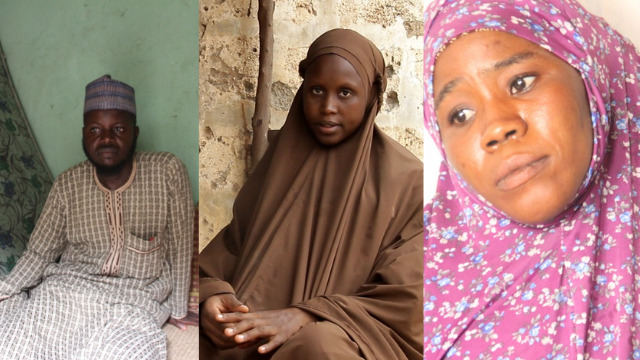
Maryam Ibrahim Sulaiman, Audu Sanni and Maryam Sanni are all victims of an illegal vaccine trial on children suspected to be suffering from meningitis by Pfizer, the pharmaceutical company in 1996.
However, while other victims have received compensation for the company’s illegal action and the life long impact it inflicted on them, these three have suffered the double jeopardy of ill health and denial of compensation.
Pfizer’s costly trick on 200 Kano children
The first half of 1996 marked the beginning of the most serious Cerebral Spinal Meningitis epidemic ever recorded in Nigeria. It was a severe public health crisis for the government at the time.
On April 3, 1996, a six-member research team from one of the world’s biggest research-based pharmaceutical companies in the United States, Pfizer, arrived in Nigeria.
The team headed straight to Kano State to treat children suffering from Meningococcal Meningitis. That year, Nigeria was still under military rule and Kano was also experiencing concurrent epidemics of measles and cholera, besides meningitis.
Before the arrival of the Pfizer team, international aid workers from Medicines San Frontieres (Doctors without Borders), the Nobel Prize-winning relief organization, were already providing free treatment with Chloramphenicol, the cheaper antibiotic that is internationally recommended for treating of bacterial Meningitis, at the IDH.
Pfizer, however, seized the opportunity to test the efficacy of its new antibiotic, Trovafloxacin (Trovan), on 200 children.
Ninety-nine out of the children were treated with Trovafloxacin/Alatrofloxacin as part of its effort to determine whether the drug, which had never been tested on children, would be an effective treatment for the disease.
One hundred and one children were administered with Ceftriaxone, the gold standard for meningitis treatment.
However, five of the children given Trovafloxacin died, along with six others who were given Ceftriaxone and many suffered brain damage, others were partly paralysed, became deaf or suffered slurred speech.
How Pfizer got its clearance
In 2001, the Washington Post unearthed a report of the investigation committee on the clinical trial of Trovan by Pfizer. The report of the committee set up by the Federal Ministry of Health chaired by Dr A. Nasidi revealed that the Principal Investigator (PI), Dr Isa Dutse, gave a backdated Ethical Committee Clearance to Pfizer, which means he gave Pfizer a forged approval to do the test in the country.
The ICIR found that the Ethical Committee was established in Aminu Kano Teaching Hospital (AKTH) in October 1996 after the trial. Also, the committee was only involved in trials within the AKTH.
Late Dr Hamid Isa Dutse. The doctor who provided Pfizer with a fake Ethical Committee Clearance to conduct the horror test in 1996 which affected over 200 children. Photo Credit: The Abusite
An official document sighted by The ICIR also revealed that the approval letter issued by Dutse on the letterhead of AKTH was irregular while the signatory to the letter, Salisu Isah Adamu, was a confidential secretary to Dutse.
At the time of his selection as the PI, Isa Dutse was a physician at the nearby Bayero Teaching Hospital, Kano State and served as the Deputy Chairman of the Medical Advisory Committee of the Teaching Hospital.
Aside from the fake approval, it was later claimed that Pfizer did not have proper/written consent from parents to use an experimental drug on their children and questions were raised over the documentation of the trial.
The victims, who spoke to The ICIR 24 years later, said that none of their parents were ever told that their wards were being administered experimental drugs and, in effect, being used as guinea pigs. Thus, no one gave Pfizer consent as is required in such procedures.
The ICIR investigation also showed that many of these parents are illiterate persons who could neither read nor write.
The document also revealed that three visiting American doctors of Pfizer (Scott Hopkins, Debra Williams and Mike Dunne) who were not cleared nor licensed by Nigerian Medical Council to practice in Nigeria participated in patient-care while Isa Dutse affirmed before the panel to have done most of the lumbar punctures. Scott Hopkins and Mike Dunne did a few.
Dutse told the panel that, in hindsight, he had regret about the clinical trials and his motive was not negative.
The report also quotes him to have admitted that “although Pfizer might have had legitimate authorisation to come in (to the country) and do the trials, he believes that Pfizer’s primary motive was far from philanthropic.”
In his closing comment before the panel, he said “I regret this whole exercise, I wonder why on earth I did this? I did not do it for any personal benefit. I did not go out to kill anyone or injure or put anyone’s life at risk”
However, when The ICIR sought the comment of Dutse on October 5, 2020, his close allies in Kano city disclosed that the doctor had died on that same day and would be buried the day-after ( October 6).
Dutse was reported dead at Aminu Kano Teaching Hospital after a brief illness and following a post-surgical intervention.
“Pfizer should be sanctioned” – Panel report
In one of the shady procedures followed by Pfizer during the deadly trial, The ICIR obtained a document which shows how the tested 200 children’s names were documented by initials.
Which means as this reporter bears Samad Uthman, the record book of Pfizer would simply record his name as SU. This made the tracking of survivors difficult.
However, Maisikeli Mustapha, one of the affected parents whose children died due to the deadly trial, formed a group of victims and made a contact tracing of all the 200 affected victims.
After the tracking, Mustapha’s group got an attorney, Etigwe Uwa of Streamsowers & Köhn chambers, and started pushing the case to the court and the public.
They then started organising themselves and named the group as Kano Trovan Victims Association (KTVF). Many of the members of this group are parents whose children were used as the guinea pigs by Pfizer.
In December, 2000 and early 2001, many foreign and few Nigerian media papers widely reported the botched trial. This got the attention of the then minister of health, Prof A.B.C. Nwosu and he constituted an investigation committee with specific terms to probe the incident.
Chaired by Abdulsalami Nasidi, the panel, among other things, recommended that Pfizer be sanctioned appropriately for breaching the Drug and Related Products Decree (Registration, etc), the Helsinki Declaration on Ethical Principles for Medical Research involving Human Subjects and the 1989 United Nations Convention on the Rights of the Child.
The panel also proffered that the pharmaceutical giant should tender an unreserved apology to the government and the people of Kano State in particular and accompanied by appropriate restitution.
Also, the Nasidi-led panel advised that Ethical Committee clearance must remain a mandatory requirement for any trial on humans. It recommended that any individual, group, or corporate organisation intending to conduct clinical trials should be conversant with and made to adhere strictly to all the relevant Nigerian laws, regulations, guidelines and procedures.
In its recommendations, the panel stated that Dr Isa Dutse, the naive and exploited “principal investigator” of the horror trial should be reprimanded and considered for disciplinary action by his institution.
While the restitution was made after a long year of legal battle, The ICIR understands that only three copies of this panel report were printed and it was never made available to the public until years later when the Washington Post exposed the findings of the Nasidi-led panel in a report.
From the US to Nigeria, long years of court wars
In 2001, the KTVF sued Pfizer in US federal court under the Alien Tort Claims Act (ATCA) alleging that the company violated customary international law by administering Trovan to minors in Kano during the meningitis outbreak.
The plaintiffs in Abdullahi v. Pfizer claimed that the drug was given without the informed consent of the children and their parents. The plaintiffs further claimed that the drug trial led to the deaths of 11 children and serious injuries to many others.
A second US lawsuit was filed against Pfizer, Adamu v. Pfizer, in November 2002. These plaintiffs were also a group of Nigerians injured in the Trovan drug trial. The Adamu plaintiffs alleged similar violations under ATCA and violations of Connecticut law. But these cases were dismissed in 2005 on grounds of forum non-conveniens and failure to state a claim under ATCA.
According to the judge, the plaintiffs failed to show a sufficient legal source for an international prohibition of non-consensual medical treatment.
In January 2009, the US court of appeals reversed the lower courts’ dismissal of the case. The Business & Human Rights Resource Center documented that a divided court found that the prohibition of non-consensual medical experimentation on humans is binding under customary international law.
In July 2009, Pfizer petitioned the US Supreme Court asking it to hear an appeal of the Court of Appeals’ January 2009 ruling.
In November 2009 the Supreme Court asked the US Solicitor General to submit a brief to the court in this case.
In May 2010 the Solicitor General submitted this brief to the court urging the court to deny Pfizer’s petition.
On February 23, 2011, the parties announced that they had reached a settlement in this lawsuit. The terms of the settlement were confidential. A joint statement issued by the parties explained that the plaintiffs in the US lawsuit will join the ongoing Healthcare/Meningitis Trust Fund process, which is being managed by an independent board of trustees in Kano, Nigeria.
The ICIR understands that in Kano State Court there was one civil suit and one criminal case and in the Federal High Court, there was one civil suit and one criminal case.
In 2001, a group of Nigerians sued Pfizer in the Federal High Court in Kano. The plaintiffs in this case, Zango v. Pfizer International, alleged that Pfizer’s drug trials were illegal. However, after severe delays, the plaintiffs elected to withdraw this case. Some of the Zango plaintiffs were part of the Adamu action in the US.
In May 2007, the Kano State brought criminal charges and civil claims against Pfizer seeking over $2 billion in damages and restitution. Settlement talks have been ongoing since November 2007. In late January 2009, the state court adjourned the case until late February to allow more time for the parties to reach a settlement out of court.
In a separate action, the Nigerian Federal Government filed suit against Pfizer and several of its employees in June 2007 seeking nearly $7 billion in damages for the deaths of children involved in the Trovan drug trial.
In late January 2009, the government informed the court that it had agreed with Pfizer to settle the lawsuit out of court.
On April 20, 2009, Wikileaks quoted Pfizer’s lawyers, Joe Petrosinelli and Atiba Adams, to have reported that Pfizer and the Kano State government had reached a preliminary settlement on lawsuits arising from the trial.
Petrosinelli said Pfizer agreed to the Kano State Attorney General’s (AG) settlement offer of $75 million, including a $10 million payment for legal fees, $30 million to the Kano State government, and $35 million for the participants and families.
According to Adams, several final details needed to be worked out on the mechanism for payment, but Pfizer recommended setting up a $35 million trust fund for the victims to be administered by a neutral third party and for the $30 million for the Kano State Government to be used for improving health care in the state.
The state government agreed to this. Justice Abubakar Bashir Wali was appointed as the board chairman of the Meningitis/Healthcare Trust Fund.
Out of the 200 victims, The Guardian UK reported on 12 August 2011 that the parents of four Nigerian children who died of meningitis were the first winners of the 15-year legal battle against Pfizer. The families of four of the children each collected cheques for $175,000 (N26.6M, calculated based on prevailing dollar rate of 1$=N152) from the compensation trust fund, after submitting DNA samples to show that the dead were their offspring.
Later, another batch of victims were paid, making about 14, leaving out 186 out of 200.
The ultimate search for claimants
After the filling of the compensation model, Pfizer Meningitis Trust announced on the radio in both Hausa and English in 2009 the intake of another set of claimants. The committee asked claimants to fill forms.
The ICIR saw proof of the distributed forms being used to wrap Suya, the open-fire barbecued steak, by sellers.
Photocopy of the claimant form sighted at a Suya joint in Kano
After the exercise, aside from the already existing 186 KTVA claimants, the committee got 337 new claimants through the process. They are named “Media Invited Claimants” due to the way they were ushered into the case through media publicity.
Our source told us that many controversies trailed the action of the committee which made it lose integrity. It was smeared by sheer politicisation by the Kano State government.
During the out-of-court settlements talks between the government of Kano State and Pfizer, the parties signed two different Memorandum of Understanding, MoUs, on different occasions which were never made available to the public.
The ICIR on October 2, 2020, wrote a Freedom of Information (FOI) request to the Attorney General and Commissioner of Justice of Kano State to request for the first and second MoU signed by parties in 2016 pertaining to the Pfizer Trovan case and documents pertaining to the trial.
However, as at press time, the Kano State government has not responded to the request. The law provides for a maximum of seven days for response to requests.
In 2016, most of the KTVA and the Media Invited Claimants were paid. But not all.
Maryam Ibrahim Sulaiman, Audu Sanni and Maryam Sanni as of press time have not been paid a dime while they still suffer eternal sickness from the trial.
Many were paid, but not as stipulated
A source close to the case told The ICIR that in the second MoU signed by the Kano State government and Pfizer in 2016, each KTVA victim is profiled to get $25,000 while the Media Invited Claimants were to get $10,000 each.
However, in an exclusive email obtained by The ICIR sent by A.B. Mahmoud (SAN), former President of Nigeria Bar Association (NBA) and counsel to the Kano State government representing the 337 Media Invited Claimants, to Anthony Idigbe (SAN), Pfizer’s lawyer, at exactly 6:44 pm on April 30, 2015, he proposed that out of the $32million available, Pfizer should retain 20 per cent of it, which is $6.4million. Etigwe Uwa, the counsel to the KTVA, was copied in the email which was sent at exactly 6:44 pm on April 30, 2015.
Mahmoud also proposed that each of the 337 Media Invited Claimants to receive $10,000 each while the Mesikelil group, KTVA get $25,000 each. He added that legal costs will be pegged at $10.6million.
He suggested that a total sum of $7.919million goes for the construction of a medical centre, settlement of the liquidation expenses and refund to Professor Muhammad Idris, the chairman of the task force appointed by the then Minister of Health, all personal expenses incurred by him in the course of controlling the epidemic.
Idris was the first to raise alarm on the illegal trial and also wrote to the Minister of Health over the illegality while he also declined to approve the trial over non-provision of all needful and relevant approval letters from NAFDAC and the minister.
Comments from the members of KTVA and Media Invited Claimants revealed that they were paid below the budgeted amount.
Copies of the “release agreement” signed separately by the two groups show that $7,000 was paid to each of the Media Invited Claimants and $20,000 for KTVA instead of $10,000 and $25,000, respectively, as contained in Mahmoud’s letter.
It is believed that each of the victims were ‘shortchanged’ by $5,000 and N3,000 respectively.
The ICIR on October 2, 2020, wrote to A.B. Mahmoud over this discrepancy in the settlement fees to the victims. In the letter, questions were raised on the use of the phrase “an agreed period of time” in a private email sent by him to other attorneys involved in the case in 2015.
He had noted that Pfizer retains 20 percent of the available funds worth $6.4million for an unspecified time to mitigate future risk.
The ICIR’s letter also questioned, “when is the right time?”
In his October 6 response, written on his behalf by his chamber, Mahmoud responded that his firm only acted on behalf of the “Kano State government during the phase of the renegotiation of the settlement agreement between 2011 and 2019”.
He added that his firm is no longer acting on behalf of the state government and due to the confidentiality clause in the terms of the settlement, he is not in a position to respond to The ICIR’s request.
My members thought I embezzled their money- Muhammad
Alhaji Bello Muhammad, the chairman of the Media Invited Invited Claimant
Bello Muhammad, the leader and the chairman of the Media Invited Claimant group told The ICIR that after the payment of the settlement into his members’ accounts, many began to question him and believed he and his other executives connived with the Pfizer lawyer to rip-off $3,000 out of the over 300 claimants.
“…it got to the point where most of our people pointed fingers at us. They accused us of having a hand in the money reduction saying we connived with them to have the money deducted,” Muhammad said.
He expressed that he has used all possible language to explain to the members that he knew nothing about the deduction. He added that it was because of the reduction without explanation that some members of his group stood not to accept the payment.
“We can’t do anything about that because we don’t have any power over that. It was because of this reduction that those among my group said they will not accept the half payment.”
“This was because they had initially raised our hopes on 10,000 before they failed us with the reduction of $3,000.”
Besides the reduction, Muhammad said he and others were paid in bits which made most of them not able to manage and monitor the inflow while some have not got part of their payment.
“They suffered us seriously because they did not release the money in full, they released it bit by bit,” he claimed.
” Please sir, help us, please help us find out what happened to the rest of the $3,000,” he pleaded with The ICIR.
However, while many were paid in Muhammad’s group, The ICIR understands that about 6 persons have not been paid. Out of the 6, three can not be located while the cases of the remaining three have been pushed before Pfizer for compensation.
Maisikeli Mustapha, the chairman of the sister group, KTVA, declined to speak to The ICIR. He explained that one of the payment clauses they signed with Pfizer was not to speak about the matter with the press.
The copy of the document sighted by this reporter showed that violation of this may result in another legal battle between an erring party or victim and the pharmaceutical company.
Victims were paid as stipulated- Pfizer
Nelson Uzuegbu, a lawyer and the representative of Anthony Idibe, Kano State Pfizer representative, told The ICIR in an interview that all the victims who have come forward have been paid.
“To the best of my knowledge, all those who put in a claim have been paid, remaining just a few who have not come forward, because maybe they are not aware or they lost track of what is happening. I am not sure of the exact number but there are few, perhaps 3, 4, 5,” Uzuegbu said.
He denied any engagement that stipulated $10,000 for media invited claimants and $25,000 for KTVA.
In another response, Nelson wrote to The ICIR that his firm (Nelson Uzuegbu & co) did not take part in the negotiations and making of an agreement between the Kano State government and relevant parties.
“Each party or set of parties was represented by senior counsel who ensured that obligations to their client were fully discharged and in strict terms”.
Nelson added that each party and its counsel in the Trovan Trial Case are “bound by confidentiality clauses in the settlement which they must adhere to. They have neither waived the said clause nor empower me to speak for them”.
However, O’Neill Lisa Margaret, Pfizer’s Global Media Relations Director for Europe, Middle East and Africa, in response to an email enquiry from The ICIR, said that the company “has met all of its obligations under these and successive agreements, which did not include any admission of liability by the company”.
“There have been multiple opportunities under the settlements spanning seven years for people with legitimate claims to submit the required information, including to an independent trust in Nigeria that was created to evaluate claims. All of those who have done so and who were verified as proper claimants have been paid. These matters were fully and finally resolved in 2016,” she explained.
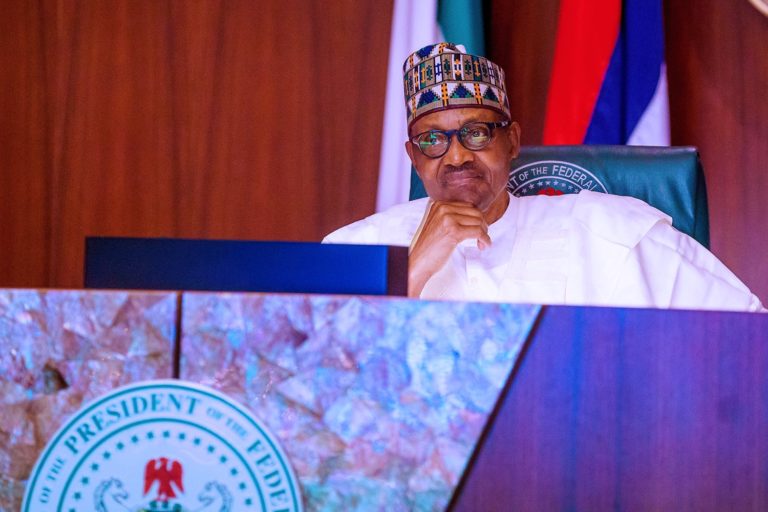
MUHAMMADU Buhari, President of Nigeria has vowed to do whatever it takes to ensure that there is no repeat of #ENDSARS protests in Nigeria again.
Muhammad Dingyadi, the Minister of Police Affairs, quoted the president to have said this during the meeting of the National Security Council (NSC) at the State House, Abuja, on Tuesday.
He said the president reassured that the Federal Government would continue to dialogue with relevant “stakeholders” in ensuring a peaceful and harmonious socio-economic environment across the country.
“What we are saying is that the government will continue to dialogue, it will continue to listen and will continue to carry all stakeholders along in ensuring that there is no repeat of what happened that destroyed a lot of property, public and private, individuals in this country,’’ the minister quoted the president to have said.
According to Muhammad, the meeting which was held to brief the president about the porus security situation in the country also took concern of the need to overhaul the nation’s security architecture and the need to equip police men with modern equipment and technology in the discharge of their duties.
He said the president assured them that he will do whatever it takes to support security agencies in providing peace in the country.
“The meeting noted with concern the increasing cases of armed banditry particularly in the North-West and North Eastern parts of the country.
“The meeting agreed to be more proactive in dealing with the situation in a more decisive manner.
“The meeting thanked the president for the concern which he has shown in repositioning the police to perform more effectively.
“President reassured that all stakeholders will be involved in the process of maintaining peace in the country, particularly the youth, community leaders, traditional rulers, politicians, public servants, religious leaders etc.’’
He noted that the federal government would continue to maintain its “bureaucratic, humane and just postures” in handling security matters in the country.
Since the heat that came with #ENDSARS protest died down a few weeks ago, the federal government and its agents have been clamping down on the campaigners of the protest.
Two weeks ago, an Abuja federal high court presided by Ahmed Mohammed, granted the request of the Central Bank Nigeria (CBN) to freeze the accounts of 19 individuals and a public affairs company linked to the #EndSARS protests.
In a clear violation of her rights, the Nigeria Immigration Service seized the international passport of Modupe Odele, one of the protesters. It was only released to her after public uproar.
Eromosele Adene, another protester was arrested in Lagos on November 7. He was moved to Abuja and subsequently moved to Lagos where he is being charged with allegations of aiding the #EndSARS protest in Lagos with financial support. He was granted a 1million naira bail by O.A. Salawu of the Yaba Magistrate Court, Lagos on Tuesday.
Tunde Bakare, the founder of the Citadel Global Community Church which was formerly known as Latter Rain Assembly, has condemned the clampdown against the protesters who were only exercising their constitutional rights to express their grievances against the misdoings of government.
He warned the government from taking further actions that will lead to another civil disobedience in the country.