THE longest-serving editor of BBC Hausa, Aliyu Tanko, has left the British Broadcasting Corporation amid allegations of bullying and maltreatment raised by his former colleague, Halima Umar Saleh and some current staff members.
Tanko, who joined the BBC 17 years ago and became Hausa Service Editor in 2020, confirmed his resignation to The ICIR Friday morning.
Media reports indicate that Tanko was suspended by the BBC on Wednesday, August 27, before tendering his resignation the following day.
According to a report by SolaceBase, sources within the corporation, noted that the suspension, which was to last three months, was part of an investigation ordered by BBC News Deputy CEO and Global Director, Jonathan Munro, following several internal and external petitions bordering on staff bullying and maltreatment,
The report noted that the BBC rejected Tanko’s resignation on the grounds that it did not follow due process.
“The resignation was rejected on the ground that it did not follow due process, that is, as a senior staff, he needs to give two months notice or pay two months’ salary in lieu of notice or vice versa if the organisation is terminating his service,” a source was quoted to have said.
Similarly, a report by Daily Nigerian said the BBC had launched investigation into the allegations against Tanko.
However, Tanko rubbished the reports claiming that the BBC rejected his resignation while speaking with The ICIR Friday morning.
He declined commenting on the allegation of staff bullying and maltreatment levelled against him.
“Yes. I resigned. And, secondly, BBC didn’t reject my resignation. BBC didn’t reject my resignation. Quote me on that. And, finally, I resigned on personal ground, it has nothing to do with anybody,” he said.
When asked if he’s aware of the investigation reportedly launched into his alleged staff bullying and maltreatment by his employers, he said, “I am not aware.”
He also declined making comments regarding the allegations, saying, “Go and talk to be people that know me. I don’t want to say anything about myself. But people that know me will tell you about me.”
The controversy trailing Tanko’s era at the BBC traces back to an interview in which Saleh, now a Senior Digital Editor at TRT Africa, reportedly accused a ‘higher up’ of maltreating her during her time at the BBC Hausa.
“There is someone (at BBC), I don’t even know what I did to him, but he really hated me for no reason…He threatened to get me expelled from BBC Hausa and kept harassing me constantly. I asked him, ‘What have I done wrong?’ He admitted that I hadn’t done anything wrong. He even said I was doing my job well,” she said in a video interview circulating on social media.
The interview, which was aired on Arewa24, was later taken down, consequently drawing a lot of attention.
Following the allegations, petitions were reportedly sent to the BBC headquarters in London, demanding his probe.
The BBC consequently reportedly sent a delegation from London to Nigeria to investigate the claims.
The ICIR reports that Tanko, who led a team of about 40 journalists in Nigeria, Ghana, Cameroon and Niger for the BBC, was in charge of four radio transmission, weekday TV new bulletin, and digital production.
Some of his innovations at the BBC include Ku San Malamanku, Mahangar Zamani, Korona Ina Mafita, Zamantakewa, Lafiya Zinariya, and Daga Bakin Mai Ita.
THE President Bola Tinubu-led Federal Government on Thursday, August 28, rewarded 17-year-old Nafisa Abdullahi Aminu from Yobe State, who was recently crowned the world’s best in English at the 2025 TeenEagle Global Finals in London, with N200,000.
At a recognition ceremony in Abuja, the Minister of Education, Tunji Alausa, and the Minister of State for Education, Suiwaba Ahmad, lauded Nafisa’s achievement and other students who excelled at the competition.
Representing Nigeria through the Nigerian Tulip International College (NTIC), Yobe state, Nafisa beat over 20,000 participants from 69 countries, including native English-speaking nations, to emerge the overall best in English Language.
Another Nigerian student, Rukayya Fema, 15, was named the best in debate, while Hadiza Kalli clinched the gold medal in the outstanding talent category.
The FG’s reward to Nafisa, however, has sparked reactions among Nigerians, especially when compared with the Federal Government’s recent $100,000 splashed on the Super Falcons and the D’Tigress, Nigeria’s national women’s football and basketball teams.
The ICIR reports that just few days before the news of Nafisa’s feat, the Federal Government splashed $100,000 (about N150 million) on the Super Falcons and D’Tigress for their impressive performances on the international stage.
D’Tigress clinched the AfroBasket championship after defeating Mali 78–64 in the final on Sunday, August 3, at the Palais des Sports Treichville in Abidjan, Côte d’Ivoire, while Super Falcons won their 10th Women’s Africa Cup of Nations (WAFCON) title in Casablanca.
While some Nigerians applauded the recognition of Nafisa’s feat, many questioned whether the N200,000 cash prize was commensurate with a historic academic victory that placed Nigeria ahead of the world in English, a language often used as a benchmark for global competitiveness.
Speaking at the event, Alausa had noted that the government was investing heavily in human capital and emphasised Tinubu’s commitment to education.
“You are the future of Nigeria, and you have made us proud. For the first time in the history of our nation, we have one of the highest budgetary allocations to education.
“Each time we approach the president for support in the sector, his response has been a resounding ‘yes’ because he believes in you, the children of Nigeria.
“Your success gives us the confidence to ask for more, and we will continue to do so on your behalf,” the minister said.
On her part, the Minister of State for Education, Suiwaba Ahmad, commended Nafisa’s resilience and urged her to see the award as the beginning of a bigger journey.
Reactions trail N200,000 cash gift
Meanwhile, the reward has reignited debate on the government’s appreciation of intellectual achievements compared to sports and entertainment.
Some Nigerians demanded that academic champions receive recognition and rewards equal to or greater than their sporting counterparts.
A X user @NaijadentistNG said of the situation, “This is the Nigerian paradox: intellectual excellence gets tokenism, while mediocrity and entertainment are over-rewarded. Until education and innovation are valued above spectacle, we’ll keep exporting our brightest minds and importing poverty of thought.”
Another user, Daniel Oladoja, expressed frustration over the imbalance, saying: “Sportsmen and women get 100k (100,000) USD but a child who wins a global contest gets 200k!!! And you wonder why we don’t have stable electricity? The government is telling kids it is better to excel in sports than to get a proper education.”
For Nnabuihe Okechi, the government’s gesture reflects a deeper neglect of education.
“Imagine after almost a month ago, this good news filtered (into) the Nigeria media, FG is giving only N200,000 to a global winner of an academic contest. How do we encourage the younger ones to take their studies seriously when others are busy being celebrated for bad behaviours as experienced in the airlines.
“In this era that social media is negatively influencing teenagers’ behaviour, we can’t encourage the ones academically inclined to excel more in order to serve as a good example to others,” he wrote.
NIGERIA, ranked 87th alongside Ethiopia on the 2025 Henley Passport Index, has again increased its passport fees, pledging to uphold the quality and integrity of its Standard Passport.
The ICIR reports that Nigerian passport has witnessed major fee hikes since the introduction of updated e-passport in 2019, and the fees have been more than quadrupled since then.
From N19,000 and N24,000, respectively, in 2017, passport with 32-page and 64-page 5-year validity attracted N25,000 and N35,000 respectively, while the one with 64-page and 10-year validity was issued for N70,000 in 2019.
The country saw another increase in the passport fees in 2024, as the Nigerian Immigration Service (NIS) explained that the hike was intended to maintain the quality and integrity of the Nigerian Standard Passport.
It raised the cost of the 32-page, five-year validity booklet from N35,000 to N50,000, and the 64-page, 10-year validity booklet from N70,000 to N100,000.
Hardly had the outbursts generated by the increase dwindled into silence when the Federal Government dropped another bombshell on passport fees increase by 100 per cent on August 28, 2025.
The new decision is to take effect on September 1.
The cost of the 32-page passport with five-year validity was increased from N50,000 to N100,000, while the 62-page document carrying 10-year validity rose from N100,000 to N200,000.
However, the latest decision did not affect Nigerians in the diaspora. They will continue to pay $150 for 32-page passport with 5-year validity, and $230 for 64-page carrying 10-year validity.
The ICIRreported in March 2025 that a Nigerian content creator, Alma Asinobi, expressed frustration in getting multiple visas for her intercontinental travel tours due to the Nigerian low-ranked passport.
Asinobi said she was frustrated with spending money on multiple visa applications with her Nigerian passport, only to experience repeated rejections.
THE Federal Government has increased passport fees by 100 per cent.
The decision, announced by the Nigeria Immigration Service (NIS) on Thursday, August 28, which will take effect from next Monday, September 1.
A statement on the decision, released on the website of the Service, said the increment aimed at ensuring the quality and integrity of the Nigerian Standard Passport.
The 32-page passport was raised from N50,000 to N100,000, while the 62-page passport was hiked from N100,000 to N200,000.
The ICIR reports that the decision affects only citizens living in Nigeria. Those in the diaspora were exempted. Part of the statement reads, “The review, which only affects passport application fees made in Nigeria, now set a new fee threshold for 32-page with 5-year validity at N100,000 and 64-page with 10-year validity at N200,000.
“Meanwhile, Nigerian passport application fees made by Nigerians in diaspora remain unchanged at $150 for 32-page with 5-year validity and $230 for 64-page with 10-year validity.”
The Service restated its commitment to providing quality service while ensuring that passport services remain accessible to all Nigerians.
THE Nigerian government is deepening ties with Brazil through the recent visit of President Bola Ahmed Tinubu to the country, a move which was sealed with several Memoranda of Understanding (MoU) that prepare ground for the expansion of $2.1 billion trade volume.
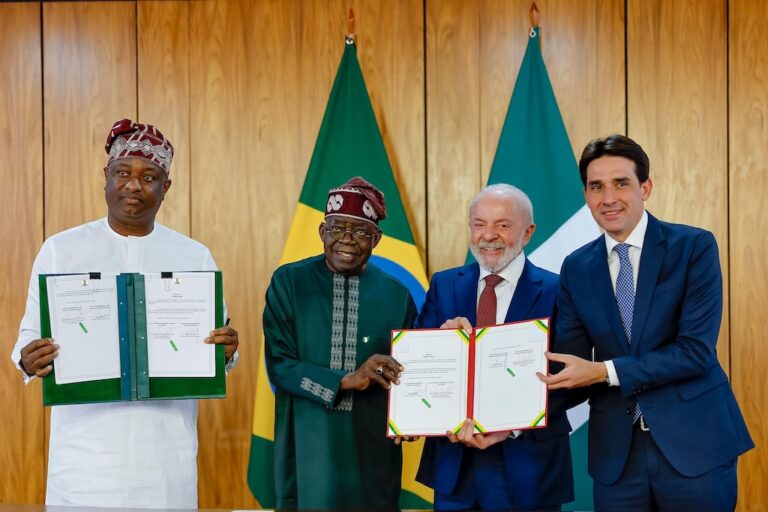
At the just-concluded visit, President Tinubu signed five new sets of MoUs, which signalled renewed efforts towards strengthening historic ties and trade relations between both countries.
The ICIR reports that President Tinubu’s latest visit to the South American country was the third since he assumed office on May 29, 2023.
To further consolidate the trade ties, President Bola Tinubu participated in a string of bilateral talks and sealed five MoUs with his Brazilian counterpart, Luiz Inácio Lula da Silva.
The two-day state visit, which started on Monday, August 25, saw both leaders witness the inking of the five MoUs to strengthen the Nigeria-Brazil bonds.
The new deals cover a range of sectors including trade, diplomacy, science, aviation, and finance.
“The trip has the potential to accelerate Nigeria’s economic growth through targeted engagements in key sectors. Yes, this is the third visit of President Tinubu to Brazil, and it is with a justifiable cause. It reflects a renewed and focused effort to build lasting economic integration between both countries,” said Special Adviser to the President on Media and Public Communications, Sunday Dare.
Dare stressed that Nigeria and Brazil share similarities in demography, economy and cultural affinity, making the visit timely and important.
The visit also revived Nigeria’s business deal with the Brazil’s state-run oil company-Petrobras, with President Tinubu’s assurance during a press conference in Sao-Paulo that they will return to Nigeria soon.
Petrobras began operations in Nigeria in 1998 in the deep waters off the Niger Delta. It sold its stakes more than 10 years ago to raise cash for domestic projects. Since then, Nigeria has been working to address some of the problems that have limited oil and gas output.
“Petrobras is the closest to us in terms of deep-water off shore. They have similarities with us when it comes to deep-water off shore. If they come into marginal fields or acreages, it is good and signposting confidence in the government reforms,” former Chairman of Major Oil Marketers Association of Nigeria, Adetunji Oyebanji, told The ICIR.
He stressed the importance of the government officials following up with several signed MoUs to ensure it leads to a successful business deals match-making and closure.
The ICIR reports that the visit led to the signing of a Bilateral Air Services Agreement (BASA) to facilitate a direct flight route between Lagos and São Paulo. This has been a long-standing barrier to their trade relations.
It also led to the signing of an MoU on science and technology to foster collaboration in biotechnology, bioeconomy, and energy, with a focus on technology transfer.
And, it further led to the signing of a finance and agriculture agreement to promote trade, investment, and agricultural financing.
These pacts, expected to boost the trade in merchandise, which currently stands at $2.1 billion as of the 2024 year-end, are strategies to strengthen the historic bond between these two countries with the world’s largest black populations.
President Bola Tinubu and his Brazilian counterpart during his two-day state visit to Brazil on Monday, August 25… Source: Bayo Onanuga
The signing of the MoUs is very strategic to Nigerian development and will boost the agriculture sector, Director of Corporate and Regulatory Affairs, Olam Agri, Ade Adefeko, commented while speaking at the Arise Global Business programme on Tuesday, August 26.
He believes the signing of the MoUs is important to cement earlier meetings and discussions between the two leaders.
“So, there have been a lot of preliminary discussions and all that. With these MoUs being signed, what we need to do now when they [President Tinubu and his ministers] come back is action.
“Again, I think the President or the presidency must appoint ambassadors or high commissioners. It has been pending, and I think it’s been way too long.”
Tinubu had in September 2023 recalled all ambassadors,, leaving only the country’s United Nations permanent representative and has yet to replace them, The ICIR reported. Nigeria has 109 diplomatic missions worldwide, comprising 76 embassies, 22 high commissions, and 11 consulates.
Dwindling trade relations
Over the last decade, Nigeria-Brazil bilateral trade, which had risen to as high as $9 billion in 2012, before dropping to $1.3 billion in 2021 is now at $2.1 billion in 2024.
Currently, Brazil’s 49th largest export destination, Brazil exported about $1 billion to Nigeria, primarily sugar and jams, and imported $1.1 billion, mostly fertilisers.
Previous bilateral deals
Nigeria and Brazil have been sharing longstanding cordial diplomatic relations as far back as the early 1960s.
Coming down to most recent collaborations, in 2019, the Green Imperative Programme (GIP), a $1.1 billion agricultural mechanisation project, was unveiled with the aim that Brazil would supply 10,000 tractors and 50,000 units of farm equipment for assembly in Nigeria.
In 2023, both countries signed an MoU to establish the Mechanism for Strategic Dialogue to foster cooperation in agriculture, trade, defence, energy, education, power, petroleum, and mining.
In 2024, during Tinubu’s participation at the G20 Leaders’ Summit, the two countries also sealed a $2.5 billion investment aimed at boosting Nigeria’s food security efforts, agricultural production, and creating job opportunities for the youth.
Long-standing trade barriers
As groundbreaking as the recent agreements are, there have been fundamental issues in their trade relations, dwindling the trade volume and causing it to drop $9 billion in 2013 to about $2 billion in 2024.
Of particular emphasis is the lack of direct flights between the two countries.
The cut-off of direct flights between the two countries has made it extremely difficult for businessmen and women to transact business, shrinking the volume and value of imports and exports, and dwindling their incomes.
Travels between both countries which should ordinarily last for about six to seven hours, have left travellers having to go through Europe, South Africa or Dubai to connect to Brazil, and spending about 13 hours besides having to pay more for air tickets.
Harnessing the agreements
After about six years of unveiling the programme, in March this year, the Nigerian government announced that the commercial phase of the $1.1 billion Green Imperative Project had kicked off to boost agricultural productivity and enhance private-sector investment in Nigeria.
Added to this $1.1 billion deal, which is now on course, are the $4.3 billion phase 2 of the project and the $2.5 billion JBS agribusiness programme sealed during Tinubu’s visit to Brazil in late 2024.
All these now amount to $7.8 billion worth of projects, which the Tinubu administration is expected to harness.
The green imperative initiative is believed to be the largest agricultural project in Africa that prioritises the development of sustainable and low-carbon agriculture, aiming to develop structural conditions to boost food production in Nigeria efficiently and competitively, according to the Nigerian government.
“Over the past seven years, there has been negotiation with the Nigerian government with a view to obtaining the necessary funds from private and regional development banks to finance this ambitious project, which is worth approximately $1.1bn dollars,” the Ambassador of Brazil to Nigeria, Carlos Garcete, said, according to a statement on Tuesday, March 18, 2025, by the Senior Special Assistant to Vice President Kashim Shettima on Media and Communication, Stanley Nkwocha.
ACCESS Holdings Plc has announced the resignation of a non-executive director, Roosevelt Ogbonna, from its board, after serving for three and a half years.
It announced this in a statement on Wednesday, August 27.
It said Ogbonna will continue to serve as the Managing Director/Chief Executive Officer of its flagship subsidiary, Access Bank.
According to the holding company, his resignation will allow Access Holdings to comply with the Central Bank of Nigeria’s (CBN) Corporate Governance Guidelines for Financial Holding Companies in Nigeria, 2023, which stipulate a maximum of nine directors for the board of a Financial Holding Company.
“The Board appreciates Mr. Ogbonna for his outstanding and continued contributions to the Access Group,” Access Holdings stated.
The ICIR reports that Roosevelt Ogbonna was appointed managing director and CEO of Access Bank in May 2022, after serving as deputy managing director from 2017 and executive director from 2013.
He joined Access Bank in 2002 from Guaranty Trust Bank and has built up more than two decades of experience in the banking industry.
His background combines both professional and academic achievements. He is a Fellow of the Institute of Chartered Accountants of Nigeria (FCA), an Honorary Member of the Chartered Institute of Bankers (HCIB), and a CFA charter holder.
Innocent Ike exits Access Holdings board
In a related development Access Holdings on Thursday, August 28, announced the appointment of Innocent Ike as the substantive group managing director/chief executive officer (GMD/CEO) of the company.
His appointment takes effect from August 29, 2025, following the receipt of regulatory approval, according to an official disclosure on Thursday.
By the appointment, Ike will succeed Bolaji Agbede, who has served as the company’s acting GMD/CEO for the past 18 months.
Access Holdings hinted that following regulatory stipulations on the required years of experience for a Financial Holding company’s managing director, Agbede will revert to her substantive role as the company’s executive director, business support.
Commenting, Access Holdings Chairman, Aigboje Aig-Imoukhuede, said, “We are thrilled to welcome Mr. Innocent Ike as we move forward. At the same time, we want to express our deepest gratitude to Ms. Bolaji Agbede. Her outstanding contributions over the past 18 months have been invaluable, and we appreciate her dedication in navigating the Company through challenges and opportunities. While regulatory requirements necessitate this change, we are grateful for the strong foundation that has been laid.”
Ike holds a bachelor’s degree in Accounting from the University of Lagos.
He is a Fellow of the Chartered Institute of Bankers of Nigeria (CIBN), a Fellow of the Institute of Chartered Accountants of Nigeria (ICAN), and a Certified IFRS expert.
He has over three decades of experience in banking and financial services, ten years of which were spent at Access Bank, where he rose to General Manager, overseeing portfolios in corporate, commercial, and public sectors.
He served as the Managing Director/Chief Executive Officer of Polaris Bank from 2020 to 2022, during which he launched VULTe, the bank’s digital banking platform.
“I am honoured to take on the role of Group Managing Director /Chief Executive Officer and excited to work alongside the talented team at Access Holdings. I look forward to building on the strong legacy established by Herbert Wigwe and Bolaji Agbede, and driving our vision forward, ensuring we continue to deliver exceptional value to our shareholders and stakeholders,” Ike said.
THE Minister of Solid Minerals Development, Dele Alake, has directed the sealing of a mining site in Gwagwalada Area Council, Federal Capital Territory (FCT).
According to a statement by his Special Assistant on Media, Segun Tomori, the minister took the decision following reports of illegal gold mining at the site and to mitigate potential environmental hazards.
The ministry said the action came in the wake of an earlier operation by the mining marshals, which led to the successful recovery and sealing of a mining site around the District 2 Extension layout in Gwagwalada on August 16, where 16 suspects were arrested and would be prosecuted soon.
“Preliminary investigations reveal that illegal artisanal miners invaded the area after the accidental discovery of a gold vein during the digging of a soakaway pit near a residential property.
“The most recent incident took place on a farmland located behind CKC in Gwagwalada. Upon receiving intelligence reports of renewed unlawful mining activity, Alake promptly ordered the deployment of mining marshals to secure the site,” the ministry stated.
The ministry said officials, led by the Director of Mines Inspectorate and represented by the Deputy Director, Sunday Okhuoya, carried out an on-the-spot assessment of the area on Wednesday.
It expressed satisfaction with the level of compliance with the minister’s directive and disclosed that relevant departments of the ministry had launched a thorough investigation to determine the root of the incidents, while also recommending measures to prevent a recurrence.
Similarly, the Commander of the Mining Marshals, Assistant Commandant of Corps (ACC) John Attah Onoja, confirmed that his team had established 24-hour surveillance over both sites, pending the outcome of the Federal Government’s ongoing inquiry.
In view of the potential environmental and public health risks associated with the illegal mining operations, the minister advised residents to steer clear of the affected areas while enforcement and remediation efforts are underway.
The minister reiterated the Federal Government’s resolve to eradicate illegal mining activities across the country, adding that his ministry was fast-tracking the deployment of satellite surveillance technology to monitor mining operations nationwide and significantly strengthen enforcement capacity.
In 2021, The ICIR, in an investigation, exposed how illegal gold mining thrived in Kundu, a remote community in the Kwali Area Council of the Federal Capital Territory.
The investigation revealed that thousands of miners, many of them from Zamfara and other parts of Nigeria, had taken over the area without licence, leaving residents to grapple with environmental degradation, polluted water sources, and declining farmland.
Despite the revelations and President Muhammadu Buhari’s public admission in 2020 that Nigeria was losing billions of dollars to illegal mining, his administration failed to act decisively.
Instead, government officials downplayed the problem, describing the miners’ activities as ‘informal’ rather than illegal. This neglect allowed the practice to flourish unchecked in Abuja and beyond.
The consequence has been the loss of billions of naira in potential revenue for both the FCT and Nigeria. While other countries generate huge earnings from their mining industries, Nigeria continues to make only a fraction of it should earn.
The ongoing seizure of the FCT’s mineral resources through illegal mining highlights how severely the country is bleeding from illegal mining.
A 300-level History and Diplomacy student at Niger Delta University, Bayelsa State, identified as Favour, has apologised for sharing a video showing a violent clash between a lecturer and a female student in her department.
In a video shared by This is Bayelsa on Wednesday, August 27, she said, “I want to sincerely apologise for my role in the circulation of a video that has caused embarrassment to my department and the school.
“I did not record the video but I acknowledged the fact that forwarding it to my class group contributed to its viral spread.
“I am sorry. I know my actions were wrong and careless, and I regret it deeply. I’m sorry to the school. I’m sorry to my department. I’m sorry to my lecturers. It was never my intention to bring shame to the department or the university. I’ve learnt a very important lesson, and I promise to be more responsible,” she said.
The ICIR reports that Favour’s apology bothers on a video shared on Monday by This is Bayelsa on social media, which captured a female student confronting a lecturer in a lecture hall, during which the lecturer was seen punching and headbutting her.
Reports indicate that the incident occurred after the lecturer allegedly caught the student cheating during an exam and ordered her to leave the hall.
The student, however, declined to leave, insisting on collecting her phone first.
In the video, a voice was heard saying, “Young lady, leave the hall first. You were caught cheating. Instead of you to leave the hall, you’re still doing ‘give me my phone.'”
The ICIR reports that the incident adds to the series of viral altercations on social media that have trended in Nigeria in recent weeks.
Recall that last week, videos surfaced online showing armed men in mufti clothes storming corps members’ lodge in Oba community, Anambra State, where they were seen beating and harassing a female corps member.
The state governor’s Special Adviser on Community Security, Ken Emeakayi, confirmed that the men seen in the video were members of Operation ‘Udo Ga-Achi,’ also known as the Agunechemba Vigilante Group.
That was a week after a viral video showed Comfort Emmanson, an ‘unruly’ passenger on Ibom Air at the Murtala Mohammed International Airport, Lagos, being dragged half naked out of the aircraft by four men, some of whom put on the Ibom Air’s reflective jacket.
Emmanson’s case surfaced a week after fuji musician Wasiu Ayinde Marshal, popularly known as KWAM 1, obstructed the safe operation of the ValueJet aircraft at the Nnamdi Azikiwe International Airport, Abuja.
NIGERIA will face a worsening debt burden in the coming year as the Federal Government has projected a rise in the debt-to-GDP (gross domestic product) ratio to 60 per cent by 2027.
The country currently has a debt-to-GDP ratio of 52.25 per cent as of December 2024, now expected to rise by 7.75 per cent.
Economic watchers say this would amount to higher inflationary pressure and create more currency problems for Nigeria, which could see Nigeria pay higher cost to service borrowed funds and trapped in debt.
With the debt surge, there are also growing fears of sovereign default, the possibility that Nigeria might struggle to meet its debt obligations.
Nigeria’s fiscal position has deteriorated significantly over the past decade, with public debt rising, driven largely by currency devaluation and persistent fiscal deficits.
“FGN’s public debt has continued to skyrocket. In just two years of this administration, the debt has doubled what the previous administration accumulated in eight years,” says Adonri,”Vice Chairman at Highcap Securities, David Adonri, said.
“While the naira-denominated debt may be covered with Ways and Means (central bank financing) at the risk of hyperinflation, escalating foreign debt must be extinguished with hard currency, which may not be available when needed. That is the real threat; a sovereign default could occur if this pace of foreign borrowing continues unchecked. We are already in a debt trap, borrowing new funds to pay old debts. If the federal government doesn’t de-leverage soon, insolvency could be imminent.”
A debt-to-GDP ratio is used to measure a country’s debt as a percentage of its GDP, which indicates its ability to repay its debt.
While a low ratio suggests a stronger economy and greater capacity to meet debt obligations, a high ratio signifies a heavier debt burden and potential repayment difficulties.
In a recent disclosure, the Debt Management Office (DMO) said that Nigeria’s debt-to-GDP ratio will rise to 60 per cent by 2027.
It disclosed this in the recently approved Medium-Term Debt Management Strategy (MTDS) for the 2024-2027 fiscal year, dated August 22.
It said the approved MTDS would ensure debt sustainability while meeting the country’s financing needs.
The MTDS, developed with technical support from the World Bank and the International Monetary Fund (IMF), is a globally recognised tool for managing public debt.
The framework aims to balance borrowing costs with associated risks, deepen the domestic securities market, and optimise the composition of Nigeria’s debt portfolio.
“The key objectives of the MTDS are to meet the Government’s financing needs and payment obligations in the short to medium term, taking into consideration the costs and risks trade-offs in the debt portfolio.
“To achieve optimum composition of the public debt portfolio that ensures debt sustainability; and to further deepen the domestic securities market through the introduction of new products,” the DMO stated.
It explained that the preparation of the MTDS usually involves the consideration of alternative funding strategies available to the government, as it seeks to meet its financing needs, taking into consideration the cost of borrowing and the associated risks, while ensuring debt sustainability in the medium to long-term.
It stressed that nominal debt as a percentage of GDP is expected to be capped at 60 per cent by 2027, compared to 52.25 per cent as at end-December 2024.
Other projections in the framework included that interest payments will not exceed 4.5 per cent of GDP compared to 3.75 per cent in 2024, while sovereign guarantees are to remain below 5 per cent of GDP, up from the 2.09 per cent
It revised domestic to external to “55:45, compared to 48:52 previously, while maintaining domestic borrowing at least 75 per cent long-term instruments against a maximum of 25 per cent short-term.
Refinancing risk is to be contained, with debt maturing in one year not to exceed 15 per cent of the total portfolio
The DMO stated further that the foreign exchange (FX) debt will be capped at 45 per cent of the entire debt stock.
It noted Nigeria’s average debt maturity of 11.05 years and average time to refixing of 10.74 years already exceeded the minimum thresholds of 10 years set in the strategy.
Nigeria’s total public debt burden has risen to N149.39 trillion as of the first quarter of this year, The ICIR reported.
It rose by N27.72 trillion year-on-year from N121.67 trillion as of the first quarter of 2024.
It is likely to rise higher in the second quarter of this year by the time the DMO releases its next report as the National Assembly had approved new foreign loans worth $24.14 billion requested by President Bola Tinubu.
AKINWALE Arobieke, better known in the UK as “Purple Aki,” has reportedly been found dead at his home in Toxteth, Liverpool.
The 64-year-old British-Nigerian bodybuilder was discovered unresponsive at his residence on Devonshire Road around 8:30 p.m. on Tuesday, August 26, according to reports.
He was pronounced dead at the scene, and authorities confirmed that his death is not being treated as suspicious.
“We can confirm that emergency services were in the Toxteth area following a non-suspicious death last night, August 26.
“At around 8:30 p.m., officers were made aware of a man in his 60s who was found unresponsive at an address on Devonshire Road, Princes Park. He was sadly pronounced deceased at the scene.
“The man’s death is not suspicious and a file will be prepared for the coroner,” a Merseyside Police spokesperson was quoted to have said.
Born Akinwale Oluwafolajimi Oluwatope Arobieke on July 15, 1961, at Crumpsall Hospital in Lancashire, Aki was of Nigerian descent.
His mother, then a secretarial student, placed him in care at just six months old. He later spent time in a Barnardo’s home in Llandudno.
As an adult, he worked in modest jobs, including as a tunnel cleaner in the Mersey Tunnels and as a messenger for Liverpool City Council.
For decades, Arobieke remained a well-known and controversial figure in Merseyside, where he was depicted in local folklore as a “bogeyman.”
He gained notoriety in the 1990s for approaching young men and asking to touch their muscles.
In 1986, he was initially convicted of the involuntary manslaughter of 16-year-old Gary Kelly, who died after coming into contact with a live rail while attempting to flee from him.
The conviction was later overturned on appeal, and Arobieke was awarded £35,000 in compensation.
Beyond that, he was also convicted of touching and measuring the muscles of young men and asking them to squat his body weight.
In 2003, Arobieke was sentenced to six years in prison for multiple counts of harassment and witness intimidation, following incidents that spread fear among young men in the region.
Similarly, in 2006, authorities imposed a Sexual Offences Prevention Order (SOPO) on him, even though he had no sexual convictions. The order prohibited him from touching, feeling, or measuring muscles, loitering around gyms or schools, or entering specific towns such as St Helens and Warrington.