Home Blog Page 1992

Edo Poll: Buhari again waxes rhetorical on election fraud

0

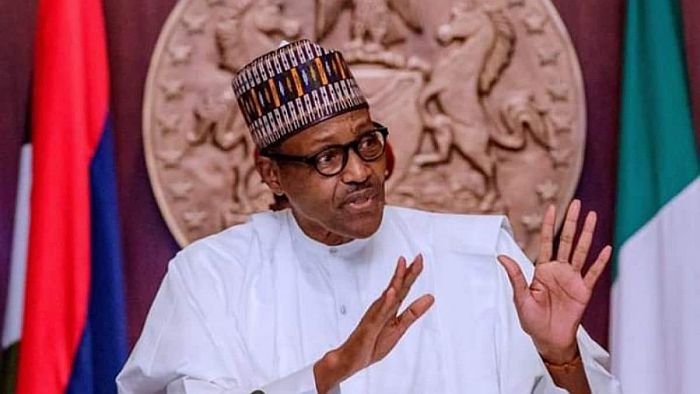
NIGERIAN President, Muhammadu Buhari says conducting free and fair elections in Nigeria is one of his main concerns for the country’s democracy ahead of the 2020 Edo gubernatorial elections.

But the president, three times,  has refused to sign the electoral bill into law. The bill prescribes swift prosecution of election violence and vote-buying perpetrators by setting up special courts, among other provisions.

Instead, the President, in a statement on Thursday signed by Femi Adesina, the Senior Special Assistant to the President on Media and Publicity, expressed his frustration at achieving electoral integrity.

“Conducting a free and fair election is one of my main concerns for our democracy and I want this commitment to be one of the legacies I will leave behind when I depart office,” Buhari said.

He called on political parties and their candidates as well as security agents participating in the Edo governorship election to uphold democratic standards during the poll.

“I am passionately committed to free and fair elections, but my own commitment is not enough if other actors at ground zero refuse to abide by the rules.

“I want to see democratic standards in the country raised higher at every level, but these cannot be achieved when politicians resort to do or die methods to gain power by any means or machination,” the President said.

Buhari urged the participant and stakeholders in the election to desist from actions that could undermine the integrity of the polls.

According to the statement, the President wishes to see an upgrade in democratic standard in the country but these may be unachievable if the political actors do not desist from the do-or-die method.

“I want to see democratic standards in the country raised higher at every level, but these cannot be achieved when politicians resort to do or die methods to gain power by any means or machination.

Buhari noted the threat posed by do or die mentality to the conduct of free and fair elections in Nigeria.

“The do-or-die mentality to politics is a threat to free and fair elections because the actors are more focused on winning than caring about a fair outcome that reflects the will of the people,” Buhari added.

The opposition is often unpersuaded by the president rhetorics on the election.

In 2019, Rivers State Governor Nyesom Wike has alleged that Nigeria president Muhammadu Buhari is not committed to free, fair and credible elections.

President Buhari declined to assent to the electoral (Amendment Bill in December 2018 after rejecting the bill on three previous occasions.


Lawmaker threatens to sue police over death of constituent in Osun

0

BAMIDELE Salam, a member of the House of Representatives has threatened to institute a legal action on behalf of the family of one of his constituents, Idris Ajibola who was killed in an auto crash while being chased by operatives of Special Ant-Robbery Squad (SARS) arm of the Nigeria Police in Osogbo, Osun State on Tuesday. 

Salam who represents Ede North, Ede South, Egbedore and Ejigbo Federal Constituency of Osun State in the in the House of Representatives issued the threat in a statemenafter a visit to the bereaved family of Idris in Ofatedo, Egbedore Local Government of the state.

He called on the Inspector General of Police to immediately order the arrest of the Policemen whose conduct led to the auto crash that killed the 21-year old apprentice.

The lawmaker said it was unfortunate that many Nigerian youths are being humiliated and wasted by law enforcement agents on a frivolous pretext of fighting cybercrime.

“These incidents of Police picking on young Nigerians for whatever reasons, either holding a laptop, phones, wearing expensive shoes or clothes or in nice cars and are picked by policemen and profiled as internet fraudsters and then chased on to their death or humiliated must come to an end,” he said.

While describing the late Idris as a son of peasant parents who struggle to eke out a daily living, Salam said there was nothing ostentatious about the life of the deceased to suggest his being involved in any crime and wondered why the police could not adopt a more civilised approach in dealing with suspects as it obtains in other parts of the world.

The lawmaker expressed shock that 48 hours after the incident, no arrest has been made of the officers involved thus fuelling speculation that the matter would be swept under the carpet like similar ones which happened in the past.

“This incident happened 48 hours ago and as we speak, there is no arrest of any of the perpetrators. The only thing I heard is the setting up of an investigation panel. 48 hours after the incident, there is no record of anyone being paraded or arrested for chasing those young boys to their destructive end where one of them lost his life,” Salam lamented.

He said if the police authorities failed to do justice to the family of the victim, he would have no choice than to seek justice in a court of law and ask for appropriate compensation for the family.

Police brutality and excesses have become a worrisome concern in Nigeria as many civil societies organizations and stakeholders are calling for institutional reforms within the police system.

In a 2020 report titled “Time to End Impunity,” Amnesty International documented at least 82 cases of torture, ill-treatment and extra-judicial execution by SARS between January 2017 and May 2020.

According to the report, the victims of SARS, a unit in the police that is set up to fight violent crimes, are predominantly male between the ages of 18 and 35, from low-income backgrounds and vulnerable groups.

“The complete failure of Nigerian authorities to bring an end to the gross human rights violations perpetrated by the Special Anti-Robbery Squad or to bring any SARS officer to justice is shocking and unacceptable. Nigerians are outraged by the systemic human rights violations perpetrated by the SARS with impunity,” said Osai Ojigho, Director of Amnesty International Nigeria.

“The systemic use of torture and other ill-treatment by SARS officers for police investigations and the continued existence of torture chambers within the Nigerian Police Force points to an absolute disregard for international human rights laws and standards.”

Amnesty International’s investigation also revealed a disturbing pattern of abuse of detainees in SARS custody despite the 2017 Anti-Torture Act. In many cases, Amnesty International says it bore witness to the scars, bruises, and dried blood on victims’ bodies. Many of them were subjected to beatings with sticks and machetes and denied medical care.

The report also shows that these horrific violations were carried out under the supervision of high-ranking police officers.

Release detained journalist, amend cyber-crime law, CPJ tells Nigerian government

0

A CIVIL Society Organisation, Community to Protest Journalists (CPJ), advocating for global press freedom has called for the release of Nigerian Journalist, Ime Sunday Silas, and amendment of the Nigeria Cyber Crime Act.

CPJ made this call in a statement posted on its official website on Wednesday noting that the journalist has been held in detention for over one month despite a court order granting his release on bail.

“Nigerian authorities should immediately release journalist Ime Sunday Silas, drop the charges against him, and reform the country’s cybercrime act to ensure it is not used against the press,” CPJ said.

Angela Quintal, CPJ’s Africa program coordinator, in New York said Silas’ illegal detention serves as one of the extents at which the Nigerian government is ready to go to suppress the press in the county.

“The prolonged detention of journalist Ime Sunday Silas is yet another grave reminder of the lengths to which Nigerian authorities are willing to go to silence journalism they find undesirable,” Quintal said.

According to CPJ, Silas was arrested and transferred to the State Police Headquarters on August 17 by officers of the Nigerian Police in Uyo city, the capital of Akwa-Ibom state.

CPJ stated that Silas was arraigned before a local magistrate court on August 18 under Section 24 of Nigeria’s 2015 cybercrime act, according to a copy of the charge sheet it reviewed.

“The court denied Silas bail on August 18, but his lawyers filed a new bail application on August 24, which was granted on September 10, Emmanuel Isangidoho, one of Silas’ lawyers, told CPJ via phone and messaging app.

“Despite being granted bail, Silas remains in the police headquarters as of today, according to Solomon Johnny, Global Concord’s editor-in-chief,” the statement read.

The advocacy group further stated that Silas’ charge sheet alleges that he violated Section 24 of the act related to “cyberstalking” by sending a message that included the title of an August 9 report published by The Profile about Martha Udom Emmanuel, the wife of Akwa-Ibom Governor Udom Emmanuel in a report, titled “Exposed: Okobo PDP Chapter Chair links Gov Udom’s Wife with a plot to blackmail Deputy Speaker,” alleged a blackmail scheme related to upcoming local council elections.

CPJ noted that the Nigerian government as part of the means to suppress the press has continued to use section 24 of the cyber-crimes law to prosecute journalists in the country.

Emmanuel Isangidoho, one of Silas’ lawyer told CPJ that it was illegal for any magistrate court to charge Silas with a federal crime, like cybercrime, and that only a higher court had the authority to hear such cases.

A check by The ICIR on the Cyber-Crime Act of 2015, Section 30 read that ‘The Attorney-General of the Federation shall prosecute offences under this Act (Cyber Crime Act) subject to the provisions of the Constitution of the Federal Republic of Nigeria, 1999’.

In a court ruling attached with the statement, CPJ said the Economic of West African States (ECOWAS) in a suit involving the Incorporated Trustees of Laws and Rights Awareness Initiatives and The Federal Republic of Nigeria ruled that the Cyber Crime Act of 2015 Section 24 of the cybercrime act violated the right of freedom of expression and ordered the government to “repeal or amend” the law.

LASG disowns viral video of branded wastebaskets sales in Lagos

0

THE Lagos State Government, on Thursday, disowned the viral video, where some individuals in uniform were promoting the sale of branded wastebaskets purportedly on behalf of the state.

A statement signed by the State Commissioner for the Environment and Water Resources, Tunji Bello, noted that all the characters in the viral video are fraudsters who do not represent the State Government or any of its agencies.

Bello affirmed that there is no unit or agency under the Ministry of the Environment and Water Resources that goes by the name “Lagos State Vehicle Waste Basket (LAVWAB) Enforcement/Compliance” as portrayed in the branded vehicle which the fraudsters operated from.

He pointed out that the dubious intent of the criminals in the video could be deduced from the fact that they operated from inside a van within an automobile workshop and were very dodgy about the kind of enforcement exercise they were supposedly carrying out.

While noting that the State Government had always encouraged all buses, trucks and articulated vehicles to provide wastebaskets in their vehicles to discourage littering of the roads and streets, Bello maintained that the present administration has never recommended any branded wastebasket to Lagosians.

The Commissioner said the development has been communicated to security agents to spread their dragnets towards apprehending the criminals and their cohorts, wherever they operated from, and bring them to book.

Bello, therefore, enjoined members of the public to report any incident of anyone claiming to represent the State Government and coercing them to purchase any particular brand of wastebaskets for placement in their vehicles.

The Commissioner also implored owners and operators of buses, trucks and articulated vehicles in the State to continue to use wastebaskets of their choice in their vehicles, as part of efforts to discourage littering and promoting a culture of proper waste disposal.

Singapore’s court acquits Nigerian of drug trafficking after nine years in detention

0

THE Court of Appeal in Singapore on Thursday discharged and acquitted Ilechukwu Uchechukwu Chukwudia, a Nigerian on death row for drug trafficking, after nearly a decade since he was arrested.

In a long-running legal tussle, the Singaporean court reversed its decision declaring Chukwudi not guilty, five years after the same court had convicted him.

Four out of five justices in a split decision on the case voted that Ilechukwu did not know there were drugs in the bag, as their findings show that he had been “deceived” unwittingly into transporting drugs.

“The picture that emerged from the evidence showed that he had grossly misjudged his childhood friend and acquaintance, naively believing that he was doing a simple favour in return for promised business contacts.

“Ignorantly, he had been deceived into transporting drugs on their behalf to (their) contact in Singapore,” the statement of the judges read.

In November 2011, Ilechukwu was charged with trafficking about 2kg of methamphetamine which was found in a black trolley bag he brought with him from Nigeria into Singapore.

He had collected the luggage at the airport in Nigeria, found only clothes in it. The luggage passed several immigration checks in both countries until he was handed the bag to a Singaporean stall assistant named Hamidah Awang at a Clarke Quay bus stop.

Hamidah’s car was then searched at Woodlands Checkpoint in River Valley Road, Singapore, and drugs were discovered in the luggage.

Drug trafficking in Singapore is punishable by death.

Ilechukwu had been acquitted after a trial in the High Court in 2014 but the appellate court reversed that decision in 2015 and found him guilty of drug trafficking.

His lawyers, Eugene Thuraisingam, Suang Wijaya and  Johannes Hadi from Eugene Thuraisingam LLP, as well as Jerrie Tan from K&L Gates Straits Law, had argued for the decision to be reviewed.

During the sentencing stage, they provided “material evidence” showing that Ilechukwu was suffering from Post-Traumatic Stress Disorder, PTSD, with dissociative symptoms.

In August 2017, the Court of Appeal then ordered a review of the case in light of the fresh evidence, given by the psychiatrist who was a prosecution witness.

At the review, the court upheld their submissions and found that Ilechukwu experienced PTSD symptoms while giving statements to authorities.

Ilechukwu’s acquittal is the second time in two years that a Nigerian citizen has won a drugs-related case in Singapore.

In May 2019, Adili Chibuike Ejike, who had been sentenced to hang for importing almost 2kg of methamphetamine, was cleared by the Court of Appeal. Adili had similarly been arrested in 2011 in a related case.

What Edo poll says about Nigeria’s democracy

0

By Ikechukwu AMAECHI


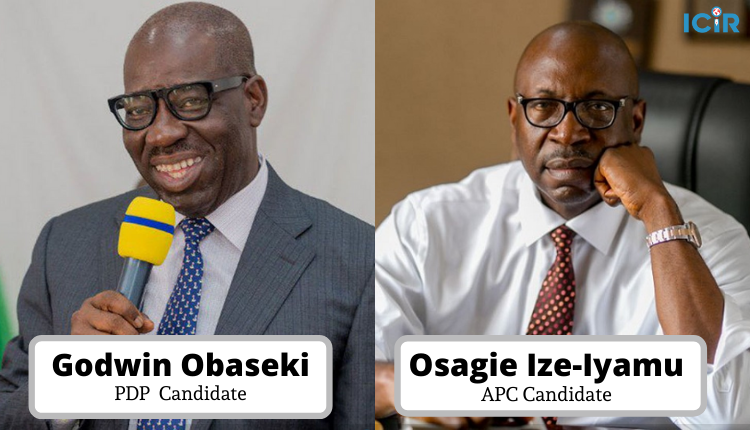
IDEALLY, voters in Edo State should decide on Saturday, September 19 whether to retain Godwin Obaseki as governor for a second term or hand the baton to Osagie Ize-Iyamu of the All Progressives Congress (APC). Obaseki recently defected from the APC to the Peoples Democratic Party (PDP).

Fourteen candidates are on the ballot but it will be a straight battle between Obaseki and Ize-Iyamu, a protégé of former Governor Adams Oshiomhole who had installed Obaseki in power in 2016.

These men know themselves well. Scions of the legendary Bini kingdom, they slugged it out in 2016.

Four years down the road, however, nothing has fundamentally changed except the political vehicles in which they are riding to Osadebe House and their prime supporters and adversaries. The issues remain the same.

It is all déjà vu.

Expectedly, the Independent National Electoral Commission (INEC) has promised a free and fair election, saying, “Your votes will count.”

“I wish to reassure you that votes will count and only the choice made by the people of Edo State will determine the outcome of the election,” INEC Chairman, Professor Mahmood Yakubu, pledged in Benin City on Monday.

Nigerians with the 2019 elections on their mind are hard put believing him. He made the same pledge before last year’s general ballot and doubled down on it in the November 2019 governorship vote in Bayelsa and Kogi. They turned out badly.

A day after Yakubu’s vacuous pledge, Edo INEC Resident Electoral Commissioner (REC), Johnson Sinikiem, said: “With barely five days to the election, please permit me to say that we are ready ….”

Despite these declarations, I dare wager a bet before the first ballot is cast: The ballot will neither be free nor fair and the winner will not be determined by the 2,210,534 registered voters or the 1,726,765 who collected their permanent voter cards (PVCs).

That ultimate decision will be made in the months ahead by Justices of the Supreme Court, none of who will cast a ballot on Saturday.

The combatants have built an impregnable war chest for the battle after the battle, which will be fought in courtrooms. Every Nigerian politician who knows his onions puts aside a large chunk of his war chest for that purpose.

Some don’t even bother to campaign; they lay ambush in the courts as Senator Hope Uzodinma did in Imo State. Today, he is governor courtesy of the Supreme Court while those who looked up to the people in whom sovereignty resides in a democracy are left out in the political cold.

On Monday, the Inspector General of Police, Mohammed Adamu, announced the deployment of no fewer than 31,000 policemen, including DIG Adeleye Oyabade, AIG Hosea Hassan and eight Commissioners of Police for the election.

Adamu is upbeat that his officers would remain impartial, firm, and committed to a free, fair, and credible election, vowing that violators of electoral laws would be dealt with irrespective of political affiliation. A load of hot air!

The same promise is made for every election, including the very violent Kogi governorship poll in November 2019 and it is observed in the breach. Nothing suggests a shift in paradigm on Saturday.

Of course, Edo will be shut down, curfew imposed, movements restricted, businesses shuttered, yet there will be violence. The lions and tigers will be let off the leash to do what they know how best to.

The Department of State Services (DSS) and the military – Army, Navy and Air Force – are also doing their own deployments. Paramilitary institutions such as the Nigeria Security and Civil Defence Corps (NSCDC) are fully mobilised.

The Federal Road Safety Commission (FRSC) is not left out. On Tuesday, it announced a deployment of 1,500 officials and 35 vehicles, including tow trucks to, among other things, enforce the “no movement order.”

Because of an off-season election, Edo State has suddenly become a war zone. We should be ashamed of what we have made of this so-called democracy. It need not be like this.

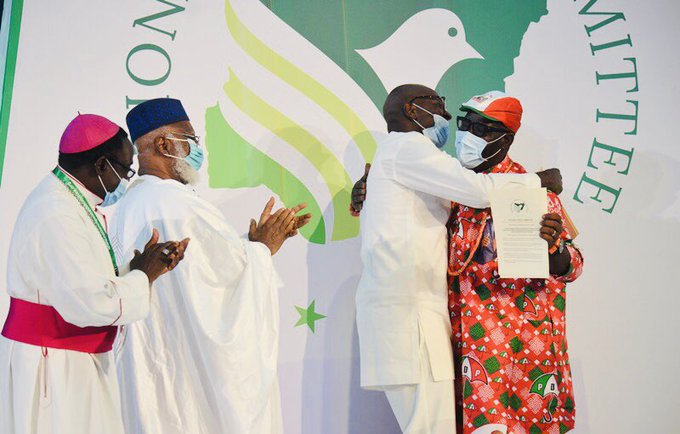
On Tuesday, the 14 contestants signed a peace accord promoted by the National Peace Committee (NPC), led by former military ruler, Abdulsalami Abubakar, and Catholic Bishop of Sokoto Diocese, Matthew Hassan Kukah.

Undiscerning observers crow that the accord is a proof that the political gladiators have decided to toe the line of peace.

Is it? Not really. Assuming without conceding that the gladiators have repented of their sins, what about the wannabe godfathers such as Oshiomhole who see the election as a matter of life and death? Did they also agree to sheath their swords?

To be clear: I doubt this peace accord will make any difference.

Besides, there is no better proof that this democracy is not working than this overarching need to compel politicians to sign a peace accord in every election cycle.

In other climes, even here in Africa, politicians don’t sign peace accords promising to be of good behaviour before elections. That is given.

We have behaved so badly democratically that the United States, a country governed by a president, Donald Trump, who is in no way an exemplar of democratic ethos, has imposed visa restrictions on unnamed Nigerians undermining democracy.

The United Kingdom has upped the ante threatening to impose visa ban, carry out asset seizure, or even prosecute under international law, Nigerians, over election-related activities in our country.

Many are clapping and calling on other European countries to weigh in, unmindful of the fact that it is rather condescending to be dictated to by other countries.

But that is how low we have come. Ghana does not face such humiliation in its democracy.

All these threats will not make any difference on Saturday. Those calling for electoral reforms don’t get it. There are too many strong men in Nigeria without strong institutions.

The strong men manipulate and control the institutions. In countries that have made progress, it is the other way round.

There will be violence in Edo on Saturday. The election will be rigged and the fundamental right of the people to choose who governs them will be grossly violated. That will be nothing new because the election has already been rigged against the people right from the primaries.

After the polls, the INEC will make its call which may not necessarily reflect the aspiration of the people, who, like the axiomatic toothless bulldog, will make noise but take no action.

Then-President Muhammadu Buhari, the self-acclaimed, world-famous democracy convert, will step in and advise the “losers” to seek redress in court. If there are fatalities, he will condole with families of those who lose their loved ones. The condolence letter template is constant. The presidential media aides will only put a new date and sign off.

Those who “win” will be inaugurated and those who “lose” will heed Buhari’s advice and go to court.

So much money, in fact much more than was used to prosecute the election, will be spent in the courts. At the end of the day, Supreme Court will give Edo people the governor it thinks they deserve.

He may be somebody who came a distant fourth, as it happened in Imo State. And Edo will join the league of states with governors appointed by the Supreme Court, not elected by the people.

And the people will move on as we are wont to do.

Democracy in Nigeria is a criminal enterprise and it continues to be so because rather than face the reality, which is, this democracy is not working, many Nigerians inexplicably choose to live in their own bubble.

Edo Election: CDD warns against vote-buying, fake news, likely electoral violence

0

THE Centre for Democracy and Development (CDD) has warned against likely electoral violence, vote-buying and spread of fake news ahead of the September 19 Edo gubernatorial election.

The organisation made this known during a press conference on pre-election analysis report on Thursday in Abuja.

According to CDD, trends of claims and counterclaims of victory, deliver your polling unit directive given to political party agents are the recipe for violence which is likely to cause partisan clashes during the election.

“CDD notes with concern the recalcitrance of political actors and their surrogates who continue to instruct their die-hard supporters to ensure 100 per cent victory at all cost in their respective polling units. Observers report that party thugs are being deployed to local governments to “deliver” votes and there is a likelihood of a breakdown of the peace,” said Adele Jinadu, the Chair, CDD Election Analysis Centre.

Jinadu added that if the claims are not countered to disabuse the minds of the electorate, especially at the grassroots, it could become the basis to incite supporters to engage in conduct inimical to public peace.

“The hotspots of possible violence identified by CDD include Etsako West, Etsako East, Etsako Central, Owan West and Akoko-Edo in Edo North Senatorial district. In Edo South, Oredo, Orhionmwon, Egor, Ovia North East, and Ikpoba-Okha LGAs have shown such early warning signs. While in Edo Central Senatorial district, Esan Central, Esan North East and Esan West,” Jinadu stated.

Idayat Hassan, the CDD director said another observation by the organisation is the spread of fake news on social media pertaining to the election.

“Both the APC and PDP in Edo state have dedicated media teams with clearly defined structures designed to maximise their online presence. While the PDP is using targeted and sponsored messages on both Instagram and Twitter, the APC is supporting a structured team of up to 300 canvassers spread across Facebook, Twitter, Nairaland and WhatsApp groups,” Hassan noted.

CDD also stated that there may be a need for the Independent Electoral Commission (INEC) to extend the voting hours for as long as possible in respect to adherence to COVID-19 protocols.

“CDD will like to point out that given the extra health precautions and social distancing policy to be adopted during polling, voting may take longer than normal. We hereby call on the Commission to prepare to provide for extended polling hours,” the organisation said.

On security, the CDD stated that its observation revealed that there has been an increase in deployment of security personnel into the state ahead of the election.

“CDD observers report an increase in the deployment of security operatives across Edo State. The role of security in the election remains to deter trouble makers, protect election materials and ensure the space is safe for poll officials, voters and election observers.

“CDD calls on the security operatives deployed in Edo State not to engage in any acts, which would intimidate or scare voters away from exercising their democratic right to vote. CDD similarly calls on the officers of the police and sister security agencies deployed to the State to ensure they do not descend into the arena of partisanship,” the organisation explained.

However, CDD noted that its observation has revealed that vote-buying may determine the outcome of the election according to interviews with some voters in the state.

“CDD observers reported an emerging trend in the pattern of vote-buying wherein it is the voters who are now searching for the highest bidder among the political camps to sell their vote to. A number of voters interviewed insisted that the only thing, which would make them vote, is if a contestant agrees to pay an amount for the vote.

“Beyond individual voters searching for willing buyers to sell their votes to, it is similarly disturbing, as confirmed by our observers that barely three days to the Edo State governorship election, the National Directorate of Employment (NDE) under the Minister of State for Labour and Employment decided to empower 2,000 women in the State,” CDD noted

Concerning the turnout of voters during the election, CDD said it believes the Edo Election presents a real opportunity to prevent some of the unacceptable fallouts from previous elections, wherein there were clear attempts to taint the vote through inflation of voter turnout.

“This was the case in the last governorship election wherein turn out increased by over 200 per cent in LGAs like Okene in Kogi state, from where the incumbent hails.

“In the 2015 governorship election, 35,143 voters (30 per cent turnout) were accredited for the election compared to 114,001 (86.9 per cent) in 2019. In Edo, INEC should be able to anticipate such magnitude of electoral fraud, so it does not become a rubber stamp for a fraudulent process,” CDD said.

Obaseki polls ahead of Ize- Iyamu in pre-election surveys

WITH less than 48 hours to the 2020 Edo governorship election, PDP flag bearer and the incumbent governor of the state, Godwin Obaseki, is polling ahead of his opponent, Osagie Ize-Iyamu, in several online surveys tracked by The ICIR.

The Centre tracked six polls conducted online via websites and microblogs, all of which show that Obaseki is more popular than other contestants in the Saturday, September 19 election.

In a poll conducted by Situation room, a civil society group, Godwin Obaseki obtained 57.73 percent of the total vote, followed by Ize-Iyamu who scored 40.07 percent and others, 0.94 percent.

Similarly, Allnews Nigeria, a digital media platform, had in August set up an online opinion poll targeted at Edo voters that lasted for two weeks, and the majority of the voters tipped Obaseki as the winner.

Obaseki polled 67.9 percent of the total votes, while Ize-Iyamu scored 28.4 percent, and others got 3.7 percent.

A survey by Opera News, a Chinese-owned news outlet, featured 1,130 voters, out of which 803 voted Obaseki, 313 for Ize-Iyamu and only 14 voted for others.

But in the poll organised by Ripples Nigeria, another online news platform, the two candidates of PDP and APC are in a close tie, notwithstanding, Obaseki was still able to snatch 17 votes more than his rival.

Out of the 7,129, Obaseki scored 3,368, representing 47.2 percent while Ize-Iyamu polled 3,351, representing 47 percent. The rest scored, 410 (5.8 percent).

Immediately after the debate organized by Channels Television on Sunday, September 13 for the candidates in the Edo election, Legit.ng organized a poll on Twitter where 858 voters participated. Obaseki gleaned 57.8  percent of the total votes, Ize-Iyamu, 24.8 percent, and other 2.3 percent, while 15 percent are indifferent.

The ICIR set up an independent poll on Wednesday to test the voting pattern. In less than 24 hours, 125 votes have been cast, out of which Obaseki polled 73.6 percent, Ize-Iyamu, 20 percent, and others, 6.4 percent.

In addition, a  social media influencer on Twitter, Segun Awosanya aka Sega L’eveilleur conducted also an independent survey and attracted 3,660 votes where Obaseki got 87 percent and Ize-Iyamu, 13 percent.

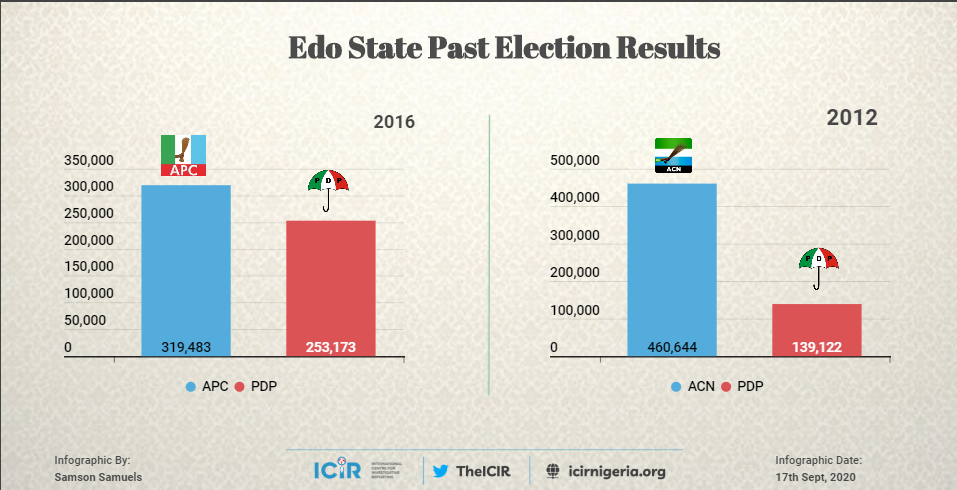
In the 2016 governorship election, Obaseki also defeated Ize-Iyamu, by 66, 310, when he polled  319,483 against Ize-Iyamu who then polled 253,173. But then Obaseki was in APC while Ize-Iyamu was in PDP, the two parties each of them now opposes.

Meanwhile, while a poll result is an indication of what the election outcomes could be, it is not always inch-perfect. Often time, polls are bedeviled by the methodological challenge of unrepresentative samples.

In 2019, for example, most polls tipped the former Vice President Abubakar Atiku as the winner of the general elections against the incumbent President Muhammadu Buhari, but the final result upturned the verdict of the pollsters. President Buhari eventually scored 15,191,847 while Atiku trailed behind with 11,262,978. Observers then noted that the basic problem could be that the polls contained many more voters sympathetic to PDP than to APC.

But there is also the existential problem of electoral fraud which president Buhari described as his “main concerns.”


In In 2018 election, Kolapo Olusola (Eleka) of PDP defeated Kayode Fayemi of APC by 25 percent in the pre-election poll in Ekiti state while Jeremiah Oseni defeated Simon Lalong by 2 percent in a keenly contested 2019 election in Plateau state. None of the two winners of the polls eventually became the governors.

Notwithstanding, it is also recorded that the elections were marred by rigging and other fraudulent parctices.

Postscript: polls monitored as at Thursday, September 17, 3:30 pm

Jonathan advocates election grading system within Commonwealth

0

GOODLUCK  Jonathan, Nigerian former President, has proposed a grading system for elections within Commonwealth member-nations as a means of improving the quality of elections, promoting democracy and strengthening institutions.

Speaking at a special virtual high-level panel which focused on 40 years of Commonwealth’s election observation experience, Jonathan called on the 53-member nation body to develop what he called a ‘democracy marker’ which is a benchmarking system of election reporting to serve as a scoring formula for measuring compliance to identified democracy standards within the Commonwealth.

“I associate myself with the efforts to improve Commonwealth election observer experience in line with the Revised Commonwealth Guidelines for the Conduct of Election Observation in Member Countries.

“As in any human experience, we can always seek to further strengthen the efficiency and effectiveness of our involvement and enhance the impact it will have in ensuring the sustainability of democracy among Commonwealth member nations.

“Along this line, I suggest that the Commonwealth develops a benchmarking system of election reporting that weighs member-nations’ performance against defined assessment standards. This can be done without compromising the Commonwealth’s policy of neutrality and non-interference on internal affairs of member-nations.

He further advised the Commonwealth to develop “a kind of ‘Democracy Marker’ with a grading framework or template for the assessment of a country’s performance after every election season.

“The Commonwealth should not just observe elections and make recommendations. I want the Commonwealth to go further by scoring countries according to their performance. The democracy marker can be used to grade all the 53-member states. After every election, the Commonwealth should review the processes to be able to grade and place every country on a particular rung of the election marker.

“Once you do that you will find that those in charge of affairs in every country in the Commonwealth will then begin to make conscious efforts to improve on their performance. That way, Commonwealth recommendations after observing elections, will become more meaningful.”

He affirmed that the rating would serve as a scoring standard for measuring compliance to identified criteria, preferably on a scale of 1-4 or category A, B, C or D, depending on the agreed template.

“There will be no risk of direct interference because those who win under any of the identified categories will of course continue to run their countries according to their own national rules and laws. But they should know, depending on the rating of their elections, whether the process that brought them to power was below or within Commonwealth standards.

“That way, leaders will know that the world is watching and assessing their performance. From their rating, they will be able to know whether their election satisfies the expectations of the international community or the Commonwealth to which they freely belong.

“From one election cycle to the other, a nation will be able to determine whether they are improving or retrogressing. There is no doubt that such a grading system will see nations struggle to move up the ladder.”

The former President said his suggestion is similar to what is already being done by many agencies and organisations. They include Human Rights Watch which conducts annual grading of human rights records of nations, Transparency International which releases the annual Corruption Perception Index (CPI) as well as Fund for Peace, an independent organisation that conducts the annual Failed State Index.

He further advised the Commonwealth to develop something similar focusing on elections, based on certain indicators upon which the rating will be based. “This will encourage leaders to work toward improving their election records, just as nations work towards improving their human rights records and corruption perception records,” he said.

Nigeria spent $770m on oil imports in first half of 2020 – CBN

0

THE Central Bank of Nigeria (CBN), on Thursday revealed that Nigeria had spent $770.58 million on oil imports in the first half of  2020.

The CBN’s data on sectoral utilisation for transactions valid for foreign exchange shows that $148.3 million was spent on oil imports in January, $145.23 million in February, and $139.55 million in March.

Foreign exchange for transactions in the oil sector dropped to $113.80 million in April and $109.11 million in May before climbing to $114.57 million in June, the data further revealed.

Oil imports accounted for about 4.35 per cent of the $17.7 billion used for imports in the country between January  and June,  2020 according to the CBN data.

The amount of foreign currency used for imports in the country stood at $3.98 billion in January, $4.98 billion in February and $5.36 billion in March. It plunged to $1.08 billion in April and $1.06 billion in May but rose to $1.24 billion in June.

The CBN data also shows that the nation’s forex reserves had been on a downward slide for months until recently, falling to a record low of $33.42 billion in April 2020 from a high of $45.18 billion in June 2019.

The refineries in Port Harcourt, Kaduna and Warri, have a combined installed capacity of 445,000 barrels per day but have continued to operate far below the installed capacity.

Godwin Emefiele, CBN Governor, at the bank’s Monetary Policy Committee meeting blamed the dwindling prices of oil on the shortage of forex.

“The depletion in forex reserves was driven by forex sales to the Bureaux de Change and the investors’ and exporters’ forex window, as well as dwindling oil receipts,” Emefiele said.

The Nigerian National Petroleum Corporation (NNPC) has been the major importer of petroleum products into the country in recent years.

With the recent petrol deregulation, most marketers have yet to resume petrol importation due to a lack of access to forex at the official rate.

“For the purpose of establishing Letters of Credit and Bills for Collection for the importation of petroleum products, authorised dealers shall forward to the Director, Trade and Exchange Department (of the CBN), all relevant supporting documents for consideration prior to commencement of the transaction,” the CBN monetary, credit, foreign trade and exchange policy guidelines read.

“Furthermore, the CBN shall be notified within 48 hours by the authorised dealers before bidding for funds to pay for such transactions,” it added.

Nigeria, Africa’s largest oil producer, relies largely on importation for petrol and other refined products as its refineries have remained in a state of disrepair for many years.