Home Blog Page 2046

FACT-CHECK: Was this man struck, “roasted” by thunderstorm while receiving phone call?

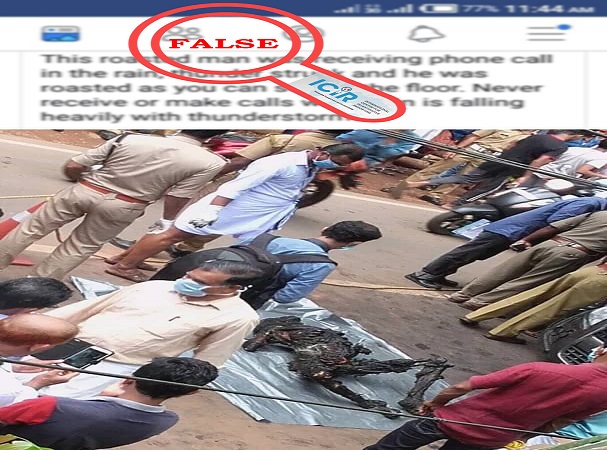
A VIRAL post  retrieved from WhatsApp on July 16, shows picture of a burnt human with a caption claiming that the person was struck and “roasted” by “thunder” (lightning bolt) while receiving  a phone call in the rain.

The photograph recently has been shared several times on  tWhatsApp, Twitter, Sharechat groups and Facebook,though The ICIR could not ascertain the origin of the image.

Some Nigerian blogs including OG Media Hub Nigeria and other Facebook pages like Orumba TV also published the image with a similar caption.

THE CLAIM

The caption reads “This roasted man was receiving phone call in the rain, thunder struck and he was roasted as you can see on the floor. Never receive or make calls while rain is falling heavily with thunderstorms.”

The claim as shared on a Facebook page, Orumba TV.

The post has three claims, namely:

1. That the man was receiving phone call in the rain

2. That thunder -lightning- struck and the man was burnt (roasted).

3. That receiving or making calls during thunderstorms can get one burnt (roasted).

THE FINDINGS

Claim 1

Forensic analysis carried out by The ICIR on the photo using InVid WeVerify application shows that the image was not manipulated, except for the texts printed at the upper edge of the photo.

Forensic analysis of the photo using InVid app.

Also, an image search of the photo using Google Reverse Image reveals that the photo was first shared on Twitter in June 2018, but without the printed text or caption.

Although search for that particular image with the caption on any news website yielded no result, findings by The ICIR show that two Twitter users with the handles: @Mano07512038 and @kaja_maiden shared that same image with other photos allegedly of the same incident involving the burnt man on June 11, 2018 and June 12, 2018 respectively.

Screenshot of tweet of the photos shared by Twitter user: @kaja_maiden on June 12, 2018.

The ICIR digged deeper and discovered that the burnt person in the image was that of a retired teacher who was found dead inside his burnt car in Ambalakkulangara, near Kakkattil, in Kozhikode district, Kerala state in India on June 6, 2018.

The deceased was identified as Koyyalummal Nanu, from Koyyal, a news website, www.OnManorama.com  reported. It was also reported in the Malayalam language edition of the website.

Screenshot of the news reported by Onmanorama.com on June 6, 2018.

When the image was subjected to further search using TinEye, it came out with five results which indicated that another news website, Mathrubhumi, also reported the incident on June 7, 2018.

To ascertain the authenticity of the images, especially the one showing the burnt man alongside those used on the news sites, The ICIR contacted the journalist who reported the story on www.OnManorama.com via email and Twitter.

The journalist, Anupama Mili, who replied via Twitter, confirmed that the photos were of the same incident that she reported.

Also, when asked to confirm if the ‘burnt man’ in the photo was the same victim mentioned in her report (as published on the news site), she said “Yes, this is.”

Screenshot of Anupama’s response to The ICIR’s enquiry via Twitter.

Kuttyadi Police Inspector, Sunil Kumar, told Mathrubhumi.com that he (the burnt man) may have set himself on fire by pouring petrol on his body.

Although no post-mortem report was received, Sunil Kumar pointed out that the doctors had informed him that the cause of death was suicide.

Experts also pointed out that the cause of the car burning was not a short circuit or any other accident, the news report stated.

From all the media reports, The ICIR was able to confirm that the man was burnt by, and reportedly died from, the fire which spread from petrol kept inside his car.

Similarly, the local Police neither retrieved any phone from the scene of the incident nor mentioned it among items recovered from the scene, according to media reports.

It is therefore evident to conclude that the man was not receiving phone call in the rain when the incident happened.

Claim 2

Further findings by The ICIR reveal that none of the locals who reported the incident to the Police and fire brigade mentioned that there was any thunderstorm or rain around the area when the incident occurred, though the ground around the scene of the incident was wet (as seen in the photos).

The ICIR could not independently verify the cause of the wetness at the scene of the incident, but believes this may not be unconnected with the water used by the fire brigade in putting out the fire from the victim’s car.

SCREENSHOT: Result of the Google Reverse Image search conducted on the photo.

Moreso, local Police in the area reportedly told the media that “the fire is obviously spread from inside” of the car.

This invalidates the claim that “thunder” – lightning-  struck and the man was “roasted” as a result of the thunderstorm.

Thunder is the sound caused by lightning, It is however the lighting that strikes. 


Claim 3

Findings by The ICIR show that there is a misconception globally that cell phones attract lightning strike which may burn (roast) the person receiving phone call during a rainy weather.

John Jensenius, lightning safety specialist for the U.S. National Weather Service, reportedly said, “If someone is struck by lightning and they have a cell phone on them, it will usually melt or burn. People have taken that and blamed the cell phone, but in reality it is unrelated.”

Although there are media reports of people killed or injured by lightning, including that of a man struck by lightning while talking on his cell phone in Kuala Lumpur in 1999, “It’s the place you’re located that is more of a concern than anything else. If you’re near a cell phone tower, that’s bad because lightning will come and hit the cell phone tower,” said AccuWeather Senior Meteorologist, Dan Kottlowski.

The US National Oceanic and Atmospheric Administration (NOAA) also affirmed Kottlowski’s position, saying lightning is not attracted to people carrying mobile phones.

“People are struck because they are in the wrong place at the wrong time. The wrong place is anywhere outside. The wrong time is anytime a thunderstorm is nearby,” it stated.

Further findings by The ICIR reveal that using a corded telephone during a rainy-stormy weather or thunderstorm is discouraged because the phone is physically connected by wires to the outside.

“A cellphone, however, has no such physical connection and the electric current from a nearby lightning strike cannot reach it. It is perfectly safe to use a cellphone during a thunderstorm,” the Chicago Tribune reported.
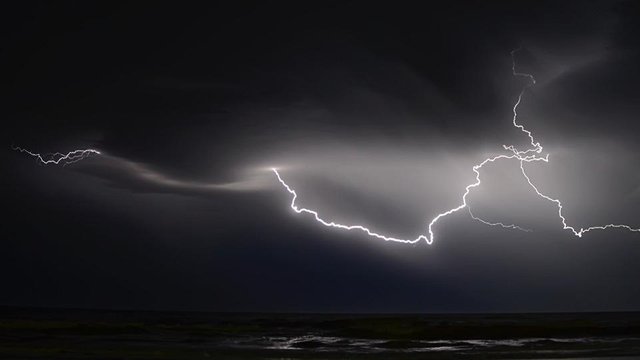
Lightning. PHOTO CREDITS: Pexels.com

A similar fact-check done by www.Snopes.com on the topic also corroborated the fact that using cell phones during stormy weather is safe.

Part of the reports reads “Cell phones (and cordless portable phones) used indoors during electrical storms are perfectly safe because there is no wire through which the electrical discharge could travel. (The belief that lightning can “follow the radio waves” into a cell phone is completely unfounded.)

“And although some people feel cell phones pose a risk when used outdoors because lightning is attracted to metal (it’s not — metal is merely good at conducting electrical currents), handsets generally contain insignificant amounts of metal,” it concluded.

The caption on the picture did not indicate what kind of phones it was referring too, because electrical discharge  could travel through a land line phone with outlet wiring connected to a phone service provider.

It is however unlikely that the man was in his car with a land line telephone on the road.


THE VERDICT

From the information obtained;

1. The claim that the man was receiving phone call in the rain is FALSE.

2. The claim that thunder – lightning – struck and the man was burnt “roasted” is also FALSE.

3. The claim that receiving or making calls during thunderstorms can get one burnt (roasted) is MOSTLY FALSE. However, when hit by a lightning bolt electrical discharge can pass through a land line telephone with outlet wires, this is not applicable to the ubiquitous cell phone.

Two ICIR journalists selected for Climate Reporting fellowship

THE Climate Tracker in collaboration with Hivos Energy has selected 12 African journalists for it’s African Sustainable Energy Reporting Fellowship.

Among the selected fellows are two journalists from The ICIRNiyi Oyedeji and Amos Abba.

Chris Wright, the Managing Director, Climate Tracker during the announcement of the fellows stated that it was a difficult task selecting the final 12 candidates out of the pool of journalists that applied and participated in the first phase of the competition.

Wright explained that Climate Tracker would support the fellows in telling in-depth stories focusing on key sustainable energy challenges facing their respective countries.

He further said that the fellowship aims at expanding the journalism skills and experience of the fellows to enable them to dive into energy challenges that they may not have explored before.

According to him, the fellows are expected to, “collaborate with the other fellows from across Africa, learn from the guidance and additional training provided by Climate Tracker, publish an in-depth story in a national publication and as well work with Climate Tracker to pitch their stories to international publications”

Climate Tracker has over years supported journalists around the world through its various climate reporting fellowship programmes.

Advocacy groups, rights lawyers call for reform of CCB, asset declaration law

ADVOCACY groups and Human rights lawyers have called for reforms in the Code of Conduct Bureau (CCB) and the Code of Conduct Tribunal (CCT) for proper enforcement of asset declaration in Nigeria.

They made this call during a panel discussion on Saturday at the virtual presentation of Citizens’ Guide to Asset Declaration by Public Officers in Nigeria.

The panel discussion was organised by the Socio-Economic Rights and Accountability Project (SERAP) in collaboration with the Open Society Initiative for West Africa (OSIWA).

During the panel discussion, Femi Falana, a Human Rights Lawyer said the CCB and CCT are the most important anti-corruption agencies in Nigeria but attention is focused on the Economic Financial Crimes Commission.

“On Code of Conduct Tribunal and the Code of Conduct Bureau, these are the most important anti-corruption agencies in Nigeria but attention is focused on EFCC even the ICPC is mostly ignored,” Falana said.

Falana noted that a Federal High Court had ruled that no one can compel a public officer to declare his asset to the public, an appeal that he has taken on because declaration must be made public.

“People often make the mistake of saying ‘Public declaration’, but there is nothing like that, the meaning of declaration is a ‘formal and explicit statement’ it is public already,” Falana stated.

According to Falana, there is a need to examine the role of professionals who engage in illicit practices thereby aiding corruption in asset declaration.

He stated that owners of property get a lawyer to prepare the document, estate managers, bankers and others, thereby hiding the true ownership of the property.

On the false declaration of assets, Yemi Akinseye, a Senior Advocate of Nigeria and Professor of Public law, said most public officers acquire properties in a proxy.

Akinseye said some of them over declare their asset in anticipation of what they want to earn and this is possible because there is no provision for verification.

He stated that the CCT and CCB are subject to the politicians who in turn sabotage their optimal functionality because they would profit from a weak CCB and CCT.

“It is not about CCB only, they are incapacitated, they don’t have funding, their budget is mostly cut at the National Assembly because they benefit from a weak CCB,” Akinseye said.

He added that there won’t be reform without demand and insistence from the media, public and CSO’s because the people benefitting from it are the ones that can change it because there is no incentive in it.

Akinseye stated that asset declaration cannot function well without a properly registered land registry, vehicle registry among others.

“There is so much informality in the system; there is a need to strengthen other institutions alongside the CCB, Nigerian prosecutors are like Eyinmba playing with Manchester United.

Our prosecutors are the Eyinmba while the defence counsel is Manchester United, some of them (prosecutor) even come to the court boarding ‘okada’, someone prosecuting a case of billions, they are not well equipped,” said Akinseye.

Sina Fagbenro Bryon, a former governance adviser with the United Kingdom’s Department for International Development (DFID) and co-founder of the KOWA party said Nigerian public officers try to cover up their resources because they had gotten it from illicit means.

He called for collaboration between the Corporate Affairs Commission (CAC), Code of Conduct Tribunal (CCT) Code of Conduct Bureau (CCB), Federal Inland Revenue (FIRS) and others.

“There is need for collaboration between the government agencies but this government is notorious to not having a coordinated system,” Fagbenro said.

Kole Shettima, the Nigeria Director of MacArthur Foundation said clearly the CCB is an agency that has been neglected and their role has not been well highlighted.

Shetimma called for the use of technology in making asset declaration accessible or easily transmitted or documented

Osai Ojigho, the Amnesty International Country Director said asset declaration should be a holistic process and not just with the CCB.

“It needs to go beyond the public declaration, it should be an annual declaration, that is when the public interest would be activated such that when there is an issue, people can talk,” Oghijo said.

She noted that through this, there would be public engagement and feedback would increase public trust and accountability in the country.

The ICIR had filed a case against the CCB over its refusal to provide details of asset declaration forms of all cabinet members of Muhammadu Buhari including the Secretary to the State Government, Chief of Staff to the President, Head of Civil service and other ministers.

FACT-CHECK: Did Oyetola spend 3 days in Abuja without seeing Buni?

A POST with several claims about 2023 presidency and the internal leadership tussle in the ruling All Progressive Congress (APC) party went viral on WhatsApp last week.

The post first surfaced on the 17th July.

The post was also shared on Facebook and blogs.

One of the claims in the post is that the Governor of Osun State, Gboyega Oyetola, was in Abuja for three days and was not able to see Governor Mai Mala Buni, who is the Chairman of the All Progressives Congress (APC) National Caretaker Committee.

Gboyega is also a member of the APC.

THE CLAIM

Part of the WhatsApp post reads – (SIC) “You can confirm from the Governor of Osun State, Mr Oyetola, he was in Abuja for three days and couldn’t see  Governor Mai Mala Buni because both Mai Mala Buni and Akeredolu group didn’t want to allow him and other pro Asiwaju Bola Tinubu group in the Committee to discuss the MODE OF PRIMARY FOR ONDO STATE APC GOVERNORSHIP ELECTION” 

The claim:   Oyetola spent three days in Abuja without seeing Buni

THE FINDINGS

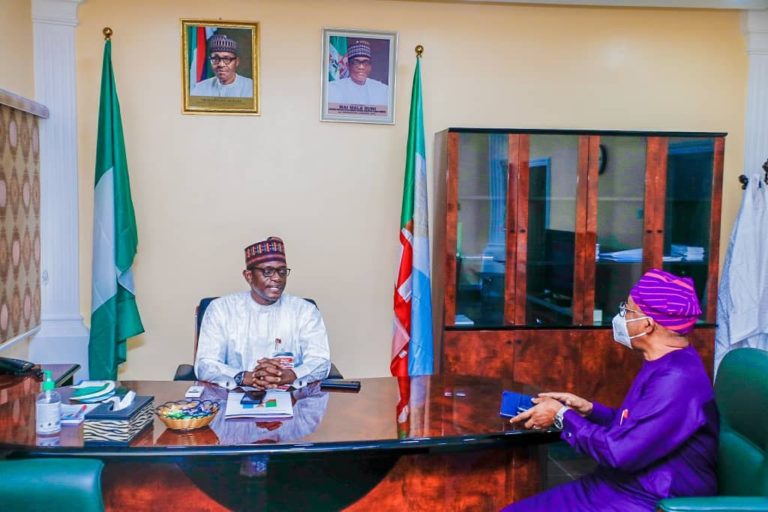
On the 17 of July at 9:35pm, Governor Oyetola spokesman, Ismaila Omipidan shared photos of Oyetola and Buni on Facebook.

Omipidan captioned it “Pictures don’t lie”.

He went further to  write that the pictures were taken before the commencement of the caretakers committee meeting at the party Secretariat. 

The ICIR also reached out to Omipidan and he restated that Oyetola met with Buni.

He said: “There is nothing true about the post (WhatsApp post). It is nothing but false. Those two leaders were together and meeting all through our stay in Abuja”.

The ICIR also contacted Mamman Muhammad, the spokesperson of Governor Buni, he confirmed that the parities in question met.

Muhammad said: “The last time they were here at the secretariat of the party, I saw the man (Oyetola) myself with my principal many times together. What kind of cheap blackmail  is that!”

Referring to the the claim, he said  “nothing like that happened, the information is false”.

THE VERDICT: 

From the information presented above, the claim that Oyetola spent three days in Abuja without seeing Buni is therefore, FALSE

Living with pain and poverty: Story of Jigawa state women farmers

ADAMU AMADU RUFA’I reports that women farmers in Jigawa State are facing hard times as a result of the COVID-19 pandemic and destruction of their farms by herdsmen thus limiting their ability to contribute to food security in the country.


THE journey from Dutse, the Jigawa State capital to Gamsarka village in Auyo Local Government Area of the state is a tedious three hours, especially due to the on-going rehabilitation of the Auyo irrigation project embarked upon by the Federal Government with the assistance of the World Bank.

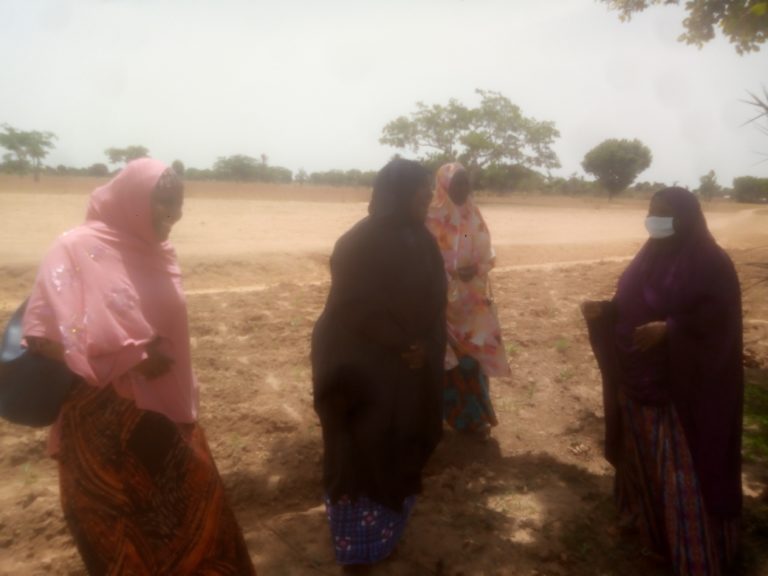
The goal of the journey was to meet women farmers in their homes and on their farms to see firsthand their travails as they try to contribute their own quota to food security in the country while also struggling to get out of poverty.

Malama Binta Audu Gamsarka, a widow with five children – two girls and three boys aged between 8 and 15 – narrated to Sunday Tribune how she struggled to survive after the death of her husband six years ago until she went into farming in order to get out of poverty.

Binta, who lives in a three-room house built with clay and fenced with dry corn stalks said that after her husband’s demise life became very difficult for the family. Sometimes, she had to send three of her children to the bush to get cow dung or to cut grass to sell in order to earn some money for food.

“None of the children was attending any formal school because they were all preoccupied with struggling to earn a living. But since I embraced farming three years ago, the family life completely changed.

“After I received an empowerment grant from the Jigawa State government and another agricultural empowerment grant I decided to start using the land we inherited from my husband. I ventured into rice farming. I have the state government to thank for this change in my family,” she stated.

Continuing, she said: “After harvesting the rainy season crop, I also planted the rice for dry season and within the first year we almost liberated ourselves from abject poverty. All my children who had dropped out of school went back while they continued to join me at the farm after school hours.”

Unfortunately, the gains recorded by Binta has been reversed as a result of the COVID-19 lockdown and closure of markets as many women farmers now tell tales of woes. According to the Binta, the pandemic has drawn her family back to the brink of poverty.

“My farming business has suffered a great setback. See my rice farm and you can understand that the crop did not get the required fertilizer and no proper management because the market where we buy the inputs has been closed while the few shops that remain open sell at a high rate.

“Transport was also high due to the lockdown, the price of our farm produce fell; these made it very difficult for small-scale women farmers to make it,” she lamented.

Elsewhere in Guri, Kirikasamma, Auyo and Kaugama, all in Jigawa North-East senatorial district, small-holder women farmers like Hajiya Fatima Dahir Auyo are lamenting the massive destruction of their farms by Fulani herdsmen.

Speaking to Sunday Tribune, Hajiya Fatima said, “we are battling with Fulani herdsmen to protect our farm produce and allow them to mature and be harvested. We have been thrown into the most difficult and worst situation of the COVID-19 pandemic which stopped us from going to the farm. It was a good opportunity for the Fulani herdsmen to graze everywhere, including the farmlands.

“As women, we pay men to do a lot of the farm work as we cannot do it by ourselves. Coronavirus has increased the price of everything due to the shortage of manpower caused by the lockdown and movement restrictions.

“We have never benefited anything from any government, be it state or federal in farming business. Several times we were asked to form associations, register and apply for support from government but nothing comes out of that.

“We are members of Rice Farmers Association of Nigeria (RIFAN) and many other farmers’ associations but men have been benefiting most from any support that comes. We the women farmers are never considered.

“We even complained to the state’s commissioner for agriculture during the Anchor Borrowers Scheme by the administration of Governor Muhammadu Badaru Abubakar. The commissioner promised us special attention but it is yet to be fulfilled. We are calling on all relevant authorities to please consider women. The bias is too much.”

In an attempt to help women farmers not only in Jigawa State but the country at large, the Federal Government introduced series of financial aids like TraderMoni, MarketMoni and FarmerMoni all with three-month breather before starting to pay back.

Being women and mostly the breadwinners of their families, women farmers would were also to be beneficiaries of food distribution to households as well as the Conditional Cash Transfer to the additional one million households ordered by President Muhammadu Buhari to be included in the National Social Register.

However, all these appear to be only on paper as Jigawa women farmers say that they have not received support from any of these schemes.

In an interview with the Jigawa State chairperson of the Small Scale Women Farmers Organization of Nigerian (SWOFON), Hajiya Hadiza Abdussalam Giwa, she lamented that, the situation is devastating as many of her members are in critical situations with regards to their farming business.

Hajiya Giwa said “The closure of markets and restriction of movement due to the coronavirus pandemic has made it very difficult for women farmers to source animal feeds and other materials needed for dry seasons farming”, adding that “the capital used by members is like a revolving fund. During dry season, they sell their farm produce to venture into animal or poultry production.

“For those in dry season crop farming, they also had similar experience as the pandemic left them with no market to take their farm produce to for sale.

“The prices of farm inputs such as fertilisers, herbicides and other farm inputs, including labour have increased. Women have to sell so much to buy so little and this has made farming very difficult for them. We are scared and losing hope of getting any bumper harvest this year.

“Our small-holder women farmers need serious support and intervention for them to survive and remain in the farming business.”

Another group of women farmers in Dutse Local Government Area of the state also narrated their ordeal to Sunday Tribune.

Speaking on behalf of the group, Malama Halims Musa Kudai, called on the federal and state governments to help women farmers with capital and modern equipment to improve their farming business.

The women farmers coordinator in Birninkudu Local Government Area of the state, Hajiya Hauwa Akawu Rijiya Bakwai, while speaking said, “the situation we found ourselves under the lockdown is very worrisome because most of my members have eaten all their capital while sitting at home under lockdown, adding that “Many of the women used their farming capital to complement the effort of our husbands to feed the family as children are at home because schools are closed.

“Now, already rainy season farming has started and we’ve eaten our capital; we have little or no money to do clearance and cultivation, buy improved seedlings and pay for labour. These are our main challenge.

“We need capital to continue with our farming either in form of grant, soft loan, intervention or any form of assistance that can enable us to remain in the system, please and please help,” she lamented.

On her part, Malama Hadiza Muhammed Kiyawa who rears a special breed of goats that could produce three to four kids per delivery, along with crop production, lamented that the coronavirus pandemic has not only been devastating on human beings but also on animals, because there is currently an acute scarcity animal feeds which has affected their growth and productivity.


“Many ended up with miscarriages due to insufficient food. I lost a number of my goats while some were sold at giveaway prices as I had no money to buy their feeds.

“I need assistance to keep up the business and also to have some capital to go for rainy season farming as it has already started in some other places.”

Resident doctors threaten FG with fresh strike in three weeks


THE National Association of Resident Doctors (NARD) has notified the Federal Government of it’s intention to go on another three-week strike if the government failed to meet up with its demands.

Aliyu Sokomba, President of NARD, who made the position of the association known in a communique on Saturday said government has up till August 17 to meet up with the demands of the resident doctors.

It would be recalled that members of the association called off an initial strike on June 22 in order  to give the Federal and State Governments time to fulfill the outstanding demands of the association.

But Sokomba said the association decided to issue another warning to go on strike after a virtual National Executive Council (NEC) meeting and scientific conference held on Saturday.

“NEC resolved to extend the suspension of our strike action by three weeks to give the government time to address our demands, failure of which will leave us with no choice other than to resume the suspended strike on Monday, August 17 2020,” he said.

The conference was held at the Gombe International Hotel between July 20 and 25 2020.

According to The PUNCH, while giving the ultimatum to the Federal Government, Sokomba lamented that the payment of COVID-19 hazard allowance to members was long overdue.

The association called for a probe by the Federal Government and the National Assembly on the non-enrollment of healthcare workers in Group Life Insurance and non-payment of death-in-service benefit to the next-of-kin of its fallen heroes, notwithstanding claims of payment to insurance companies.

Following an emergency general meeting to protest against the lack of payment for COVID-19 inducement allowance for frontline healthcare workers, NARD had embarked on an industrial action on June 15, but on June 21, the association announced the suspension of its strike after its NEC meeting attended by over 300 members.

The association said COVID-19 inducement allowance has only been paid to eleven federal health institutions, noting that most state governments are yet to review the hazard allowance of health workers.

It also stated that other reasons for the strike include  lack of personal protective equipment in some hospitals, disengagement of resident doctors at the Jos University Teaching Hospital and challenges of its members in LAUTECH Teaching Hospital, Ogbomosho, non-provision of medical residency training funding and salary shortfall for 2014-2016.

Minister directs NIPOST to suspend imposed charges on courier, logistic companies

ISA Pantami, the Minister of Communications and Digital Economy has directed the Nigerian Postal Service (NIPOST), to stop the implementation of the new charges on courier and logistics companies immediately.

Pantami’s directive which was contained in a tweet on Saturday, came after NIPOST had announced that companies which provide international courier services like DHL, UPS and FEDEX were expected to pay N20 million for a new licence and N8 million annually.

While those offering national services were expected to pay N10 million for licence and N4 million yearly for renewal with logistics companies operating within regions expected to pay N5 million for licence and N2 million annually.

For firms operating within states, the cost of procuring a licence is N2 million while renewal costs N800,000.

In his tweet, Pantami said the increase in licence fee was not in line with the regulations he had approved requesting for the implementation to be on hold.

“Please NIPOST, our attention has been drawn to an increase of licence fee, which was not part of the regulation I earlier approved for you. Your chairman and PMG (Postmaster-General) were yesterday contacted to put the implementation on hold and send a report to our ministry by Monday. Best wishes!”.

The new charges introduced by NIPOST are expected to cause an increase in the cost of courier services and delivery goods.

For Small and Medium Enterprises (SME) the licence is N250,000 while the annual renewal of the licence is N100,000 which is a category for small courier firms which have not more than five delivery vehicles.

Diepreye Alamieyeseigha

0

Diepreye Alamieyeseigha, in 1992 retired from the Nigeria Navy as a Squadron Leader.

In 1999, under the People’s Democratic Party (PDP) he was elected as the Governor of Bayelsa State. He re-contested in 2003 election and won.

Alamieyeseigha was arrested in September 2005 by the London Metropolitan Police and was charged on three counts of money laundering. He was released on bail with conditions, after three weeks in custody.

In November 2005, while his trial was ongoing in London, Alamieyeseigha stealthy flew back to Nigeria.

After he returned to Nigeria, Alamieyeseigha was impeached in December 2005. He was later, arrested by the Economic and Financial Crime Commission (EFCC) in December 2005 and charged for money laundering and corruption offences.

Alamieyeseigha was held in EFCC custody for two years while he was been tried.

In July 2007, he pleaded guilty to the corruption charges filed against him by the EFCC.

At a Federal High Court sitting presided over by Justice Mohammed Shuaibu, he was sentenced to two years jail term. The sentence was counted from the time he was arrested in 2005 till the day he was sentenced. On the 27th July 2007, he was released.

On 12 March 2013, President Goodluck Jonathan granted Alamieyeseigha state pardon.

Court says army lacks power to conduct ‘Operation Positive Identification’

THE Federal High Court sitting in Lagos on Friday sustained a lawsuit filed by Femi Falana, human rights lawyer and Senior Advocate of Nigeria (SAN) over the planned implementation of the “Operation Positive Identification’ by the Nigerian Army.

Falana had filed the Fundamental Rights Enforcement suit on October 25, 2019 against the planned exercise by the army scheduled to hold from 1 November to 23 December 2019.

He listed the Nigerian Army, the Chief of Army Staff, Lieutenant General Tukur Buratai, and the Attorney General of the Federation, Abubakar Malami, as the respondents to the suit.

While ruling on the case, Justice Rilwan Aikawa stated that the Nigerian Army has no power under the Nigerian constitution to subject civilians to such positive identification process adding that the fundamental rights of the Nigerian people to liberty and freedom of movement would be breached by the planned positive identification.

Aikawa insisted that Falana has the locus standi to have instituted the suit as he dismissed the objections of the Attorney General of the Federation and the Nigerian Army to the applicant’s suit.

Falana in his suit emphasized that it is illegal and unconstitutional for the court to uphold an act that would require  Nigerians to move around with a valid means of identification such as the National Identification Card, Voters Registration Card, Drivers’ Licence and passports or other valid official identification pleaded the court to dismiss the idea behind the exercise.

He argued that it is unconstitutional for the military to mount checkpoints on highways anywhere in the country as he cited several authorities.

The human rights lawyer added that that is the work of the police  arguing that the respondents have not given valid reasons why  soldiers must take over the duties of the police.

He also stated the his plea before the court pertains to his right to life, liberty, and freedom of movement just as every other Nigerian who could get shot by soldiers if they fail to produce any means of identification on demand adding that the appellate courts have ruled severally that the army has no business in civil actions neither are they allowed to get involved in elections.

Falana, therefore, urged the court to grant his fundamental rights application which he emphasized are completely backed by Chapter 4 of the Constitution.

But the three respondents to the suit filed a preliminary objection challenging the suit.

The Nigerian military had launched in October 2019 “Operation Positive Identification” to demand identity cards from citizens across the country stating that the operation would combat the threats of criminal insurgency and terrorism, armed banditry, kidnapping, herdsmen-farmers clashes, cultism, and communal crises across the country.

The idea attracted ciriticisms and calls to drop it by the Nigerian Army.

However, in November the House of Representatives gave the Nigerian army the approval to carry out Operation Positive Identification (OPI) in conjunction with other relevant security agencies, after it had initially kicked against the operation.

The House in its initial criticism of OPI said it  would strip Nigerians of their constitutionally guaranteed freedom of movement.

Man bags 20 years jail term for defrauding a Taiwanese

A Federal High Court sitting in Ibadan, Oyo state has sentenced a 30-year-old man, Gabriel Adekola Oluokun to 20 years imprisonment for defrauding a Taiwanese of $22,300.

Dele Oyewale, the Economic and Financial Crimes Commission, (EFCC) spokesperson disclosed this in a statement on Friday.

According to the statement, the Ibadan Zonal Office of the Commission on April 6, 2018, filed a six-count amended charge of obtaining money by false pretence following a petition from one Nduka Lucious.

Lucious alleged in the petition that the convict collected the sum of $22,300 from him in three instalments on the agreement that he would supply 100 metric tonnes of sesame seeds to one Victoria Xhung, a China-based Taiwanese businesswoman, whom the petitioner represents in Nigeria.

The statement read that Oluokun converted the money to his personal use and failed to deliver the goods as agreed.

Joyce Abdulmalik, the presiding judge, after reviewing arguments by the prosecution and defence counsel found Oluokun guilty of four of the charges.

Abdulmalik discharged the convict of count five and six of the charges and sentenced him to five years jail term for each of the remaining four charges.

The judge further ruled that the convict is to return the sum of $22,300 to the Taiwanese victim with the caveat that the jail term will be extended by additional two years if he fails to make the repayment.

The statement further read that Abdulmalik ruled that a Toyota Corolla saloon car belonging to Oluokun is to be forfeited to the Federal Government of Nigeria.