JOY Nunieh, a former managing director of the Niger Delta Development Commission (NDDC) has asked the Nigeria Police Force to investigate and charge the Minister of Niger Delta, Godswill Akpabio over alleged missing files in the Commission.
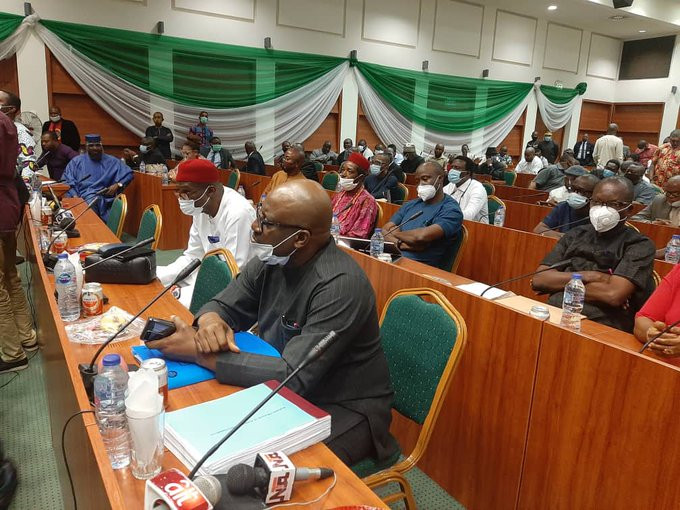
Nunieh made this demand when she virtually appeared before the House Committee on NDDC on Friday.
According to her, Akpabio was involved in the disappearance of files belonging to the NDDC against the decision of the management of the Commission.
She alleged that the missing files contained contracts of unexecuted contracts in which Akpabio was involved.
Nunieh also urged the NPF to investigate Akpabio for sending life-threatening text messages to her and for asking her to enter an oath.
“Because he is aware that I would not do his will, in a text message he sent to my phone, he said he ‘who lives by the gun would die by the gun’,” Nunieh alleged.
Nunieh further said that Akpabio has not contracted any credible forensic company in Nigeria to conduct a forensic audit of the NDDC as directed by President Muhammadu Buhari.
“I challenge him to bring out one of the nine companies to come out and say they are carrying out a forensic audit.
“There is no forensic audit going on, there are nine trustworthy forensic companies in Nigeria, none of our major auditing Nigeria firms is handling the forensics,” Nunieh alleged.
The former NDDC MD noted that in the certificate of no objection provided to the lead consultant on a forensic audit by the Bureau of Public Procurement (BPP), no source of the fund was stated in it.
“The BPP failed and neglected to state the source of fund in the certificate of no objection provided to the lead counsel.
The contract has not been approved by the Federal Executive Council (FEC) and the NDDC had no budget by then because the 2020 budget had not been passed, so where is the money coming from,” Nunieh said.
While responding to questions by the House Committee led by the Chair, Olubunmi Tunji-Ojo, Nunieh said she spent only N8 billion naira during her tenure.
However, Tunji-Ojo said the report of the Central Bank of Nigeria (CBN) has it that she spent N81.5 billion Naira during her time.
The ICIRreported how Nunieh was ‘rescued’ from the ‘unknown security operatives’ by the governor of Rivers State, Nyesom Wike.
According to Nunieh, the police officers who were at her residence in Port Harcourt failed to provide a warrant of arrest but intended to arrest her.
However, the Police Spokesperson in Rivers State, Nnamdi Omoni said the operatives are officers of the IGP Monitoring Unit and are on legitimate duty.
Omoni said they had reported to the State Command before proceeding to the residence Nunieh.
Calls from The ICIR to confirm why the IGP unit was sent as said by the Rivers Police Command was not answered by the Police Spokesperson, Frank Mba.
Also, a text message sent to him has also not been responded to as at the time of filing this report.
meanwhile, the House Committee has, however, summoned Mr. Akbaio to appear before it on Monday, July 20 at exactly 11 am.
According to the committee, Akpabio is to make a presentation to the panel on the activities of the Commission under his watch.
THE need to create safe spaces for sexually abused children and provide psychosocial support to people who have experienced gender-based violence was the focus at the official opening of SOAR Child and Teen Support Center in Durumi, Abuja.
At the launch of the child-friendly centre, speakers at the event reiterated their support for the centre, saying it would provide healing for child survivors of sexual abuse and help their families access justice and traditional support systems.
The centre which boasts of several therapy playrooms where sexually abused children can feel safe was set up by the Sexual Offences Awareness and Response Initiative, SOAR, a non-governmental organisation based in Abuja alongside its partners, Rule of Law and Anti-Corruption Program, ROLAC, and the British Council.
Speaking at the ceremony, SOAR Executive Director, Chinyere Eyoh said the programme was borne out of her personal experience as a survivor of child sexual abuse to provide psychosocial support to abused children.
“I understand the hurt, pain and trauma that every sexually abused child goes through… as it is to go after the perpetrator and ensure justice is served, this is not sufficient to ensure that the affected child is able to heal and move on trauma-free.
“However, this is overlooked by most families and even when desired it is not readily available in the setting we find ourselves. Our services at SOAR Child and Teen support Center is to fill that gap by offering help, hope and healing to child survivors of sexual abuse,” she said.
She stated that the centre had carried out trial services during the COVID-19 lockdown, using hotlines alongside organising weekly radio programmes.
The centre is the first of its kind in Abuja that offers ‘head-to-toe’ psychosocial services to children survivors of sexual violence without charge.
Though, the European Union Delegation in Nigeria through its #HerStoryYourStory initiative has 15 Sexual Harassment Referral Centres, SARCs, in 11 states in the country.
Also speaking at the event, Oluwatoyosi Giwa, ROLAC’s manager eulogised the consistent efforts made by SOAR in responding to child sexual abuse in Abuja.
“We are happy to be partnering with the SOAR initiative because since we heard of them in 2015, we have seen that they have been consistently doing good work in the area of responding to child sexual abuse in Abuja.
“In the course of the work, SOAR has taken the initiative to other states who can replicate the work it has done not in terms of the actual victims alone but in terms of the vital gap their work is filling,” she said.
During the event, some participants provided insights on the scourge of child sexual abuse and strategies by SOAR to confront the challenges.
Speaking on behalf of Bala Chiroma, Commissioner of Police, FCT command, Funmi Kolawole, the head of Gender Desk Unit of FCT Police Command, recounting gory details of child sexual abuse cases she urged Nigerian citizens to discourage the culture of silence with regards rape.
“It is our responsibility as the Police to prevent all these especially to ensure that these perpetrators are prosecuted,” she said.
She gave out the Police Gender Unit major hotlines in Abuja, encouraging the public to report incidents of rape to the following numbers 08132874774 and 08036448865.
Other participants at the event include Kolawole Olatosimi, National Coordinator, Child and Youth Protection Foundation, Ike Jacinta, Desk Officer, Federal Capital Territory Authority, FCTA, Gabriel Onyeali, National Agency for the Prohibition of Trafficking in Persons (NAPTIP), Aliyu Abdullahi, Abuja Municipal Council, AMAC and International Federation of Women Lawyers, FIDA, representative Chioma Okoye.
ON Thursday, July 16, Dele Momodu, a Nigerian journalist and publisher of The Ovation magazine claimed that Kenya’s Amina Mohammed has beaten Nigeria’s Ngozi Okonjo-Iweala for the World Trade Organization (WTO) Director-General’s position.
The claim which was started with the kicker “Breaking News” was tweeted on his twitter handle @DeleMomodu around 6:30pm.
Momodu has over 1.2 million followers on his verified handle. The tweet garnered 370 likes, 170 retweets and 64 comments before it was deleted.
A news medium, City News also posted a similar report on its website.
CLAIM
The tweet reads: “Breaking News: Kenya’s Amina Mohammed beats Nigeria’s Ngozi Okonjo Iweala for the WTO’S top Job.
The claim here is : Did Kenya’s Amina Mohammed beats Nigeria’s Ngozi Okonjo Iweala for the WTO’s top job?
The Claim by Dele Momodu
FINDINGS
Findings by THE ICIR revealed that although both Okonjo Iweala and Amina Mohammed are among the eight contestants jostling for the position of the WTO’s Director-General position, no one has been elected for the position.
While Amina Mohammed is Kenya’s candidate for the job , Ngozi Okonjo Iweala, Nigeria’s former Minister of Finance and Coordinating Minister of the Economy is the Nigeria’s candidate for the same job.
A check on the WTO’s website further revealed that nomination period for the 2020 DG selection process ended on 8 July and they are currently at the phase where the candidates are being invited to meet with members at a special General Council meeting, which is scheduled to hold from 15 to 17 July.
In addition, according to the information on the WTO’s website, the second phase of the process in which the candidates “make themselves known to members” will end on 7 September. After which the third phase would commence.
The third stage is expected to take place within a period of two months, which may involve more than one stage of consultations as members seek to narrow the field of candidates.
Further checks by The ICIR revealed that Dele Momodu has tweeted a correction to his earlier tweet stating that Amina Mohammed has not been confirmed for the WTO top job. He apologised for his action.
His tweet reads: “CORRECTION… Just received news that AMINA MOHAMED has not been confirmed for the W.T.O job but nominated by KENYA… The interviews are still ongoing…
“So is Nigeria. Even after NGOZI OKONJO-IWEALA’S interview the Nigerian delegation is still with Ngozi in Geneva. Very sorry.”
VERDICT
Based on the available information the claim that Kenya’s Amina Mohammed beats Nigeria’s Okonjo Iweala for the WTO’s top job is FALSE.
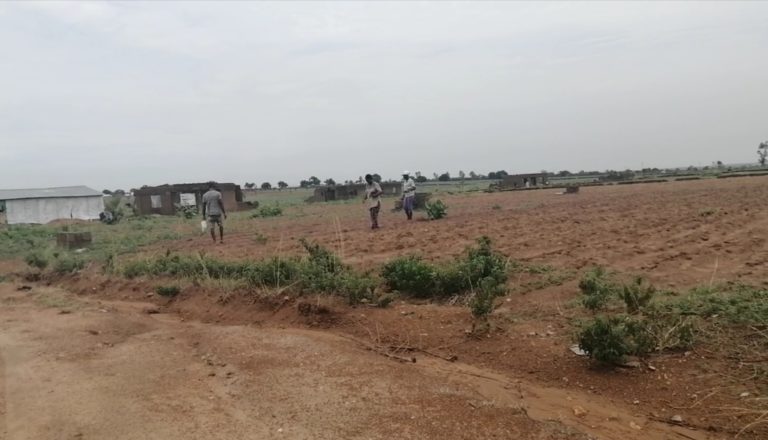
Smallholder farmers in Nigeria, majority of who are women, produce the bulk of the food that the nation feeds on. The COVID-19 pandemic has had a devastating effect on their business just as its effects are felt in other sectors of the economy. Some smallholder women farmers in Niger State recount the harrowing experiences they face because of the impact of the pandemic. JUSTINA ASISHANA, with support from the International Budget Partnership (IBP), reports.
“THIS year, I am experiencing hard times. I do not have any sprayer to use on the farm, all my sprayers have spoilt. I also do not have fertiliser or any chemical to spray on my farm. I am experiencing these challenges because there is no money to buy these things,” Dorothy Uchenna, a smallholder farmer in Niger State, told The Nation.
Dorothy is not alone in this ugly situation. Every other smallholder farmer in Niger State is facing it. They have been unable to sell their farm produce because of the ban on inter-state movement. Currently, hundreds of bags of farm produce are waiting to be off-bundled in the state because the restriction of movement has led to the unavailability of buyers for these products.
As part of Nigeria’s effort to curb the spread of COVID-19 in the country, President Muhammadu Buhari enacted the COVID-19 Regulation 2020, which, among other measures, imposed significant restrictions on the movement of people and goods in Lagos and Ogun states as well as the Federal Capital Territory (FCT). Other states across the country also restricted movements into their respective territories from neighbouring states. The move made it impossible for traders to travel to other states to buy goods and render services.
Smallholder women farmers are the worse hit by this as the majority of them are currently finding it difficult to begin this year’s cultivation of yam, soya beans, maize, rice and melon; despite the exemption of vehicles conveying food and other essential materials from the restriction. Customers of these farmers are finding it difficult to beat the inter-state ban to travel to other states.
Data got from the National Bureau of Statistics (NBS) Food Prices Watch revealed that there is a reduction in food prices, especially in yam while maize and rice showed a little rise in price. The price of some food not captured by the NBS has also gone up.
According to NBS data, in March last year, local rice was sold for N244 per kilogram and yam was sold for N197. But in March, this year, local rice was sold for N216 and yam was sold N150; last year April, rice was sold for N278 and yam for N194 per kilogram, in April this year, rice was sold for N293 and yam was sold for N124 per kilogram.
While in May last year, rice was sold for 287 and yam for N205 while in May this year, rice was sold for N289 and yam for N161.
In March last year, maize was sold for N83 per kilogram but in March this year, it was at N116; in April last year, maize was N124 but in April this year, maize was N106 while in May last year, maize was sold for N85 and in May this year, maize was sold ar N112 per kilogram.
Despite these prices, the farmers claim they are keeping their goods until the price is favourable and their customers from outside the state are allowed to come in and buy the goods from them at the prices they feel would be reasonable for them to benefit from the labour on the farm.
No farming due to lack of money – Dorothy Uchenna
The modus operandi of Dorothy Uchenna, who has a farm comprising yam, maize, millet and melon in Chachanga Local Government Area of Niger State, is to sell her produce and use part of the money for the new planting season whereby she can get input, pay the labourers she engages and others. But this year is different as she has not been able to sell her crops.
“We are still considering how to go about farming this year. This year, we are not planting much. The produce that we brought into this year that we are supposed to sell out such as melon, which we used to sell for N100,000 a bag is now N50,000. The difference is much and the market is just like that this year. We are managing to sell it out because if we don’t, the new ones that will be harvested this month will affect the sale of the old ones.”
Madam Larry, who is a yam, maize and soya-beans farmer in Paikoro Local Government Area of Niger State. She said most of the prices of products have fallen drastically, which is why she cannot sell her crops at this time as she is not ready to face the loss.
Mariam Musa whose farm is also in Chachanga Local Government Area of Niger State has bags of soya-beans, groundnut and maize, which she cannot sell because of lack of customers and fall in the prices of the crops.
Mrs Musa in her farm in Chachanga LGA
Mariam, who said she has no money to pay labourers this year, makes use of her children in farming. When The Nation visited her farm, three of her children were helping her to plant maize.
“Right now, I have 10 bags each of groundnut, soya-beans and maize and I sell per measure. I have not tried to sell it because I heard people saying all the prices have fallen and there is no market at all.”
‘We are set for loss this period’
The women farmers in Bida axis are not immune to the challenge of selling off their crops as they are faced with the same challenge. Millicent Yisa and her husband in Enagi Local Government Area of Niger State have about 150 bags of beans, melon, guinea corn, soya-beans and rice in storage.
“Today, I had to beg someone to buy the groundnut off my hands so that they will not spoil because they are already infested. This year, we are selling our farm produce at lower prices.,” she said.
An expert in Rural Agricultural Development, Professor Kola Adebayo of the Federal University of Agriculture, Abeokuta, said the reason for the gap in the storage of food and the prices of food products is a signal of the failure of government in taking proactive steps of engaging the farmers, especially after the production of their farm produce.
The Director, Planning, Research and Statistics of the Niger State Ministry of Agriculture and Rural Development, Alhassan Umar, said it is the Federal Government that is responsible for the strategic grain reserves and not the state government, adding that although there is a grain reserve in Niger State, it is, however, under the responsibility of the Federal Government.
He said the state government has a Buffer Stock programme where they buy excess grains from farmers after each farming season and sell to the people at a subsidised rate.
Rev and Mrs Yisa in their farm
Millicent Yisa and her husband have decided to pull resources and invest heavily in upland rice which they believe would help them cushion the loss they will face on other crops.
‘Dipping Egusi prices a nightmare ‘
For Ruth Illiya, maize, guinea corn, Egusi and soya beans farmer in Gurara Local Government Area of Niger State, the falling price of egusi is something farmers in the state have never experienced in the past.
“Imagine egusi that is usually sold for N500 for unpeeled and N1000 for peeled ones per mudu at this time of the year is now being sold at N150 for unpeeled and N400 for peeled ones. The price has fallen probably because people are no longer coming from outside the state to patronise us. We will face serious loss if we sell it now, that is why we are storing the produce,” she said.
Illiya added that although she has some farm produce at home, money is still needed to get additional items and essentials for the home.
‘Our members are suffering’
The effects of the lockdown and restriction of movement on businesses prompted the Federal Government to introduce fiscal and economic stimulus measures to ameliorate the impact on businesses and save the economy from total collapse.
However, being women and mostly the breadwinners for their families, smallholder women farmers are expected to be beneficiaries of both the food that is being distributed to households as palliatives as well as the Conditional Cash Transfer, particularly, the additional one million households ordered by the President to be included in the National Social Register.
But the majority of the smallholder women farmers in Niger State said they did not receive any palliatives either from the state or Federal Governments. Neither did they receive any money from the conditional cash transfer initiated by the Federal Government.
The Niger State Coordinator of the Small Scale Women Farmers’ Organisation of Nigeria (SWOFON), Grace Disa, confirmed that none of her members received any stimulus package.
Mrs Grace Disa – Niger state SWOFON Coordimator
The SWOFON Coordinator appealed to the Niger State government to also consider women during this farming season.
The majority of the smallholder women farmers in Niger State are not aware of the farmermoni while they said the conditions to get loans from Bank of Agriculture, NISRAL or Bank of Industry are usually cumbersome.
JOI Nunieh, embattled former interim Managing Director of Niger Delta Development Commission (NDDC), on Thursday, cried out over perceived victimisation, disclosing that she is now a refugee in Rivers State government house.
According to Nunieh, during the early hours of Thursday, some policemen laid siege on her residence in an attempt to abduct her. Nunieh disclosed that her premises was trespassed by the officers who showed up without an arrest warrant.
The former NDDC MD escaped following a rescue mission by Nyesom Wike, the Rivers State governor, who showed up at Nunieh’s residence in the morning, following reports that she had been forced to remain indoors by a team of policemen, allegedly working on orders of the Inspector General of Police (IGP).
Nunieh was scheduled to appear before the House of Representatives ad hoc committee set up to probe discrepancies in the commission.
The Senate and House of Representatives in early May 2020 resolved to probe the Interim Management Committee (IMC) of the NDDC following misappropriation of N40 billion within three months.
Meanwhile, President Muhammadu Buhari has ordered a speedy investigation into the NDDC corruption scandal.
Garba Shehu, the presidential spokesperson disclosed this in a statement on Thursday, noting that President Buhari is aware of the drama within the commission. According to Shehu, the president is determined to uncover the issues hindering the development of the Niger Delta.
“President Buhari expressed his strong determination to get to the root of the problem undermining the development of the Niger Delta and its peoples in spite of enormous national resources voted year after year for this singular purpose,” the statement said.
JUDE kadiri hits the road every day 6:30 am to sell facemasks since the COVID-19 pandemic surfaced in the Federal Capital Territory, Abuja. The 13-year-old J.S.S 3 student of Gwarinpa Secondary School does this with his friends around Karmo side of the city.
Jude produces the facemasks with his mother who is a tailor and hawks them at major bus stops of Jabi and Deidei of the FCT to make extra income for the family.
“It is a way to assist my mother,” said the boy.
Jude’s mother, Julie Edjeba Kadiri, a widow of eight years and a domestic worker and a trained tailor, confirmed the efforts of the boy in contributing to the finance of the family in a period of “so much financial pressure” as she described it.
According to her, “Jude has made over N25,000 since this coronavirus trouble started and I have been able to save N15,000 for him out of the money. We also feed from the money he brings home sometimes because since March ending, I could not go to my place of work where I clean the house. So, my son told me he could make facemasks. He told me he was taught where he used to learn tailoring after school hours before the restriction on the movement started. I am also a tailor by training and I have a small shop where I manage to get additional income. We began to make the facemasks together in my shop since I was not going to work again, while he goes out to sell them every day.”
JUDE KADIRI around a popular junction in Jabi, FCT, selling Face mask.
Jude is not the only one helping her parent to earn a little more income during the lockdown. Fourteen-year-old Abednego Peter and 12-year-old Jennifer Peter also lend hands to their struggling parents. In torn and loose clothes, they stood in their father’s farm, wiping sweats off their faces. They were found applying manure to their father’s maize farm in Idu Kooro area of FCT.
“I was the one that did the planting this farm, I helped my father to plant groundnut also in three other farms that belong to us in Hulunmi and Paipe village,” said the boy, who added that he was preparing for his junior WAEC exams in Junior Secondary school, Idu koro, before the outbreak of COVID-19 in the FCT.
The two underage children work on the farm without the supervision of any adult nor with any form of protection, making the girl vulnerable to rape and to kidnapping. The two siblings are among the 108 million children said to be child farmers across the world, according to the International Labour office global estimates of child labour of 2012-2016.
Since the schools were shut-down in March this year due to the coronavirus, Abednego has planted beans, maize and groundnut. Although he is not in school, he has assisted the family so much. “His mother and I have been sick, but since March he goes to farm with his sister. Only once in a while, I check what they have done, that is when they apply manure because the time for it was rolling by. He has saved me from the trouble of hiring an outsider to do the farm work for me,” said Abednego’s father, James Peter.
ABEDNEGO & his Sister JENIFA PETER, both applying Manure to their father’s maize farm around Idu Kooro , FCT.
The father of four, Peter, a full-time farmer, said his inability to provide smartphone or laptop for his son has deprived him the opportunity of joining the internet classes he heard about during the closure of schools. But the period has paid off well for him. He said his family got some palliative during the lockdown though it was not enough to sustain the family.
“We had to prepare for the rainy season on our farm, I believe it is what will sustain my family beyond this Coronavirus period and moreso, these children have been sitting at home doing nothing,” he added.
Another child working to shore up finances at home is Amarachi Isaac. She is the second child in the family of five and has been selling vegetables for her mother since she was 11.
“Some men ask if I could follow them to their car to collect my money sometimes,” Amarachi said, confirming the fear of her mother who, in spite of the assistance provided by her daughter, knows the danger of allowing a young girl to hawk in Abuja.
Amarachi’s mother, Mercy Isaac, a petty trader in kado told VON that asking her daughter to hawk vegetable is a way of reducing the financial burden on the family. She said since her school was closed due to COVID 19, Amarachi has made customers of her own. She said she is sometimes afraid of her going too far from her shop due to the fear of rape or kidnapping, but she has no choice.
“As you can see I cannot afford to buy a computer or get data for my daughter to learn via the Internet, for me it is as good as no learning for them since four months now because she attends public school, so most times she is in the shop with me selling or making extra money in her known location”.
Mrs Isaac said the family feeds from what she and her daughter make every day hence, she could not risk her daughter not being in the market in a day.
Section 28 of the Child Rights Act 2003, prohibits employment of children and forbids anyone below age 18 from performing any work that is hazardous or interferes with the child’s health, physical, mental or social development.
The Child Labour Act of Nigeria ratified in 1974 sets the minimum age for employment at 15 years, precisely to include light domestic work performed for the family.
A National Modular Child labour Survey of 2000/2001 revealed that over 15million children are engaged in child labour in Nigeria. The report stated that major reasons given by the children to engage in the act is the need to generate extra income for their family.
Jude & Julie Edjeba KADIRI, his mother making the Facemask in the mother’s shop for sales.
Jude, Abednego and Amarachi are among the under-aged children engaged in child labour and made to bear the burden of school work at the same time.
Child Rights Advocate, Kolawole Olatosimi of Child Protection Foundation, lamented that despite the fact that Abuja child hawkers are victims, their trading activities are also criminalised by the Abuja Environmental Protection Board AEPB and the FCT Social Development Secretariat.
He said: “The partnership between the FCT Social development secretariat and the AEPB is in discordant to the Child’s Rights Act of 2003. The AEPB is totally doing the wrong thing, their manner of picking up these children off the street is against the CRA. It is against the UN Convention on Child Rights. It is also against the Africa Charter on the rights and the welfare of a child to which Nigeria is a signatory. I believe the FCT Social Development Secretariat is criminalising the children who engage in hawking other forms of child labour. They make them feel responsible for hawking on the street or farming around, they arrest them, chase them to vehicles and so many of these children have been hit by vehicles., they criminalise the victims, to me its victimisation, they claim they are doing this because of implementation of the 2003 Child’s Rights act.
“The AEPB is not qualified enough to handle the children. It is wrong to handle children in such condition, the implementation is still at zero level in the FCT Secretariat, hawking for children on the street is a crime against the CRA, instead of arresting the criminals these people arrest the victims, for me, the CRA is not been implemented in the FCT.
“Some parents believe children need to assist in the provision of basic necessities for the family, some believe children need to take over in the family line of business. It is also on the increase due to the closure of schools and students of most public schools in Abuja have been at home, going to school for these children is one of the things they have that makes them close to being normal.”
Olatosimi called for effective family court in the FCT, saying the CRA provides for the court at the magistrate level and the high courts.
According to him, “the court has powers to issue a protection order when a child in the custody of a caregiver cannot take care of such child, the family court will issue a protection order that will make the government take over the care of such child”.
He advocated the full implementation of the CRA, saying fostering is another major aspect of the Act that the government must consider.
“If you take ten children off the street in a wrong way, twenty of them replace them immediately,” Kolawole added
He lamented that children engaged in child labour are those who have not come in contact with the law.
“These are children in conflict with the law, they are not even to be taken to the regular court, they are not to be sentenced but rehabilitated, but borstal homes are not provided for in the CRA”.
The Child rights advocate queried the strength of FCT social development facility in Gwagwalada, saying the CRA only provides for complete support for the children.
“Some of this crucial facility is not in place, and because this is lacking, we will continue to have an increase in the number of children hawking on the streets of Abuja.”
Felicia Onibon, also Child Rights activist and the President of Change Managers International Network, said child labour could expose children to health hazards specifically in the period of the spread of COVID 19 pandemic, she condemned hawking and other forms of child labour, adding that child labour violates child right act.
“ We need to look at the situation that has led the children on the street to hawk items to bring food to the table of members of their families, we need to critically ask questions about parents who engage their children in farm work at underage, all of these affects children directly, specifically as they have been at home for too long during the COVID 19 lockdown. Also the situation of things affecting the environment, most of these children live in a tight environment, they have found themselves at home asking for more food which parents do not have, some parents practically see the idea of hawking as a way of occupying the time of their wards without considering the fact that they are violating the children’s right.”
But when contacted, Kenechukwu Onyedima, acting Secretary Social Development Services of the FCT, boasted of the synergy between the FCT Administration and the Abuja Environmental Protection Board, saying the board has enhanced the implementation of the CRA in the FCT.
Onyedima said the FCT has taken custody of over 67 children engaged in child labour in the FCT, and a minimum of eight are picked weekly by the AEPB.
“The FCTA frowns at child labour because we have domesticated the Child Rights Act, in most cases, it is difficult for us to locate where they are, especially the children who do farm work, but once our attention is called to the plight of such children, we retrieve them from their parents and take immediate custody of them and their parents stand the chances of losing the children to the government.
“In most instances, the parents come begging for the release of their children, we then delegate officers to know where they reside in the FCT and we ensure they write undertaken that if such child is engaged in child labour again, they will lose complete custody of their children,” the FCTA official said.
On bringing alive facilities like the family court, Onyedima said enacting laws for punishing individuals who engaged children in child labour may not work. She said her experience on the job has revealed that most times, the lives of the children may be under threat if the FCT social development sues the people involved. She added that most guardians are involved.
Assistant Chief Community Development Officer, Child Protection Unit of the Federal Ministry for Women Affairs, Felix Nwaeseni, said the CRA of 2003 is on state governments residual list, making them fully responsible for the full implementation of the act.
Nwaeseni stated that effective implementation of CRA in the FCT or any of the 36 states is faced by the issue of structure and cases of differences in institutional capacity for relevant organisations to intervene.
He said the absence of family court, unavailability of substantial structure such as availability of judges, child assessors are major setbacks to the successful implementation of CRA.
“In the 14 states, including the FCT, that have already domesticated the CRA, they all have what they consider to determine if an activity is child labour. These are areas we have logjams but internationally there are minimum standards of survival issues, you measure the kind of labour a child is engaged in, it must not be that labour that submerges the right of a child to live and survive.
“Over 90 per cent issues of children is not in the legislative list, not in the concurrent list but in the residual list where the states have their powers, so what was expected of the state government was for them to take these laws, sieve it and make it capture socio-cultural realities of different states.”
The AEPB officials taking the child hawkers off the street are not trained on handling matters of child labour, he added that those who have adequate training and empowered by law do not have the facility to accommodate these children, Nwaeseni added.
He mentioned social protection shelter for children, provision of food, medical needs and engagement of counsellors as major items on the CRA as well as requirements to provide under the Child Rights international policies if the FCTA must keep the child hawkers off the street, end or reduce child labour in the territory.
“ The gender and Social Affairs department of FORCE CID under the Inspector General of Police is responsible for this activity, they are the ones FCT administration is supposed to be using, but possibly the AEPB have facilities to keep these children temporarily. This is not the best intervention under the minimum standard, the standard says these children are human beings and they have the right to good shelter for six months and feeding, to survival, medication and others.”
The Social protection worker disclosed that the ministry of labour still faces challenges on the issue of Nigeria’s law on child labour of 1974, which presently is being repealed at the National Assembly.
Looking at the budgets of most state governments, many do not prioritise children welfare. Little wonder children are often in the farms tilling the soil. The matter of children welfare is in the residual list. Therefore, it is crucial for stakeholders to approach the National Assembly for constitutional change so that matters of children’s welfare and protection can be moved to the concurrent list.
He lamented that the Federal Ministry of Women Affairs is incapacitated to carry out major advocacy on issues of child labour following the approval of child labour funds to the Federal Ministry of Labour.
Meanwhile, Nigeria’s Minister of State for Education, Emeka Nwajiuba, while reacting to the accessibility of pupils to Online studies during the COVID Pandemic in Nigeria, said less than 11 per cent of children in public schools have access to the online teaching content made available by the federal government due to unavailability of facilities
This report was sponsored by the Institute of War and Peace Reporting, IWPR and the International Centre for Investigative Reporting, ICIR, under its Human Rights Accountability and Justice project.
FOLLOWING decision of the Federal Government to pull out from the 2020 West African Senior School Certificate Examination (WASSCE) and a conflicting position from the South West State governments, the West African Examination Council (WAEC), Thursday, said it is currently reviewing the controversial situation.
WAEC told The ICIR that it has commenced consultations with the relevant stakeholders to ensure it reaches a final consensus, even as the examination date set on August 4 draws closer.
The regional secondary school examination was initially slated to commence in the country from August 4 to September 5, 2020, until the federal government’s decision.
Meanwhile, Lagos, Ekiti, Ondo, Oyo, Osun and Ogun states under the platform of the Development Agenda for Western Nigeria (DAWN) had on Tuesday, agreed to reopen schools for its Senior Secondary School students (SS3) on August 3 in order to sit for the final examinations.
The agreement was reached after Commissioners of Education, Special Advisers on Education, and Chairmen of State Universal Basic Education Board (SUBEB) concurred on the new decision.
They stressed that the schools would adhere to the Coronavirus Disease preventive guidelines recommended by the Nigeria Centre for Disease Control (NCDC).
“All the states would have reopened schools for SS3 students by August 3, with COVID-19 preventive measures put in place in each school,” the commission added even as it agreed to set up a regional examination body.
But on July 8, the federal government withdrew its decision on school reopening and appealed to the state governments to reconsider their decisions.
The Nigerian Union of Teachers (NUT) and National Parent Teachers Association of Nigeria (NAPTAN) also supported the FG frowning at the state governments’ decision.
When the reporter inquired about the possibility of WAEC organising a separate examination for the South-West states, Demianus Ojijeogu, WAEC spokesperson simply said the body was still reviewing conditions put forward by both parties and other stakeholders.
“…the Council is still reviewing the situation and is also consulting extensively to ensure that at the end of it all, it’s a win-win situation for all stakeholders,” Ojijeogu stated.
He added that ‘review and consultations were still ongoing’ when asked to give an actual date WAEC would make its decision considering the proximity of the examination date.
WAEC had in March announced its decision to suspend the 2020 examination due to COVID-19.
As of July 15, 2020, Nigeria has recorded 34, 259 confirmed cases of COVID-19 with 13, 999 recovered cases, and 760 deaths.
The World Health Organisation (WHO) also reported 13, 338, 364 confirmed cases of the virus as of the date and 579, 319 deaths in 216 countries.
AHMADU Fintiri, the governor of Adamawa State and eight other aides have disobeyed the airport COVID-19 guideline by refusing to take temperature checks, according to the Federal Airport Authority of Nigeria (FAAN).
The Airport authority made this known on Thursday via its official twitter handle condemning the action of the Adamawa state governor.
According to FAAN, Fintiri arrived at the Port Harcourt International Airport alongside eight others and refused to be sanitised or have his temperature taken.
“The Management of the Federal Airports Authority of Nigeria (FAAN) hereby strongly condemns the conduct of the Governor of Adamawa state Alh Ahmadu Umaru Fintiri, who arrived Port Harcourt International Airport aboard aircraft 5N-IZY, at 17:08 hrs on 14th July 2020 with 8 others.”
FAAN noted that the governor and eight others “flagrantly refused to observe the Airport Security and Public Health protocols as directed by the Federal Government through the Presidential Task Force (PTF).
“The team that came to receive them drove right through the barricades up to the terminal building ignoring traffic and Aviation Security instructions,” FAAN disclosed.
This followed a recent report by the FAAN alleging that the former governor of Zamfara State, Abdul-Aziz Yari also refused to have his luggage disinfected by Environmental officials in the Airport.
However, both Yari and Fintiri have respectively denied flouting the guidelines as claimed by the Airport Authority.
Governors says FAAN’s allegations are untrue
Yari threatened to sue FAAN for alleging he assaulted the environmental officer and claiming he violated the guidelines as stipulated by the PTF.
The ICIR noticed that the FAAN, following Yari’s statement, deleted the twitter post which alleged that the former governor assaulted an officer.
Solomon Kumangar, the Adamawa State Director General of Media and Communications, in a statement saidthe governor did not flout the guideline but only refused to fill a mandatory form by himself.
“Governor Ahmadu Umaru Fintiri and his team subjected themselves to the protocol, including temperature check, the only thing the Governor took exception to is filling a form as the airport demanded, the statement read.
Kumangar said Finitri refused to fill the form because his protocol officer or orderly could fill it for him.
OFFICIALS of the Niger Delta Development Commission (NDDC) led by the Acting Managing Director, Kemebrandikumo Pondei have walked out on the House of Representatives Committee on NDCC over probe of N81.5billon misappropriation suspected in the Commission.
The NDDC officials on Thursday walked out on the investigating panel with claims that the chairman of the committee, Olubunmi Tunji-Ojo has been involved in financial infractions involving the commission.
Pondei said the NDDC would not entertain questions as long as Ojo is the Chairman of the Committee.
After refusing to adhere to the point of order by the members of the committee, Pondei and other NDDC officials who accompanied him walked out on the House Panel.
Consequently, the committee resolved to issue an arrest warrant on the officials of the NDDC to ensure they appear before the panel.
Impunity cannot be allowed to stand, says Wike
Meanwhile, Nyesom Wike, the governor of Rivers State has ‘rescued’ a former managing director of the NDDC, Joy Nunieh, in Port Harcourt whose home was besieged by armed operatives on Thursday morning.
Nunieh was also scheduled to appear before the House Committee on NDCC in Abuja but was stopped from leaving by armed security personnel.
According to the former NDDC boss, the state governor rushed into her residence with security escorts to rescue her from armed men that besieged her home early in the morning.
The former NDDC boss is said to have been taken to the Rivers State Government House for safety
In a tweet about the incident, Wike said Impunity would not be allowed to stand in Rivers state adding that the state is ready to fight for justice.
“Impunity can not be allowed to stand, not in Rivers State. We are ready to fight for justice,” Wike wrote.
The trigger for the conflict was the proclamation by Colonel Odumegwu Ojukwu on 30 May 1967 that Biafra had become a republic. After 30 months of war, Biafra surrendered and was once again incorporated into Nigeria.
According to the author John de St Jorre, between half a million and a million Nigerians died, mainly from starvation, during the war.
Through the efforts of their roving diplomats during the war, Biafra achieved recognition from the states of Tanzania, Gabon, Haiti, Ivory Coast, and Zambia. But the fledgling state struggled to secure wider diplomatic support. It also found it difficult to purchase weapons and smuggle them into its controlled territory via airlift.
The efforts of these diplomats have recently come to light through the decryption of telexes sent from Portugal to Biafra during the war. Telex, short for teleprinter exchange, was a method for transmitting messages electronically over landlines or radio. Lisbon, the capital of Portugal, had become the centre for Biafran diplomacy in Europe because the government of Portugal under António de Oliveira Salazar supported Biafra with air landing and communication privileges. Paris and London were also key centres for Biafran diplomats.
In our paper, we set out what was in the encrypted messages, and how we solved them. Three of us worked on the project, each with different disciplines – a mathematician, a computer scientist and a radio technologist. We used manual and computerised cryptanalysis methods to decipher a series of transposition ciphers sent by Biafran officials in 1968 and 1969.
It took us three months to figure out how the encryption worked and what keys were used. We also needed to read about the context of the war to understand and interpret the messages. The historical figures were unfamiliar to us and many codewords were used for people, countries and objects.
In the end, the decrypted messages provided a treasure trove of information about how men and women working for the breakaway state in Europe tried to garner support for Biafra from afar during the war.
Decades long decryption project
At the time, the Biafrans sent some of their messages in plain English text and made some extra effort to encrypt some in order to ensure that at least casual eavesdroppers couldn’t read the encrypted ones. However, they made mistakes which meant that professional as well as amateur eavesdroppers could have read them.
Some were also intercepted by at least one amateur radio operator, Frode Weierud, in Oslo, a co-author of our academic paper.
At the end of July 1969 Weierud discovered a signal in the shortwave band transmitting a regular message in radioteletype: “This is Biscaia testing to LDA/3”.
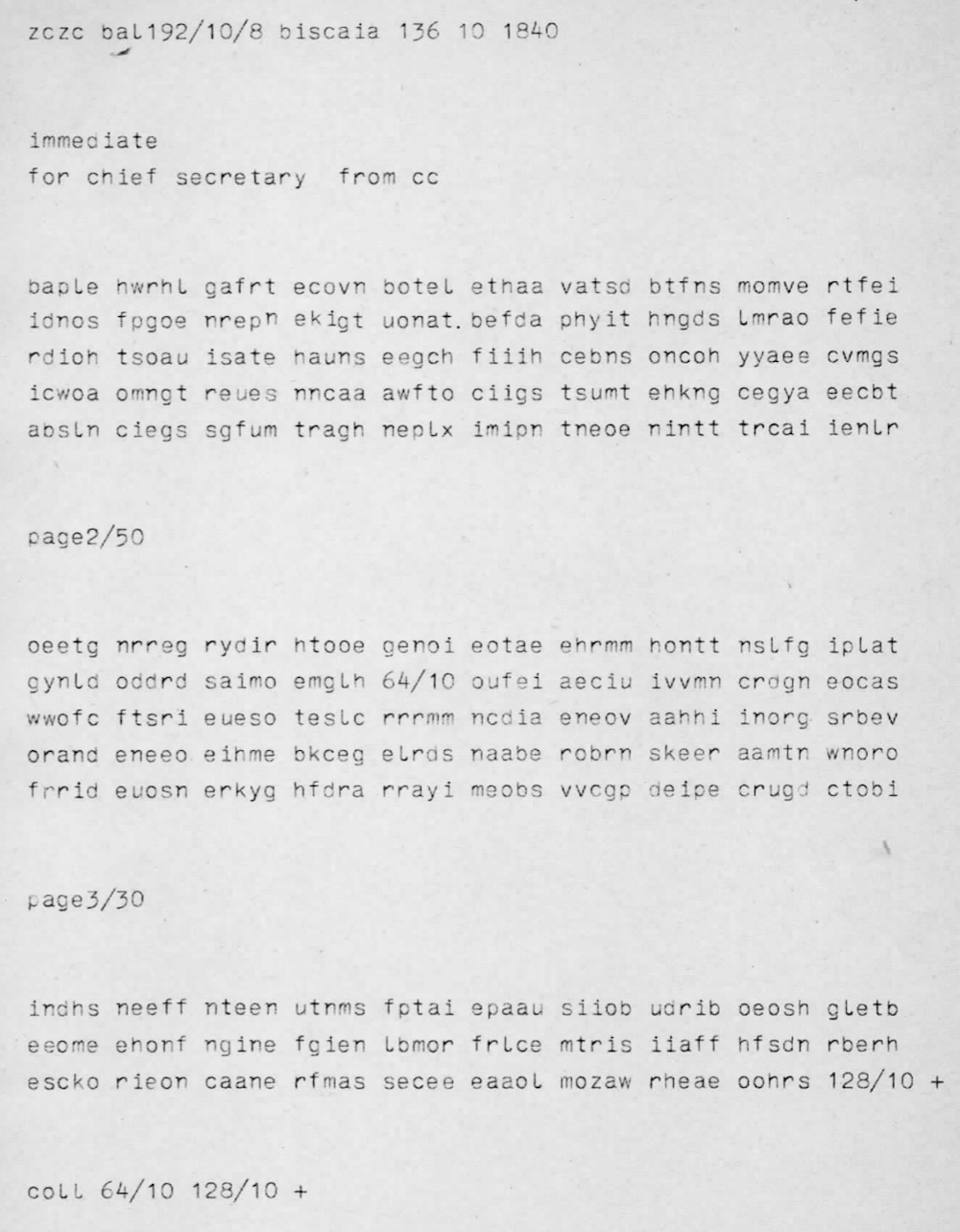
Using teleprinter devices, he was able to intercept a series of messages from the station “Biscaia”. The messages were initially in understandable English, but soon they started arriving in ciphertext, in both five-letter and five-figure groups.
Example of a five-letter encrypted message.
These messages were from a telex link between Biafra and Lisbon. During the war, Biafra had only one telex machine. It was the only communications link to and from the outside world. The machine was moved around Biafra depending on what territory was controlled.
The unencrypted, or “plaintext” messages sent over the link were often intended for wider distribution via Biafra’s public relations firm in Geneva, Markpress. The encrypted messages were between Biafran diplomats in European cities and the leaders of Biafra and were not intended for public distribution.
Although Weierud tried to decipher the messages in 1974 and wrote to a cryptography journal about them in 1978, the messages remained publicly undeciphered until he published them on his website in 2019. A Swedish signals intelligence veteran, Jan-Olof Grahn, also described the content of some messages in a 2019 book.
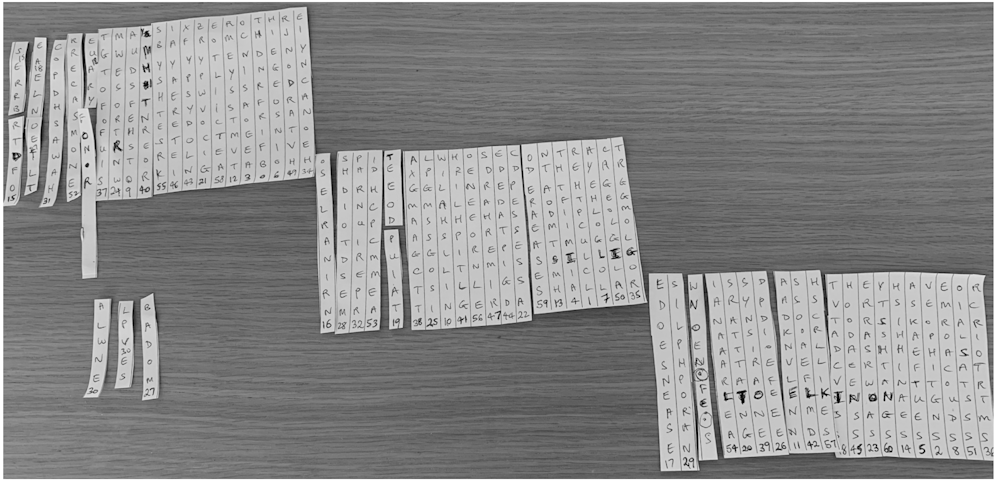
After Weierud published the messages, I joined him, as did George Lasry, a computer scientist from Israel, to decipher the messages. This was a difficult task as the cipher system was unknown. In fact, we used advanced computer algorithms, and also needed to improve them, to decipher some of the more challenging traffic. We also had to resort to manual methods at some points, writing out the letters on strips of paper and rearranging them by hand to form readable English.
Solving the ciphers by hand.
The task took many hours across all the messages. In general, the task for a code breaker is easier when more “ciphertext”, or encrypted messages, are available. The Swedish intelligence agency would have made short work of the messages, given the great number of messages intercepted by their superior equipment and the regular nature of the messages.
For instance, each message begins with the word “SECRET” followed by the name of the sender and recipient, which is given in both plain and ciphertext. If the codebreaker knows a particular phrase like this, called a “crib”, occurs in the plaintext, this can make the process of deciphering much easier.
Being able to see the original texts allows for a more accurate record of history, as the messages offer a contemporary, first-person view into the conflict. Later accounts may well be whitewashed or self-serving by contrast.
What we found
The broad subjects covered by the messages included travel arrangements, arms deals, expenses and public relations.
The longest message was from Austine Okwu, the Biafran representative to Tanzania, to Colonel Ojukwu about taking the Biafran cause to the United Nations General Assembly. Other key characters in the messages were Christopher Mojekwu, described as “Ojukwu’s closest confidant of all”, and Chris Onyekwelu, Ojukwu’s brother-in-law.
One of the messages referred to members of the delegation bringing Biafra into disrepute by not being able to pay their hotel or telephone bills. The leaders urged frugality in the message.
Other messages referred to logistics, travel and shipments. For instance, one message from Mojekwu to Ojukwu referred to a weapons transfer and contacting “Achebe” – perhaps referring to the famous author.
Another message from October 1969 referred to the possibility of flights for salt and meat, and the extension of a hospital under the direction of Edgar Ritchie, an Irish obstetrician.
What next
Many of the cities and characters are still obscured by acronyms or codewords and remain to be identified, such as “HY” and “Chabert”. On the other hand, we were able to identify a whole series of other codewords concerning places because the plaintext described public events using codewords.
The key to the solutions was increased by computer power, storage, improved algorithms and international collaboration. The five-figure ciphers remain unsolved for any readers who want a challenge; although if a “one-time pad” encryption system has been used correctly, they may never be solved. Such a system provides perfect security if certain conditions are met.
In contrast, the system used would not have provided security to a determined eavesdropper. This gave us a rare window to see diplomatic communication – often protected by strong encryption – in action. To listen in, intelligence agencies either break the codes or insert a “backdoor” into the machines used.
Apart from being a fascinating project, we also believe the messages we decrypted provide a useful complement to the later written accounts of the participants in the war.