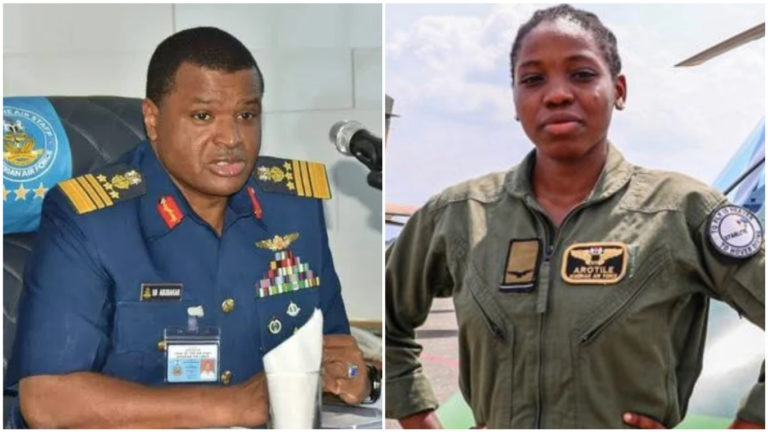
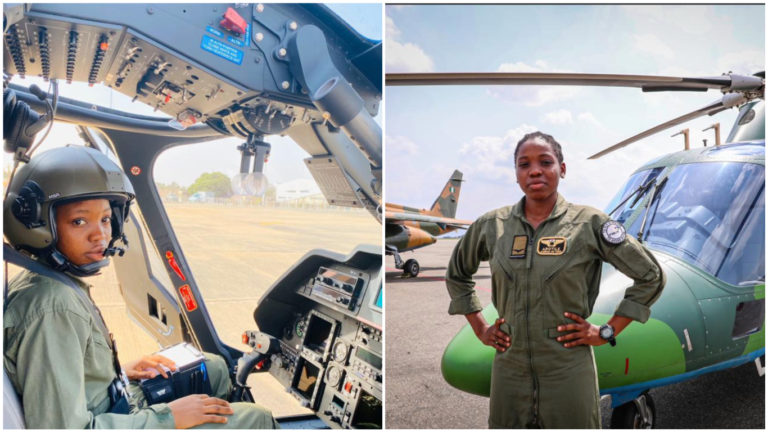
THE Nigerian Airforce (NAF) on Sunday released findngs of its investigation into the circumstances surrounding the death of Tolulope Arotile, Nigeria’s first female combat helicopter pilot, who died in a car accident on July 14 at the NAF base in Kaduna State.
Ibikunle Daramola, NAF Director of Public Relations and Information disclosed that Arotile was knocked down by a Kia Sorento SUV, with Registration Number AZ 478 MKA, driven by a former classmate, Nehemiah Adejoh.
Daramola said the 23-year-old pilot died shortly after being knocked down by the car which was occupied by three former classmates of Arotile: Mr Igbekele Folorunsho, Mr Festus Gbayegun and Adejoh, the driver of the vehicle.
“Mr Nehemiah Adejoh, Mr Igbekele Folorunsho and Mr Festus Gbayegun, drove past her in a Kia Sorento SUV, with Registration Number AZ 478 MKA. It is noteworthy that Messrs Adejoh, Folorunsho and Gbayegun are all civilians who live outside NAF Base Kaduna, but were on their way to visit one Mrs Chioma Ugwu, wife of Squadron Leader Chukwuemeka Ugwu, who lives at Ekagbo Quarters on the Base.
“Upon recognising their schoolmate, Arotile, after passing her, Mr Adejoh, who was driving, reversed the vehicle, ostensibly in an attempt to quickly meet up with the deceased, who was walking in the opposite direction.
“In the process, the vehicle struck Flying Officer Arotile from the rear, knocking her down with significant force and causing her to hit her head on the pavement. The vehicle then ran over parts of her body as it veered off the road beyond the kerb and onto the pavement, causing her further injuries,” Daramola said.
Arotile was rushed to the hospital at the NAF base in Kaduna but was pronounced dead moments later.
Daramola disclosed that the three ex-classmates were immediately arrested and it was found that Adejoh did not have a valid license.
He added that the matter would be passed to the Police Force, being a civil case.
Meanwhile, the family of Arotile, Afenifere, a Pan-Yoruba socio-political organisation and a group of civil society organisations under the aegis of Joint National Action Civil Society Coalition, had earlier demanded a corona inquest into the death of Arotile.
Their demands were that the Federal Government, the Nigerian Armed Forces, and the Nigerian Police should undertake a thorough investigation into the death of the young officer, who, before her death, was instrumental in Nigeria’s fight against insecurity, particularly in the North West and North Central regions.
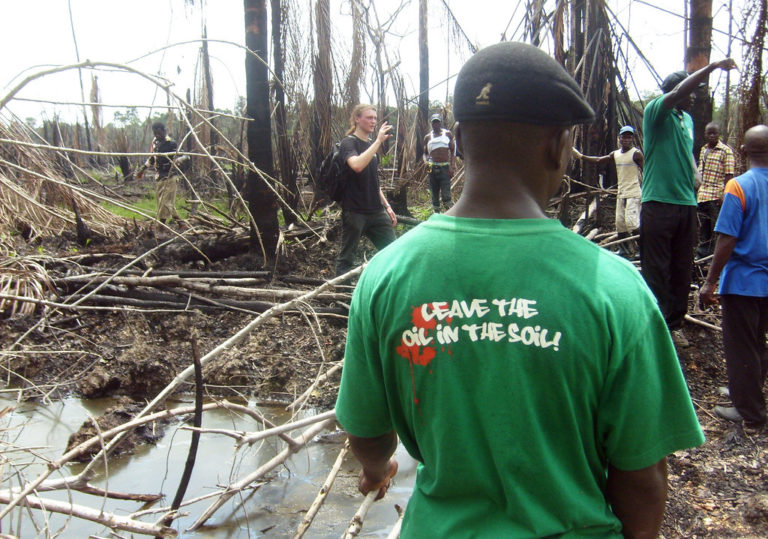
LESSON for Americans in the age of Black Lives Matter, from the Niger Delta’s long struggle for environmental justice.
In June 2020, the Trump administration, using the COVID-19 pandemic as an excuse, began to accelerate the rollback of major environmental regulations in the United States. On June 5, Trump signed an executive order aimed at weakening the National Environmental Policy Act, reducing the effectiveness of the Clean Air Act and effectively opening the door for more pollution in the country. The Executive Order accelerates the construction of pipelines and other energy projects without consideration for environmental impact assessments.
This new weakening of environmental regulations comes in the wake of many such executive orders, often targeted at weakening protections not only for the environment but blacks and people of color who live in many communities often affected by environmental pollution.
The Trump administration’s disregard for the environment was not new—in 2018, climate scientists, environmentalists and close watchers of the oil industry were once again reminded of the dangers of the Trump presidency to climate concerns when the then Interior Secretary, Ryan Zinke, proposed a vast expansion of oil drilling in the Pacific, Atlantic and Arctic oceans—ending many years of moratoriums on oil drilling in these sites. This followed similar actions regarding the opening up of sacred sites and sites of national monuments to drilling and mining activities across the US. Sites such as The Arctic National Wildlife Refuge (ANWR) in Alaska and others are part of this drilling everywhere initiative. Recently, I’ve been pondering over three interrelated issues—the current protests against the incessant murder of blacks in the US, the Dakota Access Pipelines, and the oil rich Niger Delta region of Nigeria.
These three issues speak to the ways in which blacks and people of color, especially Native Americans in North Dakota, continue to bear the brunt of environmental disasters created by big corporations with the help of policies by the Trump administration the same way that the oil corporations shape policies in Nigeria through their alliance with the Nigerian government. The Black Lives Matter movement is not just about police brutality, but also the brutality daily perpetrated on the environment in which they all live across the world. From the swampy oil polluted Niger Delta in Nigeria to the neglected and polluted environment in the city of Detroit and the poisoned water in Flint, Michigan—the imprint of neglect and abandonment by our governments in favor of big corporations has made the environment where black and people of color live one of the most unbearable in the world.
Today, environmental pollution which disproportionately affects black people continues to be one of the most pressing realities of our time. For example, for over 50 years, oil-related contamination has been a constant reality for the people of the Niger Delta who experience regular oil spills, preponderance of acid rain as a result of gas flaring and other activities of oil corporations. As activists in North Dakota continue to protest the controversial Dakota Access Pipeline (DAPL), police brutality, and other forms of injustices against blacks and people of color in the US continue. There is a connection between the struggles for environmental justice in Nigeria, the protests led by the people of Sioux Rock, and those organized by Black Lives Matter.
Beginning in 1956, when the first oil consignment was shipped to the international market, the economy of the Niger Delta has shifted away from agriculture to become defined by oil production. At the center of this significant change are the people of the Niger Delta, whose lives, livelihoods, and cultural practices depend on the lands and waters where oil is extracted. Displacement from traditional livelihoods, the destruction of sacred sites, and the pollution of the environment have resulted in many years of protests and sometimes armed struggle. The 12-day revolution led by Isaac Adaka Boro in the 1960s marked the beginning of a long and protracted fight for recognition by the people of the Niger Delta. Non-violent protest groups formed, such as the Movement for the Survival of Ogoni People (MOSOP). In 1995, Ken Saro Wiwa, the leader of MOSOP and a renowned international playwright, was killed by the Nigerian State after standing up to Shell and other multinational oil corporations. By 2005, new movements emerged, such as the Movement for Emancipation of the Niger Delta (MEND). This violent insurgency group claimed to represent the interests of all Niger Delta people in their struggle against corporations and the Nigerian state. The insurgency still continues today, though on a smaller scale, mostly overshadowed by the Boko Haram insurgency in the northeast of Nigeria. Insurgency in the Niger Delta is today largely mitigated by monthly “amnesty payments” to former insurgents by the Federal Government of Nigeria.
Meanwhile, protesters against the DAPL in the US assert that the pipeline would damage sacred land and pollute the water supply to the Standing Rock Sioux tribe and other downstream communities, just like how many years of oil exploration has rendered the entire Niger Delta region disastrous. For the Black Lives Matter movement and its allies, it is not just about police brutality but also about systemic racism in education, housing, clean water, and a livable environment devoid of pollution—a right to restored land, clean air, clean water and housing and an end to the exploitative privatization of natural resources. For the BLM, the Sioux Tribe, and the Niger Delta communities, land and water are central not only for physical survival, but also for cultural survival. Any arrangement that denies them access to these important resources can lead to loss of livelihood, destruction of sacred sites, and disruption of cultural practices that are vital to community identity.
Denial of access to sacred sites, water (in Detroit and Flint), clean air, and areas of cultural importance is a grave violence whose impact on communities cannot be overemphasized. For example, some of the sacred places threatened by the DAPL are cemeteries where the ancestors of the Sioux tribe are buried. Clearing these cemeteries to make way for oil pipelines will completely erase the connection that the community has to its history.
In my many years of work in the Niger Delta region, I have witnessed firsthand the devastating effects that oil exploration has had on entire communities. I will never forget my work in Ogoniland, a region of the Niger Delta home to the indigenous Ogoni people. In 2011, the United Nations Environment Program (UNEP) released a report detailing the level of environmental pollution in the area, and estimated that environmental cleanup and restoration could take 30 years and over $30 billion. When I saw the protests in North Dakota and the reaction of the Obama administration to suspend DAPL construction in December 2016, I became hopeful that the Standing Rock Sioux would avoid the horrific environmental conditions that have plagued the Ogonis and other Niger Delta communities for many years.
However, my hope has since turned to anxiety after the Trump administration rapidly began cutting back on environmental regulations. For example, on January 31, 2017, the Army Corps of Engineers announced that it would be granting an easement to allow construction of the DAPL to continue. This followed an executive order issued by Trump calling for construction to recommence.
The Sioux Tribe community was granted a temporary reprieve on March 25, 2020 when a Federal Judge ordered a full environmental review of the pipeline construction. However, the coming months will no doubt prove difficult for the tireless protesters of Standing Rock. Since their first temporary victory in December 2016, many of the protesters have left North Dakota, packing up their tents and returning to their daily lives. Only a few hundred steadfast “Water Warriors” remain in spite of the Trump administration’s intimidation. With the vast expansion of drilling in the Pacific, Atlantic, and Arctic oceans, many communities across the US—from Florida to Alaska—may soon find out that they have many things in common with the Ugbo, Egbema, Bonny island, Oloibiri, and other communities of the Niger Delta—chief among them, a degraded environment.
Omolade Adunbi, an anthropologist from Nigeria, is on the faculty of the University of Michigan.
THE Joint Admission and Matriculation Board (JAMB) examination used to be notorious for examination fraud. Jamb officials, in connivance with corrupt individuals at the examination centre cheated the system unhindered.
Every year, the board tried new ways to combat examination fraud but centres always found ways to circumvent the system.
In 2007, every candidate was subjected to a body scanner to ensure no one went into the examination hall with a phone or any digital device that could be used to transmit answers. But candidates outsmarted the security check by wrapping their devices in thick layers of carbon paper to make the phones undetectable to the scanners deployed by JAMB that year.
The following year, JAMB worked with telecommunication service providers to distort mobile connectivity during the examination. JAMB tutorial centre advised their candidates to get new sim cards of a particular provider that did not join in on JAMB’s proposal. The new sim was used to send in solved answers to the candidates in the examination halls.
Seeing how cheating was still highly prevalent, the board began to produce multiple sets of questions. They were called ‘types’. In those years, there could be three different types of questions. The questions were essentially the same but reshuffled such that question 1 in ‘type A’ could be question 20 in ‘type C’.
The board also found a way to figure out which type a particular candidate answered: The question 1 is always about the type. In other words, the question would typically ask what ‘type’ is on the candidate’s question booklet. The logic behind this was that, if a candidate’s question booklet said ‘Type A’, and the candidate shaded the same on the computerised answer sheet but went ahead to copy answers from ‘Type B’, the candidate would fail woefully.
Again, centres found ways to cheat despite the introduction of ‘types’. The candidates were told to disregard the ‘type’ on the question booklet and simply shade on their computerized answer slip whatever solution was sent via their phone.
2010 in Lagos Island, a particular type leaked the night before the examination and most candidates who got a whiff of the answer simply ignored the ‘type’ on their question and shaded the ‘type’ that leaked.
This went on until 2013, when the board introduced Computer-Based Test (CBT) as against the old Paper Pencil Test (PPT). The former registrar of JAMB, Professor Dibu Ojerinde, said the innovation would reduce examination malpractice during the exam.
Indeed, malpractice reduced but there were still gaps. CBT did not check impersonation and most centres got the questions the night before the examination.
Candidates who wrote JAMB examination at Bachel then said they got answers on the night before the examination.
Students at Bachel College during WAEC
“During JAMB, people always attend the Bachel camp because they know answers will flow on the eve of JAMB,” said an older candidate who did not want to be named.
Also, Mr. Adeniran claimed to have been a candidate at Bachel college when he wrote his JAMB examination. Then, he said, it was easier to cheat during JAMB. The subject teachers would sneak in and read out the answers.
“It was easy then. Within 5 minutes everyone is done but it is no longer possible,” he told Grace just before the JAMB examination.
With JAMB, old things have passed away
“It is difficult to ‘help’ anyone during JAMB examination now and Bachel will not risk a multimillion naira centre for any student,” said Mr. Smart, one of the senior staff members at Bachel.
“The old things have passed away and all things are new. What we are doing for you now is all we can do. If you are expecting anything in the examination hall tomorrow morning, you’re seriously on your own.”
Just as Mr. Smart was giving his sermon, Aunty Funmi, slapped a book on the cheek of a candidate who was sleeping away.
“Unserious girl,” she exclaimed as the teenage girl jumped out of sleep. “You won’t read this past question now so that you can know what to write tomorrow. Continue sleeping. You will sleep for another year when you fail tomorrow.”
Grace had also enrolled for JAMB in the school. There has been a plethora of testimonies on how Bachel helped candidates cheat during the JAMB examination as well. Just as she did during the WAEC examination, Grace was there to unravel how Bachel cheats the JAMB system as well.
“Make sure you’re at the camp the night before even if you won’t attend the full camp. That’s when they will give the answers,” an old candidate had informed the reporters.
Indeed, Bachel camped its registered candidates for weeks before the 2019 JAMB examination. The candidates were camped at the Bachel centre in the Egbeda area of Lagos State.
Identity card issued at Bachel for all registered candidate
The owner of the school Mr. Fasusi Kolawole said the camp was to rid students of the distractions at home and allow them to study. On the last day of camping, the activities would start out as a crash-revision programme. Different subject teachers would come in to revise with the candidates. Then at about 2 am, the real reason for the camp would be shared– solved JAMB questions.
“Bachel always gets the questions a night before,” the old candidate disclosed.
However, with the stringent measures put in place to check malpractice during the examination, it has become tough for centres like Bachel to cheat during JAMB.
At the 2019 JAMB camp, there were no leaked questions, at least in Bachel centre where this investigation was carried out.
The only ‘help’ the school could render was to share screenshots of JAMB questions from those that had taken the matriculation test on earlier days. The test was spread across days to control crowds and access to computers.
Candidates who took the test on the first day had no ‘assistance’ to rely on. But, for those who wrote from the second day, they got screenshots from previous days.
“The questions that will come out will be the same. It might not be numbered the same way but it would be the same. So, you have to memorise this and remember when you see them in the exam. If you forget, you are on your own,” Mr. Smart told the students.
‘O boy, No show o’
Grace wrote her examination on the 3rd day at Bachel CBT centre at Ogba area of Lagos. JAMB officials who took biometrics of the candidates sat by a corner. Mr. Adewunmi and Adeniran were seen around the registration point but merely stood as onlookers.
The JAMB officials took the fingerprints of the candidates as they filed into the CBT centre. The hall was quiet with the computers ready to be occupied by the candidates. Two of Bachel’s staff were spotted inside the hall. Their faces were serious but the seriousness would soften into hopelessness when they see a familiar candidate whom they would be unable to ‘assist’.
Mr. Golden, the ICT man at Bachel who had become familiar with Grace during registration for both WAEC and JAMB examination, walked up to Grace as she tried to find her seat number.
The computer assigned to Grace seat number did not power so she was redirected to another room. Mr. Golden got Grace a seat beside one of the bright students.
“Ask her question. You two are doing the same subjects,” he whispered as he leaned over as though helping to set up the computer. He had to be careful while whispering because JAMB had installed CCTV cameras in the test hall.
The spokesperson of the board, Fabian Benjamin, said the JAMB reviewed the footage from the camera after the examination to spot inappropriate conduct that the officials might have missed during the test.
Of course, Grace left the candidate undisturbed to concentrate on her test. She took the test without any ‘assistance’. About 45 minutes later, she submitted and left the test hall.
Grace biometric was again taken to ensure she was the same person who had signed in for the examination. The double checks– before and after the exam– was to reduce incidence of impersonation.
Minutes after Grace had left the test hall, Mr. Golden called to ask her how she fared.
“You should have spoken with the girl. I know her. She is very smart and you two are writing the same subjects, that was why I put you beside her,” he said.
Just as the conversation with Mr. Golden concluded, a dejected candidate walked out of the school. He had just finished the matriculation exam as well.
“O boy, no show o,” he said over the phone. “Bachel no sure again and na you convince me. I for don go Ogun State na…” the disappointed young man said to whoever was at the other end of his phone.
That, no doubt, would be the testimony of many candidates who had enrolled at Bachel centre for assistance.
Mass Failure in JAMB
In May, 2019 when the result came out, Mr Golden was the first to ask Grace if she had checked her result.
“JAMB result is out. Have you seen your own result?,” he asked.
He was eager to know if Grace had scored above 200, the minimum score for most universities in Nigeria. When Grace informed him that she scored 238, he was excited.
“All those that have been calling me had a hundred plus. A lot of people really failed,” he announced.
Grace Adebiga’s JAMB result
The secretaries at the school were all talking about the ‘mass failure’ when Grace was at the Egbeda centre a few weeks after the result was released.
“Ha, the business woman,” one of the secretary exclaimed upon seeing Grace. “I heard you did well during JAMB. All these children failed. When they will not read.”
She raised a pile of results sorted into two categories: above 200 and below 200. The pile for those who scored below 200 almost tripled the other pile.
These were the same students who had distinctions and upper credits in WASSCE. This goes to show again that the strength of Bachel’s good grades in WAEC examination was hinged on massive cheating and various examination frauds.
Deploying technology to fight malpractice
A senior official of WAEC said the council cannot easily deploy technology as in the case with JAMB. The official, who would not want to be named as he had no authority to speak for the commission, said the JAMB is a one-day examination and is relatively easy to deploy technology like the CBT.
“JAMB’s CBT is multiple choice questions but for WAEC you have practicals where you have to check the items, there are some you have to do some buildings yourself. Whatever innovation we are doing would be different from that of JAMB,” the official stated.
“As technology is advancing, we are also advancing, we are making sure whatever we can do to curb malpractice, we are doing,” he disclosed.
CBT aside, one of the technological innovations the official claimed WAEC has introduced is the biometric device that the supervisors ought to use in verifying the identity of the candidate but the device was never used at Bachel. The WAEC official who supervised Government examination attempted to use it but found that it was not charged. The official, with Mr Adewunmi, fumbled with the device for a while but ultimately abandoned it.
For a school like Bachel that is very blatant with examination fraud, only a water-tight system could have made the school conform.
The matriculation board explained in an interview with one of the reporters that technology has been the driver of the innovative ideas used in combating various forms of examination fraud that used to characterise the conduct of JAMB examinations.
“We have taken full advantage of technology,” said the spokesperson of the board. “Technology is the way to prevent malpractice and for every agency that wants to take full advantage of technology can achieve that.”
Full finger biometrics and identity verification have mitigated against impersonation and slip forgery, the board explained.
An ICT expert, Jide Abiose, said identity verification technology prevents the duplication or replication of identities, hence an innovative way to check impersonation as no two individuals have the same biometrics.
He explained that checking the biometrics gathered at the point of registration against the one presented at the point of writing the examination would significantly reduce cases of impersonation.
“When the data gathered at the registration point does not match that of the individual for the examination, if there is no match, then the person would not be allowed to write the exam,” he said.
He mentioned that this could be manipulated by deploying other higher technology that is capable of manipulating even if, such technology would be too expensive to deploy just to cheat during matriculation exam.
NIN is the next Step
The combination of the CBT and the biometric system is a good way to check examination malpractice and increase efficiency, the expert said. Nonetheless, to completely eliminate fraud in the system, Abiose suggested that JAMB data be consolidated against the national identity database.
“There are ways that JAMB can further strengthen its identity system,” he said. “They must start insisting that everybody that registers for JAMB must have a national identity card. This creates a trial of your identity, therefore creating a new identity becomes impossible.
In October 2019, the registrar of the matriculation board, Ishaq Oloyede, announced that all candidates include the National Identity Number as a requirement to register for the JAMB examination.
However, this development was postponed till 2021 following the delay, among other challenges witnessed by the prospective candidates.
”We came to a decision yesterday and decided that we will suspend the use of NIN as a prerequisite for the 2020 UTME and Direct Entry (DE) registration until 2021. By then, all candidates would have been given one year notice to register,” Oloyede said.
Abiose said having a central and robust data pool is the only way to eliminate impersonation or any form of identity fraud.
Naming and shaming as deterrent
Another method of fighting examination malpractice that has been fully adopted by JAMB is the prosecution of officials and parents found guilty of the act.
According to the WAEC official, the commission has introduced sterner punitive measures as one of the ways to also curb malpractice.
“For example, if you are caught with a phone in the exam hall, whether you are using it or not, it is CER (Cancel Entire Result). Even invigilators are not allowed to use the phone,” he claimed.
But, Benjamin said prosecuting offenders would serve as a deterrent to others. He said the board has prosecuted no less than 90 people since the last examination.
“We have successfully prosecuted over 90 people; students, teachers, parents… They all got 2 to 3 years in jail term,” Benjamin said.
Beware of louts and exam fraud racketeers
This investigation is supposed to get Grace to the University of Lagos. Testimonies gathered during preliminary research for the investigation suggested that tutorial centres in connivance with staff of the university ‘sell’ admission into the institution.
With a JAMB score of above 200 and a superlative WAEC result, Grace was qualified for the 2019 University of Lagos post –UTME exam.
At Bachel, the sales of admission into UNILAG cost N200,000. The investigation hit a hard rock as there was no funds available to follow through the bargain.
However, Oladipupo, who claimed to be a student of UNILAG promised that he could secure admissions through the back doors for a fee lesser than Bachel’s. He charged N70,000.
But, it became apparent that he is merely a lout profiting off dishonest and desperate prospective applicants.
Oladipupo gave the account number with the name Ogbewi Edeigie to pay into. When asked why the account number has a different name, he said he was born to mixed parents. He claimed he chose to be addressed as Olodipupo in connection to his maternal root.
“My mother is Yoruba,” he claimed.
That was the first red flag that Oladipupo was probably not whom he claimed to be– but a fraudster, nonetheless. Further dealings revealed that he is merely a lout with no connection with any authority in UNILAG. He simply preys on people’s laziness and greed.
On the day of the post UTME, Oladipupo, suddenly informed Grace she would have to sit for the examination herself.
He claimed the school now uses biometrics which would make it impossible to impersonate but he promised that all hope is not lost.
“Now that I cannot send my guy to sit for you, I will have to upgrade your score. Don’t worry, just make sure you submit. I will upgrade whatever you score,” he said.
At this point, the reporters knew Oladipupo was a cheap scammer, not in the league of those the investigation had set out to unravel.
When the result was released, Grace scored 18. According to Oladipupo she had score 7 but upgraded her score to 18. This was a lie. Grace had actually attempted the test having realised that the investigation had hit a dead end, at least, the UNILAG’s part.
This investigation was funded by the International Centre for Investigative Reporting, ICIR and Tiger Eye Foundation.
NIGERIA’S Ngozi Okonjo-Iweala, one of Africa’s most respected technocrats, has locked horns with seven other candidates gunning for the top job at the World Trade Organisation (WTO), as the current DG, Roberto Azevedo sets to step down in August.
But what chance does Dr. Okonjo-Iweala stand to become the next Director-General of the global trade body?
The WTO is an International organisation established in 1995 to deal with the global rules of trade between nations, pushing for a coherent and smooth regulation of trade among nations of the world.
Presently, the organisation has 164-member nations and 24 observer governments.
Okonjo-Iweala, a finance and international development expert, is Nigeria’s nomination for the position.
However, she is facing seven other high flying candidates from Africa, Europe, the Middle-East, North America, and Asia who were also nominated by their governments.
Okonjo against other African contenders
The Egyptian candidate, Abdel-Hamid Mamdouh, a senior official of WTO since 1990 and an international trade lawyer, is one of the Africans contesting for the position.
Mamdouh, a nominee of the African Union boasts of a long career in trade policy and diplomacy.
Starting out as a commercial attache in Egypt’s ministry of economy and foreign trade, Mamdouh worked up the ranks, playing key roles at the WTO and partaking in negotiations that have contributed to the standing of the international organisation till date.
Another contender is Amina C. Mohamed , Kenyan’s former minister of foreign affairs and international trade.
Mohamed served as her country’s permanent representative to the WTO for six years, emerging as the first woman to chair the General Council of the WTO in 2005, before her appointment as minister. She’s a law degree graduate and a Chevening fellow alumna.
On the other hand, with a combination of experiences working as a development economist, finance and international development expert, Okonjo-Iweala comes with a set of unique core competencies that position her as a great candidate for the job.
She graduated with a degree in economics from Harvard University in the United States (US) and also earned a doctorate degree in regional economics and development from Massachusetts Institute of Technology (MIT), also in the US.
The development economics expert also has 15 honorary degrees from top universities around the world including Yale, Brown, and University of Pennsylvania.
Beyond her ivy league education, Okonjo-Iweala, has served twice as Nigeria’s finance minister, after a successful career in the World Bank, rising to the level of Managing Director.
One of her achievements as a Minister in Nigeria was her clinching a multi-billion dollar debt relief package for Nigeria.
The AU, however, is not throwing its weight behind Okonjo-Iweala, partly due to her lack of WTO experience.
“The respectable, honourable candidates from Kenya and Nigeria have not passed through the processes and procedures of the African Union as the Egyptian candidate did,” the AU has noted.
Unlike the AU, the Economic Community of West African States (ECOWAS), a regional political and economic union of fifteen countries located in West Africa has thrown its weight behind Dr. Okonjo-Iweala.
ECOWAS did not only endorse her candidature but also urged other African and non-African countries to support her quest for the WTO job.
Her chance is, however, constrained by the fact that, she is one of the three candidates from a continent has never won the position since its establishment in 1995.
Okonjo-Iweala against candidates from other continents
Candidates from Africa are not the only rivals Okonjo will have to worry about.
There is Jesus of Mexico, formally Jesús Seade, the founding deputy DG of WTO and an expert chief negotiator.
Seade graduated summa cum laud with a degree in chemical engineering from the National Autonomous University of Mexico (UNAM) before obtaining a doctorate degree at the University of Oxford in the United Kingdom (UK).
A polyglot with citizenship of Mexico and Lebanon, Seade is fluent in all three official WTO languages and has basic knowledge of Portuguese and German.
From the UK is Liam Fox, an international trade secretary under former UK Prime Minister,Theresa May.
He served as Secretary of State for Defence from 2010 to 2011 then Secretary of State for International Trade from 2016 to 2019.
Fox as trade secretary, on his part, built a new department of government to oversee the creation of the UK’s first independent trade policy for over 40 years post Brexit.
Fox’s fellow contender from Europe is Tudor Ulianovschi from Moldavia, the Eastern part of the continent.
Ulianovschi has served as foreign affairs minister of his country and built a career in diplomacy for over a decade. His educational background is in international public and trade law.
In the Asian continent, only the Republic of Korea and Saudi Arabia presented candidates for the Director-General position.
Yoo Myung-hee, a trade minister of the Republic of Korea, has focused on trade throughout the span of her career.
Myung-hee serves as the first ever female trade minister in her country, spearheading regional and bilateral trade negotiations successfully.
Saudi Arabia’s candidate, Mohammad Maziad Al-Tuwaijri, currently advises the minister of the royal court on international and local economic strategic matters.
He holds an MBA in finance with honors from King Saud University and has served as Minister of Economy and Planning in Saudi Arabia.
For Okonjo-Iweala, having no direct trade background has raised questions about her ability to lead WTO to the promised land.
How does Okonjo-Iweala stand alongside other contenders?
During her presentation before the general council on Wednesday, Okonjo-Iwealasubmitted that trade is an essential part of development economics, which she has practiced for almost three decades successfully.
And she combines this experience with exposure, having worked in four continents for over three decades.
But with the AU’s decision to back the Egyptian candidate, Okonjo-Iweala chance may suffer a setback.
Critics have also questioned Okonjo-Iweala credentials on trade negotiations.
Many believe that her lack of WTO experience, unlike others, may weaken her chance.
But Okonjo-Iweala has punctured that arguement, reminding the critics that she combines both trading and finance skills as a finacial expert and development economist.
Though, it is too early to determine who will lead the global trade organisation, Okonjo-Iweala however stands a good chance to clinch the top job.
If appointed, she would become the first woman and African to lead the most influential global trading organisation.
THE Ekiti State Ministry of Justice on Friday published the details of a convicted rapist, 66-year-old Bayo Akintewe who has just bagged a five-year prison term for defiling a 16-year-old girl.
Akintewe who is from Ondo State was convicted by the State High Court in Ado-Ekiti and is currently serving his term at the Nigerian Correctional Centre in Ado Ekiti.
Olawale Fapohunda, Ekiti State Attorney-General and Commissioner for Justice, released a Public Notice on the status of Akintewe, following the publishing of his name in the Sex Offenders’ Register at the Ekiti State Ministry of Justice.
The publication is in furtherance of the ‘name and shame sex offenders policy’ of the Ekiti State Government.
The Government of Ekiti State was the first state in Nigeria to open sex offenders register for the purpose of curbing sexual violence as well as keeping records of convicted sex offenders in the State.
According to Fapohunda, the Ekiti State Government is also considering tougher sentences for convicted sex offenders, including life imprisonment sentencing without prerogative of mercy from the governor.
“Ekiti State is currently reviewing the sex offences provisions in its Criminal Code Law with a view to achieving the effective prosecution of sex offenders. Under the new proposals, the offence of rape will on conviction attract life imprisonment,” Fapohunda said.
Meanwhile, The ICIR earlier reported that twenty–three out of the 36 states of the federation are yet to domesticate the Violence Against Persons Prohibition (VAPP) Act, five years after the Act has been signed into law.
THE VAPP Act is a law that guarantees protection of the rights of victims of all forms of sexual and gender-based violence in the country.
AT LEAST N2 billion has been recovered by the Independent Corrupt Practices and other Related offenses Commission (ICPC), Nigeria’s anti-corruption agency, from tracking constituency projects across Nigeria.
The ICPC disclosed this on Wednesday during a radio program, Public Conscience hosted by the Progressive Impact Organization for Community Development (PRIMORG).
According to the ICPC’s acting HoD, public enlightenment and spokesperson, Azuka Ogugua the commission tracked about 484 projects in 12 states across the federation, finding that only 60 percent of constituency projects were completed and the others abandoned.
However, it was disclosed that over 200 contractors came back to abandoned projects sites following ICPC’s trackings.
The commission during its first phase of project tracking noted that Nigerian legislators pose a major challenge in the effective execution of constituency projects across the country.
Ogugua explained that members of the public believe projects are undertaken by their legislators when such is farther from the truth.
“At a time the public began to get the impression that it was the legislators when they are giving out motorcycles, grinding machines, sewing machines, not knowing that it is actually their money (governments money), it is their projects what should have been used to help them,” Ogugua said.
Meanwhile, the ICPC in the past has accused National Assembly members of stealing billions of naira in the name of constituency projects.
In a report tagged Constituency Projects Tracking Group, signed by chairman of the commission, Professor Bolaji Owasanoye, it was alleged that lawmakers duplicate contracts, and make bogus insertions into budgets of constituency projects under the guise of “capacity building and empowerment projects.”
“These Capacity Building and Empowerment projects have become a convenient conduit for embezzling public funds by the sponsoring legislators and the executing agency as they are difficult to track and verify due to their “soft” nature,” the report stated.
In this report, Damilola BANJO, who went undercover as Grace Adebiga, and Habeeb OLADAPO, expose examination malpractices in a popular Lagos school during the last WAEC and JAMB exams.
OVER the years, there has been a consistent increase in the number of students seeking tertiary education in Nigeria. Over 1.5 million young people in Nigeria sit for the West African Secondary School Certificate Examination (WASSCE) and slightly above the number sit for the Joint Admissions Matriculation Board Examination (JAMB).
In 2019, the year of this investigation, exactly 1,590,173 students registered for the West African examination and 1.8 million sat for the JAMB. Out of this number, just a little over 600,000 got admission into the different tertiary institutions available in the country.
The number of admission seekers far outnumber the available slots in the tertiary institutions. This has created a huge competition for limited spaces hence the desperate moves by students, parents and teachers who have resorted to sharp practices at every level to beat the system, thereby edging out honest students with their fraudulently acquired superlative results.
Students waiting around at Bachel College
Examination malpractice has flourished in Nigeria for a long time and many people have created an illegal business around their ability to outsmart the system, as revealed in this investigation.
After documenting stories on how results are easily bought at Bachel Academy, Damilola BANJO and Habib OLADAPO investigate some of the claims.
In this Investigation, Banjo, under the pseudonym of Grace Adebiga enrolled at Bachel Academy in Egbeda area of Lagos State, for both WASSCE and JAMB examination.
Grace Adebiga is a 25-year-old rice seller, who wanted to get tertiary education. She would need to write WASSCE and JAMB in order to achieve her goal of gaining a tertiary education. For six months, Grace went through the Bachel Academy as an admission seeker who was too busy to study but willing to pay for the needed grades. She registered for the 2019 WASSCE and JAMB in the school where she documented evidence of extortion, bribery and examination fraud.
Not all that glitter is genuine
Bachel College, and its other affiliates, like the Bachel Academy, are popular for churning out good WASSCE results and well above 200 JAMB scores. On the school’s Facebook page, a former student shared how she made her O’level result at Bacheal Academy after five failed attempts elsewhere.
“Mr bachel is the only solution for all the people in the nation that see education as the problem of our nation like me now have loss hope about all this education stuff have been doing waec gce neco for almost good five years but i thank god today because have make my result math b3 phys b3 chem b3 eng c5 biology c6 bachel is too much and one thing is that some people didn’t know that we used our money to buy our self good things love bachel once again (sic),” the student, Humble Sinner, praised the school.
An old candidate’s testimonial on Bachel Academy’s Facebook page
This would have been commendable if the results were achieved through hard work but the cue to how students of Bachel make outstanding grades is obvious in the disjointed and grammatical blunder in the testimonial of Humble Sinner. The lack of punctuation and capitalization would have earned Sinner a grade way below C6 but at Bachel even a ‘sinner’ can be made a saint.
Bachel is one of the notable private schools in Lagos by all standards. It has state-of-the art secondary schools in Ayobo, Ogba and Egbeda areas of Lagos State. The school at Ayobo is built on a large expanse of land with a lush green field for recreation. The level of examination fraud perpetrated in all the branches of Bachel schools is antithetical to the quiet exterior at the Ayobo branch.
With well over 2,000 students in its three branches, including the tutorial centre, Bachel has the capacity and infrastructure to be in the business of education, but lacks integrity to inspire value of hard work in its students.
Founded on September 15, 2006, Bachel positioned itself as the epitome of quality education in Nigeria, providing “unique, outstanding and remarkable academic service to Nigerians and foreigners of different social-status in its four standard schools at Ogba, Ayobo and Ikotun, with several academy centers in Lagos and Ogun metropolis,”
“We simply provide technical and professional standards required to bring out the best, useful and hidden potentials in students through a team of dynamic management and passionate professionals who frown at failure,” it claimed on its official website.
However, behind the walls, there is an organised system of examination fraud. The sterling grades being flaunted by Sinner, and many of its students, are the result of organised exam fraud. Everyone in the school, including WAEC officials, play a part in this malpractice. The students, and the gatemen, are not left out; they all are fully involved.
The ‘criminal’ masterminds
The three staff of Bachel College who were at the front of the examination fraud in the school
The examination fraud during the 2019 WASSCE was supervised by three staffers of the school alongside officials of the examination council. Aunty Funmi, as the slim, fair lady is often called, is one of the non academic staff in the school. Aunty Funmi is devoid of any morality, particularly when money is involved. She is dramatic, ready to dish out slaps to students who fail to fall in line or threaten the smooth operation of the illegality she supervised. She led the racket during the 2019 examination.
Grace had met aunty Funmi while trying to register, she explained the process to her and was always on hand to answer requests, resolve complaints and respond to enquiries. Everything was possible as long as the price was good.
Aunty Funmi of Bachel College after one of the examinations
Like aunty Funmi, Mr. Adewunmi organises the bribes for the WAEC officials. He is what is regarded in colloquial language as ‘the money bag’. He organised food and the wads of cash that kept the officials looking on the other side while the examination fraud went on.
On the day the Biology practical examination was written, Mr. Adewunmi asked the students to contribute more money to bribe the officials ahead of the next examination– Mathematics. He had anticipated, from experience, that supervisors during mathematics are always extra tough and it would require thicker brown envelopes to soften them. Mathematics and English Language are compulsory for every student, and passing the two subjects is very important.
Mr. Adewunmi of Bachel College
Mr. Adeniran is the youngest and the field man. He supplied the photocopied answer leaflets to the students. It was his job to ensure that all the leaflets are collected after use and safely disposed of. He was good at what he did. Adeniran had been a beneficiary of examination fraud in Bachel. He was heard bragging about how the fraud helped him score over 200 in JAMB. He wrote the examination in Bachel before the matriculation examination was computerised in 2013.
“When I wrote JAMB here, there was no CBT or computer anything. It was easier,” Mr. Adeniran said while explaining why malpractice has now become difficult during the JAMB examination.
Mr. Adeniran of Bachel College
Systemic and organized fraud
On each day of the examination, everyone knew their job and carried it out dutifully. They made sure the system was fluid. Mr Adeniran, sometimes assisted by aunty Funmi, would share solved answers to each student. He made sure no seatmate answered exactly the same set of questions. If candidate on seat 101 answered question 1,2,3; the candidate on seat 102 could answer 2,4,5. He was systemic in sharing the answers.
For every day Grace was at the centre, the WAEC officials kept their end of the bargain, from English, Literature-in-English, Government, Economics and Biology. They all looked away.
However, on the day of the Mathematics examination, the bubble almost burst. As anticipated, WAEC had sent other supervisors apart from the regular invigilators who brought in the question papers everyday, to monitor the examinations.
The crime almost got uncovered but the gateman, a man of average height, saved the day.
“When they came, I locked the door and lied that I wanted to go and get the key, meanwhile the key was in my pocket”, he bragged to students after the examination had been completed unhindered.
Solved mathematics questions shared to candidates at Bachel College during WAEC examination
He had alerted the school authorities about the presence of the officials and they, on their part, cleaned up before the officials were allowed in.
“This is the tenth year I have been part of the WAEC exam here and there has never been any incident,” the gateman said.
“It is God that helps me do it,” he added in his poor Yoruba.
The man does not see anything wrong in what he did. To him, his job was to secure the gate and make sure no ‘antagonist’ of the illicit practice gained entrance. That was his job, and exactly what he did, religiously.
The gate man, who stalled WAEC officials from enetering at Bachel college
Unknowing to the gateman, by obstructing WAEC supervisors, he commits an offense under the 1999 examination malpractice act. Section (7) (c) of the act recommends four years in jail without an option of fine.
The supervisor during mathematics examination was no different from those who invigilated previous subjects. He had allowed the mass cheating to go on without any hitch. However, when other supervisors came in, he pleaded with the students to feign seriousness.
“Don’t shade everything at once. They will know you’ve been taught,” he warned while the gateman bought them enough time for the hall to clean up all trails of irregularity.
Corrupt WAEC invigilated who allowed massive cheating during the three examinations he supervised.
How aunty Funmi ‘saved’ the day
Despite the warning by the corrupt WAEC supervisor, some students were still lax, unable to act up the decorum expected of any examination. One of the students had forgotten to return her answer leaflet to Mr. Adeniran. She was busy copying away while the supervisors– two elderly women – walked in. Catching a glance of the unsuspecting student, aunty Funmi snatched away the paper in a swift, tucked it under her pairs of jeans and quickly went out to bin it.
If the supervisor had seen the paper, it could blow off the whole malpractice. Aunty Funmi regarded her maneuver as a gallant act. She was quite livid with the girl, threatening to beat her to a pulp.
“If I catch that girl, I am going to beat the hell out of her”, she said while narrating how she outsmarted the supervisors.
“She almost gave us away to the external invigilator, I had to snatch the sheet from her and stuff them in my pants,” she said triumphantly in Yoruba with the look of a hero who had just saved the day.
Mr. Adewunmi dictating answers to the objective questions
Under the malpractice act, aunty Funmi and anyone complicit in this fraud could get up to three years in jail if prosecuted.
Section (7) of the act says “a person who wilfully obstructs a supervisor, an invigilator or agent of the examination body concerned with the conduct of the examination or any other person in the performance of his duty at the examination, commits an offence and is liable on conviction-
(b) “in the case of a principal, teacher, an invigilator, a supervisor, an examiner, or an agent or employee of the examination body concerned with the conduct of an examination, to imprisonment for a term of five years without the option of a fine.”
N3,000 for Non-appearance
The students in Bachel are also involved in the racket. Grace had missed one of the Literature exams because of a mix up in the timetable, while this might seem a costly mistake; it opened up another opportunity to see the extent of the malfeasance in the school. Aunty Funmi had been calling her repeatedly but she ignored the call. When she would not stop calling, she picked and was informed she had a Literature examination to write. It would have been impossible to get to Egbeda, where her centre was, and make it in time for the exams. But, Aunty Funmi assured her it was not a problem, only that it would cost some money.
She promised to organise a student to sit in for Grace.
The next day, after the Biology examination, she informed Grace that it cost N3,000 to get a person to write the examination for her.
Impersonation is a criminal offence liable to at least 7 years in prison. The Examination Malpractice Act recommends four years jail term for anyone found guilty of impersonation during examination.
Aunty Funmi collecting bribe to help student impersonate
Aunty Funmi had got some students in the school to sit in for Grace. This would have been done with the consent of the external officials invigilating the exam.
The examination council had put in different mechanisms to check impersonation. There is an attendant photobook that the invigilator must cross check with the candidates’ WAEC-issued identity card. However, officials sent in by WAEC usually pretend not to notice. Sometimes, they throw tantrums but none of them took any action. They simply allow mercenaries in the examination hall at will.
The person who sat for Grace during the Literature examination was a student in SS2 at Bachel College. As Grace was leaving the school, the student in the company of another friend, walked up to her to claim the credit for the examination she had written.
“Aunty, I helped you write your exam yesterday,” one of the girls told Grace. The girl was contracted by Aunty Funmi to sit in for Grace. She was given the name to write on the answer booklet and simply copy out the answers on the solved answer leaflet into the official answer booklet.
The girls did not just inform Grace out of goodwill, they demanded to be rewarded for their effort.
Dr Lateefat Dairo, a retired school principal and WAEC external supervisor decried the rate of malpractice going on in both private and public schools.
Mr. Adeniran sharing solved questions printed out in A4 papers to students
“The malpractice comes in different forms and levels and you will be surprised that even school officials are involved.” Indeed, as this investigation has shown, everyone in Bachel including WAEC officials are involved.
WAEC integrity for a plate of Amala
The seamless operation of these people would not have been possible without the contribution of external invigilators and WAEC officials that were sent on supervisory missions to the schools.
As seen on the day of Mathematics, the external supervisors were not going to tolerate any nonsense, that was why the examination hall had to be tidied before they came in. However, on some other days, the supervisors looked the other way, for a price of course.
Grace observed that the same supervisor came on the day for Civic education and Government and on both days, she observed the man collected a fat envelope after the day’s business. Interestingly, money is not the only thing the officials’ integrity is worth. On the day of CRS, the female official also requested a plate of Amala, which she ate with relish at the end of the examination.
14Mr. Adeniran prostrating to the corrupt WAEC invigilator who got big plate of Amala
The reporters were unable to get the names of the invigilating WAEC officials. They never introduced themselves at any point.
“In some of the private schools, you find out that some of the school officials already have connections with some of the WAEC officials,’ Dr Dairo disclosed.
“What normally operates is that when the supervisors do not cooperate, even if you write your report, it won’t go far, that is when you will know there is pollution inside WAEC too. You sign your report but by the time you submit, nothing gets done at the end of the day,” she added.
Corrupt WAEC invigilator who ate Amala and looked away during malpractice
After this investigation, we sent an FOI request, through the Civic Media Lab to WAEC to get the names of external invigilators sent out in Lagos state and to which schools but the request was declined.
“Yes!” Damieanus Ojijiego, the spokesperson of WAEC admitted that some of its officials are complicit. “Supervisors have been compromised by school proprietors, principals and teachers as well as candidates and their parents in the discharge of their duties but the Council has descended heavily on them. Last year, some of them caught aiding and abetting examination malpractice were arrested and paraded at the Force Headquarters, Abuja.”
“We have blacklisted a lot of them meaning they can’t supervise the Council’s examinations anymore. We have also reported the erring ones to the Ministry of Education for necessary disciplinary actions,” he added.
A very expensive corruption
The official fee for WASSCE registration is N13,950 but at Bachel College, it costs N49,000. Apart from this payment, students are forced to pay a compulsory ‘career lecture’ fee of N3,000 and another N15,000 as lesson fees. It does not matter if the student did not attend the tutorial, the N15,000 was standard. In total, N63,000 was charged to write the WAEC at Bachel college. This practice is against the policy of the examination body.
“We agree there will be some administrative charges but coercing candidates to pay N49,000 for an examination with N13,950 as registration fee is a criminality of the highest order and should not be condoned,” Ojijiego decried this outrageous payment.
Computerized answer sheet for WAEC
However, the students, particularly the external students, quietly pay the huge sum without protest. They understand that the fee, in actual fact, is for the ‘assistance’ they would get during the examination.
The school also broke WAEC regulation by enrolling external students for the school-based WASSCE.
In 2017, the examination body announced a separate WASSCE for private candidates, which took off in 2018.
In a statement by the Head of WAEC’s National Office, Olu Adenipekun said, “With growing concern among stakeholders over what they perceive as discrimination or denial of equal opportunity against private candidates, there has been a deluge of agitation, criticism and appeal across the West African Sub-Region for Council to find a way of reducing the agony of long waiting experienced by the Private Candidates who desire another shot at WASSCE.”
“The conduct of an additional diet of the WASSCE for School Candidates is written first every year and the results are released before the conduct of the WASSCE for Private Candidates. Therefore, School Candidates who wish to retake the examination usually have the opportunity of doing so with the Private Candidates examination. Council, which is the Governing Board of WAEC, after thorough deliberations on the issue, approved that National Offices should begin the conduct of one additional diet every year for private candidates.”
Candidates cheating during WAEC examination
Despite this provision, Bachel registered private candidates for the school-based WASSCE. This, it did, by forging past results and manipulating the attendance register of the school. Forgery under the examination malpractice law is a punishable offence that attracts a maximum of four-years jail term.
“This practice is against the policy of the examination body. It is against the rules and regulations guiding the conduct of the Council’s examination. It’s a misnomer for a private candidate to be allowed by a school to register for a school candidates’ examination,” WAEC disclosed.
Generic answers, outstanding grades
When the WAEC result of Grace Adebiga was released, she had what would be regarded as an outstanding result. A distinction in Government and upper credits in all others except Literature In English where she had a pass.
Grace Adebiga’s WAEC result
In a thorough examination, A D7 grade should not feature on Grace’s result sheet, that is if the result was not withheld altogether. However, all the results from Bachel college were outstanding. Candidates who would not have made an ‘E’ legitimately, passed with distinctions.
Ojijiego however states that WAEC has its way of scrutinising examination for malpractice even at marking stage. According to him, “it will be abnormal for 80% of candidates in an examination hall to fail the same set of questions in a given subject or paper. The answers flagged are usually subjected to further scrutiny to ascertain if examination malpractice had taken place.”
Solved Economics questions shared to candidates at Bachel College during WAEC examination
A WAEC examiner who does not want to be named because he still marks for the council disclosed how schools like Bachel get away with massive cheating. During the examinations, the candidates replicated the same answers in their booklets. They shuffle the numbers but essentially, the answers are the same. For example, every candidate who defined ‘division of labour’, question 4b in Economics, wrote the same definition that was photocopied for everyone.
“An examiner should not have missed that,” the WAEC examiner explained. “If students are asked to define, there will be some differences in what they wrote, 100 students can never write the same definition word-for-word without a single difference. This is how examiners are supposed to detect massive cheating.”
How then does generic answers earn Bachel’s candidates outstanding grades? He disclosed that schools like Bachel have a way of outsmarting the system.
“Their papers would always find their ways to an examiner that would do their biddings. In some cases, the examiners reach out to these schools themselves.”
Solved Government questions shared to candidates at Bachel College during WAEC examination
Ojijiego stated that the Commission will come down hard on culpable schools like Bachel.
He said, “such culpable examination centres, their officials and candidates are made to face the full weight of the law guiding the conduct of the examination. Schools found wanting are de-recognised; supervisors are blacklisted; invigilators are reported to the Ministry of Education in that State while candidates’ results are cancelled and in some cases the candidates are barred from writing examinations conducted by WAEC for a period of at least two years.”
How Bachel keeps its ‘reputation’
Bachel is famous, particularly among students of the University of Lagos and Yaba College of Technology. During preliminary research on the school, at least ten students from UNILAG said they have friends who passed through Bachel tutorial centres and made good grades in WASSCE.
During the 2019 examination, the school’s principal, Mr. Adekunle and Mr. Adewunmi repeatedly warned students not to tell anyone about the open cheating in the examination hall.
“If anyone asks you how your exam is, tell them, it is fine. Never mention to anyone that we are helping you”, Mr Adewunmi warned everyone. But, he was quick to add that the students should give a referral only after they have made their papers.
Corrupt WAEC official keeping the white envelop handed him by Mr. Adewunmi
“After you’ve seen your result, let that be the good message. You don’t have to tell them how, just show them your results and refer them to us. As much as we are trying to help you, we must also protect the school,” he added.
Of course, he said this in the presence of a WAEC supervisor.
Bachel declines comment
One of these reporters reached out to the founder of Bachel College, Fasusi Ayokunle, on the evidence of malpractice gathered in one of his schools but he refused to comment.
Ayokunle said he has set up a committee to investigate the claim and will reach out to the reporter when he has made his own findings. He is yet to do so.
We will deal with indicted schools — Lagos Ministry of Education
WAEC spokesperson, Ojijiego, had advised that all complaints about examination malpractice be directed to the state Ministry of Education.
“The Council would want the schools to be reported to the Ministry of Education in that state and be copied,” he reiterated.
Reacting to the investigations, Permanent Secretary of the Ministry of Education in Lagos State, Mrs Abosede Adelaja, gave a strong warning that schools in the state caught in the practice will be seriously dealt with.
“Lagos state is meeting with the Association to emphasize again and again that examination malpractices will not be tolerated in Lagos state and to warn all the school owners to desist from it and that any school that is caught, sanctions will be meted out on such schools,” she said in an interview with these reporter during an event in Abuja.
“Usually, we have quality assurance people monitor these schools, but you know these perpetrators, they know how they do their thing. The people monitoring cannot be in the school 24/7.
“The organisations have done a lot in form of radio jingles and training programmes that they put in place before the exams, everybody knows what is bad is bad but as you all but I want to assure you that as much that have been discovered, will be sanctioned.”
This report was funded by the International Centre for investigative Reporting, ICIR and Tiger Eye foundation.
Part Two will be published tomorrow Sunday July, 19.
A GROUP of civil society organisations under the aegis of Joint National Action Civil Society Coalition has called for probe into the unfortunate death of Flying Officer Tolulope Arotile, Nigeria’s first female combat helicopter pilot.
Arotile died on July 14, following an auto accident which occured at the Nigerian Air Force (NAF) base in Kaduna State, according to Director of Public Relations and Information for the NAF, Ibikunle Daramola.
In a statement released on Friday and sighted by The ICIR, the group urged the Federal Government, the Nigerian Armed Forces, and the Nigerian Police to undertake a thorough investigation into the death of the young officer, who died aged 23.
“Given the strategic importance of her position to national security, and the various versions of how her death occurred that have emerged in the public domain, we call on the Federal Government, the Nigerian Armed Forces, and the Nigerian Police, to undertake a thorough investigation, including commissioning a coroner’s inquest into her death,” the statement read in part.
Questions have been raised about the circumstance surrounding the death of Arotile, who before her death was instrumental in Nigeria’s fight against insecurity, particularly in the Northwest and North Central regions.
As a squadron pilot, Arotile who was winged as Nigeria’s first female combat helicopter pilot eight months before her passing, was known as a great contributor to the fight against banditry and terrorism in the country.
The group in its statement submitted that Arotile could have been a target of ‘criminal elements’, demanding that an exhaustive inquest into the cause of her death is carried out.
Similarly, the family of the deceased and Afenifere, Pan-Yoruba socio-political organisation have demanded probe into the cause of death of the young officer.
Meanwhile, the The NAF on Friday said that Arotile will be laid to rest with “full military honours at the National Military Cemetery in Abuja.”
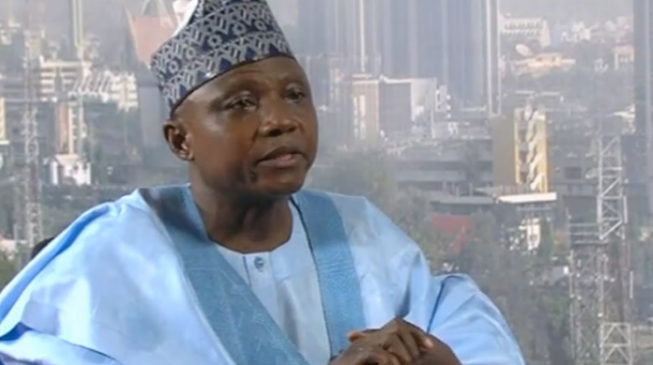
GARBA Shehu, the presidential spokesperson has denied claims made by SaharaReporters that he authored the controversial report which accused Yemi Osinbajo, the Vice President and Femi Falana, a human right lawyer of being involved in the allegation against the embattled former Acting Chairman of the Economic Financial Crimes Commission (EFCC), Ibrahim Magu.
Shehu said he does not write for the News Agency of Nigeria (NAN), thus could not be accused to have authored the said report.
“I don’t write stories for NAN,” Shehu told The ICIR in a reply to a text message sent to his line.
Shehu also said NAN never published a report indicting the vice president.
“NAN did not at any time write any such rubbish against the respected Vice President. So, I cannot be accused of doing a story that never was published by the government agency.”
Sahara Reporters had earlier accused Shehu in a tweet shared on its verified handle. It described the presidential aide as the “ghostwriter” of the viral report.
FLASH: President Buhari’s spokesperson, @GarShehu identified as the ghost writer of the story published by News Agency of Nigeria @nannews_ng alleging suspended @officialEFCC Chair, Ibrahim Magu gave VP @ProfOsinbajo N4billion and Popular Lagos lawyer, Femi Falana N28million
The report which has since been denied by Lalolu Akande, media aide to Osinbajo became an issue of public debate.
Magu also refuted the report of giving the purported sum to the vice president.
Other newspapers that published the same story have deleted the post.
One of the national dailies which had reportedly sourced the story from NAN, in which Falana was indicted has apologised for the publication.
This was after Falana through his lawyer, Adeyinka Olumide-Fusika, a Senior Advocate of Nigeria (SAN) had demanded a retraction of the story.
Meanwhile, despite published reports which showed the controversial story purportedly emanated from the NAN, the presidential spokesperson insisted otherwise.
As of the time of filing this report, NAN is yet to denying publishing the report.
However, following the claim by the Sahara Reporters, Shehu vowed to defend the current administration against any attempt by Omoyele Sowore to take-over the government.
“But as a presidential spokesperson, I stood in defence of the administration against any attempt by a digital publisher to cause the overthrow of the government elected by Nigerians,” Shehu said, stressing that “For doing my job, I know there is a price.”
Magu who has been at the centre of the allegation was accused of looting part of N551 billion recovered sum, following corruption allegation levelled against him by Abubakar Malami, the Attorney General of the Federation and Minister of Justice.
A report by the Presidential Investigation Committee investigating the suspended EFCC boss accused him of acquiring property in Dubai valued at N573 million through an Abuja based clergy identified as pastor Omale.
Magu has denied the allegation.
He was later released after spending days at Area 10, Force Criminal Investigation Department where he had been detained.
Tyrese Haspil, the personal assistant to the murdered founder of Gokada in Nigeria, Fahim Saleh is in police custody in connection with the murder of his former boss.
According to CNN, Haspil is being held in the custody of the New York Police Department (NYPD) in connection to Saleh’s murder.
Hapsil was alleged of dismembering the remains of his former boss with an electric saw when Saleh’s sister rang the doorbell of the deceased residence in Manhattan, New York.
The assistant was said to be on a repayment plan for owing Saleh about ‘tens of thousands of dollar’, CNN reported.
The ICIR had reported how authorities found the decapitated remains of the 33-year-old tech entrepreneur in his apartment.
The NYPD spokesperson, Carlos Nieves, said the elevator surveillance camera might have captured the victim’s last moments.
Nieves report stated that the surveillance showed the victim stepping into the elevator followed by a second man, dressed in a suit, wearing gloves, a hat and a mask over his face.
Saleh during his lifetime was a tech enthusiast who invested into technologies in Nigeria, Columbia and Bangladesh.
His investment in Nigeria, Gokada was worth $5.3 million in seed funding and before a ban on motorcycles in Lagos state hired over 800 drivers according to CNN.
His parent reportedly said Saleh’s death came as a shock to the family as they have lost a loved one.
They described him as a ‘brilliant and innovative mind’ that never left anyone behind in his tech journey.